REVIEW 4 major objections 6 minor 62 references
SeqTex: Generate Mesh Textures in Video Sequence
T0 review · 4 major / 6 minor · reviewed 2026-08-06 · deepseek-v4-flash
Pith's one-line read SeqTex claims that a pretrained video diffusion model, fine-tuned with geometry-guided attention, can synthesize a complete UV texture map and consistent multi-view renderings in a single end-to-end pass.
desk verdict A genuinely new end-to-end texture generation recipe with strong results, but the authors' own VAE-distortion admission leaves the key geometry-alignment mechanism untested. read the letter →
The pith
A machine-rendered reading of the paper's core claim, the machinery that carries it, and where it could break.
The reading
What carries the argument
The central object is the MUV block, a modified transformer block that processes the five-frame latent sequence $S_t = [I^{t}_{1}, I^{t}_{2}, I^{t}_{3}, I^{t}_{4}, U^{t}]$ — four noised multi-view images plus the noised UV texture map — through two decoupled branches that communicate via geometry-informed attention. In that attention, queries and keys are augmented with geometry tokens built from global 3D coordinates and surface normals, rendered as position and normal maps in both the multi-view and UV domains, so that a UV query attends to the multi-view keys whose 3D locations and orientations match its own surface position. This is the mechanism that transfers coherent image-space detail into the discontinuous UV layout despite its seams. Two further components carry part of the load: adaptive token resolution keeps UV tokens at 1024 x 1024 while downsampling multi-view tokens to 512 x 512, and a multi-task noise schedule that assigns denoising, conditioning, or nonsense roles to each frame lets one network perform both image-to-texture and geometry-to-multi-view training.
What would settle it
Render a fixed mesh with uncompressed position and normal maps, then with the VAE-compressed versions the method actually uses, and measure the difference in texture-geometry misalignment at UV seams and high-curvature regions under otherwise identical settings; if degrading the geometry conditioning does not measurably increase misalignment and blur, the geometry-informed attention is not doing the load-bearing alignment work, whereas a sharp degradation would confirm it is.
Extended reading notes
Core claim
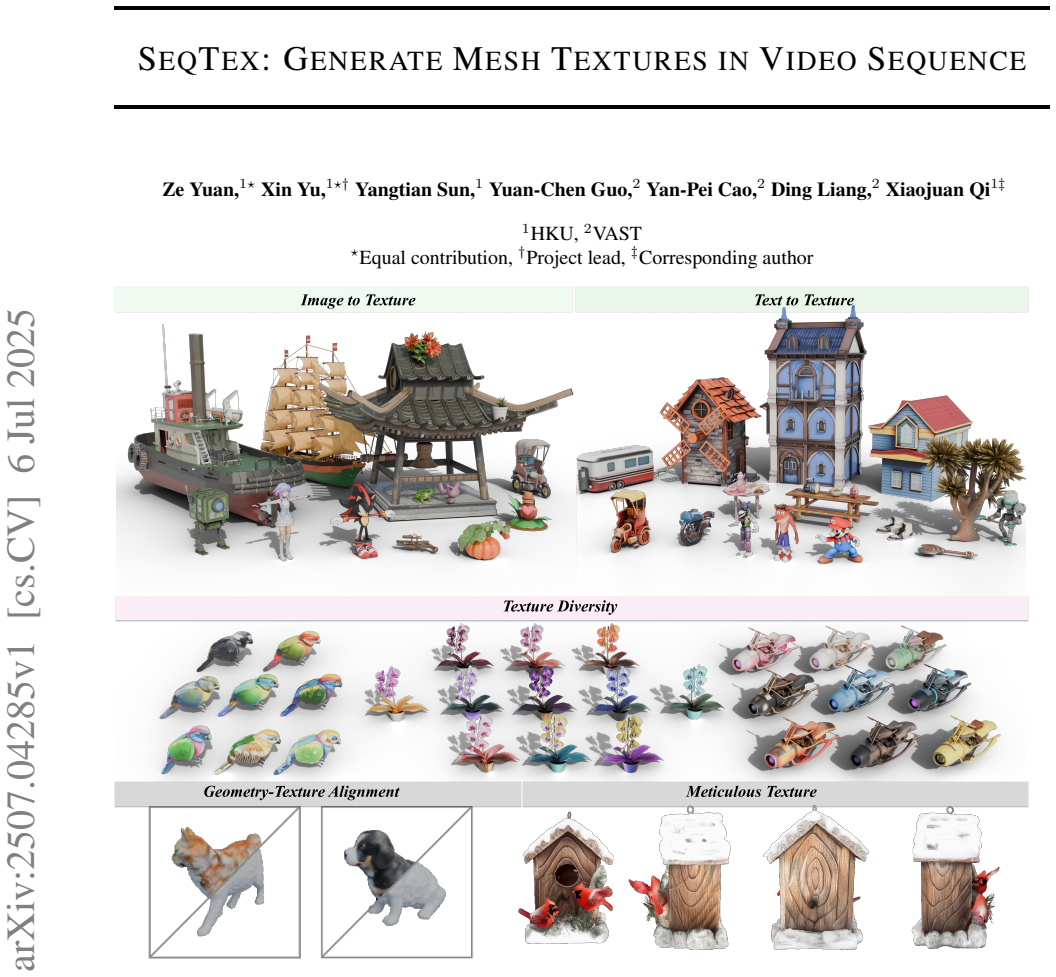
In one denoising pass, SeqTex jointly synthesizes four geometry-consistent multi-view images and a complete 1024 x 1024 UV texture map, treating the UV map as the last frame of a “video” that a fine-tuned video diffusion transformer denoises under a rectified flow objective. The sequence is conditioned on global 3D positions and surface normals, which are encoded into the same latent space as the RGB frames and injected into the attention mechanism so that each UV token is steered toward the multi-view tokens covering the same 3D surface location and orientation. The UV branch is fully fine-tuned while the multi-view branch is adapted with lightweight LoRA on the frozen base model, and the two token streams are kept separate, communicating through geometry-informed attention rather than through a shared concatenated stream. Because the multi-view and UV outputs are optimized jointly, the texture map inherits view consistency from the video prior instead of being stitched together afterward; an auxiliary geometry-to-multi-view task lets the same model also consume multi-view-only datasets, partially offsetting the scarcity of textured 3D data.
Load-bearing premise
The load-bearing premise is that the position and normal maps survive the lossy VAE compression into the latent space well enough to guide each UV token to the correct 3D surface location, a premise the paper's own limitation section softens by reporting non-negligible compression distortion that can lead to blurred details.
Editorial extensions
If this is right
- End-to-end UV synthesis removes the error accumulation and spatial inconsistencies of back-projection and blending: the final texture map comes out in one pass, at roughly the inference cost of the strongest two-stage baseline.
- Because the formulation is a sequence, multi-view-only datasets can be added to training through the geometry-to-multi-view task without re-parameterizing or baking textures, so more data should translate directly into better generalization.
- The ablations show that sharing parameters between the multi-view and UV branches, and dropping the joint multi-view/UV prediction, both degrade fidelity, indicating that the decoupled, jointly trained design is load-bearing for the reported quality.
- Training on albedo rather than lit PBR textures prevents the model from learning baked-in shadows as if they were texture, so the generated maps stay clean when applied to new, unlit contexts.
Reading between the lines
- The paper leaves open how much of the alignment gain comes from the geometry guidance versus the video prior itself; deliberately degrading the geometry maps (blurring, quantizing, or omitting them) would partition that credit.
- A natural scaling test of the sequence formulation is to add more than four multi-view frames as conditioning tokens at inference, which should improve seam consistency in regions the four views undersample, such as occluded or self-intersecting surfaces.
- If the video prior adapts this readily to the UV “frame genre,” the same trick may generate other structured outputs — roughness and metallicity atlases, lightmaps, or light-field layouts — without bespoke generative architectures.
- The text-conditioned comparison adapts image-conditioned baselines to accept an image; a direct text-only head-to-head would clarify whether the reported 57 percent preference reflects the UV-domain advantage or the quality of the image condition produced upstream.
Editorial analysis
A structured set of objections, weighed in public.
Referee Report
Summary. SeqTex reframes 3D texture generation as a joint sequence modeling problem: given an untextured mesh and an image (and optional text) condition, it fine-tunes a pretrained video diffusion transformer (Wan2.1) to denoise a token sequence consisting of four multi-view renderings and a complete UV texture map. The architecture introduces three main components: a decoupled MV branch (LoRA-finetuned) and UV branch (fully finetuned), geometry-informed attention that adds VAE-encoded global positions and normals to queries and keys in order to align UV tokens with multi-view tokens, and adaptive token resolution (512x512 MV, 1024x1024 UV). Training uses a rectified flow objective on an image-to-texture task and an auxiliary geometry-to-multiview task that enables incorporating extra multi-view-only data. Image-conditioned generation is evaluated with FID/KID against ground-truth renderings on 400 objects, and text-conditioned generation is evaluated via a user study and an MLLM scoring protocol.
Significance. If the reported results hold, SeqTex is a meaningful step: it is the first end-to-end UV-texture generator built from a video foundation model, avoiding the multi-stage fusion pipelines of prior work, and it reports large quantitative gains over TEXGen (FID 30.27 vs. 34.53, KID 1.21 vs. 11.94). The decoupled-branch design and the use of a geometry-to-multiview auxiliary task to exploit additional data are practical and well-motivated contributions. The paper also provides a public project page and states training/inference details that should aid reproducibility. However, the headline claims currently rest on measurements without error bars or significance tests, and the central geometry-alignment mechanism is not directly verified, so the strength of the contribution is not yet fully established.
major comments (4)
- [Sec. 4.1, Table 2] The text states that 'our method achieves statistically significant improvements', but no error bars, confidence intervals, or hypothesis tests are provided for FID/KID. With a validation set of only 400 objects, single-point FID/KID values are insufficient to establish a statistically meaningful ranking. Please report standard errors or confidence intervals (e.g., via bootstrapping over the test set) and specify the number of instances used for each metric.
- [Sec. 3.3 and Supp. 6.5] The geometry-informed attention is the core mechanism that lets UV tokens query multi-view tokens at corresponding 3D locations, yet the paper itself concedes that VAE-encoding of geometry maps introduces 'non-negligible differences' that 'may impair the controllability of the geo attention mechanism'. No experiment quantifies how this encoding distortion affects the final texture-geometry alignment. The current ablations (Table 4, Fig. 5) remove whole branches or the MV-UV joint modeling, but they never remove or replace the geometry conditioning itself. I request an ablation that replaces geometry-informed attention with ordinary cross-attention without cgeo, and, if possible, a direct measure of UV-to-MV correspondence accuracy (e.g., rendering the generated UV on the mesh and measuring re-projection consistency against the generated multi-view images).
- [Sec. 4.2, Table 3] The text-conditioned evaluation is the main evidence for the claim that SeqTex outperforms prior methods on text-to-texture, but the user study reports only aggregate preference percentages with no information about the number of participants, the number of items rated, or inter-rater agreement. The MLLM score is obtained with a prompt written by the authors (Fig. 9), and no sensitivity analysis is reported. Please provide the full study protocol, confidence intervals for the preference rates, and a robustness check for the MLLM judge (e.g., varying the prompt or using a second MLLM).
- [Sec. 4.3, Table 4] All quantitative ablations are performed at a reduced resolution (384x384 for MV and 768x768 for UV), while the main results use 512x512/1024x1024. The relative ordering of configurations is plausible, but the paper does not justify that the conclusions transfer to the full-resolution setting. Please either replicate the key ablations at the full resolution or provide evidence (e.g., learning curves or spot checks) that the relative ranking is stable with respect to resolution.
minor comments (6)
- [Table 4] The table uses the symbols '%' and '!' as checkmarks, but their meaning is never defined in the caption or the text. Please replace them with standard check/cross symbols and define them explicitly.
- [Sec. 3.2, Eq. (2)] The notation X_0 is used for Gaussian noise in Eq. (2) while S_0 is not defined; the clean latents are denoted S_1, which may confuse readers familiar with diffusion notation where timestep 0 is the clean signal. Please clarify the indexing convention.
- [Fig. 2] Figure 2 is very dense, and the labels in panels (c) and (d), especially the 'Geo Attention' block, are difficult to read at print size. Please enlarge the figure and add a short, explicit caption for each attention block.
- [Supp. 6.3] The MLLM prompt says that 'high weight' is given to technical quality criteria, but no numerical weighting or aggregation formula is provided. Please specify how the six criteria are combined into the final 0-100 score.
- [Supp. Alg. 1] The pseudo-code for the modified 3D RoPE uses 'mv_frames' and 'uv_frames', but the main text says MV tokens are assigned temporal positions 1-4 and the UV token position 5. Please confirm that the code matches this assignment, especially the frequency slicing in the temporal dimension.
- [References] References [45] (Claude) and [52] (FLUX) point only to general websites; please add the specific model version, access date, and a pointer to the technical documentation or repository.
Circularity Check
No circular derivation found; minor self-citation via the TEXGen dataset and evaluation protocol is not load-bearing, and the VAE-geometry limitation in Sec. 6.5 is a correctness risk rather than a circular step.
full rationale
I walked the claimed derivation chain and found no step in which a prediction reduces to its own input by construction. The core formulation (Eqs. 1–4) defines a rectified-flow objective over multi-view and UV latents; the loss in Eq. 3 is a velocity-matching objective and does not encode FID, KID, user preference, or MLLM score. The reported FID/KID numbers (Table 2) are computed on a held-out validation set of 400 objects against ground-truth renderings, so the headline quality claim is externally measured rather than fitted. The ablations in Table 4 vary whole design components (video prior, joint MV-UV modeling, decoupled branches, material representation) under the same held-out evaluation; none of these variants is tuned to the metric being reported. The only self-citation of note is the use of the TEXGen dataset and the phrase “Following [15]” for evaluation setup, where [15] is the authors’ prior TEXGen paper with overlapping authorship. This is a shared public dataset and a standard held-out protocol; no parameter in SeqTex is fitted to TEXGen’s outputs, and TEXGen serves as one of several external baselines. Thus the self-citation is real but not load-bearing. The supplementary limitation (Sec. 6.5) states that VAE-encoding of geometry maps introduces “non-negligible differences, which may impair the controllability of the geo attention mechanism, finally causing blurred details.” This is an internal admission of an unquantified failure mode in the geometry-conditioning mechanism, and it should lower confidence in the texture-geometry alignment claim; however, it is a limitation statement, not a circular derivation, because the geometry-conditioned attention is not defined in terms of the final FID/KID or preference scores. Similarly, the MLLM scoring protocol (Fig. 9) includes texture-geometry alignment as one criterion without per-criterion breakdown, which weakens evidence but does not make the result circular. I therefore find no step that satisfies the hard requirement of exhibiting a specific reduction of a prediction to its inputs, and the appropriate score is 2 rather than higher.
Assumptions & free parameters
free parameters (5)
- MV/UV resolution pair =
512x512 MV, 1024x1024 UV
- Number of multi-view frames =
4
- Flow shift =
5.0
- Noise schedule limits for conditioning and nonsense frames =
kmin=15, kmax=1000
- LoRA rank for MV branch =
not stated
assumptions (4)
- domain assumption Pretrained video diffusion transformer Wan2.1 (1.3B) contains transferable consistency priors that survive fine-tuning for UV texture synthesis.
- domain assumption Global positions and normals, after VAE encoding, retain enough fidelity to guide geometry-informed attention.
- domain assumption TEXGen dataset (120k meshes) plus curated external MV datasets provide a training distribution that generalizes to real-world scans.
- domain assumption FID/KID on renderings and MLLM scores are valid proxies for texture quality and condition adherence.
Cite this review
Pith. "Pith review of SeqTex: Generate Mesh Textures in Video Sequence." pith.science (2026). https://pith.science/paper/ZDS4DXB5
@misc{pith2026250704285,
  author       = {Pith},
  title        = {Pith review of: SeqTex: Generate Mesh Textures in Video Sequence},
  year         = {2026},
  howpublished = {\url{https://pith.science/paper/ZDS4DXB5}},
  note         = {Machine review of arXiv:2507.04285}
}
read the original abstract
Training native 3D texture generative models remains a fundamental yet challenging problem, largely due to the limited availability of large-scale, high-quality 3D texture datasets. This scarcity hinders generalization to real-world scenarios. To address this, most existing methods finetune foundation image generative models to exploit their learned visual priors. However, these approaches typically generate only multi-view images and rely on post-processing to produce UV texture maps -- an essential representation in modern graphics pipelines. Such two-stage pipelines often suffer from error accumulation and spatial inconsistencies across the 3D surface. In this paper, we introduce SeqTex, a novel end-to-end framework that leverages the visual knowledge encoded in pretrained video foundation models to directly generate complete UV texture maps. Unlike previous methods that model the distribution of UV textures in isolation, SeqTex reformulates the task as a sequence generation problem, enabling the model to learn the joint distribution of multi-view renderings and UV textures. This design effectively transfers the consistent image-space priors from video foundation models into the UV domain. To further enhance performance, we propose several architectural innovations: a decoupled multi-view and UV branch design, geometry-informed attention to guide cross-domain feature alignment, and adaptive token resolution to preserve fine texture details while maintaining computational efficiency. Together, these components allow SeqTex to fully utilize pretrained video priors and synthesize high-fidelity UV texture maps without the need for post-processing. Extensive experiments show that SeqTex achieves state-of-the-art performance on both image-conditioned and text-conditioned 3D texture generation tasks, with superior 3D consistency, texture-geometry alignment, and real-world generalization.
Figures


Figures from the paper (5 more)


Reference graph
Works this paper leans on
-
[1]
Josh Achiam, Steven Adler, Sandhini Agarwal, Lama Ahmad, Ilge Akkaya, Florencia Leoni Aleman, Diogo Almeida, Janko Altenschmidt, Sam Altman, Shyamal Anadkat, et al. Gpt-4 technical report. arXiv preprint arXiv:2303.08774, 2023
arXiv 2023
-
[2]
Improving image generation with better captions
James Betker, Gabriel Goh, Li Jing, Tim Brooks, Jianfeng Wang, Linjie Li, Long Ouyang, Juntang Zhuang, Joyce Lee, Yufei Guo, et al. Improving image generation with better captions. Computer Science. https://cdn. openai. com/papers/dall-e-3. pdf, 2(3):8, 2023
2023
-
[3]
Photorealistic text-to-image diffusion models with deep language understanding
Chitwan Saharia, William Chan, Saurabh Saxena, Lala Li, Jay Whang, Emily L Denton, Kamyar Ghasemipour, Raphael Gontijo Lopes, Burcu Karagol Ayan, Tim Salimans, et al. Photorealistic text-to-image diffusion models with deep language understanding. Advances in neural information processing systems, 35:36479–36494, 2022
2022
-
[4]
Wan: Open and advanced large-scale video generative models
Team Wan, Ang Wang, Baole Ai, Bin Wen, Chaojie Mao, Chen-Wei Xie, Di Chen, Feiwu Yu, Haiming Zhao, Jianx- iao Yang, et al. Wan: Open and advanced large-scale video generative models. arXiv preprint arXiv:2503.20314, 2025
arXiv 2025
-
[5]
Hunyuanvideo: A systematic framework for large video generative models
Weijie Kong, Qi Tian, Zijian Zhang, Rox Min, Zuozhuo Dai, Jin Zhou, Jiangfeng Xiong, Xin Li, Bo Wu, Jianwei Zhang, et al. Hunyuanvideo: A systematic framework for large video generative models. arXiv preprint arXiv:2412.03603, 2024
arXiv 2024
-
[6]
Stable video diffusion: Scaling latent video diffusion models to large datasets
Andreas Blattmann, Tim Dockhorn, Sumith Kulal, Daniel Mendelevitch, Maciej Kilian, Dominik Lorenz, Yam Levi, Zion English, Vikram V oleti, Adam Letts, Varun Jampani, and Robin Rombach. Stable video diffusion: Scaling latent video diffusion models to large datasets. CoRR, abs/2311.15127, 2023
arXiv 2023
-
[7]
Lrm: Large reconstruction model for single image to 3d
Yicong Hong, Kai Zhang, Jiuxiang Gu, Sai Bi, Yang Zhou, Difan Liu, Feng Liu, Kalyan Sunkavalli, Trung Bui, and Hao Tan. Lrm: Large reconstruction model for single image to 3d. arXiv preprint arXiv:2311.04400, 2023
arXiv 2023
-
[8]
Instant3d: Fast text-to-3d with sparse-view generation and large reconstruction model
Jiahao Li, Hao Tan, Kai Zhang, Zexiang Xu, Fujun Luan, Yinghao Xu, Yicong Hong, Kalyan Sunkavalli, Greg Shakhnarovich, and Sai Bi. Instant3d: Fast text-to-3d with sparse-view generation and large reconstruction model. arXiv preprint arXiv:2311.06214, 2023. 11 SeqTex: Generating Mesh Textures in Video Sequence
arXiv 2023
Show all 62 references
-
[9]
Triposr: Fast 3d object reconstruction from a single image
Dmitry Tochilkin, David Pankratz, Zexiang Liu, Zixuan Huang, Adam Letts, Yangguang Li, Ding Liang, Christian Laforte, Varun Jampani, and Yan-Pei Cao. Triposr: Fast 3d object reconstruction from a single image. arXiv preprint arXiv:2403.02151, 2024
2024 arXiv
-
[10]
Texturify: Generating textures on 3d shape surfaces
Yawar Siddiqui, Justus Thies, Fangchang Ma, Qi Shan, Matthias Nießner, and Angela Dai. Texturify: Generating textures on 3d shape surfaces. arXiv preprint arXiv:2204.02411, 2022
2022 arXiv
-
[11]
Mesh2tex: Generating mesh textures from image queries
Alexey Bokhovkin, Shubham Tulsiani, and Angela Dai. Mesh2tex: Generating mesh textures from image queries. In Proceedings of the IEEE/CVF International Conference on Computer Vision, pages 8918–8928, 2023
2023
-
[12]
Texture generation on 3d meshes with point-uv diffusion
Xin Yu, Peng Dai, Wenbo Li, Lan Ma, Zhengzhe Liu, and Xiaojuan Qi. Texture generation on 3d meshes with point-uv diffusion. In Proceedings of the IEEE/CVF International Conference on Computer Vision (ICCV), pages 4206–4216, October 2023
2023
-
[13]
TUVF: learning generalizable texture UV radiance fields
An-Chieh Cheng, Xueting Li, Sifei Liu, and Xiaolong Wang. TUVF: learning generalizable texture UV radiance fields. CoRR, abs/2305.03040, 2023
2023 arXiv
-
[14]
Shapenet: An information-rich 3d model repository
Angel X Chang, Thomas Funkhouser, Leonidas Guibas, Pat Hanrahan, Qixing Huang, Zimo Li, Silvio Savarese, Manolis Savva, Shuran Song, Hao Su, et al. Shapenet: An information-rich 3d model repository. arXiv preprint arXiv:1512.03012, 2015
2015 arXiv
-
[15]
Texgen: a generative diffusion model for mesh textures
Xin Yu, Ze Yuan, Yuan-Chen Guo, Ying-Tian Liu, Jianhui Liu, Yangguang Li, Yan-Pei Cao, Ding Liang, and Xiaojuan Qi. Texgen: a generative diffusion model for mesh textures. ACM Transactions on Graphics (TOG), 43(6):1–14, 2024
2024
-
[16]
Mv-adapter: Multi-view consistent image generation made easy
Zehuan Huang, Yuan-Chen Guo, Haoran Wang, Ran Yi, Lizhuang Ma, Yan-Pei Cao, and Lu Sheng. Mv-adapter: Multi-view consistent image generation made easy. arXiv preprint arXiv:2412.03632, 2024
2024 arXiv
-
[17]
Paint3d: Paint anything 3d with lighting-less texture diffusion models
Xianfang Zeng, Xin Chen, Zhongqi Qi, Wen Liu, Zibo Zhao, Zhibin Wang, Bin Fu, Yong Liu, and Gang Yu. Paint3d: Paint anything 3d with lighting-less texture diffusion models. InProceedings of the IEEE/CVF conference on computer vision and pattern recognition, pages 4252–4262, 2024
2024
-
[18]
Meta 3d texturegen: Fast and consistent texture generation for 3d objects
Raphael Bensadoun, Yanir Kleiman, Idan Azuri, Omri Harosh, Andrea Vedaldi, Natalia Neverova, and Oran Gafni. Meta 3d texturegen: Fast and consistent texture generation for 3d objects. arXiv preprint arXiv:2407.02430, 2024
2024 arXiv
-
[19]
Dreamfusion: Text-to-3d using 2d diffusion
Ben Poole, Ajay Jain, Jonathan T Barron, and Ben Mildenhall. Dreamfusion: Text-to-3d using 2d diffusion. arXiv preprint arXiv:2209.14988, 2022
2022 arXiv
-
[20]
Latent-nerf for shape-guided generation of 3d shapes and textures
Gal Metzer, Elad Richardson, Or Patashnik, Raja Giryes, and Daniel Cohen-Or. Latent-nerf for shape-guided generation of 3d shapes and textures. In CVPR, pages 12663–12673. IEEE, 2023
2023
-
[21]
Fantasia3d: Disentangling geometry and appearance for high-quality text-to-3d content creation
Rui Chen, Yongwei Chen, Ningxin Jiao, and Kui Jia. Fantasia3d: Disentangling geometry and appearance for high-quality text-to-3d content creation. In ICCV, pages 22189–22199. IEEE, 2023
2023
-
[22]
Magic3d: High-resolution text-to-3d content creation
Chen-Hsuan Lin, Jun Gao, Luming Tang, Towaki Takikawa, Xiaohui Zeng, Xun Huang, Karsten Kreis, Sanja Fidler, Ming-Yu Liu, and Tsung-Yi Lin. Magic3d: High-resolution text-to-3d content creation. In Proceedings of the IEEE/CVF conference on computer vision and pattern recognitio...
2023
-
[23]
Prolificdreamer: High-fidelity and diverse text-to-3d generation with variational score distillation.arXiv preprint arXiv:2305.16213, 2023
Zhengyi Wang, Cheng Lu, Yikai Wang, Fan Bao, Chongxuan Li, Hang Su, and Jun Zhu. Prolificdreamer: High-fidelity and diverse text-to-3d generation with variational score distillation.arXiv preprint arXiv:2305.16213, 2023
2023 arXiv
-
[24]
Texturedreamer: Image-guided texture synthesis through geometry-aware diffusion
Yu-Ying Yeh, Jia-Bin Huang, Changil Kim, Lei Xiao, Thu Nguyen-Phuoc, Numair Khan, Cheng Zhang, Manmo- han Chandraker, Carl S Marshall, Zhao Dong, et al. Texturedreamer: Image-guided texture synthesis through geometry-aware diffusion. In Proceedings of the IEEE/CVF Conference o...
2024
-
[25]
Texture: Text-guided texturing of 3d shapes
Elad Richardson, Gal Metzer, Yuval Alaluf, Raja Giryes, and Daniel Cohen-Or. Texture: Text-guided texturing of 3d shapes. In ACM SIGGRAPH 2023 conference proceedings, pages 1–11, 2023
2023
-
[26]
Text2tex: Text-driven texture synthesis via diffusion models
Dave Zhenyu Chen, Yawar Siddiqui, Hsin-Ying Lee, Sergey Tulyakov, and Matthias Nießner. Text2tex: Text-driven texture synthesis via diffusion models. In ICCV, pages 18512–18522. IEEE, 2023
2023
-
[27]
Texfusion: Synthesizing 3d textures with text-guided image diffusion models
Tianshi Cao, Karsten Kreis, Sanja Fidler, Nicholas Sharp, and Kangxue Yin. Texfusion: Synthesizing 3d textures with text-guided image diffusion models. In ICCV, pages 4146–4158. IEEE, 2023
2023
-
[28]
Text-to-3d with classifier score distillation
Xin Yu, Yuan-Chen Guo, Yangguang Li, Ding Liang, Song-Hai Zhang, and Xiaojuan Qi. Text-to-3d with classifier score distillation. arXiv preprint arXiv:2310.19415, 2023
2023 arXiv
-
[29]
Cogvideox: Text-to-video diffusion models with an expert transformer
Zhuoyi Yang, Jiayan Teng, Wendi Zheng, Ming Ding, Shiyu Huang, Jiazheng Xu, Yuanming Yang, Wenyi Hong, Xiaohan Zhang, Guanyu Feng, et al. Cogvideox: Text-to-video diffusion models with an expert transformer. arXiv preprint arXiv:2408.06072, 2024. 12 SeqTex: Generating Mesh Tex...
2024 arXiv
-
[30]
Control-a- video: Controllable text-to-video generation with diffusion models
Weifeng Chen, Yatai Ji, Jie Wu, Hefeng Wu, Pan Xie, Jiashi Li, Xin Xia, Xuefeng Xiao, and Liang Lin. Control-a- video: Controllable text-to-video generation with diffusion models. arXiv e-prints, pages arXiv–2305, 2023
2023
-
[31]
Videocomposer: Compositional video synthesis with motion controllability
Xiang Wang, Hangjie Yuan, Shiwei Zhang, Dayou Chen, Jiuniu Wang, Yingya Zhang, Yujun Shen, Deli Zhao, and Jingren Zhou. Videocomposer: Compositional video synthesis with motion controllability. Advances in Neural Information Processing Systems, 36:7594–7611, 2023
2023
-
[32]
Trajectorycrafter: Redirecting camera trajectory for monocular videos via diffusion models
Mark YU, Wenbo Hu, Jinbo Xing, and Ying Shan. Trajectorycrafter: Redirecting camera trajectory for monocular videos via diffusion models. arXiv preprint arXiv:2503.05638, 2025
2025 arXiv
-
[33]
Objectmover: Generative object movement with video prior
Xin Yu, Tianyu Wang, Soo Ye Kim, Paul Guerrero, Xi Chen, Qing Liu, Zhe Lin, and Xiaojuan Qi. Objectmover: Generative object movement with video prior. arXiv preprint arXiv:2503.08037, 2025
2025 arXiv
-
[34]
Unireal: Universal image generation and editing via learning real-world dynamics
Xi Chen, Zhifei Zhang, He Zhang, Yuqian Zhou, Soo Ye Kim, Qing Liu, Yijun Li, Jianming Zhang, Nanxuan Zhao, Yilin Wang, et al. Unireal: Universal image generation and editing via learning real-world dynamics. arXiv preprint arXiv:2412.07774, 2024
2024 arXiv
-
[35]
Generative video propagation
Shaoteng Liu, Tianyu Wang, Jui-Hsien Wang, Qing Liu, Zhifei Zhang, Joon-Young Lee, Yijun Li, Bei Yu, Zhe Lin, Soo Ye Kim, et al. Generative video propagation. arXiv preprint arXiv:2412.19761, 2024
2024 arXiv
-
[36]
Videomv: Consistent multi-view generation based on large video generative model
Qi Zuo, Xiaodong Gu, Lingteng Qiu, Yuan Dong, Weihao Yuan, Rui Peng, Siyu Zhu, Liefeng Bo, Zilong Dong, Qixing Huang, et al. Videomv: Consistent multi-view generation based on large video generative model. 2024
2024
-
[37]
SV3D: Novel multi-view synthesis and 3D generation from a single image using latent video diffusion
Vikram V oleti, Chun-Han Yao, Mark Boss, Adam Letts, David Pankratz, Dmitrii Tochilkin, Christian Laforte, Robin Rombach, and Varun Jampani. SV3D: Novel multi-view synthesis and 3D generation from a single image using latent video diffusion. In European Conference on Computer ...
2024
-
[38]
Depthcrafter: Generating consistent long depth sequences for open-world videos.arXiv preprint arXiv:2409.02095, 2024
Wenbo Hu, Xiangjun Gao, Xiaoyu Li, Sijie Zhao, Xiaodong Cun, Yong Zhang, Long Quan, and Ying Shan. Depthcrafter: Generating consistent long depth sequences for open-world videos.arXiv preprint arXiv:2409.02095, 2024
2024 arXiv
-
[39]
World-consistent video diffusion with explicit 3d modeling
Qihang Zhang, Shuangfei Zhai, Miguel Angel Bautista, Kevin Miao, Alexander Toshev, Joshua Susskind, and Jiatao Gu. World-consistent video diffusion with explicit 3d modeling. arXiv preprint arXiv:2412.01821, 2024
2024 arXiv
-
[40]
High-resolution image synthesis with latent diffusion models
Robin Rombach, Andreas Blattmann, Dominik Lorenz, Patrick Esser, and Björn Ommer. High-resolution image synthesis with latent diffusion models. In Proceedings of the IEEE/CVF conference on computer vision and pattern recognition, pages 10684–10695, 2022
2022
-
[41]
Scaling rectified flow transformers for high-resolution image synthesis
Patrick Esser, Sumith Kulal, Andreas Blattmann, Rahim Entezari, Jonas Müller, Harry Saini, Yam Levi, Dominik Lorenz, Axel Sauer, Frederic Boesel, et al. Scaling rectified flow transformers for high-resolution image synthesis. In Forty-first international conference on machine ...
2024
-
[42]
Interspatial attention for efficient 4d human video generation
Ruizhi Shao, Yinghao Xu, Yujun Shen, Ceyuan Yang, Yang Zheng, Changan Chen, Yebin Liu, and Gordon Wetzstein. Interspatial attention for efficient 4d human video generation. arXiv preprint arXiv:2505.15800, 2025
2025 arXiv
-
[43]
Worldmem: Long-term consistent world simulation with memory
Zeqi Xiao, Yushi Lan, Yifan Zhou, Wenqi Ouyang, Shuai Yang, Yanhong Zeng, and Xingang Pan. Worldmem: Long-term consistent world simulation with memory. arXiv preprint arXiv:2504.12369, 2025
2025
-
[44]
Diffusion forcing: Next-token prediction meets full-sequence diffusion
Boyuan Chen, Diego Martí Monsó, Yilun Du, Max Simchowitz, Russ Tedrake, and Vincent Sitzmann. Diffusion forcing: Next-token prediction meets full-sequence diffusion. Advances in Neural Information Processing Systems, 37:24081–24125, 2024
2024
-
[45]
Anthropic. Claude. https://claude.ai/, 2024
2024
-
[46]
Objaverse-xl: A universe of 10m+ 3d objects.Advances in Neural Information Processing Systems, 36:35799–35813, 2023
Matt Deitke, Ruoshi Liu, Matthew Wallingford, Huong Ngo, Oscar Michel, Aditya Kusupati, Alan Fan, Christian Laforte, Vikram V oleti, Samir Yitzhak Gadre, et al. Objaverse-xl: A universe of 10m+ 3d objects.Advances in Neural Information Processing Systems, 36:35799–35813, 2023
2023
-
[47]
Digital twin catalog: A large-scale photorealistic 3d object digital twin dataset
Zhao Dong, Ka Chen, Zhaoyang Lv, Hong-Xing Yu, Yunzhi Zhang, Cheng Zhang, Yufeng Zhu, Stephen Tian, Zhengqin Li, Geordie Moffatt, et al. Digital twin catalog: A large-scale photorealistic 3d object digital twin dataset. arXiv preprint arXiv:2504.08541, 2025
2025 arXiv
-
[48]
https://renderpeople.com/3d-people, 2022
Renderpeople. https://renderpeople.com/3d-people, 2022
2022
-
[49]
Panic-3d: Stylized single-view 3d reconstruction from portraits of anime characters
Shuhong Chen, Kevin Zhang, Yichun Shi, Heng Wang, Yiheng Zhu, Guoxian Song, Sizhe An, Janus Kristjansson, Xiao Yang, and Matthias Zwicker. Panic-3d: Stylized single-view 3d reconstruction from portraits of anime characters. In Proceedings of the IEEE/CVF Conference on Computer...
2023
-
[50]
Function4d: Real-time human volumetric capture from very sparse consumer rgbd sensors
Tao Yu, Zerong Zheng, Kaiwen Guo, Pengpeng Liu, Qionghai Dai, and Yebin Liu. Function4d: Real-time human volumetric capture from very sparse consumer rgbd sensors. In IEEE Conference on Computer Vision and Pattern Recognition (CVPR2021), June 2021. 13 SeqTex: Generating Mesh T...
2021
-
[51]
Sdxl: Improving latent diffusion models for high-resolution image synthesis
Dustin Podell, Zion English, Kyle Lacey, Andreas Blattmann, Tim Dockhorn, Jonas Müller, Joe Penna, and Robin Rombach. Sdxl: Improving latent diffusion models for high-resolution image synthesis. arXiv preprint arXiv:2307.01952, 2023
2023 arXiv
-
[52]
Black Forest Labs. Flux. https://github.com/black-forest-labs/flux , 2024
2024
-
[53]
Adding conditional control to text-to-image diffusion models
Lvmin Zhang, Anyi Rao, and Maneesh Agrawala. Adding conditional control to text-to-image diffusion models. In Proceedings of the IEEE/CVF international conference on computer vision, pages 3836–3847, 2023
2023
-
[54]
Analyzing and improving the training dynamics of diffusion models
Tero Karras, Miika Aittala, Jaakko Lehtinen, Janne Hellsten, Timo Aila, and Samuli Laine. Analyzing and improving the training dynamics of diffusion models. arXiv preprint arXiv:2312.02696, 2023
2023 arXiv
-
[55]
Unipc: A unified predictor-corrector framework for fast sampling of diffusion models
Wenliang Zhao, Lujia Bai, Yongming Rao, Jie Zhou, and Jiwen Lu. Unipc: A unified predictor-corrector framework for fast sampling of diffusion models. NeurIPS, 2023. 14 SeqTex: Generating Mesh Textures in Video Sequence 6 Supplementary Material 6.1 Additional Visualizations Add...
2023
-
[57]
Visual clarity: Images should not be blurry
-
[58]
No Janus problem: Each object should have a coherent, plausible 3D structure from all visible angles
-
[59]
Texture-geometry alignment: Textures should align accurately with the geometry; no obvious misplacement or warping
-
[60]
Aesthetic quality: The images should be visually appealing, with minimal flaws
-
[61]
Style consistency: The four images should have a consistent style, with no major differences
-
[62]
The text prompt is: {}
Prompt alignment: The images should closely match the content of the provided text prompt. The text prompt is: {}. A reference scoring guide: • 100: Perfect clarity, no Janus issues, excellent texture-geometry alignment; images are beautiful, stylistically consistent, and full...
-
[1000]
The main experiment is conducted in two stages
to provide the image condition. The main experiment is conducted in two stages. The first stage focuses on UV generation, training the model solely on the img2tex task. The second stage introduces the geo2mv task and incorporates the new MV dataset. 6.3 Evaluation of Text-Cond...
Reviewed August 6, 2026 · model on record in the stance chip above.
Discussion (0). Sign in to comment.