REVIEW 2 major objections 4 minor 1 cited by
A Nonconvex Approach for Exact and Efficient Multichannel Sparse Blind Deconvolution
T0 review · 2 major / 4 minor · reviewed 2026-08-14 · deepseek-v4-flash
Pith's one-line read This paper proves that plain Riemannian gradient descent, run from a random initialization on a preconditioned Huber-loss sphere, exactly recovers both the convolution kernel and the sparse inputs in multichannel sparse blind…
desk verdict Substantial and likely correct theory for multichannel sparse blind deconvolution, but the advertised Phase-2 iteration count omits a theta-dependence that its own sharpness analysis forces. read the letter →
The pith
A machine-rendered reading of the paper's core claim, the machinery that carries it, and where it could break.
The reading
What carries the argument
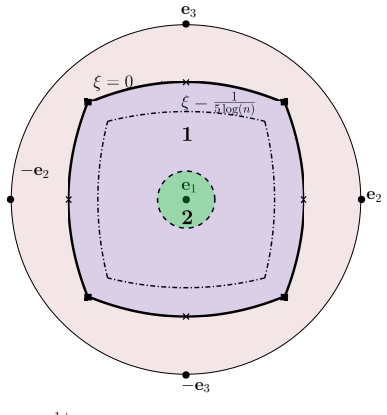
The argument rests on three objects that work together. The preconditioner $P = (\frac{1}{\theta n p}\sum_{i=1}^p C_{y_i}^{\mathsf T} C_{y_i})^{-1/2}$ approximately orthogonalizes the circulant convolution operator: it makes $R = C_a P$ close to the orthogonal matrix $Q = C_a (C_a^{\mathsf T} C_a)^{-1/2}$, symmetrizing the landscape and removing the ill-conditioning caused by a generic kernel. The Huber loss $h_\mu(z)$, a first-order smooth surrogate of the $\ell^1$ norm, promotes sparsity while keeping gradients Lipschitz, so random-process concentration and perturbation arguments go through. Finally, the $2n$ spherical regions $S_i^\xi = \{ q \in S^{n-1} : |q_i|/\|q_{-i}\|_\infty \ge \sqrt{1+\xi},\ q_i \neq 0\}$, each containing one target solution, allow the analysis to establish a regularity condition (the negative gradient aligns with the direction to $e_i$), an implicit-regularization bound (iterates never leave their region), and then a sharpness bound for the LP-rounding objective that gives linear convergence of the second phase.
What would settle it
Generate measurements $y_i = a * x_i$ with $a$ an invertible kernel of condition number $\kappa$, $x_i$ i.i.d. Bernoulli-Gaussian at $\theta=0.25$, and choose $p$ above the Theorem 3.1 bound for small $n$ (say $n=64$, $\theta=0.25$, $\mu=10^{-2}$); the two-stage algorithm should recover the kernel and signals to $\varepsilon$-precision with probability at least $1/2$. If it systematically fails at such parameters—for example, by converging to a spurious stationary point—the claimed guarantee is false; the same test with a kernel whose DFT contains a zero probes the boundary of the invertibility assumption rather than the core claim.
Extended reading notes
Core claim
On the paper's own terms, the central discovery is that multichannel sparse blind deconvolution has benign global geometry for a smooth sparsity surrogate, not for the heavy-tailed $\ell^4$ loss used in earlier nonconvex work. For an invertible kernel $a$ with condition number $\kappa$ and i.i.d. Bernoulli-Gaussian inputs with sparsity $\theta \in (1/n, 1/3)$, the preconditioned Huber objective over the sphere satisfies a regularity condition in each region $S_i^\xi$: the Riemannian gradient has inner product at least proportional to $\|q - e_i\|$ with the direction to the target basis vector $e_i$, and an implicit-regularization bound keeps iterates inside the region. With probability at least $1/2$ over a uniform random initialization, vanilla Riemannian gradient descent therefore converges linearly to an $O(\mu)$-accurate solution in $O(\theta^{-1} n^4 \log(1/\mu) + \log(np)\log(1/\varepsilon))$ iterations, and a projected subgradient method on an LP-rounding problem converges linearly to the exact kernel and signals up to a signed shift. The sample complexity is $p \ge C\max\{n, \kappa^8/(\theta \mu^2 \sigma_{\min}^2) \log^4 n\}\, \theta^{-2} n^4 \log^3 n \log(\theta n/\mu)$, an improvement over the prior $p \ge \tilde{\Omega}(\max\{n,\kappa^8\} n^8/\varepsilon^8)$.
Load-bearing premise
The load-bearing premise is the generative model: the $p$ inputs are independent Bernoulli-Gaussian with known sparsity $\theta$ in $(1/n, 1/3)$, and the kernel's discrete Fourier transform has no zero entries; if the signals are not independent sparse Gaussians or the kernel has deep frequency nulls, the benign geometry and the recovery guarantee can fail.
Editorial extensions
If this is right
- Vanilla Riemannian gradient descent from a random initialization converges linearly to an approximate solution, so the first phase has no noise-injection or step-size-schedule parameters to tune.
- The two-stage method achieves exact recovery: the phase-two LP rounding converges linearly to the signed-shift target, removing the $O(\mu)$ smoothing error introduced by the Huber loss.
- The sample complexity is polynomial in $n$ (about $n^4$) and independent of the recovery precision $\varepsilon$, improving on the previous $\tilde{\Omega}(n^8/\varepsilon^8)$ bound; the iteration count is about $n^4 + \log(1/\varepsilon)$.
- With FFT implementation, each gradient or subgradient update costs $O(p n \log n)$, so the method is computationally practical for large $n$ and is demonstrated on 2D STORM super-resolution imaging data.
- Constant sparsity levels $\theta$ up to about $1/3$ are covered, in contrast to earlier convex approaches requiring $\theta = O(1/\sqrt{n})$.
Reading between the lines
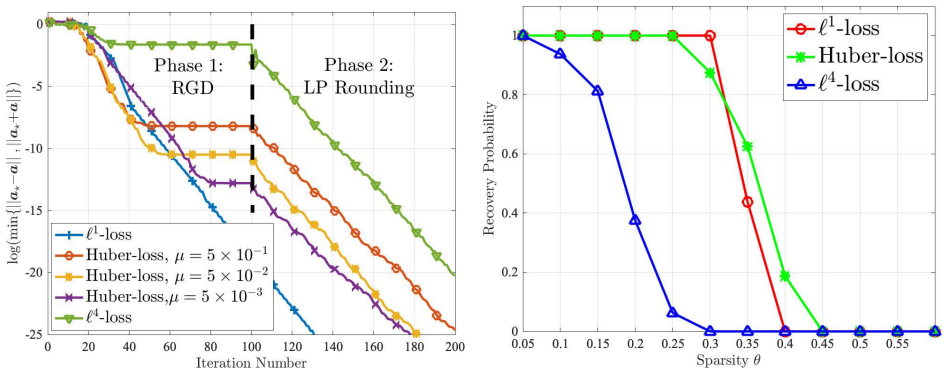
- The paper's phase-transition plots show successful recovery with $p$ close to poly-logarithmic in $n$, far below the theorem's $n^4$ bound; my inference is that the sample-complexity statement is loose and a sharper concentration argument could reduce the polynomial gap.
- The region-based geometry plus preconditioning is likely transferable to convolutional dictionary learning and blind gain-and-phase calibration, where similar bilinear nonconvex landscapes appear; the paper suggests these directions but does not prove them.
- If the Bernoulli-Gaussian assumption is replaced by heavier-tailed or dependent sparse models, the concentration and sharpness arguments would need reworking; a natural testable extension is to determine empirically how far the phase transition degrades under correlated supports.
Signed reviews
Editorial analysis
A structured set of objections, weighed in public.
Referee Report
Summary. The paper studies multichannel sparse blind deconvolution (MCS-BD), where one observes p circulant convolutions y_i = a * x_i with an invertible kernel a and i.i.d. Bernoulli-Gaussian sparse inputs x_i, and aims to recover a and all x_i up to the intrinsic signed-shift ambiguity. The authors formulate a smooth Huber-loss objective on the sphere with a data-dependent preconditioner and prove that a vanilla Riemannian gradient descent (RGD) method from a random initialization reaches an O(mu) neighborhood of the target, after which a projected subgradient method for an LP rounding problem converges linearly to the exact solution. The main theorem gives sample-complexity and iteration-complexity bounds, and the paper reports experiments on synthetic data and on a STORM microscopy dataset. The proof is developed in Appendices C-H through population geometry, concentration inequalities, and a perturbation analysis around RQ^{-1} approximately equal to I.
Significance. If the result is correct in its stated quantitative form, this is a significant contribution: it is the first provable guarantee that vanilla first-order methods with random initialization solve MCS-BD exactly (up to the signed-shift ambiguity), and its sample complexity improves on the prior nonconvex result of Li and Bresler. The paper is unusually careful in structure: the geometric assumptions are explicit, the regularity and implicit-regularization conditions are stated as separate propositions, the appendices contain a substantial amount of proof detail, and the authors provide code and honest discussion of the looseness of their bounds. The central recovery claim is not affected by the issue I raise below; however, the headline efficiency statement in Theorem 3.1 overstates what the Phase-2 sharpness analysis actually proves, and this needs to be corrected before the paper can be accepted in its present form.
major comments (2)
- [Theorem 3.1 / Appendix D.3 (Proposition D.9)] The Phase-2 iteration count claimed in Theorem 3.1, namely C log(np) log(1/epsilon), does not follow from the sharpness analysis in Appendix D.3. Proposition D.9 sets the sharpness constant to alpha = (1/50) sqrt(2/pi) theta and the projected subgradient norm bound to beta = 36 log(np), and then chooses eta with eta^2 >= 1 - alpha^2/(2 beta^2). Consequently 1 - eta is proportional to theta^2 / log^2(np), so the number of projected subgradient iterations needed to reduce dist(q) from a constant to epsilon is k >= C theta^{-2} log^2(np) log(1/epsilon), not C log(np) log(1/epsilon). Proposition 3.5 conceals this dependence inside the unspecified constant c2 in the lower bound on eta. This is a load-bearing quantitative claim: the theorem as stated overstates the Phase-2 efficiency by a factor of theta^{-2} log(np). The recovery conclusion is not invalidated, but the complexity statement and Proposition 3.5 must be revised to state the theta and log factors explicitly.
- [Proposition 3.4 / Appendix D.1 (Theorem D.1)] The Phase-1 iteration bound is stated inconsistently across the paper. Theorem 3.1 uses theta^{-1} n^4 log(1/mu), while Proposition 3.4 states N := C theta n^4 log(1/mu) and Theorem D.1 states K := C theta max{n^4, n^{5/2}/mu} log(1/mu). The proof of Theorem D.1 derives contraction factors 1 - tau alpha_1 with tau alpha_1 on the order of theta/n^4 and 1 - tau alpha_2 with tau alpha_2 on the order of mu theta/n, which support the inverse theta dependence of the main theorem rather than the theta factor displayed in Proposition 3.4 and Theorem D.1. Please reconcile these statements so that the main theorem and the appendices report the same bound.
minor comments (4)
- [Abstract and keywords] The keyword 'Riemmanian' should be spelled 'Riemannian'.
- [Table 1] The time-complexity entry for 'Ours' should be updated after the Phase-2 complexity claim is corrected; as typeset it omits the theta and log(np) factors that the analysis in Appendix D.3 actually yields.
- [Appendix G, proof of Proposition G.1] The shorthand notation PqK is used without being defined in Appendix A; Appendix A defines the projection notation P_v and P_{v^\perp}, so the shorthand should either be defined explicitly or replaced by the longer notation.
- [Section 4.1] The experiments use Riemannian line search rather than the fixed step sizes prescribed by Theorem 3.1; this is reasonable for illustration, but the text should state explicitly that the empirical convergence plots are not a direct test of the theorem's step-size and iteration-count prescriptions.
Circularity Check
No significant circularity: the recovery guarantee is derived from an explicit statistical model, with self-citations serving only as ancillary supporting lemmas.
full rationale
The paper's central claim is a probabilistic recovery guarantee for a vanilla first-order method, not a fitted or self-referential construction. The statistical assumptions (invertible kernel a and i.i.d. Bernoulli-Gaussian inputs with sparsity parameter theta) are stated in Section 2.1 and are then used to compute population gradients, concentration bounds, and sharpness constants in Appendices E-G; the conclusion is not used to define these quantities. The preconditioner P in (6) is data-dependent, but it is derived from the observed covariance and analyzed through independent perturbation bounds in Appendix H; it is not selected to force the target solution. The two-stage convergence proof is self-contained: Phase 1 uses the regularity condition (11) and implicit regularization (12), both proved from the BG model, and Phase 2 uses an explicitly computed sharpness constant alpha = (1/50) sqrt(2/pi) theta, not a fitted parameter. The self-citations, mainly [SQW16] and [SQW17], appear as supporting lemmas such as Lemma B.5 for lower-bounding sparse random matrices; those lemmas do not assume the MCS-BD recovery result and are not invoked to prohibit alternative approaches. The skeptical concern about the Phase-2 iteration count possibly omitting a theta^{-2} log^2(np) factor is an internal consistency issue in the stated complexity bound, not a circular reduction of the claimed result to its own inputs. Accordingly, no circular step is established under the required standard.
Assumptions & free parameters
free parameters (1)
- mu (Huber smoothing parameter) =
mu = 10^{-2} in experiments; theory requires mu <= c min{theta, 1/sqrt(n)}
assumptions (6)
- domain assumption The kernel a is invertible: its DFT has no zero entries, with condition number kappa = max|a_hat_i| / min|a_hat_i|.
- domain assumption Inputs x_i are i.i.d. Bernoulli-Gaussian with sparsity theta in (1/n, 1/3).
- domain assumption The preconditioning matrix P uses the sparsity parameter theta (eq 6); the proof requires this, though footnote 9 notes scaling is immaterial.
- standard math Random initialization is uniform on S^{n-1}; Lemma D.3 (from BJS18, GBW18) ensures it lands in one of the 2n regions S_i^+- with probability at least 1/2.
- standard math Sparse-subspace lemma B.5 from [SQW17] (control of ell-1 norms of sub-Gaussian matrices) is used to prove sharpness of the LP rounding objective.
- standard math Standard concentration inequalities (Bernstein, Gaussian concentration, moment-control) and matrix perturbation bounds are applied without proof.
Cite this review
Pith. "Pith review of A Nonconvex Approach for Exact and Efficient Multichannel Sparse Blind Deconvolution." pith.science (2026). https://pith.science/paper/ZE4R75XM
@misc{pith2026190810776,
  author       = {Pith},
  title        = {Pith review of: A Nonconvex Approach for Exact and Efficient Multichannel Sparse Blind Deconvolution},
  year         = {2026},
  howpublished = {\url{https://pith.science/paper/ZE4R75XM}},
  note         = {Machine review of arXiv:1908.10776}
}
abstract
We study the multi-channel sparse blind deconvolution (MCS-BD) problem, whose task is to simultaneously recover a kernel $\mathbf a$ and multiple sparse inputs $\{\mathbf x_i\}_{i=1}^p$ from their circulant convolution $\mathbf y_i = \mathbf a \circledast \mathbf x_i $ ($i=1,\cdots,p$). We formulate the task as a nonconvex optimization problem over the sphere. Under mild statistical assumptions of the data, we prove that the vanilla Riemannian gradient descent (RGD) method, with random initializations, provably recovers both the kernel $\mathbf a$ and the signals $\{\mathbf x_i\}_{i=1}^p$ up to a signed shift ambiguity. In comparison with state-of-the-art results, our work shows significant improvements in terms of sample complexity and computational efficiency. Our theoretical results are corroborated by numerical experiments, which demonstrate superior performance of the proposed approach over the previous methods on both synthetic and real datasets.
Figures

Figures from the paper (2 more)


Forward citations
Cited by 1 Pith paper
-
Short-and-Sparse Deconvolution -- A Geometric Approach
A practical alternating descent algorithm with data-driven initialization, momentum, homotopy continuation, and reweighting solves short-and-sparse blind deconvolution on synthetic and real imaging and neuroscience da...
Reference graph
Works this paper leans on
-
[1]
Leveraging diversity and sparsity in blind deconvolution
Ali Ahmed and Laurent Demanet. Leveraging diversity and sparsity in blind deconvolution. IEEE Transactions on Information Theory , 64(6):3975--4000, 2018
2018
-
[2]
Multichannel blind deconvolution and equalization using the natural gradient
Shun-ichi Amari, Scott C Douglas, Andrzej Cichocki, and Howard H Yang. Multichannel blind deconvolution and equalization using the natural gradient. In First IEEE Signal Processing Workshop on Signal Processing Advances in Wireless Communications , pages 101--104. IEEE, 1997
1997
-
[3]
Optimization algorithms on matrix manifolds
P-A Absil, Robert Mahony, and Rodolphe Sepulchre. Optimization algorithms on matrix manifolds . Princeton University Press, 2009
2009
-
[4]
Blind deconvolution using convex programming
Ali Ahmed, Benjamin Recht, and Justin Romberg. Blind deconvolution using convex programming. IEEE Transactions on Information Theory , 60(3):1711--1732, 2014
2014
-
[5]
Fast convolutional sparse coding
Hilton Bristow, Anders Eriksson, and Simon Lucey. Fast convolutional sparse coding. In Proceedings of the IEEE Conference on Computer Vision and Pattern Recognition , pages 391--398, 2013
2013
-
[6]
Weak sharp minima in mathematical programming
James V Burke and Michael C Ferris. Weak sharp minima in mathematical programming. SIAM Journal on Control and Optimization , 31(5):1340--1359, 1993
1993
-
[7]
Matrix analysis , volume 169
Rajendra Bhatia. Matrix analysis , volume 169. Springer Science & Business Media, 2013
2013
-
[8]
Subgradient Descent Learns Orthogonal Dictionaries
Yu Bai, Qijia Jiang, and Ju Sun. Subgradient descent learns orthogonal dictionaries. arXiv preprint arXiv:1810.10702 , 2018
work page Pith review arXiv 2018
Show all 89 references
-
[9]
Imaging intracellular fluorescent proteins at nanometer resolution
Eric Betzig, George H Patterson, Rachid Sougrat, O Wolf Lindwasser, Scott Olenych, Juan S Bonifacino, Michael W Davidson, Jennifer Lippincott-Schwartz, and Harald F Hess. Imaging intracellular fluorescent proteins at nanometer resolution. Science , 313(5793):1642--1645, 2006
2006
-
[10]
Subgradient methods
Stephen Boyd, Lin Xiao, and Almir Mutapcic. Subgradient methods. lecture notes of EE392o, Stanford University, Autumn Quarter , 2004:2004--2005, 2003
2004
-
[11]
Harnessing structures in big data via guaranteed low-rank matrix estimation: Recent theory and fast algorithms via convex and nonconvex optimization
Yudong Chen and Yuejie Chi. Harnessing structures in big data via guaranteed low-rank matrix estimation: Recent theory and fast algorithms via convex and nonconvex optimization. IEEE Signal Processing Magazine , 35(4), 2018
2018
-
[12]
Low-rank matrix recovery with composite optimization: good conditioning and rapid convergence
Vasileios Charisopoulos, Yudong Chen, Damek Davis, Mateo D \' az, Lijun Ding, and Dmitriy Drusvyatskiy. Low-rank matrix recovery with composite optimization: good conditioning and rapid convergence. arXiv preprint arXiv:1904.10020 , 2019
1904 arXiv
-
[13]
Gradient descent with random initialization: fast global convergence for nonconvex phase retrieval
Yuxin Chen, Yuejie Chi, Jianqing Fan, and Cong Ma. Gradient descent with random initialization: fast global convergence for nonconvex phase retrieval. Mathematical Programming , 176(1-2):5--37, 2019
2019
-
[14]
Convolutional dictionary learning: Acceleration and convergence
Il Yong Chun and Jeffrey A Fessler. Convolutional dictionary learning: Acceleration and convergence. IEEE Transactions on Image Processing , 27(4):1697--1712, 2017
2017
-
[15]
Guaranteed blind sparse spikes deconvolution via lifting and convex optimization
Yuejie Chi. Guaranteed blind sparse spikes deconvolution via lifting and convex optimization. IEEE Journal of Selected Topics in Signal Processing , 10(4):782--794, 2016
2016
-
[16]
Nonconvex optimization meets low-rank matrix factorization: An overview
Yuejie Chi, Yue M Lu, and Yuxin Chen. Nonconvex optimization meets low-rank matrix factorization: An overview. arXiv preprint arXiv:1809.09573 , 2018
2018 arXiv
-
[17]
Cand \`e s, Xiaodong Li, and Mahdi Soltanolkotabi
Emmanuel J. Cand \`e s, Xiaodong Li, and Mahdi Soltanolkotabi. Phase retrieval via wirtinger flow: Theory and algorithms. Information Theory, IEEE Transactions on , 61(4):1985--2007, April 2015
1985
-
[18]
A note on the blind deconvolution of multiple sparse signals from unknown subspaces
Augustin Cosse. A note on the blind deconvolution of multiple sparse signals from unknown subspaces. In Wavelets and Sparsity XVII , volume 10394, page 103941N. International Society for Optics and Photonics, 2017
2017
-
[19]
The null space problem i
Thomas F Coleman and Alex Pothen. The null space problem i. complexity. SIAM Journal on Algebraic Discrete Methods , 7(4):527--537, 1986
1986
-
[20]
Tail bounds via generic chaining
Sjoerd Dirksen et al. Tail bounds via generic chaining. Electronic Journal of Probability , 20, 2015
2015
-
[21]
Subgradient methods for sharp weakly convex functions
Damek Davis, Dmitriy Drusvyatskiy, Kellie J MacPhee, and Courtney Paquette. Subgradient methods for sharp weakly convex functions. Journal of Optimization Theory and Applications , 179(3):962--982, 2018
2018
-
[22]
Decoupling: from dependence to independence
Victor De la Pena and Evarist Gin \'e . Decoupling: from dependence to independence . Springer Science & Business Media, 2012
2012
-
[23]
Noisy dual principal component pursuit
Tianyu Ding, Zhihui Zhu, Tianjiao Ding, Yunchen Yang, Daniel Robinson, Manolis Tsakiris, and Rene Vidal. Noisy dual principal component pursuit. In International Conference on Machine Learning , pages 1617--1625, 2019
2019
-
[24]
A blind sparse deconvolution method for neural spike identification
Chaitanya Ekanadham, Daniel Tranchina, and Eero P Simoncelli. A blind sparse deconvolution method for neural spike identification. In Advances in Neural Information Processing Systems , pages 1440--1448, 2011
2011
-
[25]
A Mathematical Introduction to Compressive Sensing
Simon Foucart and Holger Rauhut. A Mathematical Introduction to Compressive Sensing . Springer, 2013
2013
-
[26]
Fast online deconvolution of calcium imaging data
Johannes Friedrich, Pengcheng Zhou, and Liam Paninski. Fast online deconvolution of calcium imaging data. PLoS computational biology , 13(3):e1005423, 2017
2017
-
[27]
Toeplitz and circulant matrices: A review
Robert M Gray et al. Toeplitz and circulant matrices: A review. Foundations and Trends in Communications and Information Theory , 2(3):155--239, 2006
2006
-
[28]
Efficient dictionary learning with gradient descent
Dar Gilboa, Sam Buchanan, and John Wright. Efficient dictionary learning with gradient descent. arXiv preprint arXiv:1809.10313 , 2018
2018 arXiv
-
[29]
Cvx: Matlab software for disciplined convex programming, 2008
Michael Grant, Stephen Boyd, and Yinyu Ye. Cvx: Matlab software for disciplined convex programming, 2008
2008
-
[30]
Convolutional dictionary learning: A comparative review and new algorithms
Cristina Garcia-Cardona and Brendt Wohlberg. Convolutional dictionary learning: A comparative review and new algorithms. IEEE Transactions on Computational Imaging , 4(3):366--381, 2018
2018
-
[31]
On convergence rates of subgradient optimization methods
Jean-Louis Goffin. On convergence rates of subgradient optimization methods. Mathematical programming , 13(1):329--347, 1977
1977
-
[32]
Modeling regional and psychophysiologic interactions in fmri: the importance of hemodynamic deconvolution
Darren R Gitelman, William D Penny, John Ashburner, and Karl J Friston. Modeling regional and psychophysiologic interactions in fmri: the importance of hemodynamic deconvolution. Neuroimage , 19(1):200--207, 2003
2003
-
[33]
Implicit regularization in matrix factorization
Suriya Gunasekar, Blake E Woodworth, Srinadh Bhojanapalli, Behnam Neyshabur, and Nati Srebro. Implicit regularization in matrix factorization. In Advances in Neural Information Processing Systems , pages 6151--6159, 2017
2017
-
[34]
Fir perfect signal reconstruction from multiple convolutions: minimum deconvolver orders
Gopal Harikumar and Yoram Bresler. Fir perfect signal reconstruction from multiple convolutions: minimum deconvolver orders. IEEE Transactions on Signal Processing , 46(1):215--218, 1998
1998
-
[35]
Ultra-high resolution imaging by fluorescence photoactivation localization microscopy
Samuel T Hess, Thanu PK Girirajan, and Michael D Mason. Ultra-high resolution imaging by fluorescence photoactivation localization microscopy. Biophysical journal , 91(11):4258--4272, 2006
2006
-
[36]
Robust estimation of a location parameter
Peter J Huber. Robust estimation of a location parameter. In Breakthroughs in statistics , pages 492--518. Springer, 1992
1992
-
[37]
Daostorm: an algorithm for high-density super-resolution microscopy
Seamus J Holden, Stephan Uphoff, and Achillefs N Kapanidis. Daostorm: an algorithm for high-density super-resolution microscopy. Nature methods , 8(4):279, 2011
2011
-
[38]
Non-convex optimization for machine learning
Prateek Jain, Purushottam Kar, et al. Non-convex optimization for machine learning. Foundations and Trends in Machine Learning , 10(3-4):142--336, 2017
2017
-
[39]
Optimal injectivity conditions for bilinear inverse problems with applications to identifiability of deconvolution problems
Michael Kech and Felix Krahmer. Optimal injectivity conditions for bilinear inverse problems with applications to identifiability of deconvolution problems. SIAM Journal on Applied Algebra and Geometry , 1(1):20--37, 2017
2017
-
[40]
Geometry and symmetry in short-and-sparse deconvolution
Han-Wen Kuo, Yenson Lau, Yuqian Zhang, and John Wright. Geometry and symmetry in short-and-sparse deconvolution. arXiv preprint arXiv:1901.00256 , 2019
1901 arXiv
-
[41]
Suprema of chaos processes and the restricted isometry property
Felix Krahmer, Shahar Mendelson, and Holger Rauhut. Suprema of chaos processes and the restricted isometry property. Communications on Pure and Applied Mathematics , 67(11):1877--1904, 2014
1904
-
[42]
Multichannel blind deconvolution of seismic signals
Kjetil F Kaaresen and Tofinn Taxt. Multichannel blind deconvolution of seismic signals. Geophysics , 63(6):2093--2107, 1998
1998
-
[43]
Global geometry of multichannel sparse blind deconvolution on the sphere
Yanjun Li and Yoram Bresler. Global geometry of multichannel sparse blind deconvolution on the sphere. arXiv preprint arXiv:1805.10437 , 2018
2018 arXiv
-
[44]
Blind channel identification for speech dereverberation using l1-norm sparse learning
Yuanqing Lin, Jingdong Chen, Youngmoo Kim, and Daniel D Lee. Blind channel identification for speech dereverberation using l1-norm sparse learning. In Advances in Neural Information Processing Systems , pages 921--928, 2008
2008
-
[45]
Bilinear inverse problems with sparsity: optimal identifiability conditions and efficient recovery
Yanjun Li. Bilinear inverse problems with sparsity: optimal identifiability conditions and efficient recovery . PhD thesis, University of Illinois at Urbana-Champaign, 2018
2018
-
[46]
Spectral methods for passive imaging: Nonasymptotic performance and robustness
Kiryung Lee, Felix Krahmer, and Justin Romberg. Spectral methods for passive imaging: Nonasymptotic performance and robustness. SIAM Journal on Imaging Sciences , 11(3):2110--2164, 2018
2018
-
[47]
Identifiability in blind deconvolution with subspace or sparsity constraints
Yanjun Li, Kiryung Lee, and Yoram Bresler. Identifiability in blind deconvolution with subspace or sparsity constraints. IEEE Transactions on Information Theory , 62(7):4266--4275, 2016
2016
-
[48]
Identifiability in bilinear inverse problems with applications to subspace or sparsity-constrained blind gain and phase calibration
Yanjun Li, Kiryung Lee, and Yoram Bresler. Identifiability in bilinear inverse problems with applications to subspace or sparsity-constrained blind gain and phase calibration. IEEE Transactions on Information Theory , 63(2):822--842, 2017
2017
-
[49]
Blind gain and phase calibration via sparse spectral methods
Yanjun Li, Kiryung Lee, and Yoram Bresler. Blind gain and phase calibration via sparse spectral methods. IEEE Transactions on Information Theory , 65(5):3097--3123, 2018
2018
-
[50]
Rapid, robust, and reliable blind deconvolution via nonconvex optimization
Xiaodong Li, Shuyang Ling, Thomas Strohmer, and Ke Wei. Rapid, robust, and reliable blind deconvolution via nonconvex optimization. Applied and Computational Harmonic Analysis , 2018
2018
-
[51]
An overview of robust subspace recovery
Gilad Lerman and Tyler Maunu. An overview of robust subspace recovery. Proceedings of the IEEE , 106(8):1380--1410, 2018
2018
-
[52]
Short-and-sparse deconvolution -- a geometric approach
Yenson Lau, Qing Qu, Han-Wen Kuo, Pengcheng Zhou, Yuqian Zhang, and John Wright. Short-and-sparse deconvolution -- a geometric approach. Preprint , 2019
2019
-
[53]
Self-calibration and biconvex compressive sensing
Shuyang Ling and Thomas Strohmer. Self-calibration and biconvex compressive sensing. Inverse Problems , 31(11):115002, 2015
2015
-
[54]
Self-calibration and bilinear inverse problems via linear least squares
Shuyang Ling and Thomas Strohmer. Self-calibration and bilinear inverse problems via linear least squares. SIAM Journal on Imaging Sciences , 11(1):252--292, 2018
2018
-
[55]
Fast and guaranteed blind multichannel deconvolution under a bilinear system model
Kiryung Lee, Ning Tian, and Justin Romberg. Fast and guaranteed blind multichannel deconvolution under a bilinear system model. IEEE Transactions on Information Theory , 64(7):4792--4818, 2018
2018
-
[56]
Understanding blind deconvolution algorithms
Anat Levin, Yair Weiss, Fredo Durand, and William T Freeman. Understanding blind deconvolution algorithms. IEEE Transactions on Pattern Analysis and Machine Intelligence , 33(12):2354--2367, 2011
2011
-
[57]
Incremental methods for weakly convex optimization
Xiao Li, Zhihui Zhu, Anthony Man-Cho So, and Jason D Lee. Incremental methods for weakly convex optimization. arXiv preprint arxiv.org:1907.11687 , 2019
1907 arXiv
-
[58]
Nonconvex robust low-rank matrix recovery
Xiao Li, Zhihui Zhu, Anthony Man-Cho So, and Rene Vidal. Nonconvex robust low-rank matrix recovery. arXiv preprint arXiv:1809.09237 , 2018
2018 arXiv
-
[59]
Subspace methods for the blind identification of multichannel fir filters
Eric Moulines, Pierre Duhamel, J-F Cardoso, and Sylvie Mayrargue. Subspace methods for the blind identification of multichannel fir filters. IEEE Transactions on signal processing , 43(2):516--525, 1995
1995
-
[60]
Implicit regularization in nonconvex statistical estimation: Gradient descent converges linearly for phase retrieval, matrix completion and blind deconvolution
Cong Ma, Kaizheng Wang, Yuejie Chi, and Yuxin Chen. Implicit regularization in nonconvex statistical estimation: Gradient descent converges linearly for phase retrieval, matrix completion and blind deconvolution. arXiv preprint arXiv:1711.10467 , 2017
2017 arXiv
-
[61]
Sparse approximate solutions to linear systems
Balas Kausik Natarajan. Sparse approximate solutions to linear systems. SIAM journal on computing , 24(2):227--234, 1995
1995
-
[62]
A fast algorithm for sparse multichannel blind deconvolution
Kenji Nose-Filho, Andr \'e K Takahata, Renato Lopes, and Jo \ a o MT Romano. A fast algorithm for sparse multichannel blind deconvolution. Geophysics , 81(1):V7--V16, 2015
2015
-
[63]
Geometry of optimization and implicit regularization in deep learning
Behnam Neyshabur, Ryota Tomioka, Ruslan Salakhutdinov, and Nathan Srebro. Geometry of optimization and implicit regularization in deep learning. arXiv preprint arXiv:1705.03071 , 2017
2017 arXiv
-
[64]
Simultaneous denoising, deconvolution, and demixing of calcium imaging data
Eftychios A Pnevmatikakis, Daniel Soudry, Yuanjun Gao, Timothy A Machado, Josh Merel, David Pfau, Thomas Reardon, Yu Mu, Clay Lacefield, Weijian Yang, et al. Simultaneous denoising, deconvolution, and demixing of calcium imaging data. Neuron , 89(2):285--299, 2016
2016
-
[65]
Finding a sparse vector in a subspace: Linear sparsity using alternating directions
Qing Qu, Ju Sun, and John Wright. Finding a sparse vector in a subspace: Linear sparsity using alternating directions. In Advances in Neural Information Processing Systems , pages 3401--3409, 2014
2014
-
[66]
Convolutional phase retrieval
Qing Qu, Yuqian Zhang, Yonina Eldar, and John Wright. Convolutional phase retrieval. In Advances in Neural Information Processing Systems , pages 6086--6096, 2017
2017
-
[67]
Tsakiris, John Wright, and René Vidal
Qing Qu, Zhihui Zhu, Xiao Li, Manolis C. Tsakiris, John Wright, and René Vidal. Finding the sparsest vectors in a subspace: Theory, algorithms, and applications, 2020
2020
-
[68]
Sub-diffraction-limit imaging by stochastic optical reconstruction microscopy (storm)
Michael J Rust, Mark Bates, and Xiaowei Zhuang. Sub-diffraction-limit imaging by stochastic optical reconstruction microscopy (storm). Nature methods , 3(10):793, 2006
2006
-
[69]
Euclid in a taxicab: Sparse blind deconvolution with smoothed _1/ _2 regularization
Audrey Repetti, Mai Quyen Pham, Laurent Duval, Emilie Chouzenoux, and Jean-Christophe Pesquet. Euclid in a taxicab: Sparse blind deconvolution with smoothed _1/ _2 regularization. IEEE signal processing letters , 22(5):539--543, 2015
2015
-
[70]
Manifold gradient descent solves multi-channel sparse blind deconvolution provably and efficiently, 2019
Laixi Shi and Yuejie Chi. Manifold gradient descent solves multi-channel sparse blind deconvolution provably and efficiently, 2019
2019
-
[71]
Image reconstruction from phased-array data based on multichannel blind deconvolution
Huajun She, Rong-Rong Chen, Dong Liang, Yuchou Chang, and Leslie Ying. Image reconstruction from phased-array data based on multichannel blind deconvolution. Magnetic resonance imaging , 33(9):1106--1113, 2015
2015
-
[72]
Robust multichannel blind deconvolution via fast alternating minimization
Filip Sroubek and Peyman Milanfar. Robust multichannel blind deconvolution via fast alternating minimization. IEEE Transactions on Image processing , 21(4):1687--1700, 2012
2012
-
[73]
Deconvolution methods for 3-d fluorescence microscopy images
Pinaki Sarder and Arye Nehorai. Deconvolution methods for 3-d fluorescence microscopy images. IEEE Signal Processing Magazine , 23(3):32--45, 2006
2006
-
[74]
Complete dictionary recovery over the sphere i: Overview and the geometric picture
Ju Sun, Qing Qu, and John Wright. Complete dictionary recovery over the sphere i: Overview and the geometric picture. IEEE Transactions on Information Theory , 63(2):853--884, 2016
2016
-
[75]
Complete dictionary recovery over the sphere ii: Recovery by riemannian trust-region method
Ju Sun, Qing Qu, and John Wright. Complete dictionary recovery over the sphere ii: Recovery by riemannian trust-region method. IEEE Transactions on Information Theory , 63(2):885--914, 2017
2017
-
[76]
Fluorophore localization algorithms for super-resolution microscopy
Alex Small and Shane Stahlheber. Fluorophore localization algorithms for super-resolution microscopy. Nature methods , 11(3):267, 2014
2014
-
[77]
Provable nonconvex methods/algorithms
Ju Sun. Provable nonconvex methods/algorithms. https://sunju.org/research/nonconvex/
-
[78]
Upper and lower bounds for stochastic processes: modern methods and classical problems , volume 60
Michel Talagrand. Upper and lower bounds for stochastic processes: modern methods and classical problems , volume 60. Springer Science & Business Media, 2014
2014
-
[79]
Multichannel myopic deconvolution in underwater acoustic channels via low-rank recovery
Ning Tian, Sung-Hoon Byun, Karim Sabra, and Justin Romberg. Multichannel myopic deconvolution in underwater acoustic channels via low-rank recovery. The Journal of the Acoustical Society of America , 141(5):3337--3348, 2017
2017
-
[80]
Dual principal component pursuit
Manolis C Tsakiris and Ren \'e Vidal. Dual principal component pursuit. In Proceedings of the IEEE International Conference on Computer Vision Workshops , pages 10--18, 2015
2015
-
[81]
Blind deconvolution from multiple sparse inputs
Liming Wang and Yuejie Chi. Blind deconvolution from multiple sparse inputs. IEEE Signal Processing Letters , 23(10):1384--1388, 2016
2016
-
[82]
A blind deconvolution approach to recover effective connectivity brain networks from resting state fmri data
Guo-Rong Wu, Wei Liao, Sebastiano Stramaglia, Ju-Rong Ding, Huafu Chen, and Daniele Marinazzo. A blind deconvolution approach to recover effective connectivity brain networks from resting state fmri data. Medical image analysis , 17(3):365--374, 2013
2013
-
[83]
A least-squares approach to blind channel identification
Guanghan Xu, Hui Liu, Lang Tong, and Thomas Kailath. A least-squares approach to blind channel identification. IEEE Transactions on signal processing , 43(12):2982--2993, 1995
1995
-
[84]
Structured local minima in sparse blind deconvolution
Yuqian Zhang, Han-wen Kuo, and John Wright. Structured local minima in sparse blind deconvolution. In S. Bengio, H. Wallach, H. Larochelle, K. Grauman, N. Cesa-Bianchi, and R. Garnett, editors, Advances in Neural Information Processing Systems 31 , pages 2328--2337. Curran Ass...
2018
-
[85]
On the global geometry of sphere-constrained sparse blind deconvolution
Yuqian Zhang, Yenson Lau, Han-Wen Kuo, Sky Cheung, Abhay Pasupathy, and John Wright. On the global geometry of sphere-constrained sparse blind deconvolution. In Computer Vision and Pattern Recognition (CVPR), 2017 IEEE Conference on , pages 4381--4389. IEEE, 2017
2017
-
[86]
Dual principal component pursuit: Improved analysis and efficient algorithms
Zhihui Zhu, Yifan Wang, Daniel Robinson, Daniel Naiman, Rene Vidal, and Manolis Tsakiris. Dual principal component pursuit: Improved analysis and efficient algorithms. In Advances in Neural Information Processing Systems , pages 2171--2181, 2018
2018
-
[87]
Multi-image blind deblurring using a coupled adaptive sparse prior
Haichao Zhang, David Wipf, and Yanning Zhang. Multi-image blind deblurring using a coupled adaptive sparse prior. In Proceedings of the IEEE Conference on Computer Vision and Pattern Recognition , pages 1051--1058, 2013
2013
-
[88]
Complete dictionary learning via ^ 4 -norm maximization over the orthogonal group
Yuexiang Zhai, Zitong Yang, Zhenyu Liao, John Wright, and Yi Ma. Complete dictionary learning via ^ 4 -norm maximization over the orthogonal group. arXiv preprint arXiv:1906.02435 , 2019
1906 arXiv
-
[89]
Faster storm using compressed sensing
Lei Zhu, Wei Zhang, Daniel Elnatan, and Bo Huang. Faster storm using compressed sensing. Nature methods , 9(7):721, 2012
2012
Reviewed August 14, 2026 · model on record in the stance chip above.
Discussion (0). Continue with ORCID to comment.