REVIEW 3 major objections 36 references
A dynamic ℓ_p-norm in SGD and SGDM adapts to changing curvature anisotropy during DNN training.
Reviewed by Pith at T0; open to challenge. T0 means a machine referee read the full paper against a public rubric. the ladder, T0–T4 →
T0 review · grok-4.3
2026-06-28 15:32 UTC pith:ZEJFOUIO
load-bearing objection Dynamic lp-norm SGD with cosine-annealed p offers a concrete schedule idea but rests on an unmeasured curvature-anisotropy claim and delivers only the standard convergence rate. the 3 major comments →
Beyond ell₂-norm and ell_infty-norm: A Curvature-Inspired ell_p-Norm Scheme for Deep Neural Networks
The pith
A machine-rendered reading of the paper's core claim, the machinery that carries it, and where it could break.
Core claim
We propose a novel ℓ_p-norm scheme with a dynamical value of p and incorporate it into stochastic gradient descent (SGD) and SGD with momentum (SGDM), leading to two novel optimizers with better generalization performance: ℓ_p-SGD (LPSGD) and ℓ_p-SGDM (LPSGDM). The resulting optimizers suppress the dominance of high-curvature directions in the early period by utilizing a large p (p>2), followed by a gradual decrease of p toward 2 to enable more stable and refined updates, where the latter process is motivated by the cosine annealing strategy.
What carries the argument
Dynamical ℓ_p-norm whose exponent p starts above 2 and anneals toward 2, replacing the fixed norm inside the gradient step of SGD and SGDM.
Load-bearing premise
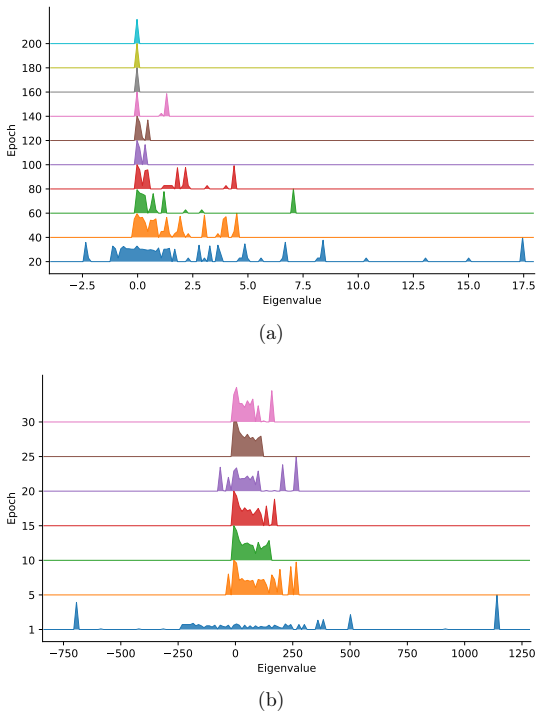
DNN training exhibits strong curvature anisotropy early and shifts toward flatter regions with weaker anisotropy later.
What would settle it
A controlled experiment in which curvature anisotropy stays constant or increases, causing the dynamic-p schedule to match or underperform fixed-p=2 or p=∞ baselines on the same tasks.
If this is right
- High-curvature directions lose their early dominance, allowing updates along lower-curvature axes.
- Later-stage updates become less prone to oscillation because coordinate-wise steps shrink as p approaches 2.
- Both algorithms retain the standard O(T^{-1/2}) rate for nonconvex stochastic optimization.
- Empirical gains appear on CIFAR-10, CIFAR-100 and ImageNet-1K with VGG-11, ResNet-18 and ResNet-50.
Where Pith is reading between the lines
- The same dynamic-norm replacement could be inserted into Adam-style methods that already maintain per-coordinate statistics.
- Replacing the cosine schedule for p with a linear or step decay would test whether the exact annealing shape is essential.
- Applying the method to language-model pretraining or reinforcement-learning agents would check whether the early-to-late anisotropy pattern holds outside vision tasks.
Editorial analysis
A structured set of objections, weighed in public.
Referee Report
Summary. The paper proposes a dynamic ℓ_p-norm scheme for SGD and SGDM (LPSGD and LPSGDM) in which p begins above 2 to mitigate strong early-training curvature anisotropy and is annealed toward 2 via a cosine schedule to stabilize later updates in flatter regions. It claims this yields better generalization than ℓ₂- or ℓ∞-based methods on CIFAR-10/100 and ImageNet-1K with VGG-11, ResNet-18 and ResNet-50, while both algorithms achieve the standard O(T^{-1/2}) rate for non-convex stochastic optimization.
Significance. If the anisotropy premise is quantitatively supported and the empirical gains prove robust, the work could supply a concrete mechanism for phase-dependent norm adaptation in first-order methods. The convergence result itself is the textbook non-convex SGD rate and does not constitute a theoretical advance; significance therefore rests entirely on whether the dynamic schedule demonstrably exploits the claimed curvature behavior and produces statistically reliable improvements.
major comments (3)
- [Abstract] Abstract (motivation paragraph): the central justification—that early training exhibits “strong curvature anisotropy” while later stages are “flatter with weaker anisotropy”—is stated qualitatively with neither a quantitative definition (e.g., ratio of Hessian eigenvalues, gradient-component variance, or effective dimension) nor any cited measurements or references. Because this premise directly motivates the choice of large initial p and its subsequent decrease, its lack of empirical grounding is load-bearing for both novelty and the claimed generalization benefit.
- [Abstract] Abstract (convergence claim): the stated O(T^{-1/2}) rate is identical to the standard non-convex SGD bound; the manuscript must clarify whether the dynamic-p analysis produces any improvement in the leading constant or merely recovers the vanilla bound. If the latter, the theoretical guarantee does not distinguish the proposed method from existing ℓ₂-SGD.
- [Abstract] Abstract (experimental claims): no explicit functional form for the cosine-annealing p-schedule, no schedule parameters, no number of independent runs, and no error-bar or statistical-significance protocol are supplied. These omissions prevent verification that the reported gains are attributable to the dynamic norm rather than post-hoc schedule tuning or run-to-run variance.
Simulated Author's Rebuttal
We thank the referee for the careful reading and constructive feedback. We address each major comment point by point below. Where the comments identify omissions or lack of clarity in the abstract, we agree that revisions are warranted and will update the manuscript accordingly.
read point-by-point responses
-
Referee: [Abstract] Abstract (motivation paragraph): the central justification—that early training exhibits “strong curvature anisotropy” while later stages are “flatter with weaker anisotropy”—is stated qualitatively with neither a quantitative definition (e.g., ratio of Hessian eigenvalues, gradient-component variance, or effective dimension) nor any cited measurements or references. Because this premise directly motivates the choice of large initial p and its subsequent decrease, its lack of empirical grounding is load-bearing for both novelty and the claimed generalization benefit.
Authors: We agree that the motivation paragraph in the abstract relies on a qualitative description without quantitative grounding or citations. In the revised version we will add a concise quantitative definition of curvature anisotropy (e.g., the ratio of the largest to smallest Hessian eigenvalue or the variance across gradient components) together with a short supporting measurement on a small-scale model, and we will cite relevant prior work on Hessian spectra and curvature dynamics during DNN training. These additions will appear in both the abstract (space permitting) and the introduction. revision: yes
-
Referee: [Abstract] Abstract (convergence claim): the stated O(T^{-1/2}) rate is identical to the standard non-convex SGD bound; the manuscript must clarify whether the dynamic-p analysis produces any improvement in the leading constant or merely recovers the vanilla bound. If the latter, the theoretical guarantee does not distinguish the proposed method from existing ℓ₂-SGD.
Authors: The analysis recovers the textbook O(T^{-1/2}) non-convex rate without an improved leading constant. We will revise the abstract and theory section to state explicitly that the bound matches the standard SGD guarantee and that the theoretical contribution is to establish convergence of the dynamic-p scheme under the same assumptions rather than a tighter rate. The practical distinction is shown through the empirical results. revision: yes
-
Referee: [Abstract] Abstract (experimental claims): no explicit functional form for the cosine-annealing p-schedule, no schedule parameters, no number of independent runs, and no error-bar or statistical-significance protocol are supplied. These omissions prevent verification that the reported gains are attributable to the dynamic norm rather than post-hoc schedule tuning or run-to-run variance.
Authors: The abstract is length-limited and therefore omits these details, which are provided in the experimental section of the full manuscript (cosine schedule form, hyper-parameters, 3–5 independent runs with standard deviations, and significance testing). We will add a brief statement of the schedule form and mention of multiple runs with error bars to the abstract or a footnote to improve verifiability without exceeding length constraints. revision: partial
Circularity Check
No circularity; standard convergence bound and qualitative motivation
full rationale
The paper's central proposal is a dynamic-p ℓ_p norm (large p early, annealed toward 2) motivated by a qualitative description of curvature anisotropy. The claimed O(T^{-1/2}) non-convex rate is the textbook SGD rate and is not shown to be derived from or equivalent to the anisotropy premise by construction. No self-citations, fitted parameters renamed as predictions, or self-definitional steps are present in the abstract or described claims. The derivation chain for the rate is therefore independent of the schedule choice.
Axiom & Free-Parameter Ledger
free parameters (2)
- initial p (>2)
- cosine-annealing schedule parameters
axioms (1)
- domain assumption DNN training exhibits strong curvature anisotropy early and weaker anisotropy later.
read the original abstract
The existing optimizers for deep neural networks (DNNs) typically rely on either the $\ell_2$ norm or the $\ell_\infty$ norm, resulting in optimizers that do not adapt well to substantial changes in curvature across parameter dimensions. Generally, the training process of DNNs often exhibits strong curvature anisotropy in the early period, whereas in the later period, the training process of DNNs tends to move toward flatter regions with weaker anisotropy. Particularly, optimizers based on the \(\ell_2\)-norm are usually dominated by high-curvature directions, restricting updates of optimizers along with lower curvature direction and thus leading to a slower convergence rate. While optimizers based on the \(\ell_\infty\)-norm are prone to oscillations in flatter regions, due to the coordinate-wise updates of the same magnitude. To address these two extreme cases generated by $\ell_2$ and $\ell_\infty$ norms, we propose a novel $\ell_p$-norm scheme with a dynamical value of $p$ and incorporate it into stochastic gradient descent (SGD) and SGD with momentum (SGDM), leading to two novel optimizers with better generalization performance: ${\ell_p}$-SGD (LPSGD) and ${\ell_p}$-SGDM (LPSGDM). Particularly, the resulting optimizers suppress the dominance of high-curvature directions in the early period by utilizing a large $p$ ($p>2$), followed by a gradual decrease of $p$ toward 2 to enable more stable and refined updates, where the latter process is motivated by the cosine annealing strategy. We establish theoretical guarantees of the resulting algorithms and analyze that both LPSGD and LPSGDM achieve an \(O(T^{-1/2})\) convergence rate for the nonconvex setting. Extensive experiments are conducted on benchmark datasets, including CIFAR-10, CIFAR-100, and ImageNet-1K, with multiple DNNs such as VGG-11, ResNet-18, and ResNet-50.
Figures


Reference graph
Works this paper leans on
-
[1]
Neural Networks 197: 108481 (2026)
Haizhou Du, Chongyi Qiu, Huan Huo: FedHyperGraph: A layer-wise personalized federated learning with correlation graphs in hyperbolic space. Neural Networks 197: 108481 (2026)
2026
-
[2]
Neural Networks 197: 108453 (2026)
Yang Liu, Jingchen Li, Huarui Wu, Ying Zhou, Chunjiang Zhao: To- wards more effective skill discovery in reinforcement learning by incor- porating state reachability. Neural Networks 197: 108453 (2026)
2026
-
[3]
Neural Networks 196: 108388 (2026)
Zhiyu Liao, Kang Chen, Yuanguo Lin, Kangkang Li, Yunxuan Liu, Hefeng Chen, Xingwang Huang, Yuanhui Yu: Attack and defense tech- niques in large language models: A survey and new perspectives. Neural Networks 196: 108388 (2026)
2026
-
[4]
A stochastic approximation method[J]
Robbins H, Monro S. A stochastic approximation method[J]. The annals of mathematical statistics, 1951: 400-407. 28
1951
-
[5]
Learning from streaming video with orthogonal gradients[C]//Proceedings of the Computer Vision and Pat- tern Recognition Conference
Han T, Gokay D, Heyward J, et al. Learning from streaming video with orthogonal gradients[C]//Proceedings of the Computer Vision and Pat- tern Recognition Conference. 2025: 13651-13660
2025
-
[6]
Resolving discrepancies in compute-optimal scaling of language models[J]
Porian T, Wortsman M, Jitsev J, et al. Resolving discrepancies in compute-optimal scaling of language models[J]. Advances in Neural In- formation Processing Systems, 2024, 37: 100535-100570
2024
-
[7]
Kingma, Jimmy Ba: Adam: A Method for Stochastic Opti- mization
Diederik P. Kingma, Jimmy Ba: Adam: A Method for Stochastic Opti- mization. ICLR (Poster) 2015
2015
-
[8]
ICLR (Poster) 2019
Ilya Loshchilov, Frank Hutter: Decoupled Weight Decay Regularization. ICLR (Poster) 2019
2019
-
[9]
Adaptive subgradient methods for online learning and stochastic optimization[J]
Duchi J, Hazan E, Singer Y. Adaptive subgradient methods for online learning and stochastic optimization[J]. Journal of machine learning re- search, 2011, 12(7)
2011
-
[10]
RMSprop converges with proper hyper- parameter[C]//International Conference on Learning Representations
Shi N, Li D, Hong M, et al. RMSprop converges with proper hyper- parameter[C]//International Conference on Learning Representations. 2021
2021
-
[11]
The geometry of sign gradient descent
Lukas Balles, Fabian Pedregosa, Nicolas Le Roux: The Geometry of Sign Gradient Descent. CoRR abs/2002.08056 (2020)
-
[12]
signSGD: Compressed optimisation for non-convex problems[C]//International conference on machine learning
Bernstein J, Wang Y X, Azizzadenesheli K, et al. signSGD: Compressed optimisation for non-convex problems[C]//International conference on machine learning. PMLR, 2018: 560-569
2018
-
[13]
Le: Symbolic Discovery of Optimization Algorithms
Xiangning Chen, Chen Liang, Da Huang, Esteban Real, Kaiyuan Wang, Hieu Pham, Xuanyi Dong, Thang Luong, Cho-Jui Hsieh, Yifeng Lu, Quoc V. Le: Symbolic Discovery of Optimization Algorithms. NeurIPS 2023
2023
-
[14]
ICLR 2024
Lizhang Chen, Bo Liu, Kaizhao Liang, Qiang Liu: Lion Secretly Solves a Constrained Optimization: As Lyapunov Predicts. ICLR 2024
2024
-
[15]
Dissecting adam: The sign, magnitude and vari- ance of stochastic gradients[C]//International Conference on Machine Learning
Balles L, Hennig P. Dissecting adam: The sign, magnitude and vari- ance of stochastic gradients[C]//International Conference on Machine Learning. PMLR, 2018: 404-413. 29
2018
-
[16]
Equilibrated adaptive learning rates for non-convex optimization[J]
Dauphin Y, De Vries H, Bengio Y. Equilibrated adaptive learning rates for non-convex optimization[J]. Advances in neural information process- ing systems, 2015, 28
2015
-
[17]
Zico Kolter, Ameet Tal- walkar: Gradient Descent on Neural Networks Typically Occurs at the Edge of Stability
Jeremy Cohen, Simran Kaur, Yuanzhi Li, J. Zico Kolter, Ameet Tal- walkar: Gradient Descent on Neural Networks Typically Occurs at the Edge of Stability. ICLR 2021
2021
-
[18]
On faster convergence of scaled sign gradient descent[J]
Li X, Lin K Y, Li L, et al. On faster convergence of scaled sign gradient descent[J]. IEEE Transactions on Industrial Informatics, 2023, 20(2): 1732-1741
2023
-
[20]
Deep resid- uallearningforimage recognition.In Proceedingsof the2016 IEEECon- ference on Computer Vision and Pattern Recognition, pages 770–778, Las Vegas, NV, USA, June 2016
Kaiming He, Xiangyu Zhang, Shaoqing Ren, and Jian Sun. Deep resid- uallearningforimage recognition.In Proceedingsof the2016 IEEECon- ference on Computer Vision and Pattern Recognition, pages 770–778, Las Vegas, NV, USA, June 2016. IEEE Computer Society
2016
-
[21]
Learning multiple layers of features from tiny images
Alex Krizhevsky, Geoffrey Hinton, et al. Learning multiple layers of features from tiny images. Technical report, Citeseer, 2009
2009
-
[22]
Ugur Güney, Yann N
Levent Sagun, Utku Evci, V. Ugur Güney, Yann N. Dauphin, Léon Bottou: Empirical Analysis of the Hessian of Over-Parametrized Neural Networks. ICLR (Workshop) 2018
2018
-
[23]
Geometry of neural network loss surfaces via random matrix theory[C]//International conference on machine learn- ing
Pennington J, Bahri Y. Geometry of neural network loss surfaces via random matrix theory[C]//International conference on machine learn- ing. PMLR, 2017: 2798-2806
2017
-
[24]
An investigation into neural net op- timization via hessian eigenvalue density[C]//International Conference on Machine Learning
Ghorbani B, Krishnan S, Xiao Y. An investigation into neural net op- timization via hessian eigenvalue density[C]//International Conference on Machine Learning. PMLR, 2019: 2232-2241
2019
-
[25]
Pyhessian: Neural networks through the lens of the hessian[C]//2020 IEEE international conference on big data (Big data)
Yao Z, Gholami A, Keutzer K, et al. Pyhessian: Neural networks through the lens of the hessian[C]//2020 IEEE international conference on big data (Big data). IEEE, 2020: 581-590. 30
2020
-
[26]
A deeper look at the hessian eigenspectrum of deep neural networks and its applications to regularization[C]//Proceedings of the AAAI Conference on Artificial In- telligence
Sankar A R, Khasbage Y, Vigneswaran R, et al. A deeper look at the hessian eigenspectrum of deep neural networks and its applications to regularization[C]//Proceedings of the AAAI Conference on Artificial In- telligence. 2021, 35(11): 9481-9488
2021
-
[27]
Optimizing neural networks with kronecker- factored approximate curvature[C]//International conference on ma- chine learning
Martens J, Grosse R. Optimizing neural networks with kronecker- factored approximate curvature[C]//International conference on ma- chine learning. PMLR, 2015: 2408-2417
2015
-
[28]
Shampoo: Preconditioned stochastic tensor optimization[C]//International Conference on Machine Learning
Gupta V, Koren T, Singer Y. Shampoo: Preconditioned stochastic tensor optimization[C]//International Conference on Machine Learning. PMLR, 2018: 1842-1850
2018
-
[29]
ICLR 2024
Hong Liu, Zhiyuan Li, David Leo Wright Hall, Percy Liang, Tengyu Ma: Sophia: A Scalable Stochastic Second-order Optimizer for Language Model Pre-training. ICLR 2024
2024
-
[30]
Sharpness-aware lookahead for accelerat- ing convergence and improving generalization[J]
Tan C, Zhang J, Liu J, et al. Sharpness-aware lookahead for accelerat- ing convergence and improving generalization[J]. IEEE Transactions on Pattern Analysis and Machine Intelligence, 2024, 46(12): 10375-10388
2024
-
[31]
ICML 2025
Xinyu Luo, Site Bai, Bolian Li, Petros Drineas, Ruqi Zhang, Brian Bullins: Stacey: Promoting Stochastic Steepest Descent via Accelerated ℓp-Smooth Nonconvex Optimization. ICML 2025
2025
-
[32]
Gradual Stochastic Gradient Descent: from signSGD to SGD viaℓp Norm[C]//Workshop on Scientific Methods for Understanding Deep Learning
Yuan J, Jiachen L, Nie F. Gradual Stochastic Gradient Descent: from signSGD to SGD viaℓp Norm[C]//Workshop on Scientific Methods for Understanding Deep Learning
-
[33]
Continual momentum filtering on parameter space for online test-time adaptation[C]//The twelfth international conference on learning representations
Lee J H, Chang J H. Continual momentum filtering on parameter space for online test-time adaptation[C]//The twelfth international conference on learning representations. 2024
2024
-
[34]
Adaptive momentum-based optimization to train deep neural network for simulating the static sta- bility of the composite structure[J]
Chi Z, Jiang Z, Kamruzzaman M M, et al. Adaptive momentum-based optimization to train deep neural network for simulating the static sta- bility of the composite structure[J]. Engineering with Computers, 2022, 38(Suppl 5): 4027-4049
2022
-
[35]
1983, 269: 543
NesterovY.Amethodforsolvingtheconvexprogrammingproblemwith convergence rate O (1/k2)[C]//Dokl akad nauk Sssr. 1983, 269: 543. 31
1983
-
[36]
Very Deep Convolutional Networks for Large-Scale Image Recognition
Karen Simonyan and Andrew Zisserman. Very deep convolutional net- works for large-scale image recognition. arXiv preprint arXiv:1409.1556, 2014
work page internal anchor Pith review Pith/arXiv arXiv 2014
-
[37]
Ima- genet: A large-scale hierarchical image database
Deng, J., Dong, W., Socher, R., Li, L.-J., Li, K., and Fei-Fei, L. Ima- genet: A large-scale hierarchical image database. In 2009 IEEE Confer- ence on Computer Vision and Pattern Recognition, pp. 248–255. Ieee, 2009. 32
2009
discussion (0)
Sign in with ORCID, Apple, or X to comment. Anyone can read and Pith papers without signing in.