TiRex-2: Generalizing TiRex to Multivariate Data and Streaming
Pith reviewed 2026-07-02 14:51 UTC · model grok-4.3
The pith
TiRex-2 extends univariate time series models to multivariate forecasting with past and future covariates while preserving strict target causality and constant per-patch streaming cost.
A machine-rendered reading of the paper's core claim, the machinery that carries it, and where it could break.
Core claim
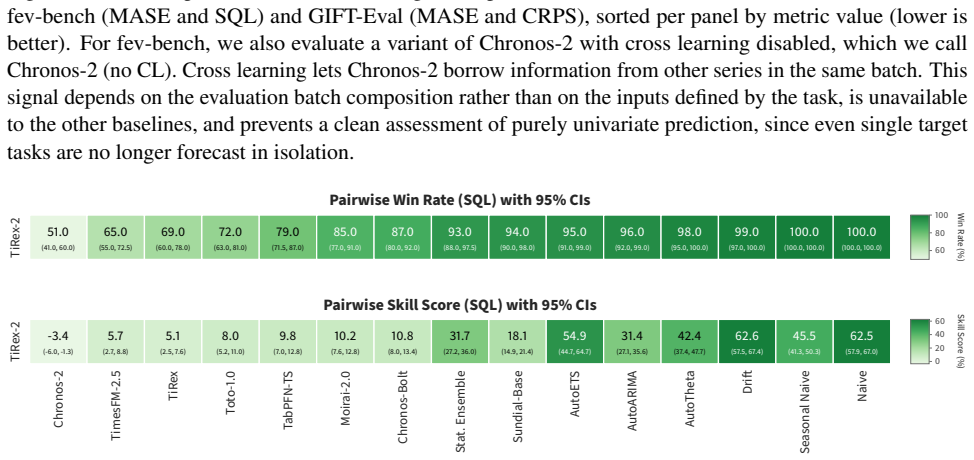
TiRex-2 is the first time series foundation model to combine multivariate forecasting that accepts both past and future covariates, strict causality over target variables, and constant per-patch cost under streaming; it realizes these properties via a memory-centric recurrent xLSTM architecture and a synthetic coupling pipeline that generates diverse multivariate samples on the fly from large univariate corpora, yielding state-of-the-art zero-shot performance on GIFT-Eval and fev-bench.
What carries the argument
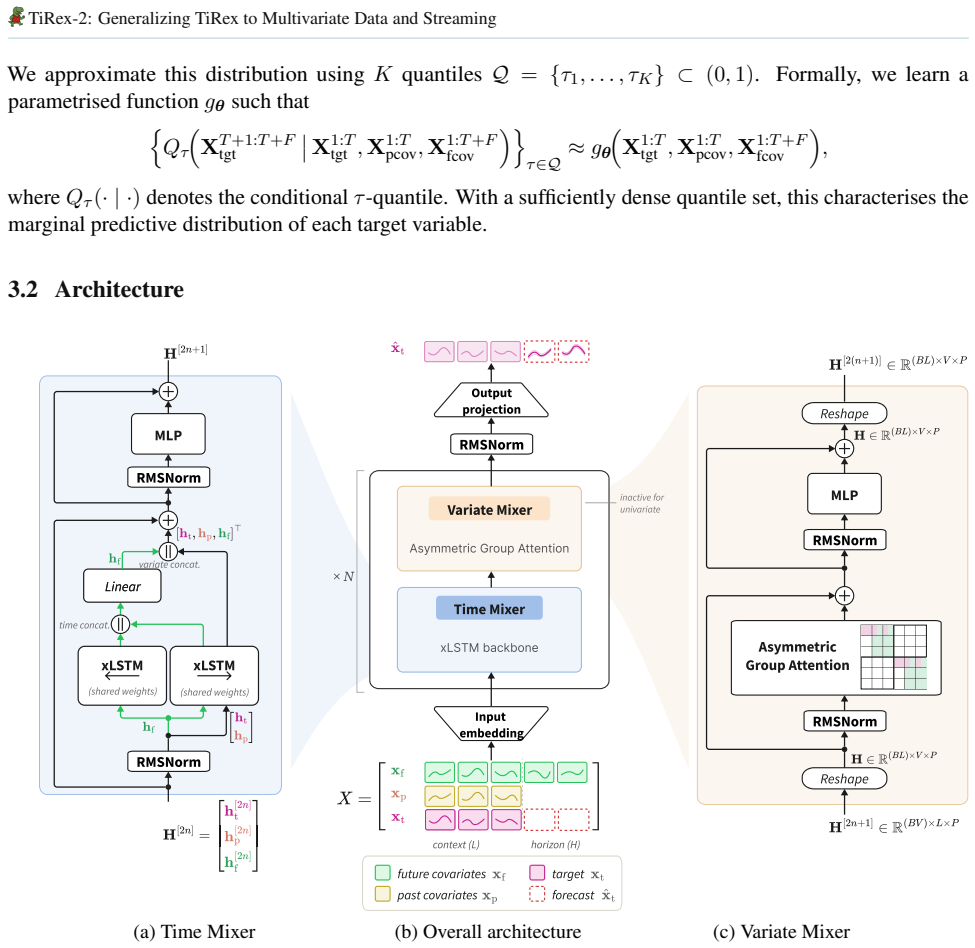
Memory-centric recurrent xLSTM design with bidirectional time mixer and asymmetric grouped-attention variate mixer that integrates future-known covariates while enforcing causality on targets.
If this is right
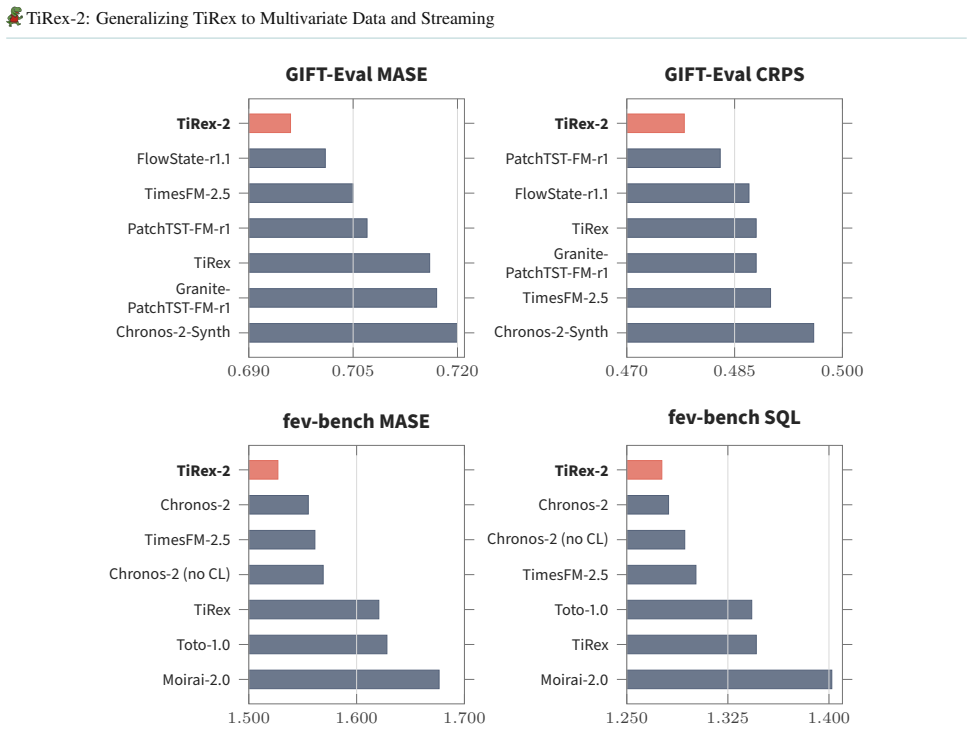
- Achieves state-of-the-art zero-shot performance on GIFT-Eval and fev-bench.
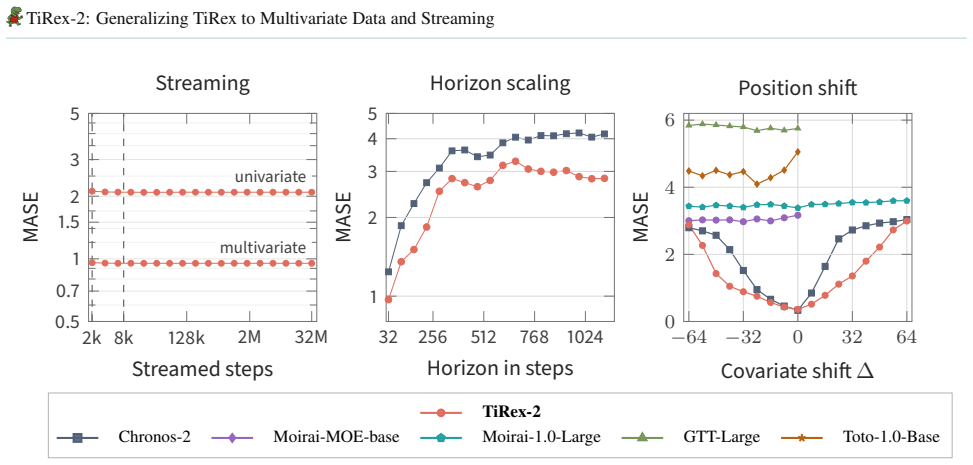
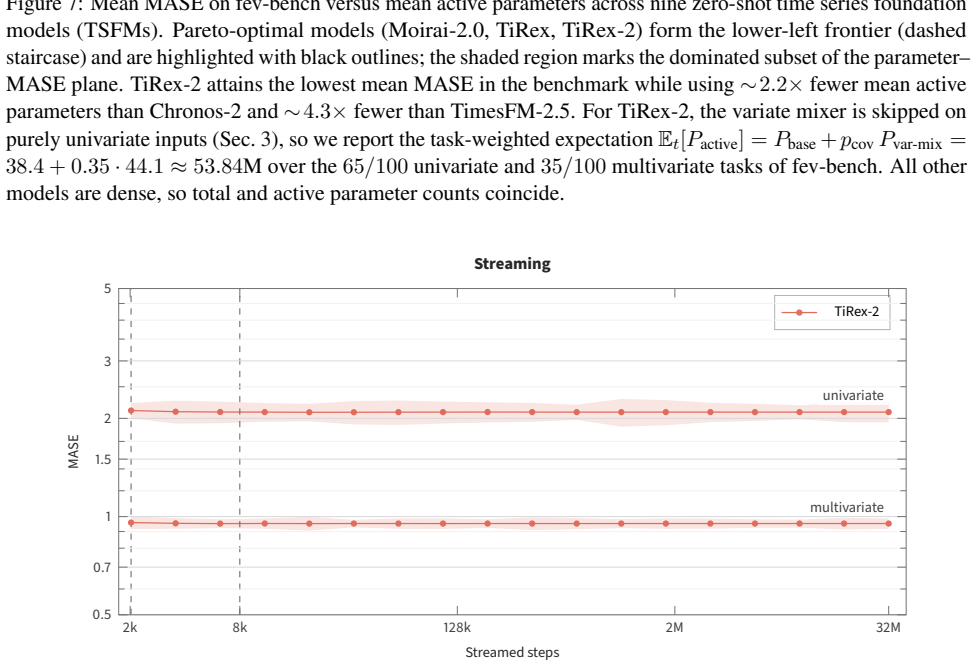
- Remains stable when streamed to arbitrary context lengths.
- Maintains constant inference cost per patch.
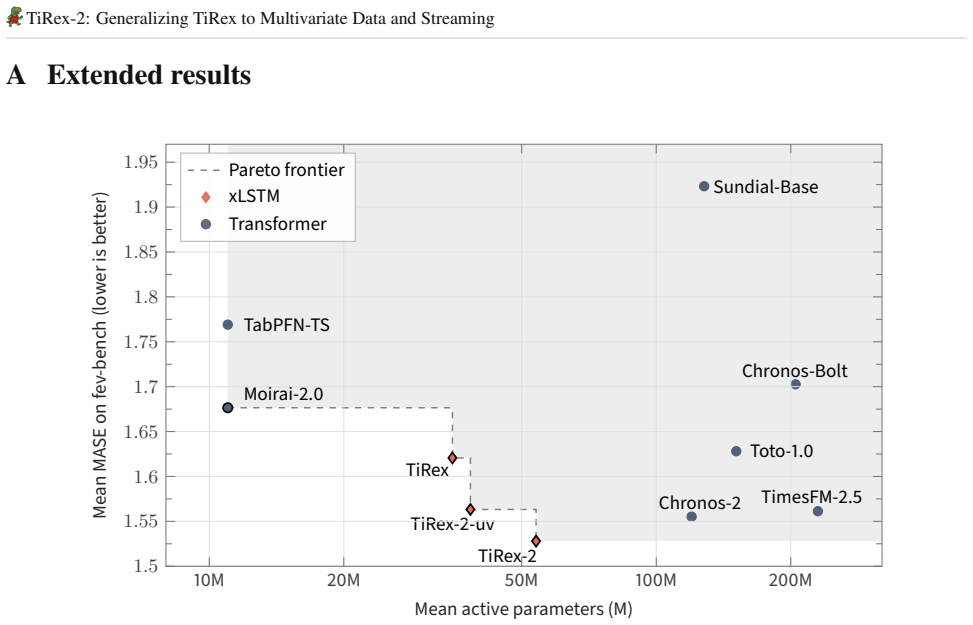
- Uses 38.4M active parameters in univariate mode and activates an additional 44.1M parameters for multivariate forecasting.
Where Pith is reading between the lines
- The constant-cost streaming property could support continuous real-time forecasting pipelines where transformer recomputation becomes prohibitive.
- If the synthetic pipeline captures enough joint statistics, similar on-the-fly coupling methods might reduce reliance on scarce labeled multivariate datasets in other sequential domains.
- The separation of time and variate mixers suggests a route to add new variables at inference time without retraining the entire model.
Load-bearing premise
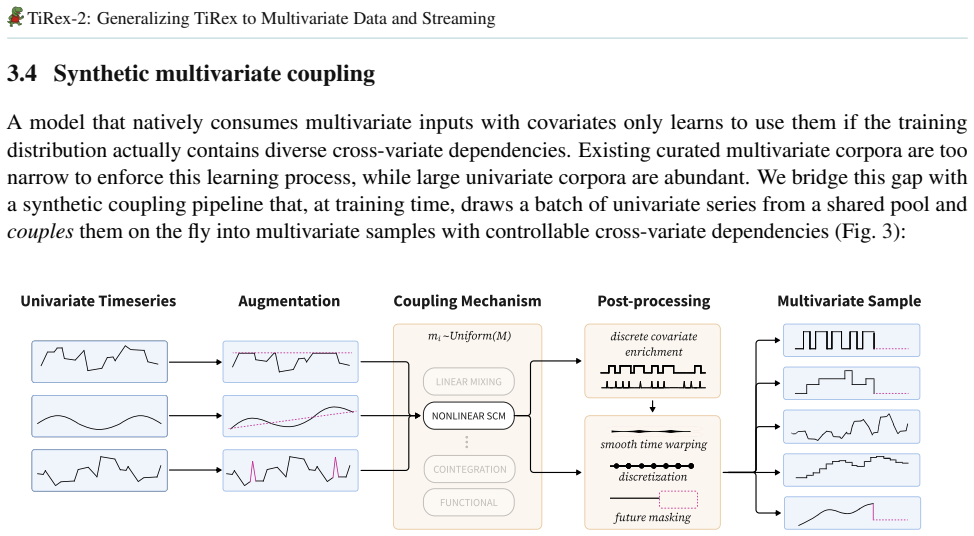
The synthetic coupling pipeline that composes diverse multivariate samples on the fly from large univariate corpora produces training distributions sufficiently representative of real-world joint variable dynamics for zero-shot generalization.
What would settle it
Performance comparison on a held-out set of real multivariate series whose cross-variable dependencies cannot be reproduced by the synthetic coupling pipeline, where TiRex-2 zero-shot accuracy falls below models trained on authentic joint data.
Figures
read the original abstract
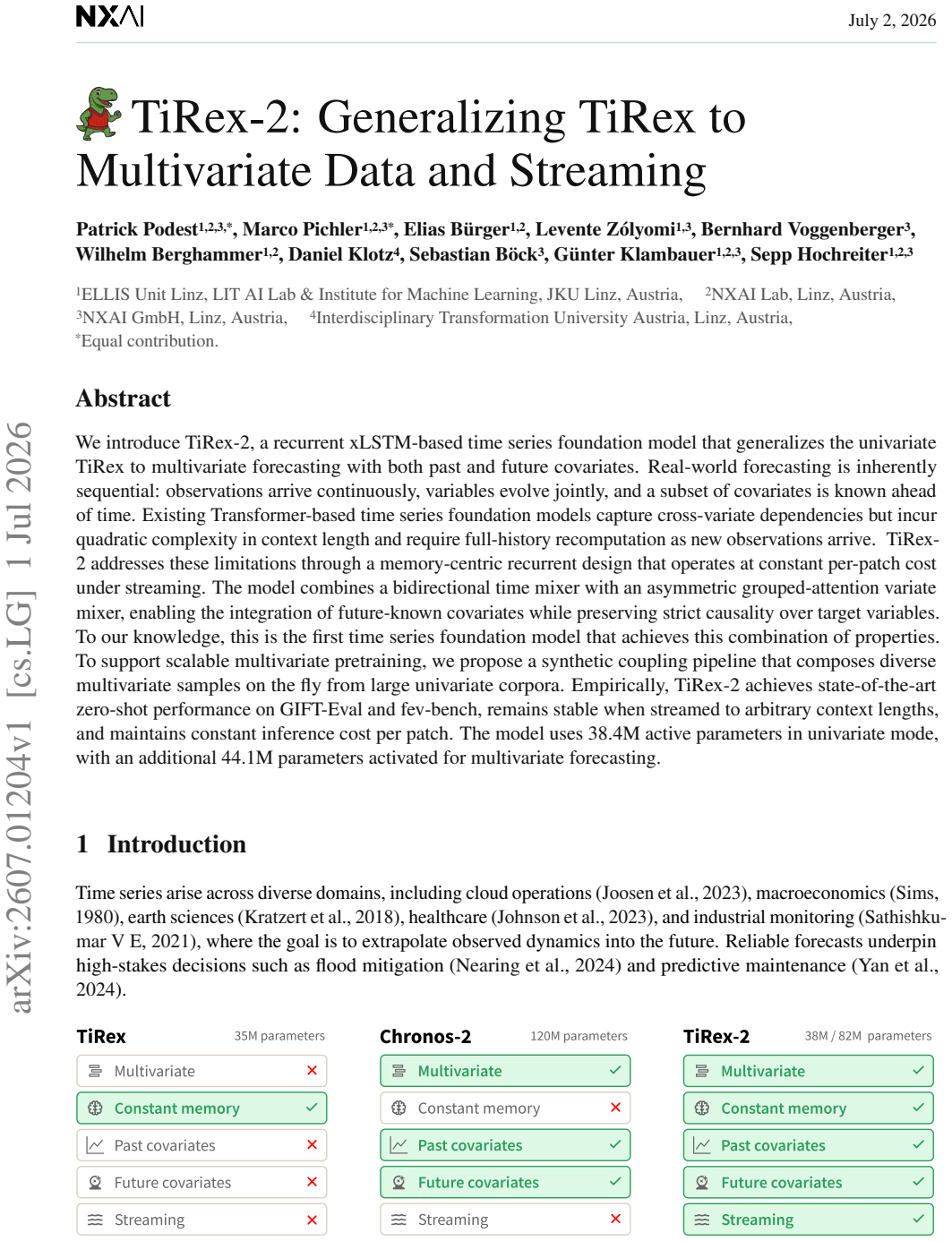
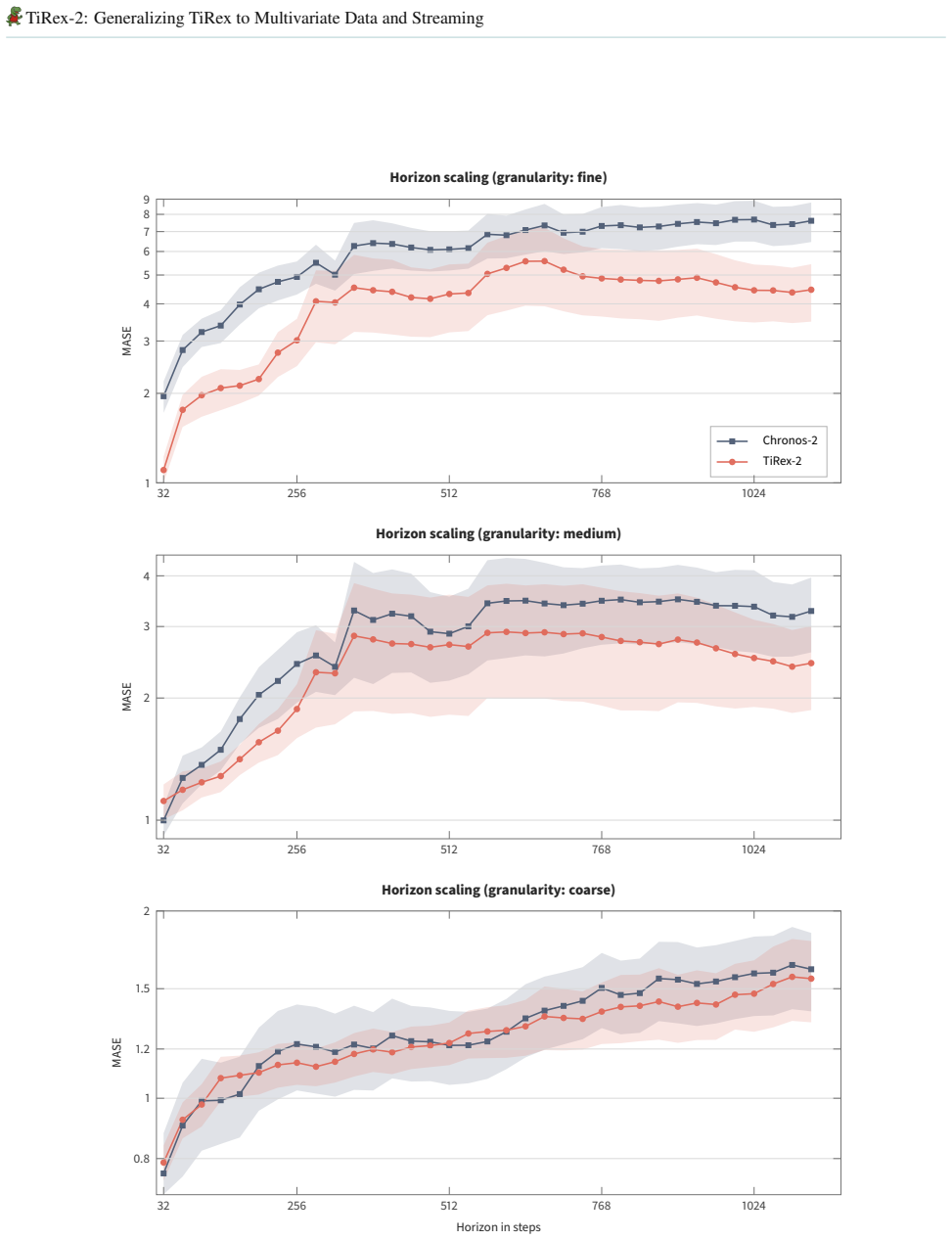
We introduce TiRex-2, a recurrent xLSTM-based time series foundation model that generalizes the univariate TiRex to multivariate forecasting with both past and future covariates. Real-world forecasting is inherently sequential: observations arrive continuously, variables evolve jointly, and a subset of covariates is known ahead of time. Existing Transformer-based time series foundation models capture cross-variate dependencies but incur quadratic complexity in context length and require full-history recomputation as new observations arrive. TiRex-2 addresses these limitations through a memory-centric recurrent design that operates at constant per-patch cost under streaming. The model combines a bidirectional time mixer with an asymmetric grouped-attention variate mixer, enabling the integration of future-known covariates while preserving strict causality over target variables. To our knowledge, this is the first time series foundation model that achieves this combination of properties. To support scalable multivariate pretraining, we propose a synthetic coupling pipeline that composes diverse multivariate samples on the fly from large univariate corpora. Empirically, TiRex-2 achieves state-of-the-art zero-shot performance on GIFT-Eval and fev-bench, remains stable when streamed to arbitrary context lengths, and maintains constant inference cost per patch. The model uses 38.4M active parameters in univariate mode, with an additional 44.1M parameters activated for multivariate forecasting.
Editorial analysis
A structured set of objections, weighed in public.
Referee Report
Summary. The manuscript introduces TiRex-2, a recurrent xLSTM-based time series foundation model extending the univariate TiRex to multivariate forecasting with past and future covariates. It employs a bidirectional time mixer and asymmetric grouped-attention variate mixer to enforce strict causality over targets while integrating known-future covariates, paired with a synthetic coupling pipeline that assembles multivariate training samples on the fly from univariate corpora. The central claims are state-of-the-art zero-shot performance on GIFT-Eval and fev-bench, constant per-patch inference cost under streaming, stability at arbitrary context lengths, and novelty in combining these properties, with 38.4M active parameters in univariate mode and an additional 44.1M activated for the multivariate case.
Significance. If the synthetic pipeline produces training distributions that faithfully capture real-world cross-variable correlations and lead-lag structure, the work would be significant as the first foundation model achieving the stated combination of multivariate support, strict target causality, future-covariate handling, and constant-cost streaming. The memory-centric recurrent design and explicit parameter counts are concrete strengths that support the efficiency claims.
major comments (2)
- [Pretraining methodology] The synthetic coupling pipeline (described in the pretraining methodology) is load-bearing for all zero-shot generalization claims: the manuscript provides no ablation, no statistical comparison of generated vs. real multivariate joint distributions (e.g., pairwise correlations or shared latent factors), and no held-out real-multivariate validation set. Without such evidence the SOTA results on GIFT-Eval and fev-bench cannot be interpreted as demonstrating transfer to actual joint dynamics.
- [Empirical evaluation] § on empirical evaluation: the claims of stability at arbitrary lengths and constant per-patch cost are central but rest on streaming experiments whose setup (context lengths tested, exact baseline recomputation costs, and any post-hoc length selection) is not detailed enough to rule out fitting artifacts or incomplete comparison to quadratic Transformer baselines.
minor comments (2)
- [Abstract] The abstract states both '38.4M active parameters in univariate mode' and 'an additional 44.1M parameters activated for multivariate forecasting'; clarify whether these figures are consistently active vs. total across all reported experiments.
- [Model architecture] Notation for the asymmetric grouped-attention variate mixer should be introduced with an equation or diagram in the model-architecture section to make the causality guarantee explicit.
Simulated Author's Rebuttal
We thank the referee for the constructive comments, which help clarify the presentation of our contributions. We address each major point below and indicate the revisions we will make to the manuscript.
read point-by-point responses
-
Referee: [Pretraining methodology] The synthetic coupling pipeline (described in the pretraining methodology) is load-bearing for all zero-shot generalization claims: the manuscript provides no ablation, no statistical comparison of generated vs. real multivariate joint distributions (e.g., pairwise correlations or shared latent factors), and no held-out real-multivariate validation set. Without such evidence the SOTA results on GIFT-Eval and fev-bench cannot be interpreted as demonstrating transfer to actual joint dynamics.
Authors: We agree that direct validation of the synthetic coupling pipeline would strengthen the interpretation of the zero-shot results. The current manuscript relies on the empirical SOTA performance on real held-out multivariate benchmarks (GIFT-Eval and fev-bench) as evidence that the pipeline produces useful training distributions. In the revised version we will add (i) a statistical comparison of pairwise correlations and lead-lag structure between synthetically generated samples and real multivariate series from the evaluation corpora, and (ii) an ablation that trains without the coupling step on the subset of data where it is feasible. We note that a fully held-out real-multivariate pretraining validation set was not available in the original experimental design, but the added analyses will address the core concern. revision: yes
-
Referee: [Empirical evaluation] § on empirical evaluation: the claims of stability at arbitrary lengths and constant per-patch cost are central but rest on streaming experiments whose setup (context lengths tested, exact baseline recomputation costs, and any post-hoc length selection) is not detailed enough to rule out fitting artifacts or incomplete comparison to quadratic Transformer baselines.
Authors: We acknowledge that the streaming experiment description in the current manuscript is insufficiently detailed. In the revision we will expand the relevant section to report: the full range of context lengths evaluated, the precise measurement protocol for per-patch inference cost (including hardware and batching details), the recomputation costs for the quadratic baselines, and confirmation that no post-hoc length selection was performed. These additions will allow readers to verify the constant-cost and stability claims against the Transformer baselines. revision: yes
Circularity Check
No circularity: performance claims rest on external benchmarks with no self-referential reduction
full rationale
The paper introduces TiRex-2 and a synthetic coupling pipeline for multivariate pretraining, then reports zero-shot results on independent external benchmarks (GIFT-Eval, fev-bench). No equations, fitted parameters, or self-citations are shown that reduce these outcomes to quantities defined by construction within the same work. The derivation chain is self-contained against external validation sets, with the pipeline serving as a proposed training method rather than a tautological input.
Axiom & Free-Parameter Ledger
Reference graph
Works this paper leans on
-
[1]
Aksu, Taha and Woo, Gerald and Liu, Juncheng and Liu, Xu and Liu, Chenghao and Savarese, Silvio and Xiong, Caiming and Sahoo, Doyen , month = oct, year =
-
[2]
Transactions on Machine Learning Research , author =
Chronos:. Transactions on Machine Learning Research , author =. 2024 , file =
2024
-
[3]
Ansari, Abdul Fatir and Shchur, Oleksandr and Küken, Jaris and Auer, Andreas and Han, Boran and Mercado, Pedro and Rangapuram, Syama Sundar and Shen, Huibin and Stella, Lorenzo and Zhang, Xiyuan and Goswami, Mononito and Kapoor, Shubham and Maddix, Danielle C. and Guerron, Pablo and Hu, Tony and Yin, Junming and Erickson, Nick and Desai, Prateek Mutalik a...
work page internal anchor Pith review Pith/arXiv arXiv doi:10.48550/arxiv.2510.15821
-
[4]
and Bohlke-Schneider, Michael and Wang, Bernie and Rangapuram, Syama Sundar , month = apr, year =
Arango, Sebastian Pineda and Mercado, Pedro and Kapoor, Shubham and Ansari, Abdul Fatir and Stella, Lorenzo and Shen, Huibin and Senetaire, Hugo Henri Joseph and Turkmen, Ali Caner and Shchur, Oleksandr and Maddix, Danielle C. and Bohlke-Schneider, Michael and Wang, Bernie and Rangapuram, Syama Sundar , month = apr, year =. Proceedings of
-
[5]
Auer, Andreas and Parthipan, Raghul and Mercado, Pedro and Ansari, Abdul Fatir and Stella, Lorenzo and Wang, Bernie and Bohlke-Schneider, Michael and Rangapuram, Syama Sundar , month = jun, year =. Zero-. doi:10.48550/arXiv.2506.03128 , abstract =
-
[6]
Auer, Andreas and Podest, Patrick and Klotz, Daniel and Böck, Sebastian and Klambauer, Günter and Hochreiter, Sepp , month = oct, year =
-
[7]
and Klambauer, Günter and Brandstetter, Johannes and Hochreiter, Sepp , month = nov, year =
Beck, Maximilian and Pöppel, Korbinian and Spanring, Markus and Auer, Andreas and Prudnikova, Oleksandra and Kopp, Michael K. and Klambauer, Günter and Brandstetter, Johannes and Hochreiter, Sepp , month = nov, year =
-
[8]
Benechehab, Abdelhakim and Feofanov, Vasilii and Paolo, Giuseppe and Thomas, Albert and Filippone, Maurizio and Kégl, Balázs , month = jun, year =
-
[9]
Burbidge, John B. and Magee, Lonnie and Robb, A. Leslie , year =. Alternative. Journal of the American Statistical Association , publisher =. doi:10.1080/01621459.1988.10478575 , number =
-
[10]
2023 , file =
Transactions on Machine Learning Research , author =. 2023 , file =
2023
-
[11]
Cheng, Hanyin and Wu, Xingjian and Shu, Yang and Rao, Zhongwen and Pan, Lujia and Yang, Bin and Guo, Chenjuan , year =
-
[12]
Cohen, Ben and Khwaja, Emaad and Wang, Kan and Masson, Charles and Ramé, Elise and Doubli, Youssef and Abou-Amal, Othmane , month = jul, year =. Toto:. doi:10.48550/arXiv.2407.07874 , abstract =
-
[13]
Cohen, Ben and Khwaja, Emaad and Doubli, Youssef and Lemaachi, Salahidine and Lettieri, Chris and Masson, Charles and Miccinilli, Hugo and Ramé, Elise and Ren, Qiqi and Rostamizadeh, Afshin and Terrail, Jean Ogier du and Toon, Anna-Monica and Wang, Kan and Xie, Stephan and Xu, Zongzhe and Zhukova, Viktoriya and Asker, David and Talwalkar, Ameet and Abou-A...
-
[14]
A decoder-only foundation model for time-series forecasting , url =
Das, Abhimanyu and Kong, Weihao and Sen, Rajat and Zhou, Yichen , month = jun, year =. A decoder-only foundation model for time-series forecasting , url =
-
[15]
and Gifford, Wesley M
Ekambaram, Vijay and Jati, Arindam and Dayama, Pankaj and Mukherjee, Sumanta and Nguyen, Nam H. and Gifford, Wesley M. and Reddy, Chandra and Kalagnanam, Jayant , month = nov, year =. Tiny
-
[16]
Faw, Matthew and Sen, Rajat and Zhou, Yichen and Das, Abhimanyu , month = jun, year =. In-
-
[17]
Feng, Cheng and Huang, Long and Krompass, Denis , month = oct, year =. General. Proceedings of the 33rd. doi:10.1145/3627673.3679931 , abstract =
-
[18]
Fu, Xinghong and Li, Yanhong and Papaioannou, Georgios and Kim, Yoon , month = feb, year =. Reverso:. doi:10.48550/arXiv.2602.17634 , abstract =
-
[19]
Shanghua Gao and Teddy Koker and Owen Queen and Thomas Hartvigsen and Theodoros Tsiligkaridis and Marinka Zitnik , booktitle=. Uni. 2024 , url=
2024
-
[20]
Journal of Forecasting , author =
Exponential smoothing:. Journal of Forecasting , author =. 1985 , pages =. doi:10.1002/for.3980040103 , abstract =
-
[21]
Chaos as an interpretable benchmark for forecasting and data-driven modelling , url =
Gilpin, William , year =. Chaos as an interpretable benchmark for forecasting and data-driven modelling , url =
-
[22]
Graf, Lars and Ortner, Thomas and Woźniak, Stanisław and Pantazi, Angeliki , month = oct, year =
-
[23]
Gruver, Nate and Finzi, Marc Anton and Qiu, Shikai and Wilson, Andrew Gordon , month = nov, year =. Large
-
[24]
Hochreiter , title =
S. Hochreiter , title =
-
[25]
Hochreiter and J
S. Hochreiter and J. Schmidhuber , title =. Neural Comput. , volume = 9, number = 8, pages =
-
[26]
The Tabular Foundation Model Tab
Shi Bin Hoo and Samuel M. The Tabular Foundation Model Tab. NeurIPS Workshop on Time Series in the Age of Large Models , year=
-
[27]
Journal of Statistical Software , author =
Automatic. Journal of Statistical Software , author =. doi:10.18637/jss.v027.i03 , language =
-
[28]
Scientific Data , author =. 2023 , pages =. doi:10.1038/s41597-022-01899-x , abstract =
-
[29]
Joosen, Artjom and Hassan, Ahmed and Asenov, Martin and Singh, Rajkarn and Darlow, Luke and Wang, Jianfeng and Barker, Adam , month = oct, year =. How. Proceedings of the 2023. doi:10.1145/3620678.3624783 , abstract =
-
[30]
Reversible
Kim, Taesung and Kim, Jinhee and Tae, Yunwon and Park, Cheonbok and Choi, Jang-Ho and Choo, Jaegul , month = oct, year =. Reversible
-
[31]
Koenker, Roger and Bassett, Gilbert , year =. Regression. Econometrica , publisher =. doi:10.2307/1913643 , abstract =
-
[32]
Rainfall–runoff modelling using
Kratzert, Frederik and Klotz, Daniel and Brenner, Claire and Schulz, Karsten and Herrnegger, Mathew , month = nov, year =. Rainfall–runoff modelling using. Hydrology and Earth System Sciences , publisher =. doi:10.5194/hess-22-6005-2018 , abstract =
-
[33]
Moirai 2.0: When less is more for time series forecasting,
Liu, Chenghao and Aksu, Taha and Liu, Juncheng and Liu, Xu and Yan, Hanshu and Pham, Quang and Savarese, Silvio and Sahoo, Doyen and Xiong, Caiming and Li, Junnan , month = feb, year =. Moirai 2.0:. doi:10.48550/arXiv.2511.11698 , abstract =
-
[34]
Liu, Xu and Liu, Juncheng and Woo, Gerald and Aksu, Taha and Liang, Yuxuan and Zimmermann, Roger and Liu, Chenghao and Li, Junnan and Savarese, Silvio and Xiong, Caiming and Sahoo, Doyen , month = jun, year =. Moirai-
-
[35]
Liu, Yong and Hu, Tengge and Zhang, Haoran and Wu, Haixu and Wang, Shiyu and Ma, Lintao and Long, Mingsheng , month = oct, year =
-
[36]
Liu, Yong and Qin, Guo and Huang, Xiangdong and Wang, Jianmin and Long, Mingsheng , month = oct, year =. Timer-
-
[37]
Sundial: A Family of Highly Capable Time Series Foundation Models
Liu, Yong and Qin, Guo and Shi, Zhiyuan and Chen, Zhi and Yang, Caiyin and Huang, Xiangdong and Wang, Jianmin and Long, Mingsheng , month = may, year =. Sundial:. doi:10.48550/arXiv.2502.00816 , abstract =
work page internal anchor Pith review Pith/arXiv arXiv doi:10.48550/arxiv.2502.00816
-
[38]
Liu, Yong and Su, Xingjian and Wang, Shiyu and Zhang, Haoran and Liu, Haixuan and Wang, Yuxuan and Ye, Zhou and Xiang, Yang and Wang, Jianmin and Long, Mingsheng , month = apr, year =. Timer-. doi:10.48550/arXiv.2603.04791 , abstract =
work page internal anchor Pith review Pith/arXiv arXiv doi:10.48550/arxiv.2603.04791
-
[39]
Decoupled
Loshchilov, Ilya and Hutter, Frank , year =. Decoupled. International
-
[40]
Vladyslav Moroshan and Julien Siems and Arber Zela and Timur Carstensen and Frank Hutter , year=. Tempo
-
[41]
Global prediction of extreme floods in ungauged watersheds , volume =. Nature , author =. 2024 , pages =. doi:10.1038/s41586-024-07145-1 , abstract =
-
[42]
and Sinthong, Phanwadee and Kalagnanam, Jayant , month = sep, year =
Nie, Yuqi and Nguyen, Nam H. and Sinthong, Phanwadee and Kalagnanam, Jayant , month = sep, year =. A
-
[43]
Oreshkin, Boris N. and Jauhari, Mayank and Selvam, Ravi Kiran and Wolff, Malcolm and Pan, Wenhao and Ramasubramanian, Shankar and Olivares, Kin G. and Konstantinova, Tatiana and Potapczynski, Andres and Cao, Mengfei and Efimov, Dmitry and Mahoney, Michael W. and Wilson, Andrew G. , month = jan, year =. Zero-shot. doi:10.48550/arXiv.2601.00970 , abstract =
-
[44]
Patil, Prathamesh and Varshney, Amit and Cherukumalli, Manoj and Deshpande, Harsh and Eun, Leonard and Sahoo, Dushyant and Chittar, Naren , month = jun, year =
-
[45]
Europhysics Letters , author =
Time-lag cross-correlations in collective phenomena , volume =. Europhysics Letters , author =. 2010 , pages =. doi:10.1209/0295-5075/90/68001 , abstract =
-
[46]
Causal inference for time series , volume =
Runge, Jakob and Gerhardus, Andreas and Varando, Gherardo and Eyring, Veronika and Camps-Valls, Gustau , year =. Causal inference for time series , volume =. Nature Reviews Earth & Environment , publisher =
-
[47]
Sathishkumar V E, Changsun Shin , year =. Steel. doi:10.24432/C52G8C , urldate =
-
[48]
International Conference On Learning Representations , year=
Bio-xLSTM: Generative modeling, representation and in-context learning of biological and chemical sequences , author=. International Conference On Learning Representations , year=
-
[49]
fev-bench: A Realistic Benchmark for Time Series Forecasting
fev-bench:. arXiv preprint arXiv:2509.26468 , author =
work page internal anchor Pith review Pith/arXiv arXiv
-
[50]
Sims, Christopher A. , year =. Macroeconomics and. Econometrica , publisher =. doi:10.2307/1912017 , abstract =
-
[51]
Super-convergence:
Smith, Leslie N and Topin, Nicholay , year =. Super-convergence:. Artificial intelligence and machine learning for multi-domain operations applications , publisher =
-
[52]
Efficient. Energies , author =. doi:10.3390/en11082039 , abstract =
-
[53]
Wang, Xue and Zhou, Tian and Gao, Jinyang and Ding, Bolin and Zhou, Jingren , month = may, year =. Output. doi:10.48550/arXiv.2506.11029 , abstract =
-
[54]
Wang, Yuxuan and Wu, Haixu and Dong, Jiaxiang and Qin, Guo and Zhang, Haoran and Liu, Yong and Qiu, Yunzhong and Wang, Jianmin and Long, Mingsheng , month = nov, year =
-
[55]
and Reddy, Chandra and Nguyen, Lam M
Wen, Yunshi and Gifford, Wesley M. and Reddy, Chandra and Nguyen, Lam M. and Kalagnanam, Jayant and Julius, Anak Agung , month = feb, year =. Revisiting the. doi:10.48550/arXiv.2602.06909 , abstract =
-
[56]
Wu, Shunyu and Huang, Jiawei and Feng, Weibin and Li, Boxin and Zhang, Xiao and Meng, Erli and Li, Dan and Lou, Jian and Ng, See-Kiong , month = mar, year =
-
[57]
Xie, Shifeng and Feofanov, Vasilii and Alonso, Marius and Odonnat, Ambroise and Zhang, Jianfeng and Redko, Ievgen , year =. 1st
-
[58]
Xue, Hao and Salim, Flora D. , month = dec, year =. doi:10.48550/arXiv.2210.08964 , abstract =
-
[59]
CITRAS: Covariate-Informed Transformer for Time Series Forecasting
Yamaguchi, Yosuke and Suemitsu, Issei and Wei, Wenpeng , month = aug, year =. doi:10.48550/arXiv.2503.24007 , abstract =
work page internal anchor Pith review Pith/arXiv arXiv doi:10.48550/arxiv.2503.24007
-
[60]
A. IEEE Access , author =. 2024 , keywords =. doi:10.1109/ACCESS.2023.3349132 , abstract =
-
[61]
Crossformer:
Zhang, Yunhao and Yan, Junchi , month = sep, year =. Crossformer:
-
[62]
Journal of Geographical Sciences , author =
Investigating the critical influencing factors of snowmelt runoff and development of a mid-long term snowmelt runoff forecasting , volume =. Journal of Geographical Sciences , author =. 2023 , keywords =. doi:10.1007/s11442-023-2131-9 , abstract =
-
[63]
Woo, Gerald and Liu, Chenghao and Kumar, Akshat and Xiong, Caiming and Savarese, Silvio and Sahoo, Doyen , month = jul, year =. Unified. Proceedings of the 41st
discussion (0)
Sign in with ORCID, Apple, or X to comment. Anyone can read and Pith papers without signing in.