REVIEW 2 major objections 5 minor 80 references
$\mathbb{Z}_n$ solitons in intertwined topological phases
T0 review · 2 major / 5 minor · reviewed 2026-08-14 · deepseek-v4-flash
Pith's one-line read Doped ground states of the $\mathbb{Z}_2$ Bose-Hubbard model host topological solitons that split each added boson into 1/2 or 1/3 charges, with the protection explained by a generalized bulk-defect correspondence from quantized…
desk verdict The fractionalization results are solid and the Z4 soliton extension is real, but the pumping-based bulk-defect correspondence needs a gap check before the topological-origin claim is fully justified. read the letter →
The pith
A machine-rendered reading of the paper's core claim, the machinery that carries it, and where it could break.
The reading
What carries the argument
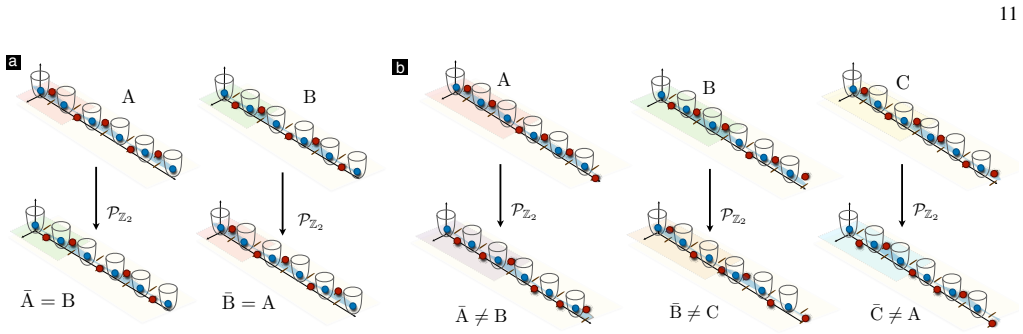
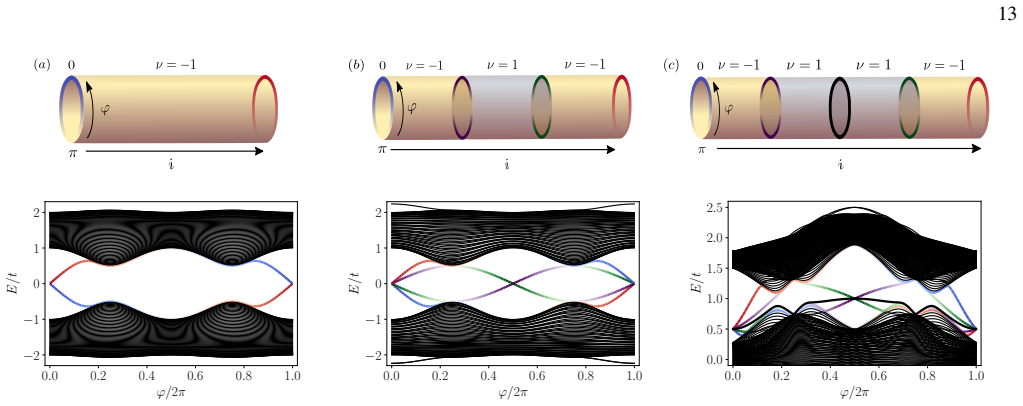
The load-bearing machinery is the inter-soliton Thouless pumping construction: the staggered field couplings are modulated as $\Delta_{\phi,i}=2(-1)^i\delta\cos\phi$ and $\beta_{\phi,i}=(-1)^i\delta\sin\phi$ (Eq.~13), so that $\phi$ acts as momentum along a synthetic dimension, and each symmetry-broken sector is assigned a many-body Chern number $\nu$ from the flow of the Berry phase $\gamma(\phi)$ through $\nu=\frac{1}{2\pi}\int_0^{2\pi}d\phi\,\partial_\phi\gamma(\phi)$ (Eq.~14). The Chern-number difference between the sectors joined by a soliton determines how many bosons are pumped between solitons over a cycle, and the presence or absence of spectral flow decides whether a bound mode is topologically protected. Complementing this, the soliton order parameter takes the universal $\tanh$ kink profile and the bound boson density the $\mathrm{sech}^2$ zero-mode profile of relativistic field theory, connecting the numerical ground states to established soliton physics.
What would settle it
Compute, with a matrix-product-state algorithm, the lowest two many-body energies of Hamiltonian (13) for $\delta=t$ and the parameters used for the two-third-filling solitons, scanning $\phi\in[0,2\pi]$: any gap closing makes the Chern numbers from Eq.~(14) ill-defined and falsifies the generalized bulk-defect correspondence as stated. A complementary check is to measure the boson number transported between two pinned solitons after one full adiabatic cycle; it must be an integer equal to the Chern-number difference, and a non-integer result would signal gap closure or non-adiabaticity.
Extended reading notes
Core claim
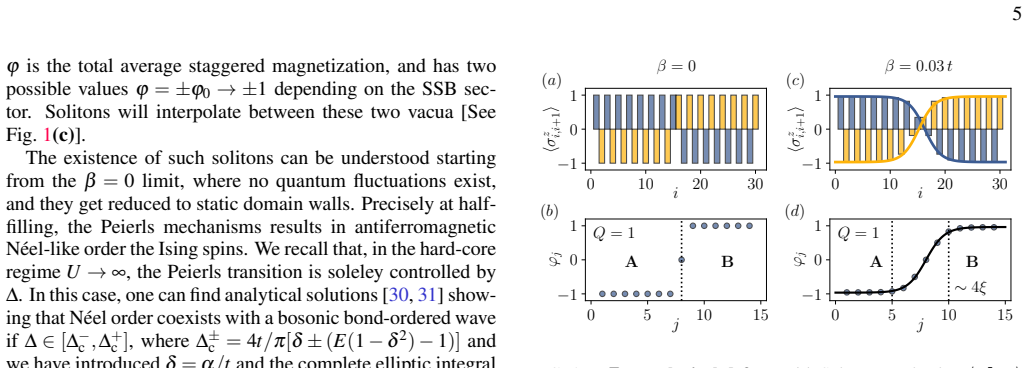
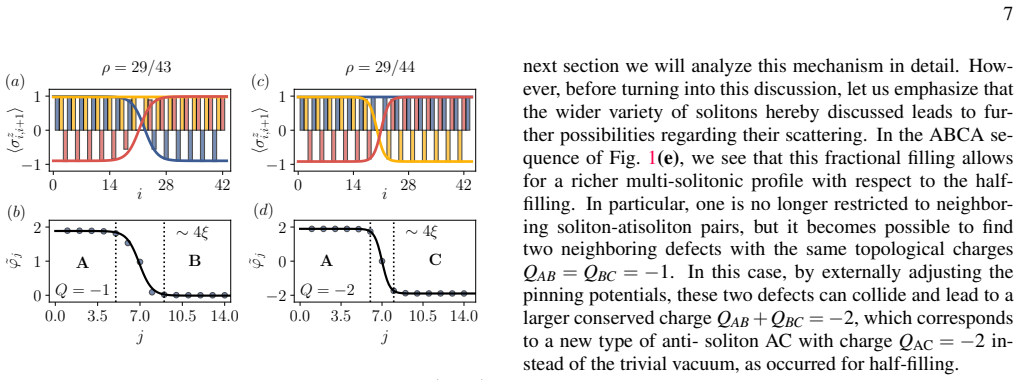
The paper's central discovery is that the $\mathbb{Z}_2$ Bose-Hubbard model has doped ground states in which the $\mathbb{Z}_2$ fields spontaneously form solitons that interpolate between symmetry-broken bond-order sectors. Doping one boson above or below half filling creates a soliton-antisoliton pair, and the integrated local density changes by $1/2$ at each defect; around two-third filling, an added particle or hole creates three defects with $1/3$ or $-1/3$ bound bosons. The paper establishes that these are not polarons: the energy of the pair decreases monotonically with separation, so the fractionalized pair is the ground state, and at higher doping the repelling solitons crystallize into a fractional soliton lattice. It then shows that a slow cyclic modulation of the staggered couplings, interpreted as a Thouless pump, assigns each symmetry-broken sector a many-body Chern number through the integrated Berry phase; the difference of Chern numbers across a defect fixes how many bosons are pumped between solitons. This generalized bulk-defect correspondence explains the bound fractional bosons even for $\mathbb{Z}_4$ solitons that separate sectors with identical equilibrium Berry phases, identifying them as remnants of protected edge states of a synthetic two-dimensional system.
Load-bearing premise
The generalized bulk-defect correspondence rests on the assumption that the many-body gap of the interacting pumping Hamiltonian stays open for every value of $\phi$ with $\delta=t$, so that the Berry-phase integral yields well-defined quantized Chern numbers; the paper computes the resulting Berry phases but does not display the gap spectrum along the cycle.
Editorial extensions
If this is right
- Above or below half filling, a single added boson does not form a polaron; the ground state contains a soliton-antisoliton pair and the integrated density jumps by exactly $1/2$ at each defect.
- Around two-third filling, adding or removing one boson creates three defects with $\pm 1/3$ bound bosons, even though the defects separate sectors that have the same equilibrium Berry phase.
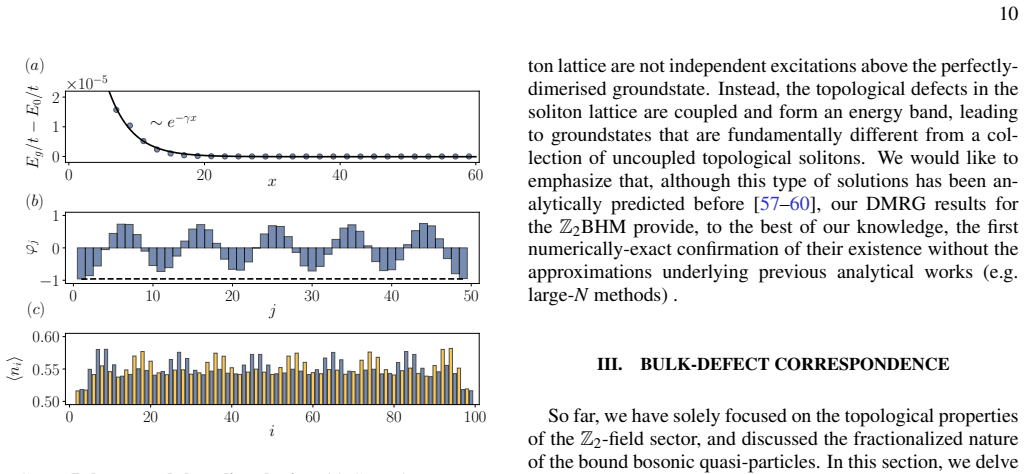
- Solitons repel with an exponentially small energy, so a finite density of extra bosons self-assembles into a fractional soliton lattice whose boson density is a periodic array of fractional charges.
- The Chern-number difference across a defect, computed through the many-body Berry-phase flow, fixes both the number of bound modes and the direction of inter-soliton transport, generalizing the bulk-defect correspondence to cases where one-dimensional invariants alone cannot explain the bound states.
- In the hard-core limit the fractional mode has support on a single sublattice due to chiral symmetry, while at finite $U$ the inversion-symmetry-quantized Berry phase and the pumping argument provide the topological explanation.
Reading between the lines
- The construction explicitly predicts that at other commensurate fillings, such as one-third filling, solitons should also have Chern-number differences (0, $\pm 2$, and so on) and hence quantized pumped charges even when all sectors share the same Berry phase; this is a testable extension the paper does not carry out.
- Because the transport calculations pin the solitons and identify the ground state with the adiabatic evolution, a direct time-dependent simulation of unpinned defects during the cycle would test the paper's claim that the pumped charge remains quantized when the defects move.
- The statistical-interaction parameters the paper mentions as an outlook, $g=1/2$ at half filling and $g=1/3$ at two-third filling, imply fractional exclusion statistics with measurable thermodynamic signatures in a cold-atom realization of the model.
- The absence of polarons, unlike fermionic SSH models, suggests that either bosonic statistics or the dynamical nature of the $\mathbb{Z}_2$ field is what selects fractionalization over polaron formation; a bosonic SSH chain without spins would isolate the responsible ingredient.
Signed reviews
Editorial analysis
A structured set of objections, weighed in public.
Referee Report
Summary. The paper studies the Z2 Bose-Hubbard model (Eq. (1)) and claims that, when doped away from commensurate fillings, the ground state contains dynamical Z_n topological solitons that bind fractionalized bosonic quasi-particles (1/2 bosons for Z2 solitons around half filling, 1/3 bosons for Z4 solitons around one- and two-third fillings). It further argues that these bound quasi-particles repel, forming a fractional soliton lattice at higher doping, and that their topological origin can be understood through an adiabatic inter-soliton pumping protocol whose quantized transport establishes a generalized bulk-defect correspondence. The evidence for the equilibrium fractionalization includes DMRG density plateaus at 1/2 and 1/3, fits to tanh and sech^2 profiles, and an energy-distance curve that excludes a polaron minimum. The pumping argument is used to assign Chern numbers to the homogeneous symmetry-broken sectors and to explain why Z4 solitons, which separate regions of equal Berry phase, nevertheless host protected bound states.
Significance. If the central claims hold, this is a significant contribution to the physics of symmetry-protected topological defects in strongly correlated systems. The equilibrium results—spontaneous Zn solitons, fractionalized bosonic bound states, and a numerically exact fractional soliton lattice—are well supported by the presented DMRG data and are interesting in their own right, particularly in the context of cold-atom implementations. The paper also makes a conceptual claim: that interacting solitons can be understood via a generalized bulk-defect correspondence based on quantized inter-soliton pumping. The presentation of explicit numerical fits to known quantum-field-theory profiles and the quantitative density-plateau diagnostics are strengths. However, the pumping-based topological origin is the least supported part of the manuscript, and it is load-bearing for the paper's central narrative.
major comments (2)
- [Sec. III.B.2, Eq. (13)] The interacting pumping cycle is assumed to keep the many-body gap open for all φ, but no gap spectrum, level-crossing check, or finite-size scaling of the gap along the cycle is presented. The text states 'By choosing δ≫t, we guarantee that the spins rotate periodically' and then immediately 'In practice, it is enough to fix δ=t'; with δ=t the superlattice modulation is not parametrically large, so the adiabatic assumption is not automatically justified. If the gap closes at any φ, the Berry-phase integral in Eq. (14) is not a well-defined quantized Chern number, and the assignments ν_Ā=-1, ν_B=1, ν_C=1 in Fig. 12 do not follow. Since the generalized bulk-defect correspondence for the Z4 solitons is a central claim, this missing gap analysis is a load-bearing issue. The equilibrium fractionalization results of Figs. 5-7 are independent of this pumping argument and are not affected by this comment.
- [Sec. III.B.2 and Figs. 11-12] The pumping argument is developed for the topological configurations Ā, ¯B, ¯C (the U=15t TBOW phases in Fig. 8), whereas the 1/3-fractionalized bound states whose origin the argument is meant to explain were obtained in Sec. II for the trivial BOW phase at U=10t (Figs. 5-7). The manuscript does not specify the interaction strength used in the pumping calculations, nor does it demonstrate that the same A-B-C-A defect structure with 1/3 bound bosons persists in the topological phase. Without an explicit connection between these parameter regimes, the Chern numbers computed for the topological sectors do not explain the fractionalization observed in the trivial BOW phase.
minor comments (5)
- [Throughout] There are numerous typos and misspellings, including 'relatisvistic' (Sec. II.A), 'inebitably' (Sec. II), 'stablished' (Sec. III.B), 'distnace' and 'miniminum' (Sec. II.C), and 'Peielrs' (Conclusions). A careful proofread is needed.
- [Sec. II, DMRG parameters] The bond dimension is stated as D=100, but no convergence analysis in D is shown for the key quantities, such as the 1/2 and 1/3 density plateaus in Fig. 5 or the energy-distance curve in Fig. 7(a). Providing such a check would strengthen the numerical claims.
- [Eq. (10)] The notation ⟨: n_j :⟩ is used for the density deviation from ρ*, but this normal-ordering symbol is never defined; it should be explicitly stated as ⟨n_j⟩ - ρ*.
- [Fig. 3(c) and pinning definition] The x-axis label 'β0/β' is related to the pinning strength ε only through the definition β0 = β(1+ε) below Eq. (2); the text should make this relationship explicit in the figure caption.
- [Reference [1]] Reference [1] is cited as unpublished and is used to motivate the extension beyond half filling; the final version should clarify its status (e.g., companion paper) or provide the relevant results explicitly.
Circularity Check
No significant circularity: the soliton profiles, fractional charges, and pumping results are supported by the paper's own DMRG and Berry-phase calculations rather than by its conclusions.
full rationale
The central claims are derived from direct numerical simulation of the Z2BHM Hamiltonian (1). In Sec. II, the soliton and fractionalization results are obtained from DMRG ground states of doped chains; the tanh profile (4) and the sech^2 density profile (10) are used as post-hoc fitting forms, while the integrated boson number Ni in Eq. (11) is computed directly from the DMRG density. The observed 1/2 and 1/3 plateaux are therefore read off from the data, not imposed by the fitting ansatz. In Sec. III, the local Berry phase is computed from the ground states, and Eq. (14) is a standard relation between the Berry-phase winding and the many-body Chern number; the paper then compares the computed Chern numbers with the observed inter-soliton transport, which is a consistency check in the usual bulk-boundary-correspondence sense, not a derivation in which the conclusion is inserted as an input. The cited prior works [30]-[32] and [1] are from the same group, but they provide phase-diagram context; the present paper supplies its own DMRG order parameters, local Berry phases, and pumping simulations for the claims it makes. The only notable weakness is that the many-body gap along the pumping cycle is not explicitly shown for delta=t, which is a correctness or robustness concern for the applicability of Eq. (14), not a circularity of the argument.
Assumptions & free parameters
assumptions (4)
- domain assumption The MPS/DMRG ground states with bond dimension D=100 and boson truncation n0=2 are converged for the order parameter, density, and Berry phase observables used.
- domain assumption The pumping cycle in Eq. (13) keeps the many-body gap open, so the Berry phase integral in Eq. (14) defines a well-defined Chern number.
- domain assumption The local Berry phase of Ref. [63] computed on a finite chain correctly assigns bulk topological invariants to the regions between solitons.
- standard math In the hardcore limit U -> infinity, the 1D bosonic chain maps via Jordan-Wigner to free fermions, so the BDI symmetry classification applies.
Cite this review
Pith. "Pith review of $\mathbb{Z}_n$ solitons in intertwined topological phases." pith.science (2026). https://pith.science/paper/ZFG2JKC3
@misc{pith2026190802186,
  author       = {Pith},
  title        = {Pith review of: $\mathbbZ_n$ solitons in intertwined topological phases},
  year         = {2026},
  howpublished = {\url{https://pith.science/paper/ZFG2JKC3}},
  note         = {Machine review of arXiv:1908.02186}
}
abstract
Topological phases of matter can support fractionalized quasi-particles localized at topological defects. The current understanding of these exotic excitations, based on the celebrated bulk-defect correspondence, typically relies on crude approximations where such defects are replaced by a static classical background coupled to the matter sector. In this work, we explore the strongly-correlated nature of symmetry-protected topological defects by focusing on situations where such defects arise spontaneously as dynamical solitons in intertwined topological phases, where symmetry breaking coexists with topological symmetry protection. In particular, we focus on the $\mathbb{Z}_2$ Bose-Hubbard model, a one-dimensional chain of interacting bosons coupled to $\mathbb{Z}_2$ fields, and show how solitons with $\mathbb{Z}_n$ topological charges appear for particle/hole dopings about certain commensurate fillings, extending the results of [1] beyond half filling. We show that these defects host fractionalized bosonic quasi-particles, forming bound states that travel through the system unless externally pinned, and repel each other giving rise to a fractional soliton lattice for sufficiently high densities. Moreover, we uncover the topological origin of these fractional bound excitations through a pumping mechanism, where the quantization of the inter-soliton transport allows us to establish a generalized bulk-defect correspondence. This in-depth analysis of dynamical topological defects bound to fractionalized quasi-particles, together with the possibility of implementing our model in cold-atomic experiments, paves the way for further exploration of exotic topological phenomena in strongly-correlated systems.
Figures


Figures from the paper (8 more)




Reference graph
Works this paper leans on
-
[1]
Solitons with Z2-valued topological charges Let us start by discussing the simplest situation, and address the appearance of topological solitons in the groundstate of the Z2BHM doped above/below half-filling. As described above, there is a bosonic Peierls’ transition where the Ising spins de- velop an antiferromagnetic N´eel-type order [see Fig. 1(b)]. In...
-
[2]
Solitons with Z4-valued topological charges Let us note that, around half-filling, it is only possible to obtain two types of topological defects, solitons with charge Q = + 1 and anti-solitons with Q =−1. By doping, the groundstate configuration can only correspond to a succession of neighboring soliton and anti-solitons, such that the over- all charge is ...
-
[3]
Thouless pumping and the bulk-defect correspondence In the beginning of the 80s, Thouless showed that gapped 1D systems undergoing a slow cyclic modulation can display quantised particle transport, and that the robustness of this ef- fect is rooted in an underlying non-zero topological invariant in higher dimensions [68]. We now briefly review this concept...
-
[4]
Inter-soliton pumping in the Z2 Bose Hubbard model Let us now move away from the single-particle scenario, and explore the pumping of bosons between the topologi- cal solitons in the strongly-correlated Z2BHM. We shall use this pumping to discuss a generalised bound-defect correspon- dence that shines light on the topological origin of the bound FIG. 12. ...
work page 2020
-
[5]
Dynamical solitons and boson frac- tionalization in cold-atom topological insulators,
D. Gonzlez-Cuadra, A. Dauphin, P. R. Grzybowski, M. Lewen- stein, and A. Bermudez, “Dynamical solitons and boson frac- tionalization in cold-atom topological insulators,” (2020), (un- published)
work page 2020
-
[6]
N. J. Zabusky and M. D. Kruskal, Phys. Rev. Lett. 15, 240 (1965)
1965
- [7]
-
[8]
Davydov, Journal of Theoretical Biology 66, 379 (1977)
A. Davydov, Journal of Theoretical Biology 66, 379 (1977)
work page 1977
Show all 80 references
-
[9]
Hasegawa and F
A. Hasegawa and F. Tappert, Applied Physics Letters 23, 142 (1973)
1973
-
[10]
T. H. R. Skyrme, Proceedings of the Royal Society of London. Series A. Mathematical and Physical Sciences260, 127 (1961)
1961
-
[11]
Abrikosov, Sov
A. Abrikosov, Sov. Phys. JETP 5, 1174 (1957)
1957
-
[12]
Finkelstein, Journal of Mathematical Physics7, 1218 (1966)
D. Finkelstein, Journal of Mathematical Physics7, 1218 (1966)
1966
-
[13]
Toulouse and M
G. Toulouse and M. Kleman, J. Physique Lett. 37, 149 (1976)
1976
-
[14]
D. J. Gross, Proceedings of the National Academy of Sciences 93, 14256 (1996)
1996
-
[15]
P. W. Anderson, Science 177, 393 (1972)
1972
-
[16]
Landau, Zh
L. Landau, Zh. Eksp. Teor. Fiz 11, 26 (1937)
1937
-
[17]
T. W. B. Kibble, Journal of Physics A: Mathematical and Gen- eral 9, 1387 (1976)
1976
-
[18]
W. H. Zurek, Nature 317, 505 (1985)
1985
-
[19]
N. D. Mermin, Rev. Mod. Phys. 51, 591 (1979)
1979
-
[20]
Jackiw, Rev
R. Jackiw, Rev. Mod. Phys. 49, 681 (1977)
1977
-
[21]
Jackiw and C
R. Jackiw and C. Rebbi, Phys. Rev. D 13, 3398 (1976)
1976
-
[22]
Jackiw and P
R. Jackiw and P. Rossi, Nuclear Physics B 190, 681 (1981)
1981
-
[23]
W. P. Su, J. R. Schrieffer, and A. J. Heeger, Phys. Rev. Lett.42, 1698 (1979)
1979
-
[24]
Read and D
N. Read and D. Green, Phys. Rev. B 61, 10267 (2000)
2000
-
[25]
Landau, Sov
L. Landau, Sov. Phys. JETP 30, 1058 (1956)
1956
-
[26]
K. G. Wilson and J. Kogut, Physics Reports 12, 75 (1974)
1974
-
[27]
C. L. Kane and E. J. Mele, Phys. Rev. Lett. 95, 146802 (2005)
2005
-
[28]
B. A. Bernevig, T. L. Hughes, and S.-C. Zhang, Science 314, 1757 (2006)
2006
-
[29]
K ¨onig, S
M. K ¨onig, S. Wiedmann, C. Br ¨une, A. Roth, H. Buhmann, L. W. Molenkamp, X.-L. Qi, and S.-C. Zhang, Science 318, 766 (2007)
2007
-
[30]
Hsieh, D
D. Hsieh, D. Qian, L. Wray, Y . Xia, Y . S. Hor, R. J. Cava, and M. Z. Hasan, Nature 452, 970 EP (2008)
2008
-
[31]
J. C. Y . Teo and C. L. Kane, Phys. Rev. B82, 115120 (2010)
2010
-
[32]
J. C. Teo and T. L. Hughes, Annual Review of Condensed Mat- ter Physics 8, 211 (2017)
2017
-
[33]
C.-K. Chiu, J. C. Y . Teo, A. P. Schnyder, and S. Ryu, Rev. Mod. Phys. 88, 035005 (2016)
2016
-
[34]
Gonz ´alez-Cuadra, P
D. Gonz ´alez-Cuadra, P. R. Grzybowski, A. Dauphin, and M. Lewenstein, Phys. Rev. Lett. 121, 090402 (2018)
2018
-
[35]
Gonz ´alez-Cuadra, A
D. Gonz ´alez-Cuadra, A. Dauphin, P. R. Grzybowski, P. W´ojcik, M. Lewenstein, and A. Bermudez, Phys. Rev. B 99, 045139 (2019)
2019
-
[36]
Gonz ´alez-Cuadra, A
D. Gonz ´alez-Cuadra, A. Bermudez, P. R. Grzybowski, M. Lewenstein, and A. Dauphin, Nature Communications 10, 2694 (2019)
2019
-
[37]
M. P. A. Fisher, P. B. Weichman, G. Grinstein, and D. S. Fisher, Phys. Rev. B 40, 546 (1989)
1989
-
[38]
J. B. Kogut, Rev. Mod. Phys. 51, 659 (1979)
1979
-
[39]
Peierls, Quantum Theory of Solids , International series of monographs on physics (Clarendon Press, 1955)
R. Peierls, Quantum Theory of Solids , International series of monographs on physics (Clarendon Press, 1955)
1955
-
[40]
W. P. Su and J. R. Schrieffer, Phys. Rev. Lett.46, 738 (1981). 17
1981
-
[41]
W. P. Su, Phys. Rev. B 27, 370 (1983)
1983
-
[42]
A. J. Heeger, S. Kivelson, J. R. Schrieffer, and W. P. Su, Rev. Mod. Phys. 60, 781 (1988)
1988
-
[43]
Bermudez and D
A. Bermudez and D. Porras, New Journal of Physics17, 103021 (2015)
2015
-
[44]
G ¨org, K
F. G ¨org, K. Sandholzer, J. Minguzzi, R. Desbuquois, M. Messer, and T. Esslinger, Nature Physics , 1 (2019)
2019
-
[45]
Barbiero, C
L. Barbiero, C. Schweizer, M. Aidelsburger, E. Dem- ler, N. Goldman, and F. Grusdt, , Preprint at https://arxiv.org/abs/1810.02777 (2018)
2018 arXiv
-
[46]
Schweizer, F
C. Schweizer, F. Grusdt, M. Berngruber, L. Barbiero, E. Dem- ler, N. Goldman, I. Bloch, and M. Aidelsburger, , Preprint at https://arxiv.org/abs/1901.07103 (2019)
2019 arXiv
-
[47]
R. B. Laughlin, Rev. Mod. Phys. 71, 863 (1999)
1999
-
[48]
Rajaraman, Solitons and Instantons
R. Rajaraman, Solitons and Instantons. An introduction to soli- tons and instants in quantum field theory(North-holland, 1982) p. 409
1982
-
[49]
W. P. Su and J. R. Schrieffer, Proceedings of the National Academy of Sciences 77, 5626 (1980)
1980
-
[50]
Brazovskii and N
S. Brazovskii and N. Kirova, Sov. Phys. JET Lett. 33, 4 (1981)
1981
-
[51]
D. K. Campbell and A. R. Bishop, Phys. Rev. B 24, 4859 (1981)
1981
-
[52]
K. A. Fraser and F. Piazza, Communications Physics 2, 48 (2019)
2019
-
[53]
Kivelson, Synthetic Metals 125, 99 (2001)
S. Kivelson, Synthetic Metals 125, 99 (2001)
2001
-
[54]
Takayama, Y
H. Takayama, Y . R. Lin-Liu, and K. Maki, Phys. Rev. B 21, 2388 (1980)
1980
-
[55]
R. F. Dashen, B. Hasslacher, and A. Neveu, Phys. Rev. D 10, 4130 (1974)
1974
-
[56]
Hauschild and F
J. Hauschild and F. Pollmann, SciPost Phys. Lect. Notes , 5 (2018)
2018
-
[57]
Peierls, Proceedings of the Physical Society 52, 34 (1940)
R. Peierls, Proceedings of the Physical Society 52, 34 (1940)
1940
-
[58]
F. R. N. Nabarro, Proceedings of the Physical Society 59, 256 (1947)
1947
-
[59]
Kivelson, in Solitons, Modern Problems in Condensed Mat- ter Sciences, V ol
S. Kivelson, in Solitons, Modern Problems in Condensed Mat- ter Sciences, V ol. 17, edited by S. Trullinger, V . Zakharoov, and V . Pokrovsky (Elsevier, 1986) pp. 301 – 387
1986
-
[60]
Niemi and G
A. Niemi and G. Semenoff, Physics Reports 135, 99 (1986)
1986
-
[61]
Horovitz, Phys
B. Horovitz, Phys. Rev. Lett. 46, 742 (1981)
1981
-
[62]
Horovitz, Phys
B. Horovitz, Phys. Rev. B 35, 734 (1987)
1987
-
[63]
Thies and K
M. Thies and K. Urlichs, Phys. Rev. D 67, 125015 (2003)
2003
-
[64]
G. m. c. Bas ¸ar and G. V . Dunne, Phys. Rev. Lett.100, 200404 (2008)
2008
-
[65]
Jordan and E
P. Jordan and E. Wigner, Zeitschrift f¨ur Physik 47, 631 (1928)
1928
-
[66]
M. V . Berry, Proceedings of the Royal Society of London. A. Mathematical and Physical Sciences 392, 45 (1984)
1984
-
[67]
Hatsugai, Journal of the Physical Society of Japan 75, 123601 (2006)
Y . Hatsugai, Journal of the Physical Society of Japan 75, 123601 (2006)
2006
-
[68]
T. D. Stanescu, V . Galitski, and S. Das Sarma, Phys. Rev. A82, 013608 (2010)
2010
-
[69]
Goldman, I
N. Goldman, I. Satija, P. Nikolic, A. Bermudez, M. A. Martin- Delgado, M. Lewenstein, and I. B. Spielman, Phys. Rev. Lett. 105, 255302 (2010)
2010
-
[70]
Grusdt, M
F. Grusdt, M. H ¨oning, and M. Fleischhauer, Phys. Rev. Lett. 110, 260405 (2013)
2013
-
[71]
Przysikezna, O
A. Przysikezna, O. Dutta, and J. Zakrzewski, New Journal of Physics 17, 013018 (2015)
2015
-
[72]
D. J. Thouless, Phys. Rev. B 27, 6083 (1983)
1983
-
[73]
M. J. Rice and E. J. Mele, Phys. Rev. Lett. 49, 1455 (1982)
1982
-
[74]
Xiao, M.-C
D. Xiao, M.-C. Chang, and Q. Niu, Rev. Mod. Phys. 82, 1959 (2010)
2010
-
[75]
Hatsugai, Physical Review B48, 11851 (1993)
Y . Hatsugai, Physical Review B48, 11851 (1993)
1993
-
[76]
Q. Niu, D. J. Thouless, and Y .-S. Wu, Phys. Rev. B 31, 3372 (1985)
1985
-
[77]
M. P. Zaletel, R. S. K. Mong, and F. Pollmann, Journal of Statistical Mechanics: Theory and Experiment 2014, P10007 (2014)
2014
-
[78]
Alexandradinata, T
A. Alexandradinata, T. L. Hughes, and B. A. Bernevig, Phys. Rev. B 84, 195103 (2011)
2011
-
[79]
Irsigler, J.-H
B. Irsigler, J.-H. Zheng, and W. Hofstetter, Phys. Rev. Lett. 122, 010406 (2019)
2019
-
[80]
F. D. M. Haldane, Phys. Rev. Lett. 67, 937 (1991)
1991
Reviewed August 14, 2026 · model on record in the stance chip above.
Discussion (0). Continue with ORCID to comment.