REVIEW 4 major objections 4 minor 92 references
In the μνSSM, charged-Higgs and chargino penguins set B→X_s l+l− rates within experimental bounds, with the asymmetry governed by C7C10 and C9C10 interference.
Reviewed by Pith at T0; open to challenge. T0 means a machine referee read the full paper against a public rubric. the ladder, T0–T4 →
T0 review · deepseek-v4-flash
2026-08-02 00:07 UTC pith:ZG3J7YQH
load-bearing objection A legitimate first calculation of B→X_s l+l− in the μνSSM, but the dominance claims rest on a single hand-set flavor-violating parameter that the model does not predict. the 4 major comments →
B to X_(s) l⁺ l⁻ in the μ from ν Supersymmetric Standard Model
The pith
A machine-rendered reading of the paper's core claim, the machinery that carries it, and where it could break.
Core claim
The paper's central claim is that the μνSSM, with flavor violation parametrized by squark mass insertions and with parameters already consistent with B→X_s γ, B_s→μ+μ− and a 125 GeV SM-like Higgs, also reproduces the measured B→X_s l+l− branching ratios in both the low-q² (1–6 GeV²) and high-q² (14.4–25 GeV²) regions. The new-physics effect is dominated by the charged-Higgs contribution to C7 through γ-penguin diagrams at low q², and by C9 and C10 through Z-penguin diagrams at high q². The forward-backward asymmetry is then shown, through a systematic interference decomposition, to be governed by the C7C10 and C9C10 interference terms, with the relative dominance shifting as tan β varies.
What carries the argument
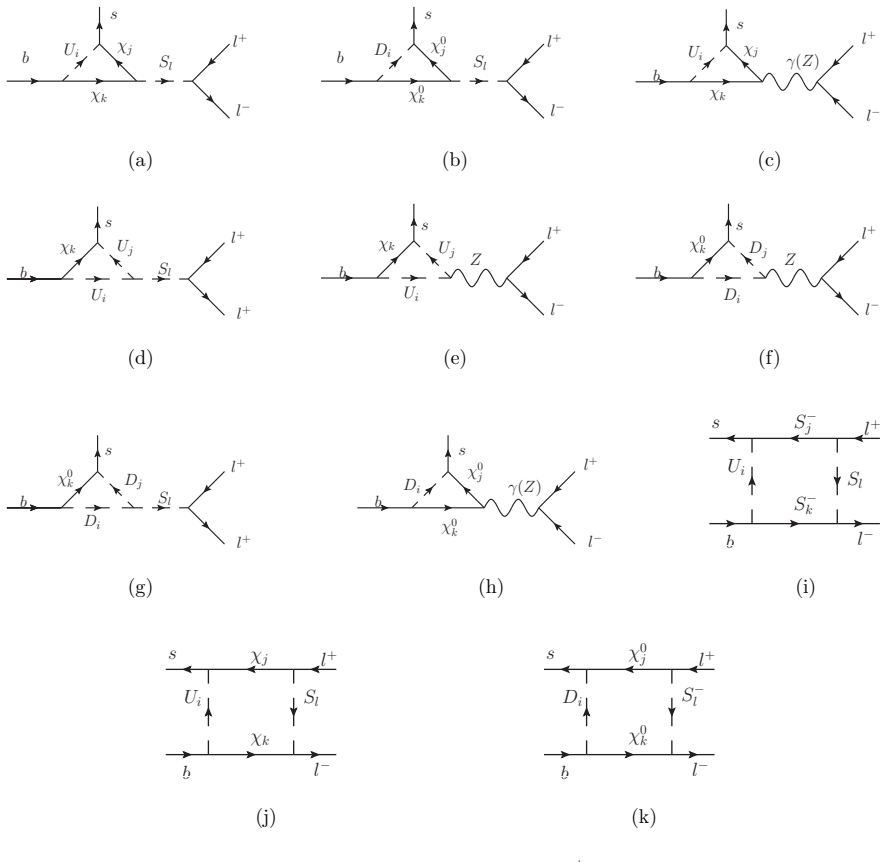
The central object is the effective-operator basis for b→sℓ+ℓ−: Wilson coefficients C7, C9, C10 (plus scalar and pseudoscalar operators), evaluated at the electroweak scale and RG-evolved to the hadronic scale. Flavor violation is introduced through the mass-insertion approximation, with δ23LL = δ23RR = δ23LR assumed equal in up- and down-squark sectors. The mechanism that carries the argument is the decomposition of each coefficient into γ-penguin, Z-penguin, scalar-penguin and box-diagram contributions, which lets the paper identify the charged-Higgs γ-penguin as the main driver of C7 and the charged-Higgs/chargino Z-penguin as the main driver of C9 and C10.
Load-bearing premise
The load-bearing premise is that the flavor-violating squark mass insertions in the up- and down-squark sectors have identical size and chirality structure (δLL=δRR=δLR), with benchmark values chosen by hand to satisfy B_s→μ+μ− bounds; if these insertions are unrelated, the claimed low-q² C7 dominance and high-q² C9/C10 dominance are not guaranteed.
What would settle it
A precise differential measurement of B→X_s l+l− in fine q² bins at high q², or a high-statistics measurement of the low-q² forward-backward zero-crossing, could falsify the claim: if the rate does not rise with tan β in the charged-Higgs-controlled regime, or if the AFB zero-crossing disagrees with the C7C10/C9C10 interference prediction, the dominance pattern and the assumed flavor-insertion universality collapse.
If this is right
- If the central claim is correct, the μνSSM parameter space that already satisfies B→X_s γ and B_s→μ+μ− also accounts for the measured B→X_s l+l− rates without invoking extra flavor structure.
- The low-q² branching ratio falls with tan β while the high-q² rate rises, tying the two regions to distinct mechanisms—C7 versus C9/C10—and giving a smoking-gun correlation for future data.
- The forward-backward asymmetry switches which interference term dominates as tan β varies, so a precise AFB measurement could act as a diagnostic of the underlying supersymmetric contributions.
- Variations in κ and the sneutrino VEV mostly rescale the rates without changing the dominance pattern, meaning the mechanism is stable across those parameter changes.
Where Pith is reading between the lines
- The paper leaves untested whether the δLL=δRR=δLR equality across up- and down-squark sectors is physically justified; a concrete next step is to derive these mass insertions from the soft-breaking terms and check whether the incidence of C7 versus C9/C10 survives.
- A sharper version of the same argument could be made with exclusive decays like B→K*ℓ+ℓ−, where angular observables translate the C7C10/C9C10 interference into a measurable zero-crossing.
- If future high-statistics data show the low-q² AFB zero-crossing at a q² very different from what the C7C10 term predicts, it would signal that the assumed equality of chirality insertions is wrong rather than that the model framework is wrong.
Editorial analysis
A structured set of objections, weighed in public.
Referee Report
Summary. The paper studies the rare inclusive decay B→X_s l⁺l⁻ in the μνSSM using the mass-insertion approximation. The new-physics Wilson coefficients are decomposed by particle and penguin type, and the branching ratios and forward-backward asymmetries are computed in the low-q² (1–6 GeV²) and high-q² (14.4–25 GeV²) regions. The parameter scan is constrained by B_s→μ⁺μ⁻, B→X_sγ, and the 125 GeV Higgs mass. The main claims are that the low-q² BR is dominated by the charged-Higgs contribution to C7, the high-q² BR by Z-penguin contributions to C9/C10, and that the forward-backward asymmetry is governed by C7C10 and C9C10 interference terms. The paper reports consistency with current experimental ranges and identifies the μνSSM parameter regions that satisfy all constraints.
Significance. If the central hierarchy in Table IV is robust, the paper provides a useful phenomenological characterization of rare B decays in the μνSSM, extending earlier work on B_s→μ⁺μ⁻ and B→X_sγ to B→X_s l⁺l⁻. The paper correctly incorporates external constraints and reproduces the SM limit in Table III, which is a useful sanity check. However, the central claim rests on the ad hoc equality of up/down and LL/RR/LR mass insertions in Eq. (15), and the full Wilson-coefficient expressions are not in the preprint. These gaps mean the claimed dominance pattern and the AFB decomposition are not yet established at the level needed for a journal publication.
major comments (4)
- [§III, Eq. (15) and Table IV] The identification of the dominant contributions depends entirely on the assumption δ23^LL = δ23^RR = δ23^LR and δ^U = δ^D. This equality is not implied by the soft Lagrangian in Eq. (9), which contains independent up-type and down-type A-terms and mass-squared matrices. In a generic MIA framework, δ^LR is chirality-flipping and expected to be suppressed by Yukawa couplings relative to δ^LL/δ^RR, and there is no reason for the up- and down-squark insertions to coincide. The benchmark values δ=0.6×10⁻³ and 0.20×10⁻³ are chosen solely to satisfy B_s→μ⁺μ⁻ in Fig. 2, not derived from the model. Since the conclusions in the abstract and Table IV about the dominance of C7, C9, C10, and the C7C10/C9C10 interference are all computed under Eq. (15), the entire numerical message is conditional on this unsupported benchmark. The authors should either justify Eq. (15) from the μνSSM soft terms or, m
- [§III, Eqs. (16)–(17) and Supplemental Material] The complete MIA loop expressions for the Wilson coefficients are not included in the manuscript; the text merely states they are 'provided in the Supplemental Material.' This makes it impossible to check the claimed decomposition into charged-Higgs, chargino, neutralino, gluino, γ-, Z-, and box contributions, or the assignment in Table IV. For a paper whose central message is about the dominant new-physics mechanisms, the Wilson-coefficient formulas must be available in the preprint or a readily accessible appendix. Without them, the numerical conclusions are unchecked and the paper is not self-contained.
- [§IV, Eq. (34)] The paper discusses at length the hadronic uncertainties of the inclusive high-q² region and then adopts the B→K*µ⁺µ⁻ angular-coefficient/transversity formalism of Ref. [54], with AFB = (3/8)(2S_s^6 + S_c^6). It is not shown that this exclusive formalism can be applied to the inclusive decay B→X_s l⁺l⁻. The relation between the inclusive θ distribution in Eqs. (28)–(33) and the K*-specific angular coefficients S_s^6, S_c^6 is missing. Since the high-q² AFB predictions in Figs. 4(d) and 5(b) rely on this formalism, the validity of those results is unclear. The authors must either derive the mapping or state explicitly that only the inclusive formulas are used and the exclusive formalism serves merely as a cross-check.
- [§V, Figs. 4–7] The theoretical curves for BR and AFB are shown without any uncertainty bands. The paper claims consistency with the experimental ranges (e.g., 'within the 3σ experimental ranges' in §V), but without an estimate of theoretical uncertainties—from scale variation, input parameters, unconstrained model parameters, or the variation of δ within the ranges quoted—the consistency statement cannot be assessed. At minimum, the authors should show the spread due to the allowed ranges of the model parameters and the input uncertainties in Table II.
minor comments (4)
- [Eq. (27)] The matrix elements for C9 and C10 in Eq. (27) contain the wrong chirality structure: (¯s_L γ^μ b_R) should be (¯s_L γ^μ b_L), matching the operators in Eq. (13). The same typo appears for the primed coefficients. Please correct.
- [§V, Fig. 4(b) and text] The text states that BR(B→X_s l⁺l⁻)_high increases from 2.3×10⁻⁶ to 2.9×10⁻⁶, but Eq. (47) and the axis label of Fig. 4(b) are in units of 10⁻⁷. If the axis is correct, the text should read 2.3×10⁻⁷ to 2.9×10⁻⁷.
- [Fig. 6 caption] Panels (c) and (d) show AFB according to the axis labels, but the caption calls them BR(B→X_s l⁺l⁻). Please correct the caption.
- [General] Typos and formatting issues: 'Chin a' on the title page, 'SUMARR Y' in Section VII, and inconsistent use of 'q2' vs 'q²' throughout. Please proofread.
Circularity Check
No significant circularity: the dominance claims are benchmark-dependent numerical findings checked against external constraints, not outputs that reduce to the fitted inputs.
full rationale
The paper's central claims are numerical predictions in a fixed benchmark parameter space, not derivations from the target observable. The flavor-violating input δ_23^AB is constrained by B_s→μ+μ− (Fig. 2), tan β by ¯B→X_sγ and the 125 GeV Higgs mass (Fig. 3), and κ further by the Higgs mass; none of these is the target observable B→X_s l+l−. The B→X_s l+l− branching ratios and asymmetries are then computed and compared with experimental ranges as a consistency check, which is a legitimate posterior check rather than a circular fit. Equation (15), which assumes δ^U=δ^D and δ^LL=δ^LR=δ^RR, is an explicit model assumption, not a derived result; the paper does not claim to derive these equalities from the μνSSM soft terms. Its load-bearing role is a robustness/correctness concern, not circularity. The AFB decomposition into C7C10 and C9C10 interference terms follows directly from Eq. (31), and the statement that these are dominant is a quantitative outcome of the chosen benchmark, not an input. The self-citations [42–44] are contextual references to previous studies of the same model, and the relevant constraints are recomputed in the present paper (Figs. 2, 3, 7), so they are not load-bearing. The framework is also validated by recovering the SM limit in Table III against independent SM predictions. Overall, the paper is self-contained against external constraints and does not exhibit circular reasoning.
Axiom & Free-Parameter Ledger
free parameters (10)
- δ^AB_23 (mass insertion) =
0.6×10^{-3} for tanβ scan; 0.20×10^{-3} for κ scan
- tan β =
scanned 5–40; constrained by ¯B→X_sγ and Higgs mass
- κ =
scanned 0.01–0.6; Higgs mass restricts to 0.4–0.6
- Aλ =
0.05–1 TeV
- υνc (right-handed sneutrino VEV) =
1.8–2.2 TeV
- λ =
0.135
- Aκ =
-300 GeV
- M2 (gaugino mass) =
1 TeV; M1=0.5M2, M3=2.7M2
- A_t =
2.6 TeV
- Soft masses m_tilde-Q, m_tilde-L, m_tilde-uc =
3 TeV, 700 GeV, 3 TeV
axioms (7)
- domain assumption µνSSM superpotential Eq. (5) with three singlet neutrino superfields and RPV couplings is the relevant BSM theory.
- domain assumption Mass insertion approximation: flavor violation is captured by small off-diagonal squark propagator insertions δ^AB_ij, Eq. (14).
- ad hoc to paper Equal mass insertions in up/down squark sectors and LL=RR=LR, Eq. (15).
- ad hoc to paper Yν and left-handed sneutrino VEVs are set to zero in the numerics.
- domain assumption Approximate sneutrino and charged-Higgs mass relations, Eqs. (41)–(45), and the tachyon condition Eq. (43).
- ad hoc to paper High-q² inclusive B→X_s l+l− can be treated with the B→K* angular-coefficient/transversity formalism, Eq. (34).
- standard math External SM inputs and predictions from Refs. [7,54,65] are correct.
read the original abstract
We investigate the impact of new physics on the rare inclusive decay $B \to X_{\mathrm{s}} l^{+} l^{-}$ within the framework of the $\mu$ from $\nu$ Supersymmetric Standard Model ($\mu\nu$SSM). The dominant contributions to the relevant Wilson coefficients and their corresponding particles are identified and analyzed. By performing a systematic scan over the relevant parameter space, we elucidate the underlying physical mechanisms governing these dominant contributions and demonstrate their consistency with the experimentally allowed regions. Experimental constraints from the decays $\bar{B} \to X_{\mathrm{s}}\gamma$, $B_{\mathrm{s}}^{0} \to \mu^{+} \mu^{-}$, and the $125\,\text{GeV}$ SM-like Higgs boson are also incorporated. We perform a systematic interference decomposition of the Wilson-coefficient contributions to the forward-backward asymmetry, identifying the $C_7C_{10}$ and $C_9C_{10}$ interference terms as the dominant contributions governing its behavior in both the low- and high-$q^2$ regions.
Figures


Reference graph
Works this paper leans on
-
[1]
Grinstein, M.J
B. Grinstein, M.J. Savage and M.B. Wise Nucl. Phys. B319 ( 1989) 271
1989
-
[2]
Misiak, Nucl
M. Misiak, Nucl. Phys. B 393(1993)23[Erratum-ibid. B 439(1995)461]
1993
-
[3]
A. J. Buras, M. M¨ unz, Phys. Rev. D 52(1995)186
1995
-
[4]
N. G. Deshpande, J. Trampetic, K. Panose, Phys. Rev. D 39(1989)1461
1989
-
[5]
C. S. Lim, T. Morozumi, A. I. Sanda, Phys. Lett. B 218(1989)343
1989
-
[6]
(5.7) of Ref
, (34) (see Eqs. (5.7) of Ref. [54]). These coefficients are constructed f rom transversity amplitudes, which factorize into short-distance Wilson coefficients and form fac tors in the heavy-quark limit, thereby allowing for a more controlled treatment of hadronic un certainties in the high-q2 region. The SM predictions for BR( B → Xse+e−) and BR( B → Xsµ+µ−)...
-
[7]
P. J. O’Donnell, H.K.K. Tung, Phys. Rev. D 43(1991)2067
1991
-
[8]
T. Huber, T. Hurth, J. Jenkins, E. Lunghi, Q. Qin et al. , JHEP 11 (2024) 130 [arXiv:2404.03517]. [Erratum: JHEP 05 (2025) 099]
Pith/arXiv arXiv 2024
-
[9]
Aubert et al
B. Aubert et al. , BABAR collaboration, Phys. Rev. Lett. 93(2004)081802
2004
-
[10]
J. P. Lees et al. [BaBar Collaboration], Phys. Rev. Lett. 112, 211802 (2014)
2014
-
[11]
Iwasaki et al
M. Iwasaki et al. , BELLE collaboration, Phys. Rev. D 72(2005)092005
2005
-
[12]
Sato et al
Y. Sato et al. , BELLE collaboration, Phys. Rev. D 93(2016)032008; ibid.93(2016)059901
2016
-
[13]
Fukae, C
S. Fukae, C. S. Kim, T. Morozumi and T. Yoshikawa, Phys. R ev. D 59(1999)074013; A. Ali, E. Lunghi, C. Greub, and G. Hiller, Phys. Rev. D 66(2002)034002
1999
-
[14]
Bertolini, F
S. Bertolini, F. Borzumati, A. Masiero and G. Ridolfi, Nu cl. Phys. B 353, 591 (1991)
1991
-
[15]
J. L. Hewett, Phys. Rev. Lett. 70, 1045 (1993) [hep-ph/9211256]
Pith/arXiv arXiv 1993
-
[16]
Ciafaloni, A
P. Ciafaloni, A. Romanino and A. Strumia, Nucl. Phys. B 524 (1998) 361
1998
-
[17]
Ciuchini, G
M. Ciuchini, G. Degrassi, P. Gambino and G. F. Giudice, N ucl. Phys. B 527 (1998)21
1998
-
[18]
F. M. Borzumati and C. Greub, Phys. Rev. D 58 (1998) 074004
1998
-
[19]
Borzumati, C
F. Borzumati, C. Greub, T. Hurth and D. Wyler, Phys. Rev. D 62, 075005 (2000)
2000
-
[20]
X. G. He, T. D. Nguyen and R. R. Volkas, Phys. Rev. D 38, 814 (1988)
1988
-
[21]
Skiba and J
W. Skiba and J. Kalinowski, Nucl. Phys. B 404, 3 (1993)
1993
-
[22]
S. R. Choudhury and N. Gaur, Phys. Lett. B 451, 86 (1999) [hep-ph/9810307]
Pith/arXiv arXiv 1999
-
[23]
C. S. Huang, W. Liao, Q. S. Yan and S. H. Zhu, Phys. Rev. D 63, 114021 (2001) [Erratum-ibid. D 64, 059902 (2001)] [hep-ph/0006250]
Pith/arXiv arXiv 2001
-
[24]
P. Cho, M. Misiak and D. Wyler, Phys. Rev. D54, 3329-3344 (1996). 29
1996
-
[25]
T.-F. Feng, Y.-L. Yan, H.-B. Zhang and S.-M. Zhao, Int. J . Mod. Phys. A 31, 1650092 (2016) [arXiv:1603.07578 [hep-ph]]
Pith/arXiv arXiv 2016
-
[26]
T.-F. Feng, J.-L. Yang, H.-B. Zhang, S.-M. Zhao and R.-F . Zhu, Phys. Rev. D 94, 115034 (2016) [arXiv:1612.02094 [hep-ph]]
Pith/arXiv arXiv 2016
-
[27]
J. L. Yang, T. F. Feng, S. M. Zhao, R. F. Zhu, X. Y. Yang and H . B. Zhang, Eur. Phys. J. C 78, no.9, 714 (2018) [arXiv:1803.09904 [hep-ph]]
Pith/arXiv arXiv 2018
-
[28]
Barbieri and G
R. Barbieri and G. F. Giudice, Phys. Lett. B 309, 86 (1993)
1993
-
[29]
A. Ali, G. F. Giudice and T. Mannel, Z. Phys. C 67, 417-432 (1995) [arXiv:hep-ph/9408213]
Pith/arXiv arXiv 1995
- [30]
-
[31]
A. Ali, P. Ball, L. T. Handoko and G. Hiller, Phys. Rev. D 61, 074024 (2000) [arXiv:hep- ph/9910221]
arXiv 2000
-
[32]
Huber, T
T. Huber, T. Hurth, J. Jenkins, E. Lunghi and Q. Qin et al. , JHEP 10 (2020) 088
2020
-
[33]
A. Masiero and L. Silvestrini, B Physics and CP Violatio n, Honolulu, p. 172, (1997) [arXiv:hep- ph/9709244]
arXiv 1997
-
[34]
A. Masiero and L. Silvestrini, Highlights of Subnuclea r Physics, Erice, p. 404, (1997) [arXiv:hep-ph/9711401]
Pith/arXiv arXiv 1997
-
[35]
E. Lunghi, A. Masiero, I. Scimemi and L. Silvestrini, Nu cl. Phys. B 568, 120-144 (2000) [arXiv:hep-ph/9906286]
Pith/arXiv arXiv 2000
-
[36]
Z. J. Xiao, F. G. Li and W. J. Zou, Commun. Theor. Phys. 46, 687 (2006)
2006
-
[37]
H. E. Haber, G. L. Kane, Phys. Rept. 117 (1985) 75
1985
-
[38]
Rosiek, Phys
J. Rosiek, Phys. Rev. D 41 (1990) 3464
1990
-
[39]
D. E. L´ opez-Fogliani, C. Mu˜ noz, Phys. Rev. Lett. 97 (2006) 041801
2006
-
[40]
Escudero, D
N. Escudero, D. E. L´ opez-Fogliani, C. Mu˜ noz, R. Ruiz d e Austri, JHEP 12 (2008) 099
2008
-
[41]
Fidalgo, D
J. Fidalgo, D. E. L´ opez-Fogliani, C. Mu˜ noz, R. Ruiz de Austri, JHEP 10 (2011) 020
2011
-
[42]
J. E. Kim, H. P. Nilles, Phys. Lett. B 138 (1984) 150
1984
-
[43]
H.-B. Zhang, T.-F. Feng, L.-N. Kou and S.-M. Zhao, Int. J . Mod. Phys. A 28 (2013) 1350117 [arXiv:1307.6284]
Pith/arXiv arXiv 2013
-
[44]
H.-B. Zhang, G.-H. Luo, T.-F. Feng, S.-M. Zhao, T.-J. Ga o and K.-S. Sun, Mod. Phys. Lett. A 29, 1450196 (2014) [arXiv:1409.6837 [hep-ph]]. 30
Pith/arXiv arXiv 2014
-
[45]
K. K. Meng, H. B. Zhang and J. L. Yang, Phys. Rev. D 111, 035036 (2025) [arXiv:2502.05466 [hep-ph]]
Pith/arXiv arXiv 2025
-
[46]
Zhang, T.-F
H.-B. Zhang, T.-F. Feng, G.-F. Luo, Z.-F. Ge and S.-M. Zh ao, JHEP 07 (2013) 069 [Erratum ibid. JHEP 10 (2013) 173]
2013
-
[47]
Zhang, T.-F
H.-B. Zhang, T.-F. Feng, S.-M. Zhao, Fei Sun, Int. J. Mod . Phys. A 29 (2014) 1450123
2014
-
[48]
Zhang, T.-F
H.-B. Zhang, T.-F. Feng, F. Sun, K.-S. Sun, J.-B. Chen an d S.-M. Zhao, Phys. Rev. D 89 (2014) 115007
2014
-
[49]
R.Grigjanis, P. J. O’Donnell, M. Sutherland and H. Nave let, Phys. Rep. 22, 93 (1993)
1993
-
[50]
Buchalla, A
G. Buchalla, A. J. Buras and M. E. Lautenbacher, Rev. Mod . Phys. 68, 1125 (1996)
1996
-
[51]
L. Lin, T. F. Feng and F. Sun, Mod. Phys. Lett. A 24, 2181-2186 (2009)
2009
-
[52]
X. Y. Yang and T. F. Feng, JHEP 1005, 059 (2010)
2010
-
[53]
Goertz and T
P. Goertz and T. Pfoh, Phys. Rev. D 84, 095016 (2011)
2011
-
[54]
A. J. Buras, M. Misiak, M. Munz and S. Pokorski, Nucl. Phy s. B 424 (1994) 374
1994
-
[55]
W. Altmannshofer, P. Ball, A. Bharucha, A. J. Buras, D. M . Straub, and M. Wick, JHEP 0901, 019 (2009) [arXiv:0811.1214 [hep-ph]]
Pith/arXiv arXiv 2009
-
[56]
Gambino, M
P. Gambino, M. Gorbahn and U. Haisch, Nucl. Phys. B 673, 238 (2003)
2003
-
[57]
Y. B. Dai, C. S. Huang and H. W. Huang, Phys. Lett. B 390, 257 (1997) [Erratum-ibid. B 513, 429 (2001)] [arXiv:hep-ph/9607389]
Pith/arXiv arXiv 1997
-
[58]
Ghincuulov, T
A. Ghincuulov, T. Hurth, G. Isidori and Y. Yao, Nucl. Ph ys. B 685(2004)351
2004
-
[59]
Buchalla, A
G. Buchalla, A. J. Buras, M. E. Lautenbacher, Rev. Mod. P hys.68(1996)1125
1996
-
[60]
I. Scimemi, Nucl. Phys. B, Proc. Suppl. 81, 219 (2000) [arXiv:hep-ph/9911355]
Pith/arXiv arXiv 2000
-
[61]
Z. Ligeti and F. J. Tackmann, Phys. Lett. B 653, 404-410 (2007), arXiv:0707.1694 [hep-ph]
Pith/arXiv arXiv 2007
-
[62]
T. Huber, T. Hurth, and E. Lunghi, Nucl. Phys. B 802, 40-62 (2008), arXiv:0712.3009 [hep- ph]
Pith/arXiv arXiv 2008
-
[63]
M. Beneke, G. Buchalla, M. Neubert, and C.T. Sachrajda, Eur. Phys. J. C 61, 439-449 (2009), arXiv:0902.4446 [hep-ph]
Pith/arXiv arXiv 2009
-
[64]
G. Isidori, Z. Polonsky, and A. Tinari, Phys. Rev. D 108, no.9, 093008 (2023), arXiv:2305.03076 [hep-ph]
Pith/arXiv arXiv 2023
-
[65]
D’Ambrosio, G.F
G. D’Ambrosio, G.F. Giudice, G.Isidori, A.Strumia, Nucl. Phys. B 645 (2002) 155-187. 31
2002
-
[66]
Navas et al
S. Navas et al. [Particle Data Group], Phys. Rev. D 110, 030001 (2024)
2024
-
[67]
ATLAS Collaboration, Phys. Rev. D 87, 012008 (2013)
2013
-
[68]
CMS Collaboration, JHEP 1210, 018 (2012)
2012
-
[69]
G. Aad et al. (ATLAS), Eur. Phys. J. C 81, 11, 1023 (2021), [arXiv:2106.09609]
Pith/arXiv arXiv 2021
-
[70]
Y. S. Amhis et al. [HFLA V], Phys. Rev. D 107, no.5, 052008 (2023) [arXiv:2206.07501 [hep- ex]]
Pith/arXiv arXiv 2023
-
[71]
M. Aaboud et al. [ATLAS], JHEP 04, 098 (2019) [arXiv:1812.03017 [hep-ex]]
Pith/arXiv arXiv 2019
-
[72]
A. M. Sirunyan et al. [CMS], JHEP 04, 188 (2020) [arXiv:1910.12127 [hep-ex]]
Pith/arXiv arXiv 2020
-
[73]
R. Aaij et al. [LHCb], Phys. Rev. Lett. 128, no.4, 041801 (2022) [arXiv:2108.09284 [hep-ex]]
arXiv 2022
-
[74]
A. Tumasyan et al. [CMS], collisions at √s = 13 TeV,” Phys. Lett. B 842, 137955 (2023) [arXiv:2212.10311 [hep-ex]]
Pith/arXiv arXiv 2023
-
[75]
M. Misiak, A. Rehman and M. Steinhauser, JHEP 06, 175 (2020) [arXiv:2002.01548 [hep-ph]]
Pith/arXiv arXiv 2020
-
[76]
M. Beneke, C. Bobeth and R. Szafron, Phys. Rev. Lett. 120, no.1, 011801 (2018) [arXiv:1708.09152 [hep-ph]]
Pith/arXiv arXiv 2018
-
[77]
M. Beneke, C. Bobeth and R. Szafron, JHEP 10, 232 (2019) [erratum: JHEP 11, 099 (2022)] [arXiv:1908.07011 [hep-ph]]
Pith/arXiv arXiv 2019
-
[78]
M. Czaja and M. Misiak, Ratio,” Symmetry 16, no.7, 917 (2024) [arXiv:2407.03810 [hep-ph]]
Pith/arXiv arXiv 2024
-
[79]
T. Hurth, G. Isidori, J. F. Kamenik, and F. Mescia, Nucl. Phys. B 808, 326–346 (2009), arXiv:0807.5039[hep-ph]
Pith/arXiv arXiv 2009
-
[80]
W. Altmannshofer, P. Paradisi, and D. M. Straub, JHEP 04 (2012) 008 [arXiv:1111.1257 [hep-ph]]; W. Altmannshofer and D. M. Straub, JHEP 08 (2012) 121 [arXiv:1206.0273 [hep- ph]]
Pith/arXiv arXiv 2012
discussion (0)
Sign in with ORCID, Apple, or X to comment. Anyone can read and Pith papers without signing in.