REVIEW 2 major objections 5 minor 56 references
Vector-field control and emergent basal-plane anisotropy of magnetic textures in noncentrosymmetric (Fe$_{0.63}$Ni$_{0.3}$Pd$_{0.07}$)$_3$P
T0 review · 2 major / 5 minor · reviewed 2026-08-10 · deepseek-v4-flash
Pith's one-line read Magnetic stripe domains in a room-temperature noncentrosymmetric magnet can be rotated continuously in any in-plane direction by weak fields of about 10 mT, and below 50 K the trained orientation is retained.
desk verdict Solid experimental core, fragile interpretive headline: the vector-field data on FNPP are real, but the rotating-DMI-axis claim rests on a possibly degenerate five-parameter fit. read the letter →
The pith
A machine-rendered reading of the paper's core claim, the machinery that carries it, and where it could break.
The reading
What carries the argument
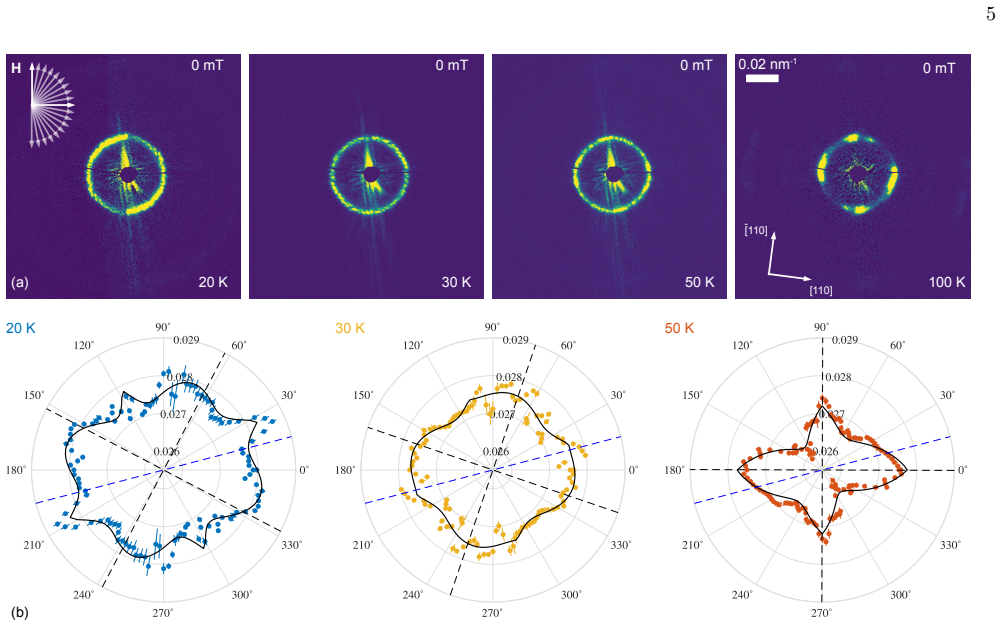
The central object is the angular wavevector model $q(\theta)=q_0[1+b\sin^2(\theta-\theta_S)+d|\cos 2(\theta-\theta_D)|+f\sin^2 2\theta]$, which separates the strain-induced uniaxial anisotropy ($b$ term), the anisotropic DMI contribution ($d$ term with an absolute-value cosine), and the combined magnetocrystalline and anisotropic-exchange basal anisotropy ($f$ term). The model is fitted to polar plots of the stripe wavevector measured at different temperatures and azimuthal field angles, yielding the orientations $\theta_S$ and $\theta_D$. The companion critical-field formula $H_C = M_s \gamma \sqrt{\alpha/\beta}$ fixes the stripe-to-fan transition scale. Together these equations turn the scattering data into a quantitative statement about which anisotropy dominates at each temperature.
What would settle it
Measure the stripe-orientation polar plots on a lamella with a different strain state, for example a free-standing flake without platinum contacts or membrane mounting, at 20–50 K; if the fitted $\theta_D$ rotation vanishes or follows the strain axis instead of the crystal axes, the reported DMI-axis rotation is a strain artifact rather than an intrinsic temperature renormalization.
Extended reading notes
Core claim
Central claim: in (Fe0.63Ni0.3Pd0.07)3P, a tetragonal S4-symmetric magnet, in-plane magnetic fields of about 10 mT continuously rotate the stripe-domain wavevector to lie perpendicular to the field, through a chiral-stripe to achiral-fan transition. Below 50 K the trained orientation is metastably pinned, so the material remembers the direction in which it was last field-trained. The paper further claims that the fitted effective DMI axis rotates by about 20 degrees at 30 K and 30 degrees at 20 K, interpreted as a temperature-driven renormalization of the DMI tensor, and that Ni moments are spatially modulated and phase-locked to the Fe magnetic order.
Load-bearing premise
The load-bearing premise is that the fitted angular form separates strain, DMI, and basal-anisotropy contributions cleanly, so that the fitted angle $\theta_D$ truly tracks the DMI orientation rather than absorbing uniaxial strain or higher-order anisotropy; if that separation fails, the reported 20–30 degree rotation of the DMI axis would be an artifact.
Editorial extensions
If this is right
- At room temperature, a device could steer stripe orientation in any basal-plane direction with about 10 mT in-plane fields, so no out-of-plane field sweep is needed.
- Below 50 K the trained stripe orientation persists at zero field, making the material a rewritable, non-volatile magnetic-pattern memory.
- The fitted rotation of the DMI axis implies that the effective DMI tensor in S4 magnets can be renormalized by temperature, so low-temperature models should not treat DMI directions as symmetry-rigid.
- The stripe-to-fan transition with its quantitative critical field connects dipolar stripe-domain physics to chiral soliton physics, using FNPP as a bridge system.
- Element-selective scattering shows Ni moments are coupled to the Fe modulation, so the magnetic texture is a two-sublattice object rather than a single-ion response.
Reading between the lines
- If the DMI-axis rotation is intrinsic, analogous temperature-driven reorientation may occur in other S4 and D2d antiskyrmion hosts; a vector-field SAXS study of Mn1.4PtSn across its spin-reorientation transition would test this.
- The directional-memory effect suggests possible applications in reconfigurable magnonics or data storage: field-train an arbitrary in-plane stripe pattern at low temperature and read it out at zero field.
- Because the model treats strain, DMI, and basal anisotropy as additive, the same fitting framework could extract the temperature-dependent anisotropy balance in other strained chiral magnets, provided the strain axis is measured independently rather than inferred from sample preparation.
Editorial analysis
A structured set of objections, weighed in public.
Referee Report
Summary. This paper reports a resonant small-angle x-ray scattering (SAXS) and ptychography study of a lamella of the S4-symmetric magnet (Fe0.63Ni0.3Pd0.07)3P in vector magnetic fields between 20 K and 300 K. The authors show that in-plane fields of about 10 mT continuously rotate the magnetic stripe wavevector to be perpendicular to the field, which they interpret as a transition from chiral stripes to an achiral fan state; below 50 K the trained stripe orientation persists after field removal. Element-selective XMCD and SAXS at the Fe and Ni L3 edges reveal that Ni carries an induced magnetic moment phase-locked to the Fe modulation. The angular dependence of the zero-field wavevector magnitude is fitted with a phenomenological expression (Eq. (2)) containing strain, DMI, and fourfold basal-anisotropy terms; the fitted DMI-axis angle θ_D is reported to rotate by about 20° at 30 K and 30° at 20 K. The paper concludes that FNPP is a model system for vector-field control of chiral spin textures and that the effective DMI landscape evolves with temperature.
Significance. The direct experimental observations—vector-field control of stripe orientation, the low-temperature metastable pinned state, the induced Ni moment, and the ptychographic imaging of stripes, solitons, and skyrmions—are well-supported by the data and will be of interest to the magnetism and skyrmionics communities. If the temperature-dependent rotation of θ_D is confirmed, the paper would provide a noteworthy demonstration that the effective DMI in a tetragonal magnet can be renormalized by competing anisotropies. However, the headline quantitative claim currently rests on a five-parameter phenomenological fit and is not uniquely determined by the data; the paper's value would increase substantially if the authors added robustness checks and an independent determination, or explicit control, of the strain axis.
major comments (2)
- [II.D, Eq. (2)] The central claim that the effective DMI orientation rotates with temperature is extracted from the angle θ_D in the five-parameter phenomenological fit of q(θ) given by Eq. (2). The reported parameters show that the fourfold coefficient f changes from 0.001±0.006 at 50 K to −0.070±0.015 at 20 K while d and b remain within uncertainty. Since the f sin²2θ term has minima that move as f grows, the apparent displacement of the cusp attributed to the d|cos2(θ−θ_D)| term may be a fitting artifact rather than a physical rotation of the DMI. The manuscript does not report the covariance between f and θ_D, nor does it test alternative forms (e.g., fixing f, removing the |cos| term, or adding higher harmonics). Additionally, the strain axis θ_S is inferred from the FIB/Pt-contact geometry rather than measured independently, so a temperature-dependent strain direction would directly bias θ_D. The data therefore support a temperature-dependent change in the angular dependence of q, but not uniquely a rotation of the DMI axis; the corresponding statements in the abstract and in Section II.D should be tempered.
- [II.C, Eq. (1)] The authors introduce Eq. (1) as the critical field for the chiral-stripe-to-fan transition and state that using parameters from Ref. [10] yields H_C ≈ 30 mT. However, the experiments show that the reorientation of q perpendicular to the in-plane field is already complete at approximately 10 mT (Figs. 3b–c). The factor-of-three discrepancy is not discussed. Because the conclusion calls Eq. (1) a quantitative expression, the authors should either reconcile the predicted and observed transition fields (for example, by accounting for parameter uncertainties or by distinguishing the onset of reorientation from the full fan transition) or soften the quantitative claim.
minor comments (5)
- [II.D, Eq. (2)] The angular variable θ is defined only implicitly; state explicitly that θ is measured in the laboratory frame relative to the vertical direction and how this frame maps onto the crystal axes [100] and [110].
- [II.D] The fitted parameters b, d, f, θ_D, and θ_S are quoted in the text for selected temperatures but not tabulated; provide a table with all fit parameters and uncertainties at each measured temperature.
- [II.D] The statement that d and b are 'nearly temperature-independent' would be more convincing if the fitted values at 20 K, 30 K, and 50 K were given explicitly rather than only the 20 K values.
- [Fig. 3(e)] The color scale in Fig. 3(e) is not described; specify the field magnitude scale and how it maps to the plotted polar curves.
- [Abstract and Conclusion] The phrase 'effective DMI orientation' should be consistently distinguished from a microscopic DMI tensor; Eqs. (1) and (2) treat γ and θ_D as effective mesoscopic parameters, and the wording should reflect that distinction throughout.
Circularity Check
The claimed temperature rotation of the effective DMI axis is read off from fitted parameters in Eq. (2), so the central 'temperature evolution' claim reduces to the fit rather than an independent prediction.
-
fitted input called prediction
[Introduction (last paragraph), Section II.D, Eq. (2), Fig. 4 caption]
"The temperature evolution is quantitatively reproduced by a theoretical model incorporating DMI, magnetocrystalline square anisotropy, and anisotropic exchange... Solid curves represent the fit according to the theoretical model... q(θ)=q0[1+b sin²(θ−θ_S)+d|cos2(θ−θ_D)|+f sin²2θ] ... For the 20 K data, the fitted model yields d≈0.073±0.019 and b≈−0.023±0.015 ... Upon further cooling, we observe a systematic rotation of the effective DMI axis θ_D by approximately 20◦ at 30 K and 30◦ at 20 K."
The 'quantitative reproduction' is a least-squares fit of Eq. (2) to the same q(θ) polar plots whose evolution it is said to reproduce; no independent observable constrains θ_D. The headline rotation of the effective DMI landscape is simply the temperature dependence of the fitted parameter θ_D, with f growing from 0.001±0.006 at 50 K to −0.070±0.015 at 20 K while d and b stay constant, so the result is an output of the fitting model, not a measured quantity. The paper also admits that the basal anisotropy contributions 'cannot be disentangled within the present experimental sensitivity,' and θ_S is inferred from FIB geometry, so the separation of the d|cos2| term from the f sin²2θ term is not uniquely forced by the data.
full rationale
The qualitative scattering observations—vector-field rotation of stripes at 300 K, low-temperature pinning, induced Ni moment, and the skyrmion/soliton sequences—are direct and independent of the model. The circularity is confined to the quantitative anisotropy story: Eq. (2) is fitted to q(θ) at each temperature, and the fitted θ_D (together with the strongly growing f term) is then presented as a discovered 'temperature-driven evolution of the effective DMI landscape.' That conclusion is a restatement of the fit parameters, not a prediction from a first-principles theory, and the paper itself notes the relevant contributions cannot be disentangled. There is no load-bearing self-citation chain: the cited prior work on anisotropic exchange in other materials is external to this sample's fitted values and does not by itself force the rotation claim. Because the central novelty in the abstract includes the rotating DMI orientation, the partial circularity warrants a 6.
Assumptions & free parameters
free parameters (6)
- q0 (baseline wavevector magnitude) =
not quoted, fitted per temperature
- b (strain uniaxial anisotropy coefficient) =
-0.023 +/- 0.015 (20 K), nearly temperature independent
- d (DMI contribution coefficient) =
0.073 +/- 0.019 (20 K), nearly temperature independent
- f (effective basal anisotropy coefficient) =
0.001 +/- 0.006 (50 K) to -0.070 +/- 0.015 (20 K)
- theta_D (effective DMI axis angle) =
rotates about 20 degrees at 30 K and 30 degrees at 20 K relative to high temperature
- theta_S (strain axis angle) =
not quoted; inferred from lamella geometry
assumptions (4)
- ad hoc to paper The q(theta) angular dependence has the perturbative form of Eq (2): q0[1 + b sin^2(theta - theta_S) + d|cos2(theta - theta_D)| + f sin^2 2theta].
- ad hoc to paper The fitted angle theta_D in the d-term can be identified with the orientation of the effective DMI.
- domain assumption The lamella is under uniaxial strain from FIB mounting with Pt contacts, with axis theta_S, and this strain contributes to q(theta).
- domain assumption Material parameters Ms, alpha, beta, gamma taken from Ref [10] are valid for estimating Hc in the measured lamella.
Cite this review
Pith. "Pith review of Vector-field control and emergent basal-plane anisotropy of magnetic textures in noncentrosymmetric (Fe$_{0.63}$Ni$_{0.3}$Pd$_{0.07}$)$_3$P." pith.science (2026). https://pith.science/paper/ZGCPTDQI
@misc{pith2026260803513,
  author       = {Pith},
  title        = {Pith review of: Vector-field control and emergent basal-plane anisotropy of magnetic textures in noncentrosymmetric (Fe$_0.63$Ni$_0.3$Pd$_0.07$)$_3$P},
  year         = {2026},
  howpublished = {\url{https://pith.science/paper/ZGCPTDQI}},
  note         = {Machine review of arXiv:2608.03513}
}
abstract
(Fe$_{0.63}$Ni$_{0.3}$Pd$_{0.07}$)$_3$P is a room-temperature magnet with $S_4$ symmetry that hosts a rich variety of topological spin textures. Here, we report a combined resonant small-angle x-ray scattering and ptychography study of (Fe$_{0.63}$Ni$_{0.3}$Pd$_{0.07}$)$_3$P in vector magnetic fields over a broad temperature range. We demonstrate deterministic vector-field control of magnetic stripe domains, where in-plane fields continuously rotate their orientation via a transition from a chiral stripe to an achiral fan configuration. Furthermore, at 50 K and below, the stripe orientation becomes metastably pinned and retains its field-trained direction. While the magnitude of the wavevector is nearly isotropic within the basal plane at room temperature, a pronounced temperature evolution of anisotropic interactions emerges upon cooling. In particular, non-trivial anisotropy axes develop at 20-50 K reflecting the combined effects of magnetocrystalline anisotropy, anisotropic exchange, and Dzyaloshinskii-Moriya interaction (DMI), whose effective orientation is found to rotate with temperature. These results establish (Fe$_{0.63}$Ni$_{0.3}$Pd$_{0.07}$)$_3$P as a model system for vector-field control of chiral spin textures and reveal a previously unrecognized temperature-driven evolution of the effective DMI landscape in a noncentrosymmetric magnet.
Figures


Figures from the paper (1 more)
Reference graph
Works this paper leans on
-
[10]
Karube, L
K. Karube, L. Peng, J. Masell, X. Yu, F. Kagawa, Y. Tokura, and Y. Taguchi, Room-temperature anti- skyrmions and sawtooth surface textures in a non- centrosymmetric magnet withS 4 symmetry, Nature Ma- terials20, 335 (2021)
2021
-
[1]
Bak and M
P. Bak and M. H. Jensen, Theory of helical magnetic structures and phase transitions in MnSi and FeGe, Jour- nal of Physics C: Solid State Physics13, L881 (1980)
1980
-
[2]
Bogdanov and A
A. Bogdanov and A. Hubert, Thermodynamically stable magnetic vortex states in magnetic crystals, Journal of Magnetism and Magnetic Materials138, 255 (1994)
1994
-
[3]
Dzyaloshinsky, A thermodynamic theory of “weak” fer- romagnetism of antiferromagnetics, Journal of Physics and Chemistry of Solids4, 241 (1958)
I. Dzyaloshinsky, A thermodynamic theory of “weak” fer- romagnetism of antiferromagnetics, Journal of Physics and Chemistry of Solids4, 241 (1958)
1958
-
[4]
Moriya, Anisotropic superexchange interaction and weak ferromagnetism, Physical Review120, 91 (1960)
T. Moriya, Anisotropic superexchange interaction and weak ferromagnetism, Physical Review120, 91 (1960)
1960
-
[5]
M¨ uhlbauer, B
S. M¨ uhlbauer, B. Binz, F. Jonietz, C. Pfleiderer, A. Rosch, A. Neubauer, R. Georgii, and P. B¨ oni, Skyrmion lattice in a chiral magnet, Science323, 915 (2009)
2009
-
[6]
Tokunaga, Yu, X.-Z., J
Y. Tokunaga, Yu, X.-Z., J. White, H. M. Rønnow, D. Morikawa, Y. Taguchi, and Y. Tokura, A new class of chiral materials hosting magnetic skyrmions beyond room temperature, Nature Communications6, 7638 (2015)
2015
-
[7]
K´ ezsm´ arki, S
I. K´ ezsm´ arki, S. Bord´ acs, P. Milde, E. Neuber, L. M. Eng, J. S. White, H. M. Rønnow, C. D. Dewhurst, M. Mochizuki, K. Yanai,et al., N´ eel-type skyrmion lat- tice with confined orientation in the polar magnetic semi- conductor GaV4S8, Nature Materials14, 1116 (2015)
2015
Show all 56 references
-
[8]
Kurumaji, T
T. Kurumaji, T. Nakajima, V. Ukleev, A. Feoktys- tov, T.-h. Arima, K. Kakurai, and Y. Tokura, N´ eel- type skyrmion lattice in the tetragonal polar magnet 9 VOSe2O5, Physical Review Letters119, 237201 (2017)
2017
-
[9]
A. K. Nayak, V. Kumar, T. Ma, P. Werner, E. Pippel, R. Sahoo, F. Damay, U. K. R¨ oßler, C. Felser, and S. S. Parkin, Magnetic antiskyrmions above room temperature in tetragonal Heusler materials, Nature548, 561 (2017)
2017
-
[11]
Karube and Y
K. Karube and Y. Taguchi, High-temperature non- centrosymmetric magnets for skyrmionics, APL Materi- als10(2022)
2022
-
[12]
Mukai and A
N. Mukai and A. O. Leonov, Skyrmion and meron or- dering in quasi-two-dimensional chiral magnets, Physical Review B106, 224428 (2022)
2022
-
[13]
T. Ma, A. K. Sharma, R. Saha, A. K. Srivastava, P. Werner, P. Vir, V. Kumar, C. Felser, and S. S. Parkin, Tunable magnetic antiskyrmion size and helical period from nanometers to micrometers in a D 2d Heusler com- pound, Advanced Materials32, 2002043 (2020)
2020
-
[14]
Sukhanov, B
A. Sukhanov, B. Z. Cespedes, P. Vir, A. Cameron, A. Heinemann, N. Martin, G. Chaboussant, V. Kumar, P. Milde, L. Eng,et al., Anisotropic fractal magnetic do- main pattern in bulk Mn1.4PtSn, Physical Review B102, 174447 (2020)
2020
-
[15]
Karube, V
K. Karube, V. Ukleev, F. Kagawa, Y. Tokura, Y. Taguchi, and J. S. White, Unveiling the anisotropic fractal magnetic domain structure in bulk crystals of antiskyrmion host (Fe,Ni,Pd) 3P by small-angle neutron scattering, Applied Crystallography55, 1392 (2022)
2022
-
[16]
rather than a helical spiral state typical to archetype chiral magnets such as MnSi [1]. In this context, the stripe-domain states realized in FNPP can be viewed as a limiting case of aπ-rotation chiral soliton lattice (π-CSL) in the weak-DMI regime, providing a natural bridge...
-
[17]
Winter, A
M. Winter, A. Pignedoli, M. Rahn, A. Sukhanov, B. Achinuq, J. Bollard, M. Azhar, K. Everschor-Sitte, D. Pohl, S. Schneider,et al., Field-induced condensa- tion ofπto 2πsoliton lattices in chiral magnets, arXiv preprint arXiv:2508.10640 (2025)
2025 arXiv
-
[18]
Karube, L
K. Karube, L. Peng, J. Masell, M. Hemmida, H.-A. Krug von Nidda, I. K´ ezsm´ arki, X. Yu, Y. Tokura, and Y. Taguchi, Doping control of magnetic anisotropy for stable antiskyrmion formation in Schreibersite (Fe,Ni)3P withS 4 symmetry, Advanced Materials34, 2108770 (2022)
2022
-
[19]
and general expectations, since higher-order mag- netocrystalline anisotropy scales with higher powers of magnetization and anisotropic exchange becomes more prominent as thermal fluctuations are suppressed [28, 42]. In addition, the random occupation of Fe, Ni, and Pd sites, ...
-
[20]
Hubert and R
A. Hubert and R. Sch¨ afer,Magnetic domains: the analy- sis of magnetic microstructures(Springer Science & Busi- ness Media, 1998)
1998
-
[21]
L. Peng, R. Takagi, W. Koshibae, K. Shibata, K. Naka- jima, T.-h. Arima, N. Nagaosa, S. Seki, X. Yu, and Y. Tokura, Controlled transformation of skyrmions and antiskyrmions in a non-centrosymmetric magnet, Nature Nanotechnology15, 181 (2020)
2020
-
[22]
Hemmida, J
M. Hemmida, J. Masell, K. Karube, D. Ehlers, H.- A. K. von Nidda, V. Tsurkan, Y. Tokura, Y. Taguchi, and I. K´ ezsm´ arki, Role of magnetic anisotropy in the antiskyrmion-host schreibersite magnets, Physical Re- view B110, 054416 (2024)
2024
-
[23]
M¨ uhlbauer, D
S. M¨ uhlbauer, D. Honecker, ´E. A. P´ erigo, F. Bergner, S. Disch, A. Heinemann, S. Erokhin, D. Berkov, C. Leighton, M. R. Eskildsen,et al., Magnetic small- angle neutron scattering, Reviews of Modern Physics91, 015004 (2019)
2019
-
[24]
L. Peng, K. V. Iakoubovskii, K. Karube, Y. Taguchi, Y. Tokura, and X. Yu, Formation and control of zero-field antiskyrmions in confining geometries, Advanced Science 9, 2202950 (2022)
2022
-
[25]
J. Jena, B. G¨ obel, T. Ma, V. Kumar, R. Saha, I. Mer- tig, C. Felser, and S. S. Parkin, Elliptical Bloch skyrmion chiral twins in an antiskyrmion system, Nature Commu- nications11, 1115 (2020)
2020
-
[26]
Z. He, Z. Wang, Z. Li, Y. Yang, S. Wang, J. Shen, T. Zhao, J. Cai, Y. Yao, J. Zhang,et al., Manipulation of topological antiskyrmion lattice transition at room tem- perature, Advanced Functional Materials , e31037 (2026)
2026
-
[27]
Y. Wu, J. Jiang, L. Kong, W. Liu, H. Zhang, S. Wang, M. Tian, H. Du, and J. Tang, Current-controlled cre- ations, deletions, and topological transformations of a single magnetic antiskyrmion in nanostructured cells, Na- ture Communications (2025)
2025
-
[28]
J. Tang, Y. Wu, J. Jiang, L. Kong, W. Liu, S. Wang, M. Tian, and H. Du, Sewing skyrmion and antiskyrmion by quadrupole of Bloch points, Science Bulletin68, 2919 (2023)
2023
-
[29]
Muto and M
T. Muto and M. Mochizuki, Switching magnetic texture via in-plane magnetic field in noncentrosymmetric dipo- lar magnets: From skyrmions to antiskyrmions and non- topological magnetic bubbles, Physical Review B112, 104409 (2025)
2025
-
[30]
Hellwig, G
O. Hellwig, G. Denbeaux, J. Kortright, and E. E. Fuller- ton, X-ray studies of aligned magnetic stripe domains in perpendicular multilayers, Physica B: Condensed Matter 336, 136 (2003)
2003
-
[31]
P. R. Baral, O. I. Utesov, C. Luo, F. Radu, A. Ma- grez, J. S. White, and V. Ukleev, Direct observation of exchange anisotropy in the helimagnetic insulator Cu2OSeO3, Physical Review Research5, L032019 (2023)
2023
-
[32]
Ukleev, O
V. Ukleev, O. Utesov, L. Yu, C. Luo, K. Chen, F. Radu, Y. Yamasaki, N. Kanazawa, Y. Tokura, T.-h. Arima, et al., Signature of anisotropic exchange interaction re- vealed by vector-field control of the helical order in a FeGe thin plate, Physical Review Research3, 013094 (2021)
2021
-
[33]
Moskvin, S
E. Moskvin, S. Grigoriev, V. Dyadkin, H. Eckerlebe, M. Baenitz, M. Schmidt, and H. Wilhelm, Complex chiral modulations in FeGe close to magnetic ordering, Physical Review Letters110, 077207 (2013)
2013
-
[34]
P. R. Baral, O. I. Utesov, S. H. Moody, M. T. Littlehales, P. Gargiani, M. Valvidares, R. Cubitt, N.-J. Steinke, C. Luo, F. Radu,et al., A surface-confined spiral state with the double period in the cubic chiral helimagnet Cu2OSeO3, npj Quantum Materials (2026)
2026
-
[35]
Adams, S
T. Adams, S. M¨ uhlbauer, C. Pfleiderer, F. Jonietz, A. Bauer, A. Neubauer, R. Georgii, P. B¨ oni, U. Keider- ling, K. Everschor,et al., Long-range crystalline nature of the skyrmion lattice in MnSi, Physical review letters 107, 217206 (2011)
2011
-
[36]
Gambino, T
R. Gambino, T. McGuire, and Y. Nakamura, Magnetic properties of the iron-group metal phosphides, Journal of Applied Physics38, 1253 (1967). 10
1967
-
[37]
Ukleev, Y
V. Ukleev, Y. Yamasaki, O. Utesov, K. Shibata, N. Kanazawa, N. Jaouen, H. Nakao, Y. Tokura, and T.-h. Arima, Metastable solitonic states in the strained itiner- ant helimagnet FeGe, Physical Review B102, 014416 (2020)
2020
-
[38]
J. D. Reim, S. Matsuzaka, K. Makino, S. Aji, R. Murasaki, D. Higashi, D. Okuyama, Y. Nambu, E. P. Gilbert, N. Booth,et al., Higher-order modulations in the skyrmion lattice phase of Cu 2OSeO3, Physical Review B 106, 104406 (2022)
2022
-
[39]
Yang, K.-W
S. Yang, K.-W. Moon, T.-S. Ju, C. Kim, S. Park, and C. Hwang, Universality of stripe domain width change by an in-plane magnetic field, Journal of Magnetism and Magnetic Materials539, 168381 (2021)
2021
-
[40]
Sukhanov, V
A. Sukhanov, V. Ukleev, P. Vir, P. Gargiani, M. Valvi- dares, J. White, C. Felser, and D. Inosov, Hybrid Bloch- N´ eel spiral states in Mn1.4PtSn probed by resonant soft x-ray scattering, Physical Review B106, L140402 (2022)
2022
-
[41]
S. Mori, S. Ii, T. Moronaga, T. Hara, K. Karube, Y. Taguchi, Y. Tokura, and X. Yu, Direct Observations of Mechanical Strain-Induced Wavevector Switching in a (Fe,Ni,Pd)3P Magnet with Anisotropic Dzyaloshinskii– Moriya Interaction, ACS Applied Materials & Interfaces 17, 22921 (2025)
2025
-
[42]
Ukleev, O
V. Ukleev, O. I. Utesov, C. Luo, F. Radu, S. Wintz, M. Weigand, S. Finizio, M. Winter, A. Tahn, B. Relling- haus,et al., Competing anisotropies in the chiral cubic magnet Co8Zn8Mn4 unveiled by resonant x-ray magnetic scattering, Physical Review B109, 184415 (2024)
2024
-
[43]
Moody, P
S. Moody, P. Nielsen, M. Wilson, D. A. Venero, A. ˇStefanˇ ciˇ c, G. Balakrishnan, and P. Hatton, Experi- mental evidence of a change of exchange anisotropy sign with temperature in Zn-substituted Cu2OSeO3, Physical Review Research3, 043149 (2021)
2021
-
[44]
Winter, A
M. Winter, A. Pignedoli, A. S. Sukhanov, M. Azhar, A. Tahn, B. Achinuq, J. R. Bollard, V. Ukleev, C. Luo, F. Radu, S. Wintz, M. Weigand, A. Mistonov, P. Vir, J. Geck, C. Felser, G. van der Laan, T. Hesjedal, K. Everschor-Sitte, B. Rellinghaus, and M. C. Rahn, Quasi-1D spin tex...
2026 arXiv
-
[45]
Ukleev, Y
V. Ukleev, Y. Yamasaki, D. Morikawa, K. Karube, K. Shibata, Y. Tokunaga, Y. Okamura, K. Amemiya, M. Valvidares, H. Nakao,et al., Element-specific soft x- ray spectroscopy, scattering, and imaging studies of the skyrmion-hosting compound Co 8Zn8Mn4, Physical Re- view B99, 144408 (2019)
2019
-
[46]
Okamura, Y
Y. Okamura, Y. Yamasaki, D. Morikawa, T. Honda, V. Ukleev, H. Nakao, Y. Murakami, K. Shibata, F. Ka- gawa, S. Seki,et al., Emergence and magnetic-field vari- ation of chiral-soliton lattice and skyrmion lattice in the strained helimagnet Cu 2OSeO3, Physical Review B96, 174417 (2017)
2017
-
[47]
Zhao, T.-H
H. Zhao, T.-H. Kim, L. Zhou, and L. Ke, Controlling skyrmion lattices via strain: Elongation, tilting, and collapse mechanisms, Physical Review B112, 214417 (2025)
2025
-
[48]
T. A. Butcher, N. W. Phillips, C.-C. Chiu, C.-C. Wei, S.- Z. Ho, Y.-C. Chen, E. Fr¨ ojdh, F. Baruffaldi, M. Carulla, J. Zhang,et al., Ptychographic nanoscale imaging of the magnetoelectric coupling in freestanding BiFeO 3, Ad- vanced Materials36, 2311157 (2024)
2024
-
[49]
Noll and F
T. Noll and F. Radu, The mechanics of the VEKMAG experiment, Proc. of MEDSI2016, Barcelona, Spain , 370 (2016)
2016
-
[50]
T. A. Butcher, S. Finizio, L. Heller, N. W. Phillips, B. Sarafimov, C. A. Vaz, A. Kleibert, B. Watts, M. Holler, and J. Raabe, Soft x-ray ptychography with SOPHIE: Guide and instrumentation, Review of Scien- tific Instruments96(2025)
2025
-
[51]
Thibault, M
P. Thibault, M. Dierolf, A. Menzel, O. Bunk, C. David, and F. Pfeiffer, High-resolution scanning x-ray diffraction microscopy, Science321, 379 (2008)
2008
-
[52]
Nolle, M
D. Nolle, M. Weigand, P. Audehm, E. Goering, U. Wiese- mann, C. Wolter, E. Nolle, and G. Sch¨ utz, Note: Unique characterization possibilities in the ultra high vacuum scanning transmission x-ray microscope (UHV- STXM)“MAXYMUS” using a rotatable permanent mag- netic field up t...
2012
-
[53]
Baruffaldi, A
F. Baruffaldi, A. Bergamaschi, M. Boscardin, M. Br¨ uckner, T. A. Butcher, M. Carulla, M. Cen- tis Vignali, R. Dinapoli, S. Finizio, E. Fr¨ ojdh,et al., Single-photon counting pixel detector for soft X-rays, Communications Physics8, 321 (2025)
2025
-
[55]
Odstrˇ cil, A
M. Odstrˇ cil, A. Menzel, and M. Guizar-Sicairos, Iterative least-squares solver for generalized maximum-likelihood ptychography, Optics Express26, 3108 (2018)
2018
-
[56]
Wakonig, H.-C
K. Wakonig, H.-C. Stadler, M. Odstrˇ cil, E. H. Tsai, A. Diaz, M. Holler, I. Usov, J. Raabe, A. Menzel, and M. Guizar-Sicairos, PtychoShelves, a versatile high- level framework for high-performance analysis of ptycho- graphic data, Applied Crystallography53, 574 (2020)
2020
-
[100]
Summing the individual azimuthal SAXS maps mea- sured at 300 K for field amplitudes of 0, 10, and 50 mT results in the patterns shown in Figs
crystal axis are shown in the Supplementary Note II. Summing the individual azimuthal SAXS maps mea- sured at 300 K for field amplitudes of 0, 10, and 50 mT results in the patterns shown in Figs. 3a–c. The aver- aged SAXS pattern at zero magnetic field reveals that the magneti...
Reviewed August 10, 2026 · model on record in the stance chip above.
Discussion (0). Continue with ORCID to comment.