REVIEW 2 major objections 5 minor 2 cited by
Non-orthogonal single-particle bases can be used directly in DMRG: the many-body overlap operator is exactly representable as a matrix product operator with bond dimension set by the basis bandwidth, not by system size.
Reviewed by Pith at T0; open to challenge. T0 means a machine referee read the full paper against a public rubric. the ladder, T0–T4 →
T0 review · deepseek-v4-flash
2026-08-02 11:24 UTC pith:ZH7YY6ND
load-bearing objection A sound and useful extension of the overlap-MPO construction to bosonic finite-element MPS; treat the claimed monotonic multigrid convergence as empirical rather than proven. the 2 major comments →
Finite-Element Matrix Product States for Continuum Models in One Dimension
The pith
A machine-rendered reading of the paper's core claim, the machinery that carries it, and where it could break.
Core claim
For a non-orthogonal single-particle basis with band-diagonal overlap matrix N (bandwidth R), the many-body overlap operator N=W†W admits an exact MPO representation with bond dimension χ=(∏_{r=1}^R(n_c r+1))^2, independent of the number of basis functions L. The proof is constructive: the basis change from the physical non-orthogonal modes to the computational canonical modes is implemented by a many-body operator W that acts locally, with Cholesky superdiagonals F of N, and whose matrix elements are organized through a particle-flow picture: virtual indices Q_{i,r} count how many particles cross the bond between sites i and i+1 on their way to a site r positions to the left. With this MPO
What carries the argument
The central object is the many-body overlap operator N=W†W acting on an auxiliary canonical Fock space. The construction that carries the argument is the explicit local MPO tensor for W, obtained from a Cholesky factorization N=F†F with banded F; the virtual index Q_{i,r} at each bond is the number of particles crossing that bond whose destination lies r sites to the left. This particle-flow picture turns the multinomial expansion of the basis change into nearest-neighbor tensors, with multinomial coefficients and (for fermions) a locally computable sign, so that W and hence N become matrix product operators. The bond dimension of N is the square of the number of allowed flow states per bond
Load-bearing premise
The central construction is exact only under two conditions that must hold simultaneously: the single-particle overlap matrix has small, system-size-independent bandwidth, and the bosonic Fock space is truncated at a finite occupation n_c; if either fails, the MPO bond dimension or the variational bound after grid refinement loses its guarantees.
What would settle it
For a tridiagonal overlap matrix (R=1) with L=20 and n_c=2, build the dense many-body overlap matrix N and compare it element-by-element with the MPO constructed from the paper's tensors; any element with relative error above machine precision would disprove the claimed exact representation. Similarly, apply the refinement map R to a coarse-grid state with an occupied site, verify that R† N_fine R = N_coarse holds to machine precision, and check that truncating the refined state at n_c changes the physical norm by more than the reported few-percent level.
If this is right
- For any 1D continuum Hamiltonian projected onto a finite-element basis, the ground-state energy is an upper bound to the continuum energy, and the bound becomes systematically tighter as the grid is refined.
- The banded-overlap MPO construction applies to fermions as well as bosons, and to any local orbital family beyond tent functions, as long as the single-particle overlap matrix has a small bandwidth.
- The coarse-to-fine refinement map is exact at the many-body level before occupation truncation, so a coarse-grid solution can be lifted to a fine grid to seed DMRG, yielding converged results at multiple resolutions in a single run.
- Observables such as momentum distributions and Tan's contact are computed directly in the continuum, recovering the physical k^-4 tail that finite-difference MPS cannot capture.
- The algorithm scales as O(L d χ D^3) with χ independent of L, so for a fixed per-element accuracy the cost grows only linearly with the number of basis functions.
Where Pith is reading between the lines
- The same overlap-MPO machinery should transfer to quantum-chemistry tensor networks built from localized atomic orbitals, where overlap matrices are naturally banded; the generalized DMRG would then avoid Lowdin orthogonalization and its delocalizing effects.
- Because the metric N is fixed and sparse-structured, the scheme could be extended to real-time evolution via a time-dependent variational principle, enabling non-equilibrium studies of impurities or quenches in non-orthogonal bases.
- The exact refinement map suggests an adaptive h-refinement strategy where only selected cells are refined, with the small occupation-truncation error monitored locally; this would concentrate the O(Δx) error where the wavefunction is cusped.
- The explicit bond-dimension formula makes the cost of higher-order elements predictable: going to quadratic elements (R=2) with n_c=2 squares the bond dimension relative to R=1, so the reported O(Δx) convergence of tent functions is a practical sweet spot unless the wavefunction is smooth enough to justify a larger overlap bandwidth.
Editorial analysis
A structured set of objections, weighed in public.
Referee Report
Summary. The paper develops an MPS framework for one-dimensional continuum quantum many-body systems using a non-orthogonal, localized single-particle basis. The physical Fock space is mapped to an auxiliary canonical computational space via an operator W, so that the many-body overlap N = W^†W becomes the metric of a generalized eigenvalue problem H|Φ> = E N|Φ>. The central technical result is that N can be represented exactly as an MPO with bond dimension independent of the number of basis functions L when the single-particle overlap matrix is banded with bandwidth R. The authors then implement a generalized DMRG solver and apply it to the Lieb-Liniger gas in a first-order finite-element basis, including inhomogeneous potentials and a Gaussian barrier. They also introduce an exact refinement map for multigrid optimization and present benchmarks against Bethe-ansatz and LDA results.
Significance. The main result—an exact, compact MPO representation of the many-body overlap for non-orthogonal local basis sets—is a genuine methodological advance. It enables a variational, local, non-orthogonal discretization of continuum models without the need to orthogonalize the basis and destroy locality. The paper provides detailed derivations, reproducible code and data (Julia packages and Zenodo archive), and benchmarks against independent Bethe-ansatz/LDA results. The finite-element MPS approach also correctly captures UV observables such as Tan's contact, which is a nontrivial check. If the formal claims are appropriately qualified, this is a solid contribution with clear value for continuum DMRG applications.
major comments (2)
- [Sec. VI B and Sec. VII A, Eqs. (48)–(49)] The claim that FE-MPS 'provides a strictly variational upper bound that approaches the continuum limit monotonically' is not formally supported by the construction. The exact refinement map R maps coarse-grid computational states to fine-grid states with local occupations up to 2n_c (Eqs. 48–49). In practice the fine grid is truncated back to the cutoff n_c, as acknowledged in Sec. VI B ('we enforce a fixed cutoff n_c on the refined state'). Consequently, the truncated fine-grid variational space is not a superset of the image of the coarse truncated space under R, and the refined-grid energy is not guaranteed to be below the coarse-grid energy. The observed monotonicity in Figs. 5, 6, and 8 is empirical, not a formal consequence of the method. The paper's own statements that truncation 'does not introduce significant error' and that compression 'typically introduces <5% energy error' ar
- [Sec. IV, Eq. (26)] The fermionic sign factor ξ_i is introduced with a short counting argument but no derivation or proof that it factorizes into local contributions as in Eq. (26). Since the paper explicitly claims to generalize the framework to fermionic statistics, this is a load-bearing point for that generalization. The absence of any fermionic benchmark makes it difficult for the reader to verify correctness. Please provide a complete derivation (e.g., by induction on the number of sites and on R) or state clearly that the fermionic extension is conjectural and defer numerical validation to later work.
minor comments (5)
- [Sec. III] Typo: 'an upper an upper-triangular F' should read 'an upper-triangular F'.
- [Sec. IV, after Eq. (28)] The bond dimension of N is stated as χ^2, but the construction would benefit from an explicit diagram showing the contraction W^†W and the local physical dimensions (n_c+1)^2. This would clarify why the intermediate output dimension (R+1)n_c of W does not enter the final MPO bond dimension.
- [Fig. 7] The horizontal axis label in panel (a) appears garbled ('k 0 500 100 0'); the intended tick labels should be cleaned up.
- [Sec. V A] The environment rescaling procedure is described qualitatively. A few details on how the extensive logarithmic factors are stored and combined when computing energies would improve reproducibility.
- [Appendix C, Eq. (C8)] The Fourier transform convention for the tent functions should be stated explicitly, as the prefactor depends on the normalization of the Fourier transform.
Circularity Check
No significant circularity: the overlap-MPO construction is derived in-paper, benchmarks are independent, and the cited prior construction is not load-bearing.
full rationale
The central claim—that the many-body overlap N=W†W admits an exact MPO with bond dimension independent of L—is derived explicitly in Sec. IV from the single-particle overlap N via a Cholesky factor F (Eq. 19) and a local particle-flow construction (Eqs. 23–28). The result is a constructive identity, not an input assumed as output. The self-citation to [arXiv:2405.10285] is provenance only; the present paper re-derives the construction rather than importing it as an unexamined black box, so it is not load-bearing. Benchmarks against Bethe ansatz and LDA (Secs. VII, Appendix E) provide external, independent validation, and the code/data are released (Code and Data Availability), further supporting reproducibility. The only caveat—located in Sec. VI.B.2 and Sec. VII.A—is that after enforcing a fixed particle-number cutoff n_c on refined grids, the exact containment H(L)⊂H(2L+1) is not preserved: the paper states "In practice, we enforce a fixed cutoff n_c on the refined state, but this does not introduce significant error since the population of the modes that we truncate away naturally vanishes in the continuum limit." Consequently, strict monotonic variational convergence across refinements is an empirical observation rather than a formally guaranteed consequence. This is a correctness/interpretation risk, not a circularity, because it does not make any predicted quantity equivalent to its input by construction.
Axiom & Free-Parameter Ledger
free parameters (3)
- local occupation cutoff n_c =
n_c = 2 for FE-MPS; n_c = 1 for modified FD-MPS
- MPS bond dimension D =
D = 10, 15, 20 in Figs. 5, 6, 8
- chemical potential µ =
tuned to reach target N = 6, 10, 12
axioms (6)
- domain assumption The overlap matrix N is banded with bandwidth R and its Cholesky factor F has only R non-zero superdiagonals (Eq. 20).
- domain assumption The map W decomposes as V W with W a particle-number-conserving single-particle transformation that leaves the vacuum invariant (Eq. 18).
- ad hoc to paper The fermionic sign factor in Eq. (26) factorizes into local crossing contributions.
- ad hoc to paper Truncating refined local occupations back to n_c introduces negligible error.
- standard math The generalized eigenvalue problem is solved by LOBPCG with nonsingular positive-definite effective metric N_eff.
- domain assumption Lieb-Liniger Bethe ansatz (and LDA for the harmonic trap) provide correct benchmarks.
read the original abstract
We present a matrix product state framework for simulating one-dimensional quantum many-body systems in the continuum using non-orthogonal single-particle basis sets. By mapping the physical problem to an auxiliary computational space, we show that the resulting many-body overlap operator can be efficiently encoded as a matrix product operator for sufficiently localized orbitals, thereby generalizing a construction that first appeared in [arXiv:2405.10285]. This construction recasts the variational ground-state search into a generalized eigenvalue problem, which can be solved using a generalized density matrix renormalization group algorithm. As a primary application, we employ a first-order finite-element expansion to study the ground state properties of the Lieb-Liniger gas in the presence of inhomogeneities. This approach also provides a natural setting for exactly refining the lattice, thereby enabling multigrid optimization strategies for matrix product states.
Figures




Forward citations
Cited by 2 Pith papers
-
Calculus of Robinet: completely positive reconstruction of time-averaged diffusive quantum trajectories
A completely-positive numerical method computes the optimal time-averaged (Robinet) quantum trajectory from a system–transmission-line dilation to arbitrarily high order, plus a proof that finitely many extra binned r...
-
Wavelet Matrix Product States for Quantum Fields
Introduces wavelet matrix product states as a tensor network variational method for continuum quantum fields, allowing standard MPS algorithms and scale refinement, tested on Lieb-Liniger energy and correlations.
Reference graph
Works this paper leans on
-
[1]
trivially isometric
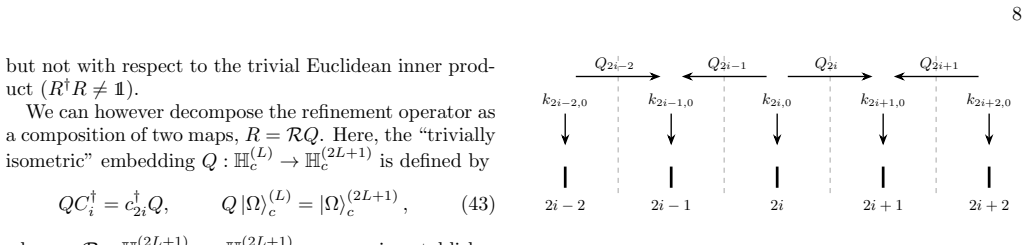
Refinement Property Consider a set of tent functions{Φ i(x)}L i=1 centered at equally spaced points{X i}L i=1, where the domain is fixed by the boundary pointsX 0 =−ℓandX L+1 = +ℓ. We can now construct a finer grid{x i}2L+1 i=1 in the inte- rior of the domain by introducing a new vertex at the midpoint of every coarse interval, yielding the correspon- den...
-
[2]
n1 n2 nL , which has a corresponding physical state|Ψ⟩= W (L) |Ψ(L)⟩c
Constructing the refinement map Let us now consider a many-body state in the MPS representation expanded in the coarse grid basis: |Ψ(L)⟩c = X {ni} M L {ni} LY i=1 1√ni! (C † i )ni ! |Ω⟩(L) c ,(45) M L = M (1) M (2) M (L). . . n1 n2 nL , which has a corresponding physical state|Ψ⟩= W (L) |Ψ(L)⟩c. We would now like to use the refinement procedure to expres...
2000
-
[3]
Two-point correlators These can be evaluated by expanding the field oper- ators in the basis{ϕ i(x)}and mapping the expectation value to the computational basis. For example, we con- sider the first order coherence,g (1)(x, x′); ⟨ ˆΨ†(x) ˆΨ(x′)⟩= X i,j ϕ∗ i (x)⟨Φ|(ˆbi)†ˆbj|Φ⟩ϕj(x′) = X i,j ϕ∗ i (x) c⟨Φ|W †(ˆbi)†ˆbjW|Φ⟩ cϕj(x′) = X i,j ϕ∗ i (x) c⟨Φ|c† i (W...
-
[4]
For a grid withL points, we reduce the computational cost fromO(L 3) to O(L2) by precomputing the standard environmentsN (k) L (Eq
Single-particle density matrix Evaluating the SPDM (Gc)ij = c⟨Φ|c† i Nc j|Φ⟩c requires computing two-point correlations embedded within the background norm MPON. For a grid withL points, we reduce the computational cost fromO(L 3) to O(L2) by precomputing the standard environmentsN (k) L (Eq. (29b)) andN (k) R (Eq. (29c)) and utilizing a sequen- tial prop...
-
[5]
For the basis defined in Eq
Momentum distribution The momentum distribution is typically computed as the Fourier transform of the real-space SPDM: n(k) = Z Z dxdy eik(x−y)⟨ ˆΨ†(x) ˆΨ(y)⟩.(C6) Expanding the field operators in the basis{ϕ i(x)}, we obtain: n(k) = X j,l ˜ϕj(k)(Gc)jl ˜ϕl(k),(C7) where ˜ϕj(k) is the Fourier transform of the tent function ϕj(x). For the basis defined in E...
-
[6]
Infinite well For a finite system ofNbosons in a one-dimensional box of lengthL, the ground state rapidities{k j}satisfy the discrete Bethe equations [37]: 2Lkj = 2πnj − NX l̸=j [θ(kj −k l) +θ(k j +k l)],(E1) wheren j ∈ {1,2, . . . , N}and the scattering phase shift is given by θ(x) = 2 arctan x 2g .(E2) Since the corresponding Jacobian is symmetric posit...
-
[7]
Assuming local homogeneity, the local chem- ical potential is given byµ(x) =µ 0 −V(x)
Non-uniform potentials For non-uniform potentials, such as the harmonic trap, we utilize the Local Density Approximation (LDA) com- bined with the thermodynamic limit (TDL) of the Bethe equations. Assuming local homogeneity, the local chem- ical potential is given byµ(x) =µ 0 −V(x). For a givenµ(x), the local rapidity densityρ(k) on the interval [−Q, Q] i...
-
[8]
Orthonormal basis The most common approach is to transform the non- orthogonal set{ϕ i}into an orthonormal basis{χ i} through a linear transformation of the operators,⃗ a † = ⃗ c†F, as described in Eq. (18). Under this basis change, the Hamiltonian matrix elements derived in Appendix A transform as: ˜tij = (F −†) k i tkl (F −1)l j,(F1) ˜Uijkl = (F −†) p i...
-
[9]
Since these operators satisfy [ˆbi,ˆa† j] =δ i j, they can be treated numerically as standard operators that satisfy the CCR
Biorthonormal basis Alternatively, one may formulate the Hamiltonian in a mixed form using the original creation operators ˆa † i and the dual annihilation operators ˆbj. Since these operators satisfy [ˆbi,ˆa† j] =δ i j, they can be treated numerically as standard operators that satisfy the CCR. The Hamilto- nian is then expressed as: ˆH= X ij ˜ti j ˆa† i...
-
[10]
Schollw¨ ock, The density-matrix renormalization group in the age of matrix product states, Ann
U. Schollw¨ ock, The density-matrix renormalization group in the age of matrix product states, Ann. Phys.326, 96 (2011)
2011
-
[11]
Sugihara, Density matrix renormalization group in a two-dimensionalλϕ 4 Hamiltonian lattice model, J
T. Sugihara, Density matrix renormalization group in a two-dimensionalλϕ 4 Hamiltonian lattice model, J. High Energy Phys.2004(05), 007
2004
-
[12]
E. M. Stoudenmire, L. O. Wagner, S. R. White, and K. Burke, One-dimensional continuum electronic struc- ture with the density-matrix renormalization group and its implications for density-functional theory, Phys. Rev. Lett.109, 056402 (2012)
2012
-
[13]
Dolfi, B
M. Dolfi, B. Bauer, M. Troyer, and Z. Ristivojevic, Multi- grid Algorithms for Tensor Network States, Phys. Rev. Lett.109, 020604 (2012)
2012
-
[14]
Verstraete and J
F. Verstraete and J. I. Cirac, Continuous matrix product states for quantum fields, Phys. Rev. Lett.104, 190405 (2010)
2010
-
[15]
Quijandr ´ ıa, J
F. Quijandr ´ ıa, J. J. Garc ´ ıa-Ripoll, and D. Zueco, Contin- uous matrix product states for coupled fields: Applica- tion to Luttinger liquids and quantum simulators, Phys. Rev. B90, 235142 (2014)
2014
-
[16]
S. S. Chung, K. Sun, and C. J. Bolech, Matrix product ansatz for Fermi fields in one dimension, Phys. Rev. B 91, 121108(R) (2015)
2015
-
[17]
S. S. Chung and C. J. Bolech, Multiple phase separation in one-dimensional mixtures of mass- and population- imbalanced attractive fermi gases, Phys. Rev. A96, 023609 (2017)
2017
-
[18]
Ganahl, J
M. Ganahl, J. Rinc´ on, and G. Vidal, Continuous matrix product states for quantum fields: An energy minimiza- tion algorithm, Phys. Rev. Lett.118, 220402 (2017)
2017
-
[19]
L. Peng, J. Pan, S. Yi, and T. Shi, Unveiling quantum phases in quasi-one-dimensional dipolar gases using con- tinuous matrix product states, Phys. Rev. A110, 023330 (2024)
2024
-
[20]
Ganahl and G
M. Ganahl and G. Vidal, Continuous matrix product states for nonrelativistic quantum fields: A lattice al- gorithm for inhomogeneous systems, Phys. Rev. B98, 195105 (2018)
2018
-
[21]
Ganahl, Continuous matrix product states for in- homogeneous quantum field theories: a basis-spline ap- proach (2017)
M. Ganahl, Continuous matrix product states for in- homogeneous quantum field theories: a basis-spline ap- proach (2017). 19
2017
-
[22]
Tuybens, J
B. Tuybens, J. De Nardis, J. Haegeman, and F. Ver- straete, Variational optimization of continuous matrix product states, Phys. Rev. Lett.128, 020501 (2022)
2022
-
[23]
I. V. Lukin and A. G. Sotnikov, Continuous matrix- product states in inhomogeneous systems with long-range interactions, Phys. Rev. B106, 144206 (2022)
2022
-
[24]
Wouters and D
S. Wouters and D. Van Neck, The density matrix renor- malization group for ab initio quantum chemistry, Eur. Phys. J. D68, 272 (2014)
2014
-
[25]
S. R. White, Hybrid grid/basis set discretizations of the schr¨ odinger equation, J. Chem. Phys.147, 244102 (2017)
2017
-
[26]
S. R. White, J. W. Wilkins, and M. P. Teter, Finite- element method for electronic structure, Phys. Rev. B 39, 5819 (1989)
1989
-
[27]
Dutta, A
S. Dutta, A. Buyskikh, A. J. Daley, and E. J. Mueller, Density Matrix Renormalization Group for Continuous Quantum Systems, Phys. Rev. Lett.128, 230401 (2022)
2022
- [28]
-
[29]
J. Haegeman, L. Lootens, Q. Mortier, A. Stottmeister, A. Ueda, and F. Verstraete, Interacting chiral fermions on the lattice with matrix product operator norms (2024), arXiv:2405.10285 [hep-lat]
Pith/arXiv arXiv 2024
-
[30]
Artacho and L
E. Artacho and L. Mil´ ans Del Bosch, Nonorthogonal ba- sis sets in quantum mechanics: Representations and sec- ond quantization, Phys. Rev. A43, 5770 (1991)
1991
-
[31]
J. A. Duersch, M. Shao, C. Yang, and M. Gu, A robust and efficient implementation of LOBPCG, SIAM J. Sci. Comput.40, C655 (2018)
2018
-
[32]
E. H. Lieb and W. Liniger, Exact analysis of an inter- acting Bose gas. I. The general solution and the ground state, Phys. Rev.130, 1605 (1963)
1963
-
[33]
Tan, Energetics of a strongly correlated Fermi gas, Ann
S. Tan, Energetics of a strongly correlated Fermi gas, Ann. Phys.323, 2952 (2008)
2008
-
[34]
Xu and M
W. Xu and M. Rigol, Universal scaling of density and mo- mentum distributions in Lieb-Liniger gases, Phys. Rev. A92, 063623 (2015)
2015
-
[35]
Bezanson, A
J. Bezanson, A. Edelman, S. Karpinski, and V. B. Shah, Julia: A fresh approach to numerical computing, SIAM Rev.59, 65 (2017)
2017
-
[36]
Devos and J
L. Devos and J. Haegeman, TensorKit.jl (2026)
2026
-
[37]
Devos, M
L. Devos, M. Van Damme, and J. Haegeman, MPSKit.jl (2026)
2026
-
[38]
Haegeman, KrylovKit.jl (2026)
J. Haegeman, KrylovKit.jl (2026)
2026
-
[39]
Datseris, J
G. Datseris, J. Isensee, S. Pech, and T. G´ al, DrWatson: the perfect sidekick for your scientific inquiries, J. Open Source Softw.5, 2673 (2020)
2020
-
[40]
Danisch and J
S. Danisch and J. Krumbiegel, Makie.jl: Flexible high- performance data visualization for julia, J. Open Source Softw.6, 3349 (2021)
2021
-
[41]
Shankar and J
A. Shankar and J. Haegeman,TentMPS.jl: First-order Finite-element MPS framework (2026)
2026
-
[42]
Shankar,TentMPSAnalysis: Simulation scripts demonstratingTentMPS.jl(2026)
A. Shankar,TentMPSAnalysis: Simulation scripts demonstratingTentMPS.jl(2026)
2026
-
[43]
A. Shankar, K. Van Acoleyen, and J. Haegeman, Code and data supporting: Finite-element matrix prod- uct states for continuum models in one dimension, 10.5281/zenodo.20600026 (2026)
-
[44]
Zvonarev, Notes on Bethe Ansatz, Harvard University (2010)
M. Zvonarev, Notes on Bethe Ansatz, Harvard University (2010)
2010
-
[45]
Shankar,LiebLinigerBetheAnsatz.jl: Bethe ansatz solution for the Lieb-Liniger model
A. Shankar,LiebLinigerBetheAnsatz.jl: Bethe ansatz solution for the Lieb-Liniger model. (2026)
2026
-
[46]
M. T. Batchelor, X. W. Guan, N. Oelkers, and C. Lee, The 1D interacting Bose gas in a hard wall box, J. Phys. A: Math. Gen.38, 7787–7806 (2005)
2005
-
[47]
E. S. Shoukralla, S. A. EL-Serafi, H. Elgohary, and M. Morgan, A computational method for solving fred- holm integral equations of the second kind, Menoufia J. Electron. Eng. Res.28, 280 (2019)
2019
discussion (0)
Sign in with ORCID, Apple, or X to comment. Anyone can read and Pith papers without signing in.