Stereo relative pose from line and point feature triplets
Pith reviewed 2026-05-25 12:27 UTC · model grok-4.3
The pith
Two minimal solvers compute stereo relative pose from every combination of three point or line features each with three projections.
A machine-rendered reading of the paper's core claim, the machinery that carries it, and where it could break.
Core claim
We present two minimal solvers for the stereo relative pose problem that together solve all minimal cases consisting of three point or line features with three projections each; a complete classification of these cases is given, and the solvers are validated inside a motion-estimation and visual-SLAM pipeline.
What carries the argument
Two algebraic minimal solvers that together cover the full classification of point/line triplet configurations for stereo relative pose.
If this is right
- Any minimal set of three features can now be used for stereo pose without regard to whether they are points or lines.
- Visual odometry systems gain the ability to process mixed-feature inputs without leaving some minimal sets unsolved.
- Integration of the solvers into a visual SLAM pipeline yields a measurable gain in motion estimation performance.
- The classification removes the need to maintain separate code paths for different point-line combinations.
Where Pith is reading between the lines
- The solvers could be dropped into existing RANSAC loops to increase the fraction of usable minimal samples when feature types vary across frames.
- Because the method works from three projections per feature, it may extend naturally to other multi-camera rigs beyond standard stereo.
- Real-time implementations could test whether the algebraic speed advantage reduces overall latency compared with iterative refinement methods.
Load-bearing premise
Every geometrically distinct combination of three point or line features with three projections each can be solved by exactly one of the two presented solvers without numerical instability or missed degeneracies.
What would settle it
A concrete triplet configuration of mixed points and lines for which neither solver returns a valid essential matrix or exhibits numerical failure.
Figures




read the original abstract
Stereo relative pose problem lies at the core of stereo visual odometry systems that are used in many applications. In this work, we present two minimal solvers for the stereo relative pose. We specifically consider the case when a minimal set consists of three point or line features and each of them has three known projections on two stereo cameras. We validate the importance of this formulation for practical purposes in our experiments with motion estimation. We then present a complete classification of minimal cases with three point or line correspondences each having three projections, and present two new solvers that can handle all such cases. We demonstrate a considerable effect from the integration of the new solvers into a visual SLAM system.
Editorial analysis
A structured set of objections, weighed in public.
Referee Report
Summary. The paper claims to present two minimal solvers for the stereo relative pose problem when using three point or line features each having three known projections across a stereo pair. It provides a complete classification of all geometrically distinct minimal cases with such triplets and asserts that the two solvers together handle every case without gaps. The work validates the formulation on motion estimation tasks and shows integration benefits in a visual SLAM pipeline.
Significance. If the classification is exhaustive and the solvers are algebraically correct and numerically stable, the contribution would be useful for stereo visual odometry, supplying efficient algebraic solutions for a practically relevant minimal configuration that mixes points and lines.
major comments (2)
- [Classification section] Classification section (referenced in the abstract): the central claim that the two solvers cover all cases rests on the asserted completeness of the enumeration of geometrically distinct 3-feature (point/line) combinations with three projections each. The manuscript must supply an explicit list or decision tree showing every combination, the assigned solver, and a verification that no combination falls outside the two solvers or triggers an unhandled degeneracy.
- [Solver derivation sections] Solver derivation sections: no derivation details, resultant degrees, or numerical stability analysis (e.g., condition numbers or failure rates on synthetic data near degeneracies) are visible for the polynomial systems solved by each of the two solvers, leaving open whether the claimed coverage is achieved without post-hoc fixes or missed singular cases.
minor comments (2)
- The abstract and introduction should state the number of solutions returned by each solver and the polynomial degree of the final univariate equation.
- Figure captions and table headings that report timing or accuracy should explicitly indicate whether the numbers include the classification step or only the solver execution.
Simulated Author's Rebuttal
We thank the referee for the constructive feedback. We address the two major comments point-by-point below and will incorporate revisions to improve clarity on the classification and solver details.
read point-by-point responses
-
Referee: [Classification section] Classification section (referenced in the abstract): the central claim that the two solvers cover all cases rests on the asserted completeness of the enumeration of geometrically distinct 3-feature (point/line) combinations with three projections each. The manuscript must supply an explicit list or decision tree showing every combination, the assigned solver, and a verification that no combination falls outside the two solvers or triggers an unhandled degeneracy.
Authors: We agree that an explicit list or decision tree would strengthen the presentation of completeness. The manuscript classifies the eight possible point/line combinations for three features (PPP, PPL, PLL, LLL and their permutations) into two geometrically distinct families handled by the respective solvers. In the revision we will add a table enumerating all combinations, the assigned solver for each, and explicit verification that none fall outside the two solvers or introduce unhandled degeneracies. revision: yes
-
Referee: [Solver derivation sections] Solver derivation sections: no derivation details, resultant degrees, or numerical stability analysis (e.g., condition numbers or failure rates on synthetic data near degeneracies) are visible for the polynomial systems solved by each of the two solvers, leaving open whether the claimed coverage is achieved without post-hoc fixes or missed singular cases.
Authors: The derivations follow standard algebraic elimination for the epipolar constraints on mixed point and line triplets, but the main text omits explicit resultant degrees and stability metrics for brevity. We will expand the solver sections in revision to include the polynomial degrees obtained for each solver and add synthetic experiments reporting condition numbers and failure rates near degeneracies. revision: yes
Circularity Check
No circularity: algebraic derivation of solvers is self-contained
full rationale
The paper derives two new minimal solvers for stereo relative pose from triplets of point/line features, each with three projections. It also presents a classification of minimal cases. No quoted equations or steps reduce a claimed prediction or result to a fitted parameter, self-definition, or load-bearing self-citation chain. The classification and solvers are presented as original contributions rather than renaming known results or smuggling ansatzes. The work is a standard geometric derivation in computer vision and remains independent of its own inputs.
Axiom & Free-Parameter Ledger
axioms (1)
- standard math Standard assumptions of calibrated stereo cameras and projective geometry for points and lines
Reference graph
Works this paper leans on
-
[1]
In: TPAMI, IEEE (2004) 756–770
Nister, D.: An efficient solution to the five-point relative pose problem. In: TPAMI, IEEE (2004) 756–770
work page 2004
-
[2]
In: Readings in computer vision
Fischler, M.A., Bolles, R.C.: Random sample consensus: a paradigm for model fit- ting with applications to image analysis and automated cartography. In: Readings in computer vision. Elsevier (1987) 726–740
work page 1987
-
[3]
IEEE Transactions on Robotics 32(6) (2016) 1309–1332
Cadena, C., Carlone, L., Carrillo, H., Latif, Y., Scaramuzza, D., Neira, J., Reid, I., Leonard, J.J.: Past, present, and future of simultaneous localization and mapping: Toward the robust-perception age. IEEE Transactions on Robotics 32(6) (2016) 1309–1332
work page 2016
-
[4]
Communications of the ACM 54(10) (2011) 105–112
Agarwal, S., Furukawa, Y., Snavely, N., Simon, I., Curless, B., Seitz, S.M., Szeliski, R.: Building Rome in a day. Communications of the ACM 54(10) (2011) 105–112
work page 2011
-
[5]
International Journal of Computer Vision 124(1) (2017) 65–79
Micusik, B., Wildenauer, H.: Structure from motion with line segments under relaxed endpoint constraints. International Journal of Computer Vision 124(1) (2017) 65–79
work page 2017
-
[6]
IEEE Transactions on Pattern Analysis and Machine Intelligence 39(6) (2017) 1209–1222
Xu, C., Zhang, L., Cheng, L., Koch, R.: Pose estimation from line correspondences: A complete analysis and a series of solutions. IEEE Transactions on Pattern Analysis and Machine Intelligence 39(6) (2017) 1209–1222
work page 2017
-
[7]
In: Workshop on omnidirectional vision
Stew´ enius, H., Nist´ er, D., Oskarsson, M.,˚Astr¨ om, K.: Solutions to minimal gener- alized relative pose problems. In: Workshop on omnidirectional vision. Volume 1. (2005) 3
work page 2005
-
[8]
International Journal of Computer Vision 98(2) (2012) 202–216
Pradeep, V., Lim, J.: Egomotion estimation using assorted features. International Journal of Computer Vision 98(2) (2012) 202–216
work page 2012
-
[9]
Ventura, J., Arth, C., Lepetit, V.: An efficient minimal solution for multi-camera motion. In: ICCV, IEEE (2015) 747–755
work page 2015
-
[10]
Kneip, L., Li, H.: Efcient computation of relative pose for multi-camera systems. In: CVPR, IEEE (2014) 1–8
work page 2014
-
[11]
In: Conference on Computer Vision and Pattern Recognition (CVPR)
Menze, M., Geiger, A.: Object scene flow for autonomous vehicles. In: Conference on Computer Vision and Pattern Recognition (CVPR). (2015)
work page 2015
-
[12]
In: 2011 International conference on computer vision, IEEE (2011) 2564–2571
Rublee, E., Rabaud, V., Konolige, K., Bradski, G.: ORB: An efficient alternative to sift or surf. In: 2011 International conference on computer vision, IEEE (2011) 2564–2571
work page 2011
-
[13]
Journal of Visual Communication and Image Representation 24(7) (2013) 794–805
Zhang, L., Koch, R.: An efficient and robust line segment matching approach based on lbd descriptor and pairwise geometric consistency. Journal of Visual Communication and Image Representation 24(7) (2013) 794–805
work page 2013
-
[14]
Nister, D., Naroditsky, O., Bergen, J.: Visual odometry. In: CVPR, IEEE (2004) 652–659
work page 2004
-
[15]
In: International Conference on Computer Vision, IEEE (2009) 1741–1748
Manmohan, C., Jongwoo, L., David, K.: Moving in stereo: Efficient structure and motion using lines. In: International Conference on Computer Vision, IEEE (2009) 1741–1748
work page 2009
-
[16]
In: International Conference on Computer Vision, IEEE (2009) 1725–1732
Brian, C., Christopher, Z., Jan-Michael, F., Marc, P.: A new minimal solution to the relative pose of a calibrated stereo camera with small field of view overlap. In: International Conference on Computer Vision, IEEE (2009) 1725–1732
work page 2009
-
[17]
In: Computer Vision (ICCV), 2011 IEEE International Conference on, IEEE (2011) 1187–1194
Dunn, E., Clipp, B., Frahm, J.M.: A geometric solver for calibrated stereo egomo- tion. In: Computer Vision (ICCV), 2011 IEEE International Conference on, IEEE (2011) 1187–1194
work page 2011
-
[18]
In: IEEE Computer Society Conference on Computer Vision and Pattern Recogni- tion
Nister, D.: A minimal solution to the generalised 3-point pose problem. In: IEEE Computer Society Conference on Computer Vision and Pattern Recogni- tion. (2004) 16 A. Vakhitov, V. Lempitsky and Y. Zheng
work page 2004
-
[19]
Computer Vision and Image Understanding 103(3) (2006) 218–228
Ramalingam, S., Lodha, S.K., Sturm, P.: A generic structure-from-motion frame- work. Computer Vision and Image Understanding 103(3) (2006) 218–228
work page 2006
-
[20]
Journal of Mathematical Imaging and Vision 27(1) (2007) 67–79
Nist´ er, D., Stew´ enius, H.: A minimal solution to the generalised 3-point pose problem. Journal of Mathematical Imaging and Vision 27(1) (2007) 67–79
work page 2007
-
[21]
In: 3D Imaging (IC3D), 2014 International Conference on, IEEE (2014) 1–6
Merzban, M.H., Abdellatif, M., Abouelsoud, A.: A simple solution for the non perspective three point pose problem. In: 3D Imaging (IC3D), 2014 International Conference on, IEEE (2014) 1–6
work page 2014
-
[22]
IEEE Transactions on Cybernetics 45(3) (2015) 404–415
Miraldo, P., Araujo, H.: Direct solution to the minimal generalized pose. IEEE Transactions on Cybernetics 45(3) (2015) 404–415
work page 2015
-
[23]
In: Proceedings of the IEEE Conference on Computer Vision and Pattern Recognition
Kukelova, Z., Heller, J., Fitzgibbon, A.: Efficient intersection of three quadrics and applications in computer vision. In: Proceedings of the IEEE Conference on Computer Vision and Pattern Recognition. (2016) 1799–1808
work page 2016
-
[24]
Cambridge university press (2003)
Hartley, R., Zisserman, A.: Multiple view geometry in computer vision. Cambridge university press (2003)
work page 2003
-
[25]
Springer Science & Business Media (2013)
Char, B.W., Geddes, K.O., Gonnet, G.H., Leong, B.L., Monagan, M.B., Watt, S.: Maple V library reference manual. Springer Science & Business Media (2013)
work page 2013
-
[26]
Cox, D.A., Little, J., O’shea, D.: Using algebraic geometry. Volume 185. Springer Science & Business Media (2006)
work page 2006
-
[27]
In: European Conference on Computer Vision, Springer (2016) 583–599
Vakhitov, A., Funke, J., Moreno-Noguer, F.: Accurate and linear time pose estima- tion from points and lines. In: European Conference on Computer Vision, Springer (2016) 583–599
work page 2016
-
[28]
Pattern Recognition Letters 32(13) (2011) 1633–1642
Akinlar, C., Topal, C.: Edlines: A real-time line segment detector with a false detection control. Pattern Recognition Letters 32(13) (2011) 1633–1642
work page 2011
-
[29]
IEEE transactions on pattern analysis and machine intelligence 25(8) (2003) 930–943
Gao, X.S., Hou, X.R., Tang, J., Cheng, H.F.: Complete solution classification for the perspective-three-point problem. IEEE transactions on pattern analysis and machine intelligence 25(8) (2003) 930–943
work page 2003
-
[30]
In: Computer Vision and Pattern Recognition (CVPR), 2012 IEEE Conference on, IEEE (2012) 3354–3361
Geiger, A., Lenz, P., Urtasun, R.: Are we ready for autonomous driving? the KITTI vision benchmark suite. In: Computer Vision and Pattern Recognition (CVPR), 2012 IEEE Conference on, IEEE (2012) 3354–3361
work page 2012
-
[31]
Mur-Artal, R., Tard´ os, J.D.: ORB-SLAM2: An open-source slam system for monocular, stereo, and RGB-D cameras. IEEE Transactions on Robotics 33(5) (2017) 1255–1262 Stereo relative pose from line and point feature triplets 1 Supplemental Materials: Stereo relative pose from line and point feature triplets In these Supplemental Materials we report additiona...
work page 2017
-
[32]
We present the trajectories for the KITTI sequences 6 (left) and 0 (right)
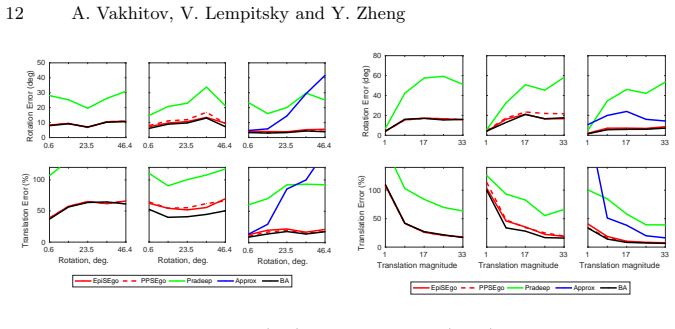
for the frame dropping experiment, see the paper for details. We present the trajectories for the KITTI sequences 6 (left) and 0 (right). The original pipeline loses track often. The modified pipeline tracks the full sequence. 1.3 Synthetic experiments We include here the results of two more synthetic experiments. In the first one we analyze a planar case, ...
discussion (0)
Sign in with ORCID, Apple, or X to comment. Anyone can read and Pith papers without signing in.