REVIEW 1 major objections 4 minor 171 references
Understanding Optical Music Recognition
T0 review · 1 major / 4 minor · reviewed 2026-08-14 · deepseek-v4-flash
Pith's one-line read This paper defines Optical Music Recognition as a research field that computationally reads music notation in documents, and organizes its applications into four levels of comprehension.
desk verdict A very good state-of-the-field paper whose four-part application taxonomy is genuinely useful, even though it is not entailed by the paper's own definition. read the letter →
The pith
A machine-rendered reading of the paper's core claim, the machinery that carries it, and where it could break.
The reading
What carries the argument
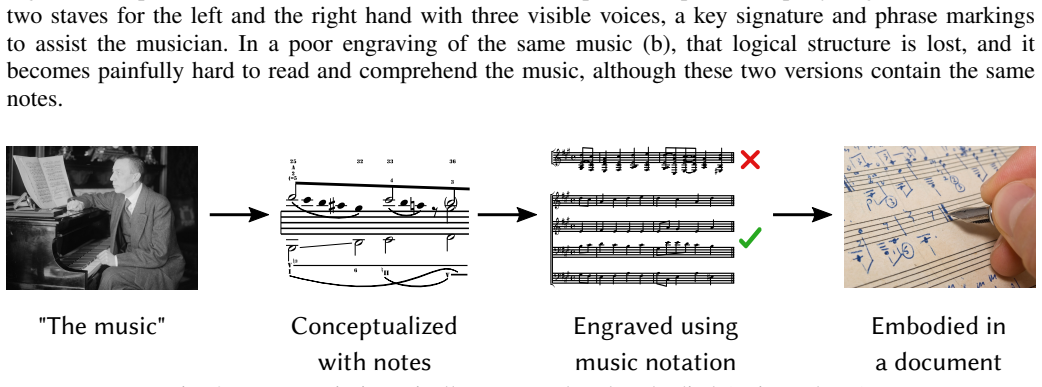
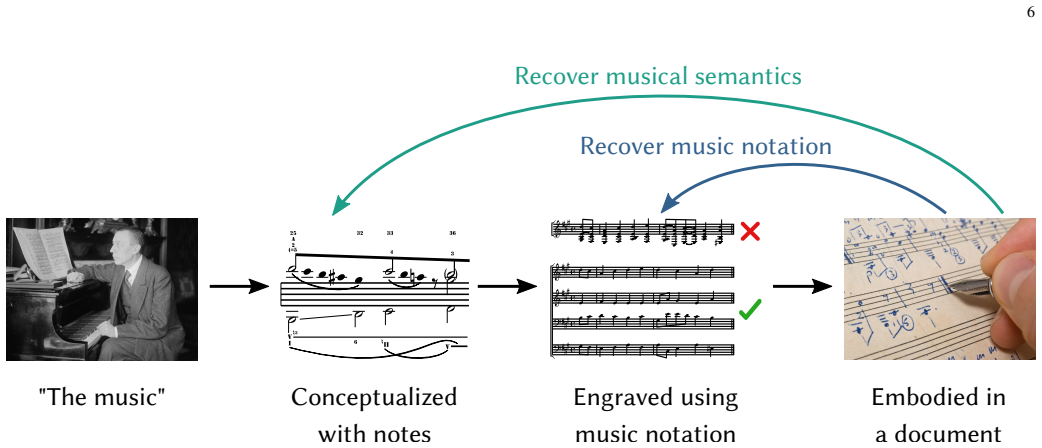
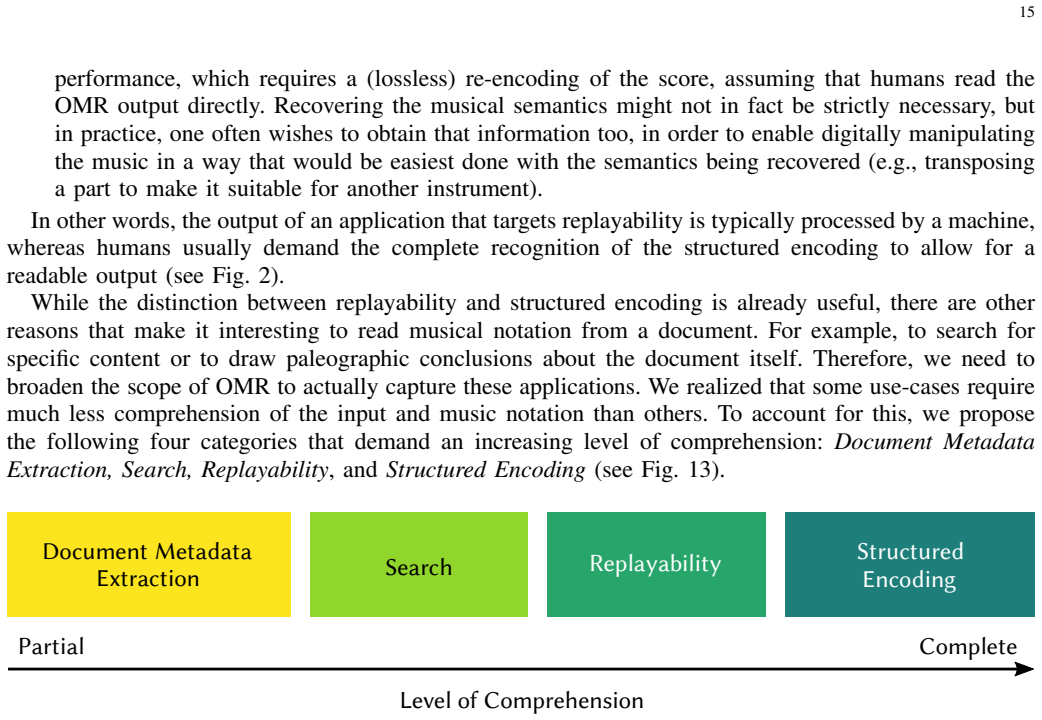
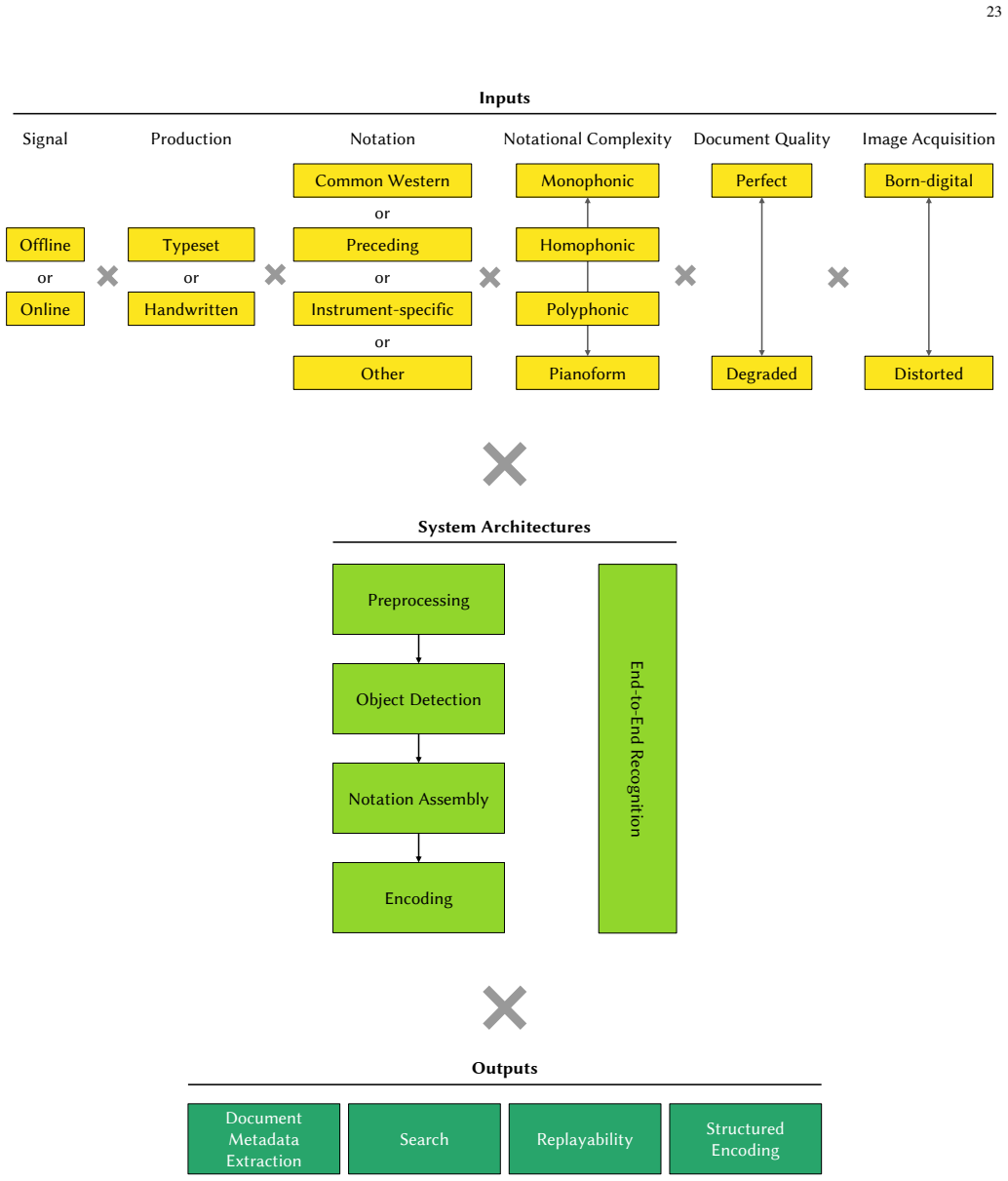
The load-bearing mechanism is the inverse-encoding model: music is conceptualized as notes in time, engraved with a notation system, and embodied in a document, and OMR runs this process backwards. The inversion splits into two prongs—recovering the notation itself and recovering the musical semantics—and the paper's four application categories are generated by how far back along this chain a system must go and how much comprehension is required. The level-of-comprehension ladder, from partial understanding for metadata extraction to complete understanding for structured encoding, is the organizing device that ties output representations to evaluation strategies.
What would settle it
Survey OMR papers from the past five years in the field's main venues and try to assign each paper's stated goal to exactly one of the four application categories; if a substantial share cannot be assigned uniquely, or if papers inside a single category report no common evaluation metric, then the taxonomy's promised shared evaluation protocols fail in practice.
Extended reading notes
Core claim
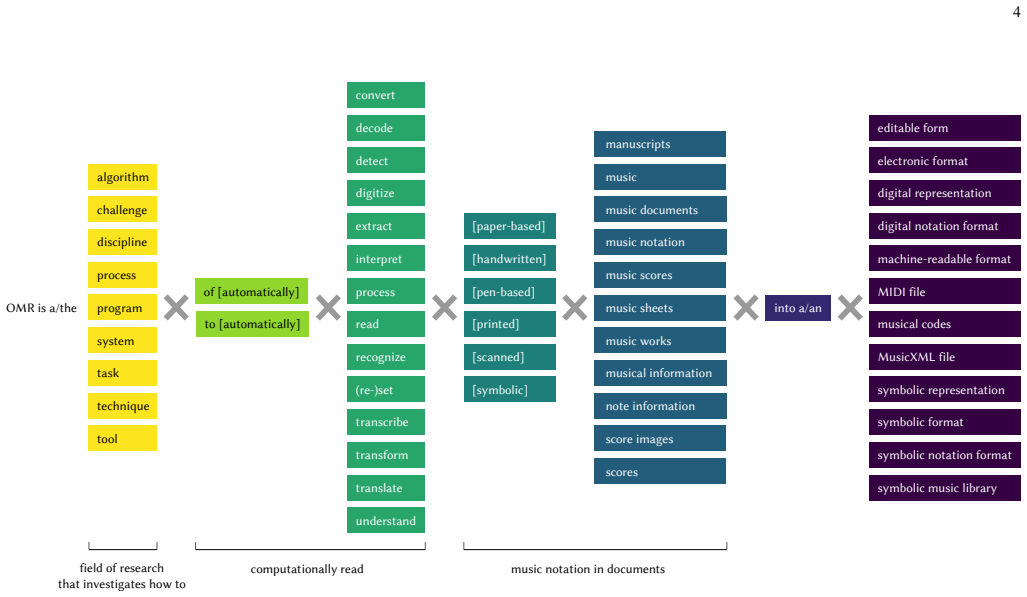
The central claim is that OMR is not a single task or process but a research field, defined as investigating how to computationally read music notation in documents. Reading itself has two distinct targets: recovering the music notation as laid out on the page, and recovering the musical semantics—pitches, velocities, onsets, and durations—encoded by that notation. Because these targets require different outputs and tolerate different errors, the paper argues OMR has at least four natural application classes: metadata extraction, search, replayability, and structured encoding, arranged by increasing comprehension. The taxonomy's practical point is that evaluation can be shared within each class: classification metrics for metadata, information-retrieval metrics for search, sequence comparison for replayability, and, once a formal model of notation exists, an intrinsic metric for structured encoding.
Load-bearing premise
The taxonomy rests on the assumption that reading a music document splits cleanly into recovering the notation and recovering the semantics, and that every real OMR application falls into exactly one of the four categories with a shared evaluation protocol.
Editorial extensions
If this is right
- The question 'Does OMR work?' becomes well-posed only when followed by a target application: metadata extraction, search, replayability, or structured encoding.
- Search applications can adopt standard information-retrieval metrics such as precision, recall, and mean average precision, since they output ranked matches to a musical query.
- Replayability systems can be evaluated by comparing pitch-onset-duration sequences, reusing symbolic melodic-similarity metrics from music information retrieval.
- Metadata extraction reduces to classification or regression and can be scored with accuracy or mean squared error.
- Structured encoding remains the hard case: without a formal model of music notation and an intrinsic edit distance between scores, no meaningful evaluation metric exists.
Reading between the lines
- The taxonomy implies that a single OMR system cannot be judged by one number; a system can be excellent for replayability yet useless for structured encoding, so the field should report results per application class.
- If search is defined by semantic queries rather than full transcription, then OMR systems for search can be trained to ignore notation details that do not affect retrieval, which may make them more error-tolerant than transcription-first pipelines.
- A natural next step would be a benchmark suite with one shared dataset and metric per application class; its absence would itself be evidence of the fragmentation the paper describes.
- Adopting the notation-versus-semantics distinction would let digital-musicology studies that only need musical semantics proceed without waiting for full structured encoding, since MIDI-level output suffices for many corpus-wide questions.
Signed reviews
Editorial analysis
A structured set of objections, weighed in public.
Referee Report
Summary. This manuscript is a tutorial and survey of Optical Music Recognition (OMR). It proposes a formal definition: OMR is a field of research that investigates how to computationally read music notation in documents (Definition 1). The paper then analyzes OMR as the process of inverting music encoding, distinguishing between recovering the music notation itself (stage A) and recovering musical semantics (stage B). On this basis, it proposes a taxonomy of OMR inputs, system architectures, and, most centrally, four application categories with increasing levels of comprehension: document metadata extraction, search, replayability, and structured encoding. The paper also reviews traditional pipeline-based approaches and deep learning alternatives, and it concludes with a list of open issues. The contributions are definitional and organizational rather than experimental, with a substantial curated bibliography provided as supplementary material.
Significance. If the definition and taxonomy are adopted by the community, this paper would materially improve the clarity, comparability, and accessibility of OMR research. The definition is carefully argued to capture the field's breadth while excluding non-OMR tasks, and the taxonomy provides a practical vocabulary for researchers and stakeholders. The paper's strength lies in its systematic organization, its concrete examples, and the extensible curated bibliography. The taxonomy is proposed pragmatically rather than proven from first principles, which is appropriate for a tutorial; this does not undermine the core definitional contribution but does leave room for clarification in the presentation.
major comments (1)
- [Section VI-B / Fig. 13] The four application categories are not derived from Definition 1 or from the A/B distinction presented in Section IV. The paper itself states that it "needed to broaden the scope" beyond the two prongs of Replayability and Structured Encoding to also include Search and Document Metadata Extraction. Moreover, the "level of comprehension" ordering in Fig. 13 is asserted rather than operationalized. Because the taxonomy is one of the paper's three headline contributions, the authors should make explicit that this is a practical systematization rather than a logical consequence of the definition, and they should discuss boundary cases such as query-by-example search, which may not require comprehension strictly between metadata extraction and replayability. A short paragraph acknowledging the heuristic nature of the ordering and pointing to possible alternative groupings would address this concern.
minor comments (4)
- [Abstract / Section I] The abstract refers to the paper as a "tutorial," while the opening of the full text says "In this work"; the wording should be aligned.
- [Fig. 13] The labels in Fig. 13 are difficult to parse in the current rendering; please ensure the figure is typeset clearly so that the four category names and the "Level of Comprehension" axis are legible.
- [Section VI-B2] Definition 3 says a musical query "must convey musical semantics," but the same section mentions image queries (query-by-example); please clarify whether image queries are interpreted semantically or are treated as raw visual patterns.
- [Section VI-B4] The paper frequently cites the authors' own prior work as illustrations; this is acceptable, but adding an explicit sentence that these works are used as examples of existing research rather than as evidence for the taxonomy would help the reader.
Circularity Check
No significant circularity: the definitions and taxonomy are argued proposals, not derivations that reduce to their own inputs.
full rationale
Walking the claimed derivation chain: Definition 1 is explicitly stipulative ('we would rather prefer to put an umbrella over OMR and name its essence by proposing the following definition'), and the later claims are structural analyses of that definition plus proposed classifications. Section IV derives two readings of 'read' (recover notation vs. recover semantics) from the writing/reading process, and Section VI-B maps Replayability and Structured Encoding onto those prongs; crucially, the paper itself states that it 'need[s] to broaden the scope of OMR' before adding Document Metadata Extraction and Search, which is an admission that the four-category taxonomy is not entailed by the two-prong analysis alone. The ordering by 'level of comprehension' is an argued proposal rather than a fitted or constructed consequence of Definition 1, so any weakness in that ordering is a support or evidence gap, not circularity. The paper's self-citations ([30], [81], [83], [119]) serve as pointers to prior workshops, baseline benchmarks, and one author's evaluation argument; none functions as an unverified uniqueness theorem or smuggled ansatz, and the intrinsic-evaluation recommendation is accompanied by fresh reasoning in the same section. No parameter is fitted and then relabeled as a prediction, and no equation or output representation is equivalent by construction to an input. Verdict: no significant circularity.
Assumptions & free parameters
assumptions (5)
- domain assumption Music is conceptualized as a structure of notes in time, defined by pitch, duration, loudness, timbre, and onset.
- domain assumption OMR ends where performers start to disagree over the same piece of music; music notation under-specifies interpretation.
- domain assumption Reading music notation can be decomposed into recovering notation (A) versus recovering musical semantics (B).
- ad hoc to paper The four proposed application categories (metadata extraction, search, replayability, structured encoding) are natural groups with increasing comprehension and shared evaluation protocols.
- domain assumption Recent deep learning advances have moved some OMR subtasks from 'hard' to 'clearly solvable', making broader applications practical.
Cite this review
Pith. "Pith review of Understanding Optical Music Recognition." pith.science (2026). https://pith.science/paper/ZJQKFCHJ
@misc{pith2026190803608,
  author       = {Pith},
  title        = {Pith review of: Understanding Optical Music Recognition},
  year         = {2026},
  howpublished = {\url{https://pith.science/paper/ZJQKFCHJ}},
  note         = {Machine review of arXiv:1908.03608}
}
read the original abstract
For over 50 years, researchers have been trying to teach computers to read music notation, referred to as Optical Music Recognition (OMR). However, this field is still difficult to access for new researchers, especially those without a significant musical background: few introductory materials are available, and furthermore the field has struggled with defining itself and building a shared terminology. In this tutorial, we address these shortcomings by (1) providing a robust definition of OMR and its relationship to related fields, (2) analyzing how OMR inverts the music encoding process to recover the musical notation and the musical semantics from documents, (3) proposing a taxonomy of OMR, with most notably a novel taxonomy of applications. Additionally, we discuss how deep learning affects modern OMR research, as opposed to the traditional pipeline. Based on this work, the reader should be able to attain a basic understanding of OMR: its objectives, its inherent structure, its relationship to other fields, the state of the art, and the research opportunities it affords.
Figures
Figures from the paper (12 more)

Reference graph
Works this paper leans on
-
[1]
Music search engine from noisy OMR data
Sanu Pulimootil Achankunju. Music search engine from noisy OMR data. In 1st International Workshop on Reading Music Systems , pages 23–24, Paris, France, 2018
2018
-
[2]
Mobile system for optical music recognition and music sound generation
Julia Adamska, Mateusz Piecuch, Mateusz Podgórski, Piotr Walkiewicz, and Ewa Lukasik. Mobile system for optical music recognition and music sound generation. In Computer Information Systems and Industrial Management , pages 571–582, Cham, 2015. Springer International Publishing
2015
-
[3]
An integrated grammar-based approach for mathematical expression recognition
Francisco Álvaro, Joan-Andreu Sánchez, and José-Miguel Benedí. An integrated grammar-based approach for mathematical expression recognition. Pattern Recognition, 51:135–147, 2016
2016
-
[4]
On automatic pattern recognition and acquisition of printed music
Alfio Andronico and Alberto Ciampa. On automatic pattern recognition and acquisition of printed music. In International Computer Music Conference, Venice, Italy, 1982. Michigan Publishing. 26
1982
-
[5]
Gocen: A handwritten notational interface for musical performance and learning music
Tetsuaki Baba, Yuya Kikukawa, Toshiki Yoshiike, Tatsuhiko Suzuki, Rika Shoji, Kumiko Kushiyama, and Makoto Aoki. Gocen: A handwritten notational interface for musical performance and learning music. In ACM SIGGRAPH 2012 Emerging Technologies , pages 9–9, New York, USA, 2012. ACM
2012
-
[6]
Dealing with superimposed objects in optical music recognition
David Bainbridge and Tim Bell. Dealing with superimposed objects in optical music recognition. In 6th International Conference on Image Processing and its Applications , number 443, pages 756–760, 1997
1997
-
[7]
The challenge of optical music recognition
David Bainbridge and Tim Bell. The challenge of optical music recognition. Computers and the Humanities , 35(2):95–121, 2001
2001
-
[8]
A music notation construction engine for optical music recognition
David Bainbridge and Tim Bell. A music notation construction engine for optical music recognition. Software: Practice and Experience, 33(2):173–200, 2003
2003
Show all 171 references
-
[9]
Identifying music documents in a collection of images
David Bainbridge and Tim Bell. Identifying music documents in a collection of images. In 7th International Conference on Music Information Retrieval, pages 47–52, Victoria, Canada, 2006
2006
-
[10]
Matching musical themes based on noisy OCR and OMR input
Stefan Balke, Sanu Pulimootil Achankunju, and Meinard Müller. Matching musical themes based on noisy OCR and OMR input. In International Conference on Acoustics, Speech and Signal Processing, pages 703–707. Institute of Electrical and Electronics Engineers Inc., 2015
2015
-
[11]
Optical music recognition by recurrent neural networks
Arnau Baró, Pau Riba, Jorge Calvo-Zaragoza, and Alicia Fornés. Optical music recognition by recurrent neural networks. In 14th International Conference on Document Analysis and Recognition , pages 25–26, Kyoto, Japan, 2017. IEEE
2017
-
[12]
Towards the recognition of compound music notes in handwritten music scores
Arnau Baró, Pau Riba, and Alicia Fornés. Towards the recognition of compound music notes in handwritten music scores. In 15th International Conference on Frontiers in Handwriting Recognition , pages 465–470. Institute of Electrical and Electronics Engineers Inc., 2016
2016
-
[13]
A starting point for handwritten music recognition
Arnau Baró, Pau Riba, and Alicia Fornés. A starting point for handwritten music recognition. In 1st International Workshop on Reading Music Systems , pages 5–6, Paris, France, 2018
2018
-
[14]
Louis W. G. Barton. The NEUMES project: digital transcription of medieval chant manuscripts. In 2nd International Conference on Web Delivering of Music , pages 211–218, 2002
2002
-
[15]
A simplified attributed graph grammar for high-level music recognition
Stephan Baumann. A simplified attributed graph grammar for high-level music recognition. In 3rd International Conference on Document Analysis and Recognition , pages 1080–1083. IEEE, 1995
1995
-
[16]
Transforming printed piano music into MIDI
Stephan Baumann and Andreas Dengel. Transforming printed piano music into MIDI. In Advances in Structural and Syntactic Pattern Recognition, pages 363–372. World Scientific, 1992
1992
-
[17]
Ehmann, and J
Mert Bay, Andreas F. Ehmann, and J. Stephen Downie. Evaluation of multiple-f0 estimation and tracking systems. In 10th International Society for Music Information Retrieval Conference , pages 315–320, Kobe, Japan, 2009
2009
-
[18]
Optical music sheet segmentation
Pierfrancesco Bellini, Ivan Bruno, and Paolo Nesi. Optical music sheet segmentation. In 1st International Conference on WEB Delivering of Music , pages 183–190. Institute of Electrical & Electronics Engineers (IEEE), 2001
2001
-
[19]
Assessing optical music recognition tools
Pierfrancesco Bellini, Ivan Bruno, and Paolo Nesi. Assessing optical music recognition tools. Computer Music Journal, 31(1):68–93, 2007
2007
-
[20]
Digital image archive of medieval music
Margaret Bent and Andrew Wathey. Digital image archive of medieval music. https://www.diamm.ac.uk, 1998
1998
-
[21]
Audiveris
Hervé Bitteur. Audiveris. https://github.com/audiveris, 2004
2004
-
[22]
Dorothea Blostein and Henry S. Baird. A critical survey of music image analysis. In Structured Document Image Analysis , pages 405–434. Springer Berlin Heidelberg, 1992
1992
-
[23]
Recognition of music notation: Sspr’90 working group report
Dorothea Blostein and Nicholas Paul Carter. Recognition of music notation: Sspr’90 working group report. In Structured Document Image Analysis, pages 573–574. Springer Berlin Heidelberg, 1992
1992
-
[24]
Justification of printed music
Dorothea Blostein and Lippold Haken. Justification of printed music. Communications of the ACM , 34(3):88–99, 1991
1991
-
[25]
Enhanced bleedthrough correction for early music documents with recto-verso registration
John Ashley Burgoyne, Johanna Devaney, Laurent Pugin, and Ichiro Fujinaga. Enhanced bleedthrough correction for early music documents with recto-verso registration. In 9th International Conference on Music Information Retrieval, pages 407–412, Philadelphia, PA, 2008
2008
-
[26]
Stephen Downie
John Ashley Burgoyne, Ichiro Fujinaga, and J. Stephen Downie. Music information retrieval. In A New Companion to Digital Humanities, pages 213–228. Wiley Blackwell, 2015
2015
-
[27]
A music representation requirement specification for academia
Donald Byrd and Eric Isaacson. A music representation requirement specification for academia. Technical report, Indiana University, Bloomington, 2016
2016
-
[28]
Prospects for improving OMR with multiple recognizers
Donald Byrd and Megan Schindele. Prospects for improving OMR with multiple recognizers. In 7th International Conference on Music Information Retrieval , pages 41–46, 2006
2006
-
[29]
Towards a standard testbed for optical music recognition: Definitions, metrics, and page images
Donald Byrd and Jakob Grue Simonsen. Towards a standard testbed for optical music recognition: Definitions, metrics, and page images. Journal of New Music Research , 44(3):169–195, 2015
2015
-
[30]
Discussion group summary: Optical music recognition
Jorge Calvo-Zaragoza, Jan Haji ˇc jr., and Alexander Pacha. Discussion group summary: Optical music recognition. In Graphics Recognition, Current Trends and Evolutions , Lecture Notes in Computer Science, pages 152–157. Springer International Publishing, 2018
2018
-
[31]
Recognition of pen-based music notation: The HOMUS dataset
Jorge Calvo-Zaragoza and Jose Oncina. Recognition of pen-based music notation: The HOMUS dataset. In 22nd International Conference on Pattern Recognition , pages 3038–3043. Institute of Electrical & Electronics Engineers (IEEE), 2014
2014
-
[32]
Camera-primus: Neural end-to-end optical music recognition on realistic monophonic scores
Jorge Calvo-Zaragoza and David Rizo. Camera-primus: Neural end-to-end optical music recognition on realistic monophonic scores. In 19th International Society for Music Information Retrieval Conference , pages 248–255, Paris, France, 2018
2018
-
[33]
End-to-end neural optical music recognition of monophonic scores
Jorge Calvo-Zaragoza and David Rizo. End-to-end neural optical music recognition of monophonic scores. Applied Sciences , 8(4), 2018
2018
-
[34]
Handwritten music recognition for mensural notation: Formulation, data and baseline results
Jorge Calvo-Zaragoza, Alejandro Toselli, and Enrique Vidal. Handwritten music recognition for mensural notation: Formulation, data and baseline results. In 14th International Conference on Document Analysis and Recognition , pages 1081–1086, Kyoto, Japan, 2017
2017
-
[35]
Toselli, and Enrique Vidal
Jorge Calvo-Zaragoza, Alejandro H. Toselli, and Enrique Vidal. Probabilistic music-symbol spotting in handwritten scores. In 16th International Conference on Frontiers in Handwriting Recognition , pages 558–563, Niagara Falls, USA, 2018
2018
-
[36]
Cancino-Chacón, Maarten Grachten, Werner Goebl, and Gerhard Widmer
Carlos E. Cancino-Chacón, Maarten Grachten, Werner Goebl, and Gerhard Widmer. Computational models of expressive music performance: A comprehensive and critical review. Frontiers in Digital Humanities , 5:25, 2018. 27
2018
-
[37]
Capella scan
capella-software AG. Capella scan. https://www.capella-software.com, 1996
1996
-
[38]
A new edition of walton’s façade using automatic score recognition
Nicholas Paul Carter. A new edition of walton’s façade using automatic score recognition. In Advances in Structural and Syntactic Pattern Recognition, pages 352–362. World Scientific, 1992
1992
-
[39]
An optical music recognition system for traditional chinese kunqu opera scores written in gong-che notation
Gen-Fang Chen and Jia-Shing Sheu. An optical music recognition system for traditional chinese kunqu opera scores written in gong-che notation. EURASIP Journal on Audio, Speech, and Music Processing , 2014(1):7, 2014
2014
-
[40]
Midi-assisted egocentric optical music recognition
Liang Chen and Kun Duan. Midi-assisted egocentric optical music recognition. In Winter Conference on Applications of Computer Vision. Institute of Electrical and Electronics Engineers Inc., 2016
2016
-
[41]
Renotation from optical music recognition
Liang Chen, Rong Jin, and Christopher Raphael. Renotation from optical music recognition. In Mathematics and Computation in Music, pages 16–26, Cham, 2015. Springer International Publishing
2015
-
[42]
Human-guided recognition of music score images
Liang Chen, Rong Jin, and Christopher Raphael. Human-guided recognition of music score images. In 4th International Workshop on Digital Libraries for Musicology . ACM Press, 2017
2017
-
[43]
Optical music recognition and human-in-the-loop computation
Liang Chen and Christopher Raphael. Optical music recognition and human-in-the-loop computation. In 1st International Workshop on Reading Music Systems , pages 11–12, Paris, France, 2018
2018
-
[44]
Atul K. Chhabra. Graphic symbol recognition: An overview. In Graphics Recognition Algorithms and Systems , pages 68–79, Berlin, Heidelberg, 1998. Springer Berlin Heidelberg
1998
-
[45]
Sainath, Yonghui Wu, Rohit Prabhavalkar, Patrick Nguyen, Zhifeng Chen, Anjuli Kannan, Ron J
Chung-Cheng Chiu, Tara N. Sainath, Yonghui Wu, Rohit Prabhavalkar, Patrick Nguyen, Zhifeng Chen, Anjuli Kannan, Ron J. Weiss, Kanishka Rao, Ekaterina Gonina, Navdeep Jaitly, Bo Li, Jan Chorowski, and Michiel Bacchiani. State-of-the-art speech recognition with sequence-to-seque...
2018
-
[46]
Bootstrapping samples of accidentals in dense piano scores for CNN-based detection
Kwon-Young Choi, Bertrand Coüasnon, Yann Ricquebourg, and Richard Zanibbi. Bootstrapping samples of accidentals in dense piano scores for CNN-based detection. In 14th International Conference on Document Analysis and Recognition , Kyoto, Japan, 2017. IAPR TC10 (Technical Commi...
2017
-
[47]
Sayeed Choudhury, M
G. Sayeed Choudhury, M. Droetboom, Tim DiLauro, Ichiro Fujinaga, and Brian Harrington. Optical music recognition system within a large-scale digitization project. In 1st International Symposium on Music Information Retrieval , 2000
2000
-
[48]
An efficient end-to-end neural model for handwritten text recognition
Arindam Chowdhury and Lovekesh Vig. An efficient end-to-end neural model for handwritten text recognition. In 29th British Machine Vision Conference, 2018
2018
-
[49]
Using grammars to segment and recognize music scores
Bertrand Coüasnon and Jean Camillerapp. Using grammars to segment and recognize music scores. In International Association for Pattern Recognition Workshop on Document Analysis Systems , pages 15–27, Kaiserslautern, Germany, 1994
1994
-
[50]
Searching page-images of early music scanned with omr: A scalable solution using minimal absent words
Tim Crawford, Golnaz Badkobeh, and David Lewis. Searching page-images of early music scanned with omr: A scalable solution using minimal absent words. In 19th International Society for Music Information Retrieval Conference , pages 233–239, Paris, France, 2018
2018
-
[51]
Michalakis, and Christine Pranzas
Christoph Dalitz, Georgios K. Michalakis, and Christine Pranzas. Optical recognition of psaltic byzantine chant notation. International Journal of Document Analysis and Recognition , 11(3):143–158, 2008
2008
-
[52]
Innovative mir applications at the bayerische staatsbibliothek
Jürgen Diet. Innovative mir applications at the bayerische staatsbibliothek. In 5th International Conference on Digital Libraries for Musicology, Paris, France, 2018
2018
-
[53]
Optical music recognition of the singer using formant frequency estimation of vocal fold vibration and lip motion with interpolated gmm classifiers
Ing-Jr Ding, Chih-Ta Yen, Che-Wei Chang, and He-Zhong Lin. Optical music recognition of the singer using formant frequency estimation of vocal fold vibration and lip motion with interpolated gmm classifiers. Journal of Vibroengineering, 16(5):2572–2581, 2014
2014
-
[54]
Learning audio–sheet music correspondences for cross-modal retrieval and piece identification
Matthias Dorfer, Jan Haji ˇc jr., Andreas Arzt, Harald Frostel, and Gerhard Widmer. Learning audio–sheet music correspondences for cross-modal retrieval and piece identification. Transactions of the International Society for Music Information Retrieval , 1(1):22–33, 2018
2018
-
[55]
Matthew J. Dovey. Overview of the OMRAS project: Online music retrieval and searching. Journal of the American Society for Information Science and Technology , 55(12):1100–1107, 2004
2004
-
[56]
Fahmy and Dorothea Blostein
Hoda M. Fahmy and Dorothea Blostein. A graph grammar programming style for recognition of music notation. Machine Vision and Applications, 6(2):83–99, 1993
1993
-
[57]
Berklee Contemporary Music Notation
Jonathan Feist. Berklee Contemporary Music Notation . Berklee Press, 2017
2017
-
[58]
Graphics Recognition, Current Trends and Evolutions , volume 11009 of Lecture Notes in Computer Science
Alicia Fornés and Lamiroy Bart, editors. Graphics Recognition, Current Trends and Evolutions , volume 11009 of Lecture Notes in Computer Science. Springer International Publishing, 2018
2018
-
[59]
The ICDAR 2011 music scores competition: Staff removal and writer identification
Alicia Fornés, Anjan Dutta, Albert Gordo, and Josep Llados. The ICDAR 2011 music scores competition: Staff removal and writer identification. In International Conference on Document Analysis and Recognition , pages 1511–1515, 2011
2011
-
[60]
CVC-MUSCIMA: A ground-truth of handwritten music score images for writer identification and staff removal
Alicia Fornés, Anjan Dutta, Albert Gordo, and Josep Lladós. CVC-MUSCIMA: A ground-truth of handwritten music score images for writer identification and staff removal. International Journal on Document Analysis and Recognition , 15(3):243–251, 2012
2012
-
[61]
Primitive segmentation in old handwritten music scores
Alicia Fornés, Josep Lladós, and Gemma Sánchez. Primitive segmentation in old handwritten music scores. In Graphics Recognition. Ten Years Review and Future Perspectives , pages 279–290, Berlin, Heidelberg, 2006. Springer Berlin Heidelberg
2006
-
[62]
Old handwritten musical symbol classification by a dynamic time warping based method
Alicia Fornés, Josep Lladós, and Gemma Sánchez. Old handwritten musical symbol classification by a dynamic time warping based method. In Graphics Recognition. Recent Advances and New Opportunities , pages 51–60, Berlin, Heidelberg, 2008. Springer Berlin Heidelberg
2008
-
[63]
Writer identification in old handwritten music scores
Alicia Fornés, Josep Lladós, Gemma Sánchez, and Horst Bunke. Writer identification in old handwritten music scores. In 8th International Workshop on Document Analysis Systems , pages 347–353, Nara, Japan, 2008
2008
-
[64]
On the use of textural features for writer identification in old handwritten music scores
Alicia Fornés, Josep Lladós, Gemma Sánchez, and Horst Bunke. On the use of textural features for writer identification in old handwritten music scores. 10th International Conference on Document Analysis and Recognition , pages 996–1000, 2009
2009
-
[65]
An optical notation recognition system for printed music based on template matching and high level reasoning
Stavroula-Evita Fotinea, George Giakoupis, Aggelos Livens, Stylianos Bakamidis, and George Carayannis. An optical notation recognition system for printed music based on template matching and high level reasoning. In RIAO ’00 Content-Based Multimedia Information Access, pages 1...
2000
-
[66]
Automatic mapping of scanned sheet music to audio recordings
Christian Fremerey, Meinard Müller, Frank Kurth, and Michael Clausen. Automatic mapping of scanned sheet music to audio recordings. In 9th International Conference on Music Information Retrieval , pages 413–418, 2008
2008
-
[67]
Optical music recognition using projections
Ichiro Fujinaga. Optical music recognition using projections. Master’s thesis, McGill University, 1988
1988
-
[68]
Simssa: Single interface for music score searching and analysis
Ichiro Fujinaga and Andrew Hankinson. Simssa: Single interface for music score searching and analysis. Journal of the Japanese Society for Sonic Arts , 6(3):25–30, 2014
2014
-
[69]
Ichiro Fujinaga, Andrew Hankinson, and Julie E. Cumming. Introduction to SIMSSA (single interface for music score searching and analysis). In 1st International Workshop on Digital Libraries for Musicology , pages 1–3. ACM, 2014
2014
-
[70]
Staff-line removal with selectional auto-encoders
Antonio-Javier Gallego and Jorge Calvo-Zaragoza. Staff-line removal with selectional auto-encoders. Expert Systems with Applications, 89:138–148, 2017
2017
-
[71]
iseenotes
Gear Up AB. iseenotes. http://www.iseenotes.com, 2017
2017
-
[72]
Susan E. George. Online pen-based recognition of music notation with artificial neural networks. Computer Music Journal, 27(2):70– 79, 2003
2003
-
[73]
Susan E. George. Wavelets for dealing with super-imposed objects in recognition of music notation. In Visual Perception of Music Notation: On-Line and Off Line Recognition , pages 78–107. IRM Press, Hershey, PA, 2004
2004
-
[74]
Giotis, Giorgos Sfikas, Basilis Gatos, and Christophoros Nikou
Angelos P. Giotis, Giorgos Sfikas, Basilis Gatos, and Christophoros Nikou. A survey of document image word spotting techniques. Pattern Recognition, 68:310–332, 2017
2017
-
[75]
MusicXML: An internet-friendly format for sheet music
Michael Good. MusicXML: An internet-friendly format for sheet music. Technical report, Recordare LLC, 2001
2001
-
[76]
Using MusicXML for file interchange
Michael Good and Geri Actor. Using MusicXML for file interchange. In Third International Conference on WEB Delivering of Music, page 153, 2003
2003
-
[77]
Writer identification in handwritten musical scores with bags of notes
Albert Gordo, Alicia Fornés, and Ernest Valveny. Writer identification in handwritten musical scores with bags of notes. Pattern Recognition, 46(5):1337–1345, 2013
2013
-
[78]
Scores of scores: An openscore project to encode and share sheet music
Mark Gotham, Peter Jonas, Bruno Bower, William Bosworth, Daniel Rootham, and Leigh VanHandel. Scores of scores: An openscore project to encode and share sheet music. In 5th International Conference on Digital Libraries for Musicology , pages 87–95, Paris, France, 2018. ACM
2018
-
[79]
Behind Bars
Elaine Gould. Behind Bars. Faber Music, 2011
2011
-
[80]
OMRJX: A framework for piano scores optical music recognition
Gianmarco Gozzi. OMRJX: A framework for piano scores optical music recognition. Master’s thesis, Politecnico di Milano, 2010
2010
-
[81]
A case for intrinsic evaluation of optical music recognition
Jan Haji ˇc jr. A case for intrinsic evaluation of optical music recognition. In 1st International Workshop on Reading Music Systems , pages 15–16, Paris, France, 2018
2018
-
[82]
Towards full-pipeline handwritten OMR with musical symbol detection by u-nets
Jan Haji ˇc jr., Matthias Dorfer, Gerhard Widmer, and Pavel Pecina. Towards full-pipeline handwritten OMR with musical symbol detection by u-nets. In 19th International Society for Music Information Retrieval Conference , pages 225–232, Paris, France, 2018
2018
-
[83]
How current optical music recognition systems are becoming useful for digital libraries
Jan Haji ˇc jr., Marta Kolárová, Alexander Pacha, and Jorge Calvo-Zaragoza. How current optical music recognition systems are becoming useful for digital libraries. In 5th International Conference on Digital Libraries for Musicology , pages 57–61, Paris, France,
-
[84]
Further steps towards a standard testbed for optical music recognition
Jan Haji ˇc jr., Jiˇrí Novotný, Pavel Pecina, and Jaroslav Pokorný. Further steps towards a standard testbed for optical music recognition. In 17th International Society for Music Information Retrieval Conference, pages 157–163, New York, USA, 2016. New York University, New Yo...
2016
-
[85]
and Pavel Pecina
Jan Haji ˇc jr. and Pavel Pecina. Groundtruthing (not only) music notation with MUSICMarker: A practical overview. In 14th International Conference on Document Analysis and Recognition , pages 47–48, Kyoto, Japan, 2017
2017
-
[86]
and Pavel Pecina
Jan Haji ˇc jr. and Pavel Pecina. The MUSCIMA++ dataset for handwritten optical music recognition. In 14th International Conference on Document Analysis and Recognition , pages 39–46, Kyoto, Japan, 2017
2017
-
[87]
Information Retrieval Evaluation
Donna Harman. Information Retrieval Evaluation . Morgan & Claypool Publishers, 1st edition, 2011
2011
-
[88]
Optical music recognition and manuscript chant sources
Kate Helsen, Jennifer Bain, Ichiro Fujinaga, Andrew Hankinson, and Debra Lacoste. Optical music recognition and manuscript chant sources. Early Music, 42(4):555–558, 2014
2014
-
[89]
The Norton Manual of Music Notation
George Heussenstamm. The Norton Manual of Music Notation . W. W. Norton & Company, 1987
1987
-
[90]
Automatic recognition of printed music and its conversion into playable music data
Władysław Homenda. Automatic recognition of printed music and its conversion into playable music data. Control and Cybernetics, 25(2):353–367, 1996
1996
-
[91]
Automatic handwritten mensural notation interpreter: From manuscript to MIDI performance
Yu-Hui Huang, Xuanli Chen, Serafina Beck, David Burn, and Luc Van Gool. Automatic handwritten mensural notation interpreter: From manuscript to MIDI performance. In 16th International Society for Music Information Retrieval Conference , pages 79–85, Málaga, Spain, 2015
2015
-
[92]
Ponce de León, David Rizo, José Oncina, Luisa Micó, Juan Ramón Rico-Juan, Carlos Pérez-Sancho, and Antonio Pertusa
José Manuel Iñesta, Pedro J. Ponce de León, David Rizo, José Oncina, Luisa Micó, Juan Ramón Rico-Juan, Carlos Pérez-Sancho, and Antonio Pertusa. Hispamus: Handwritten spanish music heritage preservation by automatic transcription. In 1st International Workshop on Reading Music...
2018
-
[93]
Optical music recognition
Linn Saxrud Johansen. Optical music recognition. Master’s thesis, University of Oslo, 2009
2009
-
[94]
Optical music imaging: Music document digitisation, recognition, evaluation, and restoration
Graham Jones, Bee Ong, Ivan Bruno, and Kia Ng. Optical music imaging: Music document digitisation, recognition, evaluation, and restoration. In Interactive multimedia music technologies , pages 50–79. IGI Global, 2008
2008
-
[95]
DocCreator: A new software for creating synthetic ground-truthed document images
Nicholas Journet, Muriel Visani, Boris Mansencal, Kieu Van-Cuong, and Antoine Billy. DocCreator: A new software for creating synthetic ground-truthed document images. Journal of Imaging , 3(4):62, 2017
2017
-
[96]
Optical character-recognition of printed music : A review of two dissertations
Michael Kassler. Optical character-recognition of printed music : A review of two dissertations. automatic recognition of sheet music by dennis howard pruslin ; computer pattern recognition of standard engraved music notation by david stewart prerau. Perspectives of New Music ...
1972
-
[97]
Klaus Keil and Jennifer A. Ward. Applications of RISM data in digital libraries and digital musicology. International Journal on Digital Libraries, 2017
2017
-
[98]
Issues in ground-truthing graphic documents
Daniel Lopresti and George Nagy. Issues in ground-truthing graphic documents. In Graphics Recognition Algorithms and Applications, pages 46–67. Springer Berlin Heidelberg, Ontario, Canada, 2002. 29
2002
-
[99]
Optical music recognition on android platform
Nawapon Luangnapa, Thongchai Silpavarangkura, Chakarida Nukoolkit, and Pornchai Mongkolnam. Optical music recognition on android platform. In International Conference on Advances in Information Technology , pages 106–115. Springer, 2012
2012
-
[100]
Handwritten musical document retrieval using music-score spotting
Rakesh Malik, Partha Pratim Roy, Umapada Pal, and Fumitaka Kimura. Handwritten musical document retrieval using music-score spotting. In 12th International Conference on Document Analysis and Recognition , pages 832–836, 2013
2013
-
[101]
Manning, Prabhakar Raghavan, and Hinrich Schütze
Chirstopher D. Manning, Prabhakar Raghavan, and Hinrich Schütze. Introduction to Information Retrieval . Cambridge University Press, 2008
2008
-
[102]
Matsushima, I
T. Matsushima, I. Sonomoto, T. Harada, K. Kanamori, and S. Ohteru. Automated high speed recognition of printed music (W ABOT-2 vision system). In International Conference on Advanced Robotics , pages 477–482, 1985
1985
-
[103]
Der vollkommene Capellmeister
Johann Mattheson. Der vollkommene Capellmeister . Herold, Christian, Hamburg, 1739
-
[104]
Mehta and Malay S
Apurva A. Mehta and Malay S. Bhatt. Optical music notes recognition for printed piano music score sheet. In International Conference on Computer Communication and Informatics , Coimbatore, India, 2015
2015
-
[105]
Format of ground truth data used in the evaluation of the results of an optical music recognition system
Hidetoshi Miyao and Robert Martin Haralick. Format of ground truth data used in the evaluation of the results of an optical music recognition system. In 4th International Workshop on Document Analysis Systems , pages 497–506, Brasil, 2000
2000
-
[106]
Smartscore x2
Musitek. Smartscore x2. http://www.musitek.com/smartscore-pro.html, 2017
2017
-
[107]
Notateme
Neuratron. Notateme. http://www.neuratron.com/notateme.html, 2015
2015
-
[108]
Photoscore 2018
Neuratron. Photoscore 2018. http://www.neuratron.com/photoscore.htm, 2018
2018
-
[109]
Big data optical music recognition with multi images and multi recognisers
Kia Ng, Alex McLean, and Alan Marsden. Big data optical music recognition with multi images and multi recognisers. In EVA London 2014 on Electronic Visualisation and the Arts , pages 215–218. BCS, 2014
2014
-
[110]
A lightweight and effective music score recognition on mobile phones
Tam Nguyen and Gueesang Lee. A lightweight and effective music score recognition on mobile phones. Journal of Information Processing Systems, 11(3):438–449, 2015
2015
-
[111]
Introduction to optical music recognition: Overview and practical challenges
Jiri Novotn `y and Jaroslav Pokorn `y. Introduction to optical music recognition: Overview and practical challenges. In Annual International Workshop on DAtabases, TExts, Specifications and Objects , pages 65–76. CEUR-WS, 2015
2015
-
[112]
Playscore
Organum. Playscore. http://www.playscore.co, 2016
2016
-
[113]
Choral public domain library
Rafael Ornes. Choral public domain library. http://cpdl.org, 1998
1998
-
[114]
Digitisation and digital library presentation system – sheet music to the mix
Tuula Pääkkönen, Jukka Kervinen, and Kimmo Kettunen. Digitisation and digital library presentation system – sheet music to the mix. In 1st International Workshop on Reading Music Systems , pages 21–22, Paris, France, 2018
2018
-
[115]
Advancing omr as a community: Best practices for reproducible research
Alexander Pacha. Advancing omr as a community: Best practices for reproducible research. In 1st International Workshop on Reading Music Systems, pages 19–20, Paris, France, 2018
2018
-
[116]
Optical music recognition in mensural notation with region-based convolutional neural networks
Alexander Pacha and Jorge Calvo-Zaragoza. Optical music recognition in mensural notation with region-based convolutional neural networks. In 19th International Society for Music Information Retrieval Conference , pages 240–247, Paris, France, 2018
2018
-
[117]
Handwritten music object detection: Open issues and baseline results
Alexander Pacha, Kwon-Young Choi, Bertrand Coüasnon, Yann Ricquebourg, Richard Zanibbi, and Horst Eidenberger. Handwritten music object detection: Open issues and baseline results. In 13th International Workshop on Document Analysis Systems , pages 163–168, 2018
2018
-
[118]
Towards a universal music symbol classifier
Alexander Pacha and Horst Eidenberger. Towards a universal music symbol classifier. In 14th International Conference on Document Analysis and Recognition , pages 35–36, Kyoto, Japan, 2017. IAPR TC10 (Technical Committee on Graphics Recognition), IEEE Computer Society
2017
-
[119]
A baseline for general music object detection with deep learning
Alexander Pacha, Jan Haji ˇc jr., and Jorge Calvo-Zaragoza. A baseline for general music object detection with deep learning. Applied Sciences, 8(9):1488–1508, 2018
2018
-
[120]
Improving omr for digital music libraries with multiple recognisers and multiple sources
Victor Padilla, Alan Marsden, Alex McLean, and Kia Ng. Improving omr for digital music libraries with multiple recognisers and multiple sources. In 1st International Workshop on Digital Libraries for Musicology , pages 1–8, London, United Kingdom, 2014. ACM
2014
-
[121]
The seils dataset: Symbolically encoded scores in modern- early notation for computational musicology
Emilia Parada-Cabaleiro, Anton Batliner, Alice Baird, and Björn Schuller. The seils dataset: Symbolically encoded scores in modern- early notation for computational musicology. In 18th International Society for Music Information Retrieval Conference , Suzhou, China, 2017
2017
-
[122]
Virtual music teacher for new music learners with optical music recognition
Viet-Khoi Pham, Hai-Dang Nguyen, and Minh-Triet Tran. Virtual music teacher for new music learners with optical music recognition. In International Conference on Learning and Collaboration Technologies , pages 415–426. Springer, 2015
2015
-
[123]
Réjean Plamondon and Sargur N. Srihari. On-line and off-line handwriting recognition: A comprehensive survey. IEEE Transactions on Pattern Analysis and Machine Intelligence , 22(1):63–84, 2000
2000
-
[124]
David S. Prerau. Computer pattern recognition of printed music. In Fall Joint Computer Conference , pages 153–162, 1971
1971
-
[125]
Songbook romeo & julia, 2005
Gérard Presgurvic. Songbook romeo & julia, 2005
2005
-
[126]
International music score library project
Project Petrucci LLC. International music score library project. http://imslp.org, 2006
2006
-
[127]
Automatic Recognition of Sheet Music
Dennis Howard Pruslin. Automatic Recognition of Sheet Music . PhD thesis, Massachusetts Institute of Technology, Cambridge, Massachusetts, USA, 1966
1966
-
[128]
Optical music recognitoin of early typographic prints using hidden Markov models
Laurent Pugin. Optical music recognitoin of early typographic prints using hidden Markov models. In 7th International Conference on Music Information Retrieval , pages 53–56, Victoria, Canada, 2006
2006
-
[129]
Reducing costs for digitising early music with dynamic adaptation
Laurent Pugin, John Ashley Burgoyne, and Ichiro Fujinaga. Reducing costs for digitising early music with dynamic adaptation. In Research and Advanced Technology for Digital Libraries , pages 471–474, Berlin, Heidelberg, 2007. Springer Berlin Heidelberg
2007
-
[130]
Evaluating OMR on the early music online collection
Laurent Pugin and Tim Crawford. Evaluating OMR on the early music online collection. In 14th International Society for Music Information Retrieval Conference , pages 439–444, Curitiba, Brazil, 2013
2013
-
[131]
Gene Ragan. Kompapp. http://kompapp.com, 2017
2017
-
[132]
Table recognition in heterogeneous documents using machine learning
Sheikh Faisal Rashid, Abdullah Akmal, Muhammad Adnan, Ali Adnan Aslam, and Andreas Dengel. Table recognition in heterogeneous documents using machine learning. In 2017 14th IAPR International Conference on Document Analysis and Recognition (ICDAR) , pages 777–782, 2017
2017
-
[133]
Marcal, Carlos Guedes, and Jamie dos Santos Cardoso
Ana Rebelo, Ichiro Fujinaga, Filipe Paszkiewicz, Andre R.S. Marcal, Carlos Guedes, and Jamie dos Santos Cardoso. Optical music recognition: state-of-the-art and open issues. International Journal of Multimedia Information Retrieval , 1(3):173–190, 2012. 30
2012
-
[134]
Towards the alignment of handwritten music scores
Pau Riba, Alicia Fornés, and Josep Lladós. Towards the alignment of handwritten music scores. In Graphic Recognition. Current Trends and Challenges, Lecture Notes in Computer Science, pages 103–116. Springer Verlag, 2017
2017
-
[135]
Camera-based optical music recognition using a convolutional neural network
Adrià Rico Blanes and Alicia Fornés Bisquerra. Camera-based optical music recognition using a convolutional neural network. In 14th International Conference on Document Analysis and Recognition , pages 27–28, Kyoto, Japan, 2017. IEEE
2017
-
[136]
David Rizo, Jorge Calvo-Zaragoza, and José M. Iñesta. Muret: A music recognition, encoding, and transcription tool. In 5th International Conference on Digital Libraries for Musicology , pages 52–56, Paris, France, 2018. ACM
2018
-
[137]
Heinz Roggenkemper and Ryan Roggenkemper. How can machine learning make optical music recognition more relevant for practicing musicians? In 1st International Workshop on Reading Music Systems , pages 25–26, Paris, France, 2018
2018
-
[138]
The music encoding initiative (MEI)
Perry Roland. The music encoding initiative (MEI). In 1st International Conference on Musical Applications Using XML , pages 55–59, 2002
2002
-
[139]
A fuzzy model for optical recognition of musical scores
Florence Rossant and Isabelle Bloch. A fuzzy model for optical recognition of musical scores. Fuzzy Sets and Systems, 141(2):165–201, 2004
2004
-
[140]
HMM-based writer identification in music score documents without staff-line removal
Partha Pratim Roy, Ayan Kumar Bhunia, and Umapada Pal. HMM-based writer identification in music score documents without staff-line removal. Expert Systems with Applications , 89:222–240, 2017
2017
-
[141]
Staats- und universitätsbibliothek dresden
Sächsische Landesbibliothek. Staats- und universitätsbibliothek dresden. https://www.slub-dresden.de, 2007
2007
-
[142]
Correcting large-scale OMR data with crowdsourcing
Charalampos Saitis, Andrew Hankinson, and Ichiro Fujinaga. Correcting large-scale OMR data with crowdsourcing. In 1st International Workshop on Digital Libraries for Musicology , pages 1–3. ACM, 2014
2014
-
[143]
Pixel.js: Web-based pixel classification correction platform for ground truth creation
Zeyad Saleh, Ke Zhang, Jorge Calvo-Zaragoza, Gabriel Vigliensoni, and Ichiro Fujinaga. Pixel.js: Web-based pixel classification correction platform for ground truth creation. In 14th International Conference on Document Analysis and Recognition , pages 39–40, Kyoto, Japan, 2017
2017
-
[144]
The Everything Reading Music Book: A Step-By-Step Introduction to Understanding Music Notation And Theory
Marc Schobrun. The Everything Reading Music Book: A Step-By-Step Introduction to Understanding Music Notation And Theory . Everything series. Adams Media, 2005
2005
-
[145]
Beyond MIDI: The Handbook of Musical Codes
Eleanor Selfridge-Field. Beyond MIDI: The Handbook of Musical Codes . MIT Press, Cambridge, MA, USA, 1997
1997
-
[146]
An open approach towards the benchmarking of table structure recognition systems
Asif Shahab, Faisal Shafait, Thomas Kieninger, and Andreas Dengel. An open approach towards the benchmarking of table structure recognition systems. In 9th International Workshop on Document Analysis Systems , pages 113–120, Boston, Massachusetts, USA,
-
[147]
[COMSCAN]: An optical music recognition system
Muhammad Sharif, Quratul-Ain Arshad, Mudassar Raza, and Wazir Zada Khan. [COMSCAN]: An optical music recognition system. In 7th International Conference on Frontiers of Information Technology , page 34. ACM, 2009
2009
-
[148]
An end-to-end trainable neural network for image-based sequence recognition and its application to scene text recognition
Baoguang Shi, Xiang Bai, and Cong Yao. An end-to-end trainable neural network for image-based sequence recognition and its application to scene text recognition. IEEE Transactions on Pattern Analysis and Machine Intelligence , 39(11):2298–2304, 2017
2017
-
[149]
A music symbols recognition method using pattern matching along with integrated projection and morphological operation techniques
Mahmood Sotoodeh, Farshad Tajeripour, Sadegh Teimori, and Kirk Jorgensen. A music symbols recognition method using pattern matching along with integrated projection and morphological operation techniques. Multimedia Tools and Applications, 77(13):16833– 16866, 2018
2018
-
[150]
Standard music font layout (SMuFL)
Daniel Spreadbury and Robert Piéchaud. Standard music font layout (SMuFL). In First International Conference on Technologies for Music Notation and Representation - TENOR2015 , pages 146–153, Paris, France, 2015. Institut de Recherche en Musicologie
2015
-
[151]
Staffpad
StaffPad Ltd. Staffpad. http://www.staffpad.net, 2017
2017
-
[152]
Musichand : A handwritten music recognition system
Gabriel Taubman. Musichand : A handwritten music recognition system. Technical report, Brown University, 2005
2005
-
[153]
Searching the liber usualis: Using CouchDB and elasticsearch to query graphical music documents
Jessica Thompson, Andrew Hankinson, and Ichiro Fujinaga. Searching the liber usualis: Using CouchDB and elasticsearch to query graphical music documents. In 12th International Society for Music Information Retrieval Conference , 2011
2011
-
[154]
Deepscores - a dataset for segmentation, detection and classification of tiny objects
Lukas Tuggener, Ismail Elezi, Jürgen Schmidhuber, Marcello Pelillo, and Thilo Stadelmann. Deepscores - a dataset for segmentation, detection and classification of tiny objects. In 24th International Conference on Pattern Recognition , Beijing, China, 2018
2018
-
[155]
MIREX 2013 symbolic melodic similarity: A geometric model supported with hybrid sequence alignment
Julián Urbano. MIREX 2013 symbolic melodic similarity: A geometric model supported with hybrid sequence alignment. Technical report, Music Information Retrieval Evaluation eXchange, 2013
2013
-
[156]
MIREX 2010 symbolic melodic similarity: Local alignment with geometric representations
Julián Urbano, Juan Lloréns, Jorge Morato, and Sonia Sánchez-Cuadrado. MIREX 2010 symbolic melodic similarity: Local alignment with geometric representations. Technical report, Music Information Retrieval Evaluation eXchange, 2010
2010
-
[157]
MIREX 2011 symbolic melodic similarity: Sequence alignment with geometric representations
Julián Urbano, Juan Lloréns, Jorge Morato, and Sonia Sánchez-Cuadrado. MIREX 2011 symbolic melodic similarity: Sequence alignment with geometric representations. Technical report, Music Information Retrieval Evaluation eXchange, 2011
2011
-
[158]
MIREX 2012 symbolic melodic similarity: Hybrid sequence alignment with geometric representations
Julián Urbano, Juan Lloréns, Jorge Morato, and Sonia Sánchez-Cuadrado. MIREX 2012 symbolic melodic similarity: Hybrid sequence alignment with geometric representations. Technical report, Music Information Retrieval Evaluation eXchange, 2012
2012
-
[159]
Optical music recognition with convolutional sequence-to-sequence models
Eelco van der Wel and Karen Ullrich. Optical music recognition with convolutional sequence-to-sequence models. In 18th International Society for Music Information Retrieval Conference , Suzhou, China, 2017
2017
-
[160]
Automatic pitch detection in printed square notation
Gabriel Vigliensoni, John Ashley Burgoyne, Andrew Hankinson, and Ichiro Fujinaga. Automatic pitch detection in printed square notation. In 12th International Society for Music Information Retrieval Conference , pages 423–428, Miami, Florida, 2011. University of Miami
2011
-
[161]
Developing an environment for teaching computers to read music
Gabriel Vigliensoni, Jorge Calvo-Zaragoza, and Ichiro Fujinaga. Developing an environment for teaching computers to read music. In 1st International Workshop on Reading Music Systems , pages 27–28, Paris, France, 2018
2018
-
[162]
Recognition of music scores with non-linear distortions in mobile devices
Quang Nhat V o, Guee Sang Lee, Soo Hyung Kim, and Hyung Jeong Yang. Recognition of music scores with non-linear distortions in mobile devices. Multimedia Tools and Applications , 77(12):15951–15969, 2018
2018
-
[163]
A system for optical music recognition and audio synthesis
Matthias Wallner. A system for optical music recognition and audio synthesis. Master’s thesis, TU Wien, 2014
2014
-
[164]
Xia and Roger B
Gus G. Xia and Roger B. Dannenberg. Improvised duet interaction: Learning improvisation techniques for automatic accompaniment. In New Interfaces for Musical Expression , Aalborg University Copenhagen, Denmark, 2017
2017
-
[165]
Watch, attend and parse: An end-to-end neural network based approach to handwritten mathematical expression recognition
Jianshu Zhang, Jun Du, Shiliang Zhang, Dan Liu, Yulong Hu, Jinshui Hu, Si Wei, and Lirong Dai. Watch, attend and parse: An end-to-end neural network based approach to handwritten mathematical expression recognition. Pattern Recognition, 71:196–206, 2017. 31 APPENDIX A: OMR B I...
2017
-
[166]
Most of these entries have either a Digital Object Identifier (DOI) or a link to the website, where the publication can be found
OMR Research Bibliography : A collection of scientific and technical publications, whose biblio- graphical metadata were manually verified for correctness from a trustworthy source (see below). Most of these entries have either a Digital Object Identifier (DOI) or a link to the w...
-
[167]
OMR Related Bibliography: A collection of scientific and technical publications, whose bibliograph- ical metadata were manually verified for correctness from a trustworthy source but are not primarily directed towards OMR, such as musicological research or general computer vision papers
-
[168]
Unverified OMR Bibliography : A collection of scientific and technical publications, that are related to Optical Music Recognition, but they could not be verified from a trustworthy source and might contain incorrect information. Many publications from this collection were author...
1990
-
[169]
Search on Google Scholar for the title of the work, if necessary with the authors last name and the year of publication
-
[170]
Information from the last three services are used with caution and if possible backed up with information from other sources
Find a trustworthy source such as the original publisher, the authors’ website, the website of the venue (that lists the article in the program) or indexing services including IEEE Xplore Digital Library, ACM Digital Library, Springer Link, Elsevier ScienceDirect, arXiv.org, d...
-
[171]
Suspicious information could be if the author’s name is missing letters because of special characters or if the year of publication is before that of cited references
Manually verify the correctness of the metadata by inspecting and correct it by obtaining the necessary information from another source, e.g., the conference website or the information state in the document. Suspicious information could be if the author’s name is missing lette...
Reviewed August 14, 2026 · model on record in the stance chip above.
Discussion (0). Continue with ORCID to comment.