REVIEW 4 major objections 6 minor 300 references
This thesis argues that reinforcement learning is objective-driven adaptation: in two-player zero-sum games, deep Q-learning with Nash-equilibrium targets yields policies that resist adversarial exploitation, and the same principle extends
Reviewed by Pith at T0; open to challenge. T0 means a machine referee read the full paper against a public rubric. the ladder, T0–T4 →
T0 review · deepseek-v4-flash
2026-08-01 17:38 UTC pith:ZK2JORBQ
load-bearing objection A thesis compiling already-published RL work with a genuinely useful benchmark, but the non-exploitability claim is overstated and half the chapters are missing. the 4 major comments →
Reinforcement Learning: From Algorithms To Foundation Models
The pith
A machine-rendered reading of the paper's core claim, the machinery that carries it, and where it could break.
Core claim
The thesis's central discovery is that a deep Q-network trained with Nash-equilibrium targets can approximate non-exploitable policies in two-player zero-sum Markov games with high-dimensional observations. Concretely, Nash-DQN replaces the single-agent max in DQN's target with the value of a Nash equilibrium of the Q-matrix at the next state, solving a small normal-form game at each update; Nash-DQN-Exploiter additionally trains an adversary that best-responds to the main policy to drive exploration. In tabular environments the method reduces to Nash value iteration, which provably finds approximate Nash equilibria with polynomial sample complexity, and in video games the learned policies w
What carries the argument
The central mechanism of the game-theoretic part is the Nash Bellman optimality update: at each state, the agent solves a normal-form two-player zero-sum game whose payoff matrix is the Q-function over joint actions, and uses the resulting Nash value as the target for the Q-network. This converts single-agent DQN's max-operator into a minimax operator, which is what carries the non-exploitability guarantee. The tabular version, Nash value iteration, is proven to find approximate Nash equilibria in polynomial steps, and the exploiter variant adds a separate value network that tracks the value of the main policy against its best response, providing targeted exploration. In the foundation-model
Load-bearing premise
The load-bearing premise is that the DQN or PPO exploiter used to measure non-exploitability is strong enough to approximate the true best response; if a stronger adversary exists, a policy that looks non-exploitable could still be beaten.
What would settle it
Train a substantially stronger exploiter—e.g., a PPO agent with many more timesteps, a policy trained via game-tree search, or a human expert—against the Nash-DQN policy in Pong or Boxing and measure its expected reward; a positive reward for the stronger adversary would refute the claim that the learned policy is non-exploitable. The thesis itself partially does this: in FightLadder, a PPO exploiter and human players systematically defeat all trained baselines, showing none achieve Nash-level robustness.
If this is right
- If Nash-DQN's reported non-exploitability holds, equilibrium-based deep RL becomes a viable route to robust policies in zero-sum games, since an equilibrium policy cannot lose to any adversary that merely best-responds.
- The reduction to Nash value iteration in tabular settings implies the practical algorithms inherit a polynomial convergence guarantee, at least when function approximation is not in the way.
- Modelling multi-agent load balancing as a Markov potential game with variance-based fairness means independent, decentralized learners can reach Nash equilibria that minimize makespan without centralised coordination.
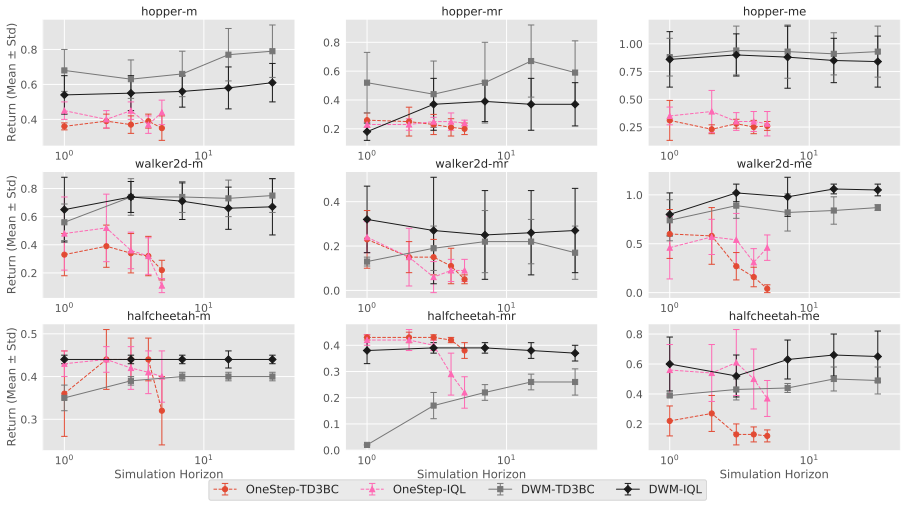
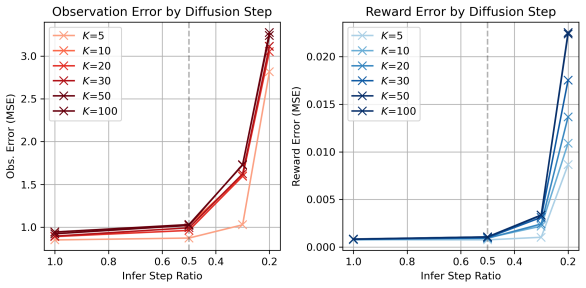
- If diffusion world models provide accurate long-horizon predictions, model-based RL with them should outperform one-step dynamics models in sample efficiency and planning horizons, as the thesis's experiments indicate.
- Consistency models used as policies show that generative-model advances can directly enrich RL action spaces, allowing multi-step generation to be collapsed into single-step control.
Where Pith is reading between the lines
- The non-exploitability claim is only as strong as the adversary used to measure it; the thesis itself reports a DQN exploiter cannot fully best-respond to an oracle Nash policy (exploitability about -0.03), so a stronger adversary, say one with more compute or a search-based planner, could in principle crack policies that pass the current test.
- If the Nash-DQN approach scales, one could extend it to partial-information games by coupling the Nash target with a belief state or recurrence, since the current method assumes full state observability.
- The Markov-potential-game formulation of load balancing suggests a template: any system objective that can be written as a variance-based fairness per agent admits decentralized learning with equilibrium guarantees, a pattern applicable to other resource-allocation domains such as traffic routing or job scheduling.
- In the foundation-model part, the implied next step is to treat a single world model as both a simulator for policy optimization and a target for fine-tuning, so that an agent can improve its model and its policy in a closed loop, a direction the thesis gestures at but does not fully develop.
Editorial analysis
A structured set of objections, weighed in public.
Referee Report
Summary. The thesis presents a two-part dissertation on reinforcement learning. Part I studies game-theoretic RL: Chapter 3 proposes Nash-DQN and Nash-DQN-Exploiter for two-player zero-sum Markov games and reports tabular experiments with exact exploitability as well as Atari/SlimeVolley experiments in which exploitability is estimated by training a DQN exploiter; Chapter 4 presents the FightLadder fighting-game benchmark with PPO-based baselines, Elo ratings, and exploitability evaluations; Chapter 5 formulates network load balancing as a Markov potential game with variance-based fairness. Part II collects work on foundation-model RL: diffusion world models, consistency models as policies, RL for few-step video generation, a video world model with retrieval augmentation, and a world model with memory. The unifying thesis is that RL can be viewed as objective-driven adaptation across strategic games and generative world models.
Significance. The thesis contains several potentially valuable contributions: the tabular comparison of Nash-VI/Nash-VI-Exploiter against self-play, fictitious play, and double-oracle baselines is a clean proof-of-concept; the FightLadder benchmark, including open-source baselines and Elo/exploitability protocols, is a practical resource for competitive MARL; the Markov-potential-game formulation of load balancing with variance-based fairness is a useful formalization. The generated-model chapters report substantial empirical results on diffusion world models, consistency-model policies, video generation, and memory-augmented world models. Had the central Chapter 3 claim—that Nash-DQN finds non-exploitable policies in zero-sum video games—been fully supported, it would be a notable result. However, as argued below, the deep-network non-exploitability claim is not established by the reported measurements.
major comments (4)
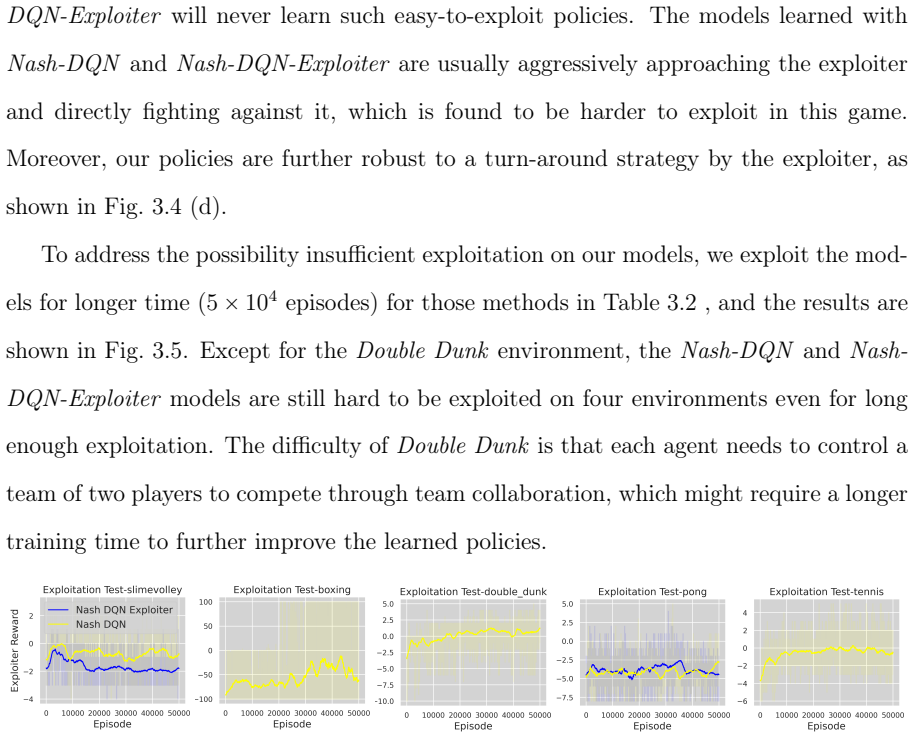
- [Sec. 3.5.3, Eq. (3.8), Table 3.1, Table 3.2] The central claim that Nash-DQN finds non-exploitable strategies is not supported by the reported experimental evidence. The quantity reported as 'approximate exploitability' is the reward of a DQN exploiter trained against a frozen policy, not the true best-response value used in Eq. (3.8). Table 3.1 calibrates this same DQN exploiter against the ground-truth Oracle Nash policy and obtains -0.027 (Env I) and -0.082 (Env II) instead of 0. The measured quantity is therefore a lower bound on true exploitability, biased in the direction of non-exploitability. Non-positive entries in Table 3.2 are compatible with strictly positive true exploitability; they only show that this particular DQN exploiter could not find a profitable deviation. The sentence in Sec. 3.5.3 that non-positive rewards 'demonstrate the non-exploitability' should be weakened to 'were not exploited by the DQN exploiter us
- [Sec. 3.4.3, Theorem 30, Sec. 3.7.9] The theoretical justification covers the tabular, optimistic versions of Nash-VI and Nash-VI-Exploiter, not the deep epsilon-greedy Nash-DQN used in the video-game experiments. The reduction in Sec. 3.7.9 only converts published episodic tabular results to the infinite-horizon discounted tabular setting by truncation and state augmentation. It does not address function approximation, minibatch SGD, target networks, or epsilon-greedy exploration. Thus Theorem 30 cannot be invoked to support the deep-network non-exploitability claim; that claim rests entirely on the biased measurement described in the previous comment. The paper should explicitly separate the tabular proof-of-concept from the heuristic deep-learning transfer.
- [Sec. 3.5.3, Table 3.2] For each method and environment, Table 3.2 reports the best-performing model over five seeds rather than the average or all seed-wise results. Best-seed selection biases the comparison in favor of the proposed method and makes the numeric values not representative of expected performance. The exploitation curves in Fig. 3.3 are informative, but the table should report mean and standard deviation (or per-seed values) for the central experimental claim.
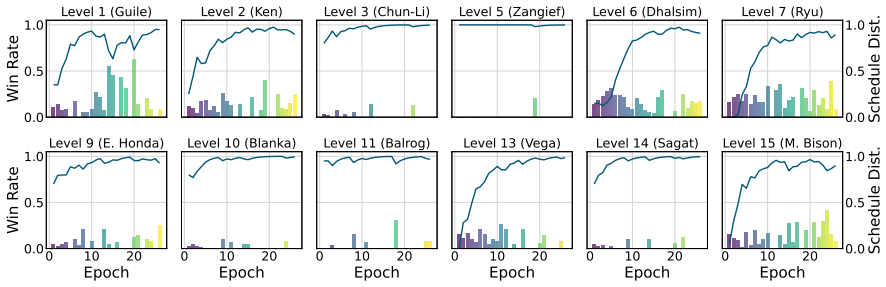
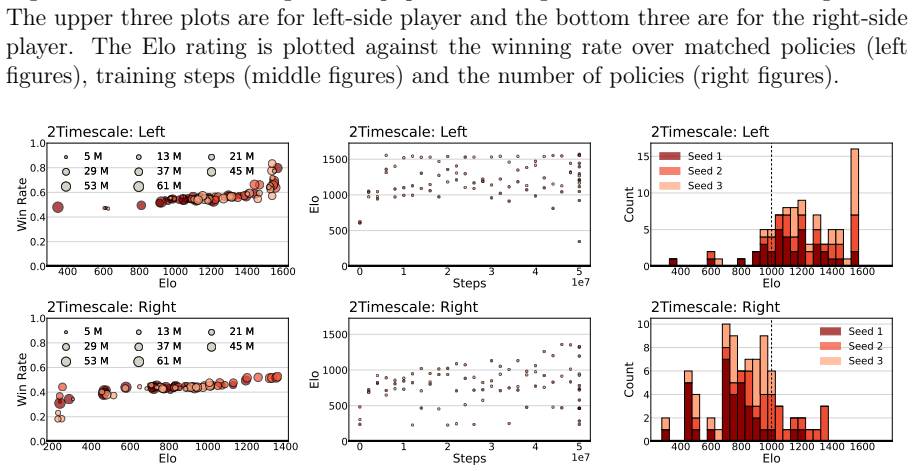
- [Sec. 4.7.3, Table 4.3] In the FightLadder benchmark results, a PPO exploiter eventually beats policies from all baselines with win rate greater than 0.5, and human players using simple strategies defeat the trained policies. This is consistent with the first major comment: 'exploitability' as measured by a fixed RL exploiter is only a lower bound relative to that exploiter. The benchmark should define the metric as 'win rate against the given exploiter' rather than calling it 'exploitability' in the game-theoretic sense, unless a calibrated or exact best-response oracle is available.
minor comments (6)
- [Contents/Ch. 2] Typo: 'Chaper 10' should be 'Chapter 10'.
- [Sec. 3.5.1, Table 3.1] The acronym 'NSFP' appears in Sec. 3.5.1 and Table 3.1; it should be 'NFSP' (Neural Fictitious Self-Play) for consistency with the rest of the text.
- [Sec. 1.2.2] In the paragraph after Eq. (1.4), the phrase 'in this infinite-horizon MDP' is accidentally duplicated.
- [Sec. 3.7.9] The section is titled 'Proof of Theorem 30' but it is a reduction to results in [Liu et al., 2021; Jin et al., 2021b]. This is fine for a thesis, but the title should say 'Proof sketch' or 'Reduction to known tabular results' to avoid implying a fully self-contained proof.
- [Sec. 4.4.5] The sentence 'While it is less efficient than FightLadder is the PettingZoo Atari' is grammatically incomplete; it should read 'While it is less efficient than PettingZoo Atari' or similar.
- [General] Several cross-references are left as 'Sec. Sec.??' (e.g., Sec. 3.5.3, Sec. 5.2). These placeholders should be resolved in the final version.
Circularity Check
No significant circularity: the thesis's central derivations are reductions to prior published theory, not definitions in terms of the target claims.
full rationale
The thesis does not exhibit a circular derivation chain. In Ch. 3, Nash-DQN is explicitly presented as a deep approximation of the tabular Nash-VI algorithm, and the convergence guarantee (Theorem 30) is imported from prior published results [Liu et al., 2021; Jin et al., 2021b]; Section 3.7.9 only supplies the episodic-to-discounted truncation on top of those theorems. This is a standard reliance on external theory rather than a self-definitional reduction. The measured 'exploitability' is an empirical quantity obtained by training a DQN/PPO exploiter; Table 3.1 and Ch. 4.5 explicitly acknowledge that this is a lower bound ('limited to the capability of deep RL algorithms in usage'), which is a validity caveat, not a circularity. The reducing arguments in Sec. 3.7.8 (specializing network to a table, full batch, many GD steps, immediate target update) are concrete and checkable. No equation is defined in terms of the quantity it is claimed to predict, no fitted parameter is renamed as a prediction, and the self-citations (to the author's and collaborators' prior work) are load-bearing only in the way any citation to published theorems is load-bearing; they are not used to forbid alternatives or to smuggle in an ansatz. Therefore no circular step meets the required evidentiary threshold.
Axiom & Free-Parameter Ledger
free parameters (4)
- Dense reward weights lambda per FightLadder game =
lambda=3 (SF2, FF2, MK); lambda=1 (SF3, KOF97)
- Frames-per-step and stacked frames (FightLadder) =
8 frames/step for SF2/FF2/MK, 3 for SF3/KOF97; stacks 12/12/12/9/9
- Exploitability smoothing window and best-seed selection =
not stated precisely
- Nash-DQN exploration rate and target-update intervals =
epsilon=0.5 in tabular runs (Sec 3.5.2)
axioms (5)
- standard math Minimax theorem, existence of Nash equilibrium in finite zero-sum games, Bellman operator contraction (Banach fixed point)
- domain assumption Polynomial sample complexity of optimistic Nash-VI and Golf-with-Exploiter in tabular Markov games (Liu et al. 2021; Jin et al. 2021b)
- domain assumption Maximizing variance-based fairness is sufficient for minimizing makespan (Prop 37; Prop 39 for product-based fairness)
- domain assumption The synchronous load-balancing model (Alg 15: task arrivals w_i(t), capacity v_j per step, per-LB assignment alpha_ij) captures real data-center load balancers
- domain assumption Truncating Atari episodes to 300 steps and using RAM observations preserves the zero-sum game structure relevant to non-exploitability
read the original abstract
Reinforcement learning (RL) provides a framework for sequential decision making under explicit objectives. In its classical form, RL studies how an agent should act to maximise long-term reward in a dynamic environment. In richer settings, the problem extends beyond a single agent and fixed environment: intelligent behavior may require strategic interaction, adaptation to uncertainty, and reasoning over high-dimensional worlds. This thesis studies RL from two perspectives: algorithms in games and RL in the era of foundation models. The first part focuses on multi-agent RL in games. It examines how incentives, policies, and equilibrium concepts interact in competitive and general-sum environments, spanning two-player zero-sum games, large-scale video games, and multi-player settings with general structure. These works investigate learning in multi-agent systems and the behavior of RL methods in interactive environments. The second part studies RL with generative and foundation models, motivated by the idea that prior knowledge can enrich sequential decision making. Pretrained generative models and learned world models serve as representation tools and structured priors for planning, control, and policy optimization. The thesis develops diffusion-based world models, investigates RL for efficient video generation, explores generative models as policy classes, and studies interactive video world models in which actions shape future observations. It also addresses long-horizon modeling through architectures with memory. Together, these contributions present a unified view of RL as objective-driven adaptation in complex sequential domains. From strategic games to generative world models, the thesis highlights how RL connects decision making, environment modeling, and emerging foundation-model capabilities, offering a broader perspective on the principles underlying intelligent behavior.
Figures













Reference graph
Works this paper leans on
-
[1]
Neurocomputing , volume=
Natural actor-critic , author=. Neurocomputing , volume=. 2008 , publisher=
2008
-
[2]
arXiv preprint arXiv:2511.12940 , year=
Recurrent autoregressive diffusion: Global memory meets local attention , author=. arXiv preprint arXiv:2511.12940 , year=
-
[3]
International Conference on Machine Learning , pages=
Soft Actor-Critic: Off-Policy Maximum Entropy Deep Reinforcement Learning with a Stochastic Actor , author=. International Conference on Machine Learning , pages=
-
[4]
Advances in neural information processing systems , pages=
Actor-critic algorithms , author=. Advances in neural information processing systems , pages=
-
[5]
Advances in neural information processing systems , volume=
Multi-agent actor-critic for mixed cooperative-competitive environments , author=. Advances in neural information processing systems , volume=
-
[6]
Mastering the game of Go without human knowledge , volume =
Silver, David and Schrittwieser, Julian and Antonoglou, Ioannis and Huang, Aja and Guez, Arthur and Hubert, Thomas and Baker, Lucas and Lai, Matthew and Bolton, Adrian and Chen, Yutian and Lillicrap, Timothy and Hui, Fan and Sifre, Laurent and Driessche, George and Graepel, Thore and Hassabis, Demis , year =. Mastering the game of Go without human knowled...
-
[7]
International Conference on Learning Representations , year=
Emergent Tool Use From Multi-Agent Autocurricula , author=. International Conference on Learning Representations , year=
-
[8]
PKU-Yuan Lab and Tuzhan AI etc. , title =. doi:10.5281/zenodo.10948109 , url =
-
[9]
2025 , url=
MAGI-1: Autoregressive Video Generation at Scale , author=. 2025 , url=
2025
-
[10]
arXiv preprint arXiv:2408.16767 , year=
Reconx: Reconstruct any scene from sparse views with video diffusion model , author=. arXiv preprint arXiv:2408.16767 , year=
-
[11]
2025 , eprint=
WORLDMEM: Long-term Consistent World Simulation with Memory , author=. 2025 , eprint=
2025
-
[12]
arXiv preprint arXiv:2411.02385 , year=
How far is video generation from world model: A physical law perspective , author=. arXiv preprint arXiv:2411.02385 , year=
-
[13]
arXiv preprint arXiv:2405.10314 , year=
Cat3d: Create anything in 3d with multi-view diffusion models , author=. arXiv preprint arXiv:2405.10314 , year=
-
[14]
2025 , eprint=
Cosmos-Drive-Dreams: Scalable Synthetic Driving Data Generation with World Foundation Models , author=. 2025 , eprint=
2025
-
[15]
arXiv preprint arXiv:2504.20995 , year=
TesserAct: Learning 4D Embodied World Models , author=. arXiv preprint arXiv:2504.20995 , year=
-
[16]
arXiv preprint arXiv:2403.14773 , year=
Streamingt2v: Consistent, dynamic, and extendable long video generation from text , author=. arXiv preprint arXiv:2403.14773 , year=
-
[17]
arXiv preprint arXiv:2503.03751 , year=
Gen3c: 3d-informed world-consistent video generation with precise camera control , author=. arXiv preprint arXiv:2503.03751 , year=
-
[18]
arXiv preprint arXiv:2503.18945 , year=
Aether: Geometric-aware unified world modeling , author=. arXiv preprint arXiv:2503.18945 , year=
-
[19]
Advances in neural information processing systems , volume=
Mcvd-masked conditional video diffusion for prediction, generation, and interpolation , author=. Advances in neural information processing systems , volume=
-
[20]
Advances in Neural Information Processing Systems , volume=
Elucidating the design space of diffusion-based generative models , author=. Advances in Neural Information Processing Systems , volume=
-
[21]
arXiv preprint arXiv:2303.08774 , year=
Gpt-4 technical report , author=. arXiv preprint arXiv:2303.08774 , year=
-
[22]
arXiv preprint arXiv:2403.11027 , year=
Reward guided latent consistency distillation , author=. arXiv preprint arXiv:2403.11027 , year=
-
[23]
arXiv preprint arXiv:2210.02410 , year=
The vendi score: A diversity evaluation metric for machine learning , author=. arXiv preprint arXiv:2210.02410 , year=
-
[24]
arXiv preprint arXiv:2207.12598 , year=
Classifier-free diffusion guidance , author=. arXiv preprint arXiv:2207.12598 , year=
-
[25]
arXiv preprint arXiv:2408.06072 , year=
Cogvideox: Text-to-video diffusion models with an expert transformer , author=. arXiv preprint arXiv:2408.06072 , year=
-
[26]
arXiv preprint arXiv:2304.11277 , year=
Pytorch fsdp: experiences on scaling fully sharded data parallel , author=. arXiv preprint arXiv:2304.11277 , year=
-
[27]
arXiv preprint arXiv:2410.13720 , year=
Movie gen: A cast of media foundation models , author=. arXiv preprint arXiv:2410.13720 , year=
-
[28]
Advances in Neural Information Processing Systems , volume=
Pick-a-pic: An open dataset of user preferences for text-to-image generation , author=. Advances in Neural Information Processing Systems , volume=
-
[29]
arXiv preprint arXiv:2409.00588 , year=
Diffusion policy policy optimization , author=. arXiv preprint arXiv:2409.00588 , year=
-
[30]
arXiv preprint arXiv:2310.04378 , year=
Latent consistency models: Synthesizing high-resolution images with few-step inference , author=. arXiv preprint arXiv:2310.04378 , year=
-
[31]
arXiv preprint arXiv:2209.14687 , year=
Diffusion posterior sampling for general noisy inverse problems , author=. arXiv preprint arXiv:2209.14687 , year=
-
[32]
arXiv preprint arXiv:2410.05954 , year=
Pyramidal Flow Matching for Efficient Video Generative Modeling , author=. arXiv preprint arXiv:2410.05954 , year=
-
[33]
arXiv preprint arXiv:2305.13301 , year=
Training diffusion models with reinforcement learning , author=. arXiv preprint arXiv:2305.13301 , year=
-
[34]
2024 , howpublished =
Kuaishou , title =. 2024 , howpublished =
2024
-
[35]
arXiv preprint arXiv:2209.14988 , year=
Dreamfusion: Text-to-3d using 2d diffusion , author=. arXiv preprint arXiv:2209.14988 , year=
-
[36]
Proceedings of the IEEE/CVF Conference on Computer Vision and Pattern Recognition , pages=
Score jacobian chaining: Lifting pretrained 2d diffusion models for 3d generation , author=. Proceedings of the IEEE/CVF Conference on Computer Vision and Pattern Recognition , pages=
-
[37]
Advances in Neural Information Processing Systems , volume=
Prolificdreamer: High-fidelity and diverse text-to-3d generation with variational score distillation , author=. Advances in Neural Information Processing Systems , volume=
-
[38]
arXiv preprint arXiv:2407.08737 , year=
Video Diffusion Alignment via Reward Gradients , author=. arXiv preprint arXiv:2407.08737 , year=
-
[39]
The Twelfth International Conference on Learning Representations , year=
Instaflow: One step is enough for high-quality diffusion-based text-to-image generation , author=. The Twelfth International Conference on Learning Representations , year=
-
[40]
arXiv preprint arXiv:2401.12945 , year=
Lumiere: A space-time diffusion model for video generation , author=. arXiv preprint arXiv:2401.12945 , year=
-
[41]
arXiv preprint arXiv:2309.15103 , year=
Lavie: High-quality video generation with cascaded latent diffusion models , author=. arXiv preprint arXiv:2309.15103 , year=
-
[42]
arXiv preprint arXiv:1802.05668 , year=
Model compression via distillation and quantization , author=. arXiv preprint arXiv:1802.05668 , year=
-
[43]
arXiv preprint arXiv:1312.6114 , year=
Auto-encoding variational bayes , author=. arXiv preprint arXiv:1312.6114 , year=
-
[44]
Advances in neural information processing systems , volume=
Generative modeling by estimating gradients of the data distribution , author=. Advances in neural information processing systems , volume=
-
[45]
arXiv preprint arXiv:2406.04324 , year=
SF-V: Single Forward Video Generation Model , author=. arXiv preprint arXiv:2406.04324 , year=
-
[46]
Proceedings of the IEEE/CVF conference on computer vision and pattern recognition , pages=
High-resolution image synthesis with latent diffusion models , author=. Proceedings of the IEEE/CVF conference on computer vision and pattern recognition , pages=
-
[47]
Proceedings of the IEEE/CVF Conference on Computer Vision and Pattern Recognition , pages=
Align your latents: High-resolution video synthesis with latent diffusion models , author=. Proceedings of the IEEE/CVF Conference on Computer Vision and Pattern Recognition , pages=
-
[48]
2024 , url =
Zangwei Zheng and Xiangyu Peng and Tianji Yang and Chenhui Shen and Shenggui Li and Hongxin Liu and Yukun Zhou and Tianyi Li and Yang You , title =. 2024 , url =
2024
-
[49]
Advances in Neural Information Processing Systems , volume=
Denoising diffusion probabilistic models , author=. Advances in Neural Information Processing Systems , volume=
-
[50]
arXiv preprint arXiv:2409.08861 , year=
Adjoint Matching: Fine-tuning Flow and Diffusion Generative Models with Memoryless Stochastic Optimal Control , author=. arXiv preprint arXiv:2409.08861 , year=
-
[51]
International Conference on Learning Representations , year=
Score-based generative modeling through stochastic differential equations , author=. International Conference on Learning Representations , year=
-
[52]
International Conference on Machine Learning , pages=
Deep unsupervised learning using nonequilibrium thermodynamics , author=. International Conference on Machine Learning , pages=
-
[53]
arXiv preprint arXiv:2204.03458 , year=
Video Diffusion Models , author=. arXiv preprint arXiv:2204.03458 , year=
-
[54]
arXiv preprint arXiv:2210.02303 , year=
Imagen Video: High Definition Video Generation with Diffusion Models , author=. arXiv preprint arXiv:2210.02303 , year=
-
[55]
arXiv preprint arXiv:2205.11495 , year=
Flexible Diffusion Modeling of Long Videos , author=. arXiv preprint arXiv:2205.11495 , year=
-
[56]
arXiv preprint arXiv:2204.03638 , year=
Long Video Generation with Time-Agnostic VQGAN and Time-Sensitive Transformer , author=. arXiv preprint arXiv:2204.03638 , year=
-
[57]
arXiv preprint arXiv:2208.04531 , year=
Unconditional Video Generation with Latent Flow Diffusion Models , author=. arXiv preprint arXiv:2208.04531 , year=
-
[58]
arXiv preprint arXiv:2209.14792 , year=
Make-A-Video: Text-to-Video Generation without Text-Video Data , author=. arXiv preprint arXiv:2209.14792 , year=
-
[59]
arXiv preprint arXiv:2210.02399 , year=
Phenaki: Variable Length Video Generation from Open Domain Textual Descriptions , author=. arXiv preprint arXiv:2210.02399 , year=
-
[60]
arXiv preprint arXiv:2104.10157 , year=
VideoGPT: Video Generation using VQ-VAE and Transformers , author=. arXiv preprint arXiv:2104.10157 , year=
-
[61]
arXiv preprint arXiv:2301.06513 , year=
Dual Diffusion Models for High-Fidelity Video Generation , author=. arXiv preprint arXiv:2301.06513 , year=
-
[62]
arXiv preprint arXiv:2205.15868 , year=
CogVideo: Large-scale Pretraining for Text-to-Video Generation with Transformers , author=. arXiv preprint arXiv:2205.15868 , year=
-
[63]
arXiv preprint arXiv:2302.01327 , year=
Text2Video-Zero: Zero-Shot Text-to-Video Generation using Pretrained Text-to-Image Diffusion Models , author=. arXiv preprint arXiv:2302.01327 , year=
-
[64]
arXiv preprint arXiv:2308.06571 , year=
Modelscope text-to-video technical report , author=. arXiv preprint arXiv:2308.06571 , year=
-
[65]
Proceedings of the IEEE/CVF Conference on Computer Vision and Pattern Recognition , pages=
Videocrafter2: Overcoming data limitations for high-quality video diffusion models , author=. Proceedings of the IEEE/CVF Conference on Computer Vision and Pattern Recognition , pages=
-
[66]
arXiv preprint arXiv:2306.09341 , year=
Human preference score v2: A solid benchmark for evaluating human preferences of text-to-image synthesis , author=. arXiv preprint arXiv:2306.09341 , year=
-
[67]
arXiv preprint arXiv:2311.15127 , year=
Stable video diffusion: Scaling latent video diffusion models to large datasets , author=. arXiv preprint arXiv:2311.15127 , year=
-
[68]
arXiv preprint arXiv:2209.03003 , year=
Flow straight and fast: Learning to generate and transfer data with rectified flow , author=. arXiv preprint arXiv:2209.03003 , year=
-
[69]
2024 , archivePrefix=
HunyuanVideo: A Systematic Framework For Large Video Generative Models , author=. 2024 , archivePrefix=
2024
-
[70]
2025 , eprint=
Movie Gen: A Cast of Media Foundation Models , author=. 2025 , eprint=
2025
-
[71]
Forty-first international conference on machine learning , year=
Scaling rectified flow transformers for high-resolution image synthesis , author=. Forty-first international conference on machine learning , year=
-
[72]
arXiv preprint arXiv:2210.02747 , year=
Flow matching for generative modeling , author=. arXiv preprint arXiv:2210.02747 , year=
-
[73]
arXiv preprint arXiv:2402.00769 , year=
Animatelcm: Accelerating the animation of personalized diffusion models and adapters with decoupled consistency learning , author=. arXiv preprint arXiv:2402.00769 , year=
-
[74]
arXiv preprint arXiv:2312.09109 , year=
Videolcm: Video latent consistency model , author=. arXiv preprint arXiv:2312.09109 , year=
-
[75]
International Conference on Learning Representations , year=
Denoising Diffusion Implicit Models , author=. International Conference on Learning Representations , year=
-
[76]
arXiv preprint arXiv:2202.00512 , year=
Progressive Distillation for Fast Sampling of Diffusion Models , author=. arXiv preprint arXiv:2202.00512 , year=
-
[77]
arXiv preprint arXiv:2106.05237 , year=
Knowledge Distillation for Generative Models , author=. arXiv preprint arXiv:2106.05237 , year=
-
[78]
arXiv preprint arXiv:2309.17400 , year=
Directly fine-tuning diffusion models on differentiable rewards , author=. arXiv preprint arXiv:2309.17400 , year=
-
[79]
Advances in Neural Information Processing Systems , volume=
Laion-5b: An open large-scale dataset for training next generation image-text models , author=. Advances in Neural Information Processing Systems , volume=
-
[80]
Advances in Neural Information Processing Systems , volume=
Imagereward: Learning and evaluating human preferences for text-to-image generation , author=. Advances in Neural Information Processing Systems , volume=
discussion (0)
Sign in with ORCID, Apple, or X to comment. Anyone can read and Pith papers without signing in.