REVIEW 5 major objections 5 minor 19 references
SpatialAfford claims that teaching a compact VLM where to look—by aligning its cross-modal attention to the ground-truth affordance region—before optimizing where to ground lets a 4B model outperform stronger 7B+ baselines.
Reviewed by Pith at T0; open to challenge. T0 means a machine referee read the full paper against a public rubric. the ladder, T0–T4 →
SpatialAfford improves affordance grounding in a 4B VLM by first supervising cross-modal attention with the ground-truth region and then applying GRPO, outperforming several 7B+ baselines.
T0 review reviewed 2026-08-05 challenge →
load-bearing objection A plausible two-stage training recipe for compact VLM affordance grounding, but the 'where to look' mechanism is not isolated and the manuscript needs completion before the causal story is credible. the 5 major comments →
SpatialAfford: Teaching Compact VLMs Where to Look and Where to Ground for Affordance
The pith
A machine-rendered reading of the paper's core claim, the machinery that carries it, and where it could break.
The reading
Core claim
SpatialAfford's central claim is that the attention–output mismatch in compact autoregressive VLMs is the bottleneck for affordance grounding, and that it is fixable by directly supervising the intermediate attention distribution before policy optimization. The method distills the ground-truth affordance box into a smoothed probability map over visual tokens and minimizes the KL divergence between that map and the model's text-to-image attention over instruction tokens; only after this alignment does it apply GRPO with an IoU-plus-L1-plus-format reward. Reported results: on ReasonAff, SpatialAfford (4B) reaches 74.92 gIoU and 82.50 P@50, beating Affordance-R1 (7B) by +7.51 and +8.00; on Shar
What carries the argument
The load-bearing object is the cross-modal attention matrix from text instruction tokens to visual patch tokens. Spatial Attention Alignment converts the ground-truth affordance box into a spatial target distribution P_M by rasterizing the box on the vision encoder's grid, smoothing it with an adaptive kernel sized to the box, and normalizing; it then penalizes KL(P_S || P_M) between the model's normalized attention map and that target, with attention extracted only from instruction tokens to avoid teacher-forcing leakage. This turns 'where to look' into a supervised spatial-reasoning objective. Stage 2 then runs GRPO with a composite reward (mean IoU, mean L1 coordinate distance, format val
Load-bearing premise
The load-bearing premise is that the model's internal 'where it looks' map is a genuine intermediate representation of visual focus, so steering that map toward the ground-truth region actually improves grounding; if that map is just a byproduct of language priors or token-position quirks, the attention-alignment stage would be an uninterpretable regularizer and the reported gains would not transfer.
What would settle it
Train SpatialAfford with SAA applied to a surrogate mask that is not the true affordance box—e.g., a random box or the object's center—while keeping Stage 2 fixed. If gIoU/P@50 gains on ReasonAff and PartAfford persist, the specific affordance semantics of the alignment target are not what drives the improvement. As a second check, after SAA, freeze the model and perturb the extracted attention map at inference; if coordinate outputs do not move, cross-modal attention is not mediating the prediction.
If this is right
- A compact 4B model can beat several 7B–8B systems on ShareRobot-Bench, ReasonAff, and PartAfford by adding attention alignment before RL, narrowing the parameter gap in embodied affordance grounding.
- The ablation shows the order is the mechanism: SAA alone reaches 42.59 gIoU and 40.50 P@50, GRPO alone reaches 42.45 and 45.55, and only SAA followed by GRPO reaches 47.80 and 55.00, so neither stage substitutes for the other.
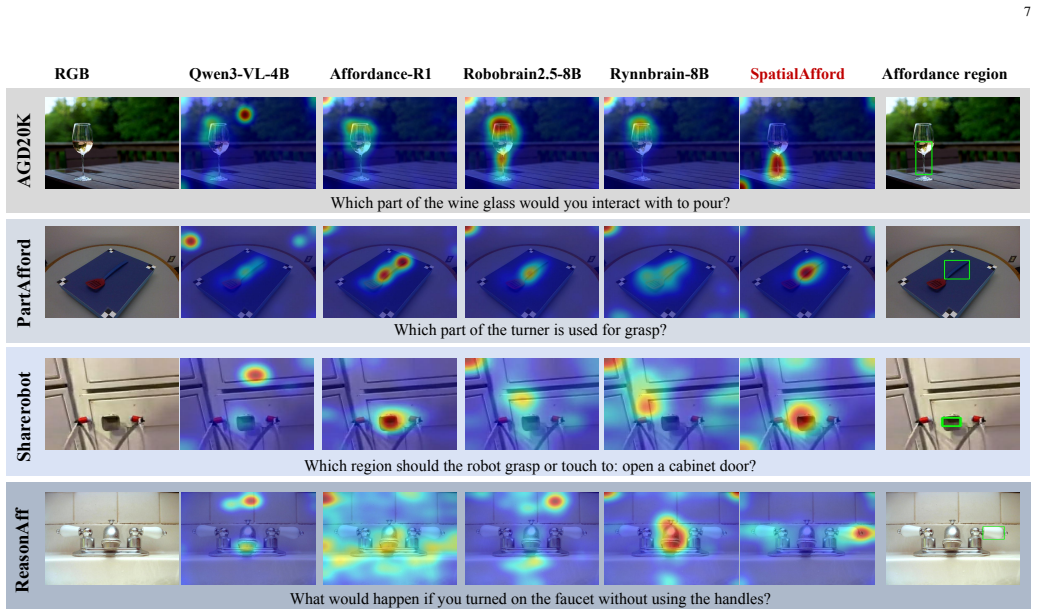
- OOD results on AGD20K give P@50 37.44 and NSS 1.05, suggesting the learned visual focus transfers to unseen egocentric scenes rather than overfitting training boxes.
- The KL form of the attention loss is load-bearing: a coverage loss improves attention alignment but degrades coordinate prediction (P@50 32.15 vs 40.50 at alpha=0.1).
Where Pith is reading between the lines
- An editorial control that the paper does not run: replace the ground-truth affordance mask in SAA with a random or object-centered mask; if the gains on ReasonAff and PartAfford persist, the specific affordance semantics of the target are not what drives the improvement.
- An editorial transfer prediction: the same 'align attention with a spatial target, then run spatial-reward RL' ordering should help other fine-grained spatial tasks, such as part-level detection, referring segmentation, and dense grounding, where output-level supervised fine-tuning is shortcut-prone.
- An editorial flag on evidence: the paper's motivating diagnosis—attention density inside the ground-truth region is suppressed with near-zero or negative NSS—is cited to an appendix (Appendix??) that is not present in this version, so the attention–output mismatch is asserted rather than directly inspectable; the benchmark gains themselves do not depend on that figure.
- An editorial scalability note: because SAA needs only a box annotation, the same loss could be trained on pseudo-labels, such as saliency maps or heatmaps from a larger model, in settings where true affordance boxes are expensive.
Editorial analysis
A structured set of objections, weighed in public.
Referee Report
Summary. The paper proposes SpatialAfford, a two-stage training framework for compact vision-language models (VLMs) on affordance grounding. Stage 1, Spatial Attention Alignment (SAA), adds to the SFT objective a KL-divergence loss that pushes the model's cross-modal attention over visual tokens toward a smoothed ground-truth affordance-box mask (Eq. 7). Stage 2, Spatial-Aware GRPO, refines coordinate prediction with rewards based on IoU, L1 distance, and format validity. The reported experiments show large improvements over general-purpose and embodied VLMs, e.g., 74.92 gIoU / 82.50 P@50 on ReasonAff versus 67.41 / 74.50 for Affordance-R1, and a 4B model outperforming several 7B+ baselines. The paper also reports an OOD evaluation on AGD20K and an ablation study indicating that SAA and GRPO contribute complementary gains.
Significance. If the central causal claim holds—that explicitly aligning attention to the affordance region before policy optimization is what drives the grounding improvements—the work is a useful contribution to compact-VLM training for embodied affordance reasoning. The method is simple, the two-stage decomposition is well motivated, and the empirical gains over strong 7B+ baselines are substantial. The ablation in Table IV shows a clear component synergy, and the AGD20K OOD evaluation is a positive feature. The paper does not ship code or trained models, and the verification of the proposed 'where-to-look' mechanism is incomplete, so the significance is conditional on the missing causal controls being supplied.
major comments (5)
- [§III-B, Eq. (7); §IV-D, Table IV] The paper's central mechanistic claim is that the spatial location of the attention target matters, but SAA changes both the location and the peakedness/entropy of the attention distribution. The presented ablations (Table IV) and α-sweep (Table V) do not isolate the spatial prior. A control experiment using a shifted, random, or uniform attention target is necessary to show that the improvement comes from aligning attention to the affordance region rather than from a generic attention-regularization effect. Without this, the 'where to look' interpretation is not supported.
- [§IV-C, Table III] The attention-alignment metrics in Table III are partly circular as evidence for SAA, since the SAA loss directly minimizes KL(PS||PM) on the training data. More importantly, the OOD results do not consistently show improved alignment: SpatialAfford's KLD (9.35) is slightly worse than the Qwen3-VL-4B baseline (9.29), even though SIM and NSS improve. The paper should reconcile this contradiction and avoid presenting Table III as unambiguous confirmation of better attention alignment.
- [§III-A and §IV-A; unreferenced appendices] The diagnostic supporting Eq. (2), the claimed attention–output mismatch, is deferred to an appendix that appears as 'Appendix??' and is not included. Likewise, training details (data mixture, hyperparameters, GRPO setup, metric definitions for cIoU and P@50–95) are referenced only as 'Appendix??'. This is a load-bearing omission: Eq. (2) motivates the entire method, and the missing implementation details prevent reproducibility and independent verification.
- [Tables I–IV] No error bars, standard deviations, or significance tests are reported for any table. The headline gains are large, but some comparisons are close, e.g., ShareRobot-Bench gIoU: SpatialAfford 47.80 vs RoboBrain2.5-8B 48.07. Without multiple seeds or statistical testing, the reader cannot assess the reliability of these comparisons; at minimum a statement that the runs are single-seed with deterministic decoding should be made.
- [§III-C, Eqs. (11)–(14)] The reward equations are inconsistent with the manuscript's own statement that training data contain single-bbox annotations. Eq. (11) defines RIoU using an optimal assignment M* between sets of predicted and ground-truth boxes, which is never used or explained for the single-box case; Eq. (12) then reverts to a single-box L1 distance. Please simplify the reward description to match the actual single-bbox setting and clarify how the 'optimal assignment' would apply.
minor comments (5)
- [Throughout] Multiple 'Appendix??' placeholders remain unresolved (e.g., in §§III-A, IV-A, IV-B). These must be filled before resubmission.
- [§III-B, Eq. (3)] The phrase 'norm1k' (also in Eq. 12) is undefined. Presumably '1k' denotes a 1/1000 normalized coordinate system; please define explicitly.
- [Fig. 3 caption] Typo: 'red box is predicated results' should be 'predicted results'. Also standardize capitalization of 'RynnBrain' / 'Rynnbrain' across text, tables, and figures.
- [§IV-A, metrics] cIoU and P@50–95 are used in tables but never defined in the main text. Please define these metrics at first use or in the experiments section.
- [§IV-D, Table V] The coverage-loss comparison is interesting, but the paper should clarify why coverage loss degrades grounding despite improving attention alignment. A brief explanation would strengthen the choice of KL divergence.
Circularity Check
No significant circularity: the central grounding results are external benchmark evaluations, not re-statements of training objectives.
full rationale
The paper's derivation chain is an empirical training pipeline, not a first-principles derivation. Stage-1 SAA (Eq. 7) is a supervised loss that pushes the model's cross-modal attention PS toward a spatial target PM derived from ground-truth boxes (Eqs. 3-6); Stage-2 GRPO optimizes coordinate rewards (Eqs. 9-14). The headline claims are grounding accuracy on ShareRobot-Bench, ReasonAff, and PartAfford (Tables I-II), which are external benchmarks and not the training objective. The only reported metric that overlaps with the training loss is the OOD KLD diagnostic in Table III, but that is not the central claim, and the transfer is not forced: AGD20K is out-of-distribution, and SpatialAfford's KLD actually worsens slightly versus Qwen3-VL-4B (9.35 vs. 9.29). The ablation in Table V further shows that a pure coverage loss can improve attention alignment while degrading coordinate grounding, so the grounding gains are not simply a re-statement of the attention objective. Self-citations are present only as motivational related work (e.g., the attention-sink citation is to Zhang et al. 2026, not the present authors) and are not load-bearing for the empirical results. The paper does have reproducibility gaps—the diagnostic evidence for Eq. (2) and training/hyperparameter details are deferred to missing 'Appendix??' passages—but missing evidence is a correctness/reproducibility concern, not circularity. Hyperparameter selection on ShareRobot-Bench is a potential overfitting risk, but it does not make the derivation equivalent to its inputs by construction. No equation reduces to its own input, and no fitted parameter is renamed as a prediction.
Axiom & Free-Parameter Ledger
free parameters (5)
- SAA loss weight alpha =
0.1
- L1 reward temperature tau_L1 =
0.05 * (W+H)/2 with W=H=1000
- Blur kernel size k =
max(3, min(floor(max(bw,bh)/2)*2+1, 7))
- GRPO group size G =
4
- KL penalty beta =
adaptive in [0.10, 0.50], target 1.0
axioms (3)
- domain assumption Cross-modal attention maps over instruction tokens reflect the model's visual focus and are causally relevant to coordinate prediction.
- domain assumption The ground-truth affordance bounding box is an accurate proxy for the visual evidence that should be attended to, at the resolution of the visual token grid.
- domain assumption The combined training set (ShareRobot-Affordance, ReasonAff-Bbox, PartAfford-Tools) provides sufficient and representative coverage for affordance grounding.
Cite this review
Pith. "Pith review of SpatialAfford: Teaching Compact VLMs Where to Look and Where to Ground for Affordance." pith.science (2026). https://pith.science/paper/ZK4OWFGK
@misc{pith2026260800502,
  author       = {Pith},
  title        = {Pith review of: SpatialAfford: Teaching Compact VLMs Where to Look and Where to Ground for Affordance},
  year         = {2026},
  howpublished = {\url{https://pith.science/paper/ZK4OWFGK}},
  note         = {Machine review of arXiv:2608.00502}
}
read the original abstract
Affordance grounding aims to localize the functional region for interaction, such as the handle to grasp or the button to press, rather than the whole object. This makes it more challenging than generic visual grounding because the target region is smaller, more ambiguous, and more dependent on task context, especially for compact vision-language models (VLMs) used in embodied settings. Recent sequence-level supervision and reinforcement learning improve coordinate prediction quality, yet compact autoregressive VLMs still lack reliable affordance-aware visual focus before coordinate generation: the model can produce better coordinate tokens while its cross-modal attention remains diffuse and weakly anchored to the true affordance evidence. To address it, we propose SpatialAfford, a two-stage framework that first aligns attention to the ground-truth affordance region through Spatial Attention Alignment (SAA), then refines coordinate prediction with Spatial-Aware GRPO. By explicitly teaching the model where to look before optimizing where to ground, SpatialAfford turns affordance grounding from a purely output-constrained objective into attention-grounded spatial reasoning. Across ShareRobot-Bench, ReasonAff, and PartAfford, SpatialAfford consistently improves affordance grounding, with a compact 4B model outperforming stronger 7B+ baselines.
Figures


Reference graph
Works this paper leans on
-
[2]
Qwen3-VL technical report.arXiv preprint arXiv:2511.21631,
Shuai Bai, Yuxuan Cai, Ruizhe Chen, et al. Qwen3-VL technical report.arXiv preprint arXiv:2511.21631,
-
[3]
Anthony Brohan, Noah Brown, Justice Carbajal, et al. RT-2: Vision-language-action models transfer web knowledge to robotic control.arXiv preprint arXiv:2307.15818, 2023a. Anthony Brohan, Yevgen Chebotar, Chelsea Finn, Karol Haus- man, Alexander Herzog, Daniel Ho, Julian Ibarz, Alex Irpan, Eric Jang, Ryan Julian, et al. Do as i can, not as i say: Grounding...
-
[9]
Hongchen Luo, Wei Zhai, Jing Zhang, and Meng Yang. One- shot affordance detection.arXiv preprint arXiv:2106.14747,
work page internal anchor Pith review Pith/arXiv arXiv
-
[11]
Qwen2.5-VL technical report.arXiv preprint arXiv:2502.13923,
Qwen Team. Qwen2.5-VL technical report.arXiv preprint arXiv:2502.13923,
-
[13]
Qiaoli Shen, Zilun Zhang, Kangjia Zhao, Qianqian Zhang, Ruochen Xu, and Tiancheng Zhao. VLM-R1: A stable and generalizable R1-style large vision-language model.arXiv preprint arXiv:2504.07615,
-
[14]
Aligning large multimodal models with factually augmented rlhf
Zhiqing Sun, Sheng Shen, Shengcao Cao, Haotian Liu, Chun- yuan Li, Yikang Shen, Chuang Gan, Liangyan Gui, Yu- Xiong Wang, Yiming Yang, et al. Aligning large multimodal models with factually augmented rlhf. InFindings of the Association for Computational Linguistics: ACL 2024, pages 13088–13110,
work page 2024
-
[15]
RoboBrain 2.5: Depth in sight, time in mind.arXiv preprint arXiv:2601.14352,
Huajie Tan, Enshen Zhou, Zhiyu Li, et al. RoboBrain 2.5: Depth in sight, time in mind.arXiv preprint arXiv:2601.14352,
-
[17]
Peng Wang, Shuai Bai, Sinan Tan, et al. Qwen2-VL: Enhanc- ing vision-language model’s perception of the world at any resolution.arXiv preprint arXiv:2409.12191,
-
[18]
PartAfford: Part- level affordance discovery from 3D objects.arXiv preprint arXiv:2202.13519,
Chao Xu, Yixin Chen, and He Wang. PartAfford: Part- level affordance discovery from 3D objects.arXiv preprint arXiv:2202.13519,
-
[19]
Xin Zou, Yizhou Wang, Yibo Yan, Yuanhuiyi Lyu, Kening Zheng, Sirui Huang, Junkai Chen, Peijie Jiang, Jia Liu, Chang Tang, and Xuming Hu. Look twice before you answer: Memory-space visual retracing for hallucination mitigation in multimodal large language models.arXiv preprint arXiv:2410.03577, 2025
Pith/arXiv arXiv 2025
-
[1979]
Mgpo: Thinking with images via multi- turn grounding-based reinforcement learning
Xinyu Huang, Yuhao Dong, Weiwei Tian, Bo Li, Rui Feng, and Ziwei Liu. Mgpo: Thinking with images via multi- turn grounding-based reinforcement learning. InFindings of the Association for Computational Linguistics: ACL 2026, pages 383–399,
work page 2026
-
[2015]
Siqu Ou, Tianrui Wan, Zhiyuan Zhao, Junyu Gao, and Xuelong Li. Do MLLMs really see it: Reinforcing visual attention in multimodal LLMs.arXiv preprint arXiv:2602.08241,
-
[2017]
Zhihong Shao, Peiyi Wang, Qihao Zhu, Runxin Xu, Junxiao Song, Xiao Bi, Haowei Zhang, Mingchuan Zhang, Y .K. Li, Y . Wu, and Daya Guo. DeepSeekMath: Pushing the limits of mathematical reasoning in open language models.arXiv preprint arXiv:2402.03300,
-
[2018]
Danny Driess, Fei Xia, Mehdi S. M. Sajjadi, et al. PaLM-E: An embodied multimodal language model.arXiv preprint arXiv:2303.03378,
-
[2021]
OpenVLA: An open-source vision-language-action model
Moo Jin Kim, Karl Pertsch, Siddharth Karamcheti, et al. OpenVLA: An open-source vision-language-action model. arXiv preprint arXiv:2406.09246,
-
[2023]
Improved baselines with visual instruction tuning
Haotian Liu, Chunyuan Li, Yuheng Li, and Yong Jae Lee. Improved baselines with visual instruction tuning. InPro- ceedings of the IEEE/CVF conference on computer vision and pattern recognition, pages 26296–26306, 2024a. Shilong Liu, Zhaoyang Zeng, Tianhe Ren, Feng Li, Hao Zhang, Jie Yang, Qing Jiang, Chunyuan Li, Jianwei Yang, Hang Su, et al. Grounding din...
work page 2034
-
[2024]
Token-Based Affordance Grounding with Large Vision-Language Models
Seung Il Lee, Qinqian Lei, Daguang Xu, Dong Yang, Robby T Tan, Yixin Chen, and Bo Wang. Token-based affor- dance grounding with large vision-language models.arXiv preprint arXiv:2607.03595,
work page internal anchor Pith review Pith/arXiv arXiv
-
[2025]
Robo- Brain 2.0 technical report.arXiv preprint arXiv:2507.02029,
BAAI RoboBrain Team, Mingyu Cao, Huajie Tan, et al. Robo- Brain 2.0 technical report.arXiv preprint arXiv:2507.02029,
-
[2026]
Shravan Venkatraman, Ritesh Thawkar, Omkar Thawakar, Rao Muhammad Anwer, Hisham Cholakkal, Salman Khan, and Fahad Shahbaz Khan. Paying more attention to visual tokens in self-evolving large multimodal models.arXiv preprint arXiv:2606.27373,
This paper was first reviewed by deepseek-v4-flash on August 5, 2026.
discussion (0)
Sign in with ORCID, Apple, or X to comment. Anyone can read and Pith papers without signing in.