REVIEW 5 major objections 5 minor 38 references
Scaling Laws for Speculative Decoding
T0 review · 5 major / 5 minor · reviewed 2026-08-15 · deepseek-v4-flash
Pith's one-line read The paper claims speculative decoding efficiency follows three log-linear scaling laws—over pretraining tokens, draft decoder count, and batch size—and that applying them yields up to 2x throughput.
desk verdict Useful qualitative recipe buried under quantitative scaling laws that the paper's own figures don't support. read the letter →
The pith
A machine-rendered reading of the paper's core claim, the machinery that carries it, and where it could break.
The reading
What carries the argument
The mechanism that carries the argument is a pair of empirical laws plus a roofline model. The pretrain and capacity laws are log-linear regressions of measured acceptance rate against log10 of pretraining tokens and decoder count, fitted over seven token budgets (1B–100B) and decoder depths (1, 2, 5, 10). The batch-size law comes from a roofline analysis: the paper hand-counts FLOPs and memory reads/writes for every component of a Scylla forward pass (draft FC layer, QKV projections, self-attention, MLP, LM head), forms the arithmetic intensity I(b,topk)=W_comp/W_mem, and asserts that maximum throughput occurs exactly where I equals the hardware critical intensity I_crit=P_peak/B_mem. Solving that equality for Qwen2.5-72B with 10K prefill yields the optimal-TopK formula. The roofline model is what turns the batch-size law from empirical curve-fitting into a closed-form, hardware-aware prediction.
What would settle it
Run Qwen2.5-72B on the same H800 setup at batch sizes 1, 4, 16, 32, and 64 and measure throughput for each TopK value from 10 to 80; if the argmax TopK deviates systematically from 27904√(1+0.034/b)−27897, for instance if the optimal width stays flat or falls with batch size, Theorem 1.3 is falsified. Independently, re-run the pretrain-token sweep on a single fixed corpus; an acceptance-rate slope far from 0.08 per decade, or a downturn past 50B tokens, would falsify Theorem 1.1.
Extended reading notes
Core claim
The central claim is that acceptance rate and throughput in speculative decoding are predictable, log-linear functions of three controllable resources. Theorems 1.1 and 1.2 state that acceptance rate equals α·log10(T_pretrain)+β with (α,β)≈(0.08,5.05), and α·log10(D)+β with (α,β)≈(0.74,4.61), where T_pretrain is pretraining tokens and D is draft decoder count. Theorem 1.3 states that throughput equals α·log2(b)+β with (α,β)≈(286.79,7.54) along the optimal TopK path topk(b)=27904√(1+0.034/b)−27897. The paper argues that pretraining data, decoder depth, and batch size can be scaled independently, that pretrain-token scaling beats SFT-data scaling at about half the training iterations, and that the combined system Scylla achieves a 1.5–2.2-point acceptance-rate gain at temperature T=0 and up to 2× throughput versus a fixed-policy baseline, with throughput gains concentrated at large batch sizes where a fixed tree width collapses.
Load-bearing premise
The entire batch-size law rests on the assumption that hand-counted arithmetic intensity correctly predicts real performance and that the best tree width is exactly where it equals the hardware's critical compute-to-memory ratio; the resulting constants were never verified against measured optimal tree widths on actual hardware.
Editorial extensions
If this is right
- Pretraining a draft model on roughly 10–50B tokens is a cheap, inference-free way to raise acceptance rate, with gains continuing though saturating past 50B tokens.
- Each additional log-unit of draft decoder depth buys a predictable acceptance-rate increase, so draft capacity can be budgeted against added inference cost.
- Batch-adaptive TopK selection prevents the throughput collapse that fixed tree widths cause at large batches, keeping arithmetic intensity near the critical point.
- At batch 64, a system following the laws keeps a 1.21x speedup over no speculative decoding while a fixed-policy baseline falls below it.
- Pretrain scaling plus the same SFT data reaches a given acceptance rate with 4.5x training iterations versus 8x for SFT-only scaling.
Reading between the lines
- If the log-linear form is general, the same pretrain-token and decoder-count curves could be used to predict when a draft model is good enough before running expensive verification experiments.
- The functional form topk(b)∝√(1+C/b) likely transfers across dense models and GPUs, but the constant C should be recalibrated per model and accelerator; treating C=0.034 as universal would be an overreach the paper does not make.
- The laws were measured on Transformer-style autoregressive draft models; testing them on Medusa-style heads or early-exit drafts would reveal whether they are laws of speculative decoding or of this architecture family.
- Since the paper leaves RLHF out, a natural extension is to prepend a preference-optimization stage to the draft model; if the pretrain+SFT curves hold, RLHF should shift the intercept β upward without changing the log slope.
Signed reviews
Editorial analysis
A structured set of objections, weighed in public.
Referee Report
Summary. The manuscript proposes three log-linear scaling laws for speculative decoding: acceptance rate as a function of pretraining-token volume (Theorem 1.1), acceptance rate as a function of draft-model decoder count (Theorem 1.2), and decoding throughput/optimal top-k path as functions of batch size (Theorem 1.3). On the basis of these laws, the authors build Scylla, a draft-model training and inference configuration that scales pretraining data, decoder depth, and batch-adaptive top-k selection. The paper reports that Scylla achieves higher acceptance rates than EAGLE2/EAGLE3 on several benchmarks and about 2x throughput over EAGLE2 on an industrial inference engine.
Significance. If the quantitative scaling laws were established, the paper would provide actionable guidance for draft-model pretraining budgets, decoder-capacity choices, and batch-dependent tree sizes in speculative decoding, and the Scylla system would be a useful demonstration. The empirical study covers multiple backbones and benchmarks, and the industrial throughput comparison is a useful data point. However, the central quantitative claims are not recoverable from the paper's own figures and tables: the stated constants in Theorems 1.1 and 1.2 do not match the displayed data points, and Theorem 1.3's throughput equation contradicts the measured throughput in Table 5. The validation of the optimal-top-k formula is circular because it is derived from a roofline model and then 'validated' against that same model's output. Since the scaling laws are the load-bearing contribution, these problems substantially weaken the paper's main claim.
major comments (5)
- [§3.1, Theorem 1.1, Figure 1 (left)] The stated constants α≈0.08 and β≈5.05 are not supported by the paper's own data. Using the seven points visible in Figure 1 (left), which are also given in §4.1 (x = 1, 2, 5, 10, 20, 50, 100 B; y = 5.13, 5.15, 5.29, 5.33, 5.30, 5.43, 5.40), an ordinary least-squares fit yields a slope of roughly 0.15 and an intercept of roughly 5.00, not (0.08, 5.05). The discrepancy is not a unit artifact: rescaling the x-axis by a constant changes only the intercept, while the slope is off by nearly a factor of two. The paper provides no fitting procedure, raw data, or repeated-runs summary that would recover the stated coefficients, so Theorem 1.1 as written is not established by the displayed evidence.
- [§3.1, Theorem 1.2, Figure 1 (middle)] The four points in Figure 1 (middle) (D = 1, 2, 5, 10; y = 5.03, 5.24, 5.65, 5.83) fit a log-linear line with slope approximately 0.83 and intercept approximately 5.02, whereas Theorem 1.2 states α≈0.74 and β≈4.61. With only four points and no error bars, an R² of 0.99 is not strong evidence of a precise law. If these are the data behind the theorem, the stated constants are not recoverable; if other data were used, that data and the fitting procedure must be reported.
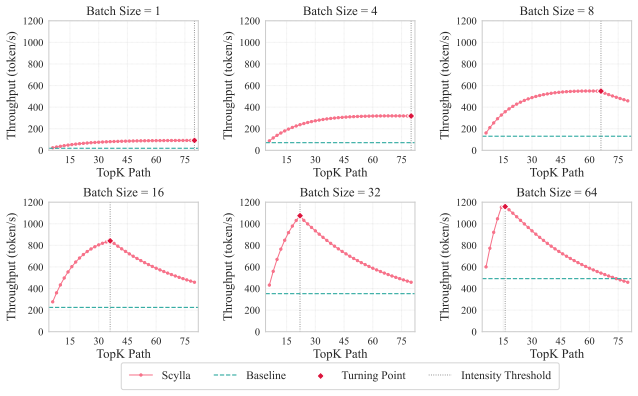
- [§3.2, §4.3, Theorem 1.3, Table 5] Equation (3) predicts roughly 7.5 tokens/s at b = 1 and 1728 tokens/s at b = 64, while Table 5 reports Scylla + Opt.topk at 250 and 2150 tokens/s, respectively. The equation therefore cannot be a fit to the measured system throughput; it must be a fit to the theoretical roofline curves of Figure 5. The paper should state this distinction explicitly and provide a direct measured-versus-predicted comparison. As written, the claim that Theorem 1.3 is 'validated' by the regression is misleading, because the displayed throughput values in Table 5 do not match the theorem.
- [§3.2, Eq. (7), Figure 1 (right)] The optimal-top-k formula in Eq. (4) is derived by imposing I(b, topk,opt) = I_crit, and the claimed validation of Eq. (4) is performed by fitting the same roofline model's theoretical curves (Figure 1 right and Figure 5). This is circular: the model is used to generate the data that then confirms the model. There is no independent hardware measurement of the optimal top-k value for Qwen2.5-72B across batch sizes. Without such a measurement, Theorem 1.3's top-k law is not empirically validated.
- [§3, Theorems 1.1–1.3] The three statements are called 'Theorems' but are empirical curve fits with no derivation, no standard errors, and no model-selection analysis. The pretraining effect itself is small: the acceptance rate changes from 5.13% to 5.43% over two orders of magnitude of tokens, and the paper reports no repeated-run variability or error bars. Since the design decisions behind Scylla (10B pretraining, decoder scaling, batch-adaptive top-k) are justified by these quantitative laws, the lack of a reproducible fitting protocol is a load-bearing gap.
minor comments (5)
- [Abstract and §4.4] '1.5-2.2 higher acceptance rate' is ambiguous: the reported numbers are 1.47–2.22 percentage-point improvements over EAGLE2, not a 1.5–2.2x multiplicative increase. Please state which quantity is meant.
- [Figure 1] The right panel uses a linear batch-size axis while the caption says 'log scale'; clarify the axis transformation. Also specify whether the points in each panel are single-benchmark values, means over benchmarks, or different from the values quoted in the text.
- [Appendix E, Eq. (8)] Equation (8) introduces an extra parameter k described only as 'ranging from 0.9 to 1.2'. It should be stated how k is determined, how many configurations are used, and whether the fitted relationship is identified rather than an arbitrary parametric form.
- [§4.4, Table 5] The text says observed throughput discrepancies arise from communication overhead and kernel utilization but still uses Table 5 to support the scaling law. Provide a side-by-side comparison of theoretical and measured throughput for the same batch sizes so the reader can judge the size of the discrepancy.
- [§6 and 'Code will be released later'] The quantitative claims depend entirely on fits, but no raw data, fitting scripts, or code are provided. The statement in §6 that the scaling laws are 'verified only in Transformer-based Scylla' should also be reflected in the abstract and conclusion, where the laws are presented as general.
Circularity Check
Theorems 1.1 and 1.2 are in-sample regressions presented as validation; Theorem 1.3's optimal-topk formula is defined by Eq. 7 and then 'validated' against the same roofline curves.
-
fitted input called prediction
[Theorem 1.1/1.2 and Section 4.1-4.2, Figure 1 Left/Middle, Figures 6-7]
"Acceptance rate =α· log10(Tpretrain) +β; α∼ 0.08, β ∼ 5.05 (1) ... These results validate that scaling pretraining data enhances performance but with diminishing returns at larger scales. The observed trend follows a log-linear scaling law (Theorem 1.1) with strong statistical validity (R2 = 0.89), indicating a strong logarithmic correlation between acceptance rate and pretraining tokens."
The constants α and β are least-squares fits to the very points plotted in Figure 1 Left (and similarly in Figure 1 Middle for Theorem 1.2). The text then cites the R² of that same fit as 'validation' of the law. There is no held-out prediction, no separate measurement, and no independent test: evaluating the formula at the fitted token budgets merely inverts the regression that produced α and β. The same structure is used for Theorem 1.2, where the decoder-count points in Figure 1 Middle are fitted and then reported as confirming the log-linear law.
-
self definitional
[Section 3.2, Eq. (7), Theorem 1.3, and Section 4.3, Figure 1 Right]
"It is demonstrated that maximum throughput consistently occurs when the arithmetic intensity approaches Icrit. Optimal topk Configuration. To maintain optimal throughput during batch size scaling, we derive the optimal topk criterion: I(b, topk,opt) := Icrit (7) ... By solving Equation 7 under Qwen2.5-72B architecture with a 10K prefill input, we formalize empirical scaling laws in Theorem 1.3. The right panel of Figure 1 validates the inverse-batch square root scaling law between batch size (b) and TopK-path (topk) fitted in Equation 4."
Equation 7 defines the optimal topk as the solution of I(b, topk) = Icrit within the paper's own roofline model. Figure 5, from which the 'Optimal Top-k Path' curve is taken, is explicitly labeled 'Theoretical throughput of Qwen2.5-72B (single-GPU)', and its maxima are computed from the same analytical FLOP/memory formulas. Therefore Equation 4 is a fitted re-expression of that defining equation, and the claimed 'validation' in Figure 1 Right is a regression on the same theoretical curve, not an independent measurement of optimal topk on hardware.
1 more flagged steps
-
fitted input called prediction
[Section 4.3, Eq. (3) and following sentence]
"Furthermore, we establish a log-linear scaling law (Equation 3) for maximum throughput as a function of batch size. The regression validates Theorem 1.3’s efficacy in maximizing throughput during batch size scaling while avoiding throughput degradation."
The throughput law α ≈ 286.79, β ≈ 7.54 is obtained by regression on the theoretical maximum-throughput curves shown in Figure 5 and Figure 1 Right, which are generated by the same roofline model used to define I(b, topk). Calling the regression a 'validation' is in-sample: it only checks that the fitted line reproduces the model output from which it was estimated. The real-system throughputs in Table 5 are presented separately and are attributed to communication and kernel effects rather than used to verify the stated α and β constants.
full rationale
The paper's genuinely independent content is the external system comparison: acceptance rate versus EAGLE/EAGLE2/EAGLE3 in Figure 2 and Table 4, and throughput versus EAGLE2 in Table 5. These empirical benchmarks do not reduce to the fitted scaling-law formulas, so the paper is not wholly circular. However, the three stated scaling laws are not independently predicted. Theorem 1.1 and Theorem 1.2 are least-squares fits to the same data points that the text cites as confirmatory evidence; reporting R² of the fit does not validate the law out of sample. Theorem 1.3's optimal-topk formula is defined by Equation 7 as the point where arithmetic intensity equals Icrit in the paper's roofline model, and the 'validation' of that formula regresses Equation 4 onto the same theoretical curves. The throughput law in Equation 3 is likewise a regression on those theoretical maxima. Thus the quantitative scaling claims are partly descriptive fits or restatements of their defining equations, while the system-level Scylla results retain independent empirical content. This yields a partial circularity score of 6.
Assumptions & free parameters
free parameters (8)
- alpha_pretrain =
0.08
- beta_pretrain =
5.05
- alpha_capacity =
0.74
- beta_capacity =
4.61
- alpha_batch_throughput =
286.79
- beta_batch_throughput =
7.54
- topk_scale_constants =
27904, 27897, 0.034
- acceptance_topk_k =
0.9 to 1.2
assumptions (5)
- standard math Speculative decoding token acceptance probability is min(1, P(t)/P_hat(t)), and rejected tokens are sampled from the residual distribution (Section 2).
- domain assumption The FLOPs and memory-access formulas in Tables 3, 7, and 8 accurately model the real kernels on NVIDIA H800 hardware (Section 3.2, Appendix C).
- ad hoc to paper The empirical log-linear form (acceptance rate linear in log tokens or log decoders) is the correct functional form for scaling (Theorems 1.1 and 1.2).
- ad hoc to paper The optimal TopK-path is exactly the point where arithmetic intensity equals the critical intensity I_crit (Eq. 7).
- domain assumption Single-epoch pretraining and two-epoch SFT on ShareGPT reveal scaling behavior that transfers across model families (Section 4.1).
Cite this review
Pith. "Pith review of Scaling Laws for Speculative Decoding." pith.science (2026). https://pith.science/paper/ZLIMPOPV
@misc{pith2026250507858,
  author       = {Pith},
  title        = {Pith review of: Scaling Laws for Speculative Decoding},
  year         = {2026},
  howpublished = {\url{https://pith.science/paper/ZLIMPOPV}},
  note         = {Machine review of arXiv:2505.07858}
}
read the original abstract
The escalating demand for efficient decoding in large language models (LLMs) is particularly critical for reasoning-intensive architectures like OpenAI-o3 and DeepSeek-R1, which depend on extended chain-of-thought reasoning. This study investigates speculative decoding techniques through dense LLM architectures to establish foundational insights for accelerating reasoning tasks. While speculative decoding methods leveraging parallel draft-verification cycles have emerged as promising acceleration techniques, the scaling laws governing decoding efficiency remain under-explored compared to conventional backbone LLMs developed through Pretraining->SFT->RLHF training paradigms. In this work, we discover Log-linear Scaling Laws (Theorem 1.1, 1.2 and 1.3) governing draft model acceptance rate (or decoding speed) across three dimensions: pretraining token volume, draft model capacity, and decoding batch size. Building on these laws, we achieve Scylla, which coordinates multi-dimensional scaling for popular LLMs (Llama2/3, Qwen2.5). Empirical validation shows Scylla achieves 1.5-2.2 higher acceptance rate than EAGLE2 and 0.3 higher than EAGLE3 at temperature T = 0, with peak performance gains on summarization and QA tasks (Figure 2). Industrial inference engine deployments demonstrate 2X decoding throughput improvements over EAGLE2 (Table 5), validating the transformative potential of systematic scaling for efficient LLM inference. Code will be released later.
Figures


Figures from the paper (5 more)



Reference graph
Works this paper leans on
-
[1]
Scaling laws for neural language models
Jared Kaplan, Sam McCandlish, Tom Henighan, Tom B Brown, Benjamin Chess, Rewon Child, Scott Gray, Alec Radford, Jeffrey Wu, and Dario Amodei. Scaling laws for neural language models. arXiv preprint arXiv:2001.08361, 2020
arXiv 2001
-
[2]
Training compute-optimal large language models
Jordan Hoffmann, Sebastian Borgeaud, Arthur Mensch, Elena Buchatskaya, Trevor Cai, Eliza Rutherford, Diego de Las Casas, Lisa Anne Hendricks, Johannes Welbl, Aidan Clark, et al. Training compute-optimal large language models. arXiv preprint arXiv:2203.15556, 2022
arXiv 2022
-
[3]
DeepSeek-R1: Incentivizing reasoning capability in LLMs via reinforcement learning
Daya Guo, Dejian Yang, Haowei Zhang, Junxiao Song, Ruoyu Zhang, Runxin Xu, Qihao Zhu, Shirong Ma, Peiyi Wang, Xiao Bi, et al. DeepSeek-R1: Incentivizing reasoning capability in LLMs via reinforcement learning. arXiv preprint arXiv:2501.12948, 2025
arXiv 2025
-
[4]
Medusa: Simple LLM inference acceleration framework with multiple decoding heads
Tianle Cai, Yuhong Li, Zhengyang Geng, Hongwu Peng, Jason D Lee, Deming Chen, and Tri Dao. Medusa: Simple LLM inference acceleration framework with multiple decoding heads. arXiv preprint arXiv:2401.10774, 2024
arXiv 2024
-
[5]
EAGLE: Speculative sampling requires rethinking feature uncertainty
Yuhui Li, Fangyun Wei, Chao Zhang, and Hongyang Zhang. EAGLE: Speculative sampling requires rethinking feature uncertainty. arXiv preprint arXiv:2401.15077, 2024
arXiv 2024
-
[6]
EAGLE-2: Faster inference of language models with dynamic draft trees
Yuhui Li, Fangyun Wei, Chao Zhang, and Hongyang Zhang. EAGLE-2: Faster inference of language models with dynamic draft trees. arXiv preprint arXiv:2406.16858, 2024
arXiv 2024
-
[7]
EAGLE-3: Scaling up inference acceleration of large language models via training-time test
Yuhui Li, Fangyun Wei, Chao Zhang, and Hongyang Zhang. EAGLE-3: Scaling up inference acceleration of large language models via training-time test. arXiv preprint arXiv:2503.01840, 2025
arXiv 2025
-
[8]
Training language models to follow instructions with human feedback
Long Ouyang, Jeffrey Wu, Xu Jiang, Diogo Almeida, Carroll Wainwright, Pamela Mishkin, Chong Zhang, Sandhini Agarwal, Katarina Slama, Alex Ray, et al. Training language models to follow instructions with human feedback. Advances in neural information processing systems, 35:27730–27744, 2022
2022
Show all 38 references
-
[9]
Gpt-4 technical report
Josh Achiam, Steven Adler, Sandhini Agarwal, Lama Ahmad, Ilge Akkaya, Florencia Leoni Aleman, Diogo Almeida, Janko Altenschmidt, Sam Altman, Shyamal Anadkat, et al. Gpt-4 technical report. arXiv preprint arXiv:2303.08774, 2023
2023 arXiv
-
[10]
Blockwise parallel decoding for deep autoregressive models
Mitchell Stern, Noam Shazeer, and Jakob Uszkoreit. Blockwise parallel decoding for deep autoregressive models. Advances in Neural Information Processing Systems, 31, 2018
2018
-
[11]
Llama 2: Open foundation and fine-tuned chat models
Hugo Touvron, Louis Martin, Kevin Stone, Peter Albert, Amjad Almahairi, Yasmine Babaei, Nikolay Bashlykov, Soumya Batra, Prajjwal Bhargava, Shruti Bhosale, et al. Llama 2: Open foundation and fine-tuned chat models. arXiv preprint arXiv:2307.09288, 2023
2023 arXiv
-
[12]
Vicuna: An open-source chatbot impressing GPT-4 with 90%* ChatGPT quality.See https://vicuna
Wei-Lin Chiang, Zhuohan Li, Ziqing Lin, Ying Sheng, Zhanghao Wu, Hao Zhang, Lianmin Zheng, Siyuan Zhuang, Yonghao Zhuang, Joseph E Gonzalez, et al. Vicuna: An open-source chatbot impressing GPT-4 with 90%* ChatGPT quality.See https://vicuna. lmsys. org (accessed 14 April 2023)...
2023
-
[13]
Qwen2.5 technical report
An Yang, Baosong Yang, Beichen Zhang, Binyuan Hui, Bo Zheng, Bowen Yu, Chengyuan Li, Dayiheng Liu, Fei Huang, Haoran Wei, et al. Qwen2.5 technical report. arXiv preprint arXiv:2412.15115, 2024
2024 arXiv
-
[14]
The Llama 3 herd of models
Aaron Grattafiori, Abhimanyu Dubey, Abhinav Jauhri, Abhinav Pandey, Abhishek Kadian, Ahmad Al-Dahle, Aiesha Letman, Akhil Mathur, Alan Schelten, Alex Vaughan, et al. The Llama 3 herd of models. arXiv preprint arXiv:2407.21783, 2024. 10
2024 arXiv
-
[15]
Judging LLM-as-a-judge with MT-bench and chatbot arena
Lianmin Zheng, Wei-Lin Chiang, Ying Sheng, Siyuan Zhuang, Zhanghao Wu, Yonghao Zhuang, Zi Lin, Zhuohan Li, Dacheng Li, Eric Xing, et al. Judging LLM-as-a-judge with MT-bench and chatbot arena. Advances in Neural Information Processing Systems, 36:46595–46623, 2023
2023
-
[16]
Evaluating large language models trained on code
Mark Chen, Jerry Tworek, Heewoo Jun, Qiming Yuan, Henrique Ponde De Oliveira Pinto, Jared Kaplan, Harri Edwards, Yuri Burda, Nicholas Joseph, Greg Brockman, et al. Evaluating large language models trained on code. arXiv preprint arXiv:2107.03374, 2021
2021 arXiv
-
[17]
Training verifiers to solve math word problems
Karl Cobbe, Vineet Kosaraju, Mohammad Bavarian, Mark Chen, Heewoo Jun, Lukasz Kaiser, Matthias Plappert, Jerry Tworek, Jacob Hilton, Reiichiro Nakano, et al. Training verifiers to solve math word problems. arXiv preprint arXiv:2110.14168, 2021
-
[18]
Alpaca: A strong, replicable instruction- following model
Rohan Taori, Ishaan Gulrajani, Tianyi Zhang, Yann Dubois, Xuechen Li, Carlos Guestrin, Percy Liang, and Tatsunori B Hashimoto. Alpaca: A strong, replicable instruction- following model. Stanford Center for Research on Foundation Models. https://crfm. stanford. edu/2023/03/13/a...
2023
-
[19]
Abstractive text sum- marization using sequence-to-sequence RNNs and beyond
Ramesh Nallapati, Bowen Zhou, Caglar Gulcehre, Bing Xiang, et al. Abstractive text sum- marization using sequence-to-sequence RNNs and beyond. arXiv preprint arXiv:1602.06023, 2016
2016 arXiv
-
[20]
Natural questions: a benchmark for question answering research
Tom Kwiatkowski, Jennimaria Palomaki, Olivia Redfield, Michael Collins, Ankur Parikh, Chris Alberti, Danielle Epstein, Illia Polosukhin, Jacob Devlin, Kenton Lee, et al. Natural questions: a benchmark for question answering research. Transactions of the Association for Computa...
2019
-
[21]
Accelerating large language model decoding with speculative sampling
Charlie Chen, Sebastian Borgeaud, Geoffrey Irving, Jean-Baptiste Lespiau, Laurent Sifre, and John Jumper. Accelerating large language model decoding with speculative sampling. arXiv preprint arXiv:2302.01318, 2023
2023 arXiv
-
[22]
Fast inference from transformers via speculative decoding
Yaniv Leviathan, Matan Kalman, and Yossi Matias. Fast inference from transformers via speculative decoding. In International Conference on Machine Learning, pages 19274–19286. PMLR, 2023
2023
-
[23]
Online speculative decoding
Xiaoxuan Liu, Lanxiang Hu, Peter Bailis, Alvin Cheung, Zhijie Deng, Ion Stoica, and Hao Zhang. Online speculative decoding. arXiv preprint arXiv:2310.07177, 2023
2023 arXiv
-
[24]
Lookahead: An inference acceleration framework for large language model with lossless generation accuracy
Yao Zhao, Zhitian Xie, Chen Liang, Chenyi Zhuang, and Jinjie Gu. Lookahead: An inference acceleration framework for large language model with lossless generation accuracy. In Proceed- ings of the 30th ACM SIGKDD Conference on Knowledge Discovery and Data Mining, pages 6344–6355, 2024
2024
-
[25]
Ouroboros: Speculative decoding with large model enhanced drafting
Weilin Zhao, Yuxiang Huang, Xu Han, Chaojun Xiao, Zhiyuan Liu, and Maosong Sun. Ouroboros: Speculative decoding with large model enhanced drafting. arXiv e-prints, pages arXiv–2402, 2024
2024
-
[26]
Break the sequential dependency of LLM inference using lookahead decoding
Yichao Fu, Peter Bailis, Ion Stoica, and Hao Zhang. Break the sequential dependency of LLM inference using lookahead decoding. arXiv preprint arXiv:2402.02057, 2024
2024 arXiv
-
[27]
DistillSpec: Improving speculative decoding via knowledge distillation
Yongchao Zhou, Kaifeng Lyu, Ankit Singh Rawat, Aditya Krishna Menon, Afshin Ros- tamizadeh, Sanjiv Kumar, Jean-François Kagy, and Rishabh Agarwal. DistillSpec: Improving speculative decoding via knowledge distillation. arXiv preprint arXiv:2310.08461, 2023
-
[28]
CLLMs: Consistency large language models
Siqi Kou, Lanxiang Hu, Zhezhi He, Zhijie Deng, and Hao Zhang. CLLMs: Consistency large language models. In Forty-first International Conference on Machine Learning, 2024
2024
-
[29]
Sequoia: Scalable, robust, and hardware-aware speculative decoding
Zhuoming Chen, Avner May, Ruslan Svirschevski, Yuhsun Huang, Max Ryabinin, Zhihao Jia, and Beidi Chen. Sequoia: Scalable, robust, and hardware-aware speculative decoding. arXiv preprint arXiv:2402.12374, 2024
2024 arXiv
-
[30]
SSSD: Simply-scalable speculative decoding
Michele Marzollo, Jiawei Zhuang, Niklas Roemer, Lorenz K Müller, and Lukas Cavigelli. SSSD: Simply-scalable speculative decoding. arXiv preprint arXiv:2411.05894, 2024
2024 arXiv
-
[31]
Better & faster large language models via multi-token prediction
Fabian Gloeckle, Badr Youbi Idrissi, Baptiste Rozière, David Lopez-Paz, and Gabriel Syn- naeve. Better & faster large language models via multi-token prediction. arXiv preprint arXiv:2404.19737, 2024
2024 arXiv
-
[32]
Clover: Regressive lightweight speculative decoding with sequential knowledge
Bin Xiao, Chunan Shi, Xiaonan Nie, Fan Yang, Xiangwei Deng, Lei Su, Weipeng Chen, and Bin Cui. Clover: Regressive lightweight speculative decoding with sequential knowledge. arXiv preprint arXiv:2405.00263, 2024. 11
2024 arXiv
-
[33]
Clover-2: Accurate inference for regressive lightweight speculative decoding
Bin Xiao, Lujun Gui, Lei Su, and Weipeng Chen. Clover-2: Accurate inference for regressive lightweight speculative decoding. arXiv preprint arXiv:2408.00264, 2024
2024 arXiv
-
[34]
Learning harmonized represen- tations for speculative sampling
Lefan Zhang, Xiaodan Wang, Yanhua Huang, and Ruiwen Xu. Learning harmonized represen- tations for speculative sampling. arXiv preprint arXiv:2408.15766, 2024
2024 arXiv
-
[35]
Sinkhorn distance minimization for knowledge distillation
Xiao Cui, Yulei Qin, Yuting Gao, Enwei Zhang, Zihan Xu, Tong Wu, Ke Li, Xing Sun, Wengang Zhou, and Houqiang Li. Sinkhorn distance minimization for knowledge distillation. In LREC-COLING, pages 14846–14858, 2024
2024
-
[36]
Multi-level optimal transport for universal cross-tokenizer knowledge distillation on language models
Xiao Cui, Mo Zhu, Yulei Qin, Liang Xie, Wengang Zhou, and Houqiang Li. Multi-level optimal transport for universal cross-tokenizer knowledge distillation on language models. In Proceedings of the AAAI Conference on Artificial Intelligence, volume 39, pages 23724–23732, 2025
2025
-
[37]
Sinkd: Sinkhorn distance minimization for knowledge distillation
Xiao Cui, Yulei Qin, Yuting Gao, Enwei Zhang, Zihan Xu, Tong Wu, Ke Li, Xing Sun, Wengang Zhou, and Houqiang Li. Sinkd: Sinkhorn distance minimization for knowledge distillation. TNNLS, 2024
2024
-
[38]
Kangaroo: Lossless self-speculative decoding for accelerating llms via double early exiting
Fangcheng Liu, Yehui Tang, Zhenhua Liu, Yunsheng Ni, Duyu Tang, Kai Han, and Yunhe Wang. Kangaroo: Lossless self-speculative decoding for accelerating llms via double early exiting. Advances in Neural Information Processing Systems, 37:11946–11965, 2024. 12 A Pretraining Data ...
2024
Reviewed August 15, 2026 · model on record in the stance chip above.
Discussion (0). Continue with ORCID to comment.