REVIEW 4 major objections 5 minor 51 references
Resonant Raman tensors can now be computed with any electronic-structure method via a finite-difference eigenvalue-projectability identity, and consistent hybrid-functional calculations match experiment on graphene and MoS2.
Reviewed by Pith at T0; open to challenge. T0 means a machine referee read the full paper against a public rubric. the ladder, T0–T4 →
2026-08-04 00:52 UTC pith:ZLONFC4G
load-bearing objection Useful finite-difference route to resonant Raman tensors at hybrid/GW levels, with a clean consistency-decomposition message; but the 'any method' claim outruns the norm-conserving evidence and the linewidth sensitivity is untested. the 4 major comments →
Resonant Raman spectroscopies beyond density-functional theory
The pith
A machine-rendered reading of the paper's core claim, the machinery that carries it, and where it could break.
Core claim
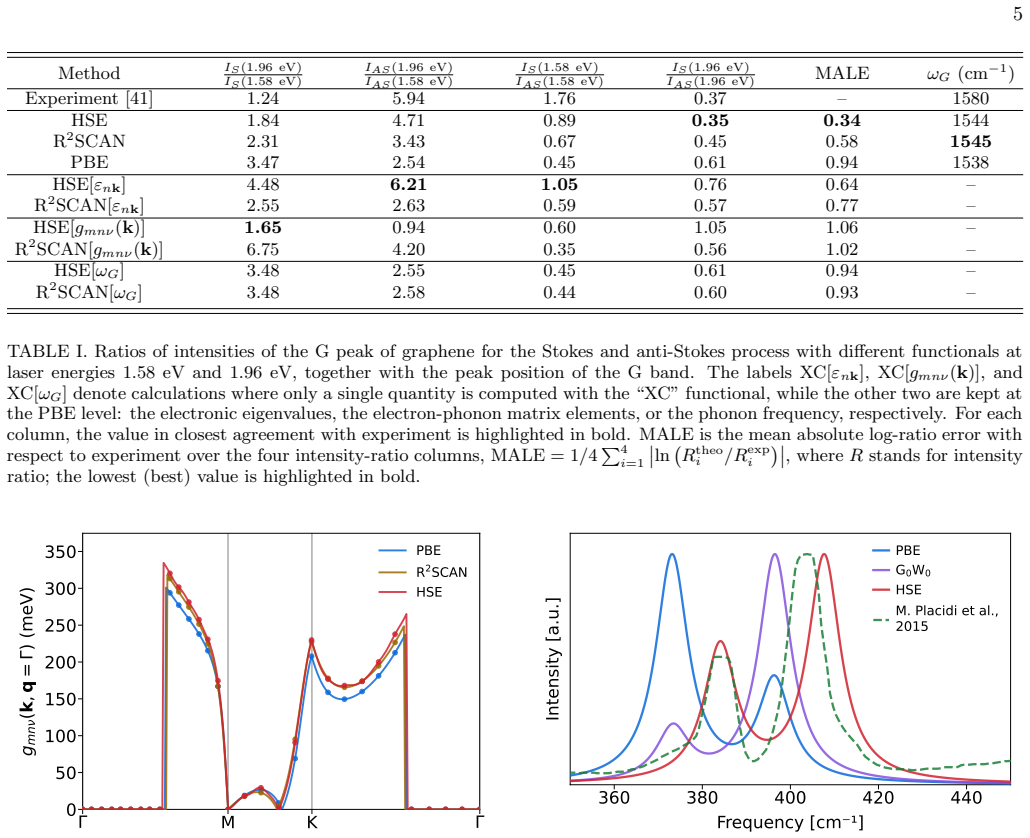
The central claim is that the full resonant Raman tensor of Eq. (2) can be computed for any electronic-structure method capable of producing forces, eigenvalues, and wavefunctions of pristine and displaced configurations, because the electron-phonon matrix element at q=Γ is recovered by the eigenvalue-projectability identity of Eq. (4). The framework is validated against density-functional perturbation theory at the PBE level and then used to show that HSE gives the best overall agreement with experiment: a mean absolute log-ratio error of 0.34 on four graphene Stokes/anti-Stokes intensity ratios, versus 0.94 for PBE and 0.58 for R2SCAN, and a MoS2 intensity ratio of 1.7 versus the experimen
What carries the argument
The central object is Eq. (4), a finite-difference eigenvalue-projectability identity that expresses the electron-phonon matrix element ⟨ψ_mk|∂V/∂τ|ψ_nk⟩ as a symmetrized difference of displaced-cell eigenvalues weighted by overlaps between displaced and pristine wavefunctions. Placed inside the third-order perturbation theory expression of Eq. (2) for the Raman tensor, and combined with Wannier interpolation to dense k-grids, this identity lets any electronic-structure method feed the full resonant Raman spectrum without a dedicated linear-response formalism.
Load-bearing premise
The result stands on the assumption that displaced-cell wavefunctions stay faithfully representable in the pristine basis so the finite-difference overlap formula recovers the true electron-phonon matrix element, and on the neglect of excitonic effects in the third-order perturbation expression.
What would settle it
Compute the electron-phonon matrix element for a material with a soft mode or strongly correlated orbitals by both Eq. (4) and a direct linear-response method beyond PBE; disagreement would signal projectability failure. Alternatively, measure resonant Raman intensities at laser energies near the exciton resonance of monolayer MoS2; a systematic deviation from the calculated spectra would confirm that the neglected exciton-phonon coupling is essential.
If this is right
- Resonant Raman calculations become available for hybrid functionals, meta-GGAs, many-body perturbation theory, and other methods that lack linear-response implementations.
- Intensity predictions improve systematically with reduced dielectric overscreening; electron-phonon couplings from HSE and R2SCAN exceed PBE values by about 5-10% in graphene.
- Mixing levels of theory, such as HSE eigenvalues with PBE couplings, can be less accurate than plain PBE, so consistent treatment is necessary.
- The workflow's modest requirements make it applicable to database-scale resonant Raman libraries for 2D materials.
Where Pith is reading between the lines
- The projectability assumption in Eq. (4) deserves scrutiny for methods or displacements where displaced wavefunctions change character dramatically; a cross-check against direct linear response for a non-PBE functional would delimit its validity.
- The paper's exclusion of excitonic effects is likely the dominant error at laser energies near exciton resonances; extending the framework to Bethe-Salpeter or exciton-phonon coupling is a natural next step that could change the reported rankings.
- The numerical evidence rests on four graphene intensity ratios and two MoS2 modes; whether HSE always beats R2SCAN will depend on the band-gap error and on the uniformity of coupling enhancement across the Brillouin zone.
- The deterioration of G0W0 from 3.0 to 4.2 when couplings are included, attributed partly to the absence of updated wavefunctions, suggests a self-consistent GW scheme would be a sharper test of many-body Raman predictions.
Editorial analysis
A structured set of objections, weighed in public.
Referee Report
Summary. The paper introduces a finite-difference framework for computing resonant Raman tensors using any electronic-structure method that supplies forces, eigenvalues, and wavefunctions of pristine and displaced configurations. The key step is Eq. (4), which expresses electron-phonon matrix elements at q=Γ through projections of displaced-cell wavefunctions onto pristine states. The method is benchmarked against density-functional perturbation theory (DFPT) at the PBE level, then applied to graphene and monolayer MoS2 with PBE, R2SCAN, HSE06, and (for MoS2) one-shot G0W0. The central numerical claims are that (i) hybrid functionals give the best overall agreement with experimental Raman intensity ratios (HSE MALE=0.34 for graphene vs. PBE 0.94), and (ii) consistent treatment of eigenvalues and electron-phonon matrix elements at the same level of theory is necessary, as partial substitutions HSE[ε_nk] and HSE[g_mnν] perform worse. The manuscript also reports that R2SCAN gives intermediate results and that G0W0 improves over PBE for MoS2 but less so than HSE.
Significance. If correct, the approach would open resonant Raman intensity calculations to hybrid functionals, meta-GGAs, and many-body methods that lack linear-response implementations, addressing a real bottleneck in the field. The paper includes a clean decomposition experiment (Table I), a direct FD-vs-DFPT benchmark (SI Fig. S1), and commits to open-source code and archived data, which are substantial strengths. The central claim of applicability to 'any electronic-structure method' is, however, broader than what is demonstrated, and the G0W0 application is internally inconsistent in a way that the paper itself acknowledges.
major comments (4)
- [Eq. (4), §1] The abstract and §1 claim the framework applies to 'any electronic-structure method,' but Eq. (4) implicitly assumes that displaced and pristine wavefunctions are orthonormal with respect to the identity. In PAW or ultrasoft pseudopotential formulations, the eigenproblem is H|ψ⟩=ε S|ψ⟩ with S≠I, and the electron-phonon matrix element contains an additional term proportional to ⟨ψ_m|∂S/∂τ|ψ_n⟩. Equation (4), which uses only bare overlaps u^±_jnk=⟨ψ^±_jk|ψ_nk⟩, cannot separate this term. The reported applications use only norm-conserving DOJO pseudopotentials (SI §IV), so the unrestricted claim is not supported. The authors should either restrict the claim to norm-conserving methods or derive the S≠I generalization.
- [§3, MoS2 G0W0] The G0W0 calculation is presented as a demonstration that the framework handles many-body perturbation theory, yet the paper states that 'G0W0 does not provide updated wavefunctions' and therefore the electron-phonon couplings 'combine quantities that are not fully consistent with each other.' Since Eq. (4) requires wavefunctions of displaced configurations at the same level of theory, the G0W0 results are not a clean test of Eq. (4), and the comparison between HSE and G0W0 is confounded (the G0W0 ratio worsens from 3.0 to 4.2 when the e-ph couplings are included). This should be explicitly framed as an inconsistent hybrid calculation, or the G0W0 demonstration should be replaced.
- [Eq. (2), Table I] The Raman tensor in Eq. (2) depends on the phenomenological linewidths γ_n and the Lorentzian smearing used to construct spectra. No values for γ_n are reported and no sensitivity analysis is given for either parameter. Because the MALE ranking in Table I and the central 'HSE best' conclusion are based on intensity ratios, it is important to show that the ordering is robust to reasonable variations of these parameters, particularly for the anti-Stokes ratios that are most sensitive to the resonance shape.
- [Eq. (4), SI §IV] The finite-difference displacement amplitude τ in Eq. (4) is a free parameter, but its value is not reported and no convergence test with respect to τ is presented. Although the FD-DFPT benchmark (SI Fig. S1) provides a validation at the PBE level, the general applicability claim would benefit from stating the chosen τ and demonstrating that the extracted electron-phonon matrix elements are converged with respect to it.
minor comments (5)
- [Eq. (1)] The notation |P_s R_ν(E_L) P_i|^2 would benefit from explicit definitions of how the polarization vectors are contracted with the tensor; the scalar/tensor character is currently ambiguous.
- [SI Fig. S1] The FD-DFPT comparison for MoS2 is performed at 2.41 eV, whereas the main-text spectra are at 3.81 eV; it would improve clarity to state why the two energies differ.
- [Table I] The column headers 'IS' and 'IAS' are hard to parse; a schematic definition of the four ratios, e.g., as explicit Stokes/anti-Stokes intensity quotients, would improve readability.
- [Abstract and §1] The phrase 'any electronic-structure method' is used prominently before the limitations are discussed. Consider softening the claim until an explicit statement about the norm-conserving or S≠I generalization is added.
- [General] There are minor typographical and grammatical issues, e.g., 'the electron-phonon couplings that enters' in §1, and the data availability text points to a Materials Cloud Archive without giving the accession link.
Circularity Check
No significant circularity: Eq. (4) is a finite-difference identity benchmarked against DFPT, and the HSE ranking is a genuine out-of-sample comparison.
full rationale
The only potentially self-referential ingredient is Eq. (4), imported from the authors' Ref. 13 and used to convert displaced-cell eigenvalues and wavefunction overlaps into electron-phonon matrix elements. This is not a fit to the paper's target: Eq. (4) is a finite-difference representation of the projected Hamiltonian derivative, and the paper independently validates it against DFPT at the PBE level (main text: "the full workflow is benchmarked against DFPT at the PBE level" and SI Fig. S1 shows "quantitative agreement"). The method ranking (HSE best, MALE = 0.34) rests on default functionals (HSE uses the "default 0.25 fraction of exact exchange") and compares predicted Stokes/anti-Stokes and E'/A1' intensity ratios to published experiments; no experimental Raman intensity is used as input or fitting target. The explicit caveats - G0W0 "does not provide updated wavefunctions... combines quantities that are not fully consistent with each other", the use of only norm-conserving DOJO pseudopotentials, and the omission of excitonic effects - limit the breadth of the "any electronic-structure method" claim and the beyond-DFT validation, but they are correctness/validity concerns rather than circular reductions. No step makes an output equal to an input by construction.
Axiom & Free-Parameter Ledger
free parameters (3)
- Phenomenological linewidth γ_n (intermediate electronic states) =
not stated in text
- Lorentzian spectral broadenings =
20 cm⁻¹ (graphene), 4 cm⁻¹ (MoS2), 5 cm⁻¹ (Fig. 4)
- Finite-difference displacement amplitude τ in Eq. (4) =
not stated
axioms (3)
- domain assumption Third-order perturbation-theory expression for the resonant Raman tensor (Eq. 2, following Venezuela et al. 2011) with constant phenomenological linewidths γ_n
- domain assumption Eigenvalue-projectability formula Eq. (4) recovers the self-consistent potential-derivative matrix elements at q=Γ
- domain assumption Wannier interpolation of eigenvalues, dipoles, and electron-phonon couplings to 150×150×1 grids is faithful
Cite this review
Pith. "Pith review of Resonant Raman spectroscopies beyond density-functional theory." pith.science (2026). https://pith.science/paper/ZLONFC4G
@misc{pith2026260800269,
  author       = {Pith},
  title        = {Pith review of: Resonant Raman spectroscopies beyond density-functional theory},
  year         = {2026},
  howpublished = {\url{https://pith.science/paper/ZLONFC4G}},
  note         = {Machine review of arXiv:2608.00269}
}
read the original abstract
Resonant Raman spectroscopy probes, in a single measurement, how electrons and phonons couple in a material. Density-functional theory (DFT) typically reproduces well phonon frequencies, but resonant Raman intensities hinge on electron-phonon matrix elements and electronic transitions that are far more sensitive to the underlying exchange-correlation approximation. However, electron-phonon coupling has so far been accessible only through linear-response theories developed for a handful of semilocal DFT methods, leaving the sensitivity of resonant Raman intensities to the electronic-structure approximation essentially unexplored. Here, we introduce a general finite-difference framework that can compute resonant Raman tensors for any electronic-structure method capable of delivering forces, eigenvalues, and wavefunctions of pristine and displaced configurations. We apply the formalism to graphene and monolayer MoS$_2$, using hybrid functionals or meta-GGAs, and show that these approaches systematically enhance electron-phonon couplings relative to semilocal DFT, reflecting reduced dielectric overscreening. A decomposition of the Raman tensor shows that accurate intensities require electronic eigenvalues and electron-phonon matrix elements to be treated consistently at the same level of theory. Among the approaches tested, hybrid functionals provide the best overall agreement with experiment. Because the framework needs only quantities every electronic-structure code already produces, it opens the door to systematic, beyond-DFT Raman characterization or benchmarking against experiments, especially for 2D materials.
Figures


Reference graph
Works this paper leans on
-
[1]
Placidi, M
M. Placidi, M. Dimitrievska, V. Izquierdo-Roca, X. Fontan´ e, A. Castellanos-Gomez, A. P´ erez-Tom´ as, N. Mestres, M. Espindola-Rodriguez, S. L´ opez-Marino, M. Neuschitzer, V. Bermudez, A. Yaremko, and A. P´ erez- Rodr ´ ıguez, 2D Materials2, 035006 (2015)
2015
-
[2]
M. Dimitrievska, A. Fairbrother, X. Fontan´ e, T. Jawhari, V. Izquierdo-Roca, E. Saucedo, and A. P´ erez-Rodr ´ ıguez, Applied Physics Letters104, 10.1063/1.4861593 (2014)
-
[3]
A. C. Ferrari, J. C. Meyer, V. Scardaci, C. Casiraghi, M. Lazzeri, F. Mauri, S. Piscanec, D. Jiang, K. S. Novoselov, S. Roth, and A. K. Geim, Physical Review Let- ters97, 187401 (2006)
2006
-
[5]
Taghizadeh, U
A. Taghizadeh, U. Leffers, T. G. Pedersen, and K. S. Thygesen, Nature Communications11, 3011 (2020)
2020
-
[6]
Marini, G
G. Marini, G. Marchese, G. Profeta, J. Sjakste, F. Macheda, N. Vast, F. Mauri, and M. Calandra, Com- puter Physics Communications295, 108950 (2024)
2024
-
[7]
J. Huang, R. Liu, Y. Zhang, N. T. Hung, H. Guo, R. Saito, and T. Yang, QR$ˆ2$-code: An open-source program for double resonance raman spectra (2025), 2505.10041 [cond- mat]
Pith/arXiv arXiv 2025
-
[8]
H. Lee, S. Ponc´ e, K. Bushick, S. Hajinazar, J. Lafuente- Bartolome, J. Leveillee, C. Lian, J.-M. Lihm, F. Macheda, H. Mori, H. Paudyal, W. H. Sio, S. Tiwari, M. Zacharias, X. Zhang, N. Bonini, E. Kioupakis, E. R. Margine, and F. Giustino, npj Computational Materials9, 156 (2023)
2023
-
[9]
Giustino, M
F. Giustino, M. L. Cohen, and S. G. Louie, Phys. Rev. B 76, 165108 (2007)
2007
-
[10]
Marzari and D
N. Marzari and D. Vanderbilt, Physical Review B56, 12847 (1997)
1997
-
[11]
Marzari, A
N. Marzari, A. A. Mostofi, J. R. Yates, I. Souza, and D. Vanderbilt, Reviews of Modern Physics84, 1419 (2012)
2012
-
[13]
A. Poliukhin, N. Colonna, F. Libbi, S. Ponc´ e, and N. Marzari, Carrier mobilities and electron-phonon inter- actions beyond DFT (2025), 2508.14852 [cond-mat]
Pith/arXiv arXiv 2025
-
[14]
A. D. Becke, The Journal of Chemical Physics98, 1372 (1993)
1993
-
[15]
J. Heyd, G. E. Scuseria, and M. Ernzerhof, The Journal of Chemical Physics118, 8207 (2003)
2003
-
[16]
J. W. Furness, A. D. Kaplan, J. Ning, J. P. Perdew, and J. Sun, The Journal of Physical Chemistry Letters11, 8208 (2020)
2020
-
[17]
M. S. Hybertsen and S. G. Louie, Phys. Rev. Lett.55, 1418 (1985)
1985
-
[18]
Onida, L
G. Onida, L. Reining, and A. Rubio, Reviews of Mod- ern Physics74, 601 (2002), publisher: American Physical Society (APS)
2002
- [19]
-
[20]
I. Dabo, A. Ferretti, N. Poilvert, Y. Li, N. Marzari, and M. Cococcioni, Physical Review B82, 115121 (2010)
2010
-
[21]
Borghi, A
G. Borghi, A. Ferretti, N. L. Nguyen, I. Dabo, and N. Marzari, Physical Review B90, 075135 (2014)
2014
-
[22]
N. L. Nguyen, N. Colonna, A. Ferretti, and N. Marzari, Physical Review X8, 021051 (2018)
2018
-
[23]
Colonna, N
N. Colonna, N. L. Nguyen, A. Ferretti, and N. Marzari, Journal of Chemical Theory and Computation15, 1905 (2019)
1905
-
[24]
A. K. Ganguly and J. L. Birman, Physical Review162, 806 (1967)
1967
-
[25]
P. Y. Yu and M. Cardona,Fundamentals of Semiconduc- tors: Physics and Materials Properties, 4th ed., Graduate Texts in Physics (Springer, Berlin, Heidelberg, 2010)
2010
-
[26]
Venezuela, M
P. Venezuela, M. Lazzeri, and F. Mauri, Physical Review B84, 035433 (2011)
2011
-
[27]
J.-J. Zhou, J. Park, I. Timrov, A. Floris, M. Cococ- cioni, N. Marzari, and M. Bernardi, Phys. Rev. Lett.127, 126404 (2021)
2021
-
[28]
W. Yang, S. Tiwari, F. Giustino, and Y.-W. Son, Phys. Rev. B112, 075203 (2025)
2025
-
[29]
Z. Li, G. Antonius, M. Wu, F. H. Da Jornada, and S. G. Louie, Physical Review Letters122, 186402 (2019)
2019
-
[30]
Z. Li, G. Antonius, Y.-H. Chan, and S. G. Louie, Com- puter Physics Communications295, 109003 (2024)
2024
-
[31]
Togo and I
A. Togo and I. Tanaka, Scripta Materialia108, 1 (2015)
2015
-
[32]
A. Togo, L. Chaput, T. Tadano, and I. Tanaka, Journal of Physics: Condensed Matter35, 353001 (2023)
2023
-
[33]
Bastonero and N
L. Bastonero and N. Marzari, npj Computational Mate- rials10, 55 (2024)
2024
-
[34]
J. Qiao, G. Pizzi, and N. Marzari, npj Computational Materials9, 208 (2023)
2023
-
[35]
See supporting information for additional figures and ta- bles, explicit results, and further information (2025), avail- able atwebsite
2025
-
[36]
D. Y. Qiu, F. H. da Jornada, and S. G. Louie, Physical Review B93, 235435 (2016)
2016
-
[37]
A. Guandalini, F. Macheda, G. Caldarelli, and F. Mauri, Physical Review Letters135, 10.1103/y1dn-m6pc (2025)
-
[38]
J. P. Perdew, K. Burke, and M. Ernzerhof, Physical Re- view Letters77, 3865 (1996). 8
1996
-
[39]
J. Heyd, G. E. Scuseria, and M. Ernzerhof, The Journal of Chemical Physics124, 219906 (2006)
2006
-
[40]
Marini, C
A. Marini, C. Hogan, M. Gr¨ uning, and D. Varsano, Com- puter Physics Communications180, 1392 (2009)
2009
-
[41]
Cong, J.-B
X. Cong, J.-B. Wu, M.-L. Lin, X.-L. Liu, W. Shi, P. Venezuela, and P.-H. Tan, Nanoscale10, 16138 (2018)
2018
-
[42]
Y. Wang, M. Engel, C. Lane, H. Miranda, L. Hou, B. Bar- biellini, R. S. Markiewicz, J.-X. Zhu, G. Kresse, A. Bansil, J. Sun, and R. Zhang, Accurate electron-phonon inter- actions from advanced density functional theory (2024), 2411.08192 [cond-mat]
arXiv 2024
-
[43]
D. J. Abramovitch, J. Coulter, S. Beck, and A. Millis, Physical Review B112, 075113 (2025)
2025
-
[44]
Z. P. Yin, A. Kutepov, and G. Kotliar, Phys. Rev. X3, 021011 (2013)
2013
-
[45]
Giustino, Rev
F. Giustino, Rev. Mod. Phys.89, 015003 (2017)
2017
-
[46]
Reichardt and L
S. Reichardt and L. Wirtz, Science Advances6, eabb5915 (2020)
2020
-
[47]
Guandalini, D
A. Guandalini, D. A. Leon, P. D’Amico, C. Cardoso, A. Ferretti, M. Rontani, and D. Varsano, Phys. Rev. B 109, 075120 (2024)
2024
-
[48]
J. P. Perdew and M. Levy, Phys. Rev. Lett.51, 1884 (1983)
1983
-
[49]
Talirz, S
L. Talirz, S. Kumbhar, E. Passaro, A. V. Yakutovich, V. Granata, F. Gargiulo, M. Borelli, M. Uhrin, S. P. Hu- ber, S. Zoupanos, C. S. Adorf, C. W. Andersen, O. Sch¨ utt, C. A. Pignedoli, D. Passerone, J. VandeVondele, T. C. Schulthess, B. Smit, G. Pizzi, and N. Marzari, Scientific Data7, 299 (2020)
2020
-
[50]
Giannozzi, S
P. Giannozzi, S. Baroni, N. Bonini, M. Calandra, R. Car, C. Cavazzoni, D. Ceresoli, G. L. Chiarotti, M. Cococ- cioni, I. Dabo, A. Dal Corso, S. De Gironcoli, S. Fab- ris, G. Fratesi, R. Gebauer, U. Gerstmann, C. Gougous- sis, A. Kokalj, M. Lazzeri, L. Martin-Samos, N. Marzari, F. Mauri, R. Mazzarello, S. Paolini, A. Pasquarello, L. Paulatto, C. Sbraccia, ...
2009
-
[51]
Giannozzi, O
P. Giannozzi, O. Andreussi, T. Brumme, O. Bunau, M. Buongiorno Nardelli, M. Calandra, R. Car, C. Cavaz- zoni, D. Ceresoli, M. Cococcioni, N. Colonna, I. Carnimeo, A. Dal Corso, S. de Gironcoli, P. Delugas, R. A. DiStasio, A. Ferretti, A. Floris, G. Fratesi, G. Fugallo, R. Gebauer, U. Gerstmann, F. Giustino, T. Gorni, J. Jia, M. Kawa- mura, H.-Y. Ko, A. Ko...
2017
-
[52]
Van Setten, M
M. Van Setten, M. Giantomassi, E. Bousquet, M. Verstraete, D. Hamann, X. Gonze, and G.-M. Rignanese, Computer Physics Communications226, 39 (2018)
2018
-
[53]
Aryasetiawan and O
F. Aryasetiawan and O. Gunnarsson, Reports on Progress in Physics61, 237 (1998)
1998
This paper was first reviewed by deepseek-v4-flash on August 4, 2026.
discussion (0)
Sign in with ORCID, Apple, or X to comment. Anyone can read and Pith papers without signing in.