Gate-Controlled Spin Qubits in Confined Altermagnets
Pith reviewed 2026-06-25 23:01 UTC · model grok-4.3
The pith
Altermagnetic quantum dots enable gate-controlled spin qubits without spin-orbit coupling.
A machine-rendered reading of the paper's core claim, the machinery that carries it, and where it could break.
Core claim
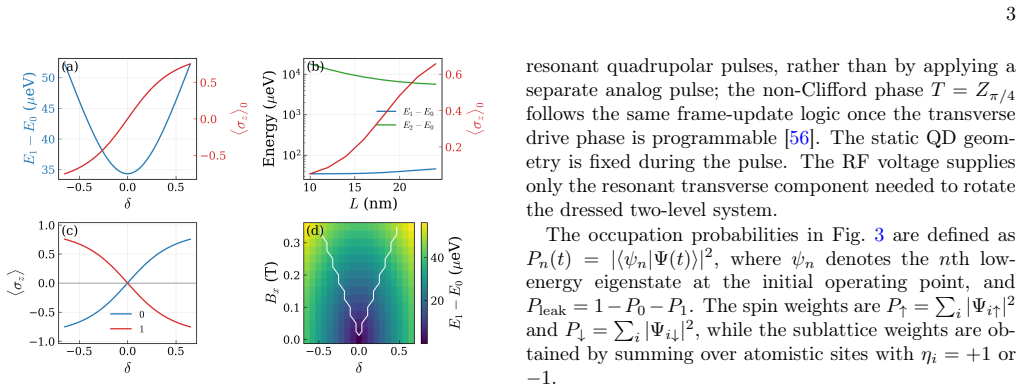
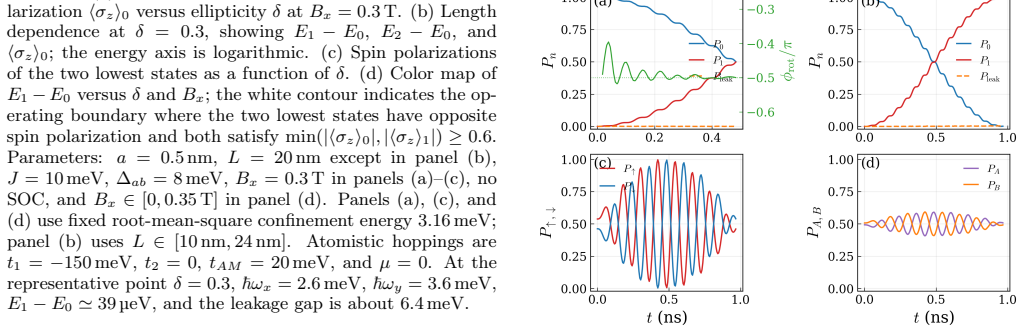
Gate-defined spin qubits in electrostatically confined altermagnetic quantum dots produce a low-energy doublet with opposite spin polarization. Phase-controlled quadrupolar gate drive about a fixed bias implements single-qubit X rotations by resonantly modulating confinement anisotropy. In double dots the spectrum projects cleanly onto isolated product states possessing a nonzero nonlocal Pauli block; resonant central-barrier modulation then drives the logical two-qubit component close to a maximally entangled state.
What carries the argument
The low-energy doublet with opposite spin polarization produced by elliptical confinement of the d-wave altermagnetic structure, which permits resonant modulation of confinement anisotropy for qubit control.
If this is right
- Single-qubit X rotations become available through resonant modulation of confinement anisotropy alone.
- Two-qubit entanglement can be generated by resonant central-barrier modulation in a double-dot geometry.
- The microwave-scale qubit gap permits use of standard microwave control hardware.
- Leakage remains suppressed by the meV-scale gap to higher states.
- The approach supplies a route to spin-qubit control in materials lacking strong spin-orbit coupling.
Where Pith is reading between the lines
- Fabrication compatibility with existing semiconductor processes could allow integration into larger quantum circuits.
- Absence of spin-orbit coupling may reduce certain decoherence channels that rely on that interaction.
- Different confinement shapes or altermagnetic symmetries could produce alternative gate sets or interaction strengths.
- Direct measurement of the predicted microwave gap and leakage gap would test the central premise.
Load-bearing premise
Realistic electrostatic confinement of a d-wave altermagnetic structure produces an isolated low-energy doublet with opposite spin polarization whose gap lies in the microwave range while the leakage gap remains in the meV range.
What would settle it
Observation that the energy separation between the low-energy doublet and the next excited states falls outside the microwave window, or that time-dependent quadrupolar drive fails to produce the predicted X rotations.
Figures
read the original abstract
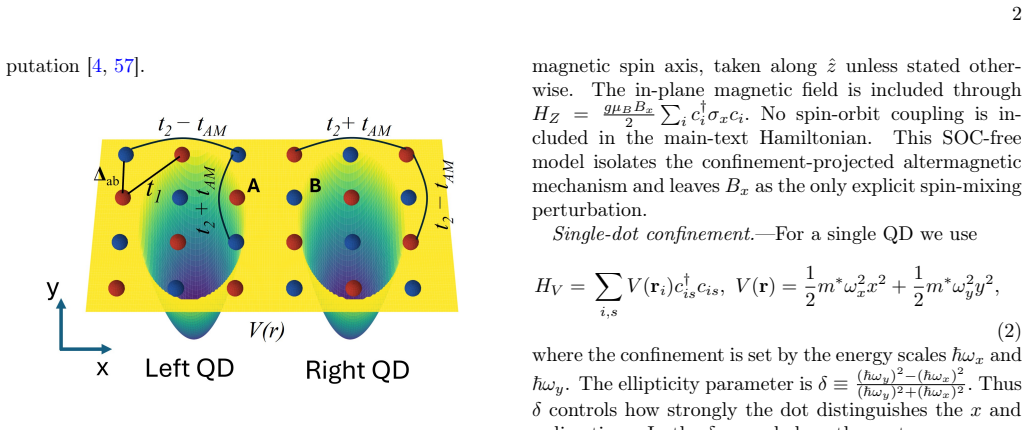
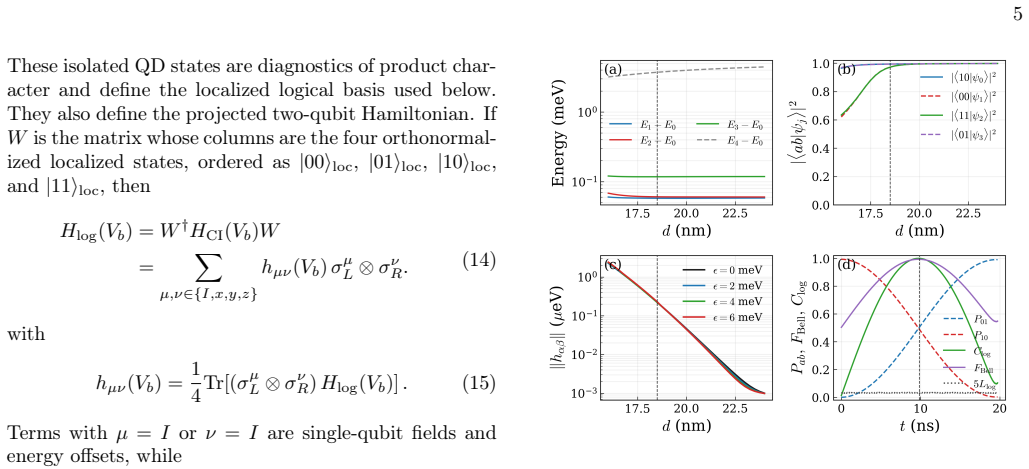
We propose gate-defined spin qubits in electrostatically confined altermagnetic quantum dots. Elliptical confinement of the $d$-wave altermagnetic structure produces a low-energy doublet with opposite spin polarization. For the range of parameters used here, the qubit states energy gap lies in the microwave range while the leakage gap remains in the meV range. Even without spin-orbit coupling, time-dependent simulations show that a phase-controlled quadrupolar gate drive about a fixed bias point implements $X_{\pi/2}$ and $X_\pi$ rotations by resonantly modulating the confinement anisotropy. We extend the study to two-qubits using a double quantum dot. We show that the double quantum dot spectrum can be cleanly projected onto isolated quantum dot product states with a nonzero nonlocal Pauli block in the effective logical two-qubit Hamiltonian. Resonant central-barrier modulation then drives the logical two-qubit component close to a maximally entangled state. These calculations show anisotropic altermagnetic quantum dots as a route to locally gate-controlled spin qubits without requiring spin-orbit coupling.
Editorial analysis
A structured set of objections, weighed in public.
Referee Report
Summary. The manuscript proposes gate-defined spin qubits in electrostatically confined altermagnetic quantum dots. Elliptical confinement of the d-wave altermagnetic structure is shown to produce a low-energy doublet with opposite spin polarization. For the parameters used, the qubit energy gap lies in the microwave range while the leakage gap is in the meV range. Time-dependent simulations demonstrate that a phase-controlled quadrupolar gate drive implements X_{π/2} and X_π rotations by resonantly modulating confinement anisotropy, even without spin-orbit coupling. The study extends to a double quantum dot, where the spectrum projects onto isolated product states with a nonzero nonlocal Pauli block in the effective logical two-qubit Hamiltonian; resonant central-barrier modulation then drives the logical component close to a maximally entangled state.
Significance. If the claimed gap hierarchy holds, the work identifies a route to locally gate-controlled spin qubits in altermagnets that does not require spin-orbit coupling. The numerical demonstration of single- and two-qubit operations via electrostatic drives is a concrete strength, as is the projection onto an effective two-qubit Hamiltonian with nonlocal Pauli terms. These elements could be of interest to the mesoscopic physics and quantum-information communities if the parameter robustness is established.
major comments (1)
- [Abstract and elliptical confinement paragraph] Abstract and paragraph on elliptical confinement: the central claim that an isolated low-energy doublet exists with microwave-scale splitting and meV-scale leakage gap 'for the range of parameters used here' is load-bearing for the time-dependent gate simulations and the protected logical subspace. No systematic robustness scan is presented against variations in altermagnetic exchange strength, confinement ellipticity, or Fermi energy; these are material-specific quantities, and modest changes could collapse the gap ratio or induce mixing with higher states, rendering the reported fidelities inapplicable.
Simulated Author's Rebuttal
We thank the referee for their careful reading of the manuscript and for highlighting the importance of parameter robustness. We address the single major comment below.
read point-by-point responses
-
Referee: [Abstract and elliptical confinement paragraph] Abstract and paragraph on elliptical confinement: the central claim that an isolated low-energy doublet exists with microwave-scale splitting and meV-scale leakage gap 'for the range of parameters used here' is load-bearing for the time-dependent gate simulations and the protected logical subspace. No systematic robustness scan is presented against variations in altermagnetic exchange strength, confinement ellipticity, or Fermi energy; these are material-specific quantities, and modest changes could collapse the gap ratio or induce mixing with higher states, rendering the reported fidelities inapplicable.
Authors: We agree that the gap hierarchy is central to the proposal and that a systematic robustness analysis would strengthen the claims. The original manuscript qualified the result to the specific parameters employed and did not include a scan over altermagnetic exchange strength, ellipticity, or Fermi energy. In the revised manuscript we will add a new appendix (or supplementary figure) that maps the qubit splitting and leakage gap across a range of these quantities. The additional data confirm that the microwave/meV hierarchy persists over a broad and physically relevant window around the reported values, thereby supporting the applicability of the gate simulations and the isolation of the logical subspace. We will also update the abstract and the elliptical-confinement paragraph to reference this robustness analysis. revision: yes
Circularity Check
No circularity: results are numerical outcomes of standard modeling for chosen parameters
full rationale
The paper's central claims rest on electrostatic confinement of d-wave altermagnets, producing an isolated doublet whose microwave/meV gap hierarchy and gate responses are obtained from time-dependent simulations for a stated range of parameters. These are direct computational outputs rather than quantities fitted from the target data or reduced by definition to the inputs. No self-definitional equations, fitted-input predictions, load-bearing self-citations, or smuggled ansatzes appear in the derivation chain. The proposal is self-contained against external benchmarks of tight-binding/continuum modeling and does not invoke uniqueness theorems or prior author results to force its conclusions.
Axiom & Free-Parameter Ledger
free parameters (1)
- confinement anisotropy and bias point
axioms (2)
- domain assumption d-wave altermagnetic order survives electrostatic confinement and produces opposite spin polarization in the ground doublet
- domain assumption the leakage states remain separated by meV while the logical gap is microwave
Forward citations
Cited by 1 Pith paper
-
All-electrical dephasing-protected spin qubits in altermagnets
Altermagnets provide all-electrical, dephasing-protected spin qubits in quantum dots with tunable frequencies via dot ellipticity and support for fSim gates plus singlet-triplet operation.
Reference graph
Works this paper leans on
-
[1]
(8) into the fixed dressed-CI basis at the operating point
The time- dependent Hamiltonian is built by projecting the barrier- drive operator in Eq. (8) into the fixed dressed-CI basis at the operating point. The static spectra in Fig. 4(a) show the lowest-energy four-state CI manifold separated from the first leakage level over the dot-separation range used for the operat- ing point. The overlap panel gives the ...
-
[2]
Loss and D
D. Loss and D. P. DiVincenzo, Quantum computation with quantum dots, Phys. Rev. A57, 120 (1998)
1998
-
[3]
Hanson, L
R. Hanson, L. P. Kouwenhoven, J. R. Petta, S. Tarucha, and L. M. K. Vandersypen, Spins in few-electron quan- tum dots, Rev. Mod. Phys.79, 1217 (2007)
2007
-
[4]
Ishihara, A
L.M.K.Vandersypen, H.Bluhm, J.S.Clarke, A.S.Dzu- rak, R. Ishihara, A. Morello, D. J. Reilly, L. R. Schreiber, and M. Veldhorst, Interfacing spin qubits in quantum dots and donors–hot, dense, and coherent, npj Quantum Inf.3, 34 (2017)
2017
-
[5]
Burkard, T
G. Burkard, T. D. Ladd, A. Pan, J. M. Nichol, and J. R. Petta, Semiconductor spin qubits, Rev. Mod. Phys.95, 025003 (2023)
2023
-
[6]
J. M. Elzerman, R. Hanson, L. H. Willems van Beveren, B. Witkamp, L. M. K. Vandersypen, and L. P. Kouwen- hoven, Single-shot read-out of an individual electron spin in a quantum dot, Nature430, 431 (2004)
2004
-
[7]
J. R. Petta, A. C. Johnson, J. M. Taylor, E. A. Laird, A. Yacoby, M. D. Lukin, C. M. Marcus, M. P. Hanson, and A. C. Gossard, Coherent manipulation of coupled electron spins in semiconductor quantum dots, Science 309, 2180 (2005)
2005
-
[8]
F. H. L. Koppens, C. Buizert, K. J. Tielrooij, I. T. Vink, K. C. Nowack, T. Meunier, L. P. Kouwenhoven, and L. M. K. Vandersypen, Driven coherent oscillations of a single electron spin in a quantum dot, Nature442, 766 (2006)
2006
-
[9]
K. C. Nowack, F. H. L. Koppens, Y. V. Nazarov, and L. M. K. Vandersypen, Coherent control of a single elec- tron spin with electric fields, Science318, 1430 (2007)
2007
-
[10]
B. M. Maune, M. G. Borselli, B. Huang, T. D. Ladd, P. W. Deelman, K. S. Holabird, A. A. Kise- lev, I. Alvarado-Rodriguez, R. S. Ross, A. E. Schmitz, M. Sokolich, C. A. Watson, M. F. Gyure, and A. T. Hunter, Coherent singlet-triplet oscillations in a silicon- based double quantum dot, Nature481, 344 (2012)
2012
-
[11]
J. J. Pla, K. Y. Tan, J. P. Dehollain, W. H. Lim, J. J. L. Morton, D. N. Jamieson, A. S. Dzurak, and A. Morello, A single-atom electron spin qubit in silicon, Nature489, 541 (2012)
2012
-
[12]
Veldhorst, J
M. Veldhorst, J. C. C. Hwang, C. H. Yang, A. W. Leen- stra, B. de Ronde, J. P. Dehollain, J. T. Muhonen, F. E. Hudson, K. M. Itoh, A. Morello, and A. S. Dzurak, An addressable quantum dot qubit with fault-tolerant control-fidelity, Nat. Nanotechnol.9, 981 (2014)
2014
-
[13]
Yoneda, K
J. Yoneda, K. Takeda, T. Otsuka, T. Nakajima, M. R. Delbecq, G. Allison, T. Honda, T. Kodera, S. Oda, Y. Hoshi, N. Usami, K. M. Itoh, and S. Tarucha, A quantum-dot spin qubit with coherence limited by charge noise and fidelity higher than 99.9%, Nat. Nanotechnol. 13, 102 (2018)
2018
-
[14]
D. M. Zajac, A. J. Sigillito, M. Russ, F. Borjans, J. M. Taylor, G. Burkard, and J. R. Petta, Resonantly driven CNOT gate for electron spins, Science359, 439 (2018)
2018
-
[15]
T. F. Watson, S. G. J. Philips, E. Kawakami, D. R. 7 Ward, P. Scarlino, M. Veldhorst, D. E. Savage, M. G. Lagally, M. Friesen, S. N. Coppersmith, M. A. Eriksson, and L. M. K. Vandersypen, A programmable two-qubit quantum processor in silicon, Nature555, 633 (2018)
2018
-
[16]
Huang, C
W. Huang, C. H. Yang, K. W. Chan, T. Tanttu, B. Hensen, R. C. C. Leon, M. A. Fogarty, J. C. C. Hwang, F. E. Hudson, K. M. Itoh, A. Morello, A. Laucht, and A. S. Dzurak, Fidelity benchmarks for two-qubit gates in silicon, Nature569, 532 (2019)
2019
-
[17]
N. W. Hendrickx, D. P. Franke, A. Sammak, G. Scap- pucci, and M. Veldhorst, Fast two-qubit logic with holes in germanium, Nature577, 487 (2020)
2020
-
[18]
N. W. Hendrickx, W. I. L. Lawrie, L. Petit, A. Sammak, G. Scappucci, and M. Veldhorst, A single-hole spin qubit, Nat. Commun.11, 3478 (2020)
2020
-
[19]
N. W. Hendrickx, W. I. L. Lawrie, M. Russ, F. van Rigge- len, S. L. de Snoo, R. N. Schouten, A. Sammak, G. Scap- pucci, and M. Veldhorst, A four-qubit germanium quan- tum processor, Nature591, 580 (2021)
2021
-
[20]
Scappucci, and S
A.Noiri, K.Takeda, T.Nakajima, T.Kobayashi, A.Sam- mak, G. Scappucci, and S. Tarucha, Fast universal quan- tum gate above the fault-tolerance threshold in silicon, Nature601, 338 (2022)
2022
-
[21]
X. Xue, M. Russ, N. Samkharadze, B. Undseth, A. Sam- mak, G. Scappucci, and L. M. K. Vandersypen, Quantum logic with spin qubits crossing the surface code threshold, Nature601, 343 (2022)
2022
-
[22]
A. R. Mills, C. R. Guinn, M. J. Gullans, A. J. Sigillito, M. M. Feldman, E. Nielsen, and J. R. Petta, Two-qubit silicon quantum processor with operation fidelity exceed- ing 99%, Sci. Adv.8, eabn5130 (2022)
2022
-
[23]
S. G. J. Philips, M. T. Mądzik, S. V. Amitonov, S. L. de Snoo, M. Russ, N. Kalhor, C. Volk, W. I. L. Lawrie, D. Brousse, L. Tryputen, B. P. Wuetz, A. Sammak, M. Veldhorst, G. Scappucci, and L. M. K. Vandersypen, Universal control of a six-qubit quantum processor in sil- icon, Nature609, 919 (2022)
2022
-
[24]
Scappucci, C
G. Scappucci, C. Kloeffel, F. A. Zwanenburg, D. Loss, M. Myronov, J.-J. Zhang, S. De Franceschi, G. Katsaros, and M. Veldhorst, The germanium quantum information route, Nat. Rev. Mater.6, 926 (2021)
2021
-
[25]
Steinacker, N
P. Steinacker, N. Dumoulin Stuyck, W. H. Lim, T. Tanttu, M. Feng, S. Serrano, A. Nickl, M. Candido, J. D. Cifuentes, E. Vahapoglu, S. K. Bartee, F. E. Hud- son, K. W. Chan, S. Kubicek, J. Jussot, Y. Canvel, S. Beyne, Y. Shimura, R. Loo, C. Godfrin, B. Raes, S. Baudot, D. Wan, A. Laucht, C. H. Yang, A. Saraiva, C. C. Escott, K. De Greve, and A. S. Dzurak, ...
2025
-
[26]
M. T. Mądzik, F. Luthi, G. G. Guerreschi, F. A. Mo- hiyaddin, F. Borjans, J. D. Chadwick, M. J. Curry, J. Ziegler, S. Atanasov, P. L. Bavdaz, E. J. Connors, J. Corrigan, H. E. Ercan, R. Flory, H. C. George, B. Harpt, E. Henry, M. M. Islam, N. Khammassi, D. Keith, L. F. Lampert, T. M. Mladenov, R. W. Morris, A. Nethwewala, S. Neyens, R. Otten, L. P. Osuna ...
2025
-
[27]
Hensgens, T
T. Hensgens, T. Fujita, L. Janssen, X. Li, C. J. Van Diepen, C. Reichl, W. Wegscheider, S. Das Sarma, and L. M. K. Vandersypen, Quantum simulation of a Fermi-Hubbard model using a semiconductor quantum dot array, Nature548, 70 (2017)
2017
-
[28]
X. Wang, E. Khatami, F. Fei, J. Wyrick, P. Nambood- iri, R. Kashid, A. F. Rigosi, G. Bryant, and R. Silver, Experimental realization of an extended Fermi-Hubbard model using a 2d lattice of dopant-based quantum dots, Nat. Commun.13, 6824 (2022)
2022
-
[29]
Buterakos and S
D. Buterakos and S. Das Sarma, Certain exact many- body results for Hubbard model ground states testable in small quantum dot arrays, Phys. Rev. B107, 014403 (2023)
2023
-
[30]
Kiczynski, S
M. Kiczynski, S. K. Gorman, H. Geng, M. B. Donnelly, Y. Chung, Y. He, J. G. Keizer, and M. Y. Simmons, En- gineering topological states in atom-based semiconductor quantum dots, Nature606, 694 (2022)
2022
-
[31]
M. B. Donnelly, Y. Chung, R. Garreis, S. Plugge, D. Pye, M. Kiczynski, J. Támara-Isaza, M. M. Munia, S. Suther- land, B. Voisin, L. Kranz, Y. L. Hsueh, A. M. S.-E. Huq, C. R. Myers, R. Rahman, J. G. Keizer, S. K. Gorman, and M. Y. Simmons, Large-scale analogue quantum sim- ulation using atom dot arrays, Nature650, 574 (2026)
2026
-
[32]
Šmejkal, J
L. Šmejkal, J. Sinova, and T. Jungwirth, Beyond conven- tional ferromagnetism and antiferromagnetism: A phase with nonrelativistic spin and crystal rotation symmetry, Phys. Rev. X12, 031042 (2022)
2022
-
[33]
Šmejkal, J
L. Šmejkal, J. Sinova, and T. Jungwirth, Emerging re- search landscape of altermagnetism, Phys. Rev. X12, 040501 (2022)
2022
-
[34]
Mazin, Editorial: Altermagnetism—a new punch line of fundamental magnetism, Phys
I. Mazin, Editorial: Altermagnetism—a new punch line of fundamental magnetism, Phys. Rev. X12, 040002 (2022)
2022
-
[35]
J.Krempáskýet al.,Altermagneticliftingofkramersspin degeneracy, Nature626, 517 (2024)
2024
-
[36]
Reimerset al., Direct observation of altermagnetic band splitting in crsb thin films, Nat
S. Reimerset al., Direct observation of altermagnetic band splitting in crsb thin films, Nat. Commun.15, 2116 (2024)
2024
-
[37]
J. A. Ouassou, A. Brataas, and J. Linder, dc joseph- son effect in altermagnets, Phys. Rev. Lett.131, 076003 (2023)
2023
-
[38]
C. W. J. Beenakker and T. Vakhtel, Phase-shifted an- dreev levels in an altermagnet josephson junction, Phys. Rev. B108, 075425 (2023)
2023
-
[39]
H. G. Giil and J. Linder, Superconductor-altermagnet memory functionality without stray fields, Phys. Rev. B 109, 134511 (2024)
2024
-
[40]
B. Lu, K. Maeda, H. Ito, K. Yada, and Y. Tanaka, φjosephson junction induced by altermagnetism, Phys. Rev. Lett.133, 226002 (2024)
2024
-
[41]
Banerjee and M
S. Banerjee and M. S. Scheurer, Altermagnetic supercon- ducting diode effect, Phys. Rev. B110, 024503 (2024)
2024
-
[42]
H. Vakili, E. Schwartz, and A. A. Kovalev, Spin-transfer torque in altermagnets with magnetic textures, Physi- cal Review Letters134, 10.1103/physrevlett.134.176401 (2025)
-
[43]
E. Schwartz, H. Vakili, and A. A. Kovalev, Thermo- magnonic torques in insulating altermagnets (2025), arXiv:2512.14660
Pith/arXiv arXiv 2025
-
[44]
Z. Zhu, R. Huang, X. Chen, Z. Cui, X. Duan, J. Zhang, I. Žutić, and T. Zhou, Altermagnetic proximity effect, Phys. Rev. Lett.136, 186702 (2026)
2026
-
[45]
J. D. Cao, K. S. Denisov, Y. Liu, and I. Žutić, Symmetry classification for alternating excitons in two-dimensional altermagnets, Phys. Rev. Lett.135, 266703 (2025). 8
2025
-
[46]
Soori, Geometry induced net spin polarization ofd- wave altermagnets, Phys
A. Soori, Geometry induced net spin polarization ofd- wave altermagnets, Phys. Rev. Mater.10, 044406 (2026)
2026
-
[47]
H. Vakili, M. Ali, I. Žutić, and A. A. Ko- valev, Supercurrent-driven néel torque in superconduc- tor/altermagnet hybrids (2026), arXiv:2603.22243
Pith/arXiv arXiv 2026
-
[48]
M. Roig, A. Kreisel, Y. Yu, B. M. Andersen, and D. F. Agterberg, Minimal models for altermagnetism, Phys. Rev. B110, 144412 (2024)
2024
-
[49]
Brekke, A
B. Brekke, A. Brataas, and A. Sudbø, Two-dimensional altermagnets: Superconductivity in a minimal micro- scopic model, Phys. Rev. B108, 224421 (2023)
2023
-
[50]
Tani and U
T. Tani and U. Zülicke, Multipole order in two- dimensionalaltermagnets,Phys.Rev.Research7,043149 (2025)
2025
-
[51]
L. P. Kouwenhoven, T. H. Oosterkamp, M. W. S. Danoe- sastro, M. Eto, D. G. Austing, T. Honda, and S. Tarucha, Excitation spectra of circular, few-electron quantum dots, Science278, 1788 (1997)
1997
-
[52]
Kyriakidis, M
J. Kyriakidis, M. Pioro-Ladrière, M. Ciorga, A. S. Sachrajda, and P. Hawrylak, Voltage-tunable singlet- triplet transition in lateral quantum dots, Phys. Rev. B 66, 035320 (2002)
2002
-
[53]
M. T. Allen, J. Martin, and A. Yacoby, Gate-defined quantum confinement in suspended bilayer graphene, Nat. Commun.3, 934 (2012)
2012
-
[54]
Prabhakar and J
S. Prabhakar and J. E. Raynolds, Gate control of a quan- tum dot single-electron spin in realistic confining poten- tials: Anisotropy effects, Phys. Rev. B79, 195307 (2009)
2009
-
[55]
R. C. C. Leon, C. H. Yang, J. C. C. Hwang, J. C. Lemyre, T. Tanttu, W. Huang, K. W. Chan, K. Y. Tan, F. E. Hudson, K. M. Itoh, A. Morello, A. Laucht, M. Pioro- Ladrière, A. Saraiva, and A. S. Dzurak, Coherent spin control of s-, p-, d- and f-electrons in a silicon quantum dot, Nat. Commun.11, 797 (2020)
2020
-
[56]
N. W. Hendrickx, L. Massai, M. Mergenthaler, F. J. Schupp, S.Paredes, S.W.Bedell, G.Salis,andA.Fuhrer, Sweet-spot operation of a germanium hole spin qubit with highly anisotropic noise sensitivity, Nat. Mater.23, 920 (2024)
2024
-
[57]
D. C. McKay, C. J. Wood, S. Sheldon, J. M. Chow, and J. M. Gambetta, EfficientZgates for quantum comput- ing, Phys. Rev. A96, 022330 (2017)
2017
-
[58]
M. J. Bremner, C. M. Dawson, J. L. Dodd, A. Gilchrist, A. W. Harrow, D. Mortimer, M. A. Nielsen, and T. J. Osborne, A practical scheme for quantum computation with any two-qubit entangling gate, Phys. Rev. Lett.89, 247902 (2002)
2002
-
[59]
See Supplemental Material for the scan protocol, one- and two-parameter sweeps overJ,t AM,∆ ab, and op- tional interfacial Rashba coupling, definitions of the qubit-gap, leakage-gap, quadrupolarmatrix-element, and Rabi-rate diagnostics, source data and plotting scripts, and the CI basis-convergence check for the two-electron calculation
-
[60]
Friesen, J
M. Friesen, J. Ghosh, M. A. Eriksson, and S. N. Coppersmith, A decoherence-free subspace in a charge quadrupole qubit, Nat. Commun.8, 15923 (2017)
2017
-
[61]
J. V. Koski, A. J. Landig, M. Russ, J. C. Abadillo-Uriel, P. Scarlino, B. Kratochwil, C. Reichl, W. Wegscheider, G. Burkard, M. Friesen, S. N. Coppersmith, A. Wallraff, K. Ensslin, and T. Ihn, Strong photon coupling to the quadrupole moment of an electron in a solid-state qubit, Nat. Phys.16, 642 (2020)
2020
-
[62]
Kratochwil, J
B. Kratochwil, J. V. Koski, A. J. Landig, P. Scar- lino, J. C. Abadillo-Uriel, C. Reichl, S. N. Coppersmith, W. Wegscheider, M. Friesen, A. Wallraff, T. Ihn, and K. Ensslin, Charge qubit in a triple quantum dot with tunablecoherence,Phys.Rev.Research3,013171(2021)
2021
-
[63]
V.N.Golovach, M.Borhani,andD.Loss,Electric-dipole- induced spin resonance in quantum dots, Phys. Rev. B 74, 165319 (2006)
2006
-
[64]
Tokura, W
Y. Tokura, W. G. van der Wiel, T. Obata, and S. Tarucha, Coherent single electron spin control in a slanting Zeeman field, Phys. Rev. Lett.96, 047202 (2006)
2006
-
[65]
Pioro-Ladrière, T
M. Pioro-Ladrière, T. Obata, Y. Tokura, Y.-S. Shin, T.Kubo, K.Yoshida, T.Taniyama,andS.Tarucha,Elec- trically driven single-electron spin resonance in a slanting Zeeman field, Nat. Phys.4, 776 (2008)
2008
-
[66]
S. M. Reimann and M. Manninen, Electronic structure of quantum dots, Rev. Mod. Phys.74, 1283 (2002)
2002
-
[67]
Rontani, C
M. Rontani, C. Cavazzoni, D. Bellucci, and G. Goldoni, Full configuration interaction approach to the few- electron problem in artificial atoms, J. Chem. Phys.124, 124102 (2006)
2006
-
[68]
Burkard, D
G. Burkard, D. Loss, and D. P. DiVincenzo, Coupled quantum dots as quantum gates, Phys. Rev. B59, 2070 (1999)
2070
-
[69]
Hu and S
X. Hu and S. Das Sarma, Hilbert-space structure of a solid-state quantum computer: Two-electron states of a double-quantum-dot artificial molecule, Phys. Rev. A61, 062301 (2000)
2000
-
[70]
Nielsen, R
E. Nielsen, R. P. Muller, and M. S. Carroll, Configuration interaction calculations of the controlled phase gate in double quantum dot qubits, Phys. Rev. B85, 035319 (2012)
2012
-
[71]
Hetényi, C
B. Hetényi, C. Kloeffel, and D. Loss, Exchange inter- action of hole-spin qubits in double quantum dots in highly anisotropic semiconductors, Phys. Rev. Research 2, 033036 (2020)
2020
-
[72]
Joecker, A
B. Joecker, A. D. Baczewski, J. K. Gamble, J. J. Pla, A. Saraiva, and A. Morello, Full configuration interac- tion simulations of exchange-coupled donors in silicon us- ing multi-valley effective mass theory, New J. Phys.23, 073007 (2021)
2021
-
[73]
Tariq and X
B. Tariq and X. Hu, Impact of the valley orbit coupling on exchange gate for spin qubits in silicon, npj Quantum Inf.8, 53 (2022)
2022
-
[74]
Geyer, B
S. Geyer, B. Hetényi, S. Bosco, L. C. Camenzind, R. S. Eggli, A. Fuhrer, D. Loss, R. J. Warburton, D. M. Zum- bühl, and A. V. Kuhlmann, Anisotropic exchange in- teraction of two hole-spin qubits, Nat. Phys.20, 1152 (2024)
2024
-
[75]
M. J. Rodríguez, E. A. Rodríguez-Mena, A. F. Kalo, and Y.-M. Niquet, Dressed basis sets for the modeling of ex- change interactions in double quantum dots, Phys. Rev. B112, 115310 (2025)
2025
-
[76]
Fenget al., An anomalous hall effect in altermagnetic ruthenium dioxide, Nat
Z. Fenget al., An anomalous hall effect in altermagnetic ruthenium dioxide, Nat. Electron.5, 735 (2022)
2022
-
[77]
Boseet al., Tilted spin current generated by the collinear antiferromagnet ruo 2, Nat
A. Boseet al., Tilted spin current generated by the collinear antiferromagnet ruo 2, Nat. Electron.5, 267 (2022)
2022
-
[78]
Karubeet al., Observation of spin-splitter torque in collinear antiferromagnetic ruo2, Phys
S. Karubeet al., Observation of spin-splitter torque in collinear antiferromagnetic ruo2, Phys. Rev. Lett.129, 137201 (2022)
2022
-
[79]
Fedchenkoet al., Observation of time-reversal symme- try breaking in the band structure of altermagnetic ruo2, Sci
O. Fedchenkoet al., Observation of time-reversal symme- try breaking in the band structure of altermagnetic ruo2, Sci. Adv.10, eadj4883 (2024). 9
2024
-
[80]
C. He, Z. Wen, J. Okabayashi, Y. Miura, T. Ma, T. Ohkubo, T. Seki, H. Sukegawa, and S. Mitani, Ev- idence for single variant in altermagnetic ruo2(101) thin films, Nat. Commun.16, 8235 (2025)
2025
discussion (0)
Sign in with ORCID, Apple, or X to comment. Anyone can read and Pith papers without signing in.