REVIEW 2 major objections 4 minor 40 references
Long-lived state in a four-spin system hyperpolarized at room temperature
T0 review · 2 major / 4 minor · reviewed 2026-08-14 · deepseek-v4-flash
Pith's one-line read This paper reports that four protons hyperpolarized at room temperature by dissolution triplet-DNP can be quantum-encoded into a long-lived singlet-pair state, extending the polarization lifetime roughly 2.4-fold and improving…
desk verdict Room-temperature triplet-DNP plus four-spin singlet encoding works, and the lifetime data are solid; the claimed sensing advantage is overstated because the contrast difference is within propagated error. read the letter →
The pith
A machine-rendered reading of the paper's core claim, the machinery that carries it, and where it could break.
The reading
What carries the argument
The load-bearing object is the singlet-pair density operator $\rho_{\mathrm{SP}} = \frac{\epsilon}{2}(|S\rangle\langle S|_{AX}\otimes I_{A'X'} + I_{AX}\otimes |S\rangle\langle S|_{A'X'}) + \frac{I_{AX}\otimes I_{A'X'}}{4}$, where $|S\rangle=(|01\rangle-|10\rangle)/\sqrt{2}$. In the AA′XX′ four-spin system of PCBA's aromatic protons, this state commutes with the dominant relaxation Hamiltonian, the intramolecular dipolar couplings $H_{\mathrm{DD},AX}$ and $H_{\mathrm{DD},A'X'}$, so it is a decoherence-free state. The singlet-locking pulse sequence prepares and sustains the state, and its decay time $T_S$ is measured from the decay of the resulting signal.
What would settle it
Measure $T_S$ and $T_1$ in the hyperpolarized solution with oxygen deliberately removed and then added back. If $T_S$ drops by the same fraction as $T_1$ once intermolecular relaxation is introduced, the singlet state is not protected against the dominant relaxation pathway; a direct singlet-fraction readout that showed little encoded singlet order would likewise falsify the claim that a long-lived quantum state explains the decay.
Extended reading notes
Core claim
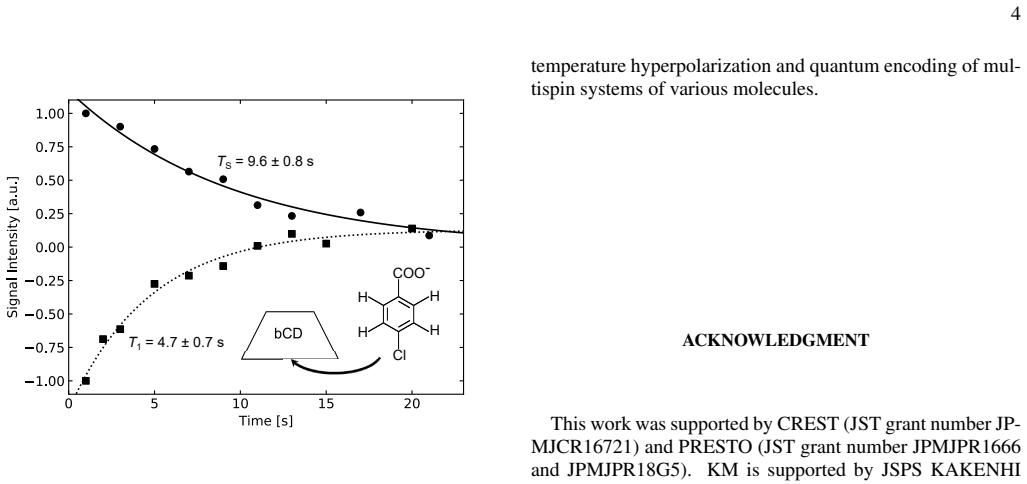
The central claim is that a four-spin AA′XX′ proton system hyperpolarized at room temperature by dissolution triplet-DNP can be quantum-encoded into a long-lived singlet-pair state whose lifetime is substantially longer than $T_1$, and that this encoded state outperforms the non-encoded state as a ligand–receptor binding probe. For PCBA in sodium carbonate solution after dissolution triplet-DNP, $T_1 = 7.4\pm0.7$ s and $T_S = 18\pm2$ s in the absence of receptor; with 2.7 mM $\beta$-cyclodextrin, $T_1 = 4.7\pm0.7$ s and $T_S = 9.6\pm0.8$ s. The contrast $C(T_i)=|T_i^{\mathrm{free}}-T_i^{\mathrm{obs}}|/(T_i^{\mathrm{free}}+T_i^{\mathrm{obs}})$ is 22% for $T_1$ and 30% for $T_S$, showing the encoded state is the more sensitive sensor. The authors attribute the advantage to suppression of intramolecular dipolar relaxation, so that the binding-induced intermolecular relaxation stands out.
Load-bearing premise
The result rests on the premise that the four protons' relaxation is dominated by the intramolecular dipolar couplings the singlet state commutes with; if solvent or dissolved-oxygen relaxation contributes comparable strength at 343 K, the lifetime gap would not come from a protected quantum state.
Editorial extensions
If this is right
- Room-temperature triplet-DNP can feed long-lived NMR states, removing the need for a cryogenic polarizer in singlet-state sensing.
- Ligand–receptor binding experiments can be made more sensitive by encoding a ligand's protons into a singlet pair state, since binding contrast rises from 22% to 30% in the demonstrated system.
- The four-spin singlet-pair scheme should transfer to other aromatic carboxylic acids that triplet-DNP can polarize, as long as their spin systems have the same AA′XX′ symmetry.
- The longer observation window ($T_S$ roughly 2–3 times $T_1$) enables NMR sensing of slower processes than ordinary polarization allows.
Reading between the lines
- A direct measurement of singlet content or state fidelity would separate quantum protection from simply slower average relaxation; the paper reports no such readout.
- If the mechanism is right, the $T_S/T_1$ ratio should be largely independent of overall correlation-time changes, while the absolute lifetimes shorten as the solution cools from 343 K toward room temperature.
- The same AA′XX′ encoding could be combined with faster dissolution or transfer to recover polarization lost in the current 10 s transfer, improving the achievable signal.
- Because the singlet state suppresses intramolecular relaxation, its lifetime could serve as a calibrated probe of intermolecular interactions generally, not just cyclodextrin binding.
Signed reviews
Editorial analysis
A structured set of objections, weighed in public.
Referee Report
Summary. The paper demonstrates the preparation of a long-lived singlet-pair state in the four aromatic protons of p-chlorobenzoic acid (PCBA) hyperpolarized by dissolution triplet-DNP at room temperature. The authors report lifetime measurements showing that the singlet-pair-state lifetime exceeds the ordinary spin-lattice relaxation time both for thermally polarized samples (TS=15±1 s vs T1=5.3±0.1 s) and after triplet-DNP (TS=18±2 s vs T1=7.4±0.7 s). They then apply the hyperpolarized long-lived state to a β-cyclodextrin/PCBA binding assay, reporting contrasts C(T1)=22% and C(TS)=30% and concluding that the encoded state is a more sensitive sensor than the non-encoded state. The central experimental observation, the lifetime extension, is supported by the reported measurements, but the sensor-advantage claim rests on a contrast comparison whose statistical significance is not quantified.
Significance. If the result holds, this is a useful proof-of-principle combining room-temperature triplet-DNP with long-lived-state encoding in a four-proton system, and it suggests that such hyperpolarized long-lived states could be used in ligand-receptor binding assays without cryogenic dissolution DNP. The paper builds on established theory (Refs. 22, 24) and uses direct lifetime measurements with clear error bars, which are strong points. The main unresolved issue is whether the data actually support the claimed sensing advantage: the 30% vs 22% contrast difference is within the propagated uncertainty, so the paper's central new claim about sensitivity needs either additional replicates or a weaker statement. Because the lifetime-extension observation itself is robust and the sensor claim is fixable, the manuscript is a good candidate for major revision rather than rejection.
major comments (2)
- [Section IV, Eq. (2) and Fig. 3/4] The conclusion that the encoded state is more sensitive than the non-encoded state is not statistically supported. Using the reported means and standard deviations (free T1=7.4±0.7 s, bound T1=4.7±0.7 s; free TS=18±2 s, bound TS=9.6±0.8 s) and independent-error propagation through Eq. (2), I obtain C(T1)=22±8% and C(TS)=30±6%; the difference is 8±10 percentage points, so the 95% confidence interval includes zero. The abstract and Section V state an 'advantage in sensing chemical phenomena' that rests on this contrast comparison. Please propagate the uncertainties, add replicates or a different statistical test, or revise the claim to reflect that the observed difference is suggestive but not established by the present data.
- [Section III] The interpretation of the longer TS as arising from a decoherence-free singlet-pair state relies on the assertion that relaxation is predominantly due to the intramolecular dipolar interactions HDD,AX and HDD,A'X'. The manuscript does not provide an experimental check of this assumption, such as a state-fidelity or singlet-order measurement, nor does it estimate contributions from intermolecular dipolar interactions with the solvent or dissolved oxygen. While the observed TS>T1 is consistent with a long-lived state, the mechanistic claim that the lifetime extension is specifically due to quantum encoding into a decoherence-free subspace would be strengthened by an additional control experiment or by explicit qualification that the microscopic origin is inferred from the assumed relaxation model.
minor comments (4)
- [Fig. 2(b) caption] The stated formulas for the interval times are inconsistent with the reported experimental values. For J=8 Hz and Δν=190 Hz, t1=1/(4J)=31.25 ms, but t2=1/(4J)+1/Δν gives 36.5 ms, not 33.65 ms, and t3=1/(2Δν) gives 2.63 ms, not 1.2 ms. Please correct either the formulas or the numerical values.
- [Introduction, second paragraph] There is a duplicated word: 'investigation of of metabolic processes' should be 'investigation of metabolic processes'.
- [Section IV] The symbol for the singlet-state lifetime is written as 'Ts' in the text near Fig. 4, while the rest of the paper uses 'TS'; please use a consistent notation.
- [Fig. 2(a) and Fig. 3] The figures would be easier to interpret if the individual data points included error bars or if the caption stated that the error bars are omitted for clarity; currently only the fitted lifetimes carry uncertainties.
Circularity Check
No significant circularity: the central claims rest on direct lifetime measurements and externally sourced long-lived-state theory, not on fitted inputs or self-citation chains.
full rationale
The paper does not derive its main result from its own fitted parameters. The long-lived singlet-pair states are defined by Eq. (1) and their decoherence-free property is attributed to external prior work (Refs. [22,24], by Pileio and Levitt, not the present authors), and the T1 and TS values are directly measured with inversion-recovery and singlet-locking pulse sequences in Section III. The binding contrast in Eq. (2) is a definition applied to measured lifetimes, and the claim that the encoded state is more sensitive compares two independently measured relaxation rates; it is not a prediction of a quantity already used as an input. Self-citations to triplet-DNP methods (e.g., Refs. [30,31]) are tools for producing hyperpolarization; the room-temperature dissolution triplet-DNP is an enabling step, but the paper's scientific claim is the observed lifetime extension and binding contrast, which do not reduce to those citations. There is no uniqueness theorem, ansatz smuggled in via citation, or fitted-parameter-renamed-as-prediction step that would make the derivation circular. Concerns about statistical significance of the contrast difference would be a correctness or robustness issue, not a circularity issue.
Assumptions & free parameters
free parameters (2)
- Singlet-locking interval times t1, t2, t3 =
t1=31.25 ms, t2=33.65 ms, t3=1.2 ms
- Triplet-DNP polarization buildup time =
300 s (0.37 mg sample); 5 min (3 mg sample)
assumptions (5)
- domain assumption Relaxation in the AA'XX' aromatic proton system is dominated by dipolar interactions HDD,AX and HDD,A'X'.
- domain assumption The singlet pair states rho_SP commute with the dipolar relaxation Hamiltonian, so their lifetime exceeds T1.
- domain assumption The measured magnetization decays are single exponentials with time constants T1 and TS.
- domain assumption Thermal polarization at 11.7 T and room temperature is 4.0e-3%, used to calibrate the DNP enhancement.
- domain assumption The sample temperature after dissolution is approximately 343 K and explains the longer post-DNP lifetimes.
Cite this review
Pith. "Pith review of Long-lived state in a four-spin system hyperpolarized at room temperature." pith.science (2026). https://pith.science/paper/ZLWU2KR6
@misc{pith2026190808699,
  author       = {Pith},
  title        = {Pith review of: Long-lived state in a four-spin system hyperpolarized at room temperature},
  year         = {2026},
  howpublished = {\url{https://pith.science/paper/ZLWU2KR6}},
  note         = {Machine review of arXiv:1908.08699}
}
read the original abstract
A solution with hyperpolarized nuclear spins encoded into a long-lived state has been utilized for sensing chemical phenomena. In a conventional way, nuclear spins are hyperpolarized at very low temperatures. In this work, we demonstrate the encoding of a four-nuclear-spin system hyperpolarized at room temperature into a long-lived state in a solution. We apply the solution with the long-lived state as a sensor in ligand--receptor binding experiments.
Figures


Reference graph
Works this paper leans on
-
[1]
A. W. Overhauser, Phys. Rev. 92, 411 (1953)
work page 1953
-
[2]
J. H. Ardenkjær-Larsen, B. Fridlund, A. Gram, G. Hansson, L. Hansson, M. H. Lerche, R. Servin, M. Thaning, and K. Gol- man, Proc. Natl. Acad. Sci. U.S.A. 100, 10158 (2003)
work page 2003
-
[3]
K. R. Keshari, J. Kurhanewicz, J. M. Macdonald, and D. M. Wilson, The Analyst 137, 3427 (2012)
work page 2012
-
[4]
K. R. Keshari and D. M. Wilson, Chem. Soc. Rev. 43, 1627 (2014)
work page 2014
-
[5]
R. Buratto, A. Bornet, J. Milani, D. Mammoli, B. Vuichoud, N. Salvi, M. Singh, A. Laguerre, S. Passemard, S. Gerber- Lemaire, S. Jannin, and G. Bodenhausen, ChemMedChem 9, 2509 (2014)
work page 2014
- [6]
- [7]
-
[8]
G. M. Palma, K. antti Suominen, and A. Ekert, Proc. R. Soc. London A 452, 567 (1996)
work page 1996
Show all 40 references
-
[9]
Decoherence-free sub- spaces and subsystems,
D. A. Lidar and K. Birgitta Whaley, “Decoherence-free sub- spaces and subsystems,” (Springer Berlin Heidelberg, Berlin, Heidelberg, 2003) pp. 83–120
2003
-
[10]
Carravetta and M
M. Carravetta and M. H. Levitt, Journal of the American Chem- ical Society 126, 6228 (2004)
2004
-
[11]
Carravetta, O
M. Carravetta, O. G. Johannessen, and M. H. Levitt, Phys. Rev. Lett. 92, 153003 (2004)
2004
-
[12]
Vinogradov and A
E. Vinogradov and A. K. Grant, J. Magn. Reson. 194, 46 (2008)
2008
-
[13]
Ahuja, R
P. Ahuja, R. Sarkar, P. R. Vasos, and G. Bodenhausen, ChemPhysChem 10, 2217 (2009)
2009
-
[14]
M. H. Levitt, Annu. Rev. Phys. Chem. 63, 89 (2012)
2012
-
[15]
Pileio, Prog
G. Pileio, Prog. NMR Spectrosc. 56, 217 (2010)
2010
-
[16]
Q. Chen, I. Schwarz, and M. B. Plenio, Phys. Rev. B 95, 224105 (2017)
2017
-
[17]
Stevanato, J
G. Stevanato, J. T. Hill-Cousins, P. H ˚akansson, S. S. Roy, L. J. Brown, R. C. D. Brown, G. Pileio, and M. H. Levitt, Angew. Chem. Int. Ed. Engl. 54, 3740 (2015)
2015
-
[18]
P. R. Vasos, A. Comment, R. Sarkar, P. Ahuja, S. Jannin, J.- P. Ansermet, J. A. Konter, P. Hautle, B. van den Brandt, and G. Bodenhausen, Proc. Natl. Acad. Sci. U.S.A. 106, 18469 (2009)
2009
-
[19]
W. S. Warren, E. Jenista, R. T. Branca, and X. Chen, Science 323, 1711 (2009)
2009
-
[21]
Hogben, P
H. Hogben, P. Hore, and I. Kuprov, J. Magn. Reson. 211, 217 (2011)
2011
-
[22]
Pileio, M
G. Pileio, M. Concistr ´e, M. Carravetta, and M. H. Levitt, J. Magn. Reson. 182, 353 (2006)
2006
-
[23]
A. A. Karabanov, C. Bretschneider, and W. K ¨ockenberger, J. Chem. Phys 131, 204105 (2009)
2009
-
[24]
Pileio and M
G. Pileio and M. H. Levitt, J. Magn. Reson. 187, 141 (2007)
2007
-
[25]
A. S. Kiryutin, S. E. Korchak, K. L. Ivanov, A. V . Yurkovskaya, and H.-M. Vieth, J. Phys. Chem. Lett. 3, 1814 (2012)
2012
-
[26]
Graafen, M
D. Graafen, M. B. Franzoni, L. M. Schreiber, H. W. Spiess, and K. M¨unnemann, J. Magn. Reson. 262, 68 (2016)
2016
-
[27]
Henstra, T.-S
A. Henstra, T.-S. Lin, J. Schmidt, and W. Wenckebach, Chem. Phys. Lett. 165, 6 (1990)
1990
-
[28]
Stehlik and H.-M
D. Stehlik and H.-M. Vieth, Pulsed Magnetic Resonance: NMR, ESR, and Optics: A Recognition , 446 (1992)
1992
-
[29]
Triplet state dynamic nuclear polarization,
K. Takeda, “Triplet state dynamic nuclear polarization,” (VDM Verlag Dr. M¨uller, 2009)
2009
-
[30]
Tateishi, M
K. Tateishi, M. Negoro, S. Nishida, A. Kagawa, Y . Morita, and M. Kitagawa, Proc. Natl. Acad. Sci. U.S.A. 111, 7527 (2014)
2014
-
[31]
Negoro, A
M. Negoro, A. Kagawa, K. Tateishi, Y . Tanaka, T. Yuasa, K. Takahashi, and M. Kitagawa, J. Phys. Chem. A 122, 4294 (2018)
2018
-
[32]
Kagawa, M
A. Kagawa, M. Negoro, R. Ohba, N. Ichijo, K. Takamine, Y . Nakamura, T. Murata, Y . Morita, and M. Kitagawa, J. Phys. 5 Chem. A 122, 9670 (2018)
2018
-
[33]
Fujiwara, M
S. Fujiwara, M. Hosoyamada, K. Tateishi, T. Uesaka, K. Ideta, N. Kimizuka, and N. Yanai, J. Am. Chem. Soc. 140, 15606 (2018)
2018
-
[34]
Tateishi, T
K. Tateishi, T. Uesaka, M. Negoro, and M. Kitagawa, WO2017002761A1 , 64 (2017)
2017
-
[35]
Kagawa, Y
A. Kagawa, Y . Murokawa, K. Takeda, and M. Kitagawa, J. Magn. Reson. 197, 9 (2009)
2009
-
[36]
Sarkar, P
R. Sarkar, P. R. Vasos, and G. Bodenhausen, J. Am. Chem. Soc. 129, 328 (2007)
2007
-
[37]
Pileio, Prog
G. Pileio, Prog. Nucl. Magn. Reson. Spectrosc. 98-99, 1 (2017)
2017
-
[38]
Salvi, R
N. Salvi, R. Buratto, A. Bornet, S. Ulzega, I. Rentero Rebollo, A. Angelini, C. Heinis, and G. Bodenhausen, J. Am. Chem. Soc. 134, 11076 (2012)
2012
-
[39]
Laustsen, G
C. Laustsen, G. Pileio, M. C. D. Tayler, L. J. Brown, R. C. D. Brown, M. H. Levitt, and J. H. Ardenkjaer-Larsen, Magn. Re- son. Med. 68, 1262 (2012)
2012
-
[40]
S. J. DeVience, R. L. Walsworth, and M. S. Rosen, NMR Biomed. 26, 1204 (2013)
2013
-
[41]
A. S. Kiryutin, H. Zimmermann, A. V . Yurkovskaya, H.-M. Vi- eth, and K. L. Ivanov, J. Magn. Reson. 261, 64 (2015)
2015
Reviewed August 14, 2026 · model on record in the stance chip above.
Discussion (0). Continue with ORCID to comment.