REVIEW 3 major objections 5 minor 65 references
Leveraging Sparse LiDAR for RAFT-Stereo: A Depth Pre-Fill Perspective
T0 review · 3 major / 5 minor · reviewed 2026-08-06 · deepseek-v4-flash
Pith's one-line read The paper claims that pre-filling sparse LiDAR disparity with interpolation restores the benefit of LiDAR guidance in RAFT-Stereo, enabling state-of-the-art stereo depth with only a few hundred points.
desk verdict Pre-filling sparse LiDAR disparities fixes RAFT-Stereo's failure mode, and the analysis is the real contribution; the main open question is whether the simulated sparse sensors transfer to real hardware. read the letter →
The pith
A machine-rendered reading of the paper's core claim, the machinery that carries it, and where it could break.
The reading
What carries the argument
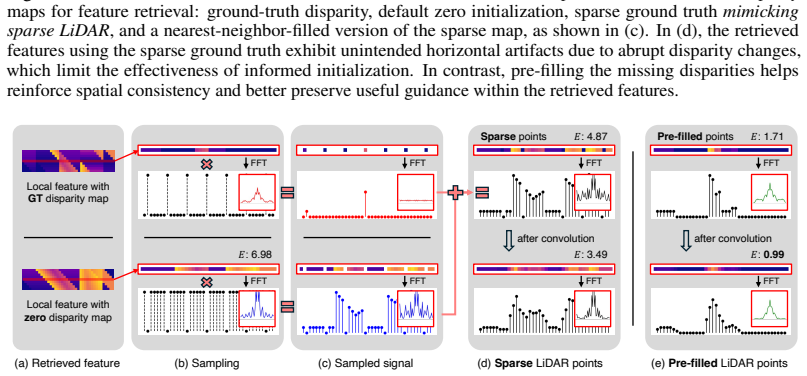
The load-bearing mechanism is the iterative cost-volume lookup of RAFT-Stereo, $S(h,w,k) = C(h,w, w - D(h,w) + k)$, which indexes the correlation volume by the current disparity estimate. With sparse guidance, most pixels index at zero disparity, so their retrieved features dominate and the sparse accurate retrievals become high-frequency spikes that low-pass-filtering convolutions suppress. Pre-filling the initial disparity map (e.g., with IP-Basic interpolation) replaces zero disparities with plausible values, converting sparse guidance into a smooth, low-frequency initialization. A separate early-fusion path backprojects the pre-filled depth into 3D coordinates and concatenates them with RGB to reinforce stereo correspondence.
What would settle it
Collect a stereo-LiDAR dataset from an actual low-beam sensor (e.g., 4- or 8-beam) in driving scenes, retrain RAFT-Stereo with naive guidance and with pre-filling, and compare; if pre-filling no longer beats naive injection on real sparse scans, the paper's mechanism and remedy do not transfer beyond subsampled dense LiDAR.
Extended reading notes
Core claim
The central claim is that pre-filling the sparse initial disparity map is what makes LiDAR guidance work inside RAFT-Stereo, for a specific mechanism. RAFT-Stereo retrieves a local slab of the correlation volume indexed by the current disparity estimate; when most pixels are zero-initialized, they dominate the retrieved features, and the sparse LiDAR-guided values appear as high-frequency outliers that the recurrent 2D convolutions attenuate. Densifying the initial map removes these discontinuities, letting the informative retrieval survive and propagate. For early fusion, the paper claims pre-filling also helps, but for a different reason — it must supply accurate correspondences — so a neural depth-completion with confidence-based top-1k subsampling is needed rather than coarse interpolation.
Load-bearing premise
The paper's sparse LiDAR is simulated by uniformly subsampling or beam-synthesizing dense 64-beam ground-truth scans, and it assumes this faithfully represents real low-cost sensors' noise, coverage, and beam patterns.
Editorial extensions
If this is right
- With as few as 300 LiDAR points per frame, pre-filled RAFT-Stereo achieves lower disparity error than RAFT-Stereo guided by full 64-beam LiDAR without pre-filling.
- GRAFT-Stereo reports lower RMSE, MAE, Bad1, and average disparity error than EG-Depth and SDG-Depth under uniform-sampled and beam-sampled sparsity on KITTI, and on VKITTI2 and MS2 with 300 points.
- The two pre-fill strategies are not interchangeable: coarse interpolation helps late fusion but hurts early fusion, where a confidence-subsampled neural completion is required.
- Because RAFT-Stereo supports anytime prediction, the late-fusion pre-fill variant provides a fast CPU-compatible path (IP-Basic) while the full model retains the accuracy–iteration trade-off.
Reading between the lines
- The zero-dominance mechanism suggests that any smoothness-inducing initialization — not only depth completion — should recover most of the gain, since even nearest-neighbor fill in the toy example reduces the retrieved-feature Laplacian from 0.65 to 0.33.
- Real low-beam LiDAR sensors add beam-specific noise and irregular coverage that uniform subsampling of dense scans does not mimic; testing on actual 4- or 8-beam hardware would determine whether the pre-fill benefit persists.
- The pre-fill-before-injection principle may transfer to other iterative refinement networks such as RAFT optical flow when they receive sparse external guidance.
- The confidence-based top-1k subsampling result implies that under a fixed guidance budget, where you place the completed points matters more than the raw accuracy of the completion.
Editorial analysis
A structured set of objections, weighed in public.
Referee Report
Summary. The paper studies how to inject sparse LiDAR depth into RAFT-Stereo for disparity estimation. The authors identify a late-fusion path (initializing the disparity map) and an early-fusion path (concatenating XYZ coordinates with RGB at the feature encoder). They observe that naive injection degrades sharply as LiDAR points become sparse (300 points) and propose a depth pre-filling step: for late fusion, filling missing disparities with interpolation (IP-Basic or a learned completion network); for early fusion, retaining only the top-1k confident completed points. The resulting GRAFT-Stereo combines both fusion paths and is evaluated on KITTI Depth Completion, VKITTI2, and MS2 under uniform subsampling and simulated 4/8/16-beam LiDAR, reporting consistent improvements over EG-Depth and SDG-Depth in disparity and depth metrics.
Significance. If the reported results hold, the paper makes a useful and counterintuitive contribution: a simple interpolation-based pre-fill of the initial disparity map can restore the benefit of very sparse LiDAR guidance to a strong iterative stereo baseline, with a signal-processing rationale (sparse guidance creates high-frequency discontinuities that low-pass recurrent convolution attenuates). The paper is also transparent about its design choices: it retrains baselines with official code, reports both disparity and depth metrics, provides ablations of late-only and full models, and includes supplementary experiments on 64-beam LiDAR, iteration trade-offs, test-time point counts, and mid-fusion. The main weaknesses are the lack of error bars or significance tests (each model trained once), the absence of real low-beam LiDAR hardware validation, and the post-hoc selection of the top-1k early-fusion subsample based on validation performance.
major comments (3)
- [Sec. 4.2, Tables 4–6, Figs. S4–S5] The paper's practical claim is that pre-filling enables sparse LiDAR guidance to work in affordable, low-cost settings, but all sparse-guidance experiments use either uniform subsampling of the semi-dense aggregated ground-truth depth map (noiseless, spatially uniform seeds) or beam sampling from a 64-beam Velodyne scan (which retains the accuracy and calibration of a high-end sensor). Real low-beam sensors exhibit larger range noise, mixed pixels, irregular coverage, and synchronization errors relative to the stereo pair. Since pre-filling propagates seed values to large unmeasured regions, biased or noisy seeds could amplify errors rather than help. The supplementary Limitations (S1.1) does not acknowledge this sensor-realism gap. I would recommend either adding experiments with synthetically injected LiDAR noise/calibration error or explicitly reframing the contribution as simulation-based and discussing the transfer risk.
- [Sec. 5.3, Table 5, S3] The early-fusion pre-filling approach relies on a post-hoc selection of the top-1k depth-completed points based on validation performance. The paper reports that retaining top-1k works, but does not report the sensitivity to the number of retained points (e.g., 500, 2k, 5k) or to the confidence measure used. Since this is a free parameter tuned on the validation set, a short sensitivity analysis would strengthen the claim that the chosen value is not overfit to the validation split. As reported, the difference between row ➅ (top-1k, 3.33 Bad1) and row ➆ (dense, 3.44 Bad1) is small, and without variance estimates it is unclear whether the improvement is significant.
- [Sec. 5.1–5.2, Figs. 4–5, Tables 2–4] The signal-processing explanation (sparse guidance creates high-frequency discontinuities that are attenuated by low-pass filtering in RAFT-Stereo) is supported by a toy example and a qualitative FF, but the connection between the Laplacian of the retrieved feature map and the final disparity error is not quantitatively established on real data. The paper shows in Table 2 that adding noise to a zero disparity map degrades accuracy, and in Table 4 that pre-filling improves accuracy, but it does not directly measure the 'feature domination' quantity E (L2 distance to ground-truth retrieval) on KITTI before and after pre-filling. A small experiment reporting E or a similar retrieval-quality metric on real validation frames would make the proposed mechanism more than a plausible narrative.
minor comments (5)
- [Abstract & Sec. 1] The abstract claims that GRAFT-Stereo 'significantly outperforms' existing methods, but no statistical significance tests are reported; consider softening to 'consistently outperforms' or adding significance measures.
- [Sec. 5.2, Table 3] The table reports IP-Basic and neural-net pre-filling alone with Bad1 of 52.51% and 17.59%, but the text does not state how these maps are evaluated (e.g., on the semi-dense ground truth or the full image); please clarify.
- [Sec. 5.3, Fig. 7] The text says 'For pixels lacking a projected LiDAR point, we concatenate zero values', but it is unclear whether this is done before or after depth pre-filling; please clarify the preprocessing order.
- [Sec. 6, Table 6 and Table S2] The main paper reports RMSE/MAE for depth while Table S1 reports disparity metrics; it would be helpful to report both in the main table or clearly state that disparity metrics are in the supplement.
- [Supplementary, Sec. S2] The beam sampling follows [63] and samples 'more LiDAR lines from the lower part of the scene'; this detail is important for reproducibility and should be briefly mentioned in the main text or at least in the caption of Fig. 1b.
Circularity Check
No significant circularity; the main comparisons are held-out empirical evaluations, with only a minor validation-selected hyperparameter and a non-load-bearing citation overlap.
full rationale
I find no significant circularity. The central claims are empirical: sparse LiDAR guidance degrades RAFT-Stereo, pre-filling the initial disparity map restores it, and GRAFT-Stereo outperforms retrained baselines on KITTI, VKITTI2, and MS2. The models are trained on the training splits and evaluated on held-out validation splits, and the baselines are retrained with their official code, so no reported number is an identity or a fitted parameter renamed as a prediction. There is no equation in which an output is defined as an input. Two mild caveats prevent a clean zero. First, the beam-sampling protocol cites [61] (Pseudo-LiDAR++, which includes co-author Wei-Lun Chao), though the implementation actually follows the external [63] and the citation is not load-bearing. Second, the top-1k subsample in early fusion (Sec. 5.3) was chosen after observing validation performance, while all reported comparisons use the same validation set, creating a small optimistic bias. Additionally, S1.1's limitations do not acknowledge that sparse LiDAR is simulated by subsampling or synthesizing beams from dense 64-beam scans rather than measured with real low-beam sensors; that is an external-validity concern, not circularity. Overall the derivation chain is self-contained and externally evaluated.
Assumptions & free parameters
free parameters (7)
- top_k_subset_for_early_fusion =
1000
- loss_weight_alpha =
0.9
- training_refinement_steps =
22
- test_refinement_steps =
32
- crop_size_late_fusion =
336x1120
- crop_size_early_fusion =
224x784
- max_disparity =
192
assumptions (3)
- domain assumption RAFT-Stereo's iterative refinement and cost volume retrieval operate as described in the paper.
- domain assumption Subsampling dense 64-beam LiDAR ground truth accurately simulates real sparse LiDAR sensors.
- ad hoc to paper Sparse guidance creates high-frequency discontinuities that are attenuated by low-pass filtering in RAFT-Stereo.
Cite this review
Pith. "Pith review of Leveraging Sparse LiDAR for RAFT-Stereo: A Depth Pre-Fill Perspective." pith.science (2026). https://pith.science/paper/ZMZBPW4Z
@misc{pith2026250719738,
  author       = {Pith},
  title        = {Pith review of: Leveraging Sparse LiDAR for RAFT-Stereo: A Depth Pre-Fill Perspective},
  year         = {2026},
  howpublished = {\url{https://pith.science/paper/ZMZBPW4Z}},
  note         = {Machine review of arXiv:2507.19738}
}
read the original abstract
We investigate LiDAR guidance within the RAFT-Stereo framework, aiming to improve stereo matching accuracy by injecting precise LiDAR depth into the initial disparity map. We find that the effectiveness of LiDAR guidance drastically degrades when the LiDAR points become sparse (e.g., a few hundred points per frame), and we offer a novel explanation from a signal processing perspective. This insight leads to a surprisingly simple solution that enables LiDAR-guided RAFT-Stereo to thrive: pre-filling the sparse initial disparity map with interpolation. Interestingly, we find that pre-filling is also effective when injecting LiDAR depth into image features via early fusion, but for a fundamentally different reason, necessitating a distinct pre-filling approach. By combining both solutions, the proposed Guided RAFT-Stereo (GRAFT-Stereo) significantly outperforms existing LiDAR-guided methods under sparse LiDAR conditions across various datasets. We hope this study inspires more effective LiDAR-guided stereo methods.
Figures


Figures from the paper (5 more)



Reference graph
Works this paper leans on
-
[1]
Raft-stereo: Multilevel recurrent field transforms for stereo matching
Lahav Lipson, Zachary Teed, and Jia Deng. Raft-stereo: Multilevel recurrent field transforms for stereo matching. In 3DV, 2021
work page 2021
-
[2]
Iterative geometry encoding volume for stereo matching
Gangwei Xu, Xianqi Wang, Xiaohuan Ding, and Xin Yang. Iterative geometry encoding volume for stereo matching. In CVPR, 2023
work page 2023
-
[3]
Selective-stereo: Adaptive frequency information selection for stereo matching
Xianqi Wang, Gangwei Xu, Hao Jia, and Xin Yang. Selective-stereo: Adaptive frequency information selection for stereo matching. In CVPR, 2024
work page 2024
-
[4]
Practical stereo matching via cascaded recurrent network with adaptive correlation
Jiankun Li, Peisen Wang, Pengfei Xiong, Tao Cai, Ziwei Yan, Lei Yang, Jiangyu Liu, Haoqiang Fan, and Shuaicheng Liu. Practical stereo matching via cascaded recurrent network with adaptive correlation. In CVPR, 2022
work page 2022
-
[5]
Pyramid stereo matching network
Jia-Ren Chang and Yong-Sheng Chen. Pyramid stereo matching network. In CVPR, 2018
work page 2018
-
[6]
End-to-end learning of geometry and context for deep stereo regression
Alex Kendall, Hayk Martirosyan, Saumitro Dasgupta, Peter Henry, Ryan Kennedy, Abraham Bachrach, and Adam Bry. End-to-end learning of geometry and context for deep stereo regression. In ICCV, 2017
work page 2017
-
[7]
Hierarchical deep stereo matching on high-resolution images
Gengshan Yang, Joshua Manela, Michael Happold, and Deva Ramanan. Hierarchical deep stereo matching on high-resolution images. In CVPR, 2019
work page 2019
-
[8]
Revisiting stereo depth estimation from a sequence-to-sequence perspective with transformers
Zhaoshuo Li, Xingtong Liu, Nathan Drenkow, Andy Ding, Francis X Creighton, Russell H Taylor, and Mathias Unberath. Revisiting stereo depth estimation from a sequence-to-sequence perspective with transformers. In ICCV, 2021
work page 2021
Show all 65 references
-
[9]
Context-enhanced stereo transformer
Weiyu Guo, Zhaoshuo Li, Yongkui Yang, Zheng Wang, Russell H Taylor, Mathias Unberath, Alan Yuille, and Yingwei Li. Context-enhanced stereo transformer. In ECCV, 2022
2022
-
[10]
V olumetric propagation network: Stereo-lidar fusion for long-range depth estimation
Jaesung Choe, Kyungdon Joo, Tooba Imtiaz, and In So Kweon. V olumetric propagation network: Stereo-lidar fusion for long-range depth estimation. RAL, 2021
2021
-
[11]
Expanding sparse lidar depth and guiding stereo matching for robust dense depth estimation
Zhenyu Xu, Yuehua Li, Shiqiang Zhu, and Yuxiang Sun. Expanding sparse lidar depth and guiding stereo matching for robust dense depth estimation. RAL, 2023
2023
-
[12]
Stereo-lidar depth estimation with deformable propagation and learned disparity-depth conversion
Ang Li, Anning Hu, Wei Xi, Wenxian Yu, and Danping Zou. Stereo-lidar depth estimation with deformable propagation and learned disparity-depth conversion. In ICRA, 2024
2024
-
[13]
Sparse lidar assisted self-supervised stereo disparity estimation
Xiaoming Zhao, Weihai Chen, Xingming Wu, Peter CY Chen, and Zhengguo Li. Sparse lidar assisted self-supervised stereo disparity estimation. In CCDC, 2022
2022
-
[14]
Sparsity invariant cnns
Jonas Uhrig, Nick Schneider, Lukas Schneider, Uwe Franke, Thomas Brox, and Andreas Geiger. Sparsity invariant cnns. In 3DV, 2017
2017
-
[15]
Are we ready for autonomous driving? the kitti vision benchmark suite
Andreas Geiger, Philip Lenz, and Raquel Urtasun. Are we ready for autonomous driving? the kitti vision benchmark suite. In CVPR, 2012
2012
-
[16]
In defense of classical image processing: Fast depth completion on the cpu
Jason Ku, Ali Harakeh, and Steven L Waslander. In defense of classical image processing: Fast depth completion on the cpu. In CRV, 2018
2018
-
[17]
Virtual kitti 2
Yohann Cabon, Naila Murray, and Martin Humenberger. Virtual kitti 2. arXiv preprint arXiv:2001.10773, 2020
2001 arXiv
-
[18]
Deep depth estimation from thermal image
Ukcheol Shin, Jinsun Park, and In So Kweon. Deep depth estimation from thermal image. In CVPR, 2023
2023
-
[19]
Non-parametric local transforms for computing visual corre- spondence
Ramin Zabih and John Woodfill. Non-parametric local transforms for computing visual corre- spondence. In ECCV, 1994. 10
1994
-
[20]
A constant-space belief propagation algorithm for stereo matching
Qingxiong Yang, Liang Wang, and Narendra Ahuja. A constant-space belief propagation algorithm for stereo matching. In CVPR, 2010
2010
-
[21]
Stereo correspondence by dynamic programming on a tree
Olga Veksler. Stereo correspondence by dynamic programming on a tree. In CVPR, 2005
2005
-
[22]
Stereo matching with color-weighted correlation, hierarchical belief propagation, and occlusion han- dling
Qingxiong Yang, Liang Wang, Ruigang Yang, Henrik Stewénius, and David Nistér. Stereo matching with color-weighted correlation, hierarchical belief propagation, and occlusion han- dling. TPAMI, 2008
2008
-
[23]
Stereo processing by semiglobal matching and mutual information.TPAMI, 2007
Heiko Hirschmuller. Stereo processing by semiglobal matching and mutual information.TPAMI, 2007
2007
-
[24]
Nerf-supervised deep stereo
Fabio Tosi, Alessio Tonioni, Daniele De Gregorio, and Matteo Poggi. Nerf-supervised deep stereo. In CVPR, 2023
2023
-
[25]
Domain generalized stereo matching via hierarchical visual transformation
Tianyu Chang, Xun Yang, Tianzhu Zhang, and Meng Wang. Domain generalized stereo matching via hierarchical visual transformation. In CVPR, 2023
2023
-
[26]
Croco v2: Improved cross-view completion pre-training for stereo matching and optical flow
Philippe Weinzaepfel, Thomas Lucas, Vincent Leroy, Yohann Cabon, Vaibhav Arora, Romain Brégier, Gabriela Csurka, Leonid Antsfeld, Boris Chidlovskii, and Jérôme Revaud. Croco v2: Improved cross-view completion pre-training for stereo matching and optical flow. In ICCV, 2023
2023
-
[27]
Graftnet: Towards domain generalized stereo matching with a broad-spectrum and task-oriented feature
Biyang Liu, Huimin Yu, and Guodong Qi. Graftnet: Towards domain generalized stereo matching with a broad-spectrum and task-oriented feature. In CVPR, 2022
2022
-
[28]
Uncertainty guided adaptive warping for robust and efficient stereo matching
Junpeng Jing, Jiankun Li, Pengfei Xiong, Jiangyu Liu, Shuaicheng Liu, Yichen Guo, Xin Deng, Mai Xu, Lai Jiang, and Leonid Sigal. Uncertainty guided adaptive warping for robust and efficient stereo matching. In ICCV, 2023
2023
-
[29]
Dps-net: Deep polarimetric stereo depth estimation
Chaoran Tian, Weihong Pan, Zimo Wang, Mao Mao, Guofeng Zhang, Hujun Bao, Ping Tan, and Zhaopeng Cui. Dps-net: Deep polarimetric stereo depth estimation. In ICCV, 2023
2023
-
[30]
Federated online adaptation for deep stereo
Matteo Poggi and Fabio Tosi. Federated online adaptation for deep stereo. In CVPR, 2024
2024
-
[31]
Accurate and efficient stereo matching via attention concatenation volume
Gangwei Xu, Yun Wang, Junda Cheng, Jinhui Tang, and Xin Yang. Accurate and efficient stereo matching via attention concatenation volume. TPAMI, 2023
2023
-
[32]
Active stereo without pattern projector
Luca Bartolomei, Matteo Poggi, Fabio Tosi, Andrea Conti, and Stefano Mattoccia. Active stereo without pattern projector. In ICCV, 2023
2023
-
[33]
Neural markov random field for stereo matching
Tongfan Guan, Chen Wang, and Yun-Hui Liu. Neural markov random field for stereo matching. In CVPR, 2024
2024
-
[34]
Openstereo: A comprehensive benchmark for stereo matching and strong baseline
Xianda Guo, Chenming Zhang, Juntao Lu, Yiqi Wang, Yiqun Duan, Tian Yang, Zheng Zhu, and Long Chen. Openstereo: A comprehensive benchmark for stereo matching and strong baseline. arXiv preprint arXiv:2312.00343, 2023
2023 arXiv
-
[35]
Segstereo: Exploiting semantic information for disparity estimation
Guorun Yang, Hengshuang Zhao, Jianping Shi, Zhidong Deng, and Jiaya Jia. Segstereo: Exploiting semantic information for disparity estimation. In ECCV, 2018
2018
-
[36]
An image is worth 16x16 words: Transformers for image recognition at scale
Alexey Dosovitskiy, Lucas Beyer, Alexander Kolesnikov, Dirk Weissenborn, Xiaohua Zhai, Thomas Unterthiner, Mostafa Dehghani, Matthias Minderer, Georg Heigold, Sylvain Gelly, et al. An image is worth 16x16 words: Transformers for image recognition at scale. In ICLR, 2021
2021
-
[37]
High-frequency stereo matching network
Haoliang Zhao, Huizhou Zhou, Yongjun Zhang, Jie Chen, Yitong Yang, and Yong Zhao. High-frequency stereo matching network. In CVPR, 2023
2023
-
[38]
Eai-stereo: Error aware iterative network for stereo matching
Haoliang Zhao, Huizhou Zhou, Yongjun Zhang, Yong Zhao, Yitong Yang, and Ting Ouyang. Eai-stereo: Error aware iterative network for stereo matching. In ACCV, 2022
2022
-
[39]
Parameterized cost volume for stereo matching
Jiaxi Zeng, Chengtang Yao, Lidong Yu, Yuwei Wu, and Yunde Jia. Parameterized cost volume for stereo matching. In ICCV, 2023. 11
2023
-
[40]
Raft: Recurrent all-pairs field transforms for optical flow
Zachary Teed and Jia Deng. Raft: Recurrent all-pairs field transforms for optical flow. In ECCV, 2020
2020
-
[41]
Noise-aware unsupervised deep lidar-stereo fusion
Xuelian Cheng, Yiran Zhong, Yuchao Dai, Pan Ji, and Hongdong Li. Noise-aware unsupervised deep lidar-stereo fusion. In CVPR, 2019
2019
-
[42]
Sparse lidar and stereo fusion (sls-fusion) for depth estimation and 3d object detection
N-A-M Mai, Pierre Duthon, Louahdi Khoudour, Alain Crouzil, and Sergio A Velastin. Sparse lidar and stereo fusion (sls-fusion) for depth estimation and 3d object detection. In ICPRS, 2021
2021
-
[43]
3d lidar and stereo fusion using stereo matching network with conditional cost volume normalization
Tsun-Hsuan Wang, Hou-Ning Hu, Chieh Hubert Lin, Yi-Hsuan Tsai, Wei-Chen Chiu, and Min Sun. 3d lidar and stereo fusion using stereo matching network with conditional cost volume normalization. In IROS, 2019
2019
-
[44]
Slfnet: A stereo and lidar fusion network for depth completion
Yongjian Zhang, Longguang Wang, Kunhong Li, Zhiheng Fu, and Yulan Guo. Slfnet: A stereo and lidar fusion network for depth completion. RAL, 2022
2022
-
[45]
Expansion of visual hints for improved generalization in stereo matching
Andrea Pilzer, Yuxin Hou, Niki Loppi, Arno Solin, and Juho Kannala. Expansion of visual hints for improved generalization in stereo matching. In WACV, 2023
2023
-
[46]
Guided stereo matching
Matteo Poggi, Davide Pallotti, Fabio Tosi, and Stefano Mattoccia. Guided stereo matching. In CVPR, 2019
2019
-
[47]
S3: Learnable sparse signal superdensity for guided depth estimation
Yu-Kai Huang, Yueh-Cheng Liu, Tsung-Han Wu, Hung-Ting Su, Yu-Cheng Chang, Tsung-Lin Tsou, Yu-An Wang, and Winston H Hsu. S3: Learnable sparse signal superdensity for guided depth estimation. In CVPR, 2021
2021
-
[48]
High-precision depth estimation with the 3d lidar and stereo fusion
Kihong Park, Seungryong Kim, and Kwanghoon Sohn. High-precision depth estimation with the 3d lidar and stereo fusion. In ICRA, 2018
2018
-
[49]
Listereo: Generate dense depth maps from lidar and stereo imagery
Junming Zhang, Manikandasriram Srinivasan Ramanagopal, Ram Vasudevan, and Matthew Johnson-Roberson. Listereo: Generate dense depth maps from lidar and stereo imagery. In ICRA, 2020
2020
-
[50]
Dfusenet: Deep fusion of rgb and sparse depth information for image guided dense depth completion
Shreyas S Shivakumar, Ty Nguyen, Ian D Miller, Steven W Chen, Vijay Kumar, and Camillo J Taylor. Dfusenet: Deep fusion of rgb and sparse depth information for image guided dense depth completion. In ITSC, 2019
2019
-
[51]
Deeplidar: Deep surface normal guided depth prediction for outdoor scene from sparse lidar data and single color image
Jiaxiong Qiu, Zhaopeng Cui, Yinda Zhang, Xingdi Zhang, Shuaicheng Liu, Bing Zeng, and Marc Pollefeys. Deeplidar: Deep surface normal guided depth prediction for outdoor scene from sparse lidar data and single color image. In CVPR, 2019
2019
-
[52]
Penet: Towards precise and efficient image guided depth completion
Mu Hu, Shuling Wang, Bin Li, Shiyu Ning, Li Fan, and Xiaojin Gong. Penet: Towards precise and efficient image guided depth completion. In ICRA, 2021
2021
-
[53]
Learning guided convolutional network for depth completion
Jie Tang, Fei-Peng Tian, Wei Feng, Jian Li, and Ping Tan. Learning guided convolutional network for depth completion. TIP, 2020
2020
-
[54]
Mff-net: Towards efficient monocular depth completion with multi-modal feature fusion
Lina Liu, Xibin Song, Jiadai Sun, Xiaoyang Lyu, Lin Li, Yong Liu, and Liangjun Zhang. Mff-net: Towards efficient monocular depth completion with multi-modal feature fusion. RAL, 2023
2023
-
[55]
Non-local spatial propagation network for depth completion
Jinsun Park, Kyungdon Joo, Zhe Hu, Chi-Kuei Liu, and In So Kweon. Non-local spatial propagation network for depth completion. In ECCV, 2020
2020
-
[56]
Learning affinity via spatial propagation networks
Sifei Liu, Shalini De Mello, Jinwei Gu, Guangyu Zhong, Ming-Hsuan Yang, and Jan Kautz. Learning affinity via spatial propagation networks. In NeurIPS, 2017
2017
-
[57]
Depth estimation via affinity learned with convolutional spatial propagation network
Xinjing Cheng, Peng Wang, and Ruigang Yang. Depth estimation via affinity learned with convolutional spatial propagation network. In ECCV, 2018
2018
-
[58]
Lrru: Long-short range recurrent updating networks for depth completion
Yufei Wang, Bo Li, Ge Zhang, Qi Liu, Tao Gao, and Yuchao Dai. Lrru: Long-short range recurrent updating networks for depth completion. In ICCV, 2023. 12
2023
-
[59]
Fcfr-net: Feature fusion based coarse-to-fine residual learning for depth completion
Lina Liu, Xibin Song, Xiaoyang Lyu, Junwei Diao, Mengmeng Wang, Yong Liu, and Liangjun Zhang. Fcfr-net: Feature fusion based coarse-to-fine residual learning for depth completion. In AAAI, 2021
2021
-
[60]
Deep residual learning for image recognition
Kaiming He, Xiangyu Zhang, Shaoqing Ren, and Jian Sun. Deep residual learning for image recognition. In CVPR, 2016
2016
-
[61]
Pseudo-lidar++: Accurate depth for 3d object detection in autonomous driving
Yurong You, Yan Wang, Wei-Lun Chao, Divyansh Garg, Geoff Pleiss, Bharath Hariharan, Mark Campbell, and Kilian Q Weinberger. Pseudo-lidar++: Accurate depth for 3d object detection in autonomous driving. ICLR, 2020
2020
-
[62]
Sea-raft: Simple, efficient, accurate raft for optical flow
Yihan Wang, Lahav Lipson, and Jia Deng. Sea-raft: Simple, efficient, accurate raft for optical flow. In ECCV, 2024
2024
-
[63]
A surface geometry model for lidar depth completion
Yiming Zhao, Lin Bai, Ziming Zhang, and Xinming Huang. A surface geometry model for lidar depth completion. RAL, 2021
2021
-
[64]
Fpga accelerated real-time recurrent all-pairs field transforms for optical flow
Yingxiang Li, Yingke Gao, Zhiwen Su, Shitao Chen, and Longjun Liu. Fpga accelerated real-time recurrent all-pairs field transforms for optical flow. In CAC, 2022
2022
-
[65]
Scene01
Ye Liu, Shuang Hao, Kun Huang, Minghui Yang, Zili Huang, Xiuyuan Qi, Yiting Li, Liang Zhou, Yu Long, and Jun Zhou. An fpga-based ultra-high performance and scalable optical flow hardware accelerator for autonomous driving. In ISCAS, 2024. 13 Supplementary Material for Leveragi...
2024
Reviewed August 6, 2026 · model on record in the stance chip above.
Discussion (0). Continue with ORCID to comment.