A Counterexample to Ziegler's Cross-Polytope Conjecture for Simplicial 0/1-Polytopes
Pith reviewed 2026-07-03 22:12 UTC · model grok-4.3
The pith
There exists a simplicial 7-polytope with 14 vertices in the 0/1-cube that is not centrally symmetric.
A machine-rendered reading of the paper's core claim, the machinery that carries it, and where it could break.
Core claim
The convex hull of a specific collection of 14 vertices chosen from {0,1}^7 is a simplicial 7-polytope whose vertex set is not invariant under central inversion.
What carries the argument
An explicit 14-vertex subset of the 7-cube whose convex hull is simplicial and asymmetric.
Load-bearing premise
The 14 chosen points form a simplicial polytope whose vertex set is not centrally symmetric.
What would settle it
A direct computational check confirming whether the listed 14 points in {0,1}^7 produce a simplicial convex hull without central symmetry.
Figures
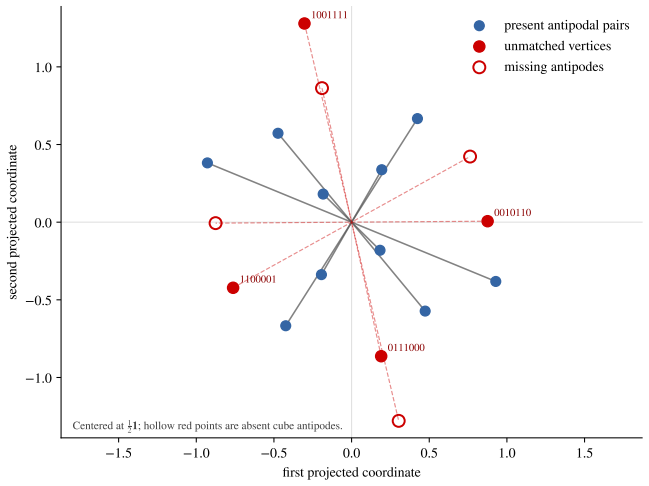
read the original abstract
Ziegler proved that every simplicial $d$-dimensional $0/1$-polytope has at most $2d$ vertices, and asked whether equality forces the polytope to be centrally symmetric and hence, equivalently, a $0/1$-realization of the $d$-dimensional cross polytope. In this note, we give a negative answer, exhibiting an explicit set of $14$ vertices in $\{0,1\}^7$ whose convex hull is a simplicial $7$-polytope and is not centrally symmetric. Moreover, via exhaustive enumeration we show that up to the symmetries of the cube, there are precisely five such polytopes in dimension $7$ (of two combinatorial types) that are not centrally symmetric.
Editorial analysis
A structured set of objections, weighed in public.
Referee Report
Summary. The manuscript disproves Ziegler's conjecture that every simplicial d-dimensional 0/1-polytope with exactly 2d vertices must be centrally symmetric (hence combinatorially a cross-polytope). It exhibits an explicit 14-vertex subset of {0,1}^7 whose convex hull is a simplicial 7-polytope whose vertex set is not closed under the map x ↦ 1−x. Exhaustive enumeration up to the action of the hypercube symmetry group shows there are precisely five such polytopes in dimension 7, falling into two combinatorial types.
Significance. The result is significant: it supplies a concrete, finitary counterexample to a natural conjecture about the extremal structure of simplicial 0/1-polytopes. The explicit vertex list together with the claim of machine-verifiable simpliciality and asymmetry constitute a strong form of evidence. The additional enumeration of all examples up to symmetry provides a complete classification in the first dimension where counterexamples appear, which is useful for future work on 0/1-polytopes.
minor comments (2)
- The manuscript states that simpliciality and non-symmetry were confirmed by exhaustive enumeration, but does not indicate the software or exact enumeration strategy used; a brief description of the verification pipeline would increase reproducibility.
- Table or listing of the five polytopes (or at least representatives of the two types) would benefit from an explicit statement of the vertex coordinates in a machine-readable format.
Simulated Author's Rebuttal
We thank the referee for their positive assessment of the manuscript, including the recognition of its significance and the recommendation to accept.
Circularity Check
Explicit construction with machine-checkable verification; no circularity
full rationale
The paper's central claim is established by exhibiting an explicit list of 14 points in {0,1}^7, followed by direct verification that their convex hull is simplicial and not centrally symmetric. Both properties are finitary and confirmed by exhaustive enumeration up to cube symmetry, with no fitted parameters, self-referential definitions, or load-bearing self-citations. The argument is self-contained against external benchmarks and does not reduce any prediction or uniqueness claim to its own inputs by construction.
Axiom & Free-Parameter Ledger
axioms (2)
- standard math Convex hull of a finite point set in R^d is a convex polytope whose faces are defined by supporting hyperplanes.
- domain assumption A polytope is centrally symmetric if its vertex set V satisfies V = c - V for some center c.
Reference graph
Works this paper leans on
-
[1]
GEPA: Reflective Prompt Evolution Can Outperform Reinforcement Learning
URL https://arxiv.org/ abs/2507.19457. Oswin Aichholzer . Extremal properties of0/1-polytopes of dimension
work page internal anchor Pith review Pith/arXiv arXiv
-
[2]
Catherine Babecki, Tycho Elling, and Asaf Ferber
doi: 10.1007/978-3-0348-8438-9_5. Catherine Babecki, Tycho Elling, and Asaf Ferber . Sharp threshold for cliques in random 0/1 polytope graphs,
- [3]
-
[4]
doi: 10.1090/S0 273-0979-1980-14712-6. Imre Bárány and Attila Pór . On 0-1 polytopes with many facets. Advances in Mathematics , 161 (2):209–228,
work page doi:10.1090/s0 1980
-
[5]
doi: https://doi.org/10.1006/aima.2001.1991
ISSN 0001-8708. doi: https://doi.org/10.1006/aima.2001.1991. URL https://www.sciencedirect.com/science/article/pii/S0001870801919917. Asaf Ferber , Michael Krivelevich, Marcelo Sales, and Wojciech Samotij. On the edge expansion of random polytopes, pages 3022–3035
-
[6]
URL https: //epubs.siam.org/doi/abs/10.1137/1.9781611978971.111
doi: 10.1137/1.9781611978971.111. URL https: //epubs.siam.org/doi/abs/10.1137/1.9781611978971.111. Tamás Fleiner , Volker Kaibel, and Günter Rote. Upper bounds on the maximal number of facets of 0/1-polytopes. European Journal of Combinatorics, 21(1):121–130,
-
[7]
Ewgenij Gawrilow and Michael Joswig
doi: 10.1006/eujc.199 9.0326. Ewgenij Gawrilow and Michael Joswig. polymake: A framework for analyzing convex polytopes. In Polytopes—Combinatorics and Computation, volume 29 of DMV Seminar, pages 43–73. Birkhäuser Basel, Basel,
-
[8]
doi: 10.1007/978-3-0348-8438-9_2. URL https://polymake.org. Volker Kaibel. Low-dimensional faces of random 0/1-polytopes. In Daniel Bienstock and George Nemhauser , editors,Integer Programming and Combinatorial Optimization. Proceedings of IPCO X, New York, NY, volume 3064 of Lecture Notes in Computer Science , pages 401–415. Springer ,
-
[9]
URL https://cloud.ovgu.de/s/2pabi8c4Lsz46gp
doi: 10.1007/978-3-540-25960-2_30. URL https://cloud.ovgu.de/s/2pabi8c4Lsz46gp. Volker Kaibel and Martin Wolff. Simple 0/1-polytopes. European Journal of Combinatorics , 21(1): 139–144,
-
[10]
7 Ulrich Kortenkamp, Jürgen Richter-Gebert, Ambatipudi Sarangarajan, and Günter M
doi: 10.1006/eujc.1999.0328. 7 Ulrich Kortenkamp, Jürgen Richter-Gebert, Ambatipudi Sarangarajan, and Günter M. Ziegler . Ex- tremal properties of 0/1-polytopes. Discrete & Computational Geometry , 17(4):439–448,
-
[11]
doi: 10.1007/PL00009303. Peter McMullen. The numbers of faces of simplicial polytopes. Israel Journal of Mathematics , 9: 559–570,
-
[12]
doi: 10.1007/BF02771471. Richard P. Stanley . Cohen–Macaulay rings and constructible polytopes. Bulletin of the American Mathematical Society, 81(1):133–135,
-
[13]
doi: 10.1090/S0002-9904-1975-13670-6. Günter M. Ziegler . Lectures on 0/1-polytopes. In Polytopes—Combinatorics and Computation , vol- ume 29 of DMV Seminar , pages 1–41. Birkhäuser Basel, Basel,
-
[14]
doi: 10.1007/978-3-034 8-8438-9_1. Günter M. Ziegler . Lectures on Polytopes , volume 152 of Graduate Texts in Mathematics . Springer , New Y ork, updated seventh printing of the first edition edition,
-
[15]
doi: 10.1007/978-1-4613-8431-1
ISBN 978-0-387-94365-7. doi: 10.1007/978-1-4613-8431-1. Corrected and updated printing. Max Zimmer , Nico Pelleriti, Christophe Roux, and Sebastian Pokutta. The Agentic Researcher: A Practical Guide to AI-Assisted Research in Mathematics and Machine Learning. Proceedings of the ICML 2026 Workshop on AI as a Tool for Mathematics, Computer Science, and Mach...
-
[16]
doi: 10.48550/arXiv.2603.15914. 8 A The five not centrally symmetric examples in dimension seven Table 3gives explicit generating vertex sets for the five simplicial, not centrally symmetric7-dimensional 0/1-polytopes with 14 vertices of Theorem 4.3, one representative per orbit under the cube symme- try group B7. V1 V2 V3 V † 4 V5 0000000 0000000 0000000...
discussion (0)
Sign in with ORCID, Apple, or X to comment. Anyone can read and Pith papers without signing in.