REVIEW 3 major objections 5 minor 2 cited by
Cauchy Horizon (In)Stability of Regular Black Holes
T0 review · 3 major / 5 minor · reviewed 2026-08-06 · deepseek-v4-flash
Pith's one-line read For regular black holes, the paper claims, the Misner-Sharp mass at the Cauchy horizon has only three possible late-time growth laws — exponential, polynomial, or logarithmic — with the logarithmic case reached by a…
desk verdict Solid phase-space analysis for Bardeen, Hayward, and Dymnikova, but the headline AS-collapse log-attractor rests on a flawed asymptotic derivation in Appendix B. read the letter →
The pith
A machine-rendered reading of the paper's core claim, the machinery that carries it, and where it could break.
The reading
What carries the argument
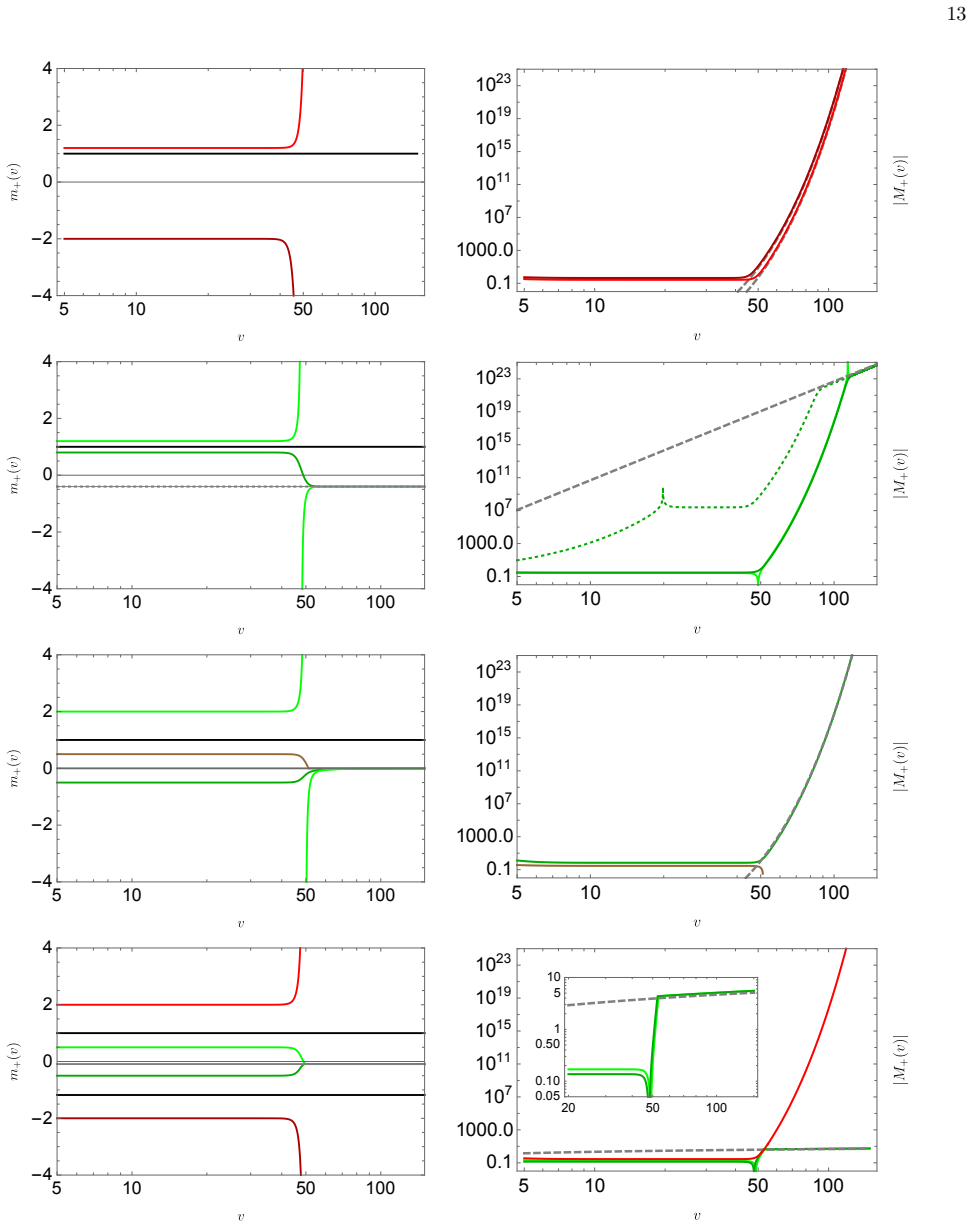
The load-bearing object is the Ori model: outgoing radiation is collapsed into a spherically symmetric thin null shell, while the ingoing flux is fixed by Price's late-time tail $m_-(v)=m_0-\beta/v^{p-1}$; the two meet at the shell and are linked by the junction condition. The dynamics reduces to two first-order equations, one for the shell radius $R(v)$ and one for the mass $m_+(v)$ in the region between the shell and the Cauchy horizon. The central concept is a quasi-fixed point: a value $m_{+,\ast}$ where the right-hand side of the mass equation vanishes when $R=r_-$, so the flow is governed by an attractive or repulsive fixed point, and the scaling of the Misner-Sharp mass is read off by a Frobenius expansion around it. For the AS-collapse attractor, the paper introduces $x(v)=1+6\xi m_+/R^{3}$ and analyzes the late-time equation (B6) through the ansatz $y(v)=y_0\left[1+\sum_{n\geq 1}y_n\log^{n}v\right]$, whose coefficients are fixed recursively by a generating function; because the authors state that they are not aware of an analytic solution of (B6), the logarithmic law is carried by this log-polynomial ansatz itself.
What would settle it
Integrate the reduced equation (B6), or the full Ori system, to very late times with several initial conditions and compare the reconstructed Misner-Sharp mass with the logarithmic law: if the ratio $M_+(v)/\bigl[(r_{-}^{3}/(12\xi))\log^{2}(y_0 v^{-p})\bigr]$ does not approach a universal constant, or if residuals require terms not captured by the recursively fixed coefficients, the logarithmic attractor fails. A more direct check is to find a non-analytic contribution, such as a $\log\log v$ correction, in the solution of (B6).
Extended reading notes
Core claim
The central claim, stated within the Ori model, is that regular black holes fall into exactly three late-time behaviors for the Misner-Sharp mass at the Cauchy horizon. The Bardeen geometry and the Reissner-Nordström geometry share a repulsive quasi-fixed point and exhibit eternal exponential mass inflation, $M_+(v)\propto v^{-p}e^{\kappa_- v}$. The Hayward geometry has a global attractive quasi-fixed point whose basin of attraction is the whole phase space, giving universal power-law growth $M_+(v)\propto v^{p}$. The Dymnikova geometry has a one-sided attractor at $m_+=0$ and generically still ends in exponential mass inflation, apart from trajectories that terminate at finite $v$. The new case is the AS-collapse regular black hole: its attractive quasi-fixed point gives $M_+^{\rm att}(v)\simeq \frac{r_{-}^{3}}{12\xi}\,\left[\log(y_0 v^{-p})\right]^{2}$, reached from a wedge of phase space and with no appreciable transient mass-inflation phase. The paper reads this as showing that the Reissner-Nordström mass-inflation instability does not automatically transfer to regular black holes.
Load-bearing premise
The logarithmic attractor rests on the assumption that the late-time solution of the differential equation (B6) is exactly described by a log-polynomial series, while the authors state that they do not know an analytic solution of that equation; if the true attractor contains any non-analytic late-time term, the logarithmic law is not established.
Editorial extensions
If this is right
- If the central claim is correct, exponential mass inflation is not the generic fate for regular black holes: only Bardeen-type flows (and Dymnikova flows reaching $v=\infty$) suffer it.
- The Hayward attractor is global: every initial condition, even after a finite transient mass-inflation episode, ends at the universal power law $M_+(v)\propto v^{p}$, with no free parameter.
- The AS-collapse attractor keeps the Misner-Sharp mass within the same order of magnitude as the black-hole mass, and the Weyl-squared curvature invariant asymptotes to a constant rather than diverging exponentially.
- The three mass behaviors reduce to two singularity-strength classes: exponential growth gives a strong singularity, while polynomial and logarithmic growth give weak singularities, so geodesics may admit a $C^{1}$ continuation.
- The phase-space structure shows that the tamed growth in the Hayward case is generic due to its cylindrical topology, whereas the AS-collapse attractor is confined to a wedge between two repulsive quasi-fixed points.
Reading between the lines
- Editorial inference: the completeness of the log-polynomial ansatz for (B6) is the obvious place to test; if the true late-time solution contains non-analytic terms such as $\log\log v$, the logarithmic law would need revision.
- Editorial inference: the classical taming of mass inflation in the AS-collapse geometry does not by itself settle the full stability question, since quantum field theory in curved spacetime can still produce divergent stress-energy near the horizon; that comparison is not made in the paper.
- Editorial inference: the dichotomy between linear and nonlinear dependence of the Misner-Sharp mass on $m_+$ suggests a practical criterion — geometries whose mass function is linear in $m_+$ fall into the exponential class, while nonlinear mass functions can admit polynomial or logarithmic attractors — which could be used to scan other regular black hole proposals.
- Editorial inference: the results give a target for numerical relativity: a full dynamical collapse simulation of the AS-collapse geometry should show whether the thin-shell idealization substantially changes the late-time logarithmic growth found here.
Editorial analysis
A structured set of objections, weighed in public.
Referee Report
Summary. The paper studies the Ori model of Cauchy-horizon mass inflation for four families of regular black holes: Bardeen, Hayward, Dymnikova, and a model arising from asymptotically safe collapse (AS-collapse). It proposes a phase-space classification of the late-time dynamics of the Misner-Sharp mass along an ingoing null shell: eternal exponential mass inflation (Bardeen and one Dymnikova branch), a polynomial attractor (Hayward), and a logarithmic attractor (AS-collapse). The Hayward result is presented as generic through a global basin-of-attraction argument, and the AS-collapse logarithmic growth is the paper's central new claim. The analytic argument for the logarithmic attractor is relegated to Appendix B and is supplemented by numerical integrations shown in Fig. 4.
Significance. If the results are correct, the paper substantially changes the expected stability picture of regular black holes: the standard Reissner-Nordstrom mass-inflation instability would not be generic, and the AS-collapse model would exhibit an extremely tame, logarithmic growth of the mass at the Cauchy horizon. The paper's organization is clear, and the phase-space treatment of the Bardeen, Hayward, and Dymnikova cases is a useful systematic contribution. The claim of a global Hayward attractor and the explicit basin analysis are valuable, as is the recognition that non-analytic mass functions require a case-by-case treatment. However, the central new result for AS-collapse depends entirely on the asymptotic analysis of Appendix B, and that analysis as written is not internally consistent. No code or data is shipped, so the numerical confirmation cannot currently be checked independently.
major comments (3)
- [Appendix B, Eqs. (B8)-(B13) and Eq. (82)] The derivation of the logarithmic attractor is internally inconsistent. For y(v) of the assumed form (B11), log y(v) = O(log log v), so the right-hand side of (B8) is dominated by the term -t kappa_- v log v; neither the left-hand side nor any term in (B11) can cancel it. Eq. (B13) would require log tilde-y ~ 12 log v, i.e. tilde-y ~ v^12, which contradicts x(v) -> 0 and is not representable by a polynomial in log v. Equivalently, substituting x(v) = y0 v^{-p} into (B6) leaves a residual of order v^{-p} log v, larger than the derivative of the purported solution. In addition, the transcendental equation for y0 appears as a + b y0 + ... in (B10) but as 3a + b y0 + ... in (82); both cannot follow from the same balancing, and neither matches the coefficient obtained by substituting x = y0 v^{-p} into (B6). Thus Eq. (81), the parameter-free attractor claim, and the absence of transient mass inflation are not established by the presented analysis.
- [Section V C, Fig. 4 (bottom row)] The numerical evidence for the log attractor consists of two trajectories with a single constant y0 fixed by solving (82), displayed over v up to roughly 100. No residuals, convergence in the upper limit of integration, or machine-readable code/data are given. A slowly varying prefactor such as x(v) approx y0 v^{-p} / log^k v produces a |M_+(v)| that is indistinguishable from the claimed form over this range with a one-constant fit. Please provide the numerical data or code, and a residual analysis demonstrating that the log form is selected at asymptotically large v.
- [Section V B, Eqs. (78)-(80) and Table II] The reconstruction of the Misner-Sharp mass for the repulsive AS branch is sensitive to the meaning of the notation in (3e). Under the standard reading M(r) = (r^3/(12 xi)) [log(1 + 6 xi m / r^3)]^2, substituting m_+ = exp(c v^{-p} e^{kappa_- v}) gives M_+ ~ v^{-2p} e^{2 kappa_- v}, not the v^{-p} e^{kappa_- v} stated in Eq. (80) and Table II. Under the alternative reading log[(...)^2], Eq. (81) and the text's log-squared discussion need to be reworded consistently. Please state the convention unambiguously and correct all affected entries in the table and the main text.
minor comments (5)
- [Table I] The header of Table I lists 'mrep_+,* matt_+,* mrep_+,*' with an apparently duplicated repulsive column; if the two repulsive points for AS-collapse are intended, they should be labeled distinctly (e.g. mrep,1 and mrep,2).
- [Section V A, Bardeen paragraph] The text says 'phase diagram shown in the top-right corner of Fig. 3' when referring to the Bardeen case; the Bardeen panel is the top-left diagram, so the pointer should be corrected.
- [Eqs. (81) and Table II] The notation log(y0 v^{-p})^2 is ambiguous between [log(y0 v^{-p})]^2 and log[(y0 v^{-p})^2]; this ambiguity propagates into the abstract's claim of 'logarithmic' growth and should be clarified at first use.
- [Footnote 2 and Eq. (3e)] The analytic continuation of the AS-collapse mass function to real values for all m should be spelled out, including the branch choice for the logarithm when the argument becomes negative.
- [References] Reference [31] appears to conflate two Ayon-Beato and Garcia papers; the two works should be cited separately to allow the reader to identify the relevant result.
Circularity Check
No significant circularity; the logarithmic AS-collapse attractor is derived from the Ori equations via an explicit asymptotic analysis, not fitted or assumed as its own conclusion.
full rationale
I walked the paper's derivation chain. The Ori-model equations (22) and (28) are obtained from the junction condition (24) and combined with the externally stated Price law (29). The late-time attractors in Sect. V B are obtained by substituting the explicit mass profiles (3) into these equations and solving the resulting ordinary differential equations asymptotically. The Hayward power-law attractor, though attributed to refs. [43,44], is re-derived here through the Frobenius expansions (67), (73), and (74); hence those self-citations are not load-bearing for the present derivation. The central new claim, the AS-collapse logarithmic attractor (81), is derived in Appendix B from the differential equation (B6). The log-polynomial ansatz (B11) is an assumed functional form, not a fitted parameter, and the resulting log-squared growth of the Misner-Sharp mass is not inserted as an input but emerges from the v^{-p} power-law factor selected by the dominant-balance argument. In the numerical section, the integration constants c are calibrated by matching the already-derived asymptotics at one value of v; this is a consistency check, not a fitted parameter renamed as a prediction. The AS-collapse mass function itself is imported from the self-cited prior work [30], but it is an external input from a collapse model and is not constructed to reproduce the logarithmic law. I also note the paper's own caveat in Appendix B that 'we are not aware of an analytic solution of (B6)', and the completeness of the log-polynomial ansatz is not proven; the dominant balance leading to (B13) also appears questionable. Those are correctness risks, not circular reductions of the conclusion to its inputs. Overall, the derivation is self-contained with respect to the orienting dynamical equations, and the central claim does not reduce by construction to any fitted or self-defined quantity.
Assumptions & free parameters
free parameters (4)
- p (Price law exponent) =
12
- m_0 (asymptotic mass in Price law) =
1
- β (Price-law amplitude) =
1
- geometry parameters (a, l, γ, ξ) =
a=0.586, l=0.483, γ=0.892, ξ=0.167
assumptions (5)
- domain assumption The Ori thin-shell model: outgoing backreaction is a single null shell and ingoing radiation a continuous null flux, with junction conditions from GR determining the mass jump.
- domain assumption Price's law for the late-time ingoing tail, m_-(v)=m0 - β/v^{p-1} with p≥12.
- domain assumption Generic smoothness and finiteness of f_+, F(v) near the attractor for the universal power-law derivation.
- standard math The late-time dynamics admit Frobenius-type asymptotic series, R(v)-r_- ~ v^{-(p-1)} and m_+(v) with powers and log corrections.
- ad hoc to paper Analytic continuation of the AS-collapse mass function so that M(r) is real for all m, as stated in footnote 2.
Cite this review
Pith. "Pith review of Cauchy Horizon (In)Stability of Regular Black Holes." pith.science (2026). https://pith.science/paper/ZOBTY34V
@misc{pith2026250703581,
  author       = {Pith},
  title        = {Pith review of: Cauchy Horizon (In)Stability of Regular Black Holes},
  year         = {2026},
  howpublished = {\url{https://pith.science/paper/ZOBTY34V}},
  note         = {Machine review of arXiv:2507.03581}
}
read the original abstract
A common feature of regular black hole spacetimes is the presence of an inner Cauchy horizon. The analogy to the Reissner-Nordstr\"om solution then suggests that these geometries suffer from a mass-inflation effect, rendering the Cauchy horizon unstable. Recently, it was shown that this analogy fails for certain classes of regular black holes, including the Hayward solution, where the late-time behavior of the mass function no longer grows exponentially but follows a power law. In this work, we extend these results in a two-fold way. First, we determine the basin-of-attraction for the power-law attractor, showing that the tamed growth of the mass function is generic. Second, we extend the systematic analysis to the Bardeen geometry, the Dymnikova black hole, and a spacetime arising from a non-singular collapse model newly proposed in the context of asymptotically safe quantum gravity. Remarkably, in the latter solution, the Misner-Sharp mass at the Cauchy horizon remains of the same order of magnitude of the mass of the black hole, since its growth is just logarithmic.
Figures


Figures from the paper (2 more)

Forward citations
Cited by 2 Pith papers
-
Evading Cauchy Horizon Excision in Scalarized Regular Black Holes
A sign-changing nonlinear electromagnetic Lagrangian is necessary for scalarized regular black holes to avoid Cauchy horizon excision.
-
Doubly regular black holes
Most proposed curvature-regular black hole metrics still contain thermodynamic Davies points, and only specially constructed families are both curvature-regular and thermodynamically regular.
Reference graph
Works this paper leans on
-
[1]
S. W. Hawking and G. F. R. Ellis, The Large Scale Struc- ture of Space-Time , Cambridge Monographs on Math- ematical Physics (Cambridge University Press, 2023), ISBN 978-1-009-25316-1, 978-1-009-25315-4, 978-0-521- 20016-5, 978-0-521-09906-6, 978-0-511-82630-6, 978-0- 521-09906-6
work page 2023
- [2]
-
[3]
R. Penrose, in Battelle rencontres - 1967 lectures in math- ematics and physics: Seattle, WA, USA, 16 - 31 July 1967 (1968), pp. 121–235
work page 1968
-
[4]
Poisson and W
E. Poisson and W. Israel, Phys. Rev. Lett. 63, 1663 (1989)
1989
-
[5]
Poisson and W
E. Poisson and W. Israel, Phys. Rev. D 41, 1796 (1990)
1990
-
[6]
Ori, Phys
A. Ori, Phys. Rev. Lett. 67, 789 (1991)
1991
- [7]
- [8]
Show all 60 references
- [9]
-
[10]
Casals, A
M. Casals, A. Fabbri, C. Mart ´ ınez, and J. Zanelli, Phys. Rev. D 99, 104023 (2019), 1902.01583
2019 arXiv
-
[11]
Zilberman, A
N. Zilberman, A. Levi, and A. Ori, Phys. Rev. Lett. 124, 171302 (2020), 1906.11303
2020 arXiv
-
[12]
Klein, J
C. Klein, J. Zahn, and S. Hollands, Phys. Rev. Lett. 127, 231301 (2021), 2103.03714
2021 arXiv
-
[13]
Zilberman, M
N. Zilberman, M. Casals, A. Ori, and A. C. Ottewill, Phys. Rev. Lett. 129, 261102 (2022), 2203.08502
2022 arXiv
-
[14]
Klein, M
C. Klein, M. Soltani, M. Casals, and S. Hollands, Phys. Rev. Lett. 132, 121501 (2024), 2402.14171
2024 arXiv
-
[15]
Arrechea, G
J. Arrechea, G. Neri, and S. Liberati, Phys. Rev. D 111, 084036 (2025), 2411.14964
2025 arXiv
-
[16]
Hollands, R
S. Hollands, R. M. Wald, and J. Zahn, Class. Quant. Grav. 37, 115009 (2020), 1912.06047
2020 arXiv
-
[17]
Hollands, C
S. Hollands, C. Klein, and J. Zahn, Phys. Rev. D 102, 085004 (2020), 2006.10991
2020 arXiv
-
[18]
Bardeen, in Proceedings of the 5th International Con- ference on Gravitation and the Theory of Relativity (1968), p
J. Bardeen, in Proceedings of the 5th International Con- ference on Gravitation and the Theory of Relativity (1968), p. 87
1968
-
[19]
Ayon-Beato and A
E. Ayon-Beato and A. Garcia, Phys. Lett. B 493, 149 (2000), gr-qc/0009077
2000 arXiv
-
[20]
Bambi, ed., Regular Black Holes
C. Bambi, ed., Regular Black Holes. Towards a New Paradigm of Gravitational Collapse , Springer Series in Astrophysics and Cosmology (Springer, 2023), ISBN 978-981-99-1595-8, 978-981-99-1598-9, 978-981-99-1596 - 5, 2307.13249
2023 arXiv
-
[21]
C. Lan, H. Yang, Y. Guo, and Y.-G. Miao, Int. J. Theor. Phys. 62, 202 (2023), 2303.11696
2023 arXiv
- [22]
-
[23]
Dymnikova, Gen
I. Dymnikova, Gen. Rel. Grav. 24, 235 (1992)
1992
-
[24]
Dymnikova, Class
I. Dymnikova, Class. Quant. Grav. 19, 725 (2002), gr- qc/0112052
2002
- [25]
- [26]
- [27]
-
[28]
S. A. Hayward, Phys. Rev. Lett. 96, 031103 (2006), gr- qc/0506126
2006
- [29]
-
[30]
Bonanno, D
A. Bonanno, D. Malafarina, and A. Panassiti, Phys. Rev. Lett. 132, 031401 (2024), 2308.10890
2024 arXiv
-
[31]
Ayon-Beato and A
E. Ayon-Beato and A. Garcia, Phys. Rev. Lett. 80, 5056 (1998), gr-qc/9911046
1998 arXiv
-
[32]
K. A. Bronnikov (2022), 2211.00743
2022 arXiv
-
[33]
Malafarina and B
D. Malafarina and B. Toshmatov, Phys. Rev. D 105, L121502 (2022), 2204.04025
2022 arXiv
-
[34]
Bueno, P
P. Bueno, P. A. Cano, and R. A. Hennigar, Phys. Lett. B 861, 139260 (2025), 2403.04827
2025 arXiv
-
[35]
Biasi, O
A. Biasi, O. Evnin, and S. Sypsas, Phys. Rev. Lett. 129, 251104 (2022), 2209.06835
2022 arXiv
- [36]
-
[37]
Casadio, A
R. Casadio, A. Kamenshchik, and J. Ovalle, Phys. Rev. D 111, 064036 (2025), 2502.13627
2025 arXiv
- [38]
-
[39]
T. Hale, R. A. Hennigar, and D. Kubiznak (2025), 2506.20802
2025 arXiv
-
[40]
Carballo-Rubio, F
R. Carballo-Rubio, F. Di Filippo, S. Liberati, C. Pacilio, and M. Visser, JHEP 07, 023 (2018), 1805.02675
2018 arXiv
-
[41]
A. J. S. Hamilton and P. P. Avelino, Phys. Rept. 495, 1 (2010), 0811.1926
2010 arXiv
- [42]
-
[43]
Bonanno, A.-P
A. Bonanno, A.-P. Khosravi, and F. Saueressig, Phys. Rev. D 103, 124027 (2021), 2010.04226
2021 arXiv
-
[44]
Bonanno, A.-P
A. Bonanno, A.-P. Khosravi, and F. Saueressig, Phys. Rev. D 108, 128502 (2023), 2402.07416
2023 arXiv
-
[45]
Bonanno, A.-P
A. Bonanno, A.-P. Khosravi, and F. Saueressig, Phys. Rev. D 107, 024005 (2023), 2209.10612
2023 arXiv
-
[46]
Carballo-Rubio, F
R. Carballo-Rubio, F. Di Filippo, S. Liberati, and M. Visser, Phys. Rev. Lett. 133, 181402 (2024), 2402.14913
2024 arXiv
-
[47]
Following the analysis made in [43], one finds that one can always find a coordinate system which is regular in the future sector of the shell
and Kr´ olak [48, 49]. Following the analysis made in [43], one finds that one can always find a coordinate system which is regular in the future sector of the shell. As a consequence, all curvature singularities building up dynamically are weak in the Tipler sense. Determining ...
2022
-
[48]
F. J. Tipler, Phys. Lett. A 64, 8 (1977)
1977
-
[49]
Krolak, Class
A. Krolak, Class. Quant. Grav. 3, 267 (1986)
1986
-
[50]
Krolak, Journal of Mathematical Physics 28, 138 (1987)
A. Krolak, Journal of Mathematical Physics 28, 138 (1987)
1987
-
[51]
Bonanno, S
A. Bonanno, S. Droz, W. Israel, and S. M. Morsink, Proc. Roy. Soc. Lond. A 450, 553 (1995), gr-qc/9411050
1995 arXiv
-
[52]
L. M. Burko, Phys. Rev. D 60, 104033 (1999), gr- qc/9907061
1999
-
[53]
M. A. Markov, ZhETF Pisma Redaktsiiu 36, 214 (1982)
1982
-
[54]
M. A. Markov, Annals Phys. 155, 333 (1984)
1984
-
[55]
V. P. Frolov, M. A. Markov, and V. F. Mukhanov, Phys. Lett. B 216, 272 (1989)
1989
-
[56]
V. P. Frolov, M. A. Markov, and V. F. Mukhanov, Phys. Rev. D 41, 383 (1990)
1990
-
[57]
V. P. Frolov, Phys. Rev. D 94, 104056 (2016), 1609.01758
2016 arXiv
-
[58]
Barrabes and W
C. Barrabes and W. Israel, Phys. Rev. D 43, 1129 (1991)
1991
-
[59]
R. H. Price, Phys. Rev. D 5, 2419 (1972)
1972
-
[60]
R. H. Price, Phys. Rev. D 5, 2439 (1972). f+ = 0 v+ =V = 0 C E I + H f− = 0 r = 0 v− =v=∞ + −Σ
1972
Reviewed August 6, 2026 · model on record in the stance chip above.
Discussion (0). Sign in to comment.