REVIEW 3 major objections 5 minor 101 references
3D climate simulations predict close-in rocky planets around M dwarfs are dark: geometric albedos 0.07–0.2 in the visible and 0–0.14 in the near-infrared, below the 0.3 commonly assumed.
Reviewed by Pith at T0; open to challenge. T0 means a machine referee read the full paper against a public rubric. the ladder, T0–T4 →
3D climate simulations of Ross 128 b yield geometric albedos of 0.07 to 0.2 in the visible and near zero in the near-infrared, well below the common 0.3 assumption.
T0 review reviewed 2026-08-05 challenge →
load-bearing objection Useful grid, but thin-atmosphere low albedo is input, not prediction—still deserves a referee. the 3 major comments →
A broad exploration of climate and observability of close-in rocky exoplanets: applications to Ross 128 b
The pith
A machine-rendered reading of the paper's core claim, the machinery that carries it, and where it could break.
The reading
Core claim
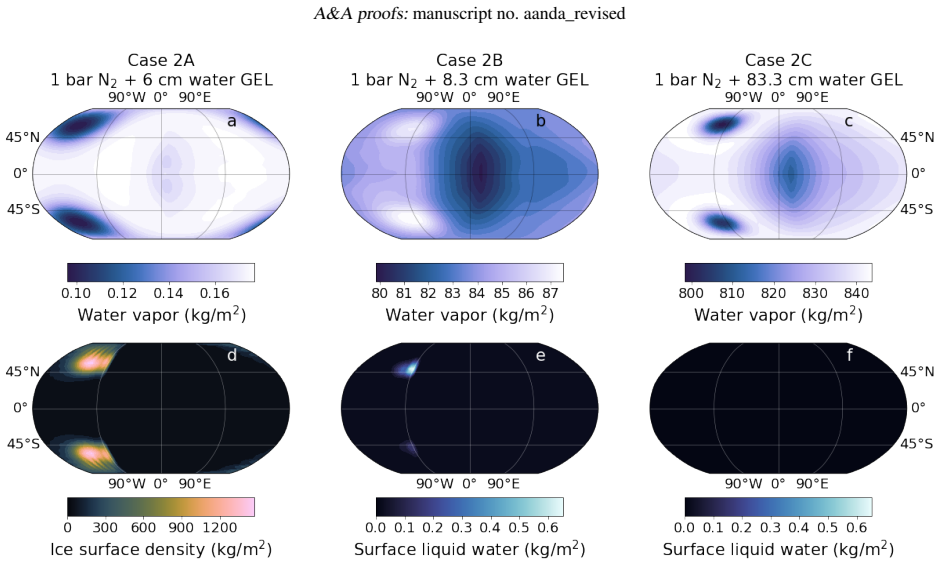
The paper's central claim is that close-in rocky exoplanets around M dwarfs, using Ross 128 b as prototype, have much lower spectral reflectivity than the geometric albedo of 0.3 commonly adopted in detection-limit calculations. Across 3D climate simulations varying atmospheric composition, surface pressure (0.1–10 bar), water inventory, and spin-orbit resonance, it computes geometric albedos of 0.07–0.2 in the RISTRETTO visible band and 0–0.14 in the ANDES near-infrared bands in every scenario. Low reflectivity results from three climate-mediated effects: water collapsing into nightside ice leaves a transparent dayside; high water vapor absorbs strongly in the near-infrared; and clouds form
What carries the argument
The load-bearing machinery is a three-dimensional global climate model coupled to a radiative-transfer spectral post-processor. The climate model simulates circulation, the water cycle, clouds, and ice for each parameter combination, and the post-processor converts each simulated atmosphere into wavelength-dependent reflectance spectra and phase curves. The physical mechanism organizing the results is the moist bistability of low-water rocky planets: the same stellar irradiation can settle into a collapsed state (water frozen onto the nightside, dayside nearly transparent, reflectivity near that of bare rock) or a runaway state (all water vaporized, near-infrared opacity high, reflectivity v
Load-bearing premise
The assumed 0.2 surface albedo for the rocky dayside and the omission of photochemical hazes set the reflectivity floor; if real surfaces are brighter or hazes form, the low-albedo result for thin and collapsed atmospheres would not hold.
What would settle it
Measure the reflected-light spectrum of a close-in rocky exoplanet around an M dwarf (for example with PCS) and retrieve the geometric albedo: values clearly above 0.2 in the visible or above 0.14 in the near-infrared, or a direct detection of dayside cloud or haze, would contradict the paper's central claim. A simpler check on the input side would be to determine the typical dayside surface albedo of such planets; a value substantially above 0.2 would break the thin-atmosphere branch.
If this is right
- The common 0.3 Earth-like albedo overestimates the reflected flux of this planet population, making detection-limit predictions look more optimistic than they are.
- In the RISTRETTO visible band, reflectivity is mainly boosted by Rayleigh scattering, so denser atmospheres appear brighter; in the ANDES near-infrared bands, water vapor and CO2 absorption dominate, so water-rich runaway atmospheres appear very dark.
- Dayside clouds cannot be assumed to brighten these planets: the simulations place water clouds mainly on the nightside, where they contribute no reflected light.
- High-resolution spectroscopy can distinguish the collapsed, transient, and runaway climate states through the depth and shape of water-vapor absorption bands, provided enough reflected flux is collected.
- Ross 128 b itself is beyond the angular-separation limits of RISTRETTO and ANDES but remains a possible PCS target, so climate-based albedo estimates should be used in PCS detection calculations.
Where Pith is reading between the lines
- If the low-albedo result generalizes, early RISTRETTO and ANDES non-detections of close-in rocky planets may be expected even for planets with substantial atmospheres; exposure times scale roughly as (0.3/A_g)^2, so a dark runaway planet could require about ten times longer integrations than current estimates suggest.
- There may be a selection bias in target choice: slightly less irradiated planets where dayside clouds or surface ice can form could be the brightest members of the population, while the hot inner-edge planets these instruments are designed to observe may be systematically the darkest.
- The assumed 0.2 surface albedo is the main lever on the thin-atmosphere branch; combining reflected-light photometry with thermal emission or polarimetry could test whether brighter real surfaces rescue these scenarios.
- The paper's prediction of small east-west phase-curve asymmetry is testable: measuring a phase-curve asymmetry would directly probe day-night cloud or ice coverage, and could falsify the nightside-cloud-dominated picture.
Editorial analysis
A structured set of objections, weighed in public.
Referee Report
Summary. The paper explores climate regimes and reflected-light observability of the non-transiting rocky exoplanet Ross 128 b, as a prototype for close-in rocky planets around M dwarfs. Using the Generic-PCM 3D global climate model, the authors vary orbital configuration (1:1 and 5:2 spin-orbit resonances), atmospheric composition (N2, N2+CO2, CO2), surface pressure (0.1–10 bar), and water inventory, producing a grid of climate scenarios that fall into collapsed, transient, and runaway states. They post-process GCM outputs with Pytmosph3R to generate reflectance spectra and compute Band and geometric albedos in the RISTRETTO and ANDES bandpasses. The central result is that hazeless, low-water rocky planets at Ross-128-like irradiation have low geometric albedos: 0.07–0.2 in the RISTRETTO band and 0–0.14 in the ANDES YJH bands. The authors argue that the common Earth-like albedo assumption of 0.3 overestimates the reflected flux for this population and should be revisited in detection-limit calculations for RISTRETTO, ANDES, and PCS.
Significance. If robust, the scenario grid and albedo estimates are of direct practical value for planning reflected-light observations of non-transiting rocky planets, a key science case for RISTRETTO, ANDES, and PCS. The paper's strengths include the physically consistent coupling of a 3D climate model with a 3D radiative-transfer postprocessor, the broad parameter exploration, the explicit distinction between climate regimes, and the public availability of GCM outputs. The authors also responsibly acknowledge several limitations in Section 5, notably the sensitivity to surface albedo and the absence of hazes. However, the headline low-albedo conclusion is substantially conditioned by the assumed surface albedo of 0.2, and the abstract and conclusions do not carry that caveat. The methodology itself is sound, but the population-level claim needs reframing before the paper can be used as a basis for instrument planning.
major comments (3)
- [Section 4.2.1 / Eq. (2) / Table D.1] For optically thin and collapsed atmospheres, the geometric albedo converges to 2/3 of the input surface albedo, as the paper itself notes. Table D.1 shows that many scenarios, including all 0.1-bar N2 cases and the dry 1-bar N2 case, have Ag≈0.11–0.13, essentially equal to (2/3)×0.2. This means that a substantial part of the quoted ranges “0.07–0.2” and “0–0.14” is not an independent prediction of the climate/radiative model but a restatement of the assumed A_surf=0.2. If a plausible higher surface albedo of 0.4 were adopted, these optically thin cases would give Ag≈0.27, and the conclusion that the 0.3 Earth-like value overestimates reflectivity would no longer hold for those scenarios. The abstract and conclusions should state the result as conditional on the assumed surface albedo, and the paper should quantify the linear scaling explicitly, e.g., by showing Ag(A_surf) for the collap
- [Section 5 (Discussion) and Abstract] The Discussion acknowledges that the results are “highly sensitive to the assumed surface albedo” and that photochemical hazes are not included in the simulations, yet the abstract and Section 6 state the low-albedo result as a general property of “hazeless rocky planets” and conclude that “there is a high probability that these warm exoplanets will exhibit low albedo and therefore appear optically dark.” This is an overstatement: the quantitative albedo ranges apply only to the specific model set with A_surf=0.2 and no hazes, and the omitted haze process could systematically increase reflectivity. The manuscript should either soften the population-level claim or explicitly restate the scope in the abstract and conclusions, e.g., “under the assumptions of a dark rocky surface and no photochemical hazes.”
- [Section 3.1.3 / Figure 6] The text notes that total water mass in the simulations is not conserved, attributing the discrepancy to a numerical effect of order 10^-3% and saying it “requires further investigation.” While the magnitude is small and likely does not affect the climate classification, this is a conservation test and the reader should be told whether the non-conservation is a known caveat of the water-cycle scheme or a bug. If it is a known scheme property, one sentence stating that would be sufficient; if not fully characterized, the statement should be more transparent about the possible impact on the reported climate regimes.
minor comments (5)
- [Abstract] The phrase “hazeless rocky planets” should be expanded to “hazeless rocky planets with a dark surface albedo (A_surf=0.2)” to avoid the impression that the low albedo range is independent of the surface assumption.
- [Section 2.1.2] The sentence “the spectral resolution is 58 for the IR and 28 for the visible, whereas for both Earth-like and H2O+CO2 mixtures, the IR and visible resolutions are 58 and 28, respectively” appears to state the same values twice; the sentence should be clarified or merged.
- [Section 4.2.2] The phrase “geometric albedo converging to 2/3 of A_surf” should include a pointer to Eq. (2) and a brief derivation, since this is the key diagnostic for optically thin cases. Currently the reader must infer the Lambertian-sphere result from Section 2.2.2.
- [Table D.1] The table would be more informative if it included a column giving the corresponding Lambertian-sphere value 2/3×A_surf, so readers can immediately separate model-predicted reflectivity from the surface input. Alternatively, a caption note could state that for radiatively transparent cases Ag approaches 0.13.
- [Section 3.1.1 / Appendix A] The text says L_Ro/Rp≈1, while Appendix A computes 1.0–1.4. This is fine, but consider stating the range in the main text to avoid an apparent inconsistency.
Circularity Check
Low-albedo conclusion for collapsed/thin-atmosphere cases restates the assumed surface albedo A_surf=0.2 via the Lambertian relation A_g=(2/3)A_surf; the water-vapor and CO2 absorption results are independent, so circularity is partial.
specific steps
-
self definitional
[Section 2.1 (Table 2); Section 4.2.1; Section 4.2.2]
"Each simulation is initialized with a flat surface, with a surface albedo of 0.2 and a thermal inertia of 1000 J m −2 K−1 s−1/2. ... The collapsed case (dark blue) exhibits the highest mean geometric albedo among the three cases for both RISTRETTO and ANDES, with values ranging from 0.11 to 0.13. These values closely correspond to the geometric albedo of a Lambertian sphere with a surface albedo of 0.2, which means that the atmosphere is relatively radiatively transparent."
For the optically thin/collapsed scenarios, the reported geometric albedo is algebraically determined by the assumed input surface albedo: the paper's own Lambertian-sphere conversion gives A_g = (2/3) A_surf (Section 2.2.2), so A_surf = 0.2 yields A_g ≈ 0.133. The paper explicitly states that the 0.1-bar spectrum 'converges to 2/3 of Asurf at all wavelengths,' and that the 0.11-0.13 values 'closely correspond' to a Lambertian sphere with A_surf=0.2. Thus the low reflectivity emphasized in the abstract for transparent/collapsed cases is not an independent prediction of the climate or radiative model, but a restatement of the assumed dark surface. Section 5 concedes the results are 'highly sensitive to the assumed surface albedo.' The runaway/water-vapor absorption reductions in ANDES bands
full rationale
The main circular element is the surface-albedo floor: for radiatively transparent, collapsed, and thin-atmosphere cases, the computed geometric albedo is essentially 2/3 of the assumed A_surf=0.2, so the claimed low reflectivity in those scenarios is an input assumption propagated through the Lambertian relation. The paper itself acknowledges this in Sections 4.2.1, 4.2.2, and 5. However, the lower albedos in runaway and water-rich scenarios are produced by water-vapor and CO2 absorption computed from the GCM and Pytmosph3R, and the Rayleigh-scattering increase at 10 bars is an independent atmospheric effect. The citations for the surface albedo (Buratti, Mallama, Greene, Zieba) are external observational evidence, not self-citations. The moist-bistability classification cites Leconte et al. (2013b), but the present GCM simulations independently reproduce the collapsed and runaway states, so that self-citation is not load-bearing. No uniqueness theorem or ansatz is smuggled in via self-citation. Because part of the headline range is forced by construction while other parts are genuinely computed, the overall circularity is partial, not total.
Axiom & Free-Parameter Ledger
free parameters (5)
- Surface albedo A_surf =
0.2
- Surface thermal inertia =
1000 J m-2 K-1 s-1/2
- Cloud condensation nuclei concentration =
1e5 kg-1
- Planetary mass, radius, gravity =
1.56 M_Earth, 1.13 R_Earth, g=12 m/s2
- Initial water inventories =
0.83, 6, 8.3, 83.3 cm GEL depending on case
axioms (6)
- domain assumption Primitive equations with the LMDz dynamical core
- domain assumption Lambertian phase function for scattering
- domain assumption Correlated-k opacity tables from prior papers
- domain assumption Mean flux approximation for eccentric orbit
- ad hoc to paper No photochemical haze formation
- domain assumption Spin-orbit resonance states from Valente and Correia 2022
Cite this review
Pith. "Pith review of A broad exploration of climate and observability of close-in rocky exoplanets: applications to Ross 128 b." pith.science (2026). https://pith.science/paper/ZOIQTQ2V
@misc{pith2026260803857,
  author       = {Pith},
  title        = {Pith review of: A broad exploration of climate and observability of close-in rocky exoplanets: applications to Ross 128 b},
  year         = {2026},
  howpublished = {\url{https://pith.science/paper/ZOIQTQ2V}},
  note         = {Machine review of arXiv:2608.03857}
}
read the original abstract
VLT/RISTRETTO, ELT/ANDES and ELT/PCS will soon enable atmospheric characterization of non-transiting, small rocky exoplanets orbiting closer than the inner edge of the Habitable Zone around M dwarfs, combining high-contrast imaging with high-resolution spectroscopy in reflected light. A key parameter for reflected-light observability is wavelength-dependent reflectivity, shaped by climate, surface and atmospheric properties. This work refines spectral reflectivity predictions for this population. Using Ross 128 b as a prototype, we provide physically consistent geometric albedo estimates within the RISTRETTO and ANDES spectral ranges across diverse atmospheric scenarios. We run 3D global climate model simulations of Ross 128 b for varying atmospheric compositions, surface pressures, water inventories and spin-orbit resonances to explore its possible climate regimes. We then compute synthetic reflectance spectra with Pytmosph3R to assess spectral signatures per scenario and discuss detectability and instrument capacity for constraining climate. Results show hazeless rocky planets receiving irradiation similar to Ross 128 b exhibit low reflectivity, with geometric albedos of 0.07-0.2 in the RISTRETTO bandpass and 0-0.14 in the ANDES bandpass across all scenarios. This low reflectivity can stem from the lack of clouds or surface ice deposits on the dayside, or from strong atmospheric absorption due to high water vapor concentrations, depending on the parameter configurations. These features are characteristic of the climate moist bistability found in close-in, low-water-reservoir planets in previous studies. Our results suggest arbitrary albedo assumptions, such as the common 0.3 Earth-like value, can overestimate reflectivity for this population, highlighting the need for accurate climate models to improve reflectivity predictions and optimize preparation for next-generation spectrographs.
Figures




Reference graph
Works this paper leans on
-
[1]
J., Barnes, J., et al
Anglada-Escudé, G., Amado, P. J., Barnes, J., et al. 2016, Nature, 536, 437
2016
-
[2]
2017, A&A, 602, A88
Astudillo-Defru, N., Forveille, T., Bonfils, X., et al. 2017, A&A, 602, A88
2017
-
[3]
M., Rowe, J
Batalha, N. M., Rowe, J. F., Bryson, S. T., et al. 2013, ApJS, 204, 24
2013
-
[4]
2016, A&A, 591, A106
Bolmont, E., Libert, A.-S., Leconte, J., & Selsis, F. 2016, A&A, 591, A106
2016
-
[5]
E., et al
Bolmont, E., Selsis, F., Owen, J. E., et al. 2017, MNRAS, 464, 3728
2017
-
[6]
2018, A&A, 613, A25
Bonfils, X., Astudillo-Defru, N., Díaz, R., et al. 2018, A&A, 613, A25
2018
-
[7]
A., Mayne, N
Boutle, I. A., Mayne, N. J., Drummond, B., et al. 2017, A&A, 601, A120
2017
-
[8]
J., Thompson, M
Bower, D. J., Thompson, M. A., Hakim, K., Tian, M., & Sossi, P. A. 2025, ApJ, 995, 59
2025
-
[9]
2025, A&A, 702, A230
Bugatti, M., Lovis, C., Billot, N., et al. 2025, A&A, 702, A230
2025
-
[10]
J., Hillier, J
Buratti, B. J., Hillier, J. K., & Wang, M. 1996, Icarus, 124, 490
1996
-
[11]
2019, A&A, 623, A161
Caldas, A., Leconte, J., Selsis, F., et al. 2019, A&A, 623, A161
2019
-
[12]
& Hapke, B
Cassidy, W. & Hapke, B. 1975, Icarus, 25, 371
1975
-
[13]
2023, A&A, 680, A103
Chaverot, G., Bolmont, E., & Turbet, M. 2023, A&A, 680, A103
2023
-
[14]
2022, A&A, 658, A40 Del Genio, A
Chaverot, G., Turbet, M., Bolmont, E., & Leconte, J. 2022, A&A, 658, A40 Del Genio, A. D., Way, M. J., Amundsen, D. S., et al. 2019, Astrobiology, 19, 99
2022
-
[15]
2025, A&A, 698, A76
Drant, T., Tian, M., Carrasco, N., & Heng, K. 2025, A&A, 698, A76
2025
-
[16]
Dressing, C. D. & Charbonneau, D. 2015, ApJ, 807, 45
2015
-
[17]
H., Glidden, A., et al
Espinoza, N., Allen, N. H., Glidden, A., et al. 2025, ApJ, 990, L52
2025
-
[18]
2022, A&A, 658, A41 Article number, page 17 of 24 A&A proofs:manuscript no
Falco, A., Zingales, T., Pluriel, W., & Leconte, J. 2022, A&A, 658, A41 Article number, page 17 of 24 A&A proofs:manuscript no. aanda_revised
2022
-
[19]
J., Turbet, M., Villanueva, G
Fauchez, T. J., Turbet, M., Villanueva, G. L., et al. 2019, ApJ, 887, 194
2019
-
[20]
& Leconte, J
Forget, F. & Leconte, J. 2014, Philosophical Transactions of the Royal Society of London Series A, 372, 20130084
2014
-
[21]
Fulton, B. J. & Petigura, E. A. 2018, AJ, 156, 264
2018
-
[22]
Gill, A. E. 1980, Quarterly Journal of the Royal Meteorological Society, 106, 447
work page 1980
-
[23]
Gillon, M., Ducrot, E., Bell, T. J., et al. 2025, Nature Astronomy, arXiv:2509.02128
Pith/arXiv arXiv 2025
-
[24]
M., et al
Gillon, M., Jehin, E., Lederer, S. M., et al. 2016, Nature, 533, 221
2016
-
[25]
H., Demory, B.-O., et al
Gillon, M., Triaud, A. H., Demory, B.-O., et al. 2017, Nature, 542, 456
2017
- [26]
-
[27]
Goldblatt, C., Robinson, T. D., Zahnle, K. J., & Crisp, D. 2013, Nature Geo- science, 6, 661
work page 2013
-
[28]
P., Bell, T
Greene, T. P., Bell, T. J., Ducrot, E., et al. 2023, Nature, 618, 39
2023
-
[29]
Hammond, M., Tsai, S.-M., & Pierrehumbert, R. T. 2020, ApJ, 901, 78
work page 2020
-
[30]
Y ., Ford, E
He, M. Y ., Ford, E. B., & Ragozzine, D. 2019, MNRAS, 490, 4575
2019
-
[31]
2006, Climate Dynamics, 27, 787
Hourdin, F., Musat, I., Bony, S., et al. 2006, Climate Dynamics, 27, 787
work page 2006
-
[32]
Y ., Carrasco, N., & Charnay, B
Jaziri, A. Y ., Carrasco, N., & Charnay, B. 2026, Nature Scientific Report, arXiv:2601.18324
-
[33]
Kane, S. R., Bott, K. M., Goodis Gordon, K. E., et al. 2026, PASP, 138, 024404
work page 2026
-
[34]
E., van der Avoird, A., et al
Karman, T., Gordon, I. E., van der Avoird, A., et al. 2019, Icarus, 328, 160
2019
-
[35]
2021, The Messenger, 182, 38
Kasper, M., Cerpa Urra, N., Pathak, P., et al. 2021, The Messenger, 182, 38
2021
-
[36]
Kasting, J. F. 1988, Icarus, 74, 472
work page 1988
-
[37]
F., Whitmire, D
Kasting, J. F., Whitmire, D. P., & Reynolds, R. T. 1993, Icarus, 101, 108
1993
-
[38]
2019, Journal of Geophysical Research (Planets), 124, 2306
Kodama, T., Genda, H., O’ishi, R., Abe-Ouchi, A., & Abe, Y . 2019, Journal of Geophysical Research (Planets), 124, 2306
work page 2019
-
[39]
Koll, D. D. B. & Abbot, D. S. 2016, ApJ, 825, 99
work page 2016
-
[40]
K., Ramirez, R., Kasting, J
Kopparapu, R. K., Ramirez, R., Kasting, J. F., et al. 2013, ApJ, 765, 131
2013
-
[41]
K., Ramirez, R
Kopparapu, R. K., Ramirez, R. M., SchottelKotte, J., et al. 2014, ApJ, 787, L29
2014
- [42]
- [43]
-
[44]
Kreidberg, L. & Stevenson, K. B. 2025, Proceedings of the National Academy of Science, 122, e2416190122
work page 2025
- [45]
-
[46]
2023, ApJ, 955, L22
Lim, O., Benneke, B., Doyon, R., et al. 2023, ApJ, 955, L22
2023
-
[47]
2022, in Society of Photo-Optical Instru- mentation Engineers (SPIE) Conference Series, V ol
Lovis, C., Blind, N., Chazelas, B., et al. 2022, in Society of Photo-Optical Instru- mentation Engineers (SPIE) Conference Series, V ol. 12184, Ground-based and Airborne Instrumentation for Astronomy IX, ed. C. J. Evans, J. J. Bryant, & K. Motohara, 121841Q
work page 2022
-
[48]
2024, in Society of Photo-Optical Instru- mentation Engineers (SPIE) Conference Series, V ol
Lovis, C., Blind, N., Chazelas, B., et al. 2024, in Society of Photo-Optical Instru- mentation Engineers (SPIE) Conference Series, V ol. 13096, Ground-based and Airborne Instrumentation for Astronomy X, ed. J. J. Bryant, K. Moto- hara, & J. R. D. Vernet, 130961I
work page 2024
-
[49]
2017, A&A, 599, A16
Lovis, C., Snellen, I., Mouillet, D., et al. 2017, A&A, 599, A16
2017
-
[50]
& Barnes, R
Luger, R. & Barnes, R. 2015, Astrobiology, 15, 119
2015
-
[51]
Madden, J. H. & Kaltenegger, L. 2018, Astrobiology, 18, 1559
work page 2018
-
[52]
2017, arXiv e-prints, arXiv:1703.02670
Mallama, A. 2017, arXiv e-prints, arXiv:1703.02670
Pith/arXiv arXiv 2017
-
[53]
W., Feiden, G
Mann, A. W., Feiden, G. A., Gaidos, E., Boyajian, T., & von Braun, K. 2015, ApJ, 804, 64
2015
-
[54]
2022, in Society of Photo-Optical Instrumentation Engineers (SPIE) Conference Series, V ol
Marconi, A., Abreu, M., Adibekyan, V ., et al. 2022, in Society of Photo-Optical Instrumentation Engineers (SPIE) Conference Series, V ol. 12184, Ground- based and Airborne Instrumentation for Astronomy IX, ed. C. J. Evans, J. J. Bryant, & K. Motohara, 1218424
work page 2022
-
[55]
1966, Journal of the Meteorological Society of Japan, 44, 25
Matsuno, T. 1966, Journal of the Meteorological Society of Japan, 44, 25
work page 1966
- [56]
- [57]
-
[58]
Meador, W. E. & Weaver, W. R. 1980, Journal of the Atmospheric Sciences, 37, 630
work page 1980
-
[59]
Mignon, L., Delfosse, X., Meunier, N., et al. 2025, A&A, 700, A146
work page 2025
-
[60]
Milankovitch, M. 1941, Kanon der Erdebestrahlung und seine anwendung auf das eiszeitenproblem (Koniglich Serbische Akademie)
work page 1941
-
[61]
Mlawer, E. J., Payne, V . H., Moncet, J.-L., et al. 2012, Philosophical Transactions of the Royal Society of London Series A, 370, 2520
work page 2012
-
[62]
R., Irwin, J., Charbonneau, D., et al
Newton, E. R., Irwin, J., Charbonneau, D., et al. 2016, ApJ, 821, 93
2016
-
[63]
2025, Experimental Astronomy, 59, 29
Palle, E., Biazzo, K., Bolmont, E., et al. 2025, Experimental Astronomy, 59, 29
2025
-
[64]
2024, A&A, 688, A59
Parc, L., Bouchy, F., Venturini, J., Dorn, C., & Helled, R. 2024, A&A, 688, A59
2024
-
[65]
Petigura, E. A., Howard, A. W., & Marcy, G. W. 2013, Proceedings of the Na- tional Academy of Science, 110, 19273
work page 2013
-
[66]
Piaulet-Ghorayeb, C., Benneke, B., Turbet, M., et al. 2025, ApJ, 989, 181
work page 2025
-
[67]
Pierrehumbert, R. T. 2010, Principles of Planetary Climate
work page 2010
-
[68]
Pieters, C. M. & Noble, S. K. 2016, Journal of Geophysical Research (Planets), 121, 1865
work page 2016
-
[69]
Quirino, D., Gilli, G., Kaltenegger, L., et al. 2023, MNRAS, 523, L86
work page 2023
-
[70]
Rackham, B. V ., Apai, D., & Giampapa, M. S. 2019, The Astronomical Journal, 157, 96, arXiv: 1812.06184
Pith/arXiv arXiv 2019
-
[71]
S., Reylé, C., Allard, F., et al
Rajpurohit, A. S., Reylé, C., Allard, F., et al. 2013, A&A, 556, A15
work page 2013
-
[72]
D., Boyajian, T
Ribas, I., Gregg, M. D., Boyajian, T. S., & Bolmont, E. 2017, A&A, 603, A58
2017
-
[73]
2024, Atmospheric Measurement Techniques, 17, 6025
Roccetti, G., Bugliaro, L., Gödde, F., et al. 2024, Atmospheric Measurement Techniques, 17, 6025
work page 2024
- [74]
- [75]
-
[76]
Showman, A. P. & Polvani, L. M. 2011, ApJ, 738, 71
work page 2011
-
[77]
Showman, A. P., Wordsworth, R. D., Merlis, T. M., & Kaspi, Y . 2013, in Com- parative Climatology of Terrestrial Planets, ed. S. J. Mackwell, A. A. Simon-
work page 2013
-
[78]
L., et al
Snellen, I., de Kok, R., Birkby, J. L., et al. 2015, A&A, 576, A59
2015
-
[79]
Souto, D., Unterborn, C. T., Smith, V . V ., et al. 2018, ApJ, 860, L15 Suárez Mascareño, A., Artigau, É., Mignon, L., et al. 2025, A&A, 700, A11
work page 2018
-
[80]
Taniguchi, K., Kodama, T., Turbet, M., et al. 2026, ApJ, 1000, 99
work page 2026
This paper was first reviewed by deepseek-v4-flash on August 5, 2026.
discussion (0)
Sign in with ORCID, Apple, or X to comment. Anyone can read and Pith papers without signing in.