REVIEW 4 major objections 5 minor 1 cited by
Subsampling, aligning, and averaging to find circular coordinates in recurrent time series
T0 review · 4 major / 5 minor · reviewed 2026-08-11 · deepseek-v4-flash
Pith's one-line read Circular coordinates from persistent cohomology can be made insensitive to uneven sampling by subsampling each point cloud, computing a coordinate per subsample, and Procrustes-aligning and averaging the results, yielding more informative…
desk verdict A solid, useful method paper whose central empirical claim is weakened by a self-referential tuning option and a missing comparison to existing density-robust baselines. read the letter →
The pith
A machine-rendered reading of the paper's core claim, the machinery that carries it, and where it could break.
The reading
What carries the argument
The object that carries the argument is the corrected circular coordinate, defined as the averaged output of an alignment step on subsample coordinates. The machinery has four parts: (1) a count-based density estimator $\hat{\rho}_\epsilon(x) = \#(X \cap B_\epsilon(x))$ with a bandwidth chosen by a multivariate heuristic, used in rejection sampling to equalize density; (2) per-subsample circular coordinates obtained from persistent cohomology; (3) extension of each subsample coordinate to the whole dataset by circular-mean interpolation with a Gaussian kernel; and (4) a generalized Procrustes alignment on the circle, solved approximately by an O(2) Procrustes problem in $\mathbb{R}^2$ and refined by hill climbing on the circular loss. Proposition 4.4 bounds the distance between the O(2) seed and the circular optimum by $(1+\pi)\sqrt{L^*}$, where $L^*$ is the optimal circular Procrustes loss, which justifies using the seed when the coordinates already nearly agree.
What would settle it
Generate a synthetic circle whose sampling density has two well-separated modes instead of one, run the paper's algorithm with its default settings (thirty subsamples of expected size fifty), and compare the normalized mutual information of the corrected and uncorrected coordinates against the true angle. If the corrected coordinate does not beat the uncorrected one across twenty replicates, the claim of uniform improvement fails in a regime where the optimal alignment loss is not small.
Extended reading notes
Core claim
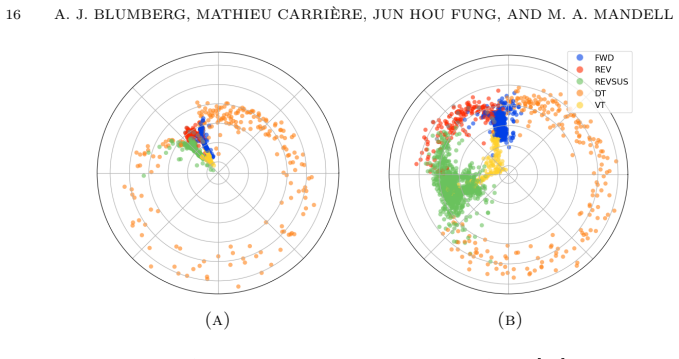
The central discovery is that density distortion in circular coordinates can be corrected by replacing a single global coordinate with an ensemble: after evaluating a count-based density estimator at each point, the algorithm accepts points with probability inversely proportional to local density, producing subsamples that are nearly uniform. Each subsample yields a circular coordinate from its first persistent cohomology class, those coordinates are extended to the full dataset by circular-mean interpolation, and the extensions are aligned and averaged by minimizing a circular Procrustes loss, seeded by an O(2) Procrustes solution in $R^{2}$. On the datasets tested, the aligned average retains more structure of the original point cloud than the uncorrected coordinate, as measured by normalized nearest-neighbor mutual information, and the subsampled computation is faster by a factor of 2.16 on the synthetic circle and 23.0 on the worm dataset. The paper also presents the resulting loop-based picture of C. elegans locomotory brain dynamics, in which specific behavioral states occupy specific regions of the circular coordinate.
Load-bearing premise
The method assumes the alignment step, which rotates and reflects the subsample coordinates into agreement, finds the best possible agreement instead of getting stuck in a bad local pattern; the paper proves this only when the subsample coordinates already nearly agree, and real data are not guaranteed to satisfy that.
Editorial extensions
If this is right
- Persistent-cohomology circular coordinates on a full point cloud can be replaced by the subsample-and-average version without losing fidelity, and with runtime gains that grow with dataset size.
- The corrected coordinate is defined on every point of the dataset, not just points in a subsample, so downstream analyses such as phase plots, tangent vectors, and behavioral segmentation can use it directly.
- On C. elegans recordings, the corrected coordinate recovers the loop structure of locomotory brain dynamics and brings out a small ventral-turn loop that the uncorrected coordinate obscures.
- The normalized nearest-neighbor mutual-information score gives a ground-truth-free criterion for comparing circular coordinates, applicable to any recurrent dataset.
- Because persistent cohomology is computed on small subsamples, the approach can handle datasets too large for a single full persistence computation.
Reading between the lines
- Inference: a multi-start variant of the hill-climbing alignment, running from several O(2) seeds and keeping the best circular Procrustes loss, would supply a practical stability check for datasets where the optimal loss is not known to be small.
- Inference: the same subsample, align, and average recipe could be applied to other coordinate constructions, for instance principal-component or diffusion-map phases, since the density-distortion mechanism is not specific to persistent cohomology.
- Inference: the mutual-information criterion suggests an automated rule for choosing the density-estimation bandwidth: select epsilon that maximizes the normalized mutual information between the coordinate and the original data, a procedure the paper only mentions as manual tuning.
- Inference: the approach extends naturally to multiple simultaneous circular coordinates (tori) by aligning subsample coordinates under the corresponding product of rotations and reflections, a case the paper leaves to future work.
Signed reviews
Editorial analysis
A structured set of objections, weighed in public.
Referee Report
Summary. The paper proposes an algorithm for computing circular coordinates on recurrent time-series data, intended to address the sensitivity of the standard persistent-cohomology pipeline to uneven sampling density. The method has three stages: rejection sampling to approximately uniformize the sampling density, computation of circular coordinates on each subsample via persistent cohomology, and alignment and averaging of these coordinates using O(2) Procrustes matching seeded by a ten Berge solver and refined by hill climbing. The authors prove a consistency result for a count-based density estimator (Proposition 3.3) and a bound relating the O(2) Procrustes solution to the circle Procrustes solution (Proposition 4.4). They validate on synthetic unbalanced circles and ellipses and on two C. elegans whole-brain calcium-imaging datasets, using normalized KSG mutual information as a quantitative metric and reporting runtime comparisons.
Significance. If the empirical claims hold, the algorithm would be a useful contribution to applied topological data analysis: it is conceptually simple, parallelizable, and directly addresses a known failure mode of circular-coordinate extraction. The theoretical sections are a genuine strength: Proposition 3.3 is a clean consistency statement with explicit rate conditions, and Proposition 4.4 gives a nontrivial geometric bound connecting the Euclidean and circular Procrustes problems. The use of subsampling also targets an important practical bottleneck, since persistent cohomology on the full Rips complex is costly. However, the significance of the paper currently rests on the empirical comparison, and that comparison has important gaps: the real-data evaluation uses only the uncorrected coordinate as a baseline, and the paper itself, in Remark 3.7, suggests tuning a key hyperparameter by the same mutual-information metric used for evaluation. The efficiency claim, while plausible, is supported by a very limited runtime experiment. These issues do not invalidate the method, but they need to be addressed before the advertised robustness and efficiency advantages can be accepted.
major comments (4)
- [Remark 3.7 and Section 5.3] The only quantitative real-data validation is the KSG mutual-information comparison in Section 5.3, and the paper's headline claim is that the corrected coordinate yields higher mutual information in every case. However, Remark 3.7 explicitly proposes tuning the density-estimation bandwidth ε by “maximizing the mutual information metric we describe in Section 5.3.” If ε, or the Gaussian kernel width β in Eq. (4.2), was selected this way, the comparison against the uncorrected coordinate is biased, because the corrected pipeline has an extra tunable knob while the baseline has no analogous tuning. The manuscript does not report the ε values used for the C. elegans experiments or state whether any MI-based selection was performed. Please report all hyperparameter choices, avoid using the evaluation metric for tuning, and provide a sensitivity analysis over ε and β; without this, the claim “higher mutual information values than the uncorrected coordinate in every case” is not a fair test.
- [Section 5.3 and Section 1] The experiments compare the corrected coordinate only with the uncorrected coordinate. The abstract claims a “more robust coordinate than other approaches,” and the introduction cites existing density-robust methods by Rybakken, Baas, and Dunn, Perea, and Paik and Park. To support the comparative claim, the paper should benchmark against at least one of these existing methods on the unbalanced circle and ellipse examples and, if feasible, on the C. elegans data, using the same evaluation metric. Without such a baseline, the contribution is established only relative to the standard uncorrected pipeline, which is a weaker statement than the paper makes.
- [Section 4, Step 3, and Section 6] The hill-climbing procedure is central to the averaging step, but the authors state in Section 6 that they “do not understand the local convexity and global properties of the optimization problem.” Proposition 4.4 only bounds the O(2) seed's distance to the circle-optimal centroid when the optimal Procrustes loss L* is small, and no evidence is given that L* is small for the real datasets. Please report the achieved loss values for all experiments and test sensitivity of the final coordinate to random restarts or alternative seeds. Without this, the corrected coordinate is not guaranteed to be a well-defined, reproducible output of the algorithm, which weakens the claim that the method is robust.
- [Section 5.4] The runtime comparison is presented only as minimum wall-clock times over 20 replicates, with no software/hardware details, no variance or error bars, and no breakdown of preprocessing, subsampling, persistent cohomology, alignment, and extension costs. Since “better efficiency” is a stated contribution in the abstract, please provide fuller experimental detail: implementation language and version, hardware, timing methodology, and ideally scaling behavior as dataset size increases. Also clarify whether the reported times include the same coordinate-extraction code path for both methods, since the corrected method involves repeated subsample computations.
minor comments (5)
- [Abstract] There is a typo in the abstract: “C. elegansthat” should be “C. elegans that.”
- [Section 5.1] The ellipse validation is only qualitative; please report quantitative errors or correlations with the arc-length parametrization, as is done for the circle example.
- [Section 5.2.1] The comparison with the Kato et al. labels in Figure 5 is described qualitatively. A quantitative agreement measure, such as a contingency-table statistic or adjusted mutual information between the discrete labels and the coordinate-derived states, would strengthen the claim.
- [References] Reference [38] contains a typo: “Desnity” should be “Density.”
- [Section 6] The word “proccesses” in the final paragraph should be “processes.”
Circularity Check
Derivation is self-contained, but the real-data MI validation is potentially circular because Remark 3.7 suggests tuning the density bandwidth by the same MI metric used in Section 5.3.
-
other
[Remark 3.7; Section 5.3; Section 4 (β ≈ ε)]
"Alternatively, the value of the hyperparameter ϵ can be manually tuned, for example by maximizing the mutual information metric we describe in Section 5.3."
Section 5.3 uses the KSG mutual-information estimate as the sole quantitative validation of the headline claim that 'the corrected coordinate from our approach yields higher mutual information values than the uncorrected coordinate in every case.' Remark 3.7 explicitly proposes tuning the density-estimation bandwidth ε, which controls the rejection-sampling correction and, via 'β ≈ ε' in Eq. 4.2, the coordinate extension, by maximizing that same MI metric. If that suggestion was followed, the corrected coordinate's MI advantage is partly by construction, because ε is a free parameter of the corrected pipeline that can be optimized to inflate the evaluation metric, while the uncorrected baseline has no analogous tunable knob.
full rationale
The core algorithm is self-contained: circular coordinates are produced from persistent cohomology on subsamples, with density equalization by rejection sampling and O(2)/circular Procrustes alignment, and the synthetic validation uses Scott's rule for ε with ground-truth angles. The self-citation to [7] supplies the alignment framework but is not used to justify the target claim, and Proposition 4.4 is a new bound rather than an imported uniqueness result. The only circularity risk is in the real-data validation: Remark 3.7 suggests tuning the density bandwidth by the same KSG mutual-information metric that Section 5.3 uses to support the headline claim of universal MI improvement. Because ε (and the coupled extension bandwidth β ≈ ε) is a free parameter of the corrected pipeline, and the paper neither reports ε values nor rules out MI-based selection, the real-data MI comparison is not demonstrably independent. This is a conditional/partial circularity rather than an observed fit, so the score is moderate rather than severe.
Assumptions & free parameters
free parameters (5)
- epsilon (density estimation bandwidth) =
chosen via Scott's rule or manual tuning (Remark 3.7)
- k (number of subsamples) =
30 for synthetic circle; unspecified for real data
- expected subsample size =
50 for synthetic circle; unspecified for real data
- beta (Gaussian kernel width in circular mean extension) =
taken approximately equal to epsilon in experiments
- delay embedding parameters (d, tau, PCA dimension) =
d=4, tau=20 frames, PCA dim=5 for Yemini data
assumptions (6)
- domain assumption Data lies on a compact smooth submanifold M of R^N with inherited volume form
- domain assumption Samples are iid from a density rho supported on all of M
- domain assumption The long bar in PH1 of each subsample corresponds to the same circular feature
- domain assumption The circular mean extension (Eq. 4.2) yields a well-defined coordinate on the whole data set
- ad hoc to paper Hill climbing converges to a near-global optimum of the circular Procrustes loss
- ad hoc to paper Intrinsic dimension d is small enough that Scott's rule yields a valid bandwidth
Cite this review
Pith. "Pith review of Subsampling, aligning, and averaging to find circular coordinates in recurrent time series." pith.science (2026). https://pith.science/paper/ZOJO2YTS
@misc{pith2026241218515,
  author       = {Pith},
  title        = {Pith review of: Subsampling, aligning, and averaging to find circular coordinates in recurrent time series},
  year         = {2026},
  howpublished = {\url{https://pith.science/paper/ZOJO2YTS}},
  note         = {Machine review of arXiv:2412.18515}
}
read the original abstract
We introduce a new algorithm for finding robust circular coordinates on data that is expected to exhibit recurrence, such as that which appears in neuronal recordings of C. elegans. Techniques exist to create circular coordinates on a simplicial complex from a dimension 1 cohomology class, and these can be applied to the Rips complex of a dataset when it has a prominent class in its dimension 1 cohomology. However, it is known this approach is extremely sensitive to uneven sampling density. Our algorithm comes with a new method to correct for uneven sampling density, adapting our prior work on averaging coordinates in manifold learning. We use rejection sampling to correct for inhomogeneous sampling and then apply Procrustes matching to align and average the subsamples. In addition to providing a more robust coordinate than other approaches, this subsampling and averaging approach has better efficiency. We validate our technique on both synthetic data sets and neuronal activity recordings. Our results reveal a topological model of neuronal trajectories for C. elegans that is constructed from loops in which different regions of the brain state space can be mapped to specific and interpretable macroscopic behaviors in the worm.
Figures


Figures from the paper (5 more)



Forward citations
Cited by 1 Pith paper
-
Density-Robust Spherical Coordinates from Persistent Cohomology
Density-robust S² coordinates are obtained by rejection-sampling uniform subsamples, computing classical spherical coordinates on each, and aligning them via a spherical Procrustes problem with a proven Euclidean relaxation.
Reference graph
Works this paper leans on
-
[1]
On the concept of space in neuroscience
Nils A. Baas. “On the concept of space in neuroscience”. In: Current Opinion in Systems Biology 1 (2017), pp. 32–37. doi: 10.1016/j.coisb.2016.12. 002
-
[2]
Towards a theoretical foundation for Laplacian-based manifold methods
Mikhail Belkin and Partha Niyogi. “Towards a theoretical foundation for Laplacian-based manifold methods”. In: Journal of Computer and System Sciences 74.8 (2008), pp. 1289–1308. doi: 10.1016/j.jcss.2007.08.006
-
[3]
Density estimation on an unknown submanifold
Cl´ ement Berenfeld and Marc Hoffmann. “Density estimation on an unknown submanifold”. In: Electronic Journal of Statistics 15.1 (2021), pp. 2179–2223
work page 2021
-
[4]
Orthogonal Procrustes rotation for two or more matri- ces
Jos M. F. ten Berge. “Orthogonal Procrustes rotation for two or more matri- ces”. In: Psychometrika 42.2 (1977), pp. 267–276
work page 1977
-
[5]
Graph Approximations to Geodesics on Embedded Manifolds
Mira Bernstein, Vin De Silva, John C. Langford, and Joshua B. Tenenbaum. “Graph Approximations to Geodesics on Embedded Manifolds”. In: (2000)
work page 2000
-
[6]
A weightedk-nearest neighbor density estimate for geometric inference
G´ erard Biau, Fr´ ed´ eric Chazal, David Cohen-Steiner, Luc Devroye, and Carlos Rodr ´ ıguez. “A weightedk-nearest neighbor density estimate for geometric inference”. In: Electronic Journal of Statistics 5 (2011), pp. 204–237. doi: 10.1214/11-EJS606
-
[7]
Resampling and averaging coordinates on data
Andrew J. Blumberg, Mathieu Carriere, Jun Hou Fung, and Michael A. Man- dell. “Resampling and averaging coordinates on data”. 2024. arXiv: 2408. 01379 [stat.ML]. url: https://arxiv.org/abs/2408.01379
work page Pith review arXiv 2024
-
[8]
The reach, metric distortion, geodesic convexity and the variation of tangent spaces
Jean-Daniel Boissonnat, Andr´ e Lieutier, and Mathijs Wintraecken. “The reach, metric distortion, geodesic convexity and the variation of tangent spaces”. In: Journal of Applied and Computational Topology 3.1 (2019), pp. 29–58. doi: 10.1007/s41468-019-00029-8
Show all 49 references
-
[9]
One dimensional approximations of neuronal dynamics reveal computation strategy
Connor Brennan, Adeeti Aggarwal, Rui Pei, David Sussillo, and Alex Proekt. “One dimensional approximations of neuronal dynamics reveal computation strategy”. In: PLOS Computational Biology 19.1 (2023), pp. 1–27. doi: 10. 1371/journal.pcbi.1010784
2023
-
[10]
A quantitative model of conserved macroscopic dynamics predicts future motor commands
Connor Brennan and Alexander Proekt. “A quantitative model of conserved macroscopic dynamics predicts future motor commands”. In: eLife 8 (2019). doi: 10.7554/eLife.46814
2019 doi
-
[11]
Topological methods for data modelling
Gunnar Carlsson. “Topological methods for data modelling”. In: Nature Re- views Physics 2 (12 2020), pp. 697–708. doi: 10.1038/s42254-020-00249-3
2020 doi
-
[12]
Geometric in- ference for probability measures
Fr´ ed´ eric Chazal, David Cohen-Steiner, and Quentin M´ erigot. “Geometric in- ference for probability measures”. In: Foundations of Computational Mathe- matics 11.6 (2011), pp. 733–751. 22 REFERENCES
2011
-
[13]
The structure and stability of persistence modules
Fr´ ed´ eric Chazal, Vin de Silva, Marc Glisse, and Steve Oudot. The structure and stability of persistence modules . Springer-Verlag, 2016
2016
-
[14]
Adaptive, locally linear models of complex dynamics
Antonio C. Costa, Tosif Ahamed, and Greg J. Stephens. “Adaptive, locally linear models of complex dynamics”. In: Proceedings of the National Academy of Sciences 116.5 (2019), pp. 1501–1510. doi: 10.1073/pnas.1813476116
2019 doi
-
[15]
A Course in Density Estimation
Luc Devroye. A Course in Density Estimation . Vol. 14. Progress in Probabil- ity and Statistics. Birkhauser, 1987
1987
-
[16]
Computational topology: an introduc- tion
Herbert Edelsbrunner and John Harer. Computational topology: an introduc- tion. American Mathematical Society, 2010
2010
-
[17]
Unsupervised learn- ing of control signals and their encodings in Caenorhabditis elegans whole- brain recordings
Charles Fieseler, Manuel Zimmer, and J. Nathan Kutz. “Unsupervised learn- ing of control signals and their encodings in Caenorhabditis elegans whole- brain recordings”. In: Journal of The Royal Society Interface 17.173 (2020). doi: 10.1098/rsif.2020.0459
2020
-
[18]
Discriminatory Analysis. Nonparametric Dis- crimination: Consistency Properties
Evelyn Fix and J. L. Hodges. “Discriminatory Analysis. Nonparametric Dis- crimination: Consistency Properties”. In: International Statistical Review / Revue Internationale de Statistique 57.3 (1989), pp. 238–247. doi: 10.2307/ 1403797
1989
-
[19]
Toroidal topology of population activity in grid cells
Richard J. Gardner, Erik Hermansen, Marius Pachitariu, Yoram Burak, Nils A. Baas, Benjamin A. Dunn, May-Britt Moser, and Edvard I. Moser. “Toroidal topology of population activity in grid cells”. In: Nature 602.7895 (2022), pp. 123–128. doi: 10.1038/s41586-021-04268-7
2022 doi
-
[20]
Barcodes: The persistent topology of data
Robert Ghrist. “Barcodes: The persistent topology of data”. In: Bull. Amer. Math. Soc. 45 (2008), pp. 61–75
2008
-
[21]
A Family of Density-Scaled Filtered Complexes
Abigail Hickok. “A Family of Density-Scaled Filtered Complexes”. arXiv:2112.03334. 2021
2021 arXiv
-
[22]
Global Brain Dynamics Embed the Motor Command Sequence of Caenorhabditis elegans
Saul Kato, Harris S. Kaplan, Tina Schr¨ odel, Susanne Skora, Theodore H. Lindsay, Eviatar Yemini, Shawn Lockery, and Manuel Zimmer. “Global Brain Dynamics Embed the Motor Command Sequence of Caenorhabditis elegans”. In: Cell 163 (3 2015), pp. 656–669. doi: 10.1016/j.cell.2015.09.034
2015 doi
-
[23]
Estimating mutual information
Alexander Kraskov, Harald St¨ ogbauer, and Peter Grassberger. “Estimating mutual information”. In: Phys. Rev. E 69 (6 2004), p. 066138. doi: 10.1103/ PhysRevE.69.066138
2004
-
[24]
Studying the Shape of Data Using Topology
Mike Lesnick. “Studying the Shape of Data Using Topology”. 2013. url: https : / / www . ias . edu / ideas / 2013 / lesnick - topological - data - analysis
2013
-
[25]
Hierarchical recurrent state space models reveal discrete and con- tinuous dynamics of neural activity in C. elegans
Scott Linderman, Annika Nichols, David Blei, Manuel Zimmer, and Liam Paninski. “Hierarchical recurrent state space models reveal discrete and con- tinuous dynamics of neural activity in C. elegans ”. In: bioRxiv (2019). doi: 10.1101/621540
2019 doi
-
[26]
A Nonparametric Estimate of a Multivariate Density Function
D. O. Loftsgaarden and C. P. Quesenberry. “A Nonparametric Estimate of a Multivariate Density Function”. In: The Annals of Mathematical Statistics 36.3 (1965), pp. 1049–1051. doi: 10.1214/aoms/1177700079
1965
-
[27]
Zigzag persis- tent homology in matrix multiplication time
Nikola Milosavljevi´ c, Dmitriy Morozov, and Primoz Skraba. “Zigzag persis- tent homology in matrix multiplication time”. In: Proceedings of the Twenty- Seventh Annual Symposium on Computational Geometry . New York, NY, USA: Association for Computing Machinery, 2011, pp. 216–2...
2011
-
[28]
Persistent (Co)Homology in Matrix Multiplication Time
Dmitriy Morozov and Primoz Skraba. “Persistent (Co)Homology in Matrix Multiplication Time”. arXiv:2412.02591. 2024
2024 arXiv
-
[29]
Nonlinear Control in the Nematode C. elegans
Megan Morrison, Charles Fieseler, and J. Nathan Kutz. “Nonlinear Control in the Nematode C. elegans ”. In: Frontiers in Computational Neuroscience 14 (2021). doi: 10.3389/fncom.2020.616639
2021
-
[30]
Accurate estimation of the normalized mutual information of multidimensional data
Daniel Nagel, Georg Diez, and Gerhard Stock. “Accurate estimation of the normalized mutual information of multidimensional data”. arXiv:2405.04980. 2024
2024 arXiv
-
[31]
Distributed Computation of Persis- tent Cohomology
Arnur Nigmetov and Dmitriy Morozov. “Distributed Computation of Persis- tent Cohomology”. arXiv:2410.16553. 2024
2024 arXiv
-
[32]
Persistence theory: from quiver representations to data analysis
Steve Oudot. Persistence theory: from quiver representations to data analysis. American Mathematical Society, 2015
2015
-
[33]
Circular Coordinates for Density-Robust Anal- ysis
Taejin Paik and Jaemin Park. “Circular Coordinates for Density-Robust Anal- ysis”. In: (2023). arXiv: 2301.12742. url: https://arxiv.org/abs/2301. 12742
2023 arXiv
-
[34]
On Estimation of a Probability Density Function and Mode
Emanuel Parzen. “On Estimation of a Probability Density Function and Mode”. In: The Annals of Mathematical Statistics 33.3 (1962), pp. 1065–
1962
-
[35]
Multiscale Projective Coordinates via Persistent Cohomol- ogy of Sparse Filtrations
Jose A. Perea. “Multiscale Projective Coordinates via Persistent Cohomol- ogy of Sparse Filtrations”. In: Discrete Computational Geometry 59 (2018), pp. 175–225. doi: 10.1007/s00454-017-9927-2
2018 doi
-
[36]
Sparse Circular Coordinates via Principal Z-Bundles
Jose A. Perea. “Sparse Circular Coordinates via Principal Z-Bundles”. In: Topological Data Analysis. Abel Symposia . Ed. by Nils A. Baas, Gunnar E. Carlsson, Gereon Quick, Markus Szymik, and Marius Thaule. Vol. 15. Springer, Cham, 2020, pp. 435–458. doi: 10.1007/978-3-030-43408-3_17
2020 doi
-
[37]
Blumberg
Raul Rabadan and Andrew J. Blumberg. Topological Data Analysis for Ge- nomics and Evolution: Topology in Biology. Cambridge University Press, 2019. doi: 10.1017/9781316671665
2019 doi
-
[38]
Remarks on Some Nonparametric Estimates of a Desnity Function
Murray Rosenblatt. “Remarks on Some Nonparametric Estimates of a Desnity Function”. In: The Annals of Mathematical Statistics 27.3 (1956), pp. 832–
1956
-
[39]
Decoding of Neural Data Using Cohomological Feature Extraction
Erik Rybakken, Nils Baas, and Benjamin Dunn. “Decoding of Neural Data Using Cohomological Feature Extraction”. In:Neural Computation 31.1 (2019), pp. 68–93. doi: 10.1162/neco_a_01150
2019 doi
-
[40]
Spherical coordinates from persistent cohomology
Nikolas C. Schonsheck and Stefan C. Schonsheck. “Spherical coordinates from persistent cohomology”. In: Journal of Applied and Computational Topology 8 (2024), pp. 149–173. doi: 10.1007/s41468-023-00141-w
2024 doi
-
[41]
David W. Scott. Multivariate Density Estimation: Theory, Practice and Vi- sualization. John Wiley & Sons, 2015
2015
-
[42]
Persistent Cohomology of Circular Coordinates
Vin de Silva, Dmitriy Morozov, and Mikael Vejdemo-Johansson. “Persistent Cohomology of Circular Coordinates”. In: Discrete & Computational Geom- etry 45.4 (2011), pp. 737–759. doi: 10.1007/s00454-011-9344-x
2011 doi
-
[43]
From Geometry to Topology: Inverse Theorems for Distributed Persistence
Elchanan Solomon, Alexander Wagner, and Paul Bendich. “From Geometry to Topology: Inverse Theorems for Distributed Persistence”. In:38th Interna- tional Symposium on Computational Geometry (SoCG 2022) . Ed. by Xavier Goaoc and Michael Kerber. Vol. 224. Leibniz International Pr...
2022 doi
-
[44]
Detecting strange attractors in turbulence
Floris Takens. “Detecting strange attractors in turbulence”. In: Dynami- cal Systems and Turbulence, Warwick 1980 . Ed. by David Rand and Lai- Sang Young. Springer Berlin Heidelberg, 1981, pp. 366–381. doi: 10.1007/ BFb0091924
1980
-
[45]
Cohomological learning of periodic motion
Mikael Vejdemo-Johansson, Florian T. Pokorny, Primoz Skraba, and Danica Kragic. “Cohomological learning of periodic motion”. In: Applicable Algebra in Engineering, Communication and Computing 26.1 (2015), pp. 5–26. doi: 10.1007/s00200-015-0251-x
2015 doi
-
[46]
NeuroPAL: A Multicolor Atlas for Whole-Brain Neuronal Identification in C. elegans
Eviatar Yemini, Albert Lin, Amin Nejatbakhsh, Erdem Varol, Ruoxi Sun, Gonzalo E. Mena, Aravinthan D.T. Samuel, Liam Paninski, Vivek Venkat- achalam, and Oliver Hobert. “NeuroPAL: A Multicolor Atlas for Whole-Brain Neuronal Identification in C. elegans”. In: Cell 184.1 (2021), ...
2021 doi
-
[47]
Revealing neural dynamical struc- ture of C. elegans with deep learning
Ruisong Zhou, Yuguo Yu, and Chunhe Li. “Revealing neural dynamical struc- ture of C. elegans with deep learning”. In: iScience 27.5 (2024). doi: https: //doi.org/10.1016/j.isci.2024.109759. Irving Institute for Cancer Dynamics, Departments of Mathematics and Computer Science, ...
2024
-
[837]
doi: 10.1214/aoms/1177728190
-
[1076]
doi: 10.1214/aoms/1177704472
Reviewed August 11, 2026 · model on record in the stance chip above.
Discussion (0). Continue with ORCID to comment.