REVIEW 2 major objections 4 minor 1 cited by
Theory and Evaluation Metrics for Learning Disentangled Representations
T0 review · 2 major / 4 minor · reviewed 2026-08-14 · deepseek-v4-flash
Pith's one-line read The paper defines disentangled representations as informative, separable, and interpretable, then builds metrics that measure all three with mutual information.
desk verdict Solid metrics paper, but the robustness claim outruns the ablation evidence. read the letter →
The pith
A machine-rendered reading of the paper's core claim, the machinery that carries it, and where it could break.
The reading
What carries the argument
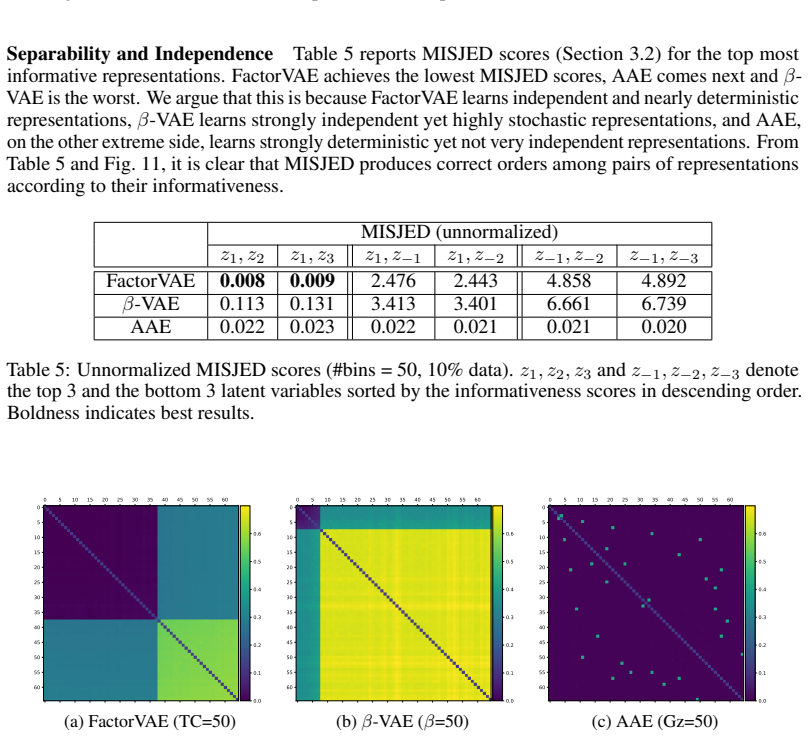
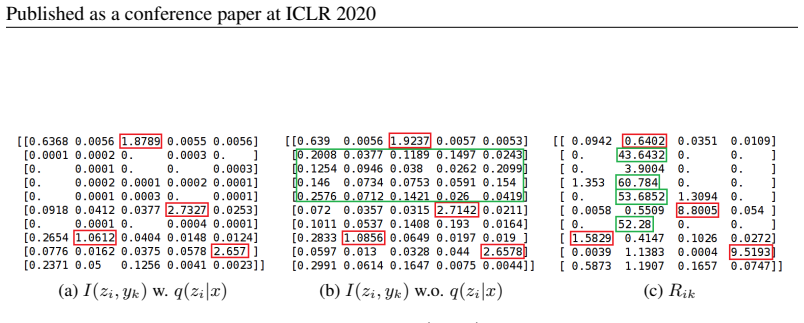
The load-bearing object is the learned encoder distribution q(zi|x) treated as a stochastic map, with all quantities computed from it rather than from decoder reconstructions or classifier weights. The identities that carry the argument are the multivariate mutual-information decomposition I(x, zi, zj) = I(x, zi) + I(x, zj) − I(x, (zi, zj)) = I(zi, zj) − I(zi, zj|x), which defines separability with respect to x, and the conditional mutual information I(x, zi | z≠i) = I(x, zi) − I(zi, z≠i) + I(zi, z≠i|x), whose informativeness-weighted average becomes WSEPIN. For interpretability the key construct is the gap between the top two latents' mutual information with factor yk: RMIG = I(zi*, yk) − I(zj°, yk), and JEMMIG = H(zi*, yk) − I(zi*, yk) + I(zj°, yk), with JEMMIG being the single metric that certifies the paper's full definition. Entropy and mutual-information terms are estimated by quantization on a fixed value range [−4, 4] with a chosen number of bins, or by Monte Carlo sampling.
What would settle it
Rank two trained models on dSprites with JEMMIG and WSEPIN at bin counts 50, 100, 200, and 500 while keeping all other settings fixed; if the relative order of the two models flips at any step, the claimed consistency of the metrics across settings fails. Equivalently, evaluate a beta-VAE with 20 latents: WSEPIN becoming negative, as in the paper's Appendix Figure 19f, would show the separability metric is not robust at latent counts the paper itself targets.
Extended reading notes
Core claim
On the paper's own terms, the central discovery is that 'disentangled' need not be a vague visual impression or a property of a particular architecture. It is the conjunction of three conditions on the learned encoder q(z|x): informativeness I(x, zi) large; full separability I(zi, z≠i) = 0; and, relative to a labeled factor yk, interpretability I(zi, yk) = H(yk), or the stronger invertibility condition I(zi, yk) = H(zi) = H(yk). The paper then claims the proposed metrics measure these conditions robustly. RMIG subtracts the second-best latent's mutual information with yk from the best one under a probabilistic assumption p(zi, yk, x) = q(zi|x) p(yk|x) p(x), avoiding MIG's need to model p(x|yk). JEMMIG adds the joint-entropy term H(zi*, yk) so that only a latent matching yk alone scores well. WSEPIN weights each latent's conditional information I(x, zi | z≠i) by its informativeness so noisy latents cannot drag the score down. Empirically the paper finds FactorVAE's representations score more interpretable than beta-VAE's or AAE's, matching visual traversals, and that FactorVAE learns a consistent set of factors across runs, analogous to PCA.
Load-bearing premise
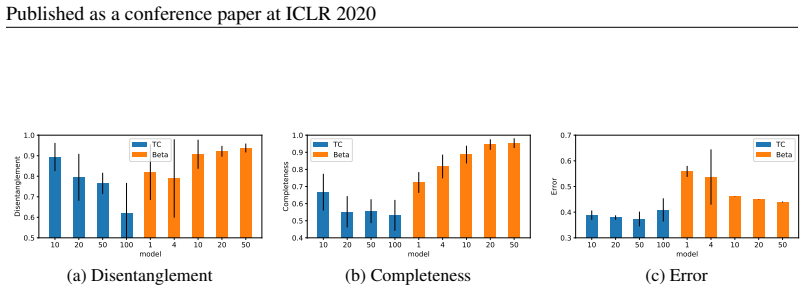
The metrics are only fair if every model is evaluated with the same binning and sampling settings, because the entropy estimates depend on those settings—the paper's own ablation shows WSEPIN turns negative and unstable when the latent count reaches 15 or 20, and JEMMIG rises as the number of bins grows.
Editorial extensions
If this is right
- Model comparison no longer needs to train a classifier for each factor, so results from different papers can be compared as long as they fix the same binning and value range.
- JEMMIG can be used as a self-contained test for whether a learned latent is disentangled with respect to a known factor, because it combines separability and interpretability in one number.
- WSEPIN gives a ground-truth-free monitor of disentanglement on real datasets like CelebA, where the true generative factors are only partially known.
- The empirical ranking, with FactorVAE above beta-VAE and AAE in interpretability and beta = 10 peaking WSEPIN, gives a benchmark expectation for future models on dSprites and CelebA.
- Because RMIG supports continuous factors and can take p(yk|x) from an external expert model, the metrics extend to supervised and semi-supervised settings where MIG cannot be applied.
Reading between the lines
- If the metrics are adopted, the practical bottleneck shifts from choosing an architecture to standardizing the evaluation protocol; a shared bin-count and value-range convention would make published JEMMIG numbers comparable, and the paper's own bin-sensitivity suggests that convention must be chosen before numbers are reported.
- The stability failure of WSEPIN at 15 to 20 latents hints that a corrected estimator, for example replacing the joint entropy H(z≠i) with pairwise or blockwise conditional entropies, could extend the method to high-dimensional latent spaces; this is a testable extension the paper does not pursue.
- The analogy between FactorVAE and PCA could be pushed further: if independence constraints force a unique solution to the information-bottleneck objective, then the same consistent representations should appear in other total-correlation-penalized models, making identifiability a property of the loss rather than of the data.
- A natural downstream check of the metrics' value is whether models ranked higher by JEMMIG also transfer better to unseen tasks; the paper does not run that check, but its definition would predict a positive relationship.
Signed reviews
Editorial analysis
A structured set of objections, weighed in public.
Referee Report
Summary. The paper proposes an information-theoretic characterization of disentangled representations along three dimensions—informativeness, separability, and interpretability—and introduces several quantitative metrics: MISJED, WSEPIN/SEPIN@k, WINDIN/INDIN@k, RMIG, and JEMMIG. The definitions are used to analyze FactorVAE, β-VAE, and AAE on dSprites and CelebA, and the proposed metrics are compared with existing ones such as MIG, DCI scores, modularity/explicitness, and Z-diff. The central claim is that the new metrics are robust, require no classifiers, support real and continuous-factor settings, and produce rankings consistent with visual inspection.
Significance. If the robustness claim holds, the paper would provide a useful, classifier-free evaluation toolkit for disentanglement learning and a formal framework connecting three commonly discussed properties. The empirical study is broad, includes comparisons with MIG and DCI-style metrics, and provides external anchors via dSprites ground-truth factors and visualizations. The paper also ships code, which aids reproducibility. However, the headline robustness claim is weakened by the paper's own ablations: WSEPIN becomes negative and unstable for 15+ latents, and JEMMIG scores change monotonically with the number of bins. These are load-bearing limitations because WSEPIN and JEMMIG are named as the two key metrics in the conclusion. The framework is still valuable, but the robustness claim needs to be either repaired with additional evidence or substantially qualified.
major comments (2)
- [Appendix A.5, Fig. 19(e)-(f)] The paper's own ablation shows that I(x,zi|z_not_i), the quantity underlying WSEPIN, becomes negative when the number of latents is 15 or 20, and the text states that "This causes the instability of WSEPIN." Since Section 5 names WSEPIN as one of the two key metrics, and since the paper itself uses 65 latents on CelebA and 10 on dSprites, WSEPIN cannot be used to compare models with different latent dimensionalities—exactly the situation in which a robust metric is needed. The robustness claim is therefore unsupported as stated. The paper should either repair the estimator, restrict WSEPIN's scope explicitly, or provide quantitative evidence that WSEPIN rankings are stable across latent counts in the regime where it is nonnegative.
- [Appendix A.5, Fig. 17] The ablation shows normalized JEMMIG increasing monotonically with the number of bins, while RMIG stabilizes only for #bins > 200, yet the main experimental tables and figures (e.g., Tables 6-9, Figs. 13 and 25) report scores at #bins = 100. The text asserts that "the relative order among different models remains the same" without presenting any rank-correlation or order-flip analysis. Since JEMMIG is introduced as a robust metric and its value depends on a user-chosen quantization granularity, the paper needs to demonstrate ranking invariance quantitatively (e.g., Spearman rank correlation over a grid of #bins values) and either report metrics in the stable regime or justify the choice of #bins = 100.
minor comments (4)
- [Section 2, Eq. (6)] Definition 1 writes the full interpretability condition as I(zi,yk) = H(zi,yk), whereas Section 2 defines full interpretability as I(zi,yk) = H(zi) = H(yk). The two conditions are equivalent only under equal entropy; please state the intended condition explicitly to avoid confusion.
- [Section 3.2] The definitions of WSEPIN and WINDIN do not show the normalization by H(zi) that is mentioned in the preceding paragraph; please make the formulas self-contained so that the reported numerical values can be reproduced unambiguously.
- [Appendix A.4, Tables 5-9] Several tables report normalized scores but do not state in the captions whether normalization is by log(#bins) or by H(yk); adding this information would improve reproducibility.
- [Appendix A.15, Figs. 26-28] The claim that FactorVAE learns "statistically equivalent factors" across runs is supported only by visual inspection; a quantitative measure, such as the correlation of factor orderings across seeds, would strengthen this claim.
Circularity Check
No significant circularity: the metrics operationalize the paper's own definitions, but the evaluative claims are anchored by external comparisons (MIG, dSprites ground truth, visual inspection).
full rationale
The paper defines informativeness, separability, and interpretability in information-theoretic terms and then constructs metrics (RMIG, JEMMIG, WSEPIN, etc.) that directly encode those definitions. This definition-to-metric move is analytic rather than circular: a metric is supposed to quantify a stated concept. The central claim that the metrics are 'robust' and 'produce more sensible evaluations' is not established solely by construction; it is tested against external anchors, including agreement with MIG on dSprites (Appdx. A.13), comparison with the metrics of Eastwood & Williams and Ridgeway & Mozer, and qualitative visual inspection (Figs. 4, 10, 12, 16). No parameter is fitted to a subset of data and then relabeled as a prediction, and no load-bearing result is imported from the authors' own prior work. The robustness concerns raised by the paper's own ablations (e.g., WSEPIN becoming negative for 15-20 latents, JEMMIG varying with #bins) are empirical limitations of the proposed estimators, not circularity in the derivation. Therefore the paper's derivation chain is self-contained with respect to circularity concerns.
Assumptions & free parameters
free parameters (3)
- Quantization value range =
[-4, 4]
- Number of bins (#bins) =
100 (default); varied 50-500 in ablation
- SEPIN@k parameter k =
3
assumptions (5)
- domain assumption q(z|x) factorizes as product of per-dimension q(z_i|x)
- domain assumption Ground truth factors y_k are available and correctly labeled
- domain assumption p(y_k|x) is known or deterministic with a delta at the label value
- domain assumption Visual inspection is a valid benchmark for evaluating the metrics
- standard math Multivariate mutual information is interpreted via McGill's decomposition
Cite this review
Pith. "Pith review of Theory and Evaluation Metrics for Learning Disentangled Representations." pith.science (2026). https://pith.science/paper/ZOTB2K6A
@misc{pith2026190809961,
  author       = {Pith},
  title        = {Pith review of: Theory and Evaluation Metrics for Learning Disentangled Representations},
  year         = {2026},
  howpublished = {\url{https://pith.science/paper/ZOTB2K6A}},
  note         = {Machine review of arXiv:1908.09961}
}
read the original abstract
We make two theoretical contributions to disentanglement learning by (a) defining precise semantics of disentangled representations, and (b) establishing robust metrics for evaluation. First, we characterize the concept "disentangled representations" used in supervised and unsupervised methods along three dimensions-informativeness, separability and interpretability - which can be expressed and quantified explicitly using information-theoretic constructs. This helps explain the behaviors of several well-known disentanglement learning models. We then propose robust metrics for measuring informativeness, separability and interpretability. Through a comprehensive suite of experiments, we show that our metrics correctly characterize the representations learned by different methods and are consistent with qualitative (visual) results. Thus, the metrics allow disentanglement learning methods to be compared on a fair ground. We also empirically uncovered new interesting properties of VAE-based methods and interpreted them with our formulation. These findings are promising and hopefully will encourage the design of more theoretically driven models for learning disentangled representations.
Figures


Figures from the paper (25 more)








Forward citations
Cited by 1 Pith paper
-
Enhancing Uncertainty Estimation and Interpretability via Bayesian Non-negative Decision Layer
A Bayesian non-negative decision layer with gamma priors and Weibull variational inference improves uncertainty estimation and interpretability for image classifiers.
Reference graph
Works this paper leans on
-
[1]
write newline
" write newline "" before.all 'output.state := FUNCTION n.dashify 't := "" t empty not t #1 #1 substring "-" = t #1 #2 substring "--" = not "--" * t #2 global.max substring 't := t #1 #1 substring "-" = "-" * t #2 global.max substring 't := while if t #1 #1 substring * t #2 global.max substring 't := if while FUNCTION format.date year duplicate empty "emp...
-
[2]
https://en.wikipedia.org/wiki/Error\_function, May 2019
Error function. https://en.wikipedia.org/wiki/Error\_function, May 2019
work page 2019
-
[3]
Deep variational information bottleneck
Alexander A Alemi, Ian Fischer, Joshua V Dillon, and Kevin Murphy. Deep variational information bottleneck. arXiv preprint arXiv:1612.00410, 2016
arXiv 2016
-
[4]
Anthony J Bell. The co-information lattice. In Proceedings of the Fifth International Workshop on Independent Component Analysis and Blind Signal Separation: ICA, volume 2003, 2003
work page 2003
-
[5]
Representation learning: A review and new perspectives
Yoshua Bengio, Aaron Courville, and Pascal Vincent. Representation learning: A review and new perspectives. IEEE Transactions on Pattern Analysis and Machine Intelligence, 35 0 (8): 0 1798--1828, 2013
2013
-
[6]
Understanding disentangling in beta -vae
Christopher P Burgess, Irina Higgins, Arka Pal, Loic Matthey, Nick Watters, Guillaume Desjardins, and Alexander Lerchner. Understanding disentangling in beta -vae. arXiv preprint arXiv:1804.03599, 2018
arXiv 2018
-
[7]
Isolating sources of disentanglement in variational autoencoders
Tian Qi Chen, Xuechen Li, Roger Grosse, and David Duvenaud. Isolating sources of disentanglement in variational autoencoders. arXiv preprint arXiv:1802.04942, 2018
arXiv 2018
-
[8]
Learning the irreducible representations of commutative lie groups
Taco Cohen and Max Welling. Learning the irreducible representations of commutative lie groups. In International Conference on Machine Learning, pp.\ 1755--1763, 2014
work page 2014
Show all 35 references
-
[9]
A framework for the quantitative evaluation of disentangled representations
Cian Eastwood and Christopher KI Williams. A framework for the quantitative evaluation of disentangled representations. 2018
2018
-
[10]
Disentangling factors of variation with cycle-consistent variational auto-encoders
Ananya Harsh Jha, Saket Anand, Maneesh Singh, and VSR Veeravasarapu. Disentangling factors of variation with cycle-consistent variational auto-encoders. In Proceedings of the European Conference on Computer Vision (ECCV), pp.\ 805--820, 2018
2018
-
[11]
Beta-vae: Learning basic visual concepts with a constrained variational framework
Irina Higgins, Loic Matthey, Arka Pal, Christopher Burgess, Xavier Glorot, Matthew Botvinick, Shakir Mohamed, and Alexander Lerchner. Beta-vae: Learning basic visual concepts with a constrained variational framework. In International Conference on Learning Representations, 2017 a
2017
-
[12]
Scan: Learning hierarchical compositional visual concepts
Irina Higgins, Nicolas Sonnerat, Loic Matthey, Arka Pal, Christopher P Burgess, Matko Bosnjak, Murray Shanahan, Matthew Botvinick, Demis Hassabis, and Alexander Lerchner. Scan: Learning hierarchical compositional visual concepts. arXiv preprint arXiv:1707.03389, 2017 b
2017 arXiv
-
[13]
Towards a definition of disentangled representations
Irina Higgins, David Amos, David Pfau, Sebastien Racaniere, Loic Matthey, Danilo Rezende, and Alexander Lerchner. Towards a definition of disentangled representations. arXiv preprint arXiv:1812.02230, 2018
2018 arXiv
-
[14]
Disentangling by factorising
Hyunjik Kim and Andriy Mnih. Disentangling by factorising. ICML, 2018
2018
-
[15]
Adam: A method for stochastic optimization
Diederik P Kingma and Jimmy Ba. Adam: A method for stochastic optimization. arXiv preprint arXiv:1412.6980, 2014
2014 arXiv
-
[16]
Deep convolutional inverse graphics network
Tejas D Kulkarni, William F Whitney, Pushmeet Kohli, and Josh Tenenbaum. Deep convolutional inverse graphics network. In Advances in Neural Information Processing Systems, pp.\ 2539--2547, 2015
2015
-
[17]
Variational inference of disentangled latent concepts from unlabeled observations
Abhishek Kumar, Prasanna Sattigeri, and Avinash Balakrishnan. Variational inference of disentangled latent concepts from unlabeled observations. arXiv preprint arXiv:1711.00848, 2017
2017 arXiv
-
[18]
Building machines that learn and think like people
Brenden M Lake, Tomer D Ullman, Joshua B Tenenbaum, and Samuel J Gershman. Building machines that learn and think like people. Behavioral and Brain Sciences, 40, 2017
2017
-
[19]
Deep learning face attributes in the wild
Ziwei Liu, Ping Luo, Xiaogang Wang, and Xiaoou Tang. Deep learning face attributes in the wild. In Proceedings of International Conference on Computer Vision (ICCV), 2015
2015
-
[20]
Challenging common assumptions in the unsupervised learning of disentangled representations
Francesco Locatello, Stefan Bauer, Mario Lucic, Sylvain Gelly, Bernhard Sch \"o lkopf, and Olivier Bachem. Challenging common assumptions in the unsupervised learning of disentangled representations. ICML, 2019
2019
-
[21]
Information constraints on auto-encoding variational bayes
Romain Lopez, Jeffrey Regier, Michael I Jordan, and Nir Yosef. Information constraints on auto-encoding variational bayes. In Advances in Neural Information Processing Systems, pp.\ 6114--6125, 2018
2018
-
[22]
Adversarial autoencoders
Alireza Makhzani, Jonathon Shlens, Navdeep Jaitly, Ian Goodfellow, and Brendan Frey. Adversarial autoencoders. arXiv preprint arXiv:1511.05644, 2015
2015 arXiv
-
[23]
Disentangling factors of variation in deep representation using adversarial training
Michael F Mathieu, Junbo Jake Zhao, Junbo Zhao, Aditya Ramesh, Pablo Sprechmann, and Yann LeCun. Disentangling factors of variation in deep representation using adversarial training. In Advances in Neural Information Processing Systems, pp.\ 5040--5048, 2016
2016
-
[24]
dsprites: Disentanglement testing sprites dataset
Loic Matthey, Irina Higgins, Demis Hassabis, and Alexander Lerchner. dsprites: Disentanglement testing sprites dataset. https://github.com/deepmind/dsprites-dataset/, 2017
2017
-
[25]
Multivariate information transmission
William McGill. Multivariate information transmission. Transactions of the IRE Professional Group on Information Theory, 4 0 (4): 0 93--111, 1954
1954
-
[26]
Elements of causal inference: foundations and learning algorithms
Jonas Peters, Dominik Janzing, and Bernhard Sch \"o lkopf. Elements of causal inference: foundations and learning algorithms. MIT press, 2017
2017
-
[27]
A survey of inductive biases for factorial representation learning
Karl Ridgeway. A survey of inductive biases for factorial representation learning. arXiv preprint arXiv:1612.05299, 2016
2016 arXiv
-
[28]
Learning deep disentangled embeddings with the f-statistic loss
Karl Ridgeway and Michael C Mozer. Learning deep disentangled embeddings with the f-statistic loss. In Advances in Neural Information Processing Systems, pp.\ 185--194, 2018
2018
-
[29]
Variational autoencoders pursue pca directions (by accident)
Michal Rolinek, Dominik Zietlow, and Georg Martius. Variational autoencoders pursue pca directions (by accident). arXiv preprint arXiv:1812.06775, 2018
2018 arXiv
-
[30]
Learning factorial codes by predictability minimization
J \"u rgen Schmidhuber. Learning factorial codes by predictability minimization. Neural Computation, 4 0 (6): 0 863--879, 1992
1992
-
[31]
Probabilistic principal component analysis
Michael E Tipping and Christopher M Bishop. Probabilistic principal component analysis. Journal of the Royal Statistical Society: Series B (Statistical Methodology), 61 0 (3): 0 611--622, 1999
1999
-
[32]
Recent advances in autoencoder-based representation learning
Michael Tschannen, Olivier Bachem, and Mario Lucic. Recent advances in autoencoder-based representation learning. arXiv preprint arXiv:1812.05069, 2018
2018 arXiv
-
[33]
@esa (Ref
\@ifxundefined[1] #1\@undefined \@firstoftwo \@secondoftwo \@ifnum[1] #1 \@firstoftwo \@secondoftwo \@ifx[1] #1 \@firstoftwo \@secondoftwo [2] @ #1 \@temptokena #2 #1 @ \@temptokena \@ifclassloaded agu2001 natbib The agu2001 class already includes natbib coding, so you should ...
-
[34]
\@lbibitem[] @bibitem@first@sw\@secondoftwo \@lbibitem[#1]#2 \@extra@b@citeb \@ifundefined br@#2\@extra@b@citeb \@namedef br@#2 \@nameuse br@#2\@extra@b@citeb \@ifundefined b@#2\@extra@b@citeb @num @parse #2 @tmp #1 NAT@b@open@#2 NAT@b@shut@#2 \@ifnum @merge>\@ne @bibitem@firs...
-
[35]
@open @close @open @close and [1] URL: #1 \@ifundefined chapter * \@mkboth \@ifxundefined @sectionbib * \@mkboth * \@mkboth\@gobbletwo \@ifclassloaded amsart * \@ifclassloaded amsbook * \@ifxundefined @heading @heading NAT@ctr thebibliography [1] @ \@biblabel @NAT@ctr \@bibset...
Reviewed August 14, 2026 · model on record in the stance chip above.
Discussion (0). Continue with ORCID to comment.