REVIEW 3 major objections 5 minor 2 cited by
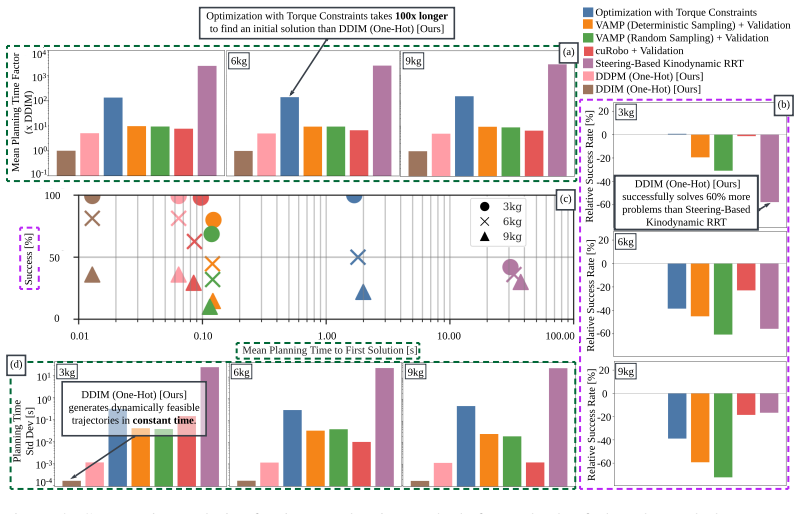
A payload-conditioned diffusion model generates dynamically feasible joint-space trajectories in constant time, preserving 67.6% of workspace at 3x nominal payload.
Reviewed by Pith at T0; open to challenge. T0 means a machine referee read the full paper against a public rubric. the ladder, T0–T4 →
A payload-conditioned diffusion model generates dynamically feasible joint trajectories in about 10 ms, allowing a 7-DoF arm to handle loads over three times its nominal payload across much of its workspace.
T0 review reviewed 2026-08-05 challenge →
load-bearing objection A genuinely new diffusion-over-pos-vel-acc planner with a useful payload-conditioning study, but the central 'no post-processing / dynamically feasible' claim is undercut by a runtime filter and a gravity-only payload wrench. the 3 major comments →
Dynamics-Compliant Trajectory Diffusion for Super-Nominal Payload Manipulation
The pith
A machine-rendered reading of the paper's core claim, the machinery that carries it, and where it could break.
The reading
Core claim
The central claim is that payload-dependent dynamic constraints can be folded into a diffusion model's learned distribution, so sampling from the distribution is itself planning. The model is trained on 25,000 time-parameterized, collision-free trajectories that have each been filtered by an inverse-dynamics check for the maximum payload they support under joint torque limits. At inference, the target payload mass is encoded (one-hot encoding is the best of the four tested) and applied as a global conditioning signal across the denoising U-Net, so the entire trajectory is generated to be dynamically feasible for that mass. The comparison across encodings and baselines—plan-and-filter, kinody
What carries the argument
The central object is a payload-conditioned denoising diffusion model over a 21-dimensional state per waypoint (7 joints times angle, velocity, acceleration), with start and goal states pinned by inpainting, collisions handled by gradient guidance, and payload mass injected as a global conditioning vector appended to the diffusion timestep embedding. The load-bearing identity is the inverse-dynamics equation τ = M(q)q¨ + C(q,q˙)q˙ + g(q) + f(q˙) + J^{-1}(q)F_ext, with the payload wrench modeled as F_g = mg[0,0,-1,0,0,0]^T. This equation converts a payload mass into a joint-torque feasibility check and defines the maximum supported payload for each training trajectory.
Load-bearing premise
The payload is modeled as a point mass centered at the end-effector, so a real load with inertia, an off-center mass, or flexibility can create torques the model never accounted for.
What would settle it
Attach a 9 kg object whose center of mass is offset 10 cm from the end-effector origin, run the trajectories the model generates for that mass, and record joint torques; if any exceed the manufacturer torque limits, the dynamic-feasibility claim fails for non-ideal payloads.
If this is right
- A fixed robot can handle payloads beyond its nameplate rating by choosing configuration-aware trajectories, without hardware changes.
- Dynamically feasible trajectories can be generated in roughly constant time, enabling real-time planning under torque limits.
- One-hot payload encoding, with DDIM's five-step denoising, reproduces the training distribution's success rate, including in the nominal 0–3 kg regime.
- Because feasibility is baked into the learned distribution, no explicit constraint checking is needed at runtime for the modeled conditions.
- The same conditioning mechanism can be extended to object-level properties beyond mass, such as center-of-mass offset, toward non-rigid or asymmetric payloads.
Where Pith is reading between the lines
- Extending the conditioning input from scalar mass to a full 6D wrench would let the architecture represent center-of-mass offsets and inertia explicitly, which is the natural next test of the diffusion approach.
- At about 10 ms per sample, the model could serve as a fast feasibility oracle or proposal generator inside a slower optimizer, using the diffusion distribution to warm-start constraint satisfaction.
- The 67.6% workspace-accessibility figure is bound to the training data's coverage; a different task distribution or robot would require retraining and would likely show a different envelope.
- A direct stress test: train on trajectories whose payloads have randomized center-of-mass offsets, then measure how success rate degrades as offset grows; that isolates the point-mass assumption from the diffusion architecture.
Editorial analysis
A structured set of objections, weighed in public.
Referee Report
Summary. The paper proposes a diffusion-based trajectory generator for a 7-DoF Franka Emika Panda that, conditioned on a target payload mass, outputs joint-space trajectories (angles, velocities, and accelerations) in roughly constant time (~10 ms). Training data are produced by a plan-and-filter pipeline: cuRobo generates kinematic trajectories, which are then labeled with a maximum supported payload using an identified robot dynamics model (Eq. 1) and a point-mass gravitational wrench. The paper compares four payload encodings and several planning baselines, reporting higher success rates at 3/6/9 kg payloads, and claims that up to 67.6% of the nominal workspace remains accessible at 3× nominal payload capacity, with trajectories that can be executed directly on hardware without post-processing.
Significance. If the dynamic-feasibility claim can be substantiated with a model that includes payload inertial wrenches and with quantitative hardware verification, the method would be practically valuable: constant-time, dynamics-aware joint-space trajectory generation would let users exploit configuration-dependent payload capacity rather than conservative nominal ratings. The extension of diffusion policies to directly generate positions, velocities, and accelerations, and the comparison against plan-and-filter, kinodynamic RRT, and optimization baselines, are relevant and useful. The paper also gives appropriate credit to the external parameter-identification study used for the dynamics model. However, the headline claims are currently stronger than the evidence: the feasibility labels omit payload inertial terms, and the text explicitly contradicts the 'no post-processing' claim. These issues bear directly on the central contribution, so the manuscript needs major revision rather than minor polishing.
major comments (3)
- [§4.1, Eq. (1)] The payload wrench entering Eq. (1) is only a gravitational point-mass wrench F_g = mg[0,0,-1,0,0,0]^T. For a payload rigidly attached to the end-effector, the true external wrench during motion includes the inertial reaction term m(a_com - g) and, for extended or off-center bodies, rotational inertia terms. Even for a perfectly centered point mass, a trajectory with nonzero accelerations incurs joint torques proportional to m·a_com, which are absent from the feasibility label m_i. Thus m_i is not the maximum payload the robot can carry during the planned dynamic motion; it is a gravity-only, quasi-static limit. Because the training labels and, apparently, the evaluation success rates use this same filter, the claim that generated trajectories are 'dynamically feasible' and can be 'directly executed on physical hardware' is not supported as stated. Please either incorporate the full payl
- [Abstract; §1; §5] The abstract and introduction claim trajectories can be 'directly executed on physical hardware without post-processing' and are generated 'without explicit constraint checking at runtime,' but Section 5 states: 'During execution, invalid trajectories generated by the diffusion model are simply not executed.' If invalidity is determined by a check, then this is exactly a runtime constraint check or post-processing step, contradicting the claim. If invalidity is determined only by hardware safety stops, then the model does not generate feasible trajectories by construction. The manuscript must specify the rejection mechanism, its rate, and how the 'no post-processing' claim is to be interpreted. This is not a wording issue: the constant-time guarantee is only meaningful if every output is executable or if rejected outputs are accounted for in the reported success rates.
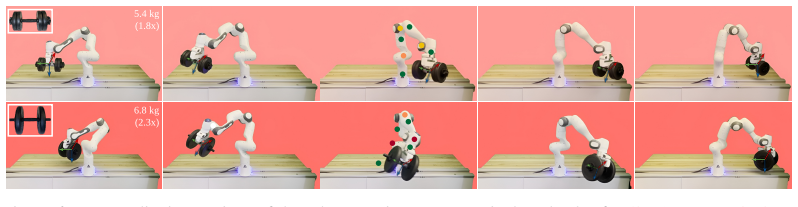
- [§5, Fig. 5; §6] The quantitative comparisons appear to evaluate success with the same simplified dynamics model (Eq. 1) that generated the training labels, so the reported success rates largely measure how well the diffusion model reproduces the training filter, not how well the method performs on hardware. The hardware evidence is qualitative (Fig. 6), and the headline 67.6% workspace accessibility figure is not derived in the main text; it is deferred to the supplementary material. Please report quantitative hardware success rates, measured joint torques, the exact procedure used to compute workspace accessibility, and whether the workspace figure is based on the simplified model or on hardware validation.
minor comments (5)
- [§3] Typo: 'prdouce' should be 'produce'. Also, in the Introduction, 'present a compelling opportunity address the curse of dimensionality' is missing 'to'.
- [§3] The denoising update is written as π_{k-1} = α·(π_k - γϵ_θ(P, π_k, k) + N(0, σ²I)); as written the noise is scaled by α, which is not the standard DDPM/DDIM update. Please clarify the exact noise injection and parameterization.
- [Fig. 4; Fig. 5] Several axis labels and legends are difficult to read, and Figure 4 does not clearly define what 'success rate' is averaged over. Please enlarge fonts and add explicit axis/legend labels.
- [§4.2] The sentence 'For subsequent experiments, we use with the one-hot encoding scheme' contains a grammatical error ('use with'). Also, the choice of 19-dimensional encoding for 0–18 kg is explained, but the mapping from continuous payload values to the ceiling index should be stated more prominently, since it affects the conservative upper-bound interpretation.
- [§7] The Limitations section is candid, but it should be moved closer to the evaluation or the limitations should be summarized earlier, because some limitations (e.g., center-of-mass offsets, non-rigid attachment) directly qualify the central 'dynamically feasible' claim.
Circularity Check
No significant circularity: the feasibility model is externally identified, the diffusion model is not fitted to the evaluation metric, and the evaluation is discriminative.
full rationale
The paper's derivation chain is: (i) generate 25,000 candidate joint-space trajectories with cuRobo; (ii) label each trajectory with a maximum supported payload m_i using the dynamics equation τ = M(q)q¨ + C(q,q˙)q˙ + g(q) + f(q˙) + J^{-1}F_ext (eq. 1), with a point-mass gravitational wrench F_g = mg[0,0,-1,0,0,0]^T and parameters taken from an external identification study (Gaz et al., [40]); (iii) train a diffusion model conditioned on payload to imitate the resulting feasible set; (iv) evaluate success rates. The evaluation uses the same dynamics equation, so the numerical success rates largely measure how well the model reproduces the training filter. This is a closed-loop evaluation, but it is not circularity: the diffusion model is not a parameter fitted to the evaluation metric, and success rates are not 100%, so the metric is discriminative rather than forced by construction. The feasibility labels originate from an externally identified dynamics model, not from the paper's own assumptions. Self-citations in the paper ([14], [18], [24]) appear only as related work or baselines and are not load-bearing for the central claim. The point-mass wrench simplification and the neglect of payload inertia/COM offsets are explicitly acknowledged limitations (Sections 4.1 and 7), not definitional equivalences. The hardware execution videos provide an independent, if qualitative, check on the 'directly executable' claim. No step in the derivation reduces by construction to its own inputs, so the appropriate circularity score is 0.
Axiom & Free-Parameter Ledger
free parameters (3)
- inference guidance weight beta
- denoising steps K =
5 (DDIM), 25 (DDPM)
- noise schedule parameters alpha, gamma, sigma
axioms (4)
- domain assumption Rigid-body dynamics equation tau = M(q) qdd + C(q,qd) qd + g(q) + f(qd) + J^{-1}(q) F_ext accurately models the Franka Panda's torques when parameters are taken from Gaz et al. (2019).
- ad hoc to paper Payload can be modeled as a point mass applying only a gravitational wrench Fg = mg[0,0,-1,0,0,0]^T at the end-effector, with no moments or inertial effects.
- domain assumption Diffusion models trained on filtered feasible trajectories will generate trajectories that stay within the same feasibility set for payloads within the training support.
- domain assumption Start and goal states (with zero velocity and acceleration) can be enforced by inpainting, and collision avoidance via gradient guidance is sufficient for the tabletop task.
Cite this review
Pith. "Pith review of Dynamics-Compliant Trajectory Diffusion for Super-Nominal Payload Manipulation." pith.science (2026). https://pith.science/paper/ZOWGGNRM
@misc{pith2026250821375,
  author       = {Pith},
  title        = {Pith review of: Dynamics-Compliant Trajectory Diffusion for Super-Nominal Payload Manipulation},
  year         = {2026},
  howpublished = {\url{https://pith.science/paper/ZOWGGNRM}},
  note         = {Machine review of arXiv:2508.21375}
}
read the original abstract
Nominal payload ratings for articulated robots are typically derived from worst-case configurations, resulting in uniform payload constraints across the entire workspace. This conservative approach severely underutilizes the robot's inherent capabilities -- our analysis demonstrates that manipulators can safely handle payloads well above nominal capacity across broad regions of their workspace while staying within joint angle, velocity, acceleration, and torque limits. To address this gap between assumed and actual capability, we propose a novel trajectory generation approach using denoising diffusion models that explicitly incorporates payload constraints into the planning process. Unlike traditional sampling-based methods that rely on inefficient trial-and-error, optimization-based methods that are prohibitively slow, or kinodynamic planners that struggle with problem dimensionality, our approach generates dynamically feasible joint-space trajectories in constant time that can be directly executed on physical hardware without post-processing. Experimental validation on a 7 DoF Franka Emika Panda robot demonstrates that up to 67.6% of the workspace remains accessible even with payloads exceeding 3 times the nominal capacity. This expanded operational envelope highlights the importance of a more nuanced consideration of payload dynamics in motion planning algorithms.
Figures


Forward citations
Cited by 2 Pith papers
-
IMPACT: Learning Internal-Model Predictive Control for Forceful Robotic Manipulation
IMPACT decouples forceful manipulation into task-planning and internal-model predictive control, claiming higher success rates, better generalization to unseen weights, and improved safety and energy efficiency in sim...
-
TACT-ful: Multi-Channel Terrain Affordance and Compliance Training for Payload-Robust Perceptive Humanoid Locomotion
A multi-channel terrain affordance reward combined with lower-body compliance training via virtual wrenches enables end-to-end PPO-trained humanoid policies to walk at 1 m/s on 0.2 m risers with improved payload robustness.
Reference graph
Works this paper leans on
- [1]
-
[2]
L. Berscheid and T. Kr ¨oger. Jerk-limited real-time trajectory generation with arbitrary target states. Robotics: Science and Systems XVII, 2021
work page 2021
-
[3]
R. Shome and L. E. Kavraki. Asymptotically optimal kinodynamic planning using bundles of edges. In 2021 IEEE International Conference on Robotics and Automation (ICRA), pages 9988–9994. IEEE, 2021
work page 2021
-
[4]
J. Ichnowski, Y . Avigal, Y . Liu, and K. Goldberg. Gomp-fit: Grasp-optimized motion planning for fast inertial transport. In2022 international conference on robotics and automation (ICRA), pages 5255–5261. IEEE, 2022
work page 2022
-
[5]
J. Arrizabalaga, L. Pries, R. Laha, R. Li, S. Haddadin, and M. Ryll. Geometric slosh-free tracking for robotic manipulators. In 2024 IEEE International Conference on Robotics and Automation (ICRA), pages 1226–1232, 2024. doi:10.1109/ICRA57147.2024.10610813
arXiv 2024
-
[6]
C. Chi, S. Feng, Y . Du, Z. Xu, E. Cousineau, B. Burchfiel, and S. Song. Diffusion policy: Visuomotor policy learning via action diffusion. In Proceedings of Robotics: Science and Systems (RSS), 2023
2023
-
[7]
Sridhar, D
A. Sridhar, D. Shah, C. Glossop, and S. Levine. Nomad: Goal masked diffusion policies for navigation and exploration. In 2024 IEEE International Conference on Robotics and Automa- tion (ICRA), pages 63–70. IEEE, 2024
2024
-
[8]
J. Carvalho, A. T. Le, M. Baierl, D. Koert, and J. Peters. Motion planning diffusion: Learn- ing and planning of robot motions with diffusion models. In 2023 IEEE/RSJ International Conference on Intelligent Robots and Systems (IROS), pages 1916–1923. IEEE, 2023
work page 2023
-
[9]
K. Saha, V . Mandadi, J. Reddy, A. Srikanth, A. Agarwal, B. Sen, A. Singh, and M. Krishna. Edmp: Ensemble-of-costs-guided diffusion for motion planning. In 2024 IEEE International Conference on Robotics and Automation (ICRA), pages 10351–10358. IEEE, 2024
work page 2024
-
[10]
D. Coleman, I. Sucan, S. Chitta, and N. Correll. Reducing the barrier to entry of complex robotic software: a moveit! case study. arXiv preprint arXiv:1404.3785, 2014
Pith/arXiv arXiv 2014
-
[11]
A. O’Neill, A. Rehman, A. Maddukuri, A. Gupta, A. Padalkar, A. Lee, A. Pooley, A. Gupta, A. Mandlekar, A. Jain, et al. Open x-embodiment: Robotic learning datasets and rt-x models: Open x-embodiment collaboration 0. In 2024 IEEE International Conference on Robotics and Automation (ICRA), pages 6892–6903. IEEE, 2024
work page 2024
-
[12]
O. M. Team, D. Ghosh, H. Walke, K. Pertsch, K. Black, O. Mees, S. Dasari, J. Hejna, T. Kreiman, C. Xu, et al. Octo: An open-source generalist robot policy. arXiv preprint arXiv:2405.12213, 2024
Pith/arXiv arXiv 2024
-
[13]
Zitkovich, T
B. Zitkovich, T. Yu, S. Xu, P. Xu, T. Xiao, F. Xia, J. Wu, P. Wohlhart, S. Welker, A. Wahid, et al. Rt-2: Vision-language-action models transfer web knowledge to robotic control. In Conference on Robot Learning, pages 2165–2183. PMLR, 2023
2023
-
[14]
A. Abderezaei, A. Pasricha, A. Klausenstock, and A. Roncone. Clutter-aware spill-free liquid transport via learned dynamics. In 2024 IEEE/RSJ International Conference on Intelligent Robots and Systems (IROS), pages 9908–9915. IEEE, 2024
work page 2024
- [15]
-
[16]
Y . Li, Z. Littlefield, and K. E. Bekris. Sparse methods for efficient asymptotically optimal kinodynamic planning. In Algorithmic Foundations of Robotics XI: Selected Contributions of the Eleventh International Workshop on the Algorithmic Foundations of Robotics , pages 263–282. Springer, 2015
work page 2015
-
[17]
S. Nayak and M. W. Otte. Bidirectional sampling-based motion planning without two-point boundary value solution. IEEE Transactions on Robotics, 38(6):3636–3654, 2022
work page 2022
-
[18]
A. Pasricha and A. Roncone. The virtues of laziness: Multi-query kinodynamic motion plan- ning with lazy methods. In 2024 IEEE International Conference on Robotics and Automation (ICRA), pages 14286–14292. IEEE, 2024
work page 2024
-
[19]
Z. Kingston, M. Moll, and L. E. Kavraki. Sampling-based methods for motion planning with constraints. Annual review of control, robotics, and autonomous systems, 1(1):159–185, 2018
work page 2018
-
[20]
J. Ichnowski, Y . Avigal, V . Satish, and K. Goldberg. Deep learning can accelerate grasp- optimized motion planning. Science Robotics, 5(48):eabd7710, 2020
work page 2020
-
[21]
L. Yan, T. Stouraitis, J. Moura, W. Xu, M. Gienger, and S. Vijayakumar. Impact-aware biman- ual catching of large-momentum objects. IEEE Transactions on Robotics, 2024
work page 2024
-
[22]
S. Kim, A. Shukla, and A. Billard. Catching objects in flight. IEEE Transactions on Robotics, 30(5):1049–1065, 2014
work page 2014
-
[23]
M. R. Dogar and S. S. Srinivasa. A framework for push-grasping in clutter. In Robotics: Science and systems, volume 2, 2011
work page 2011
-
[24]
A. Pasricha, Y .-S. Tung, B. Hayes, and A. Roncone. Pokerrt: Poking as a skill and failure recovery tactic for planar non-prehensile manipulation.IEEE Robotics and Automation Letters, 7(2):4480–4487, 2022
work page 2022
-
[25]
F. Ruggiero, V . Lippiello, and B. Siciliano. Nonprehensile dynamic manipulation: A survey. IEEE Robotics and Automation Letters, 3(3):1711–1718, 2018
work page 2018
-
[26]
K.-T. Yu, M. Bauza, N. Fazeli, and A. Rodriguez. More than a million ways to be pushed. a high-fidelity experimental dataset of planar pushing. In 2016 IEEE/RSJ international confer- ence on intelligent robots and systems (IROS), pages 30–37. IEEE, 2016
work page 2016
-
[27]
A. Zeng, S. Song, J. Lee, A. Rodriguez, and T. Funkhouser. Tossingbot: Learning to throw arbitrary objects with residual physics. IEEE Transactions on Robotics , 36(4):1307–1319, 2020
work page 2020
-
[28]
R. I. C. Muchacho, R. Laha, L. F. Figueredo, and S. Haddadin. A solution to slosh-free robot trajectory optimization. In 2022 IEEE/RSJ International Conference on Intelligent Robots and Systems (IROS), pages 223–230. IEEE, 2022
work page 2022
- [29]
-
[30]
C.-Y . Wang, W. K. Timoszyk, and J. E. Bobrow. Payload maximization for open chained manipulators: finding weightlifting motions for a puma 762 robot. IEEE Transactions on Robotics and Automation, 17(2):218–224, 2001
work page 2001
-
[31]
M. Korayem and A. Nikoobin. Maximum payload for flexible joint manipulators in point-to- point task using optimal control approach. The International Journal of Advanced Manufac- turing Technology, 38:1045–1060, 2008
work page 2008
-
[32]
H. C. Nho and P. Meckl. Intelligent feedforward control and payload estimation for a two-link robotic manipulator. IEEE/ASME transactions on mechatronics, 8(2):277–282, 2003. 11
work page 2003
-
[33]
R. Kim, S. Balakirsky, K. Ahlin, M. Marcum, and A. Mazumdar. Enhancing payload capacity with dual-arm manipulation and adaptable mechanical intelligence. Journal of Mechanisms and Robotics, 13(2):021012, 2021
work page 2021
-
[34]
L. Yan, Z. Mu, W. Xu, and B. Yang. Coordinated compliance control of dual-arm robot for payload manipulation: Master-slave and shared force control. In 2016 IEEE/RSJ International Conference on Intelligent Robots and Systems (IROS), pages 2697–2702. IEEE, 2016
work page 2016
-
[35]
A. Fishman, A. Murali, C. Eppner, B. Peele, B. Boots, and D. Fox. Motion policy networks. In Conference on Robot Learning, pages 967–977. PMLR, 2023
work page 2023
-
[36]
A. H. Qureshi, Y . Miao, A. Simeonov, and M. C. Yip. Motion planning networks: Bridging the gap between learning-based and classical motion planners. IEEE Transactions on Robotics, 37 (1):48–66, 2020
work page 2020
-
[37]
A. Ajay, Y . Du, A. Gupta, J. B. Tenenbaum, T. S. Jaakkola, and P. Agrawal. Is conditional generative modeling all you need for decision making? In The Eleventh International Con- ference on Learning Representations , 2023. URL https://openreview.net/forum?id= sP1fo2K9DFG
work page 2023
-
[38]
J. Ho, A. Jain, and P. Abbeel. Denoising diffusion probabilistic models. Advances in neural information processing systems, 33:6840–6851, 2020
2020
-
[39]
Sundaralingam, S
B. Sundaralingam, S. K. S. Hari, A. Fishman, C. Garrett, K. Van Wyk, V . Blukis, A. Millane, H. Oleynikova, A. Handa, F. Ramos, et al. Curobo: Parallelized collision-free robot motion generation. In 2023 IEEE International Conference on Robotics and Automation (ICRA), pages 8112–8119. IEEE, 2023
2023
-
[40]
C. Gaz, M. Cognetti, A. Oliva, P. R. Giordano, and A. De Luca. Dynamic identification of the franka emika panda robot with retrieval of feasible parameters using penalty-based optimiza- tion. IEEE Robotics and Automation Letters, 4(4):4147–4154, 2019
work page 2019
- [41]
-
[42]
J. Song, C. Meng, and S. Ermon. Denoising diffusion implicit models. In International Con- ference on Learning Representations , 2021. URL https://openreview.net/forum?id= St1giarCHLP
work page 2021
-
[43]
W. Thomason, Z. Kingston, and L. E. Kavraki. Motions in microseconds via vectorized sampling-based planning. In 2024 IEEE International Conference on Robotics and Automation (ICRA), pages 8749–8756. IEEE, 2024
work page 2024
-
[44]
S. M. LaValle and J. J. Kuffner Jr. Randomized kinodynamic planning. The international journal of robotics research, 20(5):378–400, 2001
work page 2001
-
[45]
H. Huang, B. Sundaralingam, A. Mousavian, A. Murali, K. Goldberg, and D. Fox. Diffusion- seeder: Seeding motion optimization with diffusion for rapid motion planning. arXiv preprint arXiv:2410.16727, 2024. 12
Pith/arXiv arXiv 2024
This paper was first reviewed by deepseek-v4-flash on August 5, 2026.
discussion (0)
Sign in with ORCID, Apple, or X to comment. Anyone can read and Pith papers without signing in.