REVIEW 1 major objections 1 minor 26 references
Reviewed by Pith at T0; open to challenge.
T0 means a machine referee read the full paper against a public rubric. The mark states how deep the mechanical check went, never who wrote it. the ladder, T0–T4 →
T0 review · grok-4.3
Progressive code-switching transfers English reasoning to other languages using only lightweight translation and a curriculum.
2026-07-02 13:26 UTC pith:ZPPZEHRA
load-bearing objection PCS provides an efficient path for multilingual reasoning transfer using progressive code-switching after partial SFT, though the RL curriculum lacks an explicit correctness signal which could undermine accuracy claims. the 1 major comments →
Efficient Multilingual Reasoning Transfer via Progressive Code-Switching
The pith
A machine-rendered reading of the paper's core claim, the machinery that carries it, and where it could break.
Core claim
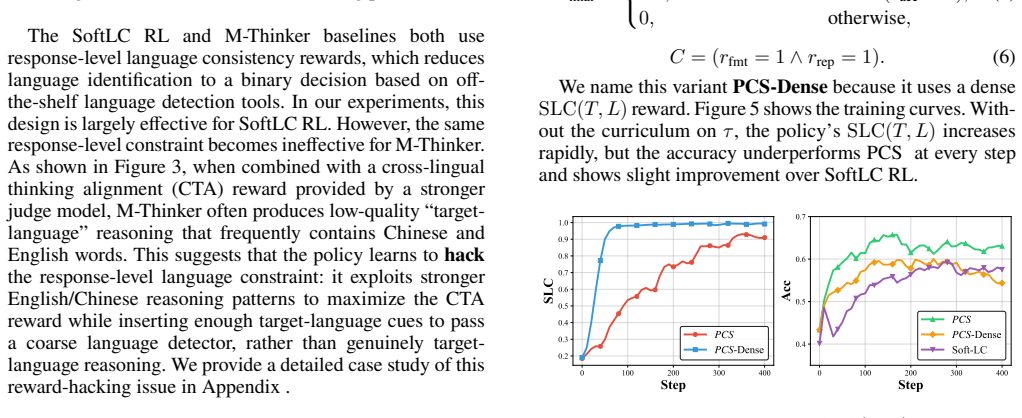
PCS first constructs code-switched reasoning traces by translating a subset of English reasoning steps into the target language and uses them to initialize the model's code-switching ability via supervised fine-tuning. It then applies reinforcement learning with a step-level language consistency curriculum, progressively raising the target-language ratio until the model reasons entirely in the target language. This progressive design provides a smooth transfer path that avoids the instability and performance degradation commonly observed when directly enforcing target-language reasoning.
What carries the argument
Progressive Code-Switching (PCS) that initializes via partial-translation code-switched traces and then applies a reinforcement-learning curriculum on step-level language consistency.
Load-bearing premise
That constructing code-switched traces by translating only a subset of English reasoning steps provides a stable initialization for the model's code-switching ability that the subsequent RL curriculum can build upon without external supervision.
What would settle it
If training directly on fully translated target-language traces without the progressive curriculum produces equal or better accuracy and language consistency, the benefit of the gradual shift would be in doubt.
If this is right
- The performance gap between target-language and English reasoning narrows substantially on multiple benchmarks.
- Reasoning becomes more consistent in the target language across steps.
- Accuracy stays competitive for five typologically diverse languages.
- Transfer succeeds without any stronger model for distillation or judging.
Where Pith is reading between the lines
- The same gradual curriculum idea might stabilize transfer of other skills such as instruction following or tool use across languages.
- The approach could reduce reliance on high-quality native-language data when deploying reasoning models in new languages.
- Applying the method to models of different sizes or to additional languages would test how far the stability benefit extends.
Editorial analysis
A structured set of objections, weighed in public.
Referee Report
Summary. The paper proposes Progressive Code-Switching (PCS) as an efficient framework to transfer English reasoning capabilities of large reasoning models to target languages. PCS constructs code-switched traces by translating only a subset of English reasoning steps, initializes via supervised fine-tuning, and then applies reinforcement learning driven by a step-level language consistency curriculum that progressively increases the target-language ratio until the model reasons fully in the target language. Experiments across multiple benchmarks and five typologically diverse languages are reported to show that PCS narrows the target-language vs. English performance gap while producing more language-consistent outputs and maintaining competitive accuracy, all without distillation from stronger models or external judges.
Significance. If the central results hold under scrutiny, the work would be significant because it removes the need for stronger models in the transfer pipeline, offering a lighter-weight path to multilingual reasoning that could scale more readily than distillation-based methods. The progressive curriculum is positioned as the mechanism that stabilizes the transfer and avoids the degradation seen in direct target-language enforcement.
major comments (1)
- [Abstract] Abstract (method description): the RL stage is described as using only a 'step-level language consistency curriculum' whose sole objective is raising the target-language ratio. No explicit correctness, validity, or outcome reward is mentioned. This is load-bearing for the central claim that accuracy is preserved once the ratio reaches 1.0; without such a term, nothing in the stated procedure prevents the policy from converging to fluent but logically invalid chains after English scaffolding is removed. An ablation or analysis showing that language-consistency alone suffices to retain validity is required.
minor comments (1)
- The abstract refers to 'multiple benchmarks' without naming them; the introduction or experimental section should list the exact datasets and metrics at the outset.
Simulated Author's Rebuttal
We thank the referee for the thoughtful and detailed review. The concern about the RL objective description is well-taken and points to a place where the abstract could be more precise. We address it directly below and commit to revisions that clarify the method and strengthen the supporting analysis.
read point-by-point responses
-
Referee: [Abstract] Abstract (method description): the RL stage is described as using only a 'step-level language consistency curriculum' whose sole objective is raising the target-language ratio. No explicit correctness, validity, or outcome reward is mentioned. This is load-bearing for the central claim that accuracy is preserved once the ratio reaches 1.0; without such a term, nothing in the stated procedure prevents the policy from converging to fluent but logically invalid chains after English scaffolding is removed. An ablation or analysis showing that language-consistency alone suffices to retain validity is required.
Authors: We agree that the abstract's phrasing is concise and does not explicitly reference any correctness or outcome-based reward term. The RL component is driven by a step-level language-consistency reward whose objective is to increase the target-language ratio according to the curriculum schedule. The manuscript argues that validity is retained because (1) the policy is initialized via SFT on code-switched traces that preserve English reasoning structure and (2) the progressive schedule avoids the abrupt removal of English scaffolding that produces degradation in direct-enforcement baselines (reported in Section 4.3). Nevertheless, the referee correctly identifies that an explicit ablation isolating the contribution of language consistency to validity would make this claim more robust. We will add such an analysis in the revision, including a comparison of reasoning validity metrics (e.g., step-level logical consistency checks) between the progressive curriculum and a non-progressive language-consistency baseline. revision: yes
Circularity Check
No circularity detected in derivation or claims
full rationale
The paper describes a procedural method (partial translation for SFT initialization followed by RL on language-consistency curriculum) and reports experimental narrowing of performance gaps on benchmarks. No equations, parameter fits, self-citations, or uniqueness theorems are present in the provided text that would reduce any claimed result to a definition, renaming, or construction by the inputs themselves. The central claims rest on external experimental outcomes rather than any self-referential reduction.
Axiom & Free-Parameter Ledger
read the original abstract
Large reasoning models (LRMs) have achieved strong reasoning capabilities in English, yet their performance degrades significantly when required to reason in other languages. A natural solution is to transfer the model's English reasoning ability to target languages. However, existing transfer approaches typically rely on distilled target-language reasoning traces from stronger LRMs or online supervision from external judge models, which are costly and difficult to scale. In this paper, we propose PCS (Progressive Code-Switching), a more efficient transfer framework that requires only lightweight translation without any stronger model for distillation or judging. PCS first constructs code-switched reasoning traces by translating a subset of English reasoning steps into the target language, and uses them to initialize the model's code-switching ability via supervised fine-tuning. It then applies reinforcement learning with a step-level language consistency curriculum, progressively raising the target-language ratio until the model reasons entirely in the target language. This progressive design provides a smooth transfer path that avoids the instability and performance degradation commonly observed when directly enforcing target-language reasoning. Experiments on multiple benchmarks and five typologically diverse languages show that PCS substantially narrows the performance gap between target-language and English reasoning, yielding more language-consistent reasoning while maintaining competitive accuracy.
Figures




Reference graph
Works this paper leans on
-
[1]
Investigating and Scaling up Code-Switching for Multilingual Language Model Pre-Training
Wang, Zhijun and Li, Jiahuan and Zhou, Hao and Weng, Rongxiang and Wang, Jingang and Huang, Xin and Han, Xue and Feng, Junlan and Deng, Chao and Huang, Shujian. Investigating and Scaling up Code-Switching for Multilingual Language Model Pre-Training. Findings of the Association for Computational Linguistics: ACL 2025. 2025. doi:10.18653/v1/2025.findings-acl.575
-
[2]
DeepSeekMath: Pushing the Limits of Mathematical Reasoning in Open Language Models , author=. 2024 , eprint=
work page 2024
-
[3]
Guo, Daya and Yang, Dejian and Zhang, Haowei and Song, Junxiao and Wang, Peiyi and Zhu, Qihao and Xu, Runxin and Zhang, Ruoyu and Ma, Shirong and Bi, Xiao and Zhang, Xiaokang and Yu, Xingkai and Wu, Yu and Wu, Z. F. and Gou, Zhibin and Shao, Zhihong and Li, Zhuoshu and Gao, Ziyi and Liu, Aixin and Xue, Bing and Wang, Bingxuan and Wu, Bochao and Feng, Bei ...
- [4]
- [5]
-
[6]
Language Matters: How Do Multilingual Input and Reasoning Paths Affect Large Reasoning Models? , author=. 2025 , eprint=
work page 2025
-
[7]
MMATH: A Multilingual Benchmark for Mathematical Reasoning , author=. 2025 , eprint=
work page 2025
- [8]
-
[9]
PolyMath: Evaluating Mathematical Reasoning in Multilingual Contexts , author=. 2025 , eprint=
work page 2025
-
[10]
AM-Thinking-v1: Advancing the Frontier of Reasoning at 32B Scale , author=. 2025 , eprint=
work page 2025
-
[11]
Think Natively: Unlocking Multilingual Reasoning with Consistency-Enhanced Reinforcement Learning , author=. 2026 , eprint=
work page 2026
-
[12]
Latino Discourse and Communicative Behavior/Ablex Publishing , year=
Syntactic Structure and Social Function of Code Switching , author=. Latino Discourse and Communicative Behavior/Ablex Publishing , year=
-
[13]
P re A lign: Boosting Cross-Lingual Transfer by Early Establishment of Multilingual Alignment
Li, Jiahuan and Huang, Shujian and Ching, Aarron and Dai, Xinyu and Chen, Jiajun. P re A lign: Boosting Cross-Lingual Transfer by Early Establishment of Multilingual Alignment. Proceedings of the 2024 Conference on Empirical Methods in Natural Language Processing. 2024. doi:10.18653/v1/2024.emnlp-main.572
-
[14]
arXiv preprint arXiv:2411.02460 , year=
Code-Switching Curriculum Learning for Multilingual Transfer in LLMs , author=. arXiv preprint arXiv:2411.02460 , year=
-
[15]
Mapo: Advancing multilingual reasoning through multilingual alignment-as-preference optimization
Mapo: Advancing multilingual reasoning through multilingual alignment-as-preference optimization , author=. arXiv preprint arXiv:2401.06838 , year=
-
[16]
Think Natively: Unlocking Multilingual Reasoning with Consistency-Enhanced Reinforcement Learning , author=. arXiv preprint arXiv:2510.07300 , year=
-
[17]
mcot: Multilingual instruction tuning for reasoning consistency in language models
mCoT: Multilingual instruction tuning for reasoning consistency in language models , author=. arXiv preprint arXiv:2406.02301 , year=
-
[18]
S o T : Structured-of-Thought Prompting Guides Multilingual Reasoning in Large Language Models
Qi, Rui and Man, Zhibo and Chen, Yufeng and Mo, Fengran and Xu, Jinan and Huang, Kaiyu. S o T : Structured-of-Thought Prompting Guides Multilingual Reasoning in Large Language Models. Findings of the Association for Computational Linguistics: EMNLP 2025. 2025. doi:10.18653/v1/2025.findings-emnlp.586
-
[19]
arXiv preprint arXiv:2511.23231 , year=
Unlocking Multilingual Reasoning Capability of LLMs and LVLMs through Representation Engineering , author=. arXiv preprint arXiv:2511.23231 , year=
-
[20]
When Models Reason in Your Language: Controlling Thinking Language Comes at the Cost of Accuracy
Qi, Jirui and Chen, Shan and Xiong, Zidi and Fern \'a ndez, Raquel and Bitterman, Danielle and Bisazza, Arianna. When Models Reason in Your Language: Controlling Thinking Language Comes at the Cost of Accuracy. Findings of the Association for Computational Linguistics: EMNLP 2025. 2025. doi:10.18653/v1/2025.findings-emnlp.1103
-
[21]
MEXA: Multilingual Evaluation of English-Centric LLMs via Cross-Lingual Alignment , author=. 2025 , eprint=
work page 2025
-
[22]
Do Llamas Work in English? On the Latent Language of Multilingual Transformers , author=. 2024 , eprint=
work page 2024
- [23]
-
[24]
MMLU-ProX: A Multilingual Benchmark for Advanced Large Language Model Evaluation , author=. 2025 , eprint=
work page 2025
-
[25]
arXiv preprint arXiv:2510.04230 , year=
Pushing on Multilingual Reasoning Models with Language-Mixed Chain-of-Thought , author=. arXiv preprint arXiv:2510.04230 , year=
-
[26]
CURE-Med: Curriculum-Informed Reinforcement Learning for Multilingual Medical Reasoning
CURE-Med: Curriculum-Informed Reinforcement Learning for Multilingual Medical Reasoning , author=. arXiv preprint arXiv:2601.13262 , year=
work page internal anchor Pith review Pith/arXiv arXiv
discussion (0)
Sign in with ORCID, Apple, or X to comment. Anyone can read and Pith papers without signing in.