REVIEW 2 major objections 2 minor 2 cited by
FASTAR is a fully differentiable stellar population synthesis code that matches traditional model accuracy while being faster, lighter, and more flexible.
Reviewed by Pith at T0; open to challenge. T0 means a machine referee read the full paper against a public rubric. the ladder, T0–T4 →
T0 review · grok-4.3
2026-06-30 15:27 UTC pith:ZQJQ77C5
load-bearing objection FASTAR adds full differentiability and continuous IMF variation to SSP models, which is a practical step for gradient-based fitting but rests on unshown interpolation accuracy. the 2 major comments →
FASTAR -- I. Continuous and differentiable evolutionary stellar population models
The pith
A machine-rendered reading of the paper's core claim, the machinery that carries it, and where it could break.
Core claim
FASTAR is a fully differentiable stellar population synthesis code constructed to allow continuous evaluation at arbitrary points in age, metallicity, and initial mass function space. It supplies spectroscopic predictions across the MILES wavelength range and broader spectral energy distributions that can be convolved with any photometric filters. When tested on globular clusters and early-type galaxy spectra, it reaches the same accuracy level as current grid-based simple stellar population models while being faster and more flexible in IMF parameterization. Its differentiability supplies a direct route to quantitative model uncertainty estimates and to gradient descent inference algorithms
What carries the argument
Continuous interpolation of stellar evolution tracks, isochrones, and spectral libraries to produce a differentiable model that supports arbitrary IMF functional forms.
Load-bearing premise
The underlying stellar evolution tracks, isochrones, and spectral libraries can be accurately interpolated and differentiated across the full parameter space without introducing systematic errors that affect performance parity with grid-based models.
What would settle it
A side-by-side test on the same globular cluster or early-type galaxy spectra in which FASTAR predictions deviate more from the data than the grid-based reference models.
If this is right
- IMF parameterization changes become straightforward, yielding consistent colors, magnitudes, and mass-to-light ratios.
- Models can be synthesized under arbitrary IMF functional forms without re-gridding.
- Spectroscopic output over 3540-7400 A and 2000-12000 A SEDs can be directly convolved with any filter set.
- The differentiable structure supplies a natural framework for gradient descent inference algorithms.
- Quantitative tracing of model behavior and uncertainties becomes possible through direct derivatives.
Where Pith is reading between the lines
- Automatic differentiation could be used to propagate uncertainties from input tracks directly into derived galaxy parameters.
- The continuous IMF treatment might simplify joint fitting of stellar populations across multiple galaxies in large surveys.
- Extension of the same interpolation approach to additional wavelength coverage or extra parameters would require only validation against new libraries.
Editorial analysis
A structured set of objections, weighed in public.
Referee Report
Summary. The paper introduces FASTAR, a fully differentiable stellar population synthesis code that enables continuous evaluation of single stellar population models over age (20 Myr to 14 Gyr), metallicity (-2.5 < [M/H] < +0.3), and arbitrary IMF parameterizations. It generates spectroscopic predictions in the MILES range (3540-7400 Å) and broader SEDs (2000-12000 Å), claims performance parity with state-of-the-art grid-based SSP models when benchmarked on globular clusters and high-S/N early-type galaxy spectra, and emphasizes advantages in speed, flexibility, and compatibility with gradient-based inference.
Significance. If the claimed accuracy parity holds under differentiation and interpolation of tracks, isochrones, and libraries such as MILES, the work would provide a useful tool for gradient-descent fitting and uncertainty quantification in stellar population analysis, extending beyond traditional discrete grids while maintaining consistency in color, magnitude, and mass-to-light conversions.
major comments (2)
- [Abstract] Abstract and validation sections: the central claim of 'performance parity' with state-of-the-art SSP models on globular clusters and early-type galaxy spectra is asserted without any reported quantitative metrics (e.g., reduced χ², mean residuals, or direct comparison tables to models such as those based on the same MILES library), making it impossible to verify that differentiability was achieved without systematic accuracy loss.
- [Methods (interpolation and differentiation)] The differentiability implementation (likely via interpolation of isochrones and spectral libraries) is load-bearing for the performance claim, yet no explicit test of derivative accuracy, finite-difference consistency, or introduced systematics across the full parameter space is described; this directly affects the weakest assumption that interpolation preserves fidelity to the underlying tracks.
minor comments (2)
- Notation for IMF functional forms and the exact wavelength sampling of the coarse SED should be defined more explicitly in the text to aid reproducibility.
- [Abstract] The abstract states the age and metallicity ranges but does not specify the exact IMF parameter ranges or functional forms tested; adding this would clarify the flexibility claim.
Simulated Author's Rebuttal
We thank the referee for their constructive comments, which highlight important aspects of validation for the differentiability claims. We address each major comment below and will revise the manuscript to strengthen the quantitative support for our assertions.
read point-by-point responses
-
Referee: [Abstract] Abstract and validation sections: the central claim of 'performance parity' with state-of-the-art SSP models on globular clusters and early-type galaxy spectra is asserted without any reported quantitative metrics (e.g., reduced χ², mean residuals, or direct comparison tables to models such as those based on the same MILES library), making it impossible to verify that differentiability was achieved without systematic accuracy loss.
Authors: We agree that the current presentation of the performance comparison is primarily qualitative. In the revised manuscript we will add quantitative metrics, including reduced χ² values and mean residuals from fits to the globular cluster and high-S/N early-type galaxy spectra, together with direct side-by-side tables against other MILES-based SSP models. These additions will be placed in the validation section to allow readers to assess whether the differentiable implementation introduces any systematic accuracy loss. revision: yes
-
Referee: [Methods (interpolation and differentiation)] The differentiability implementation (likely via interpolation of isochrones and spectral libraries) is load-bearing for the performance claim, yet no explicit test of derivative accuracy, finite-difference consistency, or introduced systematics across the full parameter space is described; this directly affects the weakest assumption that interpolation preserves fidelity to the underlying tracks.
Authors: We acknowledge that explicit verification of the computed derivatives is necessary to substantiate the differentiability claim. We will add a dedicated subsection (or appendix) that reports finite-difference consistency tests across the age, metallicity, and IMF parameter ranges, including quantitative measures of agreement and any detected systematics arising from the interpolation scheme. This will directly address the concern that interpolation may compromise fidelity to the underlying tracks. revision: yes
Circularity Check
No significant circularity detected
full rationale
The paper introduces FASTAR as a continuous, differentiable interpolation framework over external stellar evolution tracks, isochrones, and spectral libraries (explicitly including MILES). Performance parity is asserted via direct benchmarks against independent observational datasets (globular clusters and high-S/N early-type galaxy spectra), not via quantities defined or fitted within the present work. No load-bearing derivation step reduces by construction to a self-citation chain, an author-defined ansatz, or a fitted parameter renamed as a prediction. The differentiability property is presented as an additive capability rather than a re-expression of the input data. The derivation chain is therefore self-contained against external benchmarks.
Axiom & Free-Parameter Ledger
axioms (1)
- domain assumption Stellar evolution tracks and spectral libraries can be continuously interpolated without loss of fidelity across the stated ranges.
read the original abstract
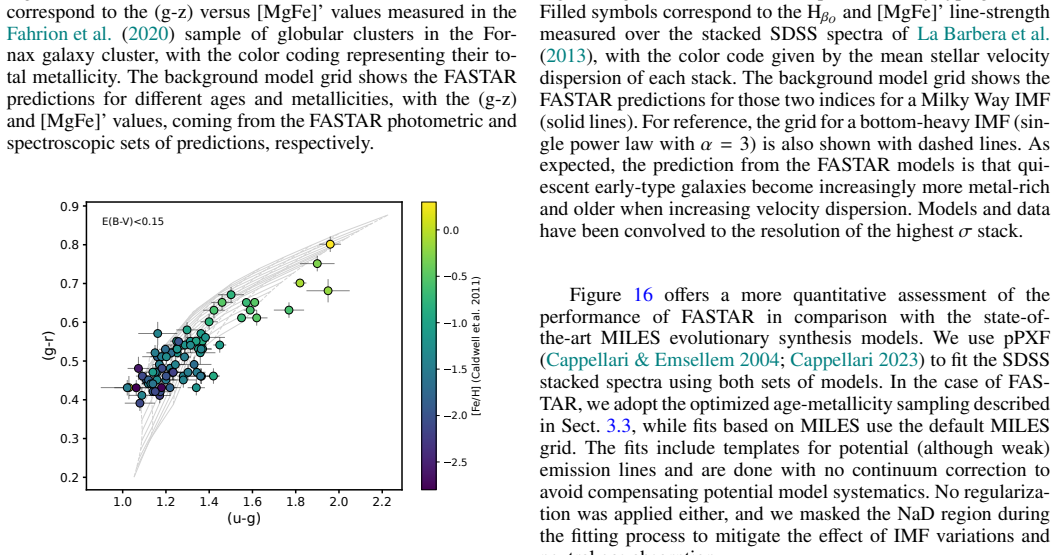
The development of evolutionary stellar population models is central to interpreting observations of galaxies in terms of astrophysical quantities. Stellar population models must therefore be both accurate and compatible with inversion algorithms in order to extract meaningful information from the observed data. Here we present FASTAR, a fully differentiable stellar population synthesis code. Contrary to traditional, grid-based single stellar population models, FASTAR can be continuously evaluated at any age (between 20 Myr and 14 Gyr), metallicity (-2.5 < [M/H] < +0.3), and initial mass function (IMF). Changes in the IMF parameterization are straightforward, allowing for consistent conversions of colors, magnitudes, and mass-to-light ratios, as well as the synthesis of models under the assumption of arbitrary IMF functional forms. FASTAR provides detailed spectroscopic predictions over the MILES wavelength range (3,540-7,400 A) as well as more coarsely sampled spectral energy distributions across a wider 2,000-to-12,000 A, which can be directly convolved with any arbitrary set of photometric filters. FASTAR performs at the same level of state-of-the-art simple stellar population models benchmarked against observations of globular clusters and high signal-to-noise spectra of early-type galaxies, but it is faster, lighter, and more flexible. Moreover, its differentiable nature allows for a quantitative understanding of model behavior and uncertainties, as well as a natural framework for gradient descent inference algorithms.
Figures




Forward citations
Cited by 2 Pith papers
-
Diffhalos: A Generative Model of Cosmological Lightcones of Dark Matter Halos
Diffhalos generates statistically accurate Monte-Carlo and quasi-Monte-Carlo lightcones of halos, subhalos and Diffmah mass-assembly histories, enabling autodiff gradients of the mass functions.
-
A Pixel-by-Pixel Path to Population III Discovery with JWST
Pixel-by-pixel SBI modeling recovers young massive Pop III clumps at up to 90 percent rate in favorable JWST-like configurations while integrated analyses fail due to contamination.
Reference graph
Works this paper leans on
-
[1]
Acquaviva, V ., Gawiser, E., & Guaita, L. 2011, ApJ, 737, 47 Adelman-McCarthy, J. K., Agüeros, M. A., Allam, S. S., et al. 2008, ApJS, 175, 297 Alsing, J., Peiris, H., Leja, J., et al. 2020, ApJS, 249, 5 Alsing, J., Thorp, S., Deger, S., et al. 2024, ApJS, 274, 12 Angthopo, J., Granett, B. R., La Barbera, F., et al. 2024, A&A, 690, A198 Asa’d, R. S., Vazd...
-
[2]
6 does not fully characterize the behavior of FASTAR SSP mod- els
While that comparison shows an overall good agreement be- tween both sets of models, as well as some differences, Fig. 6 does not fully characterize the behavior of FASTAR SSP mod- els. In Fig. C.1 we include a larger set of indices, contrasting the FASTAR (in blue) and MILES predictions (in orange) for vary- ing age, metallicity and IMF slope (under a bi...
work page 2005
discussion (0)
Sign in with ORCID, Apple, or X to comment. Anyone can read and Pith papers without signing in.