General Method for Evaluation of Stop-Bands of Periodic Structures with Symmetric Unit Cells
Pith reviewed 2026-06-27 02:31 UTC · model grok-4.3
The pith
Mirror symmetries of a unit cell let stop-band edges be obtained from eigenfrequencies at only three wavevectors.
A machine-rendered reading of the paper's core claim, the machinery that carries it, and where it could break.
Core claim
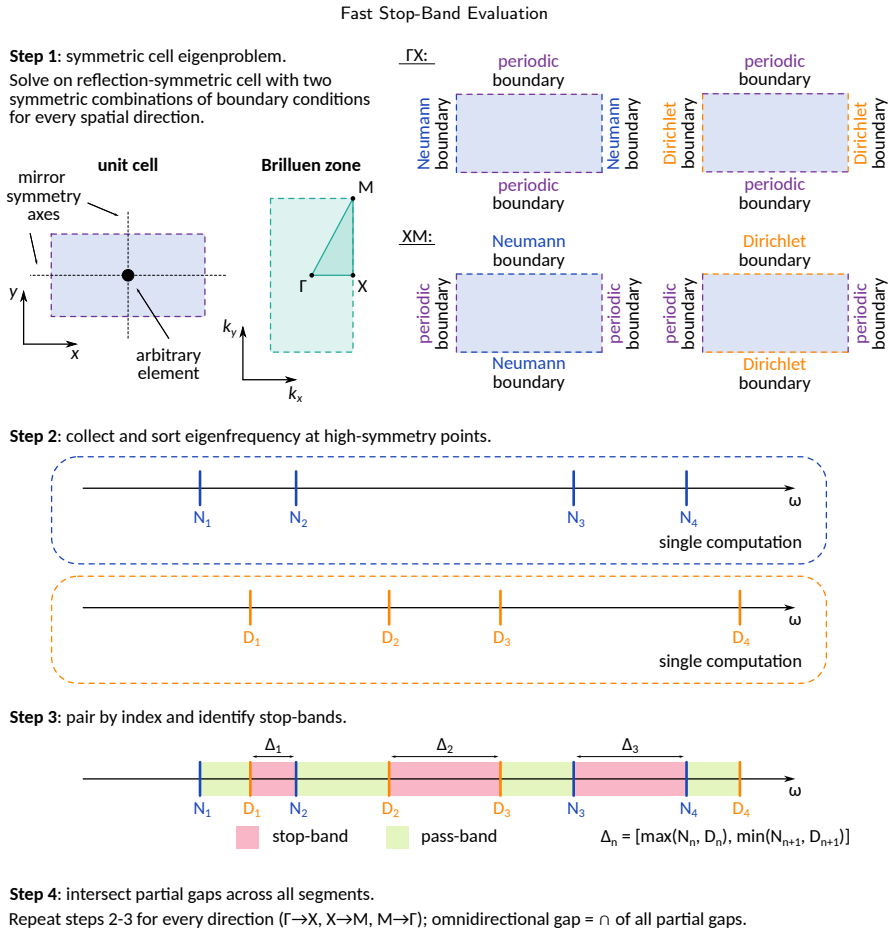
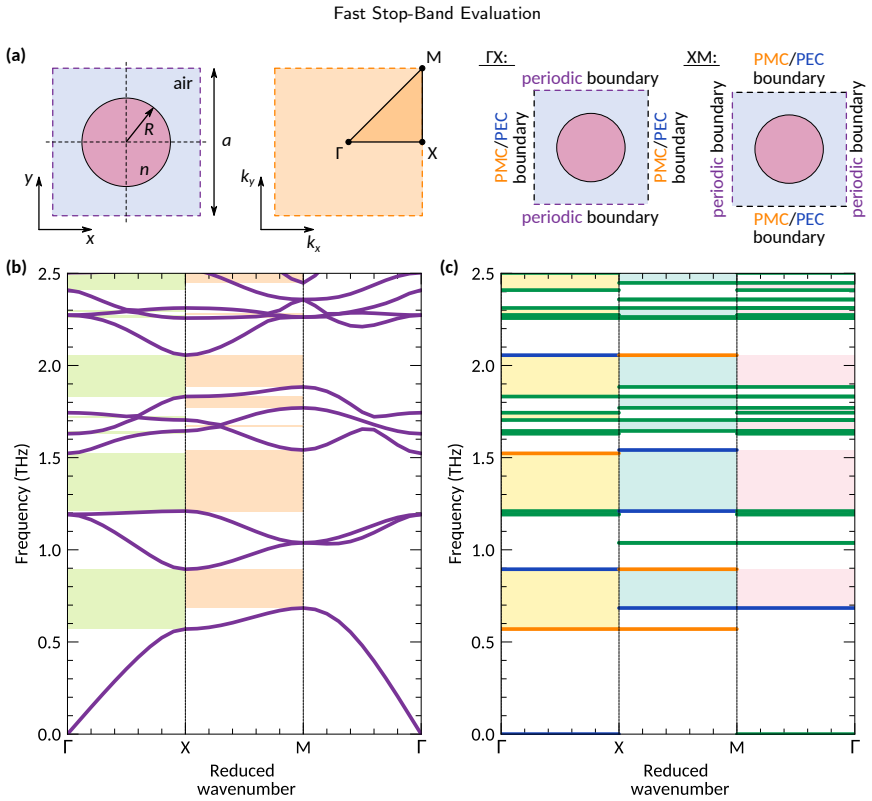
For any unit cell whose material distribution is invariant under the two mirrors normal to the cell faces, the eigenproblem at the high-symmetry vertices decomposes exactly into four independent sub-problems on the quarter cell. These sub-problems are governed by the four combinations of Neumann (sound-hard) and Dirichlet (sound-soft) conditions on the symmetry planes. Sorting and pairing the eigenfrequencies obtained along each irreducible Brillouin-zone segment by their indices then supplies explicit expressions for the stop-band intervals without computing the complete dispersion diagram.
What carries the argument
Decomposition of the standing-wave eigenproblem into four independent Neumann/Dirichlet quarter-cell problems, followed by index-based pairing of eigenfrequencies along irreducible Brillouin-zone segments
If this is right
- Stop-band boundaries are recovered directly from eigenvalue solutions at only the three points Γ, X, and M (or equivalent) of the irreducible zone.
- No additional matrix assemblies or interpolations along the zone edges are required once the four sets of eigenfrequencies are known.
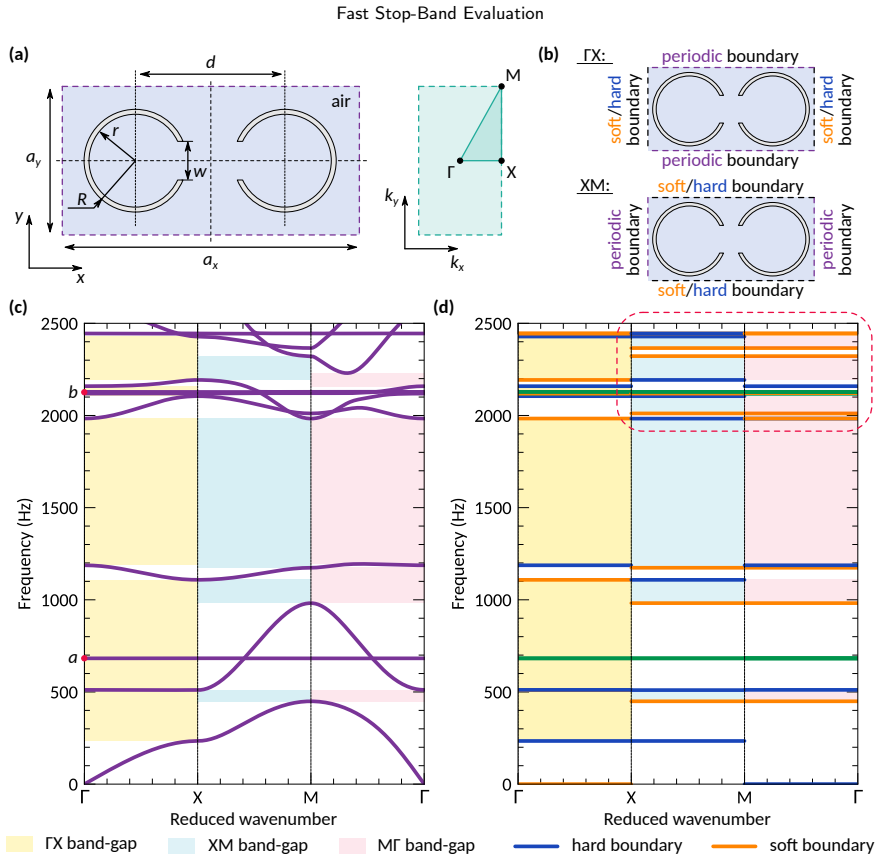
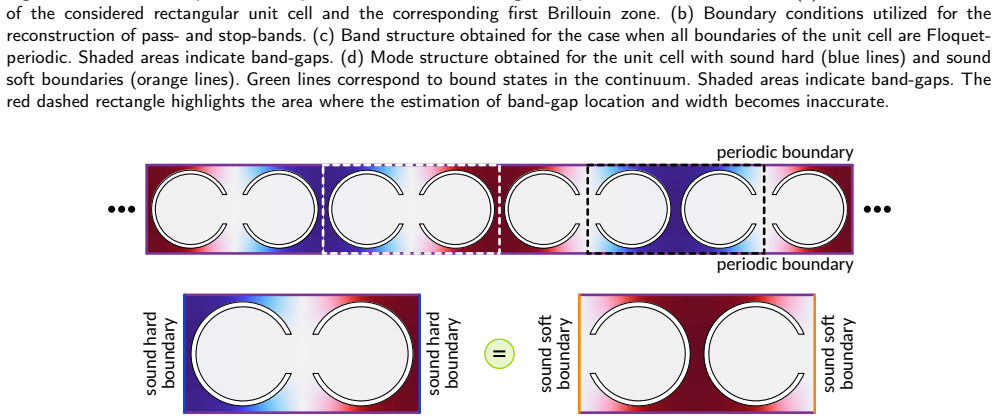
- Bands that are flat under both Neumann and Dirichlet conditions are identified as bound states in the continuum.
- The pairing rule yields only approximate stop-band edges when avoided crossings render band segments non-monotonic.
Where Pith is reading between the lines
- The same four-way decomposition could be applied to electromagnetic or elastic waves in lattices that respect the identical mirror symmetries.
- In three dimensions the presence of additional mirror planes would reduce the computational domain still further.
- The spectral conditions that produce non-monotonic bands could be used to derive correction factors that restore exact pairing in geometries with stronger coupling.
Load-bearing premise
The material distribution inside the unit cell must remain unchanged under reflection across the two planes that bisect the cell faces.
What would settle it
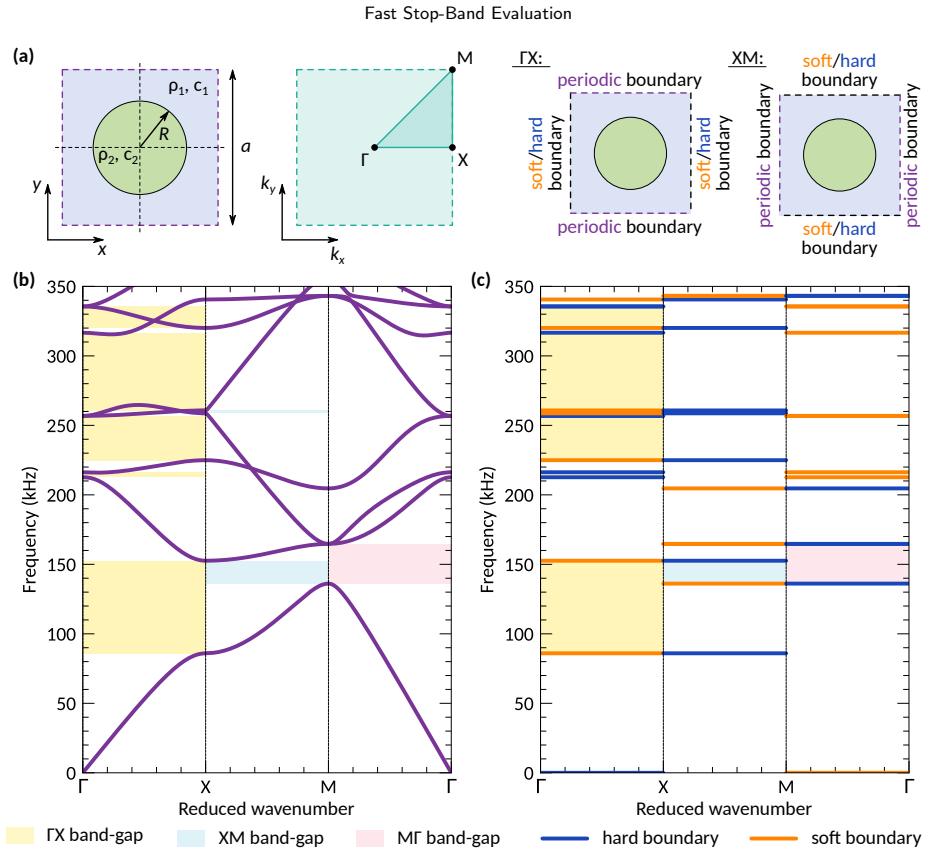
For a symmetric unit cell, solve the four quarter-cell eigenproblems at the three high-symmetry points, apply the pairing rule, and compare the resulting stop-band edges against those extracted from a full Floquet dispersion calculation; mismatch beyond the reported 1 percent tolerance for the lowest bands would falsify the exactness claim.
Figures
read the original abstract
The mirror symmetries of a periodic unit cell are exploited to decompose the standing-wave eigenproblem at the high-symmetry vertices of the Brillouin zone into four independent sub-problems on a quarter-cell, each governed by Neumann (sound-hard) or Dirichlet (sound-soft) boundary conditions. Sorting and pairing the resulting eigenfrequencies by index along each segment of the irreducible Brillouin zone boundary yields an explicit formula for the stop-band intervals without computing the full dispersion diagram. The decomposition is exact, following directly from the representation theory of the little group at each high-symmetry point. It applies to any unit cell whose material distribution is invariant under the mirrors normal to the cell faces. The method is validated on two configurations: a phononic crystal of lead cylinders in an epoxy matrix, analyzed using the plane-wave expansion, and a lattice of coupled C-shaped Helmholtz resonators, analyzed using finite-element analysis. For both systems, the reconstructed stop-band boundaries agree with the full Floquet dispersion calculation to within 1% for the lowest bands, requiring eigenvalue solutions at only three discrete wavevectors. Avoided crossings within a Brillouin zone segment can cause bands to exhibit non-monotone behavior, rendering the pairing rule approximate; the spectral conditions for this are identified. Flat bands common to both boundary-condition types are identified as bound states in the continuum.
Editorial analysis
A structured set of objections, weighed in public.
Referee Report
Summary. The manuscript claims a general method to compute stop-band intervals for periodic structures whose unit cells are invariant under face-normal mirrors. At high-symmetry Brillouin-zone vertices the eigenproblem is decomposed exactly, via little-group representation theory, into four independent quarter-cell problems with Neumann or Dirichlet boundary conditions. Sorting and pairing the resulting eigenfrequencies by index along each irreducible Brillouin-zone segment is asserted to furnish the stop-band boundaries from eigenvalue solutions at only three discrete wavevectors. The method is validated on a lead-in-epoxy phononic crystal (plane-wave expansion) and a lattice of C-shaped Helmholtz resonators (finite-element analysis), with reconstructed boundaries agreeing to within 1 % for the lowest bands. Avoided crossings are noted to produce non-monotonic dispersion that renders the pairing rule approximate; spectral conditions for this failure are identified, and flat bands common to both boundary-condition families are interpreted as bound states in the continuum.
Significance. If the pairing procedure can be made robust or its domain of validity sharply delimited, the approach would materially reduce the computational cost of stop-band estimation for symmetric periodic media. The exact symmetry decomposition at high-symmetry points and the independent numerical checks on two physically distinct systems constitute clear strengths. The explicit acknowledgment of the avoided-crossing limitation is also a positive feature.
major comments (2)
- [Abstract] Abstract and the paragraph discussing avoided crossings: the central claim that sorting and pairing yields an 'explicit formula for the stop-band intervals without computing the full dispersion diagram' is directly qualified by the statement that avoided crossings render the pairing rule approximate. Because the 1 % agreement is reported only for the lowest bands, this approximation is load-bearing for the generality asserted in the title and abstract.
- [Validation sections] Validation paragraphs: agreement to within 1 % is shown only for the lowest bands of the two example systems. No quantitative comparison is provided for higher bands where avoided crossings become more probable, leaving the practical scope of the method unclear.
minor comments (1)
- The four combinations of Neumann/Dirichlet conditions on the quarter-cell faces should be labeled explicitly (e.g., NN, ND, DN, DD) when the eigenfrequencies are first introduced.
Simulated Author's Rebuttal
We thank the referee for the constructive report and positive assessment of the symmetry decomposition and numerical checks. We address the two major comments below, agreeing where the critique is valid and outlining targeted revisions to clarify scope and strengthen validation.
read point-by-point responses
-
Referee: [Abstract] Abstract and the paragraph discussing avoided crossings: the central claim that sorting and pairing yields an 'explicit formula for the stop-band intervals without computing the full dispersion diagram' is directly qualified by the statement that avoided crossings render the pairing rule approximate. Because the 1 % agreement is reported only for the lowest bands, this approximation is load-bearing for the generality asserted in the title and abstract.
Authors: We agree that the pairing rule is approximate under avoided crossings, as already stated in the manuscript text. The decomposition itself is exact at the high-symmetry points via little-group theory, but reconstruction of full intervals assumes monotonic dispersion between those points. We will revise the abstract to state explicitly that the method furnishes exact eigenfrequencies at the three wavevectors and yields stop-band intervals via index pairing when no avoided crossings occur within a segment; the spectral conditions for breakdown will be referenced in the abstract as well. This removes any overstatement of generality while preserving the computational advantage at the symmetry points. revision: yes
-
Referee: [Validation sections] Validation paragraphs: agreement to within 1 % is shown only for the lowest bands of the two example systems. No quantitative comparison is provided for higher bands where avoided crossings become more probable, leaving the practical scope of the method unclear.
Authors: The referee correctly notes that quantitative error metrics are given only for the lowest bands. We will extend both validation sections (plane-wave expansion and finite-element examples) to report agreement percentages for higher bands (up to at least the tenth), including cases that exhibit avoided crossings. New tables or supplementary figures will quantify the deviation when the monotonicity assumption fails, thereby delineating the practical domain of the pairing rule more sharply. revision: yes
Circularity Check
No circularity: derivation rests on external representation theory with independent validation
full rationale
The core decomposition at high-symmetry points is stated to follow directly from little-group representation theory applied to the mirror-symmetric unit cell; the sorting/pairing rule for stop-band intervals is presented as a direct algebraic consequence along IBZ segments. The paper explicitly flags the approximation under avoided crossings rather than claiming exactness in all cases. No fitted parameters, self-citations as load-bearing premises, or renamings of known results appear in the provided derivation chain. The two numerical validations (PWE and FEA) are independent checks against full dispersion calculations, not self-referential. This matches the default expectation of a non-circular paper.
Axiom & Free-Parameter Ledger
axioms (1)
- standard math The representation theory of the little group at high-symmetry points of the Brillouin zone allows exact decomposition of the eigenproblem into four independent sub-problems with Neumann or Dirichlet boundary conditions.
Reference graph
Works this paper leans on
-
[1]
Acoustic Metamaterials for Noise Reduction: A Review.Advanced Materials Technologies, 7(6):2100698, 2022
Nansha Gao, Zhicheng Zhang, Jie Deng, Xinyu Guo, Baozhu Cheng, and Hong Hou. Acoustic Metamaterials for Noise Reduction: A Review.Advanced Materials Technologies, 7(6):2100698, 2022
2022
-
[2]
Srajan Dalela, P. S. Balaji, and D. P. Jena. A review on application of mechanical metamaterials for vibration control.Mechanics of AdvancedMaterialsandStructures,29(22):3237–3262,August2022
-
[3]
Optical meta- waveguides for integrated photonics and beyond.Light: Science & Applications, 10(1):235, November 2021
YuanMeng,YizhenChen,LonghuiLu,YiminDing,AndreaCusano, JonathanA.Fan,QiaomuHu,KaiyuanWang,ZhenweiXie,Zhoutian Liu,YuanmuYang,QiangLiu,MaliGong,QirongXiao,ShulinSun, Minming Zhang, Xiaocong Yuan, and Xingjie Ni. Optical meta- waveguides for integrated photonics and beyond.Light: Science & Applications, 10(1):235, November 2021
2021
-
[4]
Tailoring Structure-Borne Sound through Bandgap Engineering in Phononic Crystals and Metamaterials: A Comprehensive Review
Mourad Oudich, Nikhil JRK Gerard, Yuanchen Deng, and Yun Jing. Tailoring Structure-Borne Sound through Bandgap Engineering in Phononic Crystals and Metamaterials: A Comprehensive Review. Advanced Functional Materials, 33(2):2206309, 2023
2023
-
[5]
Phononiccrystalsforliquidsensorapplications
RLucklumandJLi. Phononiccrystalsforliquidsensorapplications. MeasurementScienceandTechnology,20(12):124014,October2009
-
[6]
Photoniccrystalsensors:Anoverview
RajeshV.NairandR.Vijaya. Photoniccrystalsensors:Anoverview. Progress in Quantum Electronics, 34(3):89–134, May 2010. A. Hvatov et al.:Preprint submitted to ElsevierPage 10 of 11 Fast Stop-Band Evaluation
2010
-
[7]
Wolfbeis
Christoph Fenzl, Thomas Hirsch, and Otto S. Wolfbeis. Photonic Crystals for Chemical Sensing and Biosensing.Angewandte Chemie International Edition, 53(13):3318–3335, 2014
2014
-
[8]
Chuanmin Chen, Zhaofeng Guo, Songtao Liu, Hongda Feng, and ChuanxiQiao.Hybridacousto-elasticmetamaterialsforsimultaneous control of low-frequency sound and vibration.Journal of Applied Physics, 129(5):054902, February 2021
2021
-
[9]
Nonlocal acoustic- mechanical metasurface for simultaneous and enhanced sound ab- sorption and vibration reduction.Materials & Design, 244:113120, August 2024
Haohan Zeng, Qiang Gao, Siyuan Gao, Feilong Mao, Zihao Su, Hao Luo, Yifan Zhu, Hui Zhang, and Haiyan Fan. Nonlocal acoustic- mechanical metasurface for simultaneous and enhanced sound ab- sorption and vibration reduction.Materials & Design, 244:113120, August 2024
2024
-
[10]
Si- multaneous acoustic and vibration isolation metamaterials based on triplyperiodicminimalsurface.Thin-WalledStructures,207:112738, February 2025
Heman Xiao, Hongqing Dai, Ning Dai, and Laishui Zhou. Si- multaneous acoustic and vibration isolation metamaterials based on triplyperiodicminimalsurface.Thin-WalledStructures,207:112738, February 2025
2025
-
[11]
Tailoring simultaneous photonic and phononic band gaps.Journal of Applied Physics, 106(7):074912, October 2009
Said Sadat-Saleh, Sarah Benchabane, Fadi Issam Baida, Maria-Pilar Bernal, and Vincent Laude. Tailoring simultaneous photonic and phononic band gaps.Journal of Applied Physics, 106(7):074912, October 2009
2009
-
[12]
Pennec, B
Y. Pennec, B. Djafari Rouhani, E. H. El Boudouti, C. Li, Y. El Hassouani,J.O.Vasseur,N.Papanikolaou,S.Benchabane,V.Laude, and A. Martinez. Simultaneous existence of phononic and photonic band gaps in periodic crystal slabs.Optics Express, 18(13):14301– 14310, June 2010
2010
-
[13]
Eftekhar, Abdelkrim Khelif, and Ali Adibi
Saeed Mohammadi, Ali A. Eftekhar, Abdelkrim Khelif, and Ali Adibi. Simultaneous two-dimensional phononic and photonic band gaps in opto-mechanical crystal slabs.Optics Express, 18(9):9164– 9172, April 2010
2010
-
[14]
Sur les équations différentielles linéaires à co- efficients périodiques.Annales Scientifiques de l’École Normale Supérieure, 12:47–88, 1883
Gaston Floquet. Sur les équations différentielles linéaires à co- efficients périodiques.Annales Scientifiques de l’École Normale Supérieure, 12:47–88, 1883
-
[15]
Über die Quantenmechanik der Elektronen in Kristall- gittern.Zeitschrift für Physik, 52:555–600, 1928
Felix Bloch. Über die Quantenmechanik der Elektronen in Kristall- gittern.Zeitschrift für Physik, 52:555–600, 1928
1928
-
[16]
J. D. Joannopoulos, editor.Photonic Crystals: Molding the Flow of Light. Princeton University Press, Princeton, 2nd ed edition, 2008
2008
-
[17]
Springer-Verlag, New York, 1 edition, 2016
Abdelkrim Khelif and Ali Adibi, editors.Phononic Crystals: Fun- damentals and Applications. Springer-Verlag, New York, 1 edition, 2016
2016
-
[18]
Dover Publications, 2nd edition, 1953
Léon Brillouin.Wave Propagation in Periodic Structures. Dover Publications, 2nd edition, 1953
1953
-
[19]
K.M. Ho, C.T. Chan, and C.M. Soukoulis. Existence of a pho- tonic gap in periodic dielectric structures.Physical Review Letters, 65(25):3152–3155, 1990
1990
-
[20]
Kushwaha, Peter Halevi, G
Manvir S. Kushwaha, Peter Halevi, G. Martínez, Leonard Dobrzyn- ski, and Bahram Djafari-Rouhani. Theory of acoustic band structure ofperiodicelasticcomposites.PhysicalReviewB,49(4):2313–2322, 1994
1994
-
[21]
Convergence problem of plane-wave expansion method for phononic crystals.Physics Letters A, 327:247–253, 2004
Yongjun Cao, Zhilin Hou, and Youyan Liu. Convergence problem of plane-wave expansion method for phononic crystals.Physics Letters A, 327:247–253, 2004
2004
-
[22]
Mahmoud I. Hussein. Reduced Bloch mode expansion for periodic media band structure calculations.Proceedings of the Royal Society A, 465:2825–2848, 2009
2009
-
[23]
Finite element prediction of wave motion in structural waveguides
BrianR.Mace,DenisDuhamel,MichaelJ.Brennan,andLarsHinke. Finite element prediction of wave motion in structural waveguides. Journal of the Acoustical Society of America, 117:2835–2843, 2005
2005
-
[24]
Modellingwavepropagation in two-dimensional structures using finite element analysis.Journal of Sound and Vibration, 318:884–902, 2008
BrianR.MaceandElisabettaManconi. Modellingwavepropagation in two-dimensional structures using finite element analysis.Journal of Sound and Vibration, 318:884–902, 2008
2008
-
[25]
Photonic bandgap calculations with Dirichlet-to-Neumann maps.Journal of the Optical Society of Amer- ica A, 23:3217–3222, 2006
Jianhua Yuan and Ya Yan Lu. Photonic bandgap calculations with Dirichlet-to-Neumann maps.Journal of the Optical Society of Amer- ica A, 23:3217–3222, 2006
2006
-
[26]
Denys J. Mead. Wave propagation and natural modes in periodic systems: I. Mono-coupled systems.Journal of Sound and Vibration, 40(1):1–18, 1975
1975
-
[27]
Wavepropagationandnaturalmodesinperiodicsys- tems: Ii
DenysJ.Mead. Wavepropagationandnaturalmodesinperiodicsys- tems: Ii. multi-coupled systems, with and without damping.Journal of Sound and Vibration, 40(1):19–39, 1975
1975
-
[28]
LS Ledet and SV Sorokin. (bi)-orthogonality relation for eigenfunc- tions of self-adjoint operators.Philosophical Transactions of the Royal Society A: Mathematical, Physical and Engineering Sciences, 377(2156), 2019
2019
-
[29]
Free vibrations of finite periodic structures in pass- and stop-bands of the counterpart infinite waveguides.Journal of Sound and Vibration, 347:200–217, July 2015
Alexander Hvatov and Sergey Sorokin. Free vibrations of finite periodic structures in pass- and stop-bands of the counterpart infinite waveguides.Journal of Sound and Vibration, 347:200–217, July 2015
2015
-
[30]
Finite element modal analysis of wave propagation in homogeneous and periodic waveguides.International Journal of Mechanical Sciences, 227:107444, 2022
SV Sorokin, PH Broberg, MT Steffensen, and LS Ledet. Finite element modal analysis of wave propagation in homogeneous and periodic waveguides.International Journal of Mechanical Sciences, 227:107444, 2022
2022
-
[31]
OnapplicationoftheFloquet theory for radially periodic membranes and plates.Journal of Sound and Vibration, 414:15–30, 2018
AlexanderHvatovandSergeySorokin. OnapplicationoftheFloquet theory for radially periodic membranes and plates.Journal of Sound and Vibration, 414:15–30, 2018
2018
-
[32]
The symmetrical cell eigenfrequency method for periodic structure stop-band definition.Vibroengineering Procedia, 25:100–105, 2019
Alexander Hvatov. The symmetrical cell eigenfrequency method for periodic structure stop-band definition.Vibroengineering Procedia, 25:100–105, 2019
2019
-
[33]
Assessmentofreduced-order models in analysis of Floquet modes in an infinite periodic elastic layer.Journal of Sound and Vibration, 440:332–345, 2019
AlexanderHvatovandSergeySorokin. Assessmentofreduced-order models in analysis of Floquet modes in an infinite periodic elastic layer.Journal of Sound and Vibration, 440:332–345, 2019
2019
-
[34]
L.P.Bouckaert,R.Smoluchowski,andE.Wigner.TheoryofBrillouin zonesandsymmetrypropertiesofwavefunctionsincrystals.Physical Review, 50:58–67, 1936
1936
-
[35]
Symmetry, degeneracy, and uncoupled modes in two-dimensional photonic lattices.Physical Review B, 52(11):7982– 7986, 1995
Kazuaki Sakoda. Symmetry, degeneracy, and uncoupled modes in two-dimensional photonic lattices.Physical Review B, 52(11):7982– 7986, 1995
1995
-
[36]
Springer, 2nd edition, 2005
Kazuaki Sakoda.Optical Properties of Photonic Crystals. Springer, 2nd edition, 2005
2005
-
[37]
Matheus I. N. Rosa, Bruce L. Davis, Liao Liu, Massimo Ruzzene, andMahmoudI.Hussein. Materialvs.structure:Topologicalorigins of band-gap truncation resonances in periodic structures.Physical Review Materials, 7:124201, 2023
2023
-
[38]
Douglas Stone, John D
Chia Wei Hsu, Bo Zhen, A. Douglas Stone, John D. Joannopoulos, and Marin Soljačić. Bound states in the continuum.Nature Reviews Materials, 1:16048, 2016
2016
-
[39]
Theoretical develop- ments and experimental Insights of acoustic and elastic bound states in the continuum.npj Acoustics, 1(1):11, July 2025
Liangshu He, Shengming Sun, Ricardo Martin Abraham-Ekeroth, Yabin Jin, Yanxun Xiang, and Dani Torrent. Theoretical develop- ments and experimental Insights of acoustic and elastic bound states in the continuum.npj Acoustics, 1(1):11, July 2025
2025
-
[40]
Powell, and Andrey Bogdanov
Mariia Krasikova, Sergey Krasikov, Anton Melnikov, Yuri Baloshin, Steffen Marburg, David A. Powell, and Andrey Bogdanov. Meta- house: Noise-Insulating Chamber Based on Periodic Structures.Ad- vanced Materials Technologies, 8(1):2200711, 2023
2023
-
[41]
Powell, Steffen Marburg, and Andrey Bogdanov
Mariia Krasikova, Aleksandra Pavliuk, Sergey Krasikov, Mikhail Kuzmin, Andrey Lutovinov, Anton Melnikov, Yuri Baloshin, David A. Powell, Steffen Marburg, and Andrey Bogdanov. Broad- bandnoise-insulatingperiodicstructuresmadeofcoupledHelmholtz resonators.APL Materials, 12(1), January 2024
2024
-
[42]
Behnam Firouzi and Sergey Sorokin. Classification of stopbands for structural waves in a periodically corrugated thin plate and compar- ative analysis of their mitigation efficiency.Journal of Sound and Vibration, page 119863, 2026. A. Hvatov et al.:Preprint submitted to ElsevierPage 11 of 11
2026
discussion (0)
Sign in with ORCID, Apple, or X to comment. Anyone can read and Pith papers without signing in.