REVIEW 4 major objections 6 minor 29 references
WordVIS: A Color Worth A Thousand Words
T0 review · 4 major / 6 minor · reviewed 2026-08-11 · deepseek-v4-flash
Pith's one-line read A word-to-color preprocessing step lets lightweight image classifiers beat multimodal models on Tobacco-3482, reaching 91.14% accuracy without document pretraining.
desk verdict Simple word-colorization trick shows consistent gains on Tobacco-3482, but the paper never tests whether the semantic score mapping is what drives them. read the letter →
The pith
A machine-rendered reading of the paper's core claim, the machinery that carries it, and where it could break.
The reading
What carries the argument
The load-bearing object is the WordVIS colorization, inspired by Levenshtein distance: for each word, each character is assigned a score between 1 and 9 and one of three channels, the channel scores over the word are summed, and the sums are multiplied by a factor derived from word length to give the word's RGB triplet (for example, the word 'deep' becomes $(52,28,0)$). This maps every word to a color while remaining nearly invariant to OCR swaps of similar letters, and it makes stop words and content words take distinct hues. The mechanism works by converting the document's text into a fixed, deterministic visual pattern that convolutional kernels can learn from, without any learned embedding or pretraining.
What would settle it
Train the same DocXClassifier-B on Tobacco-3482 images whose words are colored by a random permutation of the WordVIS lookup table, or by a hash of each word to a random RGB value, keeping all other settings identical; if accuracy stays near 91.14%, then the specific semantic score assignment is not the cause of the improvement.
Extended reading notes
Core claim
The central discovery is that a document's semantic content can be carried by color: each letter gets a numeric score and one of three channels, each word's channel scores are summed, and the sums are multiplied by the word's length to produce a deterministic RGB color. Colorized words overlaid on the original image convert the text into a visual signal that a CNN can read directly. The paper argues that this is why WordVIS preprocessing improves accuracy across ResNet50, ResNet101, DenseNet121, EfficientNetV2, and DocXClassifier-B, and why the DocXClassifier-B result of 91.14% beats larger multimodal models that require millions of pretraining samples. The claim is that textual semantic features can be embedded into the visual space with a simple, language-agnostic lookup table, removing the need for separate text encoders or document pretraining.
Load-bearing premise
The paper assumes that its hand-chosen character-to-score and character-to-channel mapping is what produces the accuracy gains, rather than the mere fact that words are given distinct colors; no experiment tests a random or alternative color mapping.
Editorial extensions
If this is right
- Document classification pipelines that already have OCR can add a deterministic colorization step and gain accuracy without retraining multimodal networks or adding pretraining data.
- On the Tobacco-3482 benchmark, WordVIS lets an image-based model beat larger multimodal models with substantially fewer parameters and less inference time (the paper reports 73.2% fewer parameters and 60% less inference time than DocXClassifier-XL).
- Because the character-score table is language-agnostic, the method should extend to new languages without language-specific pretraining data, unlike transformer-based document models.
- The ablation study shows gains across four different CNN architectures, indicating the benefit is not tied to one particular classifier.
Reading between the lines
- The paper never tests whether a random or permuted character-to-color mapping would give the same gains; a colorization that simply gives every word a distinct color might be the real mechanism, not the semantic score assignment.
- The same word-to-color embedding could be applied to other document tasks, such as key information extraction or layout analysis, where related color-coding schemes already exist.
- On larger document benchmarks, the accuracy gain may shrink because CNNs already exploit layout and image statistics; the method's advantage is most plausible in small-data regimes like Tobacco-3482.
- The color space could be tuned per dataset by learning the character-score table from a small validation set, potentially improving on the generic table used in the experiments.
Editorial analysis
A structured set of objections, weighed in public.
Referee Report
Summary. The paper proposes WordVIS, a preprocessing step for document image classification. OCR extracts words, each word is assigned an RGB color by summing hand-assigned per-character scores grouped into R/G/B channels and multiplying by word length (Sections 3.1-3.3, Eq. 1). The colorized documents are then used to train standard image classifiers. On Tobacco-3482, Table 2 reports consistent gains over no preprocessing across ResNet50, ResNet101, DenseNet121, and EfficientNetV2 (e.g., ResNet50 67.9% to 72.5%), and Table 1 reports 91.14% with DocXClassifier-B, claimed as a new benchmark record without document pretraining.
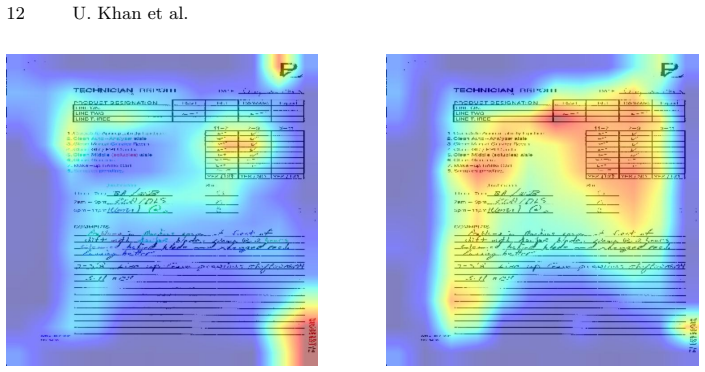
Significance. If the proposed mechanism is responsible for the gains, WordVIS is an attractive low-resource alternative to multimodal document classifiers: it avoids extra pretraining, is in principle language-agnostic, and can be plugged into existing CNN pipelines. The paper also provides qualitative attention heatmaps showing that the colorized model focuses more tightly on text regions. However, the current evidence does not isolate the semantic character-score mapping as the cause of the improvements; the missing controls, incomplete specification of the mapping, and single-dataset point estimates leave the central claim and its reproducibility questionable. The practical direction is plausible but not yet established at the level claimed.
major comments (4)
- [Sections 3.1, 3.2, and Table 2] The central claim is that the semantic character-score encoding causes the accuracy gains, but Table 2 only compares WordVIS against no preprocessing. WordVIS changes the input in at least three simultaneous ways: OCR word regions are colorized, colors are scaled by word length through M_f, and characters are mapped through a hand-chosen score table. Without controls such as a randomly permuted score table, random per-word colors, or a uniform colorization of word boxes, the reported 3-5% improvements cannot be attributed to the semantic scoring; they could arise from any deterministic colorization that highlights text. A control experiment isolating the score mapping is necessary to support the paper's main claim.
- [Sections 3.1 and 3.3] The score assignment is not reproducible as written. Section 3.1 describes a generic ascending assignment over 36 characters, but the 'deep' example in Section 3.3 uses d=3, e=5, p=7, which does not match a straightforward alphabetical ascending assignment (d=4, p=16 in a 1-based alphabet) and is inconsistent with the channel ranges in Eq. (1). The OCR-error example also appears to use p=8 for 'deeq', where the changed character is q. The exact lookup table is never provided. Without the precise mapping, the experiments cannot be replicated and the claimed robustness property is not auditable.
- [Sections 4.1 and 4.4, Table 2] The empirical evaluation rests on a single random 80/20 split of one dataset and reports only point estimates. The text states that experiments were performed multiple times to rule out standard deviation, but no variance, number of runs, or statistical test is reported. Given that the reported gains are 1.7 to 4.6 percentage points, confidence intervals or a paired analysis across repeated splits are needed before the improvements can be considered consistent; otherwise the differences could be within split-to-split noise.
- [Section 4.3 and Table 1] The claim of a new state-of-the-art record on Tobacco-3482 is not supported by a controlled comparison under identical evaluation conditions. Prior results in Table 1 come from different publications with potentially different train/validation/test protocols, while this paper uses its own random split; no error bars are reported for any baseline. To substantiate a new record, the WordVIS model and the DocXClassifier baselines should be evaluated on the same splits and with the same OCR pipeline, and the standard benchmark protocol should be followed or explicitly justified.
minor comments (6)
- [Section 3.3] The sentence before Eq. (1) says the formula is 'given below in Fig. 1 and Fig. 2', but the formula appears as equations, not in the figures; this should be corrected.
- [Sections 4.1 and 4.3] There are typos in the dataset name: 'Tabaccoo-3482' appears in Section 4.1 and in the Table 1 caption, and the name is inconsistent with 'Tobacco-3482' used elsewhere.
- [Section 3.1] The notation 'lim 1→∞ Nc' and 'lim 0→255 Cs' is nonstandard and should be replaced with clear statements about the ranges of Nc and Cs.
- [Section 4.2] The stray text 'ferrandodc' appears at the end of the training details paragraph and should be removed.
- [Section 5] The conclusion states that heatmap analysis 'drastically improve[s] the quantitative results', but the preceding discussion is about qualitative attention patterns; this appears to be a typo for 'qualitative results'.
- [Sections 3.4 and Figure 3] The example class 'ADVE' is used in the qualitative discussion, but the dataset classes are never listed; please define the ten classes of Tobacco-3482 and specify how sample documents were selected for the figures.
Circularity Check
No significant circularity: WordVIS accuracies are external benchmark results; the hand-designed color mapping is not fitted to the test labels, and the DocXClassifier self-citation serves as a baseline rather than a load-bearing derivation.
full rationale
The paper reports a deterministic preprocessing method: Section 3.1 specifies a hand-chosen character-to-score assignment, Section 3.2 defines a word-length multiplying factor, and Section 3.3 gives the RGB formulas (Eq. 1 and Eq. 2). Nothing in this construction is fitted to the Tobacco-3482 labels or to the reported accuracy values; the score table is stated to be generic and in ascending order without dataset-specific semantic knowledge. The claimed improvements are empirical outcomes of training on a fixed 80/10/10 split: Table 1 compares WordVIS DocXClassifier-B/384 (91.14%) against prior published results and against the same DocXClassifier-B/384 base (88.42%), and Table 2 compares four architectures with and without WordVIS. There is no equation by which the reported 91.14% or the 3-5% gains are derived from the scoring scheme by construction. The same-author citation to DocXClassifier (ref. 25) is used as the base architecture and for hyperparameter consistency; this is an external benchmark evaluation rather than a self-citation that supplies the paper's conclusion. The absence of a random-color control is a mechanistic attribution concern, not circularity, because it does not make the measured accuracy equivalent to the color-mapping input. The derivation chain is therefore self-contained with respect to the circularity criteria, and the appropriate finding is no significant circularity.
Assumptions & free parameters
free parameters (2)
- Per-character score Cs =
1-9 per character, exact values not disclosed
- RGB channel assignment for characters =
Not disclosed; stated as 12 characters per channel
assumptions (3)
- domain assumption OCR provides accurate word-level text and localization
- domain assumption CNN image classifiers can learn class-discriminative cues from flat RGB colors painted over words
- domain assumption The Tobacco-3482 random split and labels are reliable and comparable to prior published numbers
Cite this review
Pith. "Pith review of WordVIS: A Color Worth A Thousand Words." pith.science (2026). https://pith.science/paper/ZR6K73B2
@misc{pith2026241210155,
  author       = {Pith},
  title        = {Pith review of: WordVIS: A Color Worth A Thousand Words},
  year         = {2026},
  howpublished = {\url{https://pith.science/paper/ZR6K73B2}},
  note         = {Machine review of arXiv:2412.10155}
}
read the original abstract
Document classification is considered a critical element in automated document processing systems. In recent years multi-modal approaches have become increasingly popular for document classification. Despite their improvements, these approaches are underutilized in the industry due to their requirement for a tremendous volume of training data and extensive computational power. In this paper, we attempt to address these issues by embedding textual features directly into the visual space, allowing lightweight image-based classifiers to achieve state-of-the-art results using small-scale datasets in document classification. To evaluate the efficacy of the visual features generated from our approach on limited data, we tested on the standard dataset Tobacco-3482. Our experiments show a tremendous improvement in image-based classifiers, achieving an improvement of 4.64% using ResNet50 with no document pre-training. It also sets a new record for the best accuracy of the Tobacco-3482 dataset with a score of 91.14% using the image-based DocXClassifier with no document pre-training. The simplicity of the approach, its resource requirements, and subsequent results provide a good prospect for its use in industrial use cases.
Figures


Figures from the paper (3 more)


Reference graph
Works this paper leans on
-
[1]
Afzal, M.Z., Kolsch, A., Ahmed, S., Liwicki, M.: Cutting the Error by Half: In- vestigation of Very Deep CNN and Advanced Training Strategies for Document Image Classification. Proc. Int. Conf. Doc. Anal. Recognition, ICDAR 1, 883–888 (2017)
work page 2017
-
[2]
Afzal, M.Z., K¨ olsch, A., Ahmed, S., Liwicki, M.: Cutting the error by half: Investi- gation of very deep CNN and advanced training strategies for document image clas- sification. CoRR abs/1704.03557 (2017), http://arxiv.org/abs/1704.03557
work page Pith review arXiv 2017
-
[3]
In: Digital Image Computing: Techniques and Applications
Arif, S., Shafait, F.: Table detection in document images using foreground and background features. In: Digital Image Computing: Techniques and Applications
-
[4]
Asim, M.N., Khan, M.U.G., Malik, M.I., Razzaque, K., Dengel, A., Ahmed, S.: Two stream deep network for document image classification. Proc. Int. Conf. Doc. Anal. Recognition, ICDAR pp. 1410–1416 (2019)
work page 2019
-
[5]
Multimodal deep networks for text and image-based document classification
Audebert, N., Herold, C., Slimani, K., Vidal, C.: Multimodal deep networks for text and image-based document classification. CoRR abs/1907.06370 (2019), http://arxiv.org/abs/1907.06370
work page Pith review arXiv 2019
-
[6]
Baldi, S., Marinai, S., Soda, G.: Using tree-grammars for training set expansion in page classification. Proc. Int. Conf. Doc. Anal. Recognition, ICDAR 2003- Janua(Icdar), 829–833 (2003)
work page 2003
- [7]
-
[8]
Chen, N., Blostein, D.: A survey of document image classification: Problem state- ment, classifier architecture and performance evaluation. Int. J. Doc. Anal. Recog- nit. 10(1), 1–16 (2007)
work page 2007
Show all 29 references
-
[9]
Collins-Thompson, K., Nickolov, R.: A Clustering-Based Algorithm for Automatic Document Separation. Proc. SIGIR 2002 Work. Inf. Retr. OCR From Convert. Content to Grasping Mean. (September 2002) (2002)
2002
-
[10]
Das, A., Roy, S., Bhattacharya, U., Parui, S.K.: Document Image Classification with Intra-Domain Transfer Learning and Stacked Generalization of Deep Con- volutional Neural Networks. Proc. - Int. Conf. Pattern Recognit. 2018-Augus, 3180–3185 (2018)
2018
-
[11]
Dengel, A., Dubiel, F.: Clustering and classification of document structure-a ma- chine learning approach. Proc. Int. Conf. Doc. Anal. Recognition, ICDAR 2, 587– 591 (1995)
1995
-
[12]
CoRR abs/1909.04948 (2019), http://arxiv
Denk, T.I., Reisswig, C.: Bertgrid: Contextualized embedding for 2d document rep- resentation and understanding. CoRR abs/1909.04948 (2019), http://arxiv. org/abs/1909.04948
2019 arXiv
-
[13]
In: NAACL HLT 2019 - 2019 Conf
Devlin, J., Chang, M.W., Lee, K., Toutanova, K.: BERT: Pre-training of deep bidirectional transformers for language understanding. In: NAACL HLT 2019 - 2019 Conf. North Am. Chapter Assoc. Comput. Linguist. Hum. Lang. Technol. - Proc. Conf. vol. 1, pp. 4171–4186. Association fo...
2019
-
[14]
IEEE Trans
Diligenti, M., Frasconi, P., Gori, M.: Hidden tree Markov models for document image classification. IEEE Trans. Pattern Anal. Mach. Intell.25(4), 519–523 (2003)
2003
-
[15]
Ferrando, J., Dom ´ ınguez, J.L., Torres, J., Garc ´ ıa, R., Garc ´ ıa, D., Garrido, D., Cortada, J., Valero, M.: Improving accuracy and speeding up document image WordVIS: A Color Worth A Thousand Words 15 classification through parallel systems. Lect. Notes Comput. Sci. (inc...
2020
-
[16]
Harley, A.W., Ufkes, A., Derpanis, K.G.: Evaluation of deep convolutional nets for document image classification and retrieval. Proc. Int. Conf. Doc. Anal. Recogni- tion, ICDAR 2015-Novem, 991–995 (2015)
2015
-
[17]
Ap- plied Sciences 12(3) (2022)
Kanchi, S., Pagani, A., Mokayed, H., Liwicki, M., Stricker, D., Afzal, M.Z.: Emm- docclassifier: Efficient multimodal document image classifier for scarce data. Ap- plied Sciences 12(3) (2022). https://doi.org/10.3390/app12031457, https://www. mdpi.com/2076-3417/12/3/1457
2022 doi
-
[18]
Kang, L., Kumar, J., Ye, P., Li, Y., Doermann, D.: Convolutional neural networks for document image classification. Proc. - Int. Conf. Pattern Recognit. pp. 3168– 3172 (2014)
2014
-
[19]
CoRR abs/1809.08799 (2018), http://arxiv.org/abs/1809.08799
Katti, A.R., Reisswig, C., Guder, C., Brarda, S., Bickel, S., H¨ ohne, J., Faddoul, J.B.: Chargrid: Towards understanding 2d documents. CoRR abs/1809.08799 (2018), http://arxiv.org/abs/1809.08799
2018 arXiv
-
[20]
In: Pereira, F., Burges, C.J.C., Bottou, L., Weinberger, K.Q
Krizhevsky, A., Sutskever, I., Hinton, G.E.: Imagenet classification with deep con- volutional neural networks. In: Pereira, F., Burges, C.J.C., Bottou, L., Weinberger, K.Q. (eds.) Advances in Neural Information Processing Systems. vol. 25 (2012)
2012
-
[21]
Pattern Recognit
Kumar, J., Ye, P., Doermann, D.: Structural similarity for document image classi- fication and retrieval. Pattern Recognit. Lett. 43(1), 119–126 (2014)
2014
-
[22]
https://doi.org/10.48550/ARXIV.2105.11672, https:// arxiv.org/abs/2105.11672
Lin, W., Gao, Q., Sun, L., Zhong, Z., Hu, K., Ren, Q., Huo, Q.: Vibertgrid: A jointly trained multi-modal 2d document representation for key information extraction from documents (2021). https://doi.org/10.48550/ARXIV.2105.11672, https:// arxiv.org/abs/2105.11672
-
[23]
In: Proceedings of the 2016 ACM Symposium on Document Engineering
Noce, L., Gallo, I., Zamberletti, A., Calefati, A.: Embedded textual content for document image classification with convolutional neural networks. In: Proceedings of the 2016 ACM Symposium on Document Engineering. p. 165–173. DocEng ’16, Association for Computing Machinery, Ne...
2016
-
[24]
Powalski, R., Borchmann, L., Jurkiewicz, D., Dwojak, T., Pietruszka, M., Pa lka, G.: Going Full-TILT Boogie on Document Understanding with Text-Image-Layout Transformer. In: Doc. Anal. Recognit. – ICDAR 2021. vol. 12822 LNCS, pp. 732– 747 (2021)
2021
-
[25]
https://doi.org/10.36227/techrxiv.19310489.v2
Saifullah, Agne, S., Dengel, A., Ahmed, S.: Docxclassifier: High perfor- mance explainable deep network for document image classification (Mar 2022). https://doi.org/10.36227/techrxiv.19310489.v2
2022 doi
-
[26]
Shin, Christian and Doermann, D.: Document Image Retrieval Based on Layout Structural Similarity. Proc. 2006 Int. Conf. Image Process. Comput. Vision, Pat- tern Recognit. 2, 606–612 (2016)
2016
-
[27]
Xu, Y., Xu, Y., Lv, T., Cui, L., Wei, F., Wang, G., Lu, Y., Florencio, D., Zhang, C., Che, W., Zhang, M., Zhou, L.: LayoutLMv2: Multi-modal Pre-training for Visually-rich Document Understanding. pp. 2579–2591. Association for Computa- tional Linguistics (ACL) (dec 2021)
2021
-
[28]
Xu, Y., Li, M., Cui, L., Huang, S., Wei, F., Zhou, M.: LayoutLM: Pre-training of Text and Layout for Document Image Understanding. Proc. ACM SIGKDD Int. Conf. Knowl. Discov. Data Min. 20, 1192–1200 (2020)
2020
-
[29]
https://doi.org/10.48550/ARXIV.2004.07464, https://arxiv.org/ abs/2004.07464
Yu, W., Lu, N., Qi, X., Gong, P., Xiao, R.: Pick: Processing key informa- tion extraction from documents using improved graph learning-convolutional net- works (2020). https://doi.org/10.48550/ARXIV.2004.07464, https://arxiv.org/ abs/2004.07464
Reviewed August 11, 2026 · model on record in the stance chip above.
Discussion (0). Continue with ORCID to comment.