Local Information-Theoretic Security via Euclidean Geometry
Pith reviewed 2026-05-18 06:12 UTC · model grok-4.3
The pith
Local Euclidean approximations convert wiretap secrecy optimization into a quadratic program solved via generalized eigenvalues to yield an analytical formula for approximate local secrecy capacity.
A machine-rendered reading of the paper's core claim, the machinery that carries it, and where it could break.
Core claim
By applying local Euclidean geometric approximations to the constrained optimization of mutual information quantities in wiretap channels, the inherently non-convex problem is transformed into a tractable quadratic program; the optimal Lagrange multipliers for this program are obtained by solving a linear program whose constraints derive from the Karush-Kuhn-Tucker conditions and involve generalized eigenvalues of channel-derived matrices, thereby producing an analytical formula for the approximate local secrecy capacity together with a new class of secret local contraction coefficients characterized as the largest generalized eigenvalues of a matrix pencil that quantify the maximum ratio of
What carries the argument
Local Euclidean geometric approximations that reduce the mutual-information secrecy optimization to a quadratic program whose Lagrange multipliers are recovered from a linear program on generalized eigenvalues of channel matrices.
If this is right
- The non-convex secrecy optimization is converted into a tractable quadratic program.
- Optimal Lagrange multipliers are recovered by solving a linear program whose constraints come from KKT conditions expressed via generalized eigenvalues.
- An analytical formula for the approximate local secrecy capacity is obtained.
- Secret local contraction coefficients are defined as the largest generalized eigenvalues of a matrix pencil.
- Bounds are established relating these local coefficients to their global counterparts based on true mutual information.
Where Pith is reading between the lines
- If the approximations remain accurate for larger alphabets, the method could reduce the need for exhaustive numerical search when estimating local secrecy performance in multi-user settings.
- The eigenvalue characterization of contraction coefficients might identify channel parameters that locally maximize security efficiency without requiring full mutual-information computation.
- The same local geometric reduction could be tested on related problems such as secure key agreement or authentication to derive analogous analytical expressions.
Load-bearing premise
The local geometric approximations are accurate enough that the quadratic program and its linear-program solution for the Lagrange multipliers faithfully represent the original constrained optimization over mutual information quantities.
What would settle it
For the binary symmetric wiretap channel, compute the true local maximum of the secrecy objective by exhaustive search over input distributions near a candidate point and compare the value to the result of the quadratic-program approximation.
Figures



read the original abstract
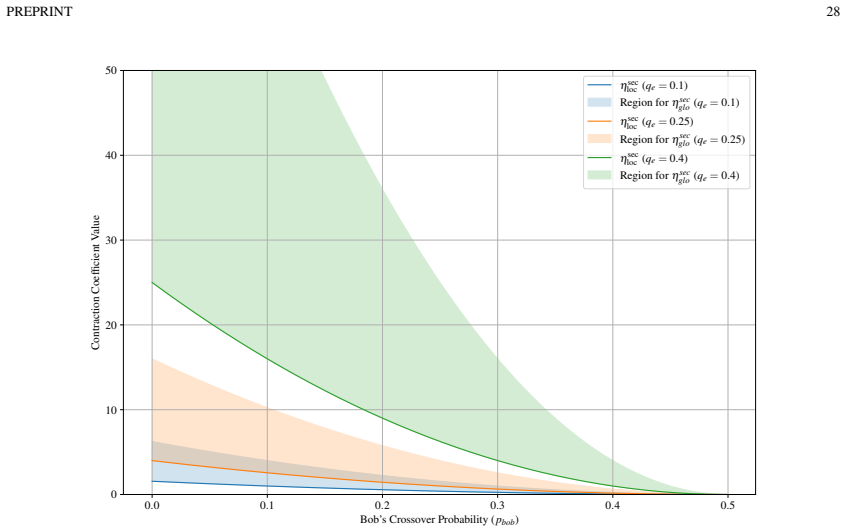
This paper introduces a methodology based on Euclidean information theory to investigate local properties of secure communication over discrete memoryless wiretap channels. We formulate a constrained optimization problem that maximizes a legitimate user's information rate while imposing explicit upper bounds on both the information leakage to an eavesdropper and the informational cost of encoding the secret message. By leveraging local geometric approximations, this inherently non-convex problem is transformed into a tractable quadratic programming structure. It is demonstrated that the optimal Lagrange multipliers governing this approximated problem can be found by solving a linear program. The constraints of this linear program are derived from Karush-Kuhn-Tucker conditions and are expressed in terms of the generalized eigenvalues of channel-derived matrices. This framework facilitates the derivation of an analytical formula for an approximate local secrecy capacity. Furthermore, we define and analyze a new class of secret local contraction coefficients. These coefficients, characterized as the largest generalized eigenvalues of a matrix pencil, quantify the maximum achievable ratio of approximate utility to approximate leakage, thus measuring the intrinsic local leakage efficiency of the channel. We establish bounds connecting these local coefficients to their global counterparts defined over true mutual information measures. The efficacy of the proposed framework is demonstrated through detailed analysis and numerical illustrations for both general multi-mode channels and the canonical binary symmetric wiretap channel.
Editorial analysis
A structured set of objections, weighed in public.
Referee Report
Summary. The paper presents a framework using Euclidean information theory to analyze local aspects of secure communications in discrete memoryless wiretap channels. It converts a non-convex optimization problem maximizing the legitimate rate under leakage and encoding cost constraints into a quadratic program through local geometric approximations of mutual informations. Optimal Lagrange multipliers are obtained by solving a linear program based on KKT conditions involving generalized eigenvalues of matrices derived from the channel. This leads to an analytical expression for an approximate local secrecy capacity and the introduction of secret local contraction coefficients, defined as the largest generalized eigenvalues of a matrix pencil, which measure the local leakage efficiency. Bounds relating these to global contraction coefficients are provided, along with numerical results for general multi-mode channels and the binary symmetric wiretap channel.
Significance. Assuming the local approximations are accurate within a suitable neighborhood, this work offers a novel analytical tool for approximating local secrecy capacities and defines new coefficients that capture the channel's local secrecy properties. The connection between local and global measures, along with the numerical validation on the binary symmetric channel, adds value to the information-theoretic security literature by providing a geometric perspective that may simplify analysis near operating points.
major comments (3)
- [Section deriving the quadratic program from local geometric approximations] The transformation of the inherently non-convex secrecy-rate maximization problem into a quadratic programming structure via local geometric approximations of mutual information quantities is load-bearing for the central claims. The manuscript does not provide explicit error bounds on the approximation or characterize the neighborhood size around the operating point where the quadratic model remains valid for the discrete memoryless wiretap channel.
- [Section on the linear program and KKT conditions] The recovery of optimal Lagrange multipliers by solving a linear program whose constraints come from KKT conditions and are expressed via generalized eigenvalues of channel-derived matrices requires a complete, verifiable derivation. Without this, the analytical formula for the approximate local secrecy capacity cannot be confirmed to faithfully represent the approximated problem.
- [Section defining and analyzing secret local contraction coefficients] The secret local contraction coefficients are defined as the largest generalized eigenvalues of a matrix pencil and bounds to global counterparts over true mutual information are claimed. The exact form of the matrix pencil and the proof of these bounds should be stated explicitly in a theorem to allow assessment of when the local coefficients meaningfully quantify leakage efficiency.
minor comments (2)
- The abstract states that efficacy is demonstrated through 'detailed analysis and numerical illustrations' for the binary symmetric wiretap channel, but a summary table of key numerical outcomes (e.g., approximated capacity values versus exact ones) would improve readability.
- [Preliminaries or notation section] Notation for the channel matrices and the matrix pencil should be introduced with explicit definitions early in the manuscript to avoid ambiguity when discussing generalized eigenvalues.
Simulated Author's Rebuttal
We thank the referee for the constructive and detailed report, which highlights both the novelty of the Euclidean-geometry approach to local secrecy and the areas where additional rigor would strengthen the presentation. We address each major comment below and will incorporate the suggested clarifications and formal statements into the revised manuscript.
read point-by-point responses
-
Referee: [Section deriving the quadratic program from local geometric approximations] The transformation of the inherently non-convex secrecy-rate maximization problem into a quadratic programming structure via local geometric approximations of mutual information quantities is load-bearing for the central claims. The manuscript does not provide explicit error bounds on the approximation or characterize the neighborhood size around the operating point where the quadratic model remains valid for the discrete memoryless wiretap channel.
Authors: We agree that explicit error bounds and a precise characterization of the neighborhood would improve the manuscript. The local quadratic model follows from the standard second-order Taylor expansion of mutual information in the Euclidean information geometry framework. In the revision we will add a new subsection that derives an explicit remainder bound using the integral form of Taylor's theorem applied to the mutual-information functional and characterizes the valid neighborhood in terms of the operator norm of the third derivative tensor, thereby quantifying when the quadratic approximation remains accurate for discrete memoryless wiretap channels. revision: yes
-
Referee: [Section on the linear program and KKT conditions] The recovery of optimal Lagrange multipliers by solving a linear program whose constraints come from KKT conditions and are expressed via generalized eigenvalues of channel-derived matrices requires a complete, verifiable derivation. Without this, the analytical formula for the approximate local secrecy capacity cannot be confirmed to faithfully represent the approximated problem.
Authors: The mapping from the KKT stationarity conditions to the linear program over generalized eigenvalues is outlined in the main text and supporting appendix. To make the derivation fully verifiable, we will expand the appendix with a self-contained, step-by-step proof that starts from the Lagrangian of the quadratic program, applies the KKT conditions, and shows how the resulting stationarity equations reduce to the generalized eigenvalue problem whose solutions yield the optimal multipliers and the closed-form expression for the approximate local secrecy capacity. revision: yes
-
Referee: [Section defining and analyzing secret local contraction coefficients] The secret local contraction coefficients are defined as the largest generalized eigenvalues of a matrix pencil and bounds to global counterparts over true mutual information are claimed. The exact form of the matrix pencil and the proof of these bounds should be stated explicitly in a theorem to allow assessment of when the local coefficients meaningfully quantify leakage efficiency.
Authors: We will add a formal theorem statement that explicitly defines the matrix pencil in terms of the Hessians of the locally approximated mutual informations (i.e., the pair of matrices constructed from the channel transition probabilities and the second-order expansions) and proves the claimed bounds by invoking the variational characterization of generalized eigenvalues together with the monotonicity properties preserved by the local Euclidean approximation near the operating point. This will clarify the regime in which the local coefficients serve as meaningful measures of leakage efficiency. revision: yes
Circularity Check
No circularity: approximate secrecy capacity and contraction coefficients derived from channel matrices via standard optimization on local approximations
full rationale
The derivation converts the constrained mutual-information maximization into a quadratic program using local Euclidean geometric approximations of the rate and leakage functions. Lagrange multipliers for the resulting QP are recovered by solving an LP whose constraints come from KKT stationarity conditions expressed via generalized eigenvalues of matrices constructed directly from the channel transition probabilities. The secret local contraction coefficients are explicitly defined as the largest generalized eigenvalues of the associated matrix pencil; this is a direct algebraic characterization of the approximated utility-to-leakage ratio, not a redefinition of the original mutual-information quantities. Bounds relating the local coefficients to their global mutual-information counterparts are stated separately and do not rely on the local quantities being identical to the global ones. No fitted parameters are renamed as predictions, no self-citations supply uniqueness theorems, and no ansatz is imported via prior work. The central results therefore remain independent of the target quantities they approximate.
Axiom & Free-Parameter Ledger
axioms (2)
- domain assumption Local geometric approximations transform the original non-convex mutual-information optimization into a tractable quadratic program whose KKT conditions yield a linear program solvable via generalized eigenvalues.
- domain assumption Generalized eigenvalues of channel-derived matrices correctly characterize the maximum ratio of approximate utility to approximate leakage.
invented entities (1)
-
secret local contraction coefficients
no independent evidence
Lean theorems connected to this paper
-
IndisputableMonolith/Cost/FunctionalEquation.leanwashburn_uniqueness_aczel unclear?
unclearRelation between the paper passage and the cited Recognition theorem.
By leveraging local geometric approximations, this inherently non-convex problem is transformed into a tractable quadratic programming structure... secret local contraction coefficients... largest generalized eigenvalues of a matrix pencil
What do these tags mean?
- matches
- The paper's claim is directly supported by a theorem in the formal canon.
- supports
- The theorem supports part of the paper's argument, but the paper may add assumptions or extra steps.
- extends
- The paper goes beyond the formal theorem; the theorem is a base layer rather than the whole result.
- uses
- The paper appears to rely on the theorem as machinery.
- contradicts
- The paper's claim conflicts with a theorem or certificate in the canon.
- unclear
- Pith found a possible connection, but the passage is too broad, indirect, or ambiguous to say the theorem truly supports the claim.
Reference graph
Works this paper leans on
-
[1]
Local approximation of secrecy capacity,
E. M. Athanasakos, N. Kalouptsidis, and H. Manjunath, “Local approximation of secrecy capacity,” inProc. European Signal Processing Conference (EUSIPCO), 2024, pp. 745–749
work page 2024
-
[2]
A mathematical theory of communication,
C. E. Shannon, “A mathematical theory of communication,”Bell System Technical Journal, vol. 27, no. 3, pp. 379–423, Jul. 1948
work page 1948
-
[3]
A. D. Wyner, “The wire-tap channel,”Bell Syst. Tech. J., vol. 54, no. 8, pp. 1355–1367, Oct. 1975
work page 1975
-
[4]
Broadcast channels with confidential messages,
I. Csiszár and J. Körner, “Broadcast channels with confidential messages,”IEEE Trans. Inf. Theory, vol. 24, no. 3, pp. 339–348, 1978
work page 1978
-
[5]
Strong secrecy on the binary erasure wiretap channel using large-girth ldpc codes,
A. Subramanian, A. Thangaraj, M. Bloch, and S. W. McLaughlin, “Strong secrecy on the binary erasure wiretap channel using large-girth ldpc codes,”IEEE Transactions on Information Forensics and Security, vol. 6, no. 3, pp. 585–594, 2011
work page 2011
-
[6]
Strong secrecy for relay wiretap channels with polar codes and double-chaining,
E. M. Athanasakos and G. Karagiannidis, “Strong secrecy for relay wiretap channels with polar codes and double-chaining,” inGLOBECOM 2020 - 2020 IEEE Global Communications Conference, 2020, pp. 1–5
work page 2020
-
[7]
Secure encoder designs based on turbo codes,
A. Katsiotis, N. Kolokotronis, and N. Kalouptsidis, “Secure encoder designs based on turbo codes,” in2015 IEEE International Conference on Communications (ICC), 2015, pp. 4315–4320
work page 2015
-
[8]
Secure coding for the gaussian wiretap channel with sparse regression codes,
E. M. Athanasakos, “Secure coding for the gaussian wiretap channel with sparse regression codes,” in2021 55th Annual Conference on Information Sciences and Systems (CISS), 2021, pp. 1–5
work page 2021
-
[9]
E. M. Athanasakos and H. Manjunath, “Sparse regression codes for secret key agreement: Achieving strong secrecy and near-optimal rates for gaussian sources,” 2025. [Online]. Available: https://arxiv.org/abs/2507.20157 PREPRINT 47
-
[10]
S. Borade and L. Zheng, “Euclidean information theory,” inInt. Zurich Seminar on Communications (IZS), Mar. 2008
work page 2008
-
[11]
Linear information coupling problems,
S.-L. Huang and L. Zheng, “Linear information coupling problems,” inProc. IEEE International Symposium on Information Theory, Jul. 2012
work page 2012
-
[12]
Euclidean information theory of networks,
S. Huang, C. Suh, and L. Zheng, “Euclidean information theory of networks,”IEEE Transactions on Information Theory, vol. 61, no. 12, pp. 6795–6814, 2015
work page 2015
-
[13]
G. L. G. Durisi and Y . Polyanskiy,Information Theoretic Perspectives on 5G Systems and Beyond. London,UK: Cambridge Univ. Press, 2020, ch. Short-packet transmission
work page 2020
-
[14]
Reliable and secure short-packet communications,
C. Feng, H.-M. Wang, and H. V . Poor, “Reliable and secure short-packet communications,”IEEE Transactions on Wireless Communications, vol. 21, no. 3, pp. 1913–1926, 2022
work page 1913
-
[15]
The information bottleneck method
N. Tishby, F. C. Pereira, and W. Bialek, “The information bottleneck method,” inProc. of the 37-th Annual Allerton Conference on Communication, Control and Computing, 1999, pp. 368–377. [Online]. Available: https://arxiv.org/abs/physics/0004057
work page internal anchor Pith review Pith/arXiv arXiv 1999
-
[16]
From the information bottleneck to the privacy funnel,
A. Makhdoumi, S. Salamatian, N. Fawaz, and M. Médard, “From the information bottleneck to the privacy funnel,” in 2014 IEEE Information Theory Workshop (ITW 2014), 2014, pp. 501–505
work page 2014
-
[17]
Optimal privacy-utility trade-off under a rate constraint,
S. Sreekumar and D. Gündüz, “Optimal privacy-utility trade-off under a rate constraint,” in2019 IEEE International Symposium on Information Theory (ISIT), 2019, pp. 2159–2163
work page 2019
-
[18]
Data disclosure with non-zero leakage and non-invertible leakage matrix,
A. Zamani, T. J. Oechtering, and M. Skoglund, “Data disclosure with non-zero leakage and non-invertible leakage matrix,” IEEE Transactions on Information Forensics and Security, vol. 17, pp. 165–179, 2022
work page 2022
-
[19]
Privacy-utility trade-off of linear regression under random projections and additive noise,
M. Showkatbakhsh, C. Karakus, and S. Diggavi, “Privacy-utility trade-off of linear regression under random projections and additive noise,” in2018 IEEE International Symposium on Information Theory (ISIT). IEEE, Jun. 2018, p. 186–190. [Online]. Available: http://dx.doi.org/10.1109/ISIT.2018.8437722
-
[20]
Long-term conversation analysis: Privacy-utility trade-off under noise and reverberation,
J. Pohlhausen, F. Nespoli, and J. Bitzer, “Long-term conversation analysis: Privacy-utility trade-off under noise and reverberation,” 2024. [Online]. Available: https://arxiv.org/abs/2408.00382
-
[21]
Tight analysis of privacy and utility tradeoff in approximate differential privacy,
Q. Geng, W. Ding, R. Guo, and S. Kumar, “Tight analysis of privacy and utility tradeoff in approximate differential privacy,” inProceedings of the Twenty Third International Conference on Artificial Intelligence and Statistics, ser. Proceedings of Machine Learning Research, S. Chiappa and R. Calandra, Eds., vol. 108. PMLR, 26–28 Aug 2020, pp. 89–99
work page 2020
-
[22]
Information-theoretic bounds for differentially private mechanisms,
G. Barthe and B. Kopf, “Information-theoretic bounds for differentially private mechanisms,” in2011 IEEE 24th Computer Security Foundations Symposium, 2011, pp. 191–204
work page 2011
-
[23]
Hypothesis testing under mutual information privacy constraints in the high privacy regime,
J. Liao, L. Sankar, V . Y . F. Tan, and F. du Pin Calmon, “Hypothesis testing under mutual information privacy constraints in the high privacy regime,”IEEE Transactions on Information Forensics and Security, vol. 13, no. 4, pp. 1058–1071, 2018
work page 2018
-
[24]
Distributed hypothesis testing with privacy constraints,
A. Gilani, S. B. Amor, S. Salehkalaibar, and V . Y . F. Tan, “Distributed hypothesis testing with privacy constraints,”Entropy, vol. 21, no. 5, p. 478, 2019
work page 2019
-
[25]
Privacy-utility tradeoff for hypothesis testing over a noisy channel,
L. Zhou and D. Cao, “Privacy-utility tradeoff for hypothesis testing over a noisy channel,”IEEE Transactions on Information Forensics and Security, vol. 16, pp. 4078–4091, 2021
work page 2021
-
[26]
Dissipation of information in channels with input constraints,
Y . Polyanskiy and Y . Wu, “Dissipation of information in channels with input constraints,”IEEE Trans. Inf. Theory, vol. 62, no. 1, pp. 35–55, 2016
work page 2016
-
[27]
Lecture notes on information theory,
——, “Lecture notes on information theory,” http://people.lids.mit.edu/yp/homepage/data/itlecturesv5.pdf, 2019
work page 2019
-
[28]
Strong data-processing inequalities for channels and bayesian networks,
——, “Strong data-processing inequalities for channels and bayesian networks,” inConvexity and Concentration. Springer New York
-
[29]
On hypercontractivity and the mutual information between boolean functions,
V . Anantharam, A. Gohari, S. Kamath, and C. Nair, “On hypercontractivity and the mutual information between boolean functions,” inProc. 51st Annual Allerton Conference on Communication, Control and Computing, Illinois, USA, Oct. 2013, pp. 13–19
work page 2013
-
[30]
Bounds between contraction coefficients,
A. Makur and L. Zheng, “Bounds between contraction coefficients,” inProc. 53rd Annual Allerton Conference on Communication, Control, and Computing (Allerton), Monticello, IL, 2015, pp. 1422–1429
work page 2015
-
[31]
On estimation of modal decompositions,
A. Makur, G. W. Wornell, and L. Zheng, “On estimation of modal decompositions,” inProc. IEEE International Symposium on Information Theory (ISIT), 2020, pp. 2717–2722
work page 2020
-
[32]
Linear Bounds between Contraction Coefficients for $f$-Divergences
A. Makur and L. Zheng, “Linear bounds between contraction coefficients for𝑓-divergences,” 2018. [Online]. Available: https://arxiv.org/abs/1510.01844
work page internal anchor Pith review Pith/arXiv arXiv 2018
-
[33]
A. Rényi, “On measures of dependence,”Acta Mathematica Academiae Scientiarum Hungarica, vol. 10, no. 3-4, pp. 441–451, 1959
work page 1959
-
[34]
S. Kamath and V . Anantharam, “Non-interactive simulation of joint distributions: The hirschfeld-gebelein-renyi maximal correlation and the hypercontractivity ribbon,” inProc. 50th Annual Allerton Conference on Communication, Control and Computing, Illinois, USA, Oct. 2012, pp. 1057–1064
work page 2012
-
[35]
V . Anantharam, A. Gohari, S. Kamath, and C. Nair, “On maximal correlation, hypercontractivity, and the data processing inequality studied by erkip and cover,” arXiv:1304.6133 [cs.IT], Apr. 2013
work page internal anchor Pith review Pith/arXiv arXiv 2013
-
[36]
Information extraction under privacy constraints,
S. Asoodeh, M. Diaz, F. Alajaji, and T. Linder, “Information extraction under privacy constraints,”Entropy, vol. 18, no. 2, p. 67, 2016
work page 2016
-
[37]
On maximal correlation, mutual information and data privacy,
S. Asoodeh, F. Alajaji, and T. Linder, “On maximal correlation, mutual information and data privacy,” inProc. IEEE 14th Canadian Workshop on Information Theory (CWIT), 2015, pp. 27–31
work page 2015
-
[38]
C. T. Li and A. E. Gamal, “Maximal correlation secrecy,”IEEE Transactions on Information Theory, vol. 64, no. 5, pp. 3916–3926, 2018
work page 2018
-
[39]
C. T. Li and A. El Gamal, “Maximal correlation secrecy,” in2015 IEEE International Symposium on Information Theory (ISIT), 2015, pp. 2939–2943
work page 2015
-
[40]
Maximal information leakage based privacy preserving data disclosure mechanisms,
T. Xiao and A. Khisti, “Maximal information leakage based privacy preserving data disclosure mechanisms,” in2019 16th Canadian Workshop on Information Theory (CWIT), 2019, pp. 1–6. PREPRINT 48
work page 2019
-
[41]
First- and second-order asymptotics in covert communication,
M. Tahmasbi and M. R. Bloch, “First- and second-order asymptotics in covert communication,”IEEE Transactions on Information Theory, vol. 65, no. 4, p. 2190–2212, Apr. 2019. [Online]. Available: http://dx.doi.org/10.1109/TIT.2018.2878526
-
[42]
M. Bloch and J. Barros,Physical-Layer Security: from Information Theory to Security Engineering. Cambridge, UK: Cambridge University Press, 2011
work page 2011
-
[43]
Information-theoretic key agreement: From weak to strong secrecy for free,
U. Maurer and S. Wolf, “Information-theoretic key agreement: From weak to strong secrecy for free,” inInt. Conf. Theory Applications Cryptographic Techn., Bruges, Belgium, May 2000, pp. 351–368
work page 2000
-
[44]
Extracting relevant structures with side information,
G. Chechik and N. Tishby, “Extracting relevant structures with side information,” inAdvances in Neural Information Processing Systems 15, S. Becker, S. Thrun, and K. Obermayer, Eds. MIT Press, 2003, pp. 689–696
work page 2003
-
[45]
S. Boyd and L. Vandenberghe,Convex Optimization. Cambridge: Cambridge University Press, 2004
work page 2004
-
[46]
Computation of channel capacity and rate-distortion functions,
R. E. Blahut, “Computation of channel capacity and rate-distortion functions,”IEEE Transactions on Information Theory, vol. 18, no. 4, pp. 460–473, Jul. 1972
work page 1972
-
[47]
An algorithm for computing the capacity of an arbitrary discrete memoryless channel,
S. Arimoto, “An algorithm for computing the capacity of an arbitrary discrete memoryless channel,”IEEE Transactions on Information Theory, vol. 18, no. 1, pp. 14–20, Jan. 1972
work page 1972
-
[48]
T. M. Cover and J. A. Thomas,Elements of Information Theory, 2nd ed. Wiley-Interscience, 2006
work page 2006
-
[49]
Information-type measures of difference of probability distributions and indirect observations,
I. Csiszár, “Information-type measures of difference of probability distributions and indirect observations,”Studia Sci. Math. Hungarica, vol. 2, pp. 299–318, 1967
work page 1967
-
[50]
On universal features for high-dimensional learning and inference,
S.-L. Huang, A. Makur, L. Zheng, and G. W. Wornell, “On universal features for high-dimensional learning and inference,” Foundations and Trends in Communications and Information Theory, 2021
work page 2021
-
[51]
A new data processing inequality and its applications in distributed source and channel coding,
W. Kang and S. Ulukus, “A new data processing inequality and its applications in distributed source and channel coding,” IEEE Transactions on Information Theory, vol. 57, no. 1, pp. 56–69, 2011
work page 2011
-
[52]
A. E. Gamal and Y .-H. Kim,Network Information Theory. Cambridge University Press, 2011
work page 2011
-
[53]
I. Csiszár and J. Körner,Information Theory: Coding Theorems for Discrete Memoryless Systems, 2nd ed. Cambridge, UK: Cambridge University Press, 2011
work page 2011
-
[54]
R. A. Horn and C. R. Johnson,Matrix Analysis, 2nd ed. Cambridge; New York: Cambridge University Press, 2013
work page 2013
-
[55]
K. B. Petersen and M. S. Pedersen, “The matrix cookbook,” Technical University of Denmark, Tech. Rep., 2008, version 7.15 or similar, available online
work page 2008
-
[56]
G. H. Golub and C. F. V . Loan,Matrix computations. The Johns Hopkins University Press, 2012, vol. 3
work page 2012
-
[57]
The rayleigh principle for finding eigenvalues,
E. Croot, “The rayleigh principle for finding eigenvalues,” Georgia Institute of Technology, School of Mathematics, Tech. Rep., 2005
work page 2005
-
[58]
D. Bertsimas and J. N. Tsitsiklis,Introduction to Linear Optimization. Belmont, MA: Athena Scientific, 1997
work page 1997
discussion (0)
Sign in with ORCID, Apple, or X to comment. Anyone can read and Pith papers without signing in.