Dynamical Tsallis WIMP Freeze-Out and Residual Memory Channels in the Radiation Sector
Pith reviewed 2026-06-29 10:31 UTC · model grok-4.3
The pith
A Tsallis nonextensive deformation applied only to dark matter during freeze-out can carry over to the radiation sector and still match current limits on the effective neutrino number.
A machine-rendered reading of the paper's core claim, the machinery that carries it, and where it could break.
Core claim
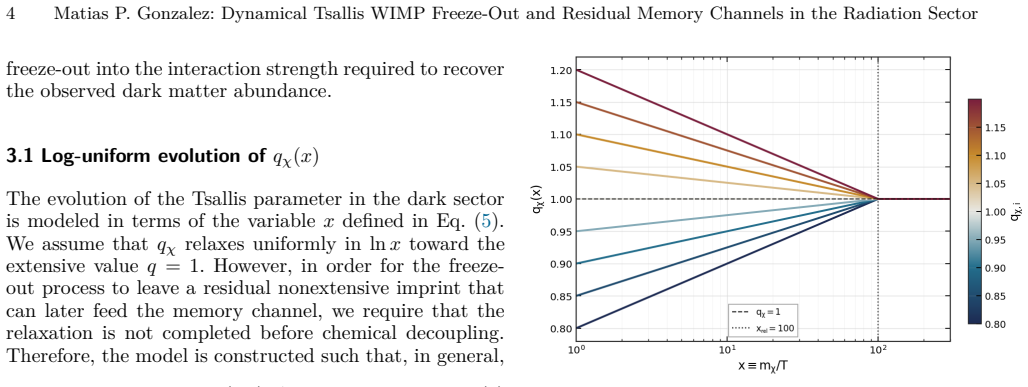
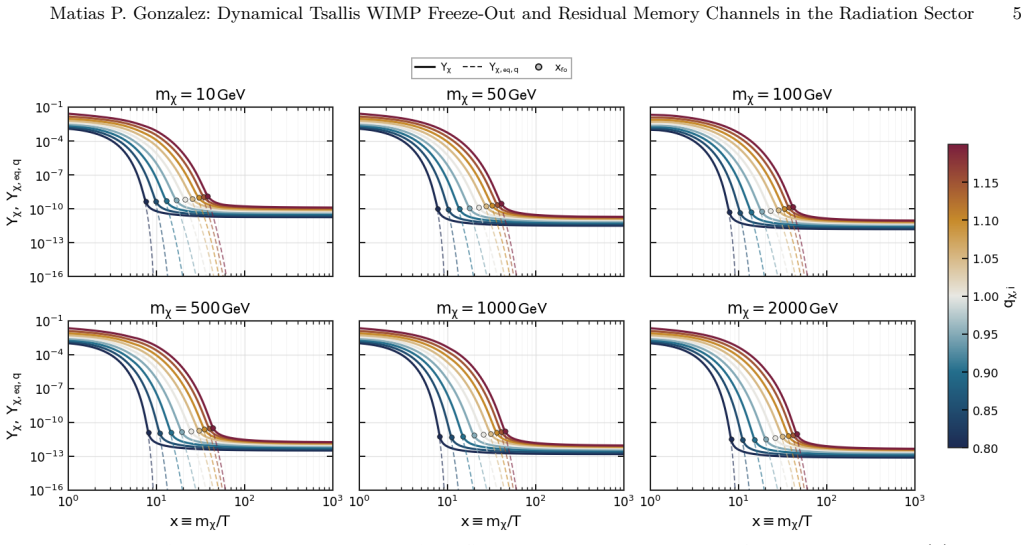
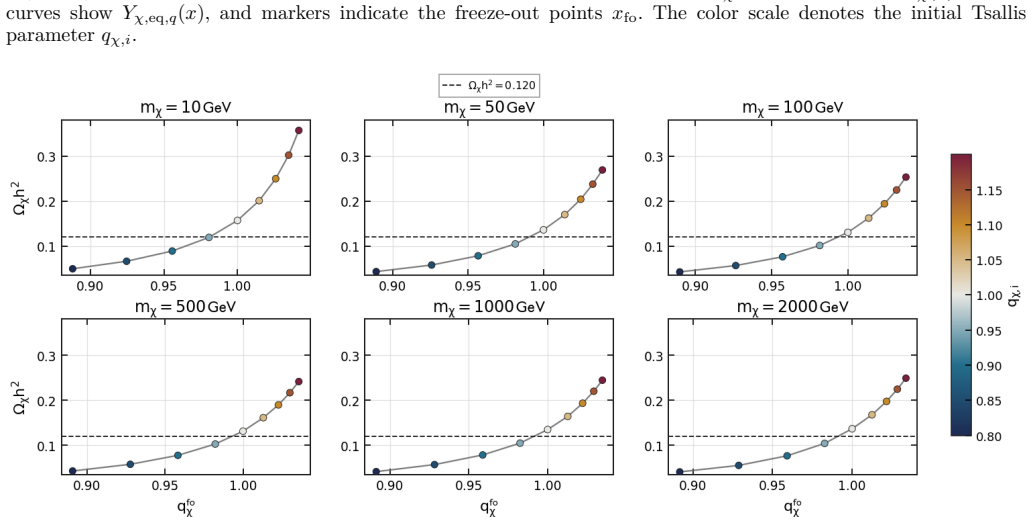
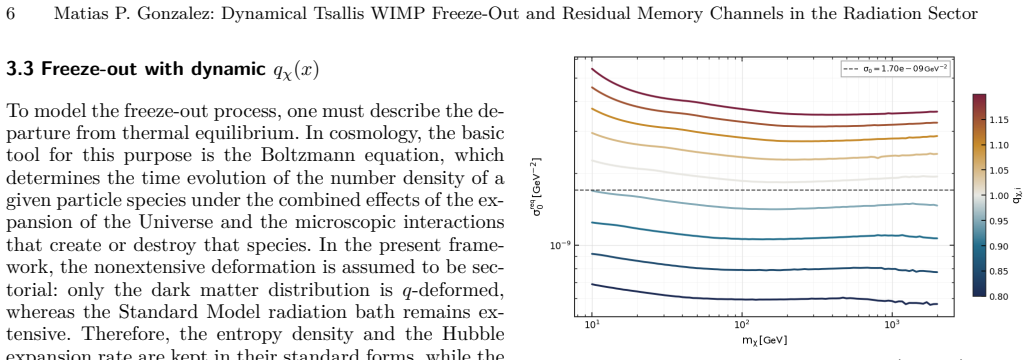
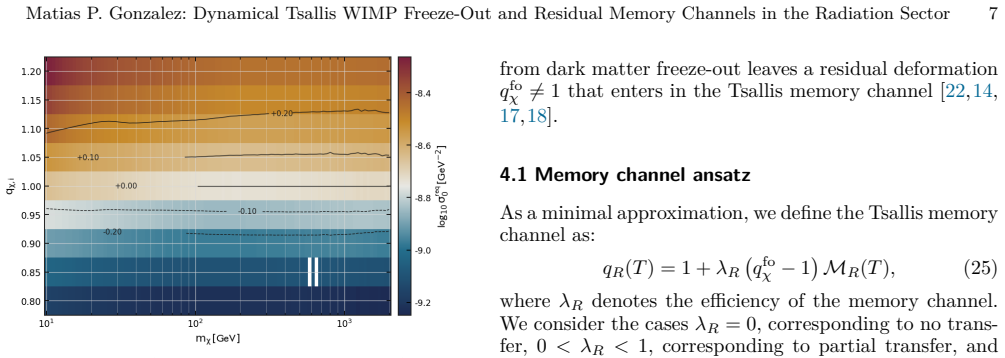
The Tsallis parameter q is made dynamical as a function of x = m_χ/T that relaxes toward the extensive limit q = 1, but not fully before freeze-out occurs. Under the sectorial deformation the relic density is computed for various masses and initial q, yielding a residual q at freeze-out that seeds a memory channel deforming only the neutrino and electron-positron sectors. This produces a correction to N_eff whose magnitude remains within the compressed CMB+BAO constraint for the explored parameter space.
What carries the argument
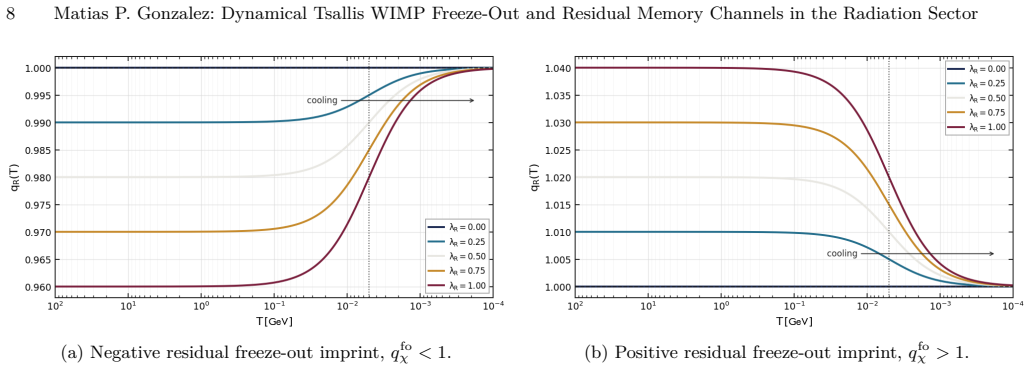
Dynamical q(x) obtained from maximum entropy with Curado-Tsallis constraints, evolving toward q=1 while preserving nonextensivity until freeze-out, and the subsequent residual-memory channel into the radiation sector.
If this is right
- Different initial q and masses produce different residual q_fo and thus different N_eff shifts.
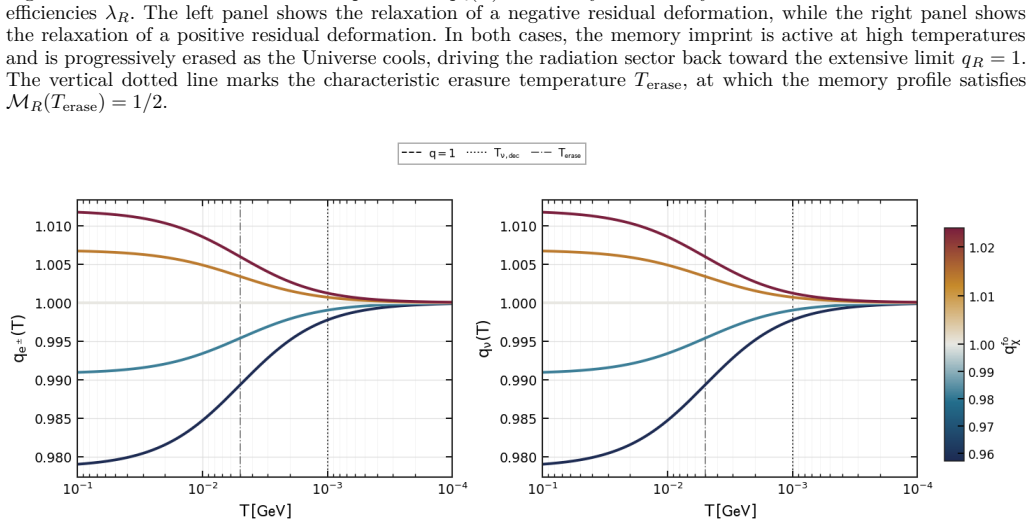
- The memory channel specifically alters neutrino energy density and photon reheating.
- Compatibility with bounds holds provided photons remain extensive.
- The scenario requires that nonextensivity is not erased before freeze-out.
Where Pith is reading between the lines
- Such a mechanism could be tested by future more precise N_eff measurements from CMB experiments.
- Extending the deformation to include photons would require new constraints from CMB spectral distortions.
- The approach opens a path to explore nonextensive effects in other early-universe processes like baryogenesis.
Load-bearing premise
That the nonextensive effects can be isolated to dark matter during freeze-out and then selectively transferred only to the electron-positron and neutrino components of the radiation sector.
What would settle it
An observation of N_eff outside the range allowed by the model for any choice of initial q and dark matter mass would rule out the residual-memory scenario as presented.
Figures
read the original abstract
In this work we generalize the thermal decoupling, or freeze-out, of weakly interacting massive particle dark matter within the Tsallis nonextensive formalism. The generalization is implemented through $q$-deformed distribution functions obtained from the maximum entropy principle with Curado-Tsallis constraints. The Tsallis parameter $q$, which measures deviations from extensivity with respect to the limit $q=1$, is promoted to a dynamical quantity depending on the dimensionless variable $x=m_\chi/T$, where $m_\chi$ is the dark matter mass. This dynamical evolution is characterized by a relaxation toward extensivity, while requiring that the nonextensive deformation is not completely erased before freeze-out. We solve the Boltzmann equation assuming a sectorial deformation, where only the dark matter equilibrium abundance is generalized and the radiation background remains extensive. The relic abundance is computed for different dark matter masses and initial values of the Tsallis parameter. From this evolution, we extract the residual value $q_\chi^{\rm fo}$ at freeze-out, which is then used as the initial input for a phenomenological memory channel. This channel propagates the residual nonextensivity into the radiation sector, specifically into the electron-positron plasma and neutrinos, while photons are kept extensive in order to avoid direct tensions with CMB physics. The resulting deformation modifies the neutrino energy density and the photon reheating contribution, producing a correction to $N_{\rm eff}$. We compare the predicted values with the compressed CMB+BAO constraint on $N_{\rm eff}$ and find that the residual-memory scenario can remain phenomenologically compatible with current bounds.
Editorial analysis
A structured set of objections, weighed in public.
Referee Report
Summary. The manuscript generalizes WIMP dark matter freeze-out in the Tsallis nonextensive formalism by promoting q to a dynamical q(x) that relaxes toward extensivity (q=1). It solves the Boltzmann equation under a sectorial deformation (only DM equilibrium abundance is q-deformed; radiation remains extensive), computes relic abundances for varying m_χ and initial q, extracts the residual q_χ^fo at freeze-out, and feeds this into a phenomenological memory channel. The channel selectively deforms the e+e- and neutrino distributions while keeping photons extensive, yielding a correction to N_eff that is claimed to remain compatible with compressed CMB+BAO bounds.
Significance. If internally consistent, the work supplies a concrete mechanism linking dynamical nonextensivity in the dark sector to residual imprints on radiation observables via a memory channel, thereby offering a new phenomenological handle on Tsallis statistics in cosmology that avoids direct tension with photon-based CMB constraints. The explicit extraction of q_χ^fo and its propagation to ΔN_eff constitutes a falsifiable prediction once the modeling choices are fixed.
major comments (2)
- [Abstract (description of memory channel and sectorial deformation)] The central construction rests on a sectorial deformation during freeze-out (DM only) followed by selective post-freeze-out propagation into e+e- and neutrinos while photons remain strictly extensive. No explicit consistency condition—such as joint entropy maximization across sectors or conservation of the total energy-momentum tensor—is provided to justify that this selective deformation can occur without back-reaction on the photon bath or violation of the extensive radiation background maintained earlier. This assumption is load-bearing for the reliability of the extracted ΔN_eff and the compatibility statement.
- [Abstract (extraction of q_χ^fo and memory channel)] The residual q_χ^fo is obtained from an evolution whose initial value and relaxation law are free modeling choices; this value is then used as direct input to the memory channel. The resulting ΔN_eff is therefore shaped by construction by the same assumptions that define the evolution, raising a circularity concern that must be addressed (e.g., by showing that the compatibility window survives independent variation of the relaxation law or by deriving q(x) from a more constrained dynamical principle).
Simulated Author's Rebuttal
We thank the referee for the thorough review and for highlighting the key assumptions in our phenomenological construction. We provide point-by-point responses to the major comments and indicate the revisions we will make to strengthen the manuscript.
read point-by-point responses
-
Referee: [Abstract (description of memory channel and sectorial deformation)] The central construction rests on a sectorial deformation during freeze-out (DM only) followed by selective post-freeze-out propagation into e+e- and neutrinos while photons remain strictly extensive. No explicit consistency condition—such as joint entropy maximization across sectors or conservation of the total energy-momentum tensor—is provided to justify that this selective deformation can occur without back-reaction on the photon bath or violation of the extensive radiation background maintained earlier. This assumption is load-bearing for the reliability of the extracted ΔN_eff and the compatibility statement.
Authors: We agree that the sectorial deformation and the selective memory channel are phenomenological assumptions without a derived consistency condition from joint entropy maximization or global energy-momentum conservation. The manuscript presents this as an exploratory model to investigate possible residual nonextensivity effects while preserving compatibility with photon-based observations. In the revised version, we will add a dedicated paragraph in the introduction and discussion sections explicitly stating these assumptions and their limitations, including a note that a more fundamental embedding would require a multi-sector Tsallis framework which is left for future work. This addresses the load-bearing nature by making the modeling choices transparent. revision: partial
-
Referee: [Abstract (extraction of q_χ^fo and memory channel)] The residual q_χ^fo is obtained from an evolution whose initial value and relaxation law are free modeling choices; this value is then used as direct input to the memory channel. The resulting ΔN_eff is therefore shaped by construction by the same assumptions that define the evolution, raising a circularity concern that must be addressed (e.g., by showing that the compatibility window survives independent variation of the relaxation law or by deriving q(x) from a more constrained dynamical principle).
Authors: The initial value of q and the form of the relaxation law are indeed modeling choices, as the dynamical q(x) is introduced phenomenologically. The value q_χ^fo is extracted from the solution of the Boltzmann equation under these choices and then propagated. To address the potential circularity, in the revised manuscript we will include an additional analysis varying the relaxation timescale independently over a range of values and demonstrate that the resulting ΔN_eff remains within the observational bounds for a substantial portion of the parameter space. We will also discuss the possibility of deriving the relaxation law from a more constrained principle, such as a specific interaction term, though a full derivation is beyond the current scope. revision: yes
Circularity Check
No significant circularity; phenomenological model with explicit inputs checked against external bounds
full rationale
The paper defines a dynamical q(x) with free initial value and relaxation law, solves the Boltzmann equation under an explicit sectorial-deformation assumption (DM only), extracts the resulting q_fo, and feeds it into a separate phenomenological memory channel to obtain a Delta N_eff correction that is then compared to CMB+BAO data for compatibility. This is a standard model-building and parameter-scan procedure whose output depends on the stated modeling choices; it does not reduce any claimed prediction to its inputs by construction, nor does it rely on load-bearing self-citations or uniqueness theorems. The central claim is merely that certain choices remain compatible with bounds, which is externally falsifiable and does not constitute circular reasoning.
Axiom & Free-Parameter Ledger
free parameters (2)
- initial Tsallis parameter q
- relaxation law for q(x)
axioms (2)
- domain assumption Maximum entropy principle with Curado-Tsallis constraints yields q-deformed distributions
- ad hoc to paper Sectorial deformation where only dark matter is nonextensive and radiation is extensive
invented entities (2)
-
dynamical Tsallis parameter q(x)
no independent evidence
-
residual memory channel
no independent evidence
Reference graph
Works this paper leans on
-
[1]
Dodelson,Modern Cosmology(Academic Press, San Diego, 2003)
S. Dodelson,Modern Cosmology(Academic Press, San Diego, 2003)
2003
-
[2]
Weinberg,Cosmology(Oxford University Press, Oxford, 2008)
S. Weinberg,Cosmology(Oxford University Press, Oxford, 2008)
2008
-
[3]
Planck 2018 results. VI. Cosmological parameters
N. Aghanim et al. [Planck Collaboration], “Planck 2018 results. VI. Cosmological parameters,” Astron. Astro- phys.641, A6 (2020). doi: 10.1051/0004-6361/201833910; arXiv:1807.06209
work page internal anchor Pith review Pith/arXiv arXiv doi:10.1051/0004-6361/201833910 2018
-
[4]
Particle Dark Matter: Evidence, Candidates and Constraints
G. Bertone, D. Hooper and J. Silk, “Particle dark mat- ter: Evidence, candidates and constraints,” Phys. Rept. 405, 279–390 (2005). doi: 10.1016/j.physrep.2004.08.031; arXiv:hep-ph/0404175
work page internal anchor Pith review Pith/arXiv arXiv doi:10.1016/j.physrep.2004.08.031 2005
-
[5]
E. W. Kolb and M. S. Turner,The Early Universe (Addison-Wesley, Redwood City, 1990)
1990
-
[6]
Lesgourgues, G
J. Lesgourgues, G. Mangano, G. Miele and S. Pastor,Neu- trino Cosmology(CambridgeUniversityPress,Cambridge, 2013)
2013
-
[7]
Relic neutrino decoupling including flavour oscillations
G. Mangano, G. Miele, S. Pastor, T. Pinto, O. Pisanti and P. D. Serpico, “Relic neutrino decoupling including flavour oscillations,” Nucl. Phys. B729, 221–234 (2005). doi: 10.1016/j.nuclphysb.2005.09.041; arXiv:hep-ph/0506164
work page internal anchor Pith review Pith/arXiv arXiv doi:10.1016/j.nuclphysb.2005.09.041 2005
-
[8]
J. J. Bennett, G. Buldgen, P. F. de Salas, M. Drewes, S. Gariazzo, S. Pastor and Y. Y. Y. Wong, “Towards a precision calculation ofN eff in the Standard Model II: Neutrino decoupling in the presence of flavour oscillations and finite-temperature QED,” JCAP04, 073 (2021). doi: 10.1088/1475-7516/2021/04/073; arXiv:2012.02726
-
[9]
C. Tsallis, J. Stat. Phys.52, 479 (1988). doi: 10.1007/BF01016429
-
[10]
Tsallis,Introduction to Nonextensive Statistical Me- chanics: Approaching a Complex World(Springer, New York, 2009)
C. Tsallis,Introduction to Nonextensive Statistical Me- chanics: Approaching a Complex World(Springer, New York, 2009)
2009
-
[11]
E. M. F. Curado and C. Tsallis, J. Phys. A24, L69 (1991); Errata: J. Phys. A24, 3187 (1991); J. Phys. A25, 1019 (1992). doi: 10.1088/0305-4470/24/2/004
-
[12]
C. Tsallis, R. S. Mendes and A. R. Plastino, Physica A 261, 534–554 (1998). doi: 10.1016/S0378-4371(98)00437- 3. Matias P. Gonzalez: Dynamical Tsallis WIMP Freeze-Out and Residual Memory Channels in the Radiation Sector 13
-
[13]
Dark matter freeze out with Tsallis statistics in the early Universe,
T. D. Rueter, T. G. Rizzo and J. L. Hewett, “Dark matter freeze out with Tsallis statistics in the early Universe,” arXiv:1911.11254 [hep-ph] (2020)
-
[14]
WIMP freeze-out dynamics under Tsallis statistics,
M. P. Gonzalez and R. A. Lineros, “WIMP freeze-out dynamics under Tsallis statistics,” Phys. Dark Univ.52, 102241 (2026). doi: 10.1016/j.dark.2026.102241
-
[15]
J. Froustey, C. Pitrou and M. C. Volpe, “Neutrino de- coupling including flavour oscillations and primordial nu- cleosynthesis,” JCAP12, 015 (2020). doi: 10.1088/1475- 7516/2020/12/015; arXiv:2008.01074
-
[16]
A precision calculation of relic neutrino decoupling,
K. Akita and M. Yamaguchi, “A precision calculation of relic neutrino decoupling,” JCAP08, 012 (2020). doi: 10.1088/1475-7516/2020/08/012; arXiv:2005.07047
-
[17]
Constraining Tsallis Corrections to Photon Reheating from Electron-Positron Annihilation
M. P. Gonzalez, “Constraining Tsallis Corrections to Photon Reheating from Electron-Positron Annihilation,” arXiv:2605.03223 [hep-ph] (2026)
work page internal anchor Pith review Pith/arXiv arXiv 2026
-
[18]
Bounds on the Tsallis parameter from a deformed neutrino sector in the early Universe,
M. P. Gonzalez, “Bounds on the Tsallis parameter from a deformed neutrino sector in the early Universe,” Eur. Phys. J. C86, 318 (2026). doi: 10.1140/epjc/s10052-026- 15600-8
-
[19]
Cosmic abundances of stable particles: Improved analysis,
P. Gondolo and G. Gelmini, “Cosmic abundances of stable particles: Improved analysis,” Nucl. Phys. B360, 145–179 (1991). doi: 10.1016/0550-3213(91)90438-4
-
[20]
G.Jungman,M.KamionkowskiandK.Griest,“Supersym- metricdarkmatter,”Phys.Rept.267,195–373(1996).doi: 10.1016/0370-1573(95)00058-5
-
[21]
Precise Relic WIMP Abundance and its Impact on Searches for Dark Matter Annihilation
G. Steigman, B. Dasgupta and J. F. Beacom, “Precise relic WIMPabundanceanditsimpactonsearchesfordarkmat- ter annihilation,” Phys. Rev. D86, 023506 (2012). doi: 10.1103/PhysRevD.86.023506; arXiv:1204.3622
work page internal anchor Pith review Pith/arXiv arXiv doi:10.1103/physrevd.86.023506 2012
-
[22]
P. Jizba and G. Lambiase, “Constraints on Tsallis cosmol- ogy from Big Bang nucleosynthesis and the relic abun- dance of cold dark matter particles,” Entropy25, 1495 (2023). doi: 10.3390/e25111495; arXiv:2310.19045
-
[23]
Relic neutrino decoupling with flavour oscillations revisited
P. F. de Salas and S. Pastor, “Relic neutrino decoupling with flavour oscillations revisited,” JCAP07, 051 (2016). doi: 10.1088/1475-7516/2016/07/051; arXiv:1606.06986
work page internal anchor Pith review Pith/arXiv arXiv doi:10.1088/1475-7516/2016/07/051 2016
-
[24]
M. Escudero Abenza, “Precision early universe thermody- namics made simple:Neff and neutrino decoupling in the Standard Model and beyond,” JCAP05, 048 (2020). doi: 10.1088/1475-7516/2020/05/048; arXiv:2001.04466
discussion (0)
Sign in with ORCID, Apple, or X to comment. Anyone can read and Pith papers without signing in.