REVIEW 2 major objections 4 minor 28 references
Unsupervised Rhythm and Voice Conversion to Improve ASR on Dysarthric Speech
T0 review · 2 major / 4 minor · reviewed 2026-08-07 · deepseek-v4-flash
Pith's one-line read Unsupervised rhythm and voice conversion, applied to dysarthric speech before recognition, cuts sentence word error rate from 31.2 to 15.9 percent.
desk verdict A genuinely useful syllable-level rhythm model for dysarthric ASR, with a large real LF-MMI gain, but the vocoded baseline and missing error bars leave the complementarity claim unproven. read the letter →
The pith
A machine-rendered reading of the paper's core claim, the machinery that carries it, and where it could break.
The reading
What carries the argument
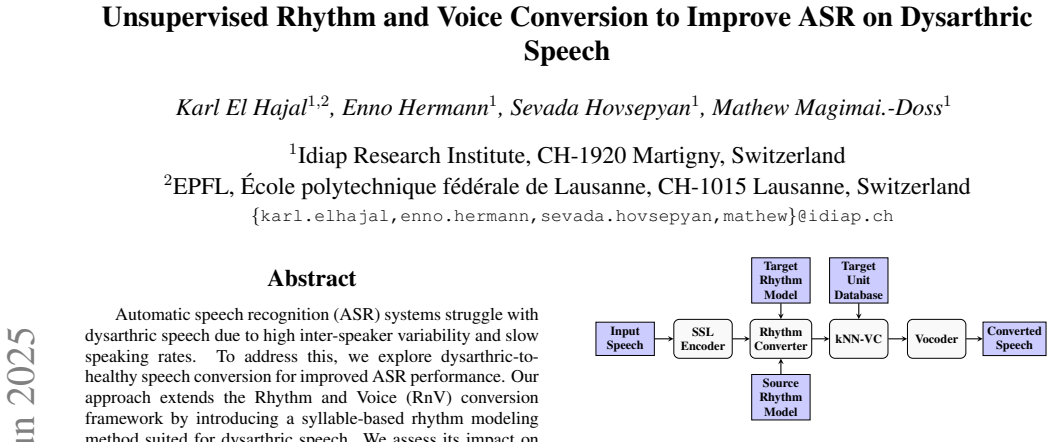
The mechanism that carries the result is a two-stage conversion pipeline applied to both training and test speech. In the rhythm stage, syllable boundaries are found from peaks of the sonority envelope, and peaks lying in silence-classified regions are discarded using the same unsupervised discrete-unit clustering that labels silences, sonorants, and obstruents; speakers are then characterized by syllables per second or by a gamma distribution fitted to syllable durations. Rhythm conversion time-stretches the utterance by the ratio of source and target speaking rates, or maps each source syllable duration to the same percentile of the target speaker's duration distribution. In the voice stage, kNN-VC replaces each source self-supervised speech unit with a weighted average of the nearest target-speaker units, and a HiFi-GAN vocoder reconstructs the waveform. These stages are evaluated separately and together to show their complementary effect.
What would settle it
Run matched conditions on the same dysarthric utterances—vocoded with no modification, time-stretched to the target speaking rate with no voice change, voice-converted with no timing change, and both conversions—and compare LF-MMI sentence WER. If the vocoded condition alone reproduces most of the drop from 31.2 to 15.9, or if arbitrary time-stretching gives the same gain as the syllable-rate conversion, then the paper's attribution of the gain to the specific rhythm and voice modifications would be contradicted.
Extended reading notes
Core claim
The paper's central claim is that rhythm conversion and voice conversion act on different sources of error in dysarthric ASR and are complementary. Each method alone improves a from-scratch LF-MMI system, and the combined pipeline yields the best result: 15.9 percent sentence WER versus 31.2 percent for original speech and 24.8 percent for the vocoder-only baseline. The proposed syllable-based rhythm model is what enables the improvement over the earlier framework: it detects syllables through the sonority envelope, filters out non-speech peaks with an unsupervised discrete-unit segmentation, and models each speaker by either a global syllables-per-second rate or a gamma distribution of syllable durations. This rhythm model separates dysarthric severity levels more cleanly than the earlier sonorant-counting method, and the fine-grained version beats its predecessor while staying comparable to global time-stretching. The paper concludes that converting all dysarthric training and test data to a single healthy target voice reduces inter-speaker variation, which is especially valuable for severe cases.
Load-bearing premise
The load-bearing assumption is that the reduced word error comes from the rhythm and voice conversions themselves; the vocoded-only baseline already lowers sentence WER from 31.2 to 24.8 without any conversion, so unaccounted vocoder effects could explain part of the gain.
Editorial extensions
If this is right
- For a from-scratch LF-MMI recognizer, converting both rhythm and voice is the best training and test recipe, taking sentence WER on dysarthric Torgo speakers from 31.2 to 15.9 percent.
- The WER gains concentrate on severe and moderately severe dysarthria, while mild speakers and control speakers are roughly unchanged or slightly better.
- Global syllable-rate time-stretching is the most reliable rhythm conversion, whereas fine-grained syllable-duration modeling helps but must avoid the segmentation artifacts that hurt the earlier Urhythmic method.
- Fine-tuning Whisper-base on the same converted data gives no improvement, indicating that very large pretraining already absorbs speaking-rate and voice mismatch for this model.
- The syllable-based speaking rates and duration distributions track dysarthria severity, so rhythm statistics alone could serve as a severity indicator.
Reading between the lines
- The paper leaves implicit that part of the measured gain is not specifically due to rhythm or voice conversion: the vocoded-only condition already drops sentence WER from 31.2 to 24.8, so a controlled decomposition of vocoder effects versus conversion effects would sharpen the claim.
- Because the conversion target is a single healthy voice, the combined pipeline may owe as much to consistency as to the particular healthy target; replacing LJSpeech with another target voice and checking whether WER stays near 15.9 would test this.
- The same unsupervised pipeline could be applied to other atypical speech, such as Parkinsonian or ALS speech, and to unseen dysarthric speakers, to see whether the rhythm statistics and conversion gains transfer without retraining.
- A practical next step is to mix converted speech with original dysarthric speech during training, since the paper only reports models trained entirely on one condition and mixing may preserve speaker-specific information the vocoder discards.
Editorial analysis
A structured set of objections, weighed in public.
Referee Report
Summary. The paper proposes an extension of the unsupervised Rhythm and Voice (RnV) conversion framework for dysarthric-to-healthy speech conversion, replacing the prior sonorant-based rhythm estimate with an unsupervised syllable-based rhythm model. The method is evaluated on the Torgo corpus by training LF-MMI models from scratch and fine-tuning Whisper-base on converted speech under leave-one-speaker-out conditions. The authors report that LF-MMI benefits substantially from conversion, with the best sentence-level WER dropping from 31.2 to 15.9, and that fine-tuned Whisper does not benefit. Code is made publicly available.
Significance. If the results are robust, this is a useful contribution to dysarthric ASR: it is unsupervised, does not require time-aligned transcriptions, uses an external benchmark (Torgo), employs a standard leave-one-speaker-out protocol, and releases code. The per-speaker plots and the inclusion of a vocoded baseline are commendable transparency practices. The paper also gives a concrete negative result for Whisper fine-tuning, which is valuable for practitioners. The main weakness is that the headline claims of complementarity and 'significant' improvement are not backed by inferential statistics, and the unexplained Vocoded baseline leaves open an alternative mechanism for part of the observed gains.
major comments (2)
- [Section 6, Table 1] The central claim that rhythm and voice conversion are complementary is not supported by inferential statistics. In Table 1, the best sentence WER (15.9) differs from kNN-VC alone (18.4) by 2.5 points and from Syllable (Global) alone (19.4) by 3.5 points, averaged over only 8 dysarthric speakers. No confidence intervals, standard deviations, or paired significance tests are reported for any row of Table 1, and Figure 5 shows substantial per-speaker heterogeneity (e.g., speaker M04 shows little rhythm benefit). The abstract's word 'significant' is therefore not justified by the evidence as presented. Please add paired bootstrap or permutation tests across the 8 speakers for at least the comparisons kNN-VC vs Syllable (Global)+kNN-VC and Vocoded vs each converted condition, together with effect sizes.
- [Section 5, Table 1 and Figure 5] The Vocoded baseline undermines the causal interpretation of the conversion gains. In Table 1, LF-MMI sentence WER drops from 31.2 (Original) to 24.8 (Vocoded) with no conversion at all, while the same condition worsens for fine-tuned Whisper (29.62 to 32.38). The paper notes this only in passing ('interestingly outperforms', Section 5) and does not explain the mechanism. Because part of the benefit attributed to rhythm/voice conversion may be due to HiFi-GAN signal transformation, the incremental gain over the Vocoded condition is the quantity that should drive the conclusions; currently it is only implicit (18.4 vs 24.8 for kNN-VC, 15.9 vs 24.8 for combined). Please provide an analysis of the vocoding effect (e.g., spectral normalization or noise suppression) and frame the main comparisons relative to the Vocoded baseline.
minor comments (4)
- [Section 5, Figure 3] The claim that the syllable-based method gives clearer separation between severity levels than sonorant-counting is based only on visual inspection; please add a quantitative measure, such as rank correlation with severity or a pairwise separability statistic.
- [Section 4.3] Whisper fine-tuning details are incomplete: it is not stated how many utterances were used per speaker, how many total steps/epochs training ran before early stopping, or whether the reported results correspond to the best epoch on a validation set; please clarify.
- [Title and throughout] The text contains a typographical spacing issue, 'V oice', in the title and in Section 2; please fix this for camera-ready formatting.
- [Section 2 and 4.4] The clustering-based segmentation method is described as 'clustering discrete units from a speech dataset into 100 centroids', but the specific clustering algorithm is not named; please state it explicitly or give a reference to the implementation.
Circularity Check
No significant circularity: the paper evaluates an externally benchmarked conversion pipeline and does not derive its headline WER claim from fitted inputs or self-cited uniqueness arguments.
full rationale
The central derivation chain is: syllable segmentation from envelope peaks/valleys plus filtering from unit clustering, per-speaker global and fine-grained rhythm models, time-stretching of discrete units, kNN-VC voice conversion, then training LF-MMI or fine-tuning Whisper on converted Torgo speech and measuring WER under Leave-One-Speaker-Out. Every stage is implemented against public datasets (Torgo, LJSpeech, WavLM, HiFi-GAN, kNN-VC) and evaluated on held-out dysarthric speakers. No parameter is fitted to the headline WER: gamma=3 and k=8 are fixed hyperparameters inherited from prior work, and the gamma duration models are descriptive fits to syllable durations, not fits to ASR error rates. The claim that rhythm and voice conversion are complementary is an empirical comparison of Table 1 rows, not a quantity defined by construction; the 15.9 WER is not equal to an input fit by definition. Self-citations to [6] and [13] are present, but the current paper's support for its central claim is its own controlled Torgo experiments, including original, vocoded, voice-only, rhythm-only, and combined conditions. The unexplained Vocoded drop from 31.2 to 24.8 is an attribution or confound concern rather than circularity: no fitted parameter is renamed as a prediction, and no equation reduces the conversion gain to the vocoder operation itself. The absence of significance testing is a statistical robustness concern, not a circularity concern. The manuscript does not contain an appended limitation or self-referential note admitting a missing or circular step.
Assumptions & free parameters
free parameters (4)
- gamma (segment length control) =
3
- k (nearest neighbors in kNN-VC) =
8
- speed perturbation factors (LF-MMI) =
0.9, 1.0, 1.1
- Whisper fine-tuning hyperparameters =
batch size 32, lr 1e-5, patience 5
assumptions (5)
- domain assumption Syllable nuclei correspond to peaks in the sonority envelope, and these peaks are reliable in dysarthric speech after VAD filtering.
- domain assumption Syllable durations for each speaker follow a gamma distribution.
- domain assumption Time-stretching speech units (via rate ratio or CDF/PPF mapping) preserves phonetic content sufficiently for ASR.
- domain assumption Converting all Torgo speech to a single healthy target voice (LJSpeech) reduces inter-speaker variability and simplifies ASR training.
- domain assumption The clustering-based segmentation into silence/sonorant/obstruent is accurate enough to serve as VAD filtering.
Cite this review
Pith. "Pith review of Unsupervised Rhythm and Voice Conversion to Improve ASR on Dysarthric Speech." pith.science (2026). https://pith.science/paper/ZRWCU4HU
@misc{pith2026250601618,
  author       = {Pith},
  title        = {Pith review of: Unsupervised Rhythm and Voice Conversion to Improve ASR on Dysarthric Speech},
  year         = {2026},
  howpublished = {\url{https://pith.science/paper/ZRWCU4HU}},
  note         = {Machine review of arXiv:2506.01618}
}
read the original abstract
Automatic speech recognition (ASR) systems struggle with dysarthric speech due to high inter-speaker variability and slow speaking rates. To address this, we explore dysarthric-to-healthy speech conversion for improved ASR performance. Our approach extends the Rhythm and Voice (RnV) conversion framework by introducing a syllable-based rhythm modeling method suited for dysarthric speech. We assess its impact on ASR by training LF-MMI models and fine-tuning Whisper on converted speech. Experiments on the Torgo corpus reveal that LF-MMI achieves significant word error rate reductions, especially for more severe cases of dysarthria, while fine-tuning Whisper on converted data has minimal effect on its performance. These results highlight the potential of unsupervised rhythm and voice conversion for dysarthric ASR. Code available at: https://github.com/idiap/RnV
Figures


Figures from the paper (1 more)

Reference graph
Works this paper leans on
-
[1]
Introduction Motor speech impairments like dysarthria can significantly hin- der communication by affecting multiple aspects of speech pro- duction, including rhythm and articulation [1]. As a result, Automatic Speech Recognition (ASR) systems trained on typ- ical speech often struggle to process dysarthric speech accu- rately [2]. This creates a need for...
-
[2]
Unsupervised Rhythm and Voice Conversion to Improve ASR on Dysarthric Speech
Background The RnV framework (Fig. 1) converts dysarthric speech into healthy speech in unsupervised fashion by leveraging properties of self-supervised speech representations [6]. Rhythm conver- sion is achieved through a modified version of Urhythmic [10], replacing soft units with discrete speech representations and ex- tending the any-to-one conversio...
work page Pith review arXiv 2025
-
[3]
Methods In this work, we extend the rhythm conversion module of the RnV framework by combining the unsupervised clustering- based method with syllable segmentation and modeling. We further train and adapt ASR models on the converted speech to assess more thoroughly whether conversion helps improve recognition performance. 3.1. Syllable-based rhythm modeli...
-
[4]
RnV implementation We implement the framework similarly to [6]
Experimental Setup 4.1. RnV implementation We implement the framework similarly to [6]. We use the 6th layer of WavLM Large [15] as our speech representa- tion, and reconstruct waveforms using a pre-trained HiFi-GAN V1 vocoder [16] checkpoint trained using the pre-matched paradigm from [11]. For the clustering-based segmentation, we useγ= 3. For kNN-VC, w...
-
[5]
We can observe that speaking rates increase with lower severity levels as expected
Results Figure 3 presents the speaking rates calculated for each Torgo speaker using the syllable-based method. We can observe that speaking rates increase with lower severity levels as expected. Severe and moderately severe speakers exhibit rates around 2 syllables per second, while control speakers have a rate close to 4 syllables per second, which alig...
-
[6]
Discussion and conclusions The rhythm analysis and modeling results demonstrate that syllable-based segmentation is well-suited for dysarthric speech. The clear correlation between speaking rate and dysarthria severity supports this approach, as speaking rate in- creases with lower severity. Additionally, fitting a gamma dis- tribution to each speaker’s s...
-
[7]
Pathological Speech Synthesis (PaSS)
Acknowledgements This work was partially supported by the Swiss National Sci- ence Foundation (SNSF) through the project “Pathological Speech Synthesis (PaSS)” (grant agreement no. 219726), by the SNSF through the Bridge Discovery project “Emotion in the loop - a step towards a comprehensive closed-loop deep brain stimulation in Parkinson’s disease (EMIL)...
-
[8]
Purely Sequence-Trained Neural Networks for ASR Based on Lattice-Free MMI,
D. Povey, V . Peddinti, D. Galvez, P. Ghahremani, V . Manohar, X. Na, Y . Wang, and S. Khudanpur, “Purely Sequence-Trained Neural Networks for ASR Based on Lattice-Free MMI,” inProc. Interspeech, 2016, pp. 2751–2755
work page 2016
Show all 28 references
-
[9]
J. R. Duffy,Motor Speech Disorders, 3rd ed. Mosby, 2012
2012
-
[10]
Whistle- blowing ASRs: Evaluating the Need for More Inclusive Speech Recognition Systems,
M. Moore, H. Venkateswara, and S. Panchanathan, “Whistle- blowing ASRs: Evaluating the Need for More Inclusive Speech Recognition Systems,” inProc. Interspeech, 2018, pp. 466–470
2018
-
[11]
Synthesizing Dysarthric Speech Using Multi-Speaker TTS For Dysarthric Speech Recognition,
M. Soleymanpour, M. T. Johnson, R. Soleymanpour, and J. Berry, “Synthesizing Dysarthric Speech Using Multi-Speaker TTS For Dysarthric Speech Recognition,” inProc. ICASSP, May 2022, pp. 7382–7386
2022
-
[12]
Few-shot Dysarthric Speech Recognition with Text-to-Speech Data Augmentation,
E. Hermann and M. Magimai.-Doss, “Few-shot Dysarthric Speech Recognition with Text-to-Speech Data Augmentation,” in Proc. Interspeech, Aug. 2023, pp. 156–160
2023
-
[13]
Training Data Augmentation for Dysarthric Automatic Speech Recognition by Text-to-Dysarthric-Speech Synthesis,
W.-Z. Leung, M. Cross, A. Ragni, and S. Goetze, “Training Data Augmentation for Dysarthric Automatic Speech Recognition by Text-to-Dysarthric-Speech Synthesis,” inProc. Interspeech, 2024, pp. 2494–2498
2024
-
[14]
Unsupervised rhythm and voice conversion of dysarthric to healthy speech for ASR,
K. E. Hajal, E. Hermann, A. Kulkarni, and M. Magimai.-Doss, “Unsupervised rhythm and voice conversion of dysarthric to healthy speech for ASR,” inProc. Workshop on Speech Pathol- ogy Analysis and DEtection (SPADE) at ICASSP, 2025
2025
-
[15]
The TORGO database of acoustic and articulatory speech from speakers with dysarthria,
F. Rudzicz, A. K. Namasivayam, and T. Wolff, “The TORGO database of acoustic and articulatory speech from speakers with dysarthria,” inProc. LREC, vol. 46, no. 4, 2012, pp. 523–541
2012
-
[16]
HiFi-GAN: Generative adversarial networks for efficient and high fidelity speech synthesis,
J. Kong, J. Kim, and J. Bae, “HiFi-GAN: Generative adversarial networks for efficient and high fidelity speech synthesis,” inProc. NeurIPS, 2020, pp. 17 022–17 033
2020
-
[17]
Robust speech recognition via large-scale weak su- pervision,
A. Radford, J. W. Kim, T. Xu, G. Brockman, C. McLeavey, and I. Sutskever, “Robust speech recognition via large-scale weak su- pervision,” inProc. ICML, 2023
2023
-
[18]
The models are trained in Kaldi [19] using the train- ing recipe from [20], i.e
acoustic models with the sequence-discriminative LF-MMI loss [8]. The models are trained in Kaldi [19] using the train- ing recipe from [20], i.e. first training HMM-GMM ASR mod- els and then using their alignments for LF-MMI training with speed perturbation (factors 0.9, 1.0,...
-
[19]
Rhythm modeling for voice conversion,
B. van Niekerk, M.-A. Carbonneau, and H. Kamper, “Rhythm modeling for voice conversion,”IEEE Signal Processing Letters, vol. 30, pp. 1297–1301, 2023
2023
-
[20]
V oice conversion with just nearest neighbors,
M. Baas, B. van Niekerk, and H. Kamper, “V oice conversion with just nearest neighbors,” inProc. Interspeech, 2023, pp. 2053– 2057
2023
-
[21]
Estimating the speaking rate by vowel detection,
T. Pfau and G. Ruske, “Estimating the speaking rate by vowel detection,” inProc. ICASSP, vol. 2, 1998, pp. 945–948 vol.2
1998
-
[22]
Syllable level features for Parkinson’s disease detection from speech,
S. Hovsepyan and M. Magimai.-Doss, “Syllable level features for Parkinson’s disease detection from speech,” inProc. ICASSP, 2024, pp. 11 416–11 420
2024
-
[23]
Pre-linguistic segmen- tation of speech into syllable-like units,
O. R ¨as¨anen, G. Doyle, and M. C. Frank, “Pre-linguistic segmen- tation of speech into syllable-like units,”Cognition, vol. 171, pp. 130–150, 2018
2018
-
[24]
WavLM: Large- scale self-supervised pre-training for full stack speech process- ing,
S. Chen, C. Wang, Z. Chen, Y . Wu, S. Liu, Z. Chen, J. Li, N. Kanda, T. Yoshioka, X. Xiao, J. Wu, L. Zhou, S. Ren, Y . Qian, Y . Qian, J. Wu, M. Zeng, X. Yu, and F. Wei, “WavLM: Large- scale self-supervised pre-training for full stack speech process- ing,”IEEE Journal of Selec...
2022
-
[25]
The LJ speech dataset,
K. Ito and L. Johnson, “The LJ speech dataset,” https://keithito. com/LJ-Speech-Dataset/, 2017
2017
-
[26]
Semi-Orthogonal Low-Rank Matrix Factor- ization for Deep Neural Networks,
D. Povey, G. Cheng, Y . Wang, K. Li, H. Xu, M. Yarmohammadi, and S. Khudanpur, “Semi-Orthogonal Low-Rank Matrix Factor- ization for Deep Neural Networks,” inProc. Interspeech, 2018, pp. 3743–3747
2018
-
[27]
The Kaldi Speech Recognition Toolkit,
D. Povey, A. Ghoshal, G. Boulianne, L. Burget, O. Glembek, N. Goel, M. Hannemann, P. Motl ´ıˇcek, Y . Qian, P. Schwarz, J. Silovsk ´y, G. Stemmer, and K. Vesel ´y, “The Kaldi Speech Recognition Toolkit,” inProc. ASRU, 2011
2011
-
[28]
Dysarthric speech recog- nition with lattice-free MMI,
E. Hermann and M. Magimai.-Doss, “Dysarthric speech recog- nition with lattice-free MMI,” inProc. ICASSP, 2020, pp. 6109– 6113
2020
Reviewed August 7, 2026 · model on record in the stance chip above.
Discussion (0). Sign in to comment.