REVIEW 4 major objections 6 minor 1 cited by
Angular momentum of glasma
T0 review · 4 major / 6 minor · reviewed 2026-08-15 · deepseek-v4-flash
Pith's one-line read The paper argues that the beam-axis polarization of final-state hadrons is set by the glasma's local angular momentum, not by vorticity or thermal vorticity, and it identifies the exact cancellation that makes the two quantities differ.
desk verdict Carrington and Mrowczynski argue the glasma's local angular momentum, not vorticity, should set the sign of Lambda polarization; the mechanism hinges on a cancellation that may not survive at the order used in the numerics. read the letter →
The pith
A machine-rendered reading of the paper's core claim, the machinery that carries it, and where it could break.
The reading
What carries the argument
The load-bearing identity is the equation of universal flow, $T^{0x}=-\frac{1}{2}t\,\partial_x T^{00}$ and $T^{0y}=-\frac{1}{2}t\,\partial_y T^{00}$ at mid-rapidity, which relates the Poynting vector to gradients of the energy density and is exactly satisfied by the proper-time-expanded energy-momentum tensor through seventh order. Plugging this identity into the expression for the local angular momentum per unit rapidity, $dL_z/d\eta=-\tau\int d^2R\,(R_y T^{0x}-R_x T^{0y})$, kills the $\Delta^4$ derivative term that would otherwise mimic the vorticity, leaving the $\Delta^6$ term built from third derivatives of the Poynting vector. Vorticity, by contrast, is a first derivative of the velocity field $V^i=T^{0i}/T^{00}$. The different derivative order is what decouples the two observables.
What would settle it
Evolve the glasma energy-momentum tensor from $\tau\simeq 0.06$ fm to freeze-out with a matched transport or hydrodynamic model and check whether the quadrupole sign of $L_z$ at large impact parameter survives; if the sign flips or the final polarization tracks thermal vorticity instead of local angular momentum, the central claim is wrong. A purely experimental version is a measurement of the azimuthal angle dependence of beam-axis $\Lambda$ polarization as a function of impact parameter, looking for the predicted octupole-to-quadrupole crossover around $b\approx 4$ fm.
Extended reading notes
Core claim
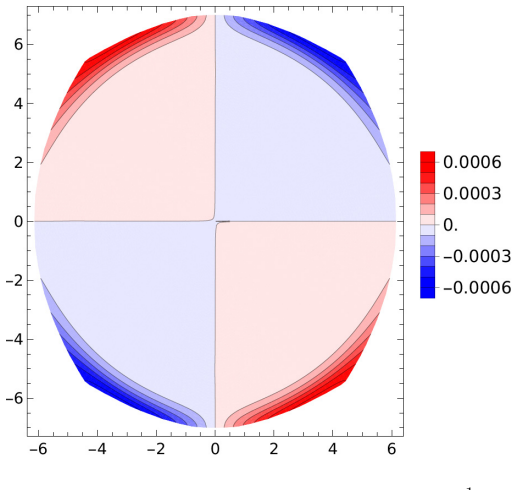
The central discovery is that for the glasma at mid-rapidity the equation of universal flow, $T^{0x}=-\frac{1}{2}t\,\partial_x T^{00}$ and $T^{0y}=-\frac{1}{2}t\,\partial_y T^{00}$, forces the leading $\Delta^4$ contribution to the local beam-axis angular momentum to vanish identically. As a result $L_z$ is controlled by the $\Delta^6$ term, which involves third spatial derivatives of the Poynting vector, whereas the vorticity $\omega_z$ is a first derivative of the velocity field. These two quantities therefore need not look alike, and in the computed glasma they do not: at small impact parameter $L_z$ is mostly octupole, at large impact parameter it develops a quadrupole component whose sign agrees with the measured $\Lambda$ polarization along the beam, while the glasma vorticity shows a quadrupole of the opposite sign. The paper also finds that the global angular momentum perpendicular to the reaction plane carried by the glasma is much smaller than the angular momentum of the participants, implying that the initial angular momentum stays with the valence quarks.
Load-bearing premise
The calculation is done at a single early instant, $\tau=0.06$ fm, with a proper-time expansion valid only below about 0.08 fm, and the paper's own conclusion is that it is unclear whether the early-time glasma is representative of the later system that produces the measured hadrons.
Editorial extensions
If this is right
- Spin-hydrodynamic descriptions that compute hadron polarization from thermal vorticity would need to be replaced or supplemented by a mechanism based on local angular momentum; the sign mismatch in the data is the paper's motivation.
- The glasma phase is not a rapidly rotating fireball: the global angular momentum imparted to it is only a small fraction of the participants' angular momentum, consistent with vanishing global polarization at LHC energies.
- The spin sign puzzle is resolved in sign at the glasma stage: the quadrupole part of $L_z$ at large impact parameter matches the measured $\Lambda$ polarization, while the vorticity has the opposite sign.
- Because the leading derivative term in $L_z$ vanishes by universal flow, any early-time system with a boost-invariant, mostly diagonal energy-momentum tensor will show the same decoupling of vorticity from local angular momentum.
Reading between the lines
- The paper's identity suggests a testable generalization: in any early-time model that satisfies the equation of universal flow, the local angular momentum should be dominated by third derivatives of the Poynting vector, so the same octupole-to-quadrupole crossover with impact parameter should appear.
- A quantitative bridge is missing: the paper notes that no calculation connects the early-time $L_z$ to freeze-out polarization, so one could match a transport or hydrodynamic code at $\tau\simeq 0.06$ fm and evolve the sign pattern to see if it survives.
- If the quadrupole $L_z$ is the correct driver, a clean experimental discriminator is the impact-parameter and multiplicity dependence of the azimuthal pattern of $\Lambda$ polarization: it should cross from octupole-dominated at small $b$ to quadrupole-dominated at large $b$.
- The $\Delta^4$ cancellation may also explain why hydrodynamic models need ad hoc shear corrections to reproduce the sign: first-derivative quantities such as thermal vorticity are the wrong variable in a far-from-equilibrium system.
Signed reviews
Editorial analysis
A structured set of objections, weighed in public.
Referee Report
Summary. This paper studies angular momentum of the glasma produced in ultrarelativistic heavy-ion collisions, using the authors' CGC-based proper-time expansion (up to eighth order) at τ=0.06 fm and mid-rapidity. It computes the global angular momentum perpendicular to the reaction plane and finds that only a small fraction of the initial nuclear angular momentum is transferred to the glasma. Its main subject is the local angular momentum along the beam axis, Lz, and the vorticity ωz of the transverse velocity field V = P/T^{00}. The authors find that Lz and ωz have qualitatively different spatial patterns: ωz is quadrupole-dominated with a sign opposite to the measured Λ polarization, while the quadrupole part of Lz at large impact parameter has the same sign as the measured Λ polarization. They explain the difference by the equation of universal flow T^{0i}=−(t/2)∂i T^{00} (Eq. (5.17)), which makes the order-Δ^4 contribution to Lz vanish, leaving a Δ^6 term built from third derivatives of the Poynting vector, whereas vorticity is a first derivative of the velocity field. They argue that local angular momentum, not thermal vorticity, may control the polarization of final-state hadrons.
Significance. If the Δ^6-dominance claim is correct, the paper establishes a qualitative distinction between vorticity and local angular momentum in the glasma that is not present in the naive rigid-body argument, and it offers a fresh perspective on the 'spin sign puzzle.' The analysis is transparent in several respects: the proper-time expansion is carried to eighth order with comparisons of sixth- and eighth-order results for Ly; the Fourier decomposition (Sec. 5B) is explicit; and the authors provide error bars based on the gradient-expansion cutoff δ. The central phenomenological statement is falsifiable in the sense that the sign of the quadrupole local angular momentum at large impact parameter is compared directly with data. However, the key mechanism — the vanishing of the Δ^4 term — rests on a relation that is exact only up to seventh order in the proper-time expansion, while the numerical results use the eighth-order tensor, and the numerical verification of Δ^6 dominance is not shown. This gap is the main obstacle to accepting the paper's central claim.
major comments (4)
- [Sec. 5E, Eq. (5.17)] The claim that the order-Δ^4 contribution to Lz is 'identically zero' is not established for the quantity actually computed. Equation (5.17) is stated to hold 'exactly ... up to seventh order' in the proper-time expansion, while the numerical Lz in Sec. 5D is computed from the eighth-order energy-momentum tensor. The Δ^4 coefficient is the curl ∂xT^{0y}−∂yT^{0x}; any eighth-order correction to T^{0i} contributes to it, so the cancellation is, at best, approximate in the presented calculation. The only numerical support is the sentence 'We have verified numerically that Lz(⃗ r)/Δ^6 is approximately independent of Δ,' with no data, no range of Δ, and no error estimate. Please provide a quantitative verification: e.g., a plot of Lz(⃗ r)/Δ^6 for several values of Δ (say 0.1, 0.15, 0.2, 0.25, 0.3 fm) and the separate magnitudes of the Δ^4 and Δ^6 coefficients. This check is load-bearing because the qualitative difference between Lz and vorticity, and the sign argument, rest entirely on Δ^6 dominance.
- [Secs. 5C and 5E] The use of Eq. (5.17) appears inconsistent with the nonzero vorticity reported in Sec. 5C. If Eq. (5.17) were exact for the T used to compute ωz, then V = −(t/2)∇ ln T^{00} and ωz would vanish identically. The resolution is that Eq. (5.17) holds only up to seventh order in the proper-time expansion; this caveat needs to be stated wherever Eq. (5.17) is invoked. Moreover, the size of the eighth-order violation of Eq. (5.17) sets the scale of the residual Δ^4 contribution to Lz. Please quantify ∂xT^{0y}−∂yT^{0x} relative to the third-derivative combinations in Eq. (5.12) to demonstrate that the residual Δ^4 term is negligible in the region and at the impact parameters used for the sign statement.
- [Secs. 5D, 6, Figs. 12-14] The phenomenological sign claim relies on the quadrupole component Φ_L^2 at b=6 fm, but the dominant contribution to Φ_L comes from large transverse distances where the gradient expansion is least trustworthy, as the authors acknowledge in Sec. 2 and in footnote 2. The error bars obtained by varying δ_max between 0.8 and 1.0 probe only the gradient-expansion cutoff; they do not test the radial weighting of the integral or the sensitivity to the proper-time truncation order. Please provide a radial-shell decomposition of Φ_L^2 or an equivalent sensitivity test (e.g., varying the upper limit Rmax in Eq. (5.15)) and state explicitly whether the sign of the quadrupole contribution is stable.
- [Abstract and Secs. 6-7] The abstract's statement that 'neither vorticity nor thermal vorticity but instead the local angular momentum controls the polarization of final-state hadrons' is stronger than what the body supports. Section 6 states 'Since our method only works at early times, it is unclear if our results have any relevance for a description of the later stages of the collision,' and Section 7 states that 'a quantitative approach which would allow one to relate the local angular momentum to polarization needs to be developed.' Please align the abstract with these caveats, e.g., by saying that the results 'suggest' or 'are consistent with' a role for local angular momentum, or by adding a concrete (even schematic) argument for how the early-time Lz pattern would survive to freeze-out.
minor comments (6)
- [Throughout] There are several typos: 'preceeds' (p. 2) should be 'precedes', 'determing' (Sec. 7) should be 'determining', 'emphasis' (Sec. 5D) should be 'emphasize', and 'local local' (Sec. 5E) should be 'local'.
- [Eqs. (5.8)-(5.9)] The symbol h_n appears without definition and the displayed formula for ωz seems to have unbalanced parentheses; please fix.
- [Sec. 2 and Sec. 5B] The use of δ both for the gradient-expansion parameter (Sec. 2) and for the non-radial Fourier coefficient δ_n(r) (Sec. 5B) is confusing; consider renaming one of them.
- [Sec. 4, Fig. 5] The discussion around Fig. 5 states that 'the curves obtained at the fourth and eighth orders show rapid growth' and that 'the second and sixth order results suggest the saturation,' which is confusing because the preceding sentence says the sixth- and eighth-order results agree for τ < 0.06 fm; please clarify which orders are being compared and why the eighth-order curve departs from the sixth-order one.
- [Sec. 5D] The grid geometry is not fully specified: the transverse plane dimensions and the total number of boxes are not given.
- [Sec. 6] The estimate ω ∼ 10^{−3} fm^{−1} relies on the assumption that ∫ d^2σ·ω is conserved; the authors flag this with 'If we assume,' but it would be helpful to state explicitly that this is an order-of-magnitude assumption with no derivation for the glasma stage.
Circularity Check
No significant circularity: the glasma L_z calculation is self-contained and the sign comparison with Λ polarization is an external benchmark.
full rationale
The glasma angular-momentum calculation is self-contained. Lz is computed directly from Eq. (3.8) by integrating the eighth-order energy-momentum tensor components over small transverse boxes; no parameter of the calculation is fitted to the Λ-polarization data. The vanishing of the Δ^4 contribution is explained through the universal-flow relation (5.17), which the paper attributes to Ref. [41] and states was derived for the glasma in the authors' Ref. [28]. Although [28] is a self-citation, the relation is a parameter-free statement about the proper-time-expanded energy-momentum tensor, not a fit to the observable being explained, and the paper additionally reports a direct numerical check that Lz/Δ^6 is approximately independent of Δ. The sign comparison of the quadrupole part of Lz with measured Λ polarization is an external benchmark rather than an input. The Sec. 6 admission that the method works only at early times is a limitation about time evolution, not a circular step. The possible objection that Eq. (5.17) is exact only through seventh order while the numerics use eighth order is a technical correctness concern about the size of the Δ^4 coefficient; it does not make the derivation circular, since the numerical Δ-independence check, if reproducible, would test that coefficient directly. Overall no load-bearing step reduces by definition or by fitted input to the conclusion.
Assumptions & free parameters
free parameters (9)
- Saturation scale Qs =
2 GeV
- Gauge coupling g =
1
- Infrared cutoff m =
0.2 GeV
- Proper time tau =
0.06 fm
- Gradient expansion cutoff delta_bar =
0.9 (varied 0.8 to 1.0)
- Box size Delta =
0.2 fm
- Proper-time truncation order =
8
- Woods-Saxon radius parameter r0 =
1.25 fm
- Woods-Saxon skin thickness a =
0.5 fm
assumptions (8)
- domain assumption CGC effective theory with Gaussian color charge distribution in each nucleus.
- domain assumption Glasma Graph approximation: Wick's theorem applied to gauge potentials rather than color charges.
- domain assumption Proper-time expansion ansatz (2.1) for the gauge potentials in the forward light cone.
- domain assumption Infinitely contracted nuclei, width w -> 0 in the boundary conditions.
- domain assumption Boost invariance and evaluation at mid-rapidity eta = z = 0.
- domain assumption Equation of universal flow (5.17): T^{0x} = -(1/2)t d_x T^{00}, T^{0y} = -(1/2)t d_y T^{00}.
- standard math Belinfante improved energy-momentum tensor is symmetric and gauge invariant.
- domain assumption Woods-Saxon distribution (2.5) for nuclear density with r0 = 1.25 fm, a = 0.5 fm.
Cite this review
Pith. "Pith review of Angular momentum of glasma." pith.science (2026). https://pith.science/paper/ZS4TOOFZ
@misc{pith2026250507324,
  author       = {Pith},
  title        = {Pith review of: Angular momentum of glasma},
  year         = {2026},
  howpublished = {\url{https://pith.science/paper/ZS4TOOFZ}},
  note         = {Machine review of arXiv:2505.07324}
}
read the original abstract
The earliest phase of an ultrarelativistic heavy ion collision can be described as a highly populated system of gluons called glasma. We study some glasma characteristics related to the system's angular momentum. The first one is the global angular momentum perpendicular to the reaction plane, which is spanned by the beam axis and impact parameter vector. We show that only a small fraction of the enormous initial angular momentum of the colliding ultrarelativistic nuclei is transferred to the glasma. Our main focus is the glasma angular momentum directed along the beam axis. This quantity has a local character and results from the inhomogeneous velocity field generated in the glasma. We calculate the vorticity and local angular momentum which show noticeably different behaviour. The results are analyzed in detail and discussed in the context of existing experimental data. We argue that neither vorticity nor thermal vorticity but instead the local angular momentum controls the polarization of final-state hadrons.
Figures


Figures from the paper (14 more)




Forward citations
Cited by 1 Pith paper
-
Analytic and Approximate Solutions to Color Glass Condensate in the Classical Weak-Field Limit
In the weak-field CGC limit the glasma energy-momentum tensor has universal late-time scaling ε,PT∼1/τ and PL∼1/τ³, with closed Meijer-G forms in the MV model and controlled series in an improved Gaussian model.
Reference graph
Works this paper leans on
-
[1]
INTRODUCTION Observations of spin polarization phenomena in relativistic heavy-ion collisions opened new possibilities to study the collision dynamics and properties of the strongly interacting matter produced in these collisions. Global polarization of hyperons and vector mesons transverse to the reaction plane (defined as the plane spanned by the beam a...
-
[2]
SUMMAR Y OF THE COMPUT A TIONAL METHOD The glasma angular momentum and vorticity are obtained from components of the energy-momentum tensor which is expressed in terms of chromodynamic fields and aver- aged over colour configurations of the colliding nuclei. To calculate the energy-momentum tensor we use a proper time expansion with a method introduced in...
-
[3]
We repeat the basic steps of this calculation below
FORMULAS FOR ANGULAR MOMENTUM In our previous work [23] we derived an expression for the angular momentum of the glasma per unit rapidity 1. We repeat the basic steps of this calculation below. We define the tensor Mµνρ =TµνRρ−TµρRν, (3.1) 1 Our method is similar to that of Ref. [34] where a slightly inconsistent procedure is used. In that paper the autho...
-
[4]
GLOBAL ANGULAR MOMENTUM The glasma is expected to have significant global angular momentum inherited from the enormous angular momentum of the incoming nuclei when they collide at a nonzero impact parameter. The angular momentum carried by the nucleons which will participate in the collision is of order 105 at maximum RHIC energies [38, 39] and even large...
-
[5]
There is a simple argument [7, 8] illustrated in the left panel of Fig
ANGULAR MOMENTUM ALONG THE BEAM DIRECTION As explained in the introduction, our main motivation is to understand the origin of the local polarization in the direction of the beam. There is a simple argument [7, 8] illustrated in the left panel of Fig. 6 that for a non-central collision the collective elliptic flow generates vorticity ωz and local angular ...
-
[6]
2, our calculation is done using a proper time expansion
RELEV ANCE OF OUR RESUL TS As explained in Sec. 2, our calculation is done using a proper time expansion. Because of compute time and memory constraints we are limited to eighth order in the expansion. At this order the radius of convergence is τ ≲ 0.08 fm. For this reason all the results presented in this paper are calculated at the very early time τ = 0...
-
[7]
Contrary to expectation, Lz(⃗ r) and ωz(⃗ r) are qualitatively different
DISCUSSION, SUMMAR Y AND CONCLUSIONS We have calculated vorticity and local angular momentum of the glasma from the earliest stage of ultrarelativistic heavy-ion collisions. Contrary to expectation, Lz(⃗ r) and ωz(⃗ r) are qualitatively different. It is therefore important to understand which of these quantities is relevant to the polarization of final-st...
work page 2023
-
[8]
Z. T. Liang and X. N. Wang, Phys. Rev. Lett. 94, 102301 (2005) [erratum: Phys. Rev. Lett. 96, 039901 (2006)]
work page 2005
Show all 57 references
-
[9]
S. A. Voloshin, [arXiv:nucl-th/0410089]
-
[10]
Adamczyk et al
L. Adamczyk et al. [STAR], Nature 548, 62 (2017)
2017
-
[11]
Acharya et al
S. Acharya et al. [ALICE], Phys. Rev. Lett. 125, 012301 (2020)
2020
-
[12]
M. S. Abdallah et al. [STAR], Nature 614, 244 (2023)
2023
-
[13]
Acharya et al
S. Acharya et al. [ALICE], Phys. Rev. Lett. 131, 042303 (2023)
2023
-
[14]
Becattini and I
F. Becattini and I. Karpenko, Phys. Rev. Lett. 120, 012302 (2018)
2018
-
[15]
S. A. Voloshin, EPJ Web Conf. 171, 07002 (2018)
2018
-
[16]
Adam et al
J. Adam et al. [STAR], Phys. Rev. Lett. 123, 132301 (2019)
2019
-
[17]
Abdulhamid et al
M. Abdulhamid et al. [STAR], Phys. Rev. Lett. 131, 202301 (2023)
2023
-
[18]
Acharya et al
S. Acharya et al. [ALICE], Phys. Rev. Lett. 128, 172005 (2022)
2022
-
[19]
Niida and S
T. Niida and S. A. Voloshin, Int. J. Mod. Phys. E 33, 2430010 (2024)
2024
-
[20]
Florkowski, A
W. Florkowski, A. Kumar and R. Ryblewski, Prog. Part. Nucl. Phys. 108, 103709 (2019)
2019
-
[21]
Becattini, M
F. Becattini, M. Buzzegoli, T. Niida, S. Pu, A. H. Tang and Q. Wang, Int. J. Mod. Phys. E 33, 2430006 (2024)
2024
-
[22]
B. Fu, S. Y. F. Liu, L. Pang, H. Song and Y. Yin, Phys. Rev. Lett. 127, 142301 (2021)
2021
-
[23]
Becattini, M
F. Becattini, M. Buzzegoli, G. Inghirami, I. Karpenko and A. Palermo, Phys. Rev. Lett. 127, 272302 (2021)
2021
-
[24]
Alzhrani, S
S. Alzhrani, S. Ryu and C. Shen, Phys. Rev. C 106, 014905 (2022)
2022
-
[25]
Florkowski, A
W. Florkowski, A. Kumar, R. Ryblewski and A. Mazeliauskas, Phys. Rev. C 100, 054907 (2019)
2019
-
[26]
C. Yi, X. Y. Wu, J. Zhu, S. Pu and G. Y. Qin, [arXiv:2408.04296 [hep-ph]]
-
[27]
Hayrapetyan et al
A. Hayrapetyan et al. [CMS], [arXiv:2502.07898 [nucl-ex]]. 32
-
[28]
Gelis, E
F. Gelis, E. Iancu, J. Jalilian-Marian and R. Venugopalan, Ann. Rev. Nucl. Part. Sci. 60, 463 (2010)
2010
-
[29]
M. E. Carrington, A. Czajka and St. Mr´ owczy´ nski, Eur. Phys. J. A58, 5 (2022)
2022
-
[30]
M. E. Carrington, A. Czajka and St. Mr´ owczy´ nski, Phys. Rev. C106, 034904 (2022)
2022
-
[31]
M. E. Carrington, A. Czajka and St. Mr´ owczy´ nski, Nucl. Phys. A1001, 121914 (2020)
2020
-
[32]
M. E. Carrington, A. Czajka and St. Mr´ owczy´ nski, Phys. Rev. C105, 064910 (2022)
2022
-
[33]
M. E. Carrington, A. Czajka and St. Mr´ owczy´ nski, Phys. Lett. B834, 137464 (2022)
2022
-
[34]
M. E. Carrington, W. N. Cowie, B. T. Friesen, St. Mr´ owczy´ nski and D. Pickering, Phys. Rev. C 108, 054903 (2023)
2023
-
[35]
M. E. Carrington, St. Mr´ owczy´ nski and J. Y. Ollitrault, Phys. Rev. C110, 054903 (2024)
2024
-
[36]
M. E. Carrington and St. Mr´ owczy´ nski, Acta Phys. Polon. B55, 4-A3 (2024)
2024
-
[37]
R. J. Fries, J. I. Kapusta and Y. Li, Nucl. Phys. A 774, 861 (2006)
2006
-
[38]
Fukushima, Phys
K. Fukushima, Phys. Rev. C 76, 021902 (2007)
2007
-
[39]
Fujii, K
H. Fujii, K. Fukushima and Y. Hidaka, Phys. Rev. C 79, 024909 (2009)
2009
-
[40]
G. Chen, R. J. Fries, J. I. Kapusta and Y. Li, Phys. Rev. C 92, 064912 (2015)
2015
-
[41]
R. J. Fries, G. Chen and S. Somanathan, Phys. Rev. C 97, 034903 (2018)
2018
-
[42]
Kovner, L
A. Kovner, L. D. McLerran and H. Weigert, Phys. Rev. D 52, 3809 (1995)
1995
-
[43]
Lappi and S
T. Lappi and S. Schlichting, Phys. Rev. D 97, 034034 (2018)
2018
-
[44]
X. D. Ji, Phys. Rev. Lett. 78, 610 (1997)
1997
-
[45]
J. H. Gao, S. W. Chen, W. T. Deng, Z. T. Liang, Q. Wang and X. N. Wang, Phys. Rev. C 77, 044902 (2008)
2008
-
[46]
Becattini, F
F. Becattini, F. Piccinini and J. Rizzo, Phys. Rev. C 77, 024906 (2008)
2008
-
[47]
Akridge, D
A. Akridge, D. Gallimore, H. Morales and J. Liao, [arXiv:2504.02192 [nucl-th]]
-
[48]
Vredevoogd and S
J. Vredevoogd and S. Pratt, Phys. Rev. C 79, 044915 (2009)
2009
-
[49]
Landau and E.M
L.D. Landau and E.M. Lifshitz, Statistical Mechanics (Pergamon Press, Oxford, 1980)
1980
-
[50]
Landau and E.M
L.D. Landau and E.M. Lifshitz, Fluid Mechanics (Pergamon Press, Oxford, 1987)
1987
-
[51]
J. I. Kapusta, E. Rrapaj and S. Rudaz, Phys. Rev. C 101, 024907 (2020)
2020
-
[52]
J. I. Kapusta, E. Rrapaj and S. Rudaz, Phys. Rev. C 102, 064911 (2020)
2020
-
[53]
Ayala, D
A. Ayala, D. de la Cruz, L. A. Hern´ andez and J. Salinas, Phys. Rev. D 102, 056019 (2020)
2020
-
[54]
Hidaka, M
Y. Hidaka, M. Hongo, M. A. Stephanov and H. U. Yee, Phys. Rev. C 109, 054909 (2024)
2024
-
[55]
Wagner, M
D. Wagner, M. Shokri and D. H. Rischke, Phys. Rev. Res. 6, 4 (2024). 33
2024
-
[56]
Florkowski, B
W. Florkowski, B. Friman, A. Jaiswal and E. Speranza, Phys. Rev. C 97, 041901 (2018)
2018
-
[57]
Sapna, S. K. Singh and D. Wagner, [arXiv:2503.22552 [hep-ph]]. 34
Reviewed August 15, 2026 · model on record in the stance chip above.
Discussion (0). Continue with ORCID to comment.