REVIEW 4 major objections 4 minor 62 references
Engineering spectro-temporal light states with physics-embedded deep learning
T0 review · 4 major / 4 minor · reviewed 2026-08-12 · deepseek-v4-flash
Pith's one-line read Feeding a neural network the Wigner function of the input pulse makes supercontinuum shaping precise enough to produce 12 fs pulses without an external compressor.
desk verdict Real experiments and a plausible but oversold 'physics-embedded' label; the missing simulator-to-experiment validation is the main thing standing between this and a strong paper. read the letter →
The pith
A machine-rendered reading of the paper's core claim, the machinery that carries it, and where it could break.
The reading
What carries the argument
The central object is the Wigner function $W(t,\omega)=\int A(t+t'/2)A^*(t-t'/2)e^{i\omega t'}dt'$, a joint time-frequency (chronocyclic) representation of the pulse field. The paper places this transform at the front of the network: instead of learning from raw spectral phase or from the output spectrum alone, the CNN sees a two-dimensional image of the pulse's spectro-temporal correlations. That representation suppresses phase variations such as the carrier-envelope offset phase and gives the convolution layers local structure to exploit, which the authors identify as the reason for faster convergence and noise robustness. The supporting machinery is a dataset of 7,000 phase profiles sampled by Latin hypercube sampling, each propagated through the generalized nonlinear Schrödinger equation to produce a target SC spectrum; the Wigner image is cropped and downsampled to $241\times81$ pixels as CNN input.
What would settle it
Take a P-CNN trained on the nominal GNLSE model and test it on a fiber with a measurably shifted zero-dispersion wavelength; if its optimized phase patterns no longer produce the targeted dispersive-wave spectra and 12 fs compression, the claim that the physics-embedded network transfers to real-world supercontinuum control is falsified.
Extended reading notes
Core claim
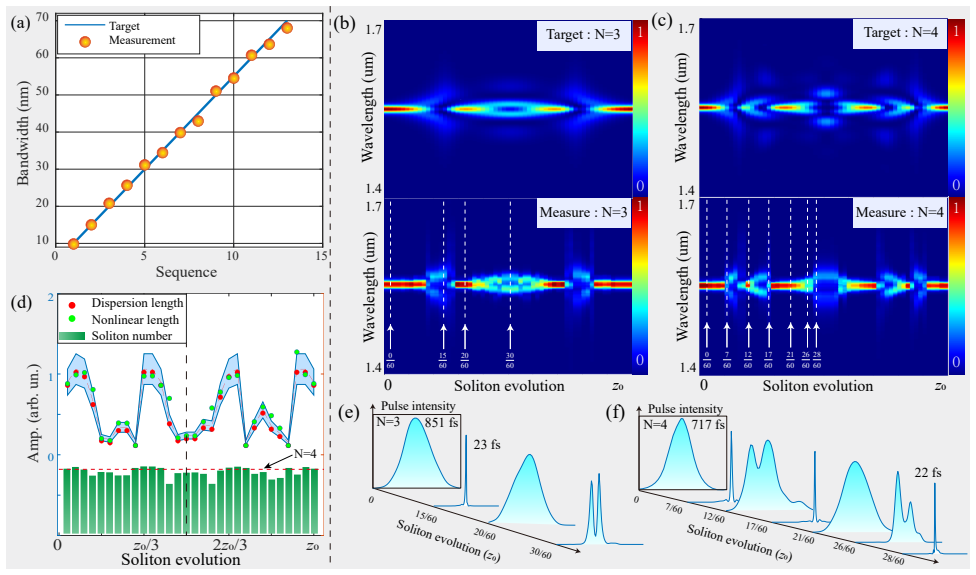
The central claim is that the Wigner distribution, computed from the shaped input pulse, is the right input representation for neural-network control of supercontinuum generation. The paper shows that feeding this spectro-temporal image into a convolutional network (P-CNN) yields a regression factor $R\approx 0.97$ against GNLSE targets, versus $R\approx 0.91$ for a three-layer feed-forward network, and that the network stays stable when Gaussian phase noise is added, with typical output error $d_E\approx 0.46$ instead of $1.17$. Experimentally, the same idea is implemented as two networks—Net-D for dispersive waves and Net-S for solitons—operating on an erbium-fiber laser, 4f pulse shaper, amplifier, and highly nonlinear fiber. With Net-D the network continuously tunes the dispersive-wave center wavelength (3.7% peak-to-peak modulation around 1070 nm) and bandwidth (60–100 nm), and produces 12 fs near-transform-limited infrared pulses—a 70-fold compression of the 850 fs soliton—without any pulse compressor. With Net-S it generates high-order solitons with $N=3$ and $4$, reproducing the spectro-temporal breather dynamics as if scanning fiber length, with measured compression factors around 33–36. The paper attributes this improvement not to the CNN itself but to the physics-embedded input: a plain feed-forward network given Wigner inputs (P-FNN) also outperforms the data-driven FNN.
Load-bearing premise
The whole scheme rests on the assumption that the computer model of the fiber—its dispersion, nonlinearity, and the pulse shaper's response—matches the real experiment closely enough that solutions found in simulation still work when applied to the actual laser.
Editorial extensions
If this is right
- The same P-CNN architecture can target spectral features (center wavelength, bandwidth) or temporal features (pulse duration) of a supercontinuum, and can switch between dispersive-wave and soliton regimes by retraining on the appropriate spectral band.
- Because the trained network returns an output spectrum from a phase pattern almost instantly, real-time closed-loop shaping of few-cycle pulses becomes feasible in this class of fiber systems, replacing minute-scale genetic-algorithm searches.
- The 12 fs result implies that octave-spanning spectra need not be paired with external prism or chirped-mirror compressors; the fiber itself can deliver near-transform-limited few-cycle pulses when the input phase is chosen correctly.
- High-order soliton breather dynamics, normally observed by physically altering fiber length or energy, can instead be scanned synthetically by reshaping the input pulse, because the P-CNN maintains a nearly constant soliton number while varying dispersion and nonlinear lengths.
- Because a plain feed-forward network (P-FNN) also gains from Wigner inputs, the benefit lies in the representation rather than in the convolutional architecture, so other network designs should inherit the same robustness.
Reading between the lines
- Extension: the paper's training pipeline should carry over to gas-filled hollow-core fibers or chip-scale waveguides, which would test whether the approach scales to µJ–mJ pulses; the authors note this direction but do not demonstrate it.
- Extension: the same Wigner-embedding could apply to spatio-temporal correlation functions to design 'space-time' wavepackets with arbitrary transverse profiles, generalizing the $(\omega,t)$ control shown here to $(k,x)$ degrees of freedom.
- Extension: a cleaner test of the mechanism would compare Wigner images against other two-dimensional representations (e.g., spectrograms from FROG) as network inputs; if the advantage persists for any joint time-frequency image, the essential ingredient is the correlation structure, not the Wigner function specifically.
- Extension: the noise-robustness result suggests the Wigner input could benefit other sensitive inverse problems in nonlinear optics, such as soliton-molecule control or extreme-event suppression; this is an inference, not a claim of the paper.
Editorial analysis
A structured set of objections, weighed in public.
Referee Report
Summary. The paper proposes a physics-embedded convolutional neural network (P-CNN) that maps a pulse-shaper spectral phase to the supercontinuum (SC) output spectrum, using the Wigner chronocyclic representation of the input field as the network input. The network is trained on 7,000 GNLSE-simulated spectra, benchmarked against a feedforward neural network under simulated phase noise, and then used experimentally to tune dispersive-wave center wavelength and bandwidth, to produce 12 fs pulses without an external compressor, and to generate spectro-temporal patterns identified as N=3 and N=4 soliton breathers. The central claim is that embedding the Wigner transform improves convergence and noise robustness and enables on-demand spectro-temporal control of SC.
Significance. If the results hold, the paper offers a practical and transferable idea: replacing a raw spectral-phase vector with a physically motivated spectro-temporal representation as CNN input improves inverse design in a strongly nonlinear system. The simulation benchmark is clearly described, the network architecture is reproducible from the main text, and the experimental demonstrations are ambitious, including continuous dispersive-wave tuning, 12 fs compression, and high-order soliton patterns. The main value lies in showing that physics-embedded input representations can reduce noise sensitivity in ultrafast nonlinear control. However, the strength of the experimental conclusions depends on the fidelity of the GNLSE training surrogate, and that link is not yet established.
major comments (4)
- [Methods-1; Methods-2] The experimental claims rest on a GNLSE-trained surrogate that is never validated for this setup. Eq. (1) is stated generically, and Methods-1 gives fiber lengths and amplifier stages but no values for the HNF dispersion coefficients β_k, the nonlinear coefficient γ, the Raman response R(t), or the spontaneous-Raman noise Γ_R; the pulse-shaper transfer function is justified only by reference to Ref. 51. Since the 7,000-sample training set (Methods-2) is generated from this simulation, any systematic model-experiment mismatch means the P-CNN inverse solutions are not guaranteed to be solutions of the physical system. Please provide the full parameter set and a quantitative comparison between a simulated SC spectrum and a measured OSA spectrum for representative phases, including the noise model used.
- [Benchmarking P-CNN performance; Methods-2] The FNN-versus-P-CNN benchmark is not controlled: the FNN receives a one-dimensional phase vector, while the P-CNN receives a 241×81 Wigner image and uses a convolutional architecture with additional fully connected layers. The two models therefore differ simultaneously in input representation, input dimensionality, and parameter count, so the reported threefold loss reduction and noise-robustness advantage (Fig. 2) cannot be attributed to the physics-embedded input alone. Please include matched-capacity models and/or an FNN fed the same Wigner features, and report parameter counts for all models.
- [Spectral Domain Engineering; Temporal Domain Engineering; Spectro-Temporal Engineering] The central experimental demonstrations (Figs. 3(c,d), 4(a), and 5(a)) are single-shot sequences with no error bars, no repeated trials, and no quoted measurement uncertainty. Claims of agreement with targets, such as the 3.7% center-wavelength modulation and the 10–70 nm bandwidth tracking, therefore do not yet establish reproducibility. Please add repeated measurements for at least a subset of points and quantify residual errors, for example as RMS deviation from the target curve.
- [Spectro-Temporal Engineering: High-Order Solitons; Eq. (8)] The effective-z interpretation is not justified. The claim that varying the input spectral phase is equivalent to scanning the physical propagation distance z is not generally true for the GNLSE, and Eq. (8) omits the fiber parameters γ and β_2 from the expression for N², so the constant-N evidence in Fig. 5(d) depends on unstated constants. Please either derive the equivalence explicitly or reframe the demonstration as target-spectrum matching; if solitonic dynamics is claimed, validate it with an independent measure, such as full-field evolution or phase-sensitive characterization.
minor comments (4)
- [Abstract; Discussion] The claim of a 'sub-three optical cycle' 12 fs pulse should be reconciled with the carrier wavelength. At 1070 nm, three optical cycles correspond to about 10.7 fs, so a 12 fs pulse is not sub-three-cycle at that wavelength; please specify the carrier wavelength or revise the statement.
- [Fig. 7(d) caption; main text] 'Elicude distance' should be 'Euclidean distance', and the sentence 'in does serve as an ideal benchmarking tool' contains a grammatical error.
- [Fig. 2(c) table] The table in the bottom-left panel is difficult to parse because the columns for GNLSE, FNN, P-FNN, and P-CNN are not clearly aligned with the metric rows; please reformat it.
- [Eq. (4)] The notation I_tarG is confusing; please define the reference spectrum as I_tar and the noisy predictions as I_N, or use consistent subscripts throughout.
Circularity Check
No significant circularity; the central derivation is independent, with only a minor self-citation for pulse-shaper calibration.
full rationale
The paper's derivation chain is not circular. The GNLSE (Eq. 1) is an independent physical model used to generate training targets, and the CNN is trained as a surrogate for that model. Benchmarking I_pred against I_tar from GNLSE is a standard held-out evaluation, not a fit renamed as a prediction. The Wigner transform (Eq. 3) is an exact mathematical representation, and its use as an input does not define the output. The noise-robustness comparison uses GNLSE as an external reference, and the experimental demonstrations are closed-loop: measured OSA spectra and SHG-FROG traces are compared against targets, with the P-CNN providing initial solutions that are then refined by gradient descent against measured data. The 12 fs pulse duration and the N=3 and N=4 soliton reconstructions are experimental measurements, not outputs recovered from the training set. The only self-citation that appears in a load-bearing position is Ref. 51, used to justify that the 4f pulse shaper has a reliable programmed-phase-to-field response, allowing efficient dataset generation without re-characterizing every setting. That citation is to prior experimental calibration work, which is externally falsifiable and independent of the present fitted values, so it does not constitute circular reasoning. The absence of explicit fiber parameters and the lack of a direct simulated-versus-measured SC spectrum comparison are correctness and validation risks, not circularity.
Assumptions & free parameters
free parameters (3)
- Wigner input downsampling resolution =
241x81 pixels
- CNN architecture hyperparameters =
32 and 64 filters, 3x3 kernels, 436 output nodes
- Gaussian phase noise level =
Unspecified in main text
assumptions (5)
- domain assumption The GNLSE (Eq. 1) accurately models supercontinuum generation in the highly nonlinear fiber.
- domain assumption The fiber parameters (dispersion beta_k, nonlinear coefficient gamma, Raman response R(t)) used in simulations match the experimental HNF.
- domain assumption The 4f pulse shaper has a linear, reliable response between the programmed phase and the output field, as validated in prior work (ref 51).
- domain assumption SHG-FROG measurements reconstruct the pulse amplitude and phase with sufficient accuracy.
- ad hoc to paper Varying the pulse-shaper phase is equivalent to scanning the physical propagation distance z for high-order soliton dynamics.
Cite this review
Pith. "Pith review of Engineering spectro-temporal light states with physics-embedded deep learning." pith.science (2026). https://pith.science/paper/ZSP4XQ2J
@misc{pith2026241114410,
  author       = {Pith},
  title        = {Pith review of: Engineering spectro-temporal light states with physics-embedded deep learning},
  year         = {2026},
  howpublished = {\url{https://pith.science/paper/ZSP4XQ2J}},
  note         = {Machine review of arXiv:2411.14410}
}
read the original abstract
Frequency synthesis and spectro-temporal control of optical wave packets are central to ultrafast science, with supercontinuum (SC) generation standing as one remarkable example. Through passive manipulation, femtosecond (fs) pulses from nJ-level lasers can be transformed into octave-spanning spectra, supporting few-cycle pulse outputs when coupled with external pulse compressors. While strategies such as machine learning have been applied to control the SC's central wavelength and bandwidth, their success has been limited by the nonlinearities and strong sensitivity to measurement noise. Here, we propose and demonstrate how a physics-embedded convolutional neural network (P-CNN) that embeds spectro-temporal correlations can circumvent such challenges, resulting in faster convergence and reduced noise sensitivity. This innovative approach enables on-demand control over spectro-temporal features of SC, achieving few-cycle pulse shaping without external compressors. This approach heralds a new era of arbitrary spectro-temporal light state engineering, with implications for ultrafast photonics, photonic neuromorphic computation, and AI-driven optical systems.
Figures


Figures from the paper (4 more)



Reference graph
Works this paper leans on
-
[1]
Ranka, J. K., Windeler, R. S. & Stentz, A. J. Visible continuum generation in air–silica microstructure optical fibers with anomalous dispersion at 800 nm.Opt. Lett.25, 25–27, DOI: 10.1364/OL.25.000025 (2000)
-
[2]
Agrawal, G. P. Nonlinear fiber optics. InNonlinear Science at the Dawn of the 21st Century, 195–211 (Springer, 2000). 3.Alfano, R. R.The supercontinuum laser source: fundamentals with updated references(Springer, 2006). 16/20
work page 2000
-
[4]
Dudley, J. M., Genty, G. & Coen, S. Supercontinuum generation in photonic crystal fiber.Rev. modern physics 78, 1135 (2006)
work page 2006
-
[5]
Sell, A., Krauss, G., Scheu, R., Huber, R. & Leitenstorfer, A. 8-fs pulses from a compact er:fiber system: quantitative modeling and experimental implementation.Opt. Express17, 1070–1077, DOI: 10.1364/OE.17. 001070 (2009)
-
[6]
Borondics, F.et al.Supercontinuum-based fourier transform infrared spectromicroscopy.Optica5, 378–381 (2018)
work page 2018
- [7]
-
[8]
Gündo˘gdu, S., Virally, S., Scaglia, M., Seletskiy, D. V . & Moskalenko, A. S. Self-referenced subcycle metrology of quantum fields.Laser & Photonics Rev.17, 2200706 (2023)
work page 2023
-
[9]
Tu, H. & Boppart, S. A. Coherent fiber supercontinuum for biophotonics.Laser & photonics reviews7, 628–645 (2013)
work page 2013
Show all 62 references
-
[10]
Ji, X.et al.Millimeter-scale chip–based supercontinuum generation for optical coherence tomography.Sci. Adv. 7, eabg8869 (2021)
2021
-
[11]
J.et al.Carrier-envelope phase control of femtosecond mode-locked lasers and direct optical frequency synthesis.Science288, 635–639, DOI: 10.1126/science.288.5466.635 (2000)
Jones, D. J.et al.Carrier-envelope phase control of femtosecond mode-locked lasers and direct optical frequency synthesis.Science288, 635–639, DOI: 10.1126/science.288.5466.635 (2000). https://www.science.org/doi/pdf/ 10.1126/science.288.5466.635
2000 doi
-
[12]
C.et al.Invited article: A compact optically coherent fiber frequency comb.Rev
Sinclair, L. C.et al.Invited article: A compact optically coherent fiber frequency comb.Rev. Sci. Insrum.86, 081301 (2015)
2015
-
[13]
Fehrenbacher, D.et al.Free-running performance and full control of a passively phase-stable er:fiber frequency comb.Optica2, 917–923, DOI: 10.1364/OPTICA.2.000917 (2015)
2015 doi
-
[14]
Photonics 4, 33–36 (2010)
Krauss, G.et al.Synthesis of a single cycle of light with compact erbium-doped fibre technology.Nat. Photonics 4, 33–36 (2010)
2010
-
[15]
Shumakova, V .et al.Multi-millijoule few-cycle mid-infrared pulses through nonlinear self-compression in bulk. Nat. communications7, 12877 (2016). 16.Steinleitner, P.et al.Single-cycle infrared waveform control.Nat. Photonics16, 512–518 (2022)
2016
-
[17]
Y ., L’Huillier, A
Lewenstein, M., Balcou, P., Ivanov, M. Y ., L’Huillier, A. & Corkum, P. B. Theory of high-harmonic generation by low-frequency laser fields.Phys. Rev. A49, 2117–2132, DOI: 10.1103/PhysRevA.49.2117 (1994). 18.Corkum, P. B. & Krausz, F. Attosecond science.Nat. Phys.3, 381–387 (2007)
1994 doi
-
[19]
Nobel lecture: Sub-atomic motions.Rev
Krausz, F. Nobel lecture: Sub-atomic motions.Rev. Mod. Phys.96, 030502, DOI: 10.1103/RevModPhys.96. 030502 (2024)
2024 doi
-
[20]
& Villeneuve, D
Peng, P., Marceau, C. & Villeneuve, D. M. Attosecond imaging of molecules using high harmonic spectroscopy. Nat. Rev. Phys.1, 144–155 (2019)
2019
-
[21]
Commun.11, 2748 (2020)
Li, J.et al.Attosecond science based on high harmonic generation from gases and solids.Nat. Commun.11, 2748 (2020)
2020
-
[22]
Nanophotonics12, 1199–1244 (2023)
Brès, C.-S.et al.Supercontinuum in integrated photonics: generation, applications, challenges, and perspectives. Nanophotonics12, 1199–1244 (2023)
2023
-
[23]
V ., Pastirk, I
Lozovoy, V . V ., Pastirk, I. & Dantus, M. Multiphoton intrapulse interference. iv. ultrashort laser pulse spectral phase characterization and compensation.Opt. Lett.29, 775–777 (2004)
2004
-
[24]
M., Cruz, J
Xu, B., Gunn, J. M., Cruz, J. M. D., Lozovoy, V . V . & Dantus, M. Quantitative investigation of the multi- photon intrapulse interference phase scan method for simultaneous phase measurement and compensation of femtosecond laser pulses.J. Opt. Soc. Am. B23, 750–759 (2006). 17/20
2006
-
[25]
Monmayrant, A., Weber, S. J. & Chatel, B. A newcomer’s guide to ultrashort pulse shaping and characterization. J. Phys. B43, 103001 (2010)
2010
-
[26]
R.et al.Self-referenced frequency combs using high-efficiency silicon-nitride waveguides.Opt
Carlson, D. R.et al.Self-referenced frequency combs using high-efficiency silicon-nitride waveguides.Opt. Lett.42, 2314–2317 (2017)
2017
-
[27]
E.et al.Multioctave supercontinuum generation and frequency conversion based on rotational nonlinearity.Sci
Beetar, J. E.et al.Multioctave supercontinuum generation and frequency conversion based on rotational nonlinearity.Sci. Adv.6, eabb5375 (2020)
2020
-
[28]
Photonics15, 277–280 (2021)
Elu, U.et al.Seven-octave high-brightness and carrier-envelope-phase-stable light source.Nat. Photonics15, 277–280 (2021)
2021
-
[29]
Photonics15, 884–889 (2021)
Piccoli, R.et al.Intense few-cycle visible pulses directly generated via nonlinear fibre mode mixing.Nat. Photonics15, 884–889 (2021). 30.Genty, G., Coen, S. & Dudley, J. M. Fiber supercontinuum sources.JOSA B24, 1771–1785 (2007)
2021
-
[31]
Lett.46, 1820–1823 (2021)
Genier, E.et al.Ultra-flat, low-noise, and linearly polarized fiber supercontinuum source covering 670–1390 nm.Opt. Lett.46, 1820–1823 (2021)
2021
-
[32]
communications9, 4884 (2018)
Wetzel, B.et al.Customizing supercontinuum generation via on-chip adaptive temporal pulse-splitting.Nat. communications9, 4884 (2018)
2018
-
[33]
Sylvestre, T.et al.Recent advances in supercontinuum generation in specialty optical fibers.JOSA B38, F90–F103 (2021)
2021
-
[34]
M., Wagner, K
Tzang, O., Caravaca-Aguirre, A. M., Wagner, K. & Piestun, R. Adaptive wavefront shaping for controlling nonlinear multimode interactions in optical fibres.Nat. Photonics12, 368–374 (2018)
2018
-
[35]
Lett.48, 4512–4515 (2023)
Hary, M.et al.Tailored supercontinuum generation using genetic algorithm optimized fourier domain pulse shaping.Opt. Lett.48, 4512–4515 (2023)
2023
-
[36]
Reports13, 1865 (2023)
Lapre, C.et al.Genetic algorithm optimization of broadband operation in a noise-like pulse fiber laser.Sci. Reports13, 1865 (2023)
2023
-
[37]
R., Silva, L
Martins, G. R., Silva, L. C., Segatto, M. E., Rocha, H. R. & Castellani, C. E. Design and analysis of recurrent neural networks for ultrafast optical pulse nonlinear propagation.Opt. Lett.47, 5489–5492 (2022)
2022
-
[38]
T.et al.Optimizing supercontinuum spectro-temporal properties by leveraging machine learning towards multi-photon microscopy.Front
Hoang, V . T.et al.Optimizing supercontinuum spectro-temporal properties by leveraging machine learning towards multi-photon microscopy.Front. Photonics3, 940902 (2022)
2022
-
[39]
Shih, M.et al.Maximizing supercontinuum bandwidths in gas-filled hollow-core fibers using artificial neural networks.J. Appl. Phys.133(2023)
2023
-
[40]
A., Epstein, J
Farfan, C. A., Epstein, J. & Turner, D. B. Femtosecond pulse compression using a neural-network algorithm. Opt. Lett.43, 5166–5169 (2018)
2018
-
[41]
& Finot, C
Boscolo, S. & Finot, C. Artificial neural networks for nonlinear pulse shaping in optical fibers.Opt. & Laser Technol.131, 106439 (2020)
2020
-
[42]
Salmela, L.et al.Feed-forward neural network as nonlinear dynamics integrator for supercontinuum generation. Opt. Lett.47, 802–805 (2022)
2022
-
[43]
communications9, 4923 (2018)
Närhi, M.et al.Machine learning analysis of extreme events in optical fibre modulation instability.Nat. communications9, 4923 (2018)
2018
-
[44]
Salmela, L., Lapre, C., Dudley, J. M. & Genty, G. Machine learning analysis of rogue solitons in supercontinuum generation.Sci. Reports10, 9596 (2020). 45.Genty, G.et al.Machine learning and applications in ultrafast photonics.Nat. Photonics15, 91–101 (2021). 46.Zuo, C.et al.D...
2020
-
[47]
Walmsley, I. A. & Dorrer, C. Characterization of ultrashort electromagnetic pulses.Adv. Opt. Photonics1, 308–437 (2009)
2009
-
[48]
S.et al.Intensity correlations in the wigner representation.arXiv preprint arXiv:2407.12901 (2024)
Najafabadi, M. S.et al.Intensity correlations in the wigner representation.arXiv preprint arXiv:2407.12901 (2024)
2024 arXiv
-
[49]
D., Beckman, R
McKay, M. D., Beckman, R. J. & Conover, W. J. A comparison of three methods for selecting values of input variables in the analysis of output from a computer code.Technometrics42, 55–61 (2000)
2000
-
[50]
Malomed, B. A. Optical solitons and vortices in fractional media: A mini-review of recent results. InPhotonics, vol. 8, 353 (Multidisciplinary Digital Publishing Institute, 2021)
2021
-
[51]
Liu, S., Zhang, Y ., Malomed, B. A. & Karimi, E. Experimental realisations of the fractional schrödinger equation in the temporal domain.Nat. Commun.14, 222 (2023)
2023
-
[52]
communications8, 813 (2017)
Köttig, F.et al.Mid-infrared dispersive wave generation in gas-filled photonic crystal fibre by transient ionization-driven changes in dispersion.Nat. communications8, 813 (2017)
2017
-
[53]
Phys.19, 863–868 (2023)
Moussa, H.et al.Observation of temporal reflection and broadband frequency translation at photonic time interfaces.Nat. Phys.19, 863–868 (2023)
2023
-
[54]
& Lisak, M
Anderson, D. & Lisak, M. Nonlinear asymmetric self-phase modulation and self-steepening of pulses in long optical waveguides.Phys. Rev. A27, 1393 (1983)
1983
-
[55]
F., Stolen, R
Mollenauer, L. F., Stolen, R. H. & Gordon, J. P. Experimental observation of picosecond pulse narrowing and solitons in optical fibers.Phys. Rev. Lett.45, 1095 (1980). 56.Malomed, B. A.Soliton management in periodic systems(Springer Science & Business Media, 2006). 57.Karniada...
1980
-
[58]
& Marquardt, F
Lopez-Pastor, V . & Marquardt, F. Self-learning machines based on hamiltonian echo backpropagation.Phys. Rev. X13, 031020 (2023)
2023
-
[59]
W., Gobert, O
Jolly, S. W., Gobert, O. & Quéré, F. Spatio-temporal characterization of ultrashort laser beams: a tutorial.J. Opt.22, 103501, DOI: 10.1088/2040-8986/abad08 (2020)
2020 doi
-
[60]
& Suchowski, H
Korman, S., Bahar, E., Arieli, U. & Suchowski, H. Spatio-temporal ultrafast pulse shaping at the femtosecond- nanometer scale.Opt. Lett.47, 4279–4282, DOI: 10.1364/OL.461953 (2022)
2022 doi
-
[61]
& Zhan, Q
Chong, A., Wan, C., Chen, J. & Zhan, Q. Generation of spatiotemporal optical vortices with controllable transverse orbital angular momentum.Nat. Photonics14, 350–354 (2020)
2020
-
[62]
Brunton, S. L. & Kutz, J. N. Promising directions of machine learning for partial differential equations.Nat. Comput. Sci.1–12 (2024)
2024
-
[63]
Photonics 1–9 (2024)
Bandyopadhyay, S.et al.Single-chip photonic deep neural network with forward-only training.Nat. Photonics 1–9 (2024). 64.McMahon, P. L. The physics of optical computing.Nat. Rev. Phys.5, 717–734 (2023)
2024
-
[65]
Sci.10, 2303835 (2023)
Fischer, B.et al.Neuromorphic computing via fission-based broadband frequency generation.Adv. Sci.10, 2303835 (2023)
2023
-
[66]
Shumailov, I.et al.Ai models collapse when trained on recursively generated data.Nature631, 755–759 (2024)
2024
-
[67]
& Wise, F
Ilday, F., Buckley, J., Clark, W. & Wise, F. Self-similar evolution of parabolic pulses in a laser.Phys. Rev. Lett. 92, 213902 (2004)
2004
-
[68]
& Malomed, B
Liu, S., Cui, Y ., Karimi, E. & Malomed, B. A. On-demand harnessing of photonic soliton molecules.Optica9, 240–250 (2022). 19/20
2022
-
[69]
& Karimi, E
Liu, S., Cui, Y ., Zhou, Z. & Karimi, E. An efficient collinear frog system to character the ultrafast infrared laser pulse. In2021 Photonics & Electromagnetics Research Symposium (PIERS), 2690–2694 (IEEE, 2021)
2021
-
[70]
& Boyd, R
Bolduc, E., Bent, N., Santamato, E., Karimi, E. & Boyd, R. W. Exact solution to simultaneous intensity and phase encryption with a single phase-only hologram.Opt. Lett.38, 3546–3549 (2013). 71.Liu, S.-L.et al.Classical analogy of a cat state using vortex light.Commun. Phys.2, ...
2013
-
[72]
H., Hribar, M
Byrd, R. H., Hribar, M. E. & Nocedal, J. An interior point algorithm for large-scale nonlinear programming. SIAM J. on Optim.9, 877–900 (1999). 20/20
1999
Reviewed August 12, 2026 · model on record in the stance chip above.
Discussion (0). Continue with ORCID to comment.