REVIEW 4 major objections 5 minor 19 references
Advocacy Learning: Learning through Competition and Class-Conditional Representations
T0 review · 4 major / 5 minor · reviewed 2026-08-14 · deepseek-v4-flash
Pith's one-line read This paper proposes that attention-based classifiers improve when each class gets a dedicated advocate whose argument a judge learns to weigh, and reports small consistent gains on MNIST and Fashion-MNIST.
desk verdict Advocacy learning is a genuinely new training trick with modest, real gains on two benchmarks, but the paper's own experiments show the method is fragile in ways the abstract understates; it still deserves a careful referee. read the letter →
The pith
A machine-rendered reading of the paper's core claim, the machinery that carries it, and where it could break.
The reading
What carries the argument
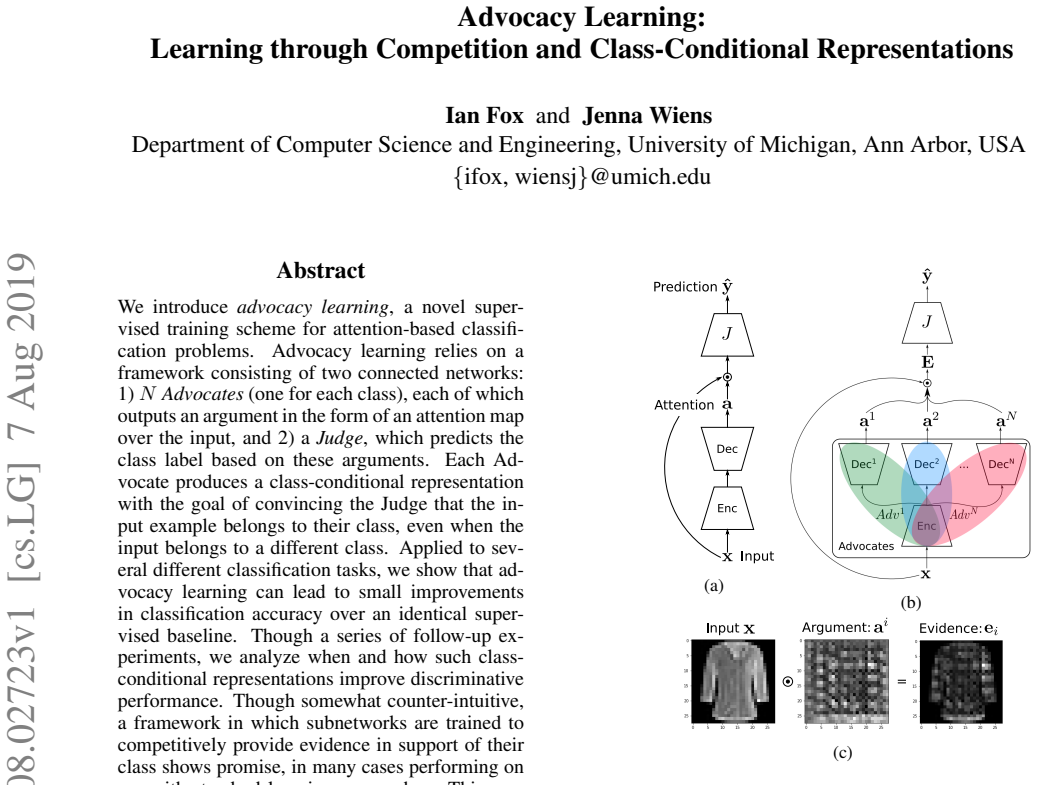
The central object is the advocacy net: $N$ advocate subnetworks (one per class) share an encoder and output attention maps $a_i \in [0,1]^d$; each evidence is $e_i = a_i \odot x$, and the judge network receives $E = [e_1, \ldots, e_N]$ and outputs $\hat{y}$. Training alternates two objectives: the judge minimizes the standard classification loss on the true label, while advocate $i$ minimizes $-\log \hat{y}[i]$, the loss that would be correct if the input belonged to class $i$. The honest variant updates advocate $i$ only when $i$ is the true class. This asymmetric training is the mechanism that creates competition; the shared encoder and the L1 sparsity penalty on attention maps are what keep the advocates from becoming incoherent.
What would settle it
Run a capacity sweep on Fashion-MNIST varying the number of residual blocks in the judge and advocates: the paper's claim predicts a middle-capacity zone where the deceptive Advocacy Net beats the best Multi-Attention Net. If no such zone exists, or if it appears at a capacity balance different from the MNIST result, the capacity-balance explanation is wrong.
Extended reading notes
Core claim
The central claim is that training per-class attention maps competitively, with each advocate maximizing the judge's probability for its assigned class, can yield small but consistent accuracy gains over identical networks trained end-to-end. The result is shown on MNIST and Fashion-MNIST across five seeds, with the deceptive version outperforming both the attention baseline and the honest variant (99.42 vs. 99.32 on MNIST; 91.62 vs. 90.81 on Fashion-MNIST). The paper also reports that the gains are conditional: with a high-capacity judge on CIFAR-10, advocacy collapses to 30.54% accuracy while the honest variant stays competitive, and on MIMIC-III deceptive advocacy underperforms baselines while honest advocacy slightly improves AUPR. The discovery is that competition and deception, normally avoided in supervised learning, can be useful if the judge is powerful enough to evaluate evidence but not so powerful that it trains slowly and gets deceived.
Load-bearing premise
The load-bearing premise is that a usable balance between judge and advocate capacities can be found: the judge must be strong enough to weigh evidence well and weak enough not to be fooled by deceptive advocates.
Editorial extensions
If this is right
- On balanced image tasks, replacing a single supervised attention map with $N$ class-conditional maps improves accuracy even before competition is added.
- The deception objective contributes beyond class-conditionality: the Advocacy Net outperforms the Honest Advocacy Net on MNIST and Fashion-MNIST.
- Gains are conditional: the scheme degrades sharply when the judge is much higher capacity than the advocates (CIFAR-10) and when inputs cannot be morphologically transformed between classes (MIMIC-III).
- Honest advocacy is the stable variant: it retains accuracy in the high-capacity-judge setting and improves AUPR on clinical mortality prediction.
Reading between the lines
- As an extension not tested in the paper, competition should transfer to other argument formats: if an input can be edited to resemble a wrong class, advocates could argue with additive or textual edits rather than pixel masks, and the same inverted-U judge-capacity curve should appear.
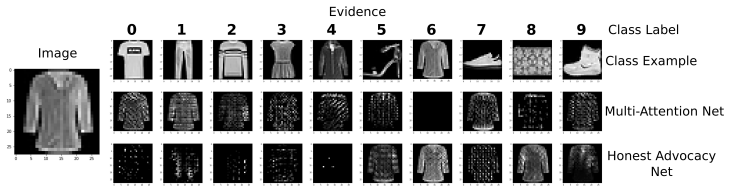
- As an extension, the 8/9 asymmetry suggests a testable predictor: deception helps most for class pairs where one class can be visually morphed into the other, and confusions should shrink mainly in the morphable direction.
- As an extension, a curriculum that anneals the fraction of deceptive advocate updates from zero to the full advocacy objective might stabilize high-capacity judges, combining the robustness of honest advocacy with the accuracy of deception.
Signed reviews
Editorial analysis
A structured set of objections, weighed in public.
Referee Report
Summary. The paper introduces advocacy learning, a supervised training scheme for attention-based classification in which N class-specific Advocate subnetworks each produce an attention map ("argument") and a Judge network predicts the class from the element-wise products of these maps with the input. Advocates are trained with the deceptive objective of maximizing the Judge's probability for their own class even on inputs from other classes; an honest variant trains each Advocate only on its own class's examples. Experiments compare Advocacy Nets against an Attention Net and a Multi-Attention Net on MNIST, Fashion-MNIST, CIFAR-10, MIMIC-III mortality prediction, and imbalanced/binary MNIST variants. The main positive result is a small but consistent accuracy improvement on MNIST (99.42% vs 99.16% Attention Net, 99.33% Multi-Attention Net) and Fashion-MNIST (91.62% vs 89.71% Attention Net, 90.11% Multi-Attention Net), with means and standard deviations over five seeds. Results on CIFAR-10, MIMIC, and Binary MNIST are mixed or negative, and the paper concludes that advocacy learning is beneficial only in some circumstances.
Significance. If the MNIST and Fashion-MNIST results are reproducible, advocacy learning is a conceptually novel way to combine class-conditional attention with competition among subnetworks. The paper's strengths include the public code release, the use of architecture-matched baselines (Multi-Attention Net) to isolate the effect of the training objective, the honest-advocacy ablation, and the five-seed mean/standard-deviation reporting on the main image benchmarks. The central limitation is that the method's success appears to depend on a judge/advocate capacity balance that is identified post hoc on test-set accuracy, and the CIFAR-10 collapse with a ResNet-110 judge shows the balance is not automatically achieved. This limits the strength of the general claim until a principled, out-of-sample model-selection procedure is demonstrated.
major comments (4)
- [Section 4.3] The capacity analysis in Section 4.3 selects the number of residual blocks by comparing test-set accuracies (best Advocacy Net 99.46% vs best Multi-Attention Net 99.34%) with no validation split and no multiple-seed error bars reported for the search. Because the conclusion that the Judge should have higher capacity than the Advocates is drawn from this post hoc test-set selection, the paper does not provide a reproducible model-selection protocol. Given that Section 4.1 shows a high-capacity Judge (ResNet-110) collapses the Advocacy Net to 30.54% on CIFAR-10, the balance is load-bearing for the central claim; please re-run the capacity search using a held-out validation split and report means and standard deviations over seeds for the selected configuration.
- [Section 4.1] CIFAR-10 results are reported as single accuracies without standard deviations: 83.47 vs 79.73 for the lower-capacity setup and 30.54 vs 92.01/92.68 for the ResNet-110 judge setup. The collapse of the deceptive Advocacy Net under a high-capacity Judge is a serious instability that conflicts with an unqualified reading of the abstract's claim that advocacy learning leads to improvements. Please report repeated-seed statistics and specify the exact architecture and hyperparameters used for the CIFAR-10 experiments, or explicitly restrict the claim to the settings in which the improvement is statistically stable.
- [Section 3.2] The L1 attention regularization penalty coefficient is mentioned but its value is never given, and no sensitivity analysis is provided. Since the sparsity of the attention maps directly controls the evidence available to the Judge, an unspecified coefficient makes the experiments not fully reproducible and leaves open the possibility that the observed gains depend on a particular regularization strength. Please report the coefficient and, ideally, include a small robustness sweep over this hyperparameter.
- [Section 4.4 / Table 2] Table 2 shows that the Advocacy Net underperforms the Attention Net on MIMIC (AUROC 77.73 vs 83.29) and on Binary MNIST (98.72 vs 99.23), and only matches the Honest Advocacy Net on Imbalanced MNIST (99.17 vs 99.17). The paper's conclusion appropriately says 'in some circumstances,' but the abstract and introduction's phrasing ('can lead to small improvements') should be scoped to balanced multi-class image data, and these negative results should be treated as boundary conditions of the method rather than as a general demonstration of improvement.
minor comments (5)
- [Abstract] The phrase 'Though a series of follow-up experiments' should be 'Through a series of follow-up experiments'.
- [Section 4.3] In the sentence reporting the shared-encoder ablation, 'FMIST' should be 'FMNIST'.
- [References] Reference [Adam et al., 2017] is misattributed; the PyTorch paper should be cited as Paszke et al., 2017.
- [Algorithm 1] The honest-advocate update condition in line 13 ('if not honest or i = y') is easy to misread; consider rewriting as 'if (not honest) or (i == y)' and adding a sentence clarifying that honest advocates receive no gradient for classes other than the true class.
- [Section 3.1] The abstract's phrase 'identical supervised baseline' is ambiguous; the Multi-Attention Net is the architecture-matched baseline, while the Attention Net removes all but one attention module. Please clarify this distinction in the text.
Circularity Check
No significant circularity: advocacy learning is assessed on held-out canonical test splits relative to identical supervised baselines, so the reported gains do not reduce by construction to a fitted quantity.
full rationale
The paper makes an empirical claim ('advocacy learning can lead to small improvements in classification accuracy over an identical supervised baseline', Abstract/Section 4) and supports it by comparing test-set accuracies of Advocacy Nets, Honest Advocacy Nets, Multi-Attention Nets, and Attention Nets trained under the same setup (Tables 1 and 2; Section 3.1). No equation defines the reported accuracy in terms of the training objective, and no fitted parameter is renamed as a prediction: the judge loss is standard cross-entropy on the true label, advocate losses are class-indexed cross-entropies (Section 2.3, Algorithm 1), and the outcomes are measured on canonical test splits after early stopping on a 10% validation split (Section 3.2). There are no load-bearing self-citations: the reference list contains no prior work whose conclusions this paper relies on from the same authors, and no 'uniqueness' theorem is invoked to force the architecture. The admitted fragility of the judge/advocate balance (Section 4.1, ResNet-110 collapse to 30.54%; Section 4.3 capacity search) and the post-hoc nature of the capacity comparison are substantive generalization/selection concerns, but they are not circularity: the central result is still an out-of-sample comparison, not an identity forced by how the method is defined. Accordingly, the appropriate finding is no significant circularity (0).
Assumptions & free parameters
free parameters (5)
- learning_rate =
1e-4
- L1 attention regularization penalty coefficient =
not reported
- validation_split =
10% of training data
- early_stopping_patience =
10 epochs
- residual_block_counts_in_capacity_search =
Judge 1-5, Advocates 1-3
assumptions (4)
- standard math Cross-entropy loss and gradient descent are valid for optimizing the described subnetworks.
- domain assumption Element-wise multiplication of an attention map in [0,1] with the input produces useful evidence for classification.
- domain assumption A shared encoder among advocates is a beneficial architectural choice.
- ad hoc to paper The deceptive advocate objective (minimizing -log y_hat[i]) will encourage useful class-conditional evidence without destabilizing the judge.
invented entities (2)
-
Advocate subnetworks (one per class)
-
Judge subnetwork
Cite this review
Pith. "Pith review of Advocacy Learning: Learning through Competition and Class-Conditional Representations." pith.science (2026). https://pith.science/paper/ZSRMIGYJ
@misc{pith2026190802723,
  author       = {Pith},
  title        = {Pith review of: Advocacy Learning: Learning through Competition and Class-Conditional Representations},
  year         = {2026},
  howpublished = {\url{https://pith.science/paper/ZSRMIGYJ}},
  note         = {Machine review of arXiv:1908.02723}
}
abstract
We introduce advocacy learning, a novel supervised training scheme for attention-based classification problems. Advocacy learning relies on a framework consisting of two connected networks: 1) $N$ Advocates (one for each class), each of which outputs an argument in the form of an attention map over the input, and 2) a Judge, which predicts the class label based on these arguments. Each Advocate produces a class-conditional representation with the goal of convincing the Judge that the input example belongs to their class, even when the input belongs to a different class. Applied to several different classification tasks, we show that advocacy learning can lead to small improvements in classification accuracy over an identical supervised baseline. Though a series of follow-up experiments, we analyze when and how such class-conditional representations improve discriminative performance. Though somewhat counter-intuitive, a framework in which subnetworks are trained to competitively provide evidence in support of their class shows promise, in many cases performing on par with standard learning approaches. This provides a foundation for further exploration into competition and class-conditional representations in supervised learning.
Figures

Reference graph
Works this paper leans on
-
[1]
Automatic Differentiation in PyTorch
[Adam et al., 2017] Paszke Adam, Chintala Soumith, Chanan Gregory, Yang Edward, DeVito Zachary, Lin Zeming, Desmaison Alban, Antiga Luca, and Lerer Adam. Automatic Differentiation in PyTorch. In Autodiff Workshop in the Proceedings of Neural Information Processing Systems,
work page 2017
-
[3]
[Desautels et al., 2016] Thomas Desautels, Jacob Calvert, Jana Hoffman, Melissa Jay, Yaniv Kerem, Lisa Shieh, David Shimabukuro, Uli Chettipally, Mitchell D Feldman, Chris Barton, David J Wales, and Ritankar Das. Predic- tion of Sepsis in the Intensive Care Unit With Minimal Electronic Health Record Data: A Machine Learning Ap- proach. JMIR Medical Inform...
work page 2016
-
[7]
[He et al., 2016] Kaiming He, Xiangyu Zhang, Shaoqing Ren, and Jian Sun
arXiv: 1703.07771. [He et al., 2016] Kaiming He, Xiangyu Zhang, Shaoqing Ren, and Jian Sun. Deep residual learning for image recog- nition. IEEE Conference on Computer Vision and Pattern Recognition (CVPR),
arXiv 2016
-
[9]
arXiv: 1805.00899. [Itti et al., 1998] L. Itti, C. Koch, and E. Niebur. A model of saliency-based visual attention for rapid scene analysis. IEEE Transactions on Pattern Analysis and Machine In- telligence, 20(11):1254–1259, November
arXiv 1998
-
[11]
[Kingma and Ba, 2014] Diederik P. Kingma and Jimmy Ba. Adam: A method for stochastic optimization. Interna- tional Conference for Learning Representations,
work page 2014
-
[12]
[Makhzani and Frey, 2015] Alireza Makhzani and Bren- dan J. Frey. Winner-take-all autoencoders. In Advances in Neural Information Processing Systems , pages 2791– 2799,
work page 2015
-
[14]
Deconvolution and checkerboard artifacts
[Odena et al., 2016] Augustus Odena, Vincent Dumoulin, and Chris Olah. Deconvolution and checkerboard artifacts. Distill,
work page 2016
-
[15]
Learning Independent Causal Mechanisms
[Parascandolo et al., 2018] Giambattista Parascandolo, Niki Kilbertus, Mateo Rojas-Carulla, and Bernhard Sch ¨olkopf. Learning Independent Causal Mechanisms. In Interna- tional Conference on Machine Learning , pages 4036– 4044, July
work page 2018
Show all 19 references
-
[16]
”Why Should I Trust You?”: Ex- plaining the Predictions of Any Classifier
[Ribeiro et al., 2016] Marco Tulio Ribeiro, Sameer Singh, and Carlos Guestrin. ”Why Should I Trust You?”: Ex- plaining the Predictions of Any Classifier. In Proceedings of the 22Nd ACM SIGKDD International Conference on Knowledge Discovery and Data Mining , KDD ’16, pages 1135–...
2016
-
[17]
event- place: San Francisco, California, USA
ACM. event- place: San Francisco, California, USA. [Ronneberger et al., 2015] Olaf Ronneberger, Philipp Fis- cher, and Thomas Brox. U-net: Convolutional networks for biomedical image segmentation. In International Conference on Medical image computing and computer- assisted in...
2015
-
[18]
[Sabour et al., 2017] Sara Sabour, Nicholas Frosst, and Ge- offrey E. Hinton. Dynamic routing between capsules. In Advances in Neural Information Processing Systems , pages 3856–3866,
2017
-
[19]
Mastering the game of Go without human knowledge
[Silver et al., 2017] David Silver, Julian Schrittwieser, Karen Simonyan, Ioannis Antonoglou, Aja Huang, Arthur Guez, Thomas Hubert, Lucas Baker, Matthew Lai, Adrian Bolton, Yutian Chen, Timothy Lillicrap, Fan Hui, Laurent Sifre, George van den Driessche, Thore Graepel, and De...
2017
-
[20]
Attention is all you need
[Vaswani et al., 2017] Ashish Vaswani, Noam Shazeer, Niki Parmar, Jakob Uszkoreit, Llion Jones, Aidan N Gomez, Łukasz Kaiser, and Illia Polosukhin. Attention is all you need. In Advances in neural information processing sys- tems, pages 5998–6008,
2017
-
[21]
Fashion-MNIST: a Novel Image Dataset for Benchmarking Machine Learning Algorithms
[Xiao et al., 2017] Han Xiao, Kashif Rasul, and Roland V ollgraf. Fashion-MNIST: a Novel Image Dataset for Benchmarking Machine Learning Algorithms. arXiv:1708.07747 [cs, stat] , August
2017 arXiv
-
[1998]
Pollard, Lu Shen, H
[Johnson et al., 2016] Alistair EW Johnson, Tom J. Pollard, Lu Shen, H. Lehman Li-wei, Mengling Feng, Mohammad Ghassemi, Benjamin Moody, Peter Szolovits, Leo An- thony Celi, and Roger G. Mark. MIMIC-III, a freely ac- cessible critical care database. Scientific data, 3:160035,
2016
-
[2015]
Maslove, Francois Lamon- tagne, John C
[Maslove et al., 2017] David M. Maslove, Francois Lamon- tagne, John C. Marshall, and Daren K. Heyland. A path to precision in the ICU. Critical Care, 21(1):79, April
2017
-
[2016]
Namboodiri, Philip H
[Ghosh et al., 2018] Arnab Ghosh, Viveka Kulharia, Vinay P. Namboodiri, Philip H. S. Torr, and Puneet K. Dokania. Multi-Agent Diverse Generative Adversarial Networks. In IEEE Conference on Computer Vision and Pattern Recognition (CVPR), pages 8513–8521,
2018
-
[2017]
Segnet: A deep convolu- tional encoder-decoder architecture for image segmenta- tion
[Badrinarayanan et al., 2017] Vijay Badrinarayanan, Alex Kendall, and Roberto Cipolla. Segnet: A deep convolu- tional encoder-decoder architecture for image segmenta- tion. IEEE transactions on pattern analysis and machine intelligence, 39(12):2481–2495,
2017
-
[2018]
Gen- erative adversarial nets
[Goodfellow et al., 2014] Ian Goodfellow, Jean Pouget- Abadie, Mehdi Mirza, Bing Xu, David Warde-Farley, Sherjil Ozair, Aaron Courville, and Yoshua Bengio. Gen- erative adversarial nets. In Advances in Neural Informa- tion Processing Systems, pages 2672–2680,
2014
Reviewed August 14, 2026 · model on record in the stance chip above.
Discussion (0). Continue with ORCID to comment.