"AI Watermarking": Bridging Policy Discourse and Technical Capabilities
Pith reviewed 2026-06-30 11:31 UTC · model grok-4.3
The pith
Policy proposals for tracking AI-generated content assume detection capabilities that existing methods cannot reliably deliver.
A machine-rendered reading of the paper's core claim, the machinery that carries it, and where it could break.
Core claim
The paper establishes that there are critical disconnects between the demands in policy discourse for reliable tracking of AI-generated content and the actual capabilities and limitations of current technical methods like watermarking, while also surfacing ambiguities and potential pitfalls in the policy language and trends.
What carries the argument
Inductive coding applied to a broad corpus of policy documents on AI content transparency to reveal patterns of disconnect.
If this is right
- Policies may require watermarking features that are not yet technically feasible at scale.
- Ambiguities in policy documents could lead to varied interpretations and inconsistent application across jurisdictions.
- Trends in the discourse highlight pitfalls such as over-reliance on unproven detection methods.
- Open questions remain about how to align future technical development with regulatory needs.
Where Pith is reading between the lines
- Closer integration between policy drafting and technical experts could reduce these mismatches in future regulations.
- The identified gaps suggest that enforcement of such policies might require new standards for what counts as reliable detection.
- Similar disconnects may exist in other areas of AI governance beyond content tracking.
Load-bearing premise
The methodology for selecting documents and performing inductive coding produces a representative corpus that accurately identifies the main policy-relevant gaps without bias.
What would settle it
Finding that major policy proposals on AI content tracking are fully consistent with demonstrated technical capabilities of watermarking and detection systems would challenge the central claim of significant disconnects.
Figures
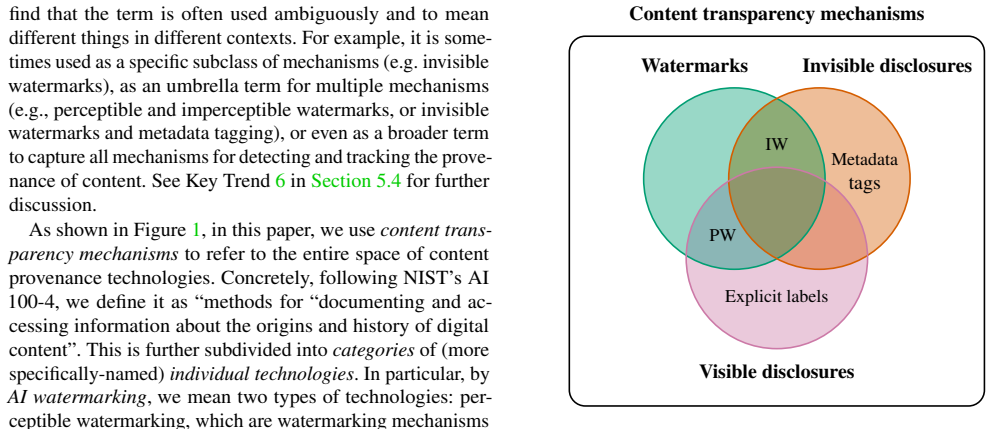
read the original abstract
The widespread deployment of generative artificial intelligence (AI) models has raised serious concerns about the proliferation of AI-generated content. This has led to a surge of interest in, and demand for, reliable tracking and detection mechanisms for content that is AI-generated, such as watermarking, metadata tagging, content tagging, and more. The problem has captured the attention of policymakers as well as the popular media, and a spate of recent bills in the US have sought to regulate the spread of AI content, and enforce or promote methods to track and label it. This work performs a critical analysis of the policy discourse surrounding generative AI content transparency in the US and EU. Through a broad document selection methodology, we first collect a broad corpus of documents containing legislative language and policy-relevant discourse on the topic. We then analyze these through inductive coding, and leverage our coding to systematize these documents, identifying key patterns, gaps, and open questions. We identify critical points of disconnect between policy and technological capabilities and practice, and we highlight and discuss potential ambiguities and pitfalls raised by the trends in our corpus.
Editorial analysis
A structured set of objections, weighed in public.
Referee Report
Summary. The paper performs a critical analysis of policy discourse on generative AI content transparency in the US and EU. It collects a broad corpus of legislative and policy-relevant documents via a broad document selection methodology, applies inductive coding to systematize the documents and surface patterns/gaps/open questions, and identifies critical disconnects between policy language and technical capabilities along with ambiguities and pitfalls in the trends observed.
Significance. If the corpus is representative and the coding reliable, the work could usefully map mismatches between policy ambitions for AI content tracking (e.g., watermarking mandates) and current technical practice, providing a foundation for more grounded regulation. The inductive approach is appropriate for surfacing emergent themes in policy documents.
major comments (1)
- [Methodology] Methodology (document collection and inductive coding): the description supplies no corpus size, explicit search strings, inclusion/exclusion criteria, or inter-coder reliability statistics. Because the central claims rest on the coded corpus reliably surfacing representative disconnects and pitfalls, the absence of these details prevents assessment of selection or interpretation bias.
Simulated Author's Rebuttal
We thank the referee for their constructive review and for recognizing the potential value of mapping policy-technical disconnects in AI content transparency. We agree that greater methodological transparency is needed to support assessment of the corpus and coding process, and we will revise the manuscript to address this.
read point-by-point responses
-
Referee: [Methodology] Methodology (document collection and inductive coding): the description supplies no corpus size, explicit search strings, inclusion/exclusion criteria, or inter-coder reliability statistics. Because the central claims rest on the coded corpus reliably surfacing representative disconnects and pitfalls, the absence of these details prevents assessment of selection or interpretation bias.
Authors: We agree this information is necessary for evaluating selection and interpretation bias. In the revised manuscript we will expand the methodology section to report the exact corpus size, the explicit search strings and sources used for document collection, the full inclusion/exclusion criteria, and a description of the inductive coding process including how consistency was maintained (e.g., team review and consensus procedures). These additions will directly address the concern while preserving the qualitative, inductive nature of the study. revision: yes
Circularity Check
No circularity: qualitative policy analysis with no derivations or self-referential constructions
full rationale
The paper conducts a critical analysis of policy documents via broad corpus collection and inductive coding. It contains no equations, fitted parameters, predictions, uniqueness theorems, or ansatzes. All enumerated circularity patterns require self-definition, fitted inputs called predictions, or load-bearing self-citations that reduce a central claim to its own inputs; none are present. The methodology describes document selection and coding at a high level but does not invoke any internal construction that forces the reported disconnects. The analysis is therefore self-contained against external policy texts.
Axiom & Free-Parameter Ledger
Reference graph
Works this paper leans on
-
[1]
https://gith ub.com/hackerfactor/SEAL .PERMALINK: https: //perma.cc/BPZ5-CKUE
Secure evidence attribution label (seal). https://gith ub.com/hackerfactor/SEAL .PERMALINK: https: //perma.cc/BPZ5-CKUE
-
[2]
My AI Safety Lecture for UT Effective Altruism
Scott Aaronson. My AI Safety Lecture for UT Effective Altruism. https://scottaaronson.blog/?p=6823 , 2022.PERMALINK:https://perma.cc/F8P2-BRPP
2022
-
[3]
AI could empower and prolif- erate social engineering cyberattacks
Abdulaziz Almaslukh. AI could empower and prolif- erate social engineering cyberattacks. https://ww w.weforum.org/stories/2024/10/ai- agent s-in-cybersecurity-the-augmented-risks-w e-all-need-to-know-about/ , 2024.PERMALINK: https://perma.cc/3NFC-8FNN
2024
-
[4]
Regulatory Mapping on Artificial Intel- ligence in Latin America
Access Now. Regulatory Mapping on Artificial Intel- ligence in Latin America. https://www.accessno w.org/wp-content/uploads/2024/07/TRF-LAC -Reporte-Regional-IA-JUN-2024-V3.pdf , 2024. PERMALINK:https://perma.cc/2LHM-FG83
2024
-
[5]
The simple macroeconomics of AI
Daron Acemoglu. The simple macroeconomics of AI. Economic Policy, 2025
2025
-
[6]
Do the Right Thing
Kendra Albert and James Grimmelmann. Do the Right Thing. Communications of the ACM, 2023
2023
-
[7]
The Real Dangers of Generative AI.Journal of Democracy, 2024
Danielle Allen and E Glen Weyl. The Real Dangers of Generative AI.Journal of Democracy, 2024
2024
-
[8]
Amazon Titan Image Generator and watermark detection API are now available in Ama- zon Bedrock
Antje Barth. Amazon Titan Image Generator and watermark detection API are now available in Ama- zon Bedrock. https://aws.amazon.com/blo gs/aws/amazon- titan- image- generator- and - watermark- detection- api- are- now- avail able- in- amazon- bedrock/ , 2025.PERMALINK: https://perma.cc/THH8-C9AG
2025
-
[9]
Epistemological per- spectives on is research: a framework for analysing and systematizing epistemological assumptions.Informa- tion Systems Journal, 17(2):197–214, 2007
Jörg Becker and Björn Niehaves. Epistemological per- spectives on is research: a framework for analysing and systematizing epistemological assumptions.Informa- tion Systems Journal, 17(2):197–214, 2007
2007
-
[10]
low rate of accuracy
Benj Edwards. OpenAI discontinues its AI writing detector due to “low rate of accuracy”’. https://ar stechnica.com/information-technology/2023 /07/openai-discontinues-its-ai-writing-d etector-due-to-low-rate-of-accuracy/ , 2023. PERMALINK:https://perma.cc/4PD9-WC92
2023
-
[11]
Coalition for Content provenance and authen- ticity
C2PA. Coalition for Content provenance and authen- ticity. https://c2pa.org/ .PERMALINK: https: //perma.cc/3J4Q-HKQT
-
[12]
Anna Carobene, Andrea Padoan, Federico Cabitza, Giuseppe Banfi, and Mario Plebani. Rising adoption of artificial intelligence in scientific publishing: evaluating the role, risks, and ethical implications in paper drafting and review process.Clinical Chemistry and Laboratory Medicine (CCLM), 2024
2024
-
[13]
Generative AI and Electoral Commu- nications.Georgetown Law Technology Review, 2025
Evan Chiacchiaro. Generative AI and Electoral Commu- nications.Georgetown Law Technology Review, 2025
2025
-
[14]
Nist’s software un-standards.George- town Law Tech Review, 2025
Bryan H Choi. Nist’s software un-standards.George- town Law Tech Review, 2025
2025
-
[15]
Pseudorandom Error- Correcting Codes
Miranda Christ and Sam Gunn. Pseudorandom Error- Correcting Codes. InCRYPTO, 2024
2024
-
[16]
Undetectable Watermarks for Language Models
Miranda Christ, Sam Gunn, and Or Zamir. Undetectable Watermarks for Language Models. InPMLR, 2024
2024
-
[17]
Securing the future of GenAI: Policy and technology.arXiv preprint arXiv:2407.12999, 2024
Mihai Christodorescu, Ryan Craven, Soheil Feizi, Neil Gong, Mia Hoffmann, Somesh Jha, Zhengyuan Jiang, Mehrdad Saberi Kamarposhti, John Mitchell, Jessica Newman, et al. Securing the future of GenAI: Policy and technology.arXiv preprint arXiv:2407.12999, 2024
-
[18]
Watermarking Language Models for Many Adaptive Users
Aloni Cohen, Alexander Hoover, and Gabe Schoenbach. Watermarking Language Models for Many Adaptive Users. InIEEE S&P, 2025
2025
-
[19]
How ChatGPT Could Embed a ‘Water- mark’ in the Text It Generates.https://www.nytime s.com/interactive/2023/02/17/business/ai-t ext-detection.html, 2023
Keith Collins. How ChatGPT Could Embed a ‘Water- mark’ in the Text It Generates.https://www.nytime s.com/interactive/2023/02/17/business/ai-t ext-detection.html, 2023. 22
2023
-
[20]
Provisions on the Administration of Deep Synthesis Internet Information Services
Cyberspace Administration of China. Provisions on the Administration of Deep Synthesis Internet Information Services. https://www.chinalawtranslate.com/ en/deep-synthesis/ , 2022.PERMALINK: https: //perma.cc/XGH9-XHWD
2022
-
[21]
Tay- lan Cemgil, Zahra Ahmed, Kitty Stacpoole, Ilia Shu- mailov, Ciprian Baetu, Sven Gowal, Demis Hassabis, and Pushmeet Kohli
Sumanth Dathathri, Abigail See, Sumedh Ghaisas, Po- Sen Huang, Rob McAdam, Johannes Welbl, Vandana Bachani, Alex Kaskasoli, Robert Stanforth, Tatiana Matejovicova, Jamie Hayes, Nidhi Vyas, Majd Al Merey, Jonah Brown-Cohen, Rudy Bunel, Borja Balle, A. Tay- lan Cemgil, Zahra Ahmed, Kitty Stacpoole, Ilia Shu- mailov, Ciprian Baetu, Sven Gowal, Demis Hassabis...
2024
-
[22]
Report on encryption, anonymity, and the human rights framework
David Kaye. Report on encryption, anonymity, and the human rights framework. https://docs.un.org/A/ HRC/29/32, 2015.PERMALINK: https://perma.cc /EP3N-JYLF
2015
-
[23]
Navigating the Jagged Technological Frontier: Field Experimental Evidence of the Effects of AI on Knowledge Worker Productivity and Quality
Fabrizio Dell’Acqua, Edward McFowland III, Ethan R Mollick, Hila Lifshitz-Assaf, Katherine Kellogg, Saran Rajendran, Lisa Krayer, François Candelon, and Karim R Lakhani. Navigating the Jagged Technological Frontier: Field Experimental Evidence of the Effects of AI on Knowledge Worker Productivity and Quality. Harvard Business School Technology & Operation...
2023
-
[24]
Evaluating the efficacy of AI content detection tools in differentiating between human and AI-generated text
Ahmed M Elkhatat, Khaled Elsaid, and Saeed Almeer. Evaluating the efficacy of AI content detection tools in differentiating between human and AI-generated text. International Journal for Educational Integrity, 2023
2023
-
[25]
GPTs are GPTs: Labor market impact potential of LLMs.Science, 2024
Tyna Eloundou, Sam Manning, Pamela Mishkin, and Daniel Rock. GPTs are GPTs: Labor market impact potential of LLMs.Science, 2024
2024
-
[26]
Publicly-Detectable Watermarking for Language Models.IACR Communications in Cryptology, 2024
Jaiden Fairoze, Sanjam Garg, Somesh Jha, Saeed Mahloujifar, Mohammad Mahmoody, and Mingyuan Wang. Publicly-Detectable Watermarking for Language Models.IACR Communications in Cryptology, 2024
2024
-
[27]
Demon- strating Rigor Using Thematic Analysis: A Hybrid Ap- proach of Inductive and Deductive Coding and Theme Development.International Journal of Qualitative Methods, 2006
Jennifer Fereday and Eimear Muir-Cochrane. Demon- strating Rigor Using Thematic Analysis: A Hybrid Ap- proach of Inductive and Deductive Coding and Theme Development.International Journal of Qualitative Methods, 2006
2006
-
[28]
Labeling Synthetic Content: User Perceptions of Label Designs for AI-Generated Content on Social Media
Dilrukshi Gamage, Dilki Sewwandi, Min Zhang, and Arosha K Bandara. Labeling Synthetic Content: User Perceptions of Label Designs for AI-Generated Content on Social Media. InCHI, 2025
2025
-
[29]
Alexander Gamero-Garrido, Stefan Savage, Kirill Levchenko, and Alex C. Snoeren. Quantifying the Pres- sure of Legal Risks on Third-party Vulnerability Re- search. In Bhavani Thuraisingham, David Evans, Tal Malkin, and Dongyan Xu, editors,ACM CCS
-
[30]
Two AI Transparency Concerns that Governments Should Align On
Tommaso Giardini, Nora Fischer, and Johannes Fritz. Two AI Transparency Concerns that Governments Should Align On. https://www.techpolicy.pre ss/two-ai-transparency-concerns-that-gov ernments-should-align-on/ , 2024.PERMALINK: https://perma.cc/9YML-PNK4
2024
-
[31]
SynthID – A tool to watermark and identify content generated through AI
Google DeepMind. SynthID – A tool to watermark and identify content generated through AI. https://de epmind.google/science/synthid/ .PERMALINK: https://perma.cc/Z5AW-XNNV
-
[32]
Greenberg
Brad A. Greenberg. Rethinking Technology Neutrality. Minnesota Law Review, 2015
2015
-
[33]
Reg- ulating ChatGPT and other large generative AI models
Philipp Hacker, Andreas Engel, and Marco Mauer. Reg- ulating ChatGPT and other large generative AI models. InACM FAccT, 2023
2023
-
[34]
Global Standard Setting in Internet Governance
Alison Harcourt, George Christou, and Seamus Simpson. Global Standard Setting in Internet Governance. Oxford University Press, 2020
2020
-
[35]
Center for Countering Digital Hate. The Double-Edged Sword of AI: How Generative Language Models Like Google Bard and ChatGPT Pose a Threat to Countering Hate and Misinformation Online.Harvard Data Science Review, 2024
2024
-
[36]
RE: Senate Bill Number 97 of the 2024 Regular Session by Senator Royce Duplessis
Jeff Landry. RE: Senate Bill Number 97 of the 2024 Regular Session by Senator Royce Duplessis. https: //www.legis.la.gov/legis/ViewDocument.aspx ?d=1382564, 2024.PERMALINK: https://perma.cc /WB44-9RNP
2024
-
[37]
Evading Watermark based Detection of AI- Generated Content
Zhengyuan Jiang, Jinghuai Zhang, and Neil Zhenqiang Gong. Evading Watermark based Detection of AI- Generated Content. InACM CCS, 2023
2023
-
[38]
Nikola Jovanovic, Robin Staab, and Martin T. Vechev. Watermark Stealing in Large Language Models. In ICML, 2024
2024
-
[39]
A Watermark for Large Language Models
John Kirchenbauer, Jonas Geiping, Yuxin Wen, Jonathan Katz, Ian Miers, and Tom Goldstein. A Watermark for Large Language Models. In Andreas Krause, Emma Brunskill, Kyunghyun Cho, Barbara Engelhardt, Sivan Sabato, and Jonathan Scarlett, editors,ICML, 2023
2023
-
[40]
Robust Distortion-free Watermarks for Language Models.TMLR, 2024
Rohith Kuditipudi, John Thickstun, Tatsunori Hashimoto, and Percy Liang. Robust Distortion-free Watermarks for Language Models.TMLR, 2024. 23
2024
-
[41]
How we’re increasing transparency for gen AI content with the C2PA
Laurie Richardson. How we’re increasing transparency for gen AI content with the C2PA. https://blog .google/technology/ai/google- gen- ai- con tent- transparency- c2pa/ , 2024.PERMALINK: https://perma.cc/3S98-9CBW
2024
-
[42]
An empirical investigation of the impact of ChatGPT on creativity
Byung Cheol Lee and Jaeyeon Chung. An empirical investigation of the impact of ChatGPT on creativity. Nature Human Behaviour, 2024
2024
-
[43]
GPT detectors are biased against non- native English writers.Patterns, 2023
Weixin Liang, Mert Yuksekgonul, Yining Mao, Eric Wu, and James Zou. GPT detectors are biased against non- native English writers.Patterns, 2023
2023
-
[44]
ChatGPT Hits 1 Billion Users? ‘Doubled In Just Weeks’ Says OpenAI CEO
Martine Paris. ChatGPT Hits 1 Billion Users? ‘Doubled In Just Weeks’ Says OpenAI CEO. https://www.fo rbes.com/sites/martineparis/2025/04/12/cha tgpt-hits-1-billion-users-openai-ceo-say s-doubled-in-weeks/ , 2025.PERMALINK: https: //perma.cc/2UF2-7ATN
2025
-
[45]
One of the Biggest Problems in Regulating AI Is Agreeing on a Definition
Matt O’Shaughnessy. One of the Biggest Problems in Regulating AI Is Agreeing on a Definition. https: //carnegieendowment.org/posts/2022/10/one-o f-the-biggest-problems-in-regulating-ai-i s-agreeing-on-a-definition , 2022.PERMALINK: https://perma.cc/5RUV-RWRC
2022
-
[46]
Google’s Gemini AI app has 400M monthly active users
Maxwell Zeff. Google’s Gemini AI app has 400M monthly active users. https://techcrunch.com /2025/05/20/googles- gemini- ai- app- has- 4 00m-monthly-active-users , 2025.PERMALINK: https://perma.cc/P5M3-D8V9
2025
-
[47]
Interrater reliability: the kappa statis- tic.Biochemia medica, 2012
Mary L McHugh. Interrater reliability: the kappa statis- tic.Biochemia medica, 2012
2012
-
[48]
Detect- GPT: Zero-Shot Machine-Generated Text Detection us- ing Probability Curvature
Eric Mitchell, Yoonho Lee, Alexander Khazatsky, Christopher D Manning, and Chelsea Finn. Detect- GPT: Zero-Shot Machine-Generated Text Detection us- ing Probability Curvature. InICML, 2023
2023
-
[49]
Content Industry Promotion Act, 2024
National Assembly of South Korea. Content Industry Promotion Act, 2024
2024
-
[50]
Watermarking Without Standards Is Not AI Governance
Alexander Nemecek, Yuzhou Jiang, and Erman Ayday. Watermarking Without Standards Is Not AI Governance. arXiv preprint arXiv:2505.23814, 2025
-
[51]
Labeling AI-Generated Images on Face- book, Instagram and Threads
Nick Clegg. Labeling AI-Generated Images on Face- book, Instagram and Threads. https://about.fb .com/news/2024/02/labeling-ai-generated-i mages-on-facebook-instagram-and-threads/ , 2024.PERMALINK:https://perma.cc/2PHP-GKXT
2024
-
[52]
Introducing ChatGPT
OpenAI. Introducing ChatGPT. https://openai .com/index/chatgpt/ , 2022.PERMALINK: https: //perma.cc/S23B-THHG
2022
-
[53]
Understanding the source of what we see and hear online
OpenAI. Understanding the source of what we see and hear online. https://openai.com/index/underst anding-the-source-of-what-we-see-and-hea r-online/, 2024.PERMALINK: https://perma.cc /W55G-CV8G
2024
-
[54]
A Researcher’s Guide to Some Legal Risks of Security Research
Sunoo Park and Kendra Albert. A Researcher’s Guide to Some Legal Risks of Security Research. A joint pub- lication of the Cyberlaw Clinic at Harvard Law School, the Technology Law and Policy Clinic at NYU Law, and the Electronic Frontier Foundation, 2024. Available at: https://clinic.cyber.harvard.edu/wp-conte nt/uploads/2024/08/Security-Researchers-G uid...
2024
-
[55]
Misunderstanding AI’s Democracy Problem.UCLA Journal of Law & Technology, 2025
Nathaniel Persily. Misunderstanding AI’s Democracy Problem.UCLA Journal of Law & Technology, 2025
2025
-
[56]
Taking Sides on Technology Neutrality
Chris Reed. Taking Sides on Technology Neutrality. SCRIPTed, 2007
2007
-
[57]
Bram Rijsbosch, Gijs van Dijck, and Konrad Kollnig. Adoption of Watermarking Measures for AI-Generated Content and Implications under the EU AI Act.arXiv preprint arXiv:2503.18156, 2025
-
[58]
SAGE publications, 2014
Johnny Saldana.Thinking Qualitatively: Methods of Mind. SAGE publications, 2014
2014
-
[59]
OpenAI has the tech to watermark ChatGPT text–it just won’t release it
Samuel Axon. OpenAI has the tech to watermark ChatGPT text–it just won’t release it. https://ar stechnica.com/ai/2024/08/openai- has- the - tech- to- watermark- chatgpt- text- it- jus t-wont-release-it/ , 2024.PERMALINK: https: //perma.cc/4F54-HS5G
2024
-
[60]
Watermarking: where to? https: //www.youtube.com/live/YzuVet3YkkA?si=p0QG bUn07Rx-zO-W, 2024.PERMALINK: https://perma
Scott Aaronson. Watermarking: where to? https: //www.youtube.com/live/YzuVet3YkkA?si=p0QG bUn07Rx-zO-W, 2024.PERMALINK: https://perma. cc/2SUK-DHGT
2024
-
[61]
There’s a Tool to Catch Students Cheating With ChatGPT
Deepa Seetharaman and Matt Barnum. There’s a Tool to Catch Students Cheating With ChatGPT. OpenAI Hasn’t Released It. https://www.wsj.com/tech/ai/open ai-tool-chatgpt-cheating-writing-135b755a , 2024
2024
-
[62]
AI models collapse when trained on recursively generated data
Ilia Shumailov, Zakhar Shumaylov, Yiren Zhao, Nicolas Papernot, Ross Anderson, and Yarin Gal. AI models collapse when trained on recursively generated data. Nature, 2024
2024
-
[63]
AI on Snapchat: Improved Transparency, Safety, and Policies
Snap Values. AI on Snapchat: Improved Transparency, Safety, and Policies. https://values.snap.com/ne ws/ai-on-snapchat-improved-transparency-s afety-policy, 2024.PERMALINK: https://perma. cc/XB7W-X3ZH. 24
2024
-
[64]
A Real Account of Deep Fakes.Cor- nell Legal Studies Research Paper Forthcoming, Michi- gan Law Review, Forthcoming, 2024
Benjamin Sobel. A Real Account of Deep Fakes.Cor- nell Legal Studies Research Paper Forthcoming, Michi- gan Law Review, Forthcoming, 2024
2024
-
[65]
Initial Rescissions of Harmful Ex- ecutive Orders and Actions
The White House. Initial Rescissions of Harmful Ex- ecutive Orders and Actions. https://www.whit ehouse.gov/presidential- actions/2025/01 /initial- rescissions- of- harmful- executi ve- orders- and- actions/ , 2025.PERMALINK: https://perma.cc/FCN3-F6DQ
2025
-
[66]
Removing Barriers to American Leadership in Artificial Intelligence
The White House. Removing Barriers to American Leadership in Artificial Intelligence. https://www. whitehouse.gov/presidential-actions/2025/ 01/removing-barriers-to-american-leadershi p-in-artificial-intelligence/ , 2025.PERMA- LINK:https://perma.cc/324U-9K2W
2025
-
[67]
LLaMA: Open and Efficient Foundation Language Models
Hugo Touvron, Thibaut Lavril, Gautier Izacard, Xavier Martinet, Marie-Anne Lachaux, Timothée Lacroix, Bap- tiste Rozière, Naman Goyal, Eric Hambro, Faisal Azhar, et al. LLaMA: Open and Efficient Foundation Language Models.arXiv preprint arXiv:2302.13971, 2023
work page internal anchor Pith review Pith/arXiv arXiv 2023
-
[68]
Dates of Sessions of the Congress
United States Senate. Dates of Sessions of the Congress. https://www.senate.gov/legislative/Dates ofSessionsofCongress.htm .PERMALINK: https: //perma.cc/R3AJ-9JN5
-
[69]
Even in Death, Internet Explorer Lives On in South Korea
Daisuke Wakabayashi and Jin Yu Young. Even in Death, Internet Explorer Lives On in South Korea. https: //www.nytimes.com/2022/07/08/business/kore a-internet-explorer.html, 2022
2022
-
[70]
Internet Governance, Standard Setting, and Self-Regulation.Northern Kentucky Law Review, 2001
Philip J Weiser. Internet Governance, Standard Setting, and Self-Regulation.Northern Kentucky Law Review, 2001
2001
-
[71]
Watermarks in the Sand: Impossibility of Strong Water- marking for Large Language Models
Hanlin Zhang, Benjamin L Edelman, Danilo Francati, Daniele Venturi, Giuseppe Ateniese, and Boaz Barak. Watermarks in the Sand: Impossibility of Strong Water- marking for Large Language Models. InICML, 2024
2024
-
[72]
REMARK-LLM: A Robust and Efficient Watermarking Framework for Gen- erative Large Language Models
Ruisi Zhang, Shehzeen Samarah Hussain, Paarth Neekhara, and Farinaz Koushanfar. REMARK-LLM: A Robust and Efficient Watermarking Framework for Gen- erative Large Language Models. InUSENIX Security, 2024
2024
-
[73]
SoK: Watermarking for AI-Generated Content
Xuandong Zhao, Sam Gunn, Miranda Christ, Jaiden Fairoze, Andres Fabrega, Nicholas Carlini, Sanjam Garg, Sanghyun Hong, Milad Nasr, Florian Tramèr, Somesh Jha, Lei Li, Yu-Xiang Wang, and Dawn Song. SoK: Watermarking for AI-Generated Content. InIEEE S&P, 2025
2025
-
[74]
substantially modified
Xuandong Zhao, Kexun Zhang, Zihao Su, Saastha Vasan, Ilya Grishchenko, Christopher Kruegel, Giovanni Vigna, Yu-Xiang Wang, and Lei Li. Invisible Image Water- marks Are Provably Removable Using Generative AI. InNeurIPS, 2024. 25 A Recap of Key Takeaways and Open Ques- tions In this section, we list all key trends and open questions iden- tified in Sections...
2024
discussion (0)
Sign in with ORCID, Apple, or X to comment. Anyone can read and Pith papers without signing in.