D³-Subsidy: Online and Sequential Driver Subsidy Decision-Making for Large-Scale Ride-Hailing Market
Pith reviewed 2026-05-21 07:22 UTC · model grok-4.3
The pith
Prefix-conditioned diffusion generates future trajectories from fixed history to set city-level driver subsidies that respect caps and lift rides plus GMV.
A machine-rendered reading of the paper's core claim, the machinery that carries it, and where it could break.
Core claim
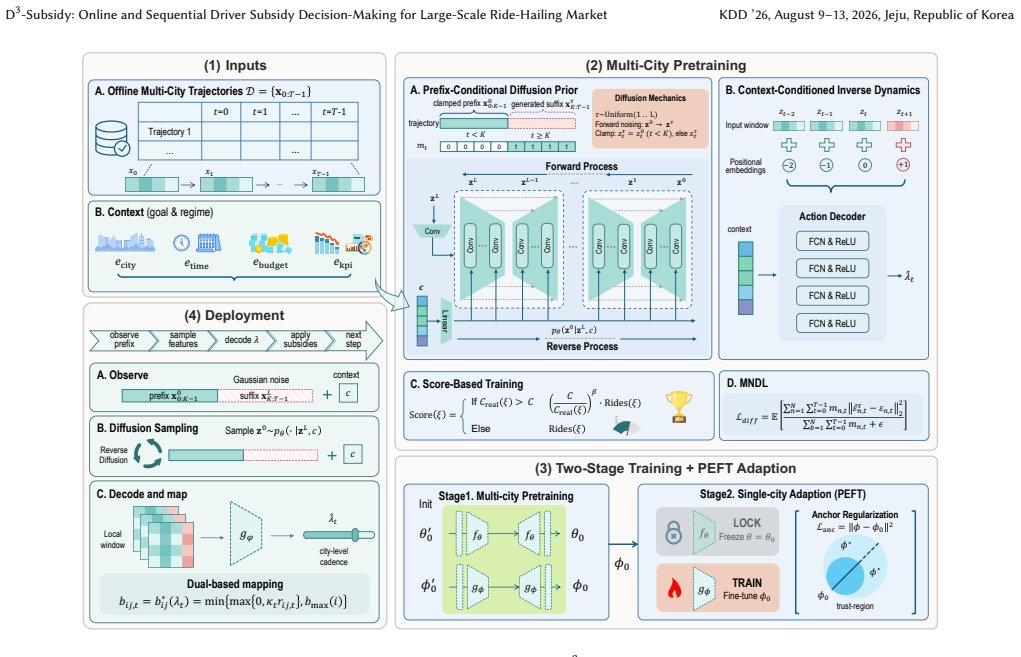
D³-Subsidy is a hierarchical diffusion-based framework for deployable city-wide subsidy control that bridges the train-inference gap with a prefix-conditioned diffusion model sampling plausible future trajectories from immutable historical observations; these plans are decoded by a context-conditioned inverse module into low-dimensional city-level signals and then mapped to fine-grained incentives through a Lagrangian-dual-derived construction that directly embeds subsidy-rate caps, all supported by multi-city pretraining and parameter-efficient fine-tuning for transfer across heterogeneous cities.
What carries the argument
Prefix-conditioned diffusion model that samples plausible future trajectories from immutable historical observations, which aligns training with the fixed-history constraint of online deployment and supplies forward-looking plans for the downstream inverse module and Lagrangian mapping.
If this is right
- Rides and GMV increase in offline evaluations while cap compliance improves.
- Real-world A/B test shows significant uplift with budget-related violation metrics staying inside operational thresholds.
- City-level plans convert to per-order incentives without iterative optimization, meeting low-latency requirements at scale.
- Multi-city pretraining plus parameter-efficient fine-tuning supports transfer to new cities without full retraining.
Where Pith is reading between the lines
- The same prefix-conditioning pattern could be tested on other online resource-allocation problems where only past observations are available at decision time.
- If the diffusion trajectories prove robust across market regimes, the framework might reduce reliance on city-specific hand-tuned rules.
- Measuring how much the Lagrangian mapping preserves optimality when demand shocks exceed the diffusion model's training distribution would clarify its limits.
Load-bearing premise
The prefix-conditioned diffusion model produces future trajectories that remain plausible and decision-relevant when the only information available at deployment time is immutable historical observations.
What would settle it
A live deployment in which the diffusion-generated trajectories diverge substantially from realized outcomes, causing the resulting subsidy schedule to produce lower rides or GMV than a simple historical-average baseline while still satisfying cap constraints.
Figures


read the original abstract
Ride-hailing platforms like DiDi Chuxing operate in highly dynamic environments where balancing driver supply and passenger demand is critical. Although driver-side subsidies serve as a primary lever to align these forces and improve key KPIs like completed rides (\texttt{Rides}) and gross merchandise value (\texttt{GMV}), optimizing them in production requires simultaneously meeting three constraints: (i) responsiveness to stochastic shocks, (ii) strict subsidy-rate caps, and (iii) low-latency execution at city scale. These requirements rule out expensive per-order optimization, calling for a forward-looking, constraint-aware city-level controller for online sequential decision making. To meet these requirements, we introduce D$^3$-Subsidy (Dynamic Driver-side Diffusion-based Subsidy), a hierarchical diffusion-based framework for deployable city-wide subsidy control. To bridge the train-inference gap, D$^3$-Subsidy employs a prefix-conditioned diffusion model that samples plausible future trajectories from immutable historical observations, ensuring the training protocol aligns with the fixed-history nature of online deployment. These generated plans are then decoded by a context-conditioned inverse module into low-dimensional city-level control signals. For scalable execution, we bridge the gap between city-level planning and fine-grained dispatch via a Lagrangian-dual-derived mapping, which embeds subsidy-rate caps directly into order-driver incentives without iterative optimization. Additionally, a multi-city pretraining strategy with parameter-efficient fine-tuning enables robust transfer across heterogeneous cities. Extensive offline evaluations demonstrate that D$^3$-Subsidy improves \texttt{Rides} and \texttt{GMV} while enhancing cap compliance, and a real-world A/B test confirms significant uplift while keeping budget-related violation metrics within operational thresholds.
Editorial analysis
A structured set of objections, weighed in public.
Referee Report
Summary. The manuscript introduces D³-Subsidy, a hierarchical diffusion-based framework for online sequential driver subsidy decision-making in large-scale ride-hailing markets. It employs a prefix-conditioned diffusion model to generate future trajectories from immutable historical observations (to bridge the train-inference gap), decodes these into city-level control signals via a context-conditioned inverse module, and uses a Lagrangian-dual-derived mapping to embed subsidy-rate caps into incentives without iterative optimization. A multi-city pretraining strategy with parameter-efficient fine-tuning supports transfer across cities. The central claims are improvements in completed rides (Rides) and GMV, plus enhanced cap compliance, demonstrated via extensive offline evaluations and a real-world A/B test that keeps budget-related violation metrics within thresholds.
Significance. If the prefix-conditioned diffusion trajectories prove decision-relevant and robust under immutable history, the work provides a scalable, constraint-aware controller suitable for production ride-hailing systems. The combination of generative modeling for forward-looking planning with Lagrangian embedding for hard constraints, together with the multi-city transfer approach, represents a practical advance in applying diffusion models to sequential operational decisions. The real-world A/B test component adds deployment relevance, though its evidential weight depends on the missing statistical details.
major comments (2)
- [Abstract] Abstract: The reported improvements in Rides and GMV from offline evaluations and the A/B test are asserted without any baselines, statistical significance tests, data exclusion criteria, sample sizes, or error bars. This directly undermines verification of the central claim that D³-Subsidy delivers meaningful uplift while satisfying operational constraints.
- [Abstract] Abstract (description of prefix-conditioned diffusion model): The framework's ability to produce plausible, decision-relevant future trajectories when only immutable historical observations are available at inference time is load-bearing for all downstream KPI gains. The manuscript provides no implementation details on the prefix conditioning, no ablation against simpler predictors (e.g., historical averages or autoregressive baselines), and no robustness checks under typical ride-hailing distribution shifts, leaving the train-inference gap bridge unverified.
minor comments (2)
- Ensure that all KPI definitions (Rides, GMV, cap compliance, budget violation metrics) are explicitly defined with formulas or precise operational descriptions in the main text, not only in the abstract.
- The Lagrangian-dual mapping is described at a high level; a brief pseudocode or equation sketch in the methods section would clarify how subsidy-rate caps are embedded without iterative optimization.
Simulated Author's Rebuttal
We thank the referee for the constructive feedback on our manuscript. We address each major comment below and indicate the revisions we will make to strengthen the presentation of results and methods.
read point-by-point responses
-
Referee: [Abstract] Abstract: The reported improvements in Rides and GMV from offline evaluations and the A/B test are asserted without any baselines, statistical significance tests, data exclusion criteria, sample sizes, or error bars. This directly undermines verification of the central claim that D³-Subsidy delivers meaningful uplift while satisfying operational constraints.
Authors: We agree that the abstract, as a concise summary, would benefit from additional context to support immediate verification of the claims. The full manuscript details the baselines (rule-based, optimization, and learning-based methods), statistical tests with p-values, data exclusion criteria, sample sizes, and error bars in Sections 4 and 5. We will revise the abstract to briefly reference the primary baselines and note that reported uplifts are statistically significant (p < 0.05) with full details in the experimental sections. revision: yes
-
Referee: [Abstract] Abstract (description of prefix-conditioned diffusion model): The framework's ability to produce plausible, decision-relevant future trajectories when only immutable historical observations are available at inference time is load-bearing for all downstream KPI gains. The manuscript provides no implementation details on the prefix conditioning, no ablation against simpler predictors (e.g., historical averages or autoregressive baselines), and no robustness checks under typical ride-hailing distribution shifts, leaving the train-inference gap bridge unverified.
Authors: The prefix conditioning mechanism is described in Section 3.1, where the diffusion model is trained to generate future trajectories conditioned solely on immutable historical prefixes to align with online inference. To directly address the request for verification, we will add explicit implementation details on the conditioning (e.g., prefix length and masking strategy) to the methods section and include new ablations against historical averages and autoregressive predictors, plus robustness experiments under simulated demand shocks and distribution shifts, in the revised manuscript. revision: yes
Circularity Check
No significant circularity detected; derivation remains self-contained
full rationale
The paper describes a hierarchical framework with a prefix-conditioned diffusion model that generates future trajectories from immutable historical observations to address the train-inference gap for online subsidy decisions. Central claims of KPI improvements (Rides, GMV, cap compliance) are supported by offline evaluations and a real-world A/B test, treating historical data as external input. No equations, fitted parameters renamed as predictions, or self-citation chains are exhibited that would reduce the reported outcomes or diffusion trajectories to the inputs by construction. The approach aligns training with deployment constraints without self-definitional loops or ansatz smuggling via prior work.
Axiom & Free-Parameter Ledger
Lean theorems connected to this paper
-
IndisputableMonolith/Cost/FunctionalEquation.leanwashburn_uniqueness_aczel unclear?
unclearRelation between the paper passage and the cited Recognition theorem.
prefix-conditioned diffusion model that samples plausible future trajectories from immutable historical observations... constraint-aware score that penalizes infeasible trajectories... context-conditioned inverse dynamics module... Lagrangian-dual-derived mapping
-
IndisputableMonolith/Foundation/BranchSelection.leanbranch_selection unclear?
unclearRelation between the paper passage and the cited Recognition theorem.
Score(ξ) = (C / C_real(ξ))^β * Rides(ξ) if violation else Rides(ξ)
What do these tags mean?
- matches
- The paper's claim is directly supported by a theorem in the formal canon.
- supports
- The theorem supports part of the paper's argument, but the paper may add assumptions or extra steps.
- extends
- The paper goes beyond the formal theorem; the theorem is a base layer rather than the whole result.
- uses
- The paper appears to rely on the theorem as machinery.
- contradicts
- The paper's claim conflicts with a theorem or certificate in the canon.
- unclear
- Pith found a possible connection, but the passage is too broad, indirect, or ambiguous to say the theorem truly supports the claim.
discussion (0)
Sign in with ORCID, Apple, or X to comment. Anyone can read and Pith papers without signing in.