REVIEW 1 minor 12 references
Theorie der Electrophorese -- Het Relaxatie-Effect
T0 review · 0 major / 1 minor · reviewed 2026-05-24 · grok-4.3
Pith's one-line read The electrophoretic velocity of a charged spherical particle is related to its double layer potential by a complete analysis that includes the relaxation effect.
desk verdict This is a clean English translation of Overbeek's 1940s thesis that makes the original derivation of electrophoretic mobility accessible, but it contains no new results. read the letter →
The pith
A machine-rendered reading of the paper's core claim, the machinery that carries it, and where it could break.
The reading
What carries the argument
The relaxation effect, the distortion of the ionic double layer caused by the particle's motion that produces an additional force opposing the electrophoretic drive.
What would settle it
Precise measurements of electrophoretic mobility for well-characterized spherical particles at controlled ionic strengths that deviate systematically from the velocity predicted by the double-layer potential relation.
Extended reading notes
Core claim
The electrophoretic velocity of a charged spherical particle under an external electric field is related to the potential of the double layer through a mathematical solution that incorporates the relaxation effect, in which the motion of the particle causes a distortion in the surrounding ionic distribution that in turn alters the local electric field and the hydrodynamic resistance.
Load-bearing premise
The fluid around the particle and the distribution of ions can be treated with continuum equations from fluid mechanics and equilibrium statistical mechanics.
Editorial extensions
If this is right
- The mobility can be calculated as a function of the zeta potential and the thickness of the double layer.
- Surface charge density can be inferred from measured velocity once the double-layer potential is known.
- The same framework supplies the hydrodynamic and electrostatic corrections needed to interpret mobility data across different electrolyte concentrations.
- It supplies the theoretical foundation for using electrophoresis to characterize particle size and charge in colloidal suspensions.
Reading between the lines
- The same relaxation mechanism would be expected to influence other electrokinetic phenomena such as sedimentation potential or streaming current in similar geometries.
- Modern numerical methods could solve the governing equations for non-spherical shapes or higher field strengths where the original analytic approach reaches its limits.
- The derived relation remains the reference point against which experimental deviations at high surface potentials can be tested for additional nonlinear effects.
Editorial analysis
A structured set of objections, weighed in public.
Referee Report
Summary. The manuscript is an English translation of J. Th. G. Overbeek's 1940s doctoral thesis on the theory of electrophoresis, focusing on the relaxation effect. It derives the electrophoretic velocity of a charged spherical colloidal particle in an external electric field in terms of the double-layer potential, using continuum fluid mechanics, colloidal electrostatics, statistical thermodynamics, and transport theory.
Significance. If the translation is faithful, the work has substantial historical and pedagogic value as the first complete theoretical treatment of electrophoretic motion for charged spheres. It provided the framework for a key experimental technique in colloid science and is noted as ranking with the DLVO theory in foundational importance.
minor comments (1)
- [Translators' note] The translators' note would be strengthened by adding the precise original publication details (journal or monograph series, year, and publisher) of the Dutch thesis.
Simulated Author's Rebuttal
We thank the referee for their positive evaluation of the manuscript and their recommendation to accept. The referee accurately highlights the historical importance of Overbeek's thesis as the first complete theoretical treatment of electrophoretic mobility for charged spheres and its foundational role alongside the DLVO theory.
Circularity Check
No significant circularity; derivation from first principles
full rationale
The document is a 1940s doctoral thesis (translated) deriving electrophoretic velocity from continuum fluid mechanics, electrostatics, statistical thermodynamics and transport theory applied to a charged sphere. No self-citations appear as load-bearing premises, no fitted parameters are relabeled as predictions, and no uniqueness theorems or ansatzes are imported from the authors' own prior work. The central result is obtained by solving the coupled differential equations under stated boundary conditions; the derivation chain is self-contained against external physical laws and does not reduce to its own inputs by construction.
Assumptions & free parameters
assumptions (1)
- standard math Standard mathematical techniques for solving differential equations in fluid mechanics and electrostatics
Cite this review
Pith. "Pith review of Theorie der Electrophorese -- Het Relaxatie-Effect." pith.science (2026). https://pith.science/paper/ZUDZCAUL
@misc{pith2026190705542,
  author       = {Pith},
  title        = {Pith review of: Theorie der Electrophorese -- Het Relaxatie-Effect},
  year         = {2026},
  howpublished = {\url{https://pith.science/paper/ZUDZCAUL}},
  note         = {Machine review of arXiv:1907.05542}
}
read the original abstract
In this thesis, a theoretical treatment of the relation between electrophoretic velocity and the potential of the double layer of colloidal particles is presented. Translators' note: The theory of electrophoresis is one of the foundational topics that underpinned the development of colloid and surface science and ranks with the famous Derjaguin-Landau-Verwey-Overbeek (DLVO) theory of colloidal stability. J. Th. G. Overbeek ("Theo" to all who knew him) was the first to develop a complete theoretical analysis of the electrophoretic motion of a charged spherical particle under the influence of an external electric field. This provided the theoretical framework for a widely used experimental method to characterize the state of charge and particle size of small colloidal particles. The solution of this problem required mastery of fluid mechanics, colloidal electrostatics, statistical thermodynamics and transport theory in addition to solid applied mathematics. Theo carried out this study as his doctoral thesis under H.R. Kruyt at Utrecht University. The thesis, in Dutch, was later published as a monograph. Given the important pedagogic value and historical status of this work, we felt that it deserved to enjoy a wide readership.
Figures


Figures from the paper (10 more)




Lean theorems connected to this paper
-
IndisputableMonolith/Cost/FunctionalEquation.leanwashburn_uniqueness_aczel unclear?
unclearRelation between the paper passage and the cited Recognition theorem.
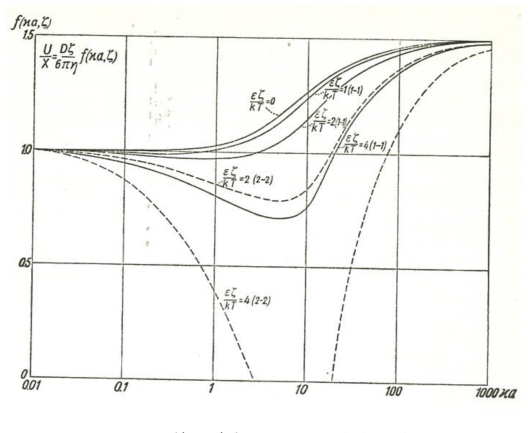
The derivation of an electrophoresis equation, expressing the total sum of hydrodynamic and electric forces... relaxation effect, due to the distortion of the double layer
-
IndisputableMonolith/Foundation/RealityFromDistinction.leanreality_from_one_distinction unclear?
unclearRelation between the paper passage and the cited Recognition theorem.
assumptions of continuum fluid mechanics, colloidal electrostatics, statistical thermodynamics and transport theory
What do these tags mean?
- matches
- The paper's claim is directly supported by a theorem in the formal canon.
- supports
- The theorem supports part of the paper's argument, but the paper may add assumptions or extra steps.
- extends
- The paper goes beyond the formal theorem; the theorem is a base layer rather than the whole result.
- uses
- The paper appears to rely on the theorem as machinery.
- contradicts
- The paper's claim conflicts with a theorem or certificate in the canon.
- unclear
- Pith found a possible connection, but the passage is too broad, indirect, or ambiguous to say the theorem truly supports the claim.
Reference graph
Works this paper leans on
-
[1]
This might lead to errors for sols with small particles
The Brownian motion of the particle is not taken into account. This might lead to errors for sols with small particles
-
[2]
The mutual interaction between sol particles is neglected, which is not allowed in highly concen- trated sols. A sol can be considered concentrated, if the total charge of the sol particles is at least of the same order as the total charge of all other ions in the sol
-
[3]
The ions in the double layer are considered as point charges, while only the Coulomb energy is accounted for. It should be necessary, in about the same manner as Stern 101 has indicated, to take into account the ion radius and adsorption forces
-
[4]
Lately indications have shown that the structure of the double layer is more complex than we imagined up to now. Verlende 102 finds that the conductivity of the double layer is 10-50 times larger than according to its charge. M. Klomp´ e 103 renders credible that a large electrophoretic velocity can exist, for cases where the potential difference in the diff...
-
[5]
The biggest objection against our calculations is the fact, that the series expansion was truncated early, such that the results are only valid for small ζ-potentials. In view of the enormously tedious calculations that are associated with higher terms, it seems to be recommendable to solve the in chapter IV given principal equations through graphical mea...
-
[6]
We have indicated clearly, which factors are important in the calculation of the electrophoretic velocity and how this calculation can be performed. 101O. STERN, Z. Elektrochem. 30, 508 (1924). 102Ed. VERLENDE, Proc. Kon. Ned. Akad. v. Westensch., Amsterdam 42 764 (1939. PhD Thesis Ghent 1940, page 50. 103M. KLOMP ´E, PhD. Thesis Utrecht (1941). Marga Klo...
work page 1924
-
[7]
An electrolysis formula (48) has been deduced, which fully accounts for the electrophoretic drag and the relaxation effect
-
[8]
From (48), after introducing several approximations, the formula (89) was deduced, which de- scribes the relationship between the electrophoretic velocity and ζ for small ζ-potentials accurately. This confirms the formula of Henry for ζ→ 0 and also confirms that for ζ-potentials below 25 mV only small corrections (a few percent) are needed
Show all 12 references
-
[9]
The order of magnitude of these corrections, the dependence on κa and on the associated phenomena correspond to a large extend to experimental facts such as: a
If (89) is applied to larger ζ-potentials, it turns out that the relaxation effect brings along impor- tant corrections on the electrophoretic velocity. The order of magnitude of these corrections, the dependence on κa and on the associated phenomena correspond to a large exten...
1931
-
[10]
Since inside the sphere the conductivity is very high, the field is very low
The current is perpendicular to the sphere surface and is equal inside and outside the sphere. Since inside the sphere the conductivity is very high, the field is very low. Thus Φ i = 0, thus (Φ)r=a = 0, thus (I)x=κa = 0. See eqs. (74), (17) and (58)
-
[11]
The current through the surface is transferred in a (given) ratio of cations and anions. It is for example imaginable, that only the H+ ions (in the Pt-sol) or the Ag+ ions (in a Ag-sol) are being discharged at the boundary of the sphere-fluid and that the anions are not partic...
-
[12]
Thus according to (77’) D ( dI dx ) x=κa = Di ( I x ) x=κa
The strengths of the field inside and outside the sphere are proportional to the dielectric con- stants. Thus according to (77’) D ( dI dx ) x=κa = Di ( I x ) x=κa . Since for a good conductor the dielectric constant is very high, this condition demands that ( I)x=κa = 0, which...
1940
Reviewed May 24, 2026 · model on record in the stance chip above.
Discussion (0). Continue with ORCID to comment.