REVIEW 2 major objections 5 minor 72 references
Atomic Higgsings of 6D SCFTs II: Induced Flows
T0 review · 2 major / 5 minor · reviewed 2026-08-10 · deepseek-v4-flash
Pith's one-line read This paper identifies a class of minimal 6d Higgsings — the induced flows — that are exactly governed by induced nilpotent orbits, and uses the same physics to define inductions of discrete homomorphisms into E8.
desk verdict The conformal-matter half is solid and useful; the DE-type orbi-instanton induction is an honest physical proposal whose circularity the authors themselves flag. read the letter →
The pith
A machine-rendered reading of the paper's core claim, the machinery that carries it, and where it could break.
The reading
What carries the argument
The load-bearing object is the induced nilpotent orbit. For a Levi subalgebra $l \subset g$ and an orbit $O_l \subset l$, the induced orbit $O_g = \mathrm{Ind}^g_l(O_l)$ is the unique nilpotent orbit in $g$ that meets $O_l + \mathfrak{n}$ in a dense open set, where $\mathfrak{n}$ is the nilradical of any parabolic with Levi $l$; its dimension is $\dim(O_g) = \dim(O_l) + 2\dim(\mathfrak{n})$. Atomicity is guaranteed by deleting exactly one Dynkin node of $g$ to form $l$, so the rank drops by one and the flow's transverse slice has quaternionic dimension one. Because inductions of orbits preserve codimension (Eq. 2.5), the Higgs branch codimension computation yields the unit quaternionic dimension of every atomic induced flow. On the orbi-instanton side the analogous object is the induced discrete homomorphism $\mathrm{Ind}^g_l(\alpha) \in \mathrm{Hom}(\Gamma_g, E_8)$, defined through the theory itself: a UV orbi-instanton admits an atomic flow to the IR theory with homomorphism $\alpha$ exactly when the UV homomorphism is this induction, with $d(\alpha) = d(\mathrm{Ind}^g_l(\alpha))$ for the dimension function defined by Higgs branch dimension differences (Eqs. 3.1, 3.19). For A-type cyclic groups the induction is explicit: Kac labels add componentwise, $s' = s_1 + s_2 \in \mathrm{Hom}(\mathbb{Z}_{k_1+k_2}, E_8)$.
What would settle it
Compute the transverse slice of a predicted atomic induced flow in the orthosymplectic setting, for instance the flow from the formal $(so(6), so(6))$ conformal matter quiver (2.30) to the unitary quiver (2.31): the Hilbert-series comparison in §2.2.1 should give the Kleinian singularity $A_{n-3}$, and any slice of quaternionic dimension other than 1 would falsify Eq. (2.8). For the orbi-instanton side, trace two different atomic paths from the same UV homomorphism in the A-type hierarchy: the closure rule $s' = s_1 + s_2$ and the equality $d(\alpha) = d(\mathrm{Ind}^g_l(\alpha))$ must agree along both paths, and a disagreement would show the induction map is not well defined.
Extended reading notes
Core claim
On the paper's own terms, the central discovery is that a specific family of atomic Higgsings — the induced flows — is governed by Lusztig-Spaltenstein induction of nilpotent orbits. For conformal matter theories engineered by M5-branes probing a Kleinian singularity $C^2/\Gamma_g$, an induced flow simultaneously separates the M5 stack into two parts and performs a complex structure deformation $C^2/\Gamma_g \to C^2/\Gamma_{l_1} \oplus C^2/\Gamma_{l_2}$; the UV nilpotent VEV is then forced to be $O_g = \mathrm{Ind}^g_l(O_l)$ with $l$ a Levi subalgebra of $g$ obtained by deleting a single Dynkin node, and the transverse slice has quaternionic dimension exactly 1 (Eq. 2.8). For orbi-instanton theories, the same physical mechanism defines an induction $\mathrm{Ind}^g_l : \bigoplus_i \mathrm{Hom}(\Gamma_{l_i}, E_8) \to \mathrm{Hom}(\Gamma_g, E_8)$ (Eq. 3.18) for discrete homomorphisms into $E_8$: by definition, the induced flows between orbi-instanton SCFTs are precisely the atomic flows realizing these inductions, and the dimension function $d(\alpha)$ is preserved along them. The picture extends to $E_8 \times E_8$ heterotic little string theories with two M9-branes, where monotonicity of the 2-group structure constant is verified in explicit examples.
Load-bearing premise
The load-bearing premise is that each orbi-instanton SCFT corresponds one-to-one with a homomorphism in $\mathrm{Hom}(\Gamma, E_8)$, together with the paper's own definition of the induction of homomorphisms through the very atomic flows it describes; the paper concedes that existence, uniqueness, and a geometric meaning for this induction map are still open.
Editorial extensions
If this is right
- For conformal matter theories, the full set of atomic induced flows is read off from orbit inductions through rank-one Levi subalgebras, so enumerating these flows reduces to Lie-theoretic data rather than brute-force tensor branch search.
- Every atomic induced flow has a transverse slice of quaternionic dimension exactly one, furnishing the unit steps of the Higgs branch Hasse diagrams for the conformal matter and orbi-instanton hierarchies.
- Inductions of discrete homomorphisms are transitive and preserve the dimension function $d(\alpha)$, giving a physically defined partial ordering on $\mathrm{Hom}(\Gamma, E_8)$ that mirrors the RG ordering of the corresponding SCFTs.
- The $a$-anomaly decreases along induced flows for A-type and D-type conformal matter theories, with E-type and orbi-instanton cases expected to follow from the same anomaly polynomial data, supporting the 6d $a$-theorem for flows that change the tensor branch structure.
- For $E_8 \times E_8$ heterotic little string theories the same flows decrease the 2-group structure constant $\kappa_R$, matching the proposed monotonicity for LSTs.
Reading between the lines
- If the physical induction map on $\mathrm{Hom}(\Gamma, E_8)$ is well defined, the Hasse diagrams computed here become a practical generator of the missing classification data for non-cyclic $\Gamma$, since complete mathematical tables exist only for $\Gamma = D_5, D_7, E_8$.
- A direct test of the orbi-instanton construction would be to write down magnetic quivers for the D4-type theories in Table 3.1 and verify each unit flow by the decay and fission algorithm; Appendix C proposes candidate quivers for exactly this check.
- One could attempt a uniqueness proof: combining the known $\mathrm{Hom}(\Gamma, E_8)$ tables with the conservation of $d(\alpha)$ may force a unique induction map, upgrading the paper's physical definition to a mathematical theorem.
- The $\mathbb{Z}_3$ centre-flavour and duality-defect remarks suggest induced flows may provide a controlled setting for tracking discrete symmetries — centre symmetries and non-invertible duality defects — along 6d RG flows.
Editorial analysis
A structured set of objections, weighed in public.
Referee Report
Summary. This paper studies 'induced flows', a family of atomic Higgs branch RG flows of 6d (1,0) SCFTs, in two classes of theories: conformal matter theories labelled by pairs of nilpotent orbits, and orbi-instanton theories (and E8 × E8 little string theories) labelled by a nilpotent orbit together with a discrete homomorphism from a finite subgroup Γ ⊂ SU(2) into E8. For conformal matter, the main claim is a dictionary: an atomic induced flow from a theory associated with (Og, Og) to one associated with (Ol, Ol) is governed by Og = Ind^g_l(Ol), with l obtained by deleting one node of the Dynkin diagram of g, and the transverse slice then has quaternionic dimension one (Eqs. (2.1)-(2.8)). This is supported by A-, D-, E-type examples, an exhaustive E6 table (Appendix B), magnetic-quiver and Hilbert-series checks, and brane pictures. For orbi-instanton theories, the same physics is used to define 'induced discrete homomorphisms' Ind^g_l(α) ∈ Hom(Γg, E8) (Eq. (3.18)). For cyclic Γ this reduces to the well-defined additive rule on Kac labels (Eq. (3.8)); for DE-type Γ it is a physical definition whose existence and uniqueness rest on the conjectured one-to-one correspondence between orbi-instanton SCFTs and Hom(Γ, E8) of [2,8]. The paper further analyzes Higgs branch dimension functions, 2-group structure constants for LSTs (§3.3), and checks a-monotonicity for the A- and D-type induced flows (§4).
Significance. The nilpotent-orbit part (§2) is the most solid contribution: the identification of induced flows with induced nilpotent orbits provides a clean dictionary to an established mathematical structure, backed by explicit dimension calculations (2.4)-(2.8), the exhaustive atomic-induction data for E6 in Appendix B, magnetic-quiver/Hilbert-series cross-checks (2.33)-(2.40), and brane interpretations. The A-type orbi-instanton induction of §3.1 is elementary and well-defined. The DE-type 'induction of discrete homomorphisms' (Eq. 3.18) is a genuinely novel proposal but is definitionally circular and conditional on the conjectured SCFT–Hom(Γ, E8) correspondence; the authors' explicit caveats (end of §1, §3.2) are to their credit, but they do not by themselves settle the well-definedness of the main object of §3.2. The paper ships a large amount of reproducible data (Tables 3.1, 3.2, B.1–B.4; Hilbert series; explicit quiver flows), and the dimension-function preservation rule (3.19) is a falsifiable consistency condition. Overall this is a substantial contribution to the program of mapping the Hasse diagrams of 6d SCFTs, provided the §3.2 and §4 issues below are addressed.
major comments (2)
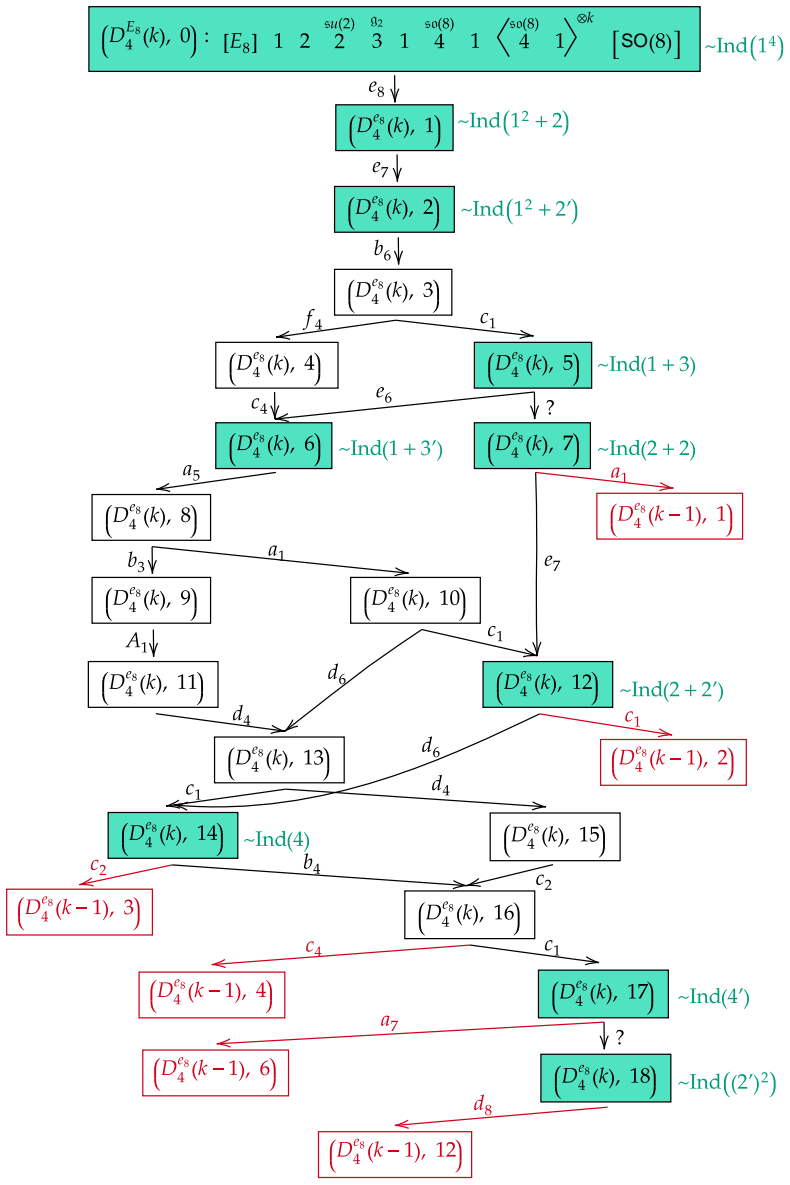
- [Section 3.2, Eq. (3.18)] The central object of the orbi-instanton section is defined through the very flows it is meant to describe: Ind^g_l(α) is introduced as the element of Hom(Γg, E8) such that the g-type orbi-instanton theory with this homomorphism and nilpotent orbit ν = Ind^g_l(O_trivial) 'admits an induced flow' to the l-type theory with homomorphism α. For DE-type Γ, Hom(Γ, E8) is not classified, and the identification between orbi-instanton SCFTs and discrete homomorphisms is itself the conjectured correspondence of [2,8] invoked in §3.2; the paper acknowledges the gap at the end of §1 ('the mathematical rigour (e.g. existence and uniqueness of this induction map) and a geometric meaning would still be desired') and in §3.2. Since (3.18) is the advertised result of the abstract, the revised version should state (3.18) explicitly as a conjecture with the precise dependence on the [2,8] correspondence, or supply an independent well-definedness check. Two concrete checks suggest themselves: (i) path-independence of the UV theory obtained by iterating atomic flows in the Hasse diagram; (ii) agreement with the partial classifications of Hom(Γ, E8) for Γ = D5, D7, E8 in [36]. The uniqueness asserted for the shaded nodes in the D4 example (Tables 3.1–3.2: 'we also give the unique homomorphism α') is not demonstrated; dimension-function preservation (3.19) is a necessary but not sufficient check, since d(α) is itself read off from the same SCFT data.
- [Section 4, Eqs. (4.3)–(4.16)] The a-monotonicity 'check' is not a complete derivation as written. First, the reduction to 24(α−β) relies on the assertion '∆γ = ∆δ = 0', which is not justified: γ and δ in (4.5)–(4.6) depend on Σ r_if_i and on the tensor-multiplet count, and an atomic induced flow removes one tensor multiplet, so the invariance of Σ r_if_i under the induction must be established. Second, the coefficient comparisons in (4.12) and (4.15) are written term-by-term with the same indices on the UV and IR sides, but the two quadratic forms live on index sets of different lengths (N−1 versus (Ks−1)+(Kt−1)), and the pairing induced by r^T = s^T ⊔ t^T shifts indices; the text does not specify the index map or prove the required inequality (the UV coefficient 12k(N−k)/N − 1/2 at a shifted index k can be smaller than the IR coefficient 12i(Ks−i)/Ks − 1/2 at the original index i, so the comparison is not automatic). Third, N is used both for the orbit size |r| (via (4.8)–(4.9), where N = |r| = |s|+|t|) and for the quiver length (in (4.3), 'N−1 is the number of tensor multiplets'); in the long-quiver regime these differ. The section needs a clean notational setup and a complete inequality argument, or the claim should be explicitly downgraded to a verified-in-examples observation.
minor comments (5)
- [Section 2, Eqs. (2.3)–(2.7)] The codimension subscripts in (2.3) and (2.7) are inconsistent with the convention codim_A(B) = dimC(A) − dimC(B) stated in the same section: 'codimH2(H1)' and the displayed terms 'codim_{O_{L,2}^g}(O_{L,2}^g)' are dimension-zero or negative as written, so the chain leading to (2.8) is not readable; please rewrite these equations with consistent UV/IR labels for the orbits.
- [Figures 2.1 and 3.1] In the version under review, Figures 2.1 and 3.1 and their captions contain scrambled text (e.g. 'ablask; d jf d jkd jf all; ...', a stray 'SO', and '12 M5' where '1/2 M5' is meant); these figures must be re-typeset before publication, as the current text does not render the brane pictures.
- [Section 2.2.1, Eqs. (2.30)–(2.36)] The statement that 'so(6) ≅ sl(4)... the orbit [2^2,1^2]_{so(6)} is the same as the orbit [2,1^2]_{sl(4)}' compares partitions of different integers (6 and 4); since the identification runs through the accidental isomorphism under which the 6 of so(6) corresponds to the ∧²4 of sl(4), a one-sentence clarification of the partition translation would remove an apparent contradiction.
- [Section 1, footnote 3] The claim that a short-quiver theory admitting an induced flow 'can always be redefined' as a long-quiver theory is stated only in words; since the long-quiver condition is used repeatedly (§1, §2, §4), please include one explicit example of such a redefinition.
- [Table 3.2] The shorthand for the Hom(Z4, E8) elements ('14', '12+2', '(2′)2', ...) is never defined in the table or its caption; one line of explanation (s0=4 for '14', s0=2, s1=1 for '12+2', following Eq. (3.2)) would make the table self-contained.
Circularity Check
The orbi-instanton induction map is defined by the same induced flows it claims to describe, making the DE-type UV/IR induction statements true by construction; the conformal-matter and A-type sectors are independently sourced.
-
self definitional
[Section 3.2, Eq. (3.18)]
"The induced flow from an orbi-instanton theory of type g to an orbi-instanton theory of type l gives a physical definition of the induction from ⊕_i Hom(Γ_{l_i}, E8) to Hom(Γ_g, E8). ... For such g, l and a homomorphism α ∈ ⊕_i Hom(Γ_{l_i},E8), we have Ind^g_l(α) ∈ Hom(Γ_g,E8) (3.18) such that the orbi-instanton SCFT of type g with discrete homomorphism Ind^g_l(α) ... admits an induced flow ... to the orbi-instanton SCFT of type l with discrete homomorphism α."
Equation (3.18) does not give Ind^g_l(α) any independent characterization; it defines the induced homomorphism as the one labelling a UV theory that admits an induced flow to α. The existence of that flow is therefore not a derived prediction but the definitional input. The paper itself concedes the gap: 'the mathematical rigour (e.g. existence and uniqueness of this induction map) and a geometric meaning would still be desired.' The dimension-preservation statement (3.19) is an observed consistency condition on this definition, not a derivation of it.
-
self definitional
[Section 1, page 5]
"When there is an atomic Higgsing from a UV orbi-instanton theory to an IR orbi-instanton theory (which could have either one or multiple components) following our algorithm introduced in [1], we say that the associated homomorphism αIR induces the homomorphism αUV."
Here 'induces' is stipulated to mean 'is connected by an atomic Higgsing.' Consequently the paper's later assertion that the UV homomorphism is the induction of the IR homomorphism restates the existence of the flow used to define the relation, and no existence or uniqueness theorem for the map αIR ↦ αUV is supplied. The inductive structure is loaded into the definition rather than derived.
full rationale
The conformal-matter part (Section 2) is not circular: Eq. (2.1) applies the externally defined Lusztig-Spaltenstein induction of nilpotent orbits, and the dimension-one transverse slice (2.8) follows from standard codimension identities. The A-type orbi-instanton induction (3.8) is an explicit prescription (componentwise Kac-label addition) that the paper benchmarks against unitary magnetic quiver decay/fission. The circularity is confined to the DE-type orbi-instanton construction: the induction of discrete homomorphisms into E8 is defined through the very atomic induced flows it is then said to govern. The paper is candid about this ('the mathematical rigour (e.g. existence and uniqueness of this induction map) and a geometric meaning would still be desired'), but candor does not remove the definitional circularity. The reliance on the conjectured one-to-one correspondence with Hom(Γ,E8) and on the authors' prior algorithm [1] is a dependency of the definition, not an independent check of it. Overall, the central orbi-instanton claim is partially circular, while the nilpotent-orbit and A-type sectors retain independent content.
Assumptions & free parameters
assumptions (5)
- domain assumption 6d SCFTs are classified by F-theory generalized quivers, and nilpotent VEVs on flavour symmetries correspond to nilpotent orbits in the corresponding Lie algebra.
- domain assumption The M-theory operations of splitting M5-branes and complex-structure-deforming the Kleinian singularity faithfully realize atomic Higgs-branch flows, so Eq. (2.1) is necessary and sufficient for atomicity.
- domain assumption There is a one-to-one correspondence between orbi-instanton SCFTs and Hom(Gamma,E8), conjectured in [2,8] and assumed in Section 3.2.
- domain assumption The atomic transverse slice for combo and endpoint-changing induced flows has quaternionic dimension 1, and the principal-orbit codimension identity (2.4) holds.
- ad hoc to paper Induction of discrete homomorphisms into E8 is defined by the existence of an atomic Higgsing between the corresponding orbi-instanton theories.
invented entities (1)
-
Induced discrete homomorphisms Ind^g_l(alpha) from Hom(Gamma_l,E8) to Hom(Gamma_g,E8)
Cite this review
Pith. "Pith review of Atomic Higgsings of 6D SCFTs II: Induced Flows." pith.science (2026). https://pith.science/paper/ZV6OE4XT
@misc{pith2026250103313,
  author       = {Pith},
  title        = {Pith review of: Atomic Higgsings of 6D SCFTs II: Induced Flows},
  year         = {2026},
  howpublished = {\url{https://pith.science/paper/ZV6OE4XT}},
  note         = {Machine review of arXiv:2501.03313}
}
abstract
We study a specific type of atomic Higgsings of the 6d $\mathcal{N}=(1,0)$ theories, which we call the induced flows. For the conformal matter theory associated with a pair of nilpotent orbits, the induced flows are given by the inductions of the orbits. We also consider the induced flows for the orbi-instanton theories (as well as some little string theories) that are associated with the homomorphisms from the discrete subgroups of $\mathrm{SU}(2)$ to $E_8$. This gives a physical definition of the inductions among these discrete homomorphisms, analogous to the inductions of the nilpotent orbits. We analyze the Higgs branch dimensions, the monotonicity of the Weyl anomalies (or the 2-group structure constants for LSTs) and the brane pictures under the induced flows.
Figures


Figures from the paper (3 more)

Reference graph
Works this paper leans on
-
[36]
Conjugacy of Alt 5 and SL(2, 5) subgroups of E8(C),
D. D. Frey, “Conjugacy of Alt 5 and SL(2, 5) subgroups of E8(C),”
-
[1]
J. Bao and H. Y. Zhang, “Atomic Higgsings of 6D SCFTs,” arXiv:2409.17224 [hep-th]
-
[2]
Atomic Classification of 6D SCFTs,
J. J. Heckman, D. R. Morrison, T. Rudelius, and C. Vafa, “Atomic Classification of 6D SCFTs,” Fortsch. Phys. 63 (2015) 468–530, arXiv:1502.05405 [hep-th]
arXiv 2015
-
[3]
6D RG Flows and Nilpotent Hierarchies
J. J. Heckman, T. Rudelius, and A. Tomasiello, “6D RG Flows and Nilpotent Hierarchies,” JHEP 07 (2016) 082, arXiv:1601.04078 [hep-th]
work page Pith review arXiv 2016
-
[4]
T-Branes, String Junctions, and 6D SCFTs
F. Hassler, J. J. Heckman, T. B. Rochais, T. Rudelius, and H. Y. Zhang, “T-Branes, String Junctions, and 6D SCFTs,” Phys. Rev. D 101 no. 8, (2020) 086018, arXiv:1907.11230 [hep-th]. 49
work page Pith review arXiv 2020
-
[5]
Two 6d origins of 4d SCFTs: class $\mathcal{S}$ and 6d (1,0) on a torus
F. Baume, M. J. Kang, and C. Lawrie, “Two 6D origins of 4D SCFTs: Class S and 6D (1, 0) on a torus,” Phys. Rev. D 106 no. 8, (2022) 086003, arXiv:2106.11990 [hep-th]
work page Pith review arXiv 2022
-
[6]
M. Del Zotto, J. J. Heckman, A. Tomasiello, and C. Vafa, “6d Conformal Matter,” JHEP 02 (2015) 054, arXiv:1407.6359 [hep-th]
arXiv 2015
-
[7]
$E_8$ instantons on type-A ALE spaces and supersymmetric field theories
N. Mekareeya, K. Ohmori, Y. Tachikawa, and G. Zafrir, “E 8 instantons on type-A ALE spaces and supersymmetric field theories,” JHEP 09 (2017) 144, arXiv:1707.04370 [hep-th]
work page Pith review arXiv 2017
Show all 72 references
-
[8]
6D SCFTs and the classification of homomorphisms Γ ADE → E8,
D. D. Frey and T. Rudelius, “6D SCFTs and the classification of homomorphisms Γ ADE → E8,” Adv. Theor. Math. Phys. 24 no. 3, (2020) 709–756, arXiv:1811.04921 [hep-th]
2020 arXiv
-
[9]
Hierarchy of RG flows in 6d (1 , 0) orbi-instantons,
M. Fazzi and S. Giri, “Hierarchy of RG flows in 6d (1 , 0) orbi-instantons,” arXiv:2208.11703 [hep-th]
-
[10]
Hierarchies of RG flows in 6d (1, 0) massive E-strings,
M. Fazzi, S. Giacomelli, and S. Giri, “Hierarchies of RG flows in 6d (1, 0) massive E-strings,” JHEP 03 (2023) 089, arXiv:2212.14027 [hep-th]
2023 arXiv
-
[11]
Geometry of 6D RG Flows,
J. J. Heckman, D. R. Morrison, T. Rudelius, and C. Vafa, “Geometry of 6D RG Flows,” JHEP 09 (2015) 052, arXiv:1505.00009 [hep-th]
2015 arXiv
-
[12]
T-branes, Anomalies and Moduli Spaces in 6D SCFTs,
N. Mekareeya, T. Rudelius, and A. Tomasiello, “T-branes, Anomalies and Moduli Spaces in 6D SCFTs,” JHEP 10 (2017) 158, arXiv:1612.06399 [hep-th]
2017 arXiv
-
[13]
Bestiary of 6D (1, 0) SCFTs: Nilpotent orbits and anomalies,
F. Baume and C. Lawrie, “Bestiary of 6D (1, 0) SCFTs: Nilpotent orbits and anomalies,” Phys. Rev. D 110 no. 4, (2024) 045021, arXiv:2312.13347 [hep-th]
2024 arXiv
-
[14]
Proving the 6d a-theorem with the double affine Grassmannian,
M. Fazzi, S. Giri, and P. Levy, “Proving the 6d a-theorem with the double affine Grassmannian,” arXiv:2312.17178 [hep-th]
-
[15]
Fission, Fusion, and 6D RG Flows,
J. J. Heckman, T. Rudelius, and A. Tomasiello, “Fission, Fusion, and 6D RG Flows,” JHEP 02 (2019) 167, arXiv:1807.10274 [hep-th]
2019 arXiv
-
[16]
On the Classification of 6D SCFTs and Generalized ADE Orbifolds,
J. J. Heckman, D. R. Morrison, and C. Vafa, “On the Classification of 6D SCFTs and Generalized ADE Orbifolds,” JHEP 05 (2014) 028, arXiv:1312.5746 [hep-th]. [Erratum: JHEP 06, 017 (2015)]
2014 arXiv
-
[17]
Evidence for F theory,
C. Vafa, “Evidence for F theory,” Nucl. Phys. B469 (1996) 403–418, arXiv:hep-th/9602022 [hep-th]
1996 arXiv
-
[18]
Compactifications of F theory on Calabi-Yau threefolds. 1,
D. R. Morrison and C. Vafa, “Compactifications of F theory on Calabi-Yau threefolds. 1,” Nucl. Phys. B473 (1996) 74–92, arXiv:hep-th/9602114 [hep-th]
1996 arXiv
-
[19]
Compactifications of F theory on Calabi-Yau threefolds. 2.,
D. R. Morrison and C. Vafa, “Compactifications of F theory on Calabi-Yau threefolds. 2.,” Nucl. Phys. B 476 (1996) 437–469, arXiv:hep-th/9603161
1996 arXiv
-
[20]
Quiver Subtractions,
S. Cabrera and A. Hanany, “Quiver Subtractions,” JHEP 09 (2018) 008, arXiv:1803.11205 [hep-th]
2018 arXiv
-
[21]
The Higgs Mechanism – Hasse Diagrams for Symplectic Singularities,
A. Bourget, S. Cabrera, J. F. Grimminger, A. Hanany, M. Sperling, A. Zajac, and Z. Zhong, “The Higgs Mechanism – Hasse Diagrams for Symplectic Singularities,” arXiv:1908.04245 [hep-th]. 50
1908 arXiv
-
[22]
Fibrations and Hasse diagrams for 6d SCFTs,
A. Bourget and J. F. Grimminger, “Fibrations and Hasse diagrams for 6d SCFTs,” JHEP 12 (2022) 159, arXiv:2209.15016 [hep-th]
2022 arXiv
-
[23]
Magnetic quivers and negatively charged branes,
A. Hanany and M. Sperling, “Magnetic quivers and negatively charged branes,” JHEP 11 (2022) 010, arXiv:2208.07270 [hep-th]
2022 arXiv
-
[24]
Supersymmetric Boundary Conditions in N=4 Super Yang-Mills Theory,
D. Gaiotto and E. Witten, “Supersymmetric Boundary Conditions in N=4 Super Yang-Mills Theory,” J. Statist. Phys. 135 (2009) 789–855, arXiv:0804.2902 [hep-th]
2009 arXiv
-
[25]
Monopole operators and Hilbert series of Coulomb branches of 3d N = 4 gauge theories,
S. Cremonesi, A. Hanany, and A. Zaffaroni, “Monopole operators and Hilbert series of Coulomb branches of 3d N = 4 gauge theories,” JHEP 01 (2014) 005, arXiv:1309.2657 [hep-th]
2014 arXiv
-
[26]
Towards a mathematical definition of Coulomb branches of 3-dimensional N = 4 gauge theories, I,
H. Nakajima, “Towards a mathematical definition of Coulomb branches of 3-dimensional N = 4 gauge theories, I,” Adv. Theor. Math. Phys. 20 (2016) 595–669, arXiv:1503.03676 [math-ph]
2016 arXiv
-
[27]
Towards a mathematical definition of Coulomb branches of 3-dimensional N = 4 gauge theories, II,
A. Braverman, M. Finkelberg, and H. Nakajima, “Towards a mathematical definition of Coulomb branches of 3-dimensional N = 4 gauge theories, II,” Adv. Theor. Math. Phys. 22 (2018) 1071–1147, arXiv:1601.03586 [math.RT]
2018 arXiv
-
[28]
Ring objects in the equivariant derived Satake category arising from Coulomb branches (with an appendix by Gus Lonergan),
A. Braverman, M. Finkelberg, and H. Nakajima, “Ring objects in the equivariant derived Satake category arising from Coulomb branches (with an appendix by Gus Lonergan),” Physics 23 (2019) 253–344, arXiv:1706.02112 [math.RT]
2019 arXiv
-
[29]
Coulomb branches of quiver gauge theories with symmetrizers,
H. Nakajima and A. Weekes, “Coulomb branches of quiver gauge theories with symmetrizers,” J. Eur. Math. Soc. 25 no. 1, (2021) 203–230, arXiv:1907.06552 [math.QA]
2021 arXiv
-
[30]
Decay and Fission of Magnetic Quivers,
A. Bourget, M. Sperling, and Z. Zhong, “Decay and Fission of Magnetic Quivers,” Phys. Rev. Lett. 132 no. 22, (2024) 221603, arXiv:2312.05304 [hep-th]
2024 arXiv
-
[31]
Higgs branch RG flows via decay and fission,
A. Bourget, M. Sperling, and Z. Zhong, “Higgs branch RG flows via decay and fission,” Phys. Rev. D 109 no. 12, (2024) 126013, arXiv:2401.08757 [hep-th]
2024 arXiv
-
[32]
A Pathway to Decay and Fission of Orthosymplectic Quiver Theories,
C. Lawrie, L. Mansi, M. Sperling, and Z. Zhong, “A Pathway to Decay and Fission of Orthosymplectic Quiver Theories,” arXiv:2412.15202 [hep-th]
-
[33]
T-Branes and Monodromy,
S. Cecotti, C. Cordova, J. J. Heckman, and C. Vafa, “T-Branes and Monodromy,” JHEP 07 (2011) 030, arXiv:1010.5780 [hep-th]
2011 arXiv
-
[34]
T-Branes and Geometry,
L. B. Anderson, J. J. Heckman, and S. Katz, “T-Branes and Geometry,” JHEP 05 (2014) 080, arXiv:1310.1931 [hep-th]
2014 arXiv
-
[35]
Point - like instantons on K3 orbifolds,
P. S. Aspinwall and D. R. Morrison, “Point - like instantons on K3 orbifolds,” Nucl. Phys. B 503 (1997) 533–564, arXiv:hep-th/9705104
1997 arXiv
-
[37]
Nilpotent Orbits and Codimension-two Defects of 6d N = (2, 0) Theories,
O. Chacaltana, J. Distler, and Y. Tachikawa, “Nilpotent Orbits and Codimension-two Defects of 6d N = (2, 0) Theories,” Int. J. Mod. Phys. A 28 (2013) 1340006, arXiv:1203.2930 [hep-th]
2013 arXiv
-
[38]
String junctions for arbitrary Lie algebra representations,
O. DeWolfe and B. Zwiebach, “String junctions for arbitrary Lie algebra representations,” Nucl. Phys. B 541 (1999) 509–565, arXiv:hep-th/9804210. 51
1999 arXiv
-
[39]
General prescription for global U (1)’s in 6D SCFTs,
F. Apruzzi, M. Fazzi, J. J. Heckman, T. Rudelius, and H. Y. Zhang, “General prescription for global U (1)’s in 6D SCFTs,” Phys. Rev. D 101 no. 8, (2020) 086023, arXiv:2001.10549 [hep-th]
2020 arXiv
-
[40]
D. H. Collingwood and W. M. McGovern, Nilpotent Orbits in Semisimple Lie Algebras . Van Nostrand Reinhold Mathematics Series. Van Nostrand Reinhold Co., New York, 1993
1993
-
[41]
Distinguishing 6D (1, 0) SCFTs: An extension to the geometric construction,
J. Distler, M. J. Kang, and C. Lawrie, “Distinguishing 6D (1, 0) SCFTs: An extension to the geometric construction,” Phys. Rev. D 106 no. 6, (2022) 066011, arXiv:2203.08829 [hep-th]
2022 arXiv
-
[42]
Magnetic quivers and line defects — On a duality between 3d N = 4 unitary and orthosymplectic quivers,
S. Nawata, M. Sperling, H. E. Wang, and Z. Zhong, “Magnetic quivers and line defects — On a duality between 3d N = 4 unitary and orthosymplectic quivers,” JHEP 02 (2022) 174, arXiv:2111.02831 [hep-th]
2022 arXiv
-
[43]
Spaltenstein, Classes unipotentes et sous-groupes de Borel , vol
N. Spaltenstein, Classes unipotentes et sous-groupes de Borel , vol. 946. Springer, 1982
1982
-
[44]
Frozen singularities in M and F theory,
Y. Tachikawa, “Frozen singularities in M and F theory,” JHEP 06 (2016) 128, arXiv:1508.06679 [hep-th]
2016 arXiv
-
[45]
Frozen Generalized Symmetries,
M. Cvetiˇ c, M. Dierigl, L. Lin, E. Torres, and H. Y. Zhang, “Frozen Generalized Symmetries,” arXiv:2410.07318 [hep-th]
-
[46]
6D SCFTs, center-flavor symmetries, and Stiefel-Whitney compactifications,
J. J. Heckman, C. Lawrie, L. Lin, H. Y. Zhang, and G. Zoccarato, “6D SCFTs, center-flavor symmetries, and Stiefel-Whitney compactifications,” Phys. Rev. D 106 no. 6, (2022) 066003, arXiv:2205.03411 [hep-th]
2022 arXiv
-
[47]
The fate of discrete 1-form symmetries in 6d,
F. Apruzzi, M. Dierigl, and L. Lin, “The fate of discrete 1-form symmetries in 6d,” SciPost Phys. 12 no. 2, (2022) 047, arXiv:2008.09117 [hep-th]
2022 arXiv
-
[48]
The Higgs Branch of 6d (1,0) SCFTs & LSTs with DE-type SUSY Enhancement,
C. Lawrie and L. Mansi, “The Higgs Branch of 6d (1,0) SCFTs & LSTs with DE-type SUSY Enhancement,” arXiv:2406.02670 [hep-th]
-
[49]
Intermediate Defect Groups, Polarization Pairs, and Non-invertible Duality Defects,
C. Lawrie, X. Yu, and H. Y. Zhang, “Intermediate Defect Groups, Polarization Pairs, and Non-invertible Duality Defects,” arXiv:2306.11783 [hep-th]
-
[50]
Exploring G-ality defects in 2-dim QFTs,
D.-C. Lu, Z. Sun, and Z. Zhang, “Exploring G-ality defects in 2-dim QFTs,” arXiv:2406.12151 [hep-th]
-
[51]
Heterotic and Type I string dynamics from eleven dimensions,
P. Horava and E. Witten, “Heterotic and Type I string dynamics from eleven dimensions,” Nucl. Phys. B 460 (1996) 506–524, arXiv:hep-th/9510209
1996 arXiv
-
[52]
V. G. Kac, Infinite-dimensional Lie algebras , vol. 44 of Progress in Mathematics. Birkh¨ auser Boston, Inc., Boston, MA, 1983. https://doi.org/10.1007/978-1-4757-1382-4 . An introduction
1983 doi
-
[53]
Some comments on string dynamics,
E. Witten, “Some comments on string dynamics,” in STRINGS 95: Future Perspectives in String Theory, pp. 501–523. 7, 1995. arXiv:hep-th/9507121
1995 arXiv
-
[54]
Point - like instantons and the spin (32) / Z(2) heterotic string,
P. S. Aspinwall, “Point - like instantons and the spin (32) / Z(2) heterotic string,” Nucl. Phys. B 496 (1997) 149–176, arXiv:hep-th/9612108
1997 arXiv
-
[55]
New theories in six-dimensions and matrix description of M theory on T 5 and T 5/Z2,
N. Seiberg, “New theories in six-dimensions and matrix description of M theory on T 5 and T 5/Z2,” Phys. Lett. B 408 (1997) 98–104, arXiv:hep-th/9705221. 52
1997 arXiv
-
[56]
M & m’s,
A. Losev, G. W. Moore, and S. L. Shatashvili, “M & m’s,” Nucl. Phys. B 522 (1998) 105–124, arXiv:hep-th/9707250
1998 arXiv
-
[57]
New string theories in six-dimensions via branes at orbifold singularities,
K. A. Intriligator, “New string theories in six-dimensions via branes at orbifold singularities,” Adv. Theor. Math. Phys. 1 (1998) 271–282, arXiv:hep-th/9708117
1998 arXiv
-
[58]
Branes and six-dimensional supersymmetric theories,
A. Hanany and A. Zaffaroni, “Branes and six-dimensional supersymmetric theories,” Nucl. Phys. B 529 (1998) 180–206, arXiv:hep-th/9712145
1998 arXiv
-
[59]
Branes at orbifolds versus Hanany Witten in six-dimensions,
I. Brunner and A. Karch, “Branes at orbifolds versus Hanany Witten in six-dimensions,” JHEP 03 (1998) 003, arXiv:hep-th/9712143
1998 arXiv
-
[60]
F-theory and the Classification of Little Strings,
L. Bhardwaj, M. Del Zotto, J. J. Heckman, D. R. Morrison, T. Rudelius, and C. Vafa, “F-theory and the Classification of Little Strings,” Phys. Rev. D 93 no. 8, (2016) 086002, arXiv:1511.05565 [hep-th]. [Erratum: Phys.Rev.D 100, 029901 (2019)]
2016 arXiv
-
[61]
Back to heterotic strings on ALE spaces. Part I. Instantons, 2-groups and T-duality,
M. Del Zotto, M. Liu, and P.-K. Oehlmann, “Back to heterotic strings on ALE spaces. Part I. Instantons, 2-groups and T-duality,” JHEP 01 (2023) 176, arXiv:2209.10551 [hep-th]
2023 arXiv
-
[62]
Higher derivative terms, toroidal compactification, and Weyl anomalies in six-dimensional (2, 0) theories,
C. Cordova, T. T. Dumitrescu, and X. Yin, “Higher derivative terms, toroidal compactification, and Weyl anomalies in six-dimensional (2, 0) theories,” JHEP 10 (2019) 128, arXiv:1505.03850 [hep-th]
2019 arXiv
-
[63]
On renormalization group flows and the a-theorem in 6d,
H. Elvang, D. Z. Freedman, L.-Y. Hung, M. Kiermaier, R. C. Myers, and S. Theisen, “On renormalization group flows and the a-theorem in 6d,” JHEP 10 (2012) 011, arXiv:1205.3994 [hep-th]
2012 arXiv
-
[64]
Effective field theory of 6D SUSY RG Flows,
J. J. Heckman, S. Kundu, and H. Y. Zhang, “Effective field theory of 6D SUSY RG Flows,” Phys. Rev. D 104 no. 8, (2021) 085017, arXiv:2103.13395 [hep-th]
2021 arXiv
-
[65]
Inverses of Cartan matrices of Lie algebras and Lie superalgebras,
Y. Wei and Y. M. Zou, “Inverses of Cartan matrices of Lie algebras and Lie superalgebras,” Linear Algebra and its Applications 521 (2017) 283–298, arXiv:1711.01294 [math.RT]
2017 arXiv
-
[66]
Induced nilpotent orbits of the simple Lie algebras of exceptional type,
W. A. de Graaf and A. Elashvili, “Induced nilpotent orbits of the simple Lie algebras of exceptional type,” arXiv:0905.2743 [math.RT]
-
[67]
Finite groups of Lie type: Conjugacy classes and complex characters,
R. W. Carter, “Finite groups of Lie type: Conjugacy classes and complex characters,” Pure Appl. Math. 44 (1985)
1985
-
[68]
A special decomposition of the nilpotent cone of a classical Lie algebra,
H. Kraft and C. Procesi, “A special decomposition of the nilpotent cone of a classical Lie algebra,” Ast´ erisque173 no. 174, (1989) 10
1989
-
[69]
On the geometry of conjugacy classes in classical groups,
H. Kraft and C. Procesi, “On the geometry of conjugacy classes in classical groups,” Commentarii Mathematici Helvetici 57 (1982) 539–602
1982
-
[70]
The Hitchin Image in Type-D,
A. Balasubramanian, J. Distler, R. Donagi, and C. Perez-Pardavila, “The Hitchin Image in Type-D,” arXiv:2310.05880 [hep-th]
-
[71]
Induced unipotent classes,
G. Lusztig and N. Spaltenstein, “Induced unipotent classes,” Journal of the London Mathematical Society 2 no. 1, (1979) 41–52
1979
-
[72]
Derived subalgebras of centralisers and finite-algebras,
A. Premet and L. Topley, “Derived subalgebras of centralisers and finite-algebras,” Compositio Mathematica 150 no. 9, (2014) 1485–1548, arXiv:1301.4653 [math.RT]. 53
2014 arXiv
Reviewed August 10, 2026 · model on record in the stance chip above.
Discussion (0). Continue with ORCID to comment.