Flexible Flows for Biological Sequence Design
Pith reviewed 2026-06-27 14:19 UTC · model grok-4.3
The pith
A structured coupling and latent edit parameterization make discrete flow matching flexible for variable-length biological sequences.
A machine-rendered reading of the paper's core claim, the machinery that carries it, and where it could break.
Core claim
The authors claim that incorporating domain knowledge via a structured coupling and using a latent edit-based rate parameterization allows discrete flow matching to handle variable-length sequences and produce high-quality biological designs, leading to superior results across multiple tasks.
What carries the argument
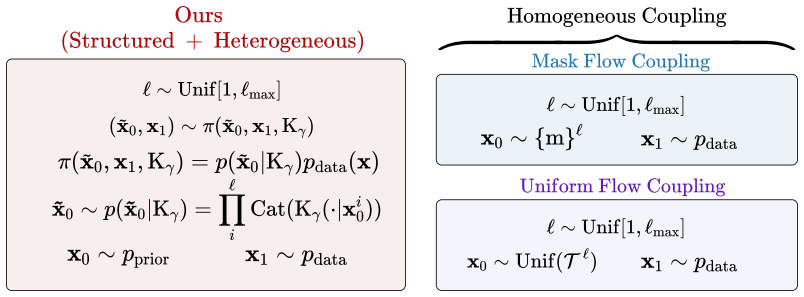
Structured coupling encoding domain-specific preferences among sequence elements, together with latent edit-based rate parameterization for variable-length generation.
If this is right
- Improved performance in unconditional and conditional DNA sequence generation.
- Better results for peptide sequence generation.
- Effective density estimation for biological sequences.
- Coherent steering of generation in continuous latent space via classifier-free guidance.
Where Pith is reading between the lines
- This could allow easier integration of biological priors into generative models for other sequence types like proteins.
- The tractable variable-length modeling might apply to non-biological discrete data such as text or code.
- Test-time controls like temperature scaling could be adapted for other flow-based generative tasks.
Load-bearing premise
The structured coupling biases the source distribution toward plausible regions and the latent edit parameterization models variable lengths tractably without altering the flow objective.
What would settle it
An experiment where sequences generated without the structured coupling perform no better than standard discrete flow matching baselines on DNA generation tasks would falsify the benefit of the coupling.
Figures

read the original abstract
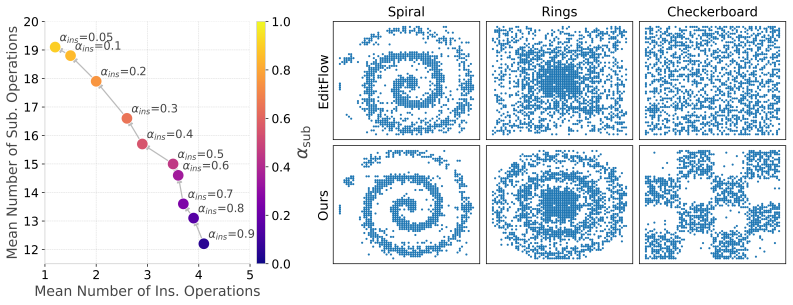
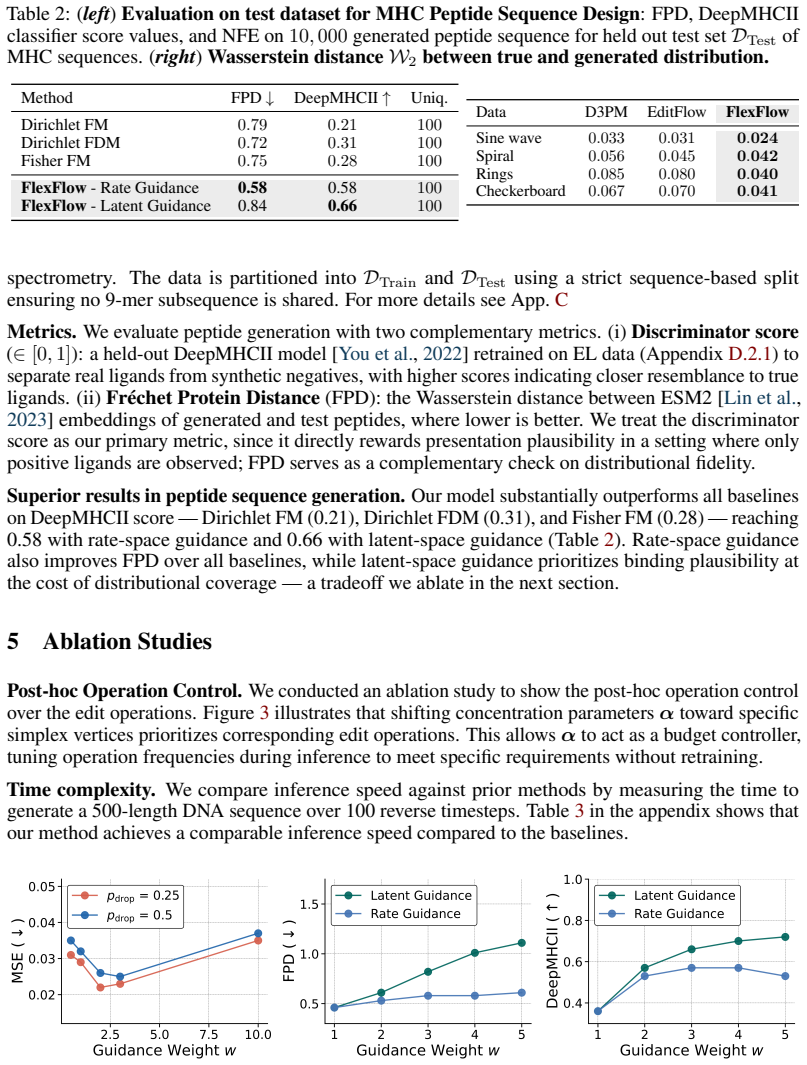
Designing functional biological sequences requires navigating vast discrete spaces under strict evolutionary and biophysical constraints. Discrete Flow Matching (DFM) offers a generative framework over such spaces, but existing approaches rely on biologically uninformative couplings and offer limited flexibility for variable-length sequence generation and fine-grained control. We propose a structured coupling that encodes domain-specific preferences among sequence elements, biasing the source distribution toward plausible regions without modifying the flow objective or training procedure. Building on this, we introduce a latent edit-based rate parameterization that models variable-length generation via edit operations conditioned on a shared global latent, akin to a latent variable model, while remaining tractable. We further introduce a latent classifier-free guidance mechanism that steers generation coherently in continuous latent space, along with Dirichlet-prior temperature scaling for test-time control over edit operations. Our method achieves state-of-the-art performance across diverse biological sequence tasks, including density estimation, unconditional and conditional DNA sequence generation, and peptide sequence generation.
Editorial analysis
A structured set of objections, weighed in public.
Referee Report
Summary. The manuscript extends Discrete Flow Matching (DFM) for biological sequence design by introducing a structured coupling that encodes domain-specific preferences to bias the source distribution, a latent edit-based rate parameterization for variable-length sequences conditioned on a shared global latent, a latent classifier-free guidance mechanism, and Dirichlet-prior temperature scaling. These modifications are claimed to preserve the original flow objective and training procedure while achieving state-of-the-art results on density estimation, unconditional/conditional DNA generation, and peptide generation tasks.
Significance. If the empirical claims are substantiated, the work offers a principled way to inject biological priors into flow-based generative models without altering the core objective, which could improve sample quality and controllability in discrete sequence spaces. The emphasis on tractability and compatibility with existing DFM training is a positive feature. However, the abstract provides no quantitative results, baselines, or ablation details, limiting assessment of whether the extensions deliver genuine gains beyond existing methods.
major comments (2)
- [Abstract / Experimental results] The central claim of state-of-the-art performance across multiple tasks rests entirely on experimental validation that is not described in the abstract or visible in the provided summary. Without reported metrics, baselines, dataset details, or statistical significance tests, it is impossible to evaluate whether the structured coupling and latent edit parameterization produce the asserted improvements.
- [Method (latent edit-based rate parameterization)] The weakest assumption—that the latent edit-based rate parameterization remains tractable while modeling variable-length generation via edit operations conditioned on a shared global latent—requires explicit complexity analysis or runtime comparisons. No equation or section is cited to confirm that the added latent variable does not increase the per-step cost beyond standard DFM.
minor comments (1)
- [Introduction / Methods] Notation for the structured coupling and the latent classifier-free guidance should be defined with explicit equations early in the methods section to avoid ambiguity when comparing to standard DFM couplings.
Simulated Author's Rebuttal
We thank the referee for their thoughtful review. The full manuscript contains the requested experimental details and analysis; we address each major comment below and agree to revisions where they strengthen clarity.
read point-by-point responses
-
Referee: [Abstract / Experimental results] The central claim of state-of-the-art performance across multiple tasks rests entirely on experimental validation that is not described in the abstract or visible in the provided summary. Without reported metrics, baselines, dataset details, or statistical significance tests, it is impossible to evaluate whether the structured coupling and latent edit parameterization produce the asserted improvements.
Authors: The full manuscript (Sections 4–5, Tables 1–4) reports quantitative metrics, baselines (standard DFM and other generative models), dataset details, and statistical significance for density estimation, unconditional/conditional DNA generation, and peptide generation. The abstract follows conventional length constraints by summarizing contributions at a high level. We will revise the abstract to include key quantitative highlights (e.g., relative improvements on primary metrics) for improved accessibility. revision: yes
-
Referee: [Method (latent edit-based rate parameterization)] The weakest assumption—that the latent edit-based rate parameterization remains tractable while modeling variable-length generation via edit operations conditioned on a shared global latent—requires explicit complexity analysis or runtime comparisons. No equation or section is cited to confirm that the added latent variable does not increase the per-step cost beyond standard DFM.
Authors: Section 3.2 derives the latent edit-based rate parameterization and shows that the shared global latent is sampled once per sequence, after which edit rates are computed with the same per-step complexity as standard DFM (no additional matrix operations or sampling per timestep). We will add an explicit complexity analysis paragraph plus runtime comparisons in the revised version to make this explicit. revision: yes
Circularity Check
No significant circularity; claims rest on new modeling extensions and empirical validation
full rationale
The paper proposes structured coupling and latent edit-based rate parameterization as extensions to Discrete Flow Matching that preserve the original objective and remain tractable. These are presented as independent modeling choices rather than redefinitions of existing quantities. Performance claims (SOTA on density estimation and sequence generation tasks) are framed as empirical outcomes, with no visible equations, fitted-input predictions, or self-citation chains that reduce the central results to inputs by construction. The derivation chain is therefore self-contained against external benchmarks.
Axiom & Free-Parameter Ledger
free parameters (1)
- Dirichlet-prior temperature
axioms (2)
- domain assumption Discrete Flow Matching framework remains valid when source distribution is biased by domain-specific couplings
- domain assumption Latent edit-based rate parameterization is tractable for variable-length sequence generation
invented entities (2)
-
latent edit-based rate parameterization
no independent evidence
-
latent classifier-free guidance mechanism
no independent evidence
Reference graph
Works this paper leans on
-
[1]
Generative replay with feedback connections as a general strategy for continual learning
Generative replay with feedback connections as a general strategy for continual learning , author=. arXiv preprint arXiv:1809.10635 , year=
work page internal anchor Pith review Pith/arXiv arXiv
-
[2]
Entropy , volume=
An appraisal of incremental learning methods , author=. Entropy , volume=. 2020 , publisher=
2020
-
[3]
Flow matching guide and code , author=. arXiv preprint arXiv:2412.06264 , year=
work page internal anchor Pith review Pith/arXiv arXiv
-
[4]
Advances in neural information processing systems , volume=
Simplified and generalized masked diffusion for discrete data , author=. Advances in neural information processing systems , volume=
-
[5]
arXiv preprint arXiv:2504.10983 , year=
Protflow: fast protein sequence design via flow matching on compressed protein language model embeddings , author=. arXiv preprint arXiv:2504.10983 , year=
-
[6]
arXiv preprint arXiv:2510.25368 , year=
Position: Biology is the Challenge Physics-Informed ML Needs to Evolve , author=. arXiv preprint arXiv:2510.25368 , year=
-
[7]
Frontiers in Probabilistic Inference: Learning meets Sampling , year=
PepTune: De Novo Generation of Therapeutic Peptides with Multi-Objective-Guided Discrete Diffusion , author=. Frontiers in Probabilistic Inference: Learning meets Sampling , year=
-
[8]
Advances in Neural Information Processing Systems , volume=
Simple and effective masked diffusion language models , author=. Advances in Neural Information Processing Systems , volume=
-
[9]
arXiv preprint arXiv:2306.15006 , year=
Dnabert-2: Efficient foundation model and benchmark for multi-species genome , author=. arXiv preprint arXiv:2306.15006 , year=
-
[10]
arXiv preprint arXiv:2508.04724 , year=
Understanding protein function with a multimodal retrieval-augmented foundation model , author=. arXiv preprint arXiv:2508.04724 , year=
-
[11]
Advances in Neural Information Processing Systems , volume=
Poet: A generative model of protein families as sequences-of-sequences , author=. Advances in Neural Information Processing Systems , volume=
-
[12]
LoRA: Low-Rank Adaptation of Large Language Models
Lora: Low-rank adaptation of large language models. arXiv 2021 , author=. arXiv preprint arXiv:2106.09685 , volume=
work page internal anchor Pith review Pith/arXiv arXiv 2021
-
[13]
Advances in Neural Information Processing Systems , volume=
Perflow: Piecewise rectified flow as universal plug-and-play accelerator , author=. Advances in Neural Information Processing Systems , volume=
-
[14]
EvoFlows: Evolutionary Edit-Based Flow-Matching for Protein Engineering
EvoFlows: Evolutionary Edit-Based Flow-Matching for Protein Engineering , author=. arXiv preprint arXiv:2603.11703 , year=
work page internal anchor Pith review Pith/arXiv arXiv
-
[15]
International Conference on Machine Learning , pages=
Abode: Ab initio antibody design using conjoined odes , author=. International Conference on Machine Learning , pages=. 2023 , organization=
2023
-
[16]
, author=
Amino acid substitution matrices from protein blocks. , author=. Proceedings of the national academy of sciences , volume=
-
[17]
Science , volume=
Evolutionary-scale prediction of atomic-level protein structure with a language model , author=. Science , volume=. 2023 , publisher=
2023
-
[18]
Science , volume=
Simulating 500 million years of evolution with a language model , author=. Science , volume=. 2025 , publisher=
2025
-
[19]
arXiv preprint arXiv:2410.13782 , year=
Dplm-2: A multimodal diffusion protein language model , author=. arXiv preprint arXiv:2410.13782 , year=
-
[20]
arXiv preprint arXiv:2402.18567 , year=
Diffusion language models are versatile protein learners , author=. arXiv preprint arXiv:2402.18567 , year=
-
[21]
BioRxiv , pages=
Protein generation with evolutionary diffusion: sequence is all you need , author=. BioRxiv , pages=. 2023 , publisher=
2023
-
[22]
International Conference on Machine Learning , pages=
Dirichlet diffusion score model for biological sequence generation , author=. International Conference on Machine Learning , pages=. 2023 , organization=
2023
-
[23]
Cell systems , volume=
Progen2: exploring the boundaries of protein language models , author=. Cell systems , volume=. 2023 , publisher=
2023
-
[24]
Building Normalizing Flows with Stochastic Interpolants
Building normalizing flows with stochastic interpolants , author=. arXiv preprint arXiv:2209.15571 , year=
work page internal anchor Pith review Pith/arXiv arXiv
-
[25]
Nature communications , volume=
ProtGPT2 is a deep unsupervised language model for protein design , author=. Nature communications , volume=. 2022 , publisher=
2022
-
[26]
Advances in neural information processing systems , volume=
Structured denoising diffusion models in discrete state-spaces , author=. Advances in neural information processing systems , volume=
-
[27]
ArXiv , pages=
Gumbel-softmax flow matching with straight-through guidance for controllable biological sequence generation , author=. ArXiv , pages=
-
[28]
Advances in Neural Information Processing Systems , volume=
Fisher flow matching for generative modeling over discrete data , author=. Advances in Neural Information Processing Systems , volume=
-
[29]
Nature genetics , volume=
A sequence-based global map of regulatory activity for deciphering human genetics , author=. Nature genetics , volume=. 2022 , publisher=
2022
-
[30]
arXiv preprint arXiv:2602.00869 , year=
Improving flow matching by aligning flow divergence , author=. arXiv preprint arXiv:2602.00869 , year=
-
[31]
Nature , volume=
A promoter-level mammalian expression atlas , author=. Nature , volume=. 2014 , publisher=
2014
-
[32]
Proceedings of the National Academy of Sciences , volume=
Cap analysis gene expression for high-throughput analysis of transcriptional starting point and identification of promoter usage , author=. Proceedings of the National Academy of Sciences , volume=. 2003 , publisher=
2003
-
[33]
Nature , volume=
An atlas of human long non-coding RNAs with accurate 5' ends , author=. Nature , volume=. 2017 , publisher=
2017
-
[34]
Nature methods , volume=
Transposition of native chromatin for fast and sensitive epigenomic profiling of open chromatin, DNA-binding proteins and nucleosome position , author=. Nature methods , volume=. 2013 , publisher=
2013
-
[35]
Genome research , volume=
Interpretation of allele-specific chromatin accessibility using cell state--aware deep learning , author=. Genome research , volume=. 2021 , publisher=
2021
-
[36]
Nature , volume=
Decoding gene regulation in the fly brain , author=. Nature , volume=. 2022 , publisher=
2022
-
[37]
International Conference on Machine Learning , pages=
Graphically structured diffusion models , author=. International Conference on Machine Learning , pages=. 2023 , organization=
2023
-
[38]
Discrete Diffusion Modeling by Estimating the Ratios of the Data Distribution
Discrete diffusion modeling by estimating the ratios of the data distribution , author=. arXiv preprint arXiv:2310.16834 , year=
work page internal anchor Pith review Pith/arXiv arXiv
-
[39]
arXiv preprint arXiv:2406.01572 , year=
Unlocking guidance for discrete state-space diffusion and flow models , author=. arXiv preprint arXiv:2406.01572 , year=
-
[40]
Classifier-Free Diffusion Guidance
Classifier-free diffusion guidance , author=. arXiv preprint arXiv:2207.12598 , year=
work page internal anchor Pith review Pith/arXiv arXiv
-
[41]
arXiv preprint arXiv:2506.00327 , year=
Latent Guidance in Diffusion Models for Perceptual Evaluations , author=. arXiv preprint arXiv:2506.00327 , year=
-
[42]
arXiv preprint arXiv:2505.10311 , year=
Whitened Score Diffusion: A Structured Prior for Imaging Inverse Problems , author=. arXiv preprint arXiv:2505.10311 , year=
-
[43]
arXiv preprint arXiv:2402.05841 , year=
Dirichlet flow matching with applications to dna sequence design , author=. arXiv preprint arXiv:2402.05841 , year=
-
[44]
arXiv preprint arXiv:2412.03487 , year=
Flow matching with general discrete paths: A kinetic-optimal perspective , author=. arXiv preprint arXiv:2412.03487 , year=
-
[45]
arXiv preprint arXiv:2410.20587 , year=
Generator matching: Generative modeling with arbitrary markov processes , author=. arXiv preprint arXiv:2410.20587 , year=
-
[46]
USSR computational mathematics and mathematical physics , volume=
The relaxation method of finding the common point of convex sets and its application to the solution of problems in convex programming , author=. USSR computational mathematics and mathematical physics , volume=. 1967 , publisher=
1967
-
[47]
arXiv preprint arXiv:2402.04997 , year=
Generative flows on discrete state-spaces: Enabling multimodal flows with applications to protein co-design , author=. arXiv preprint arXiv:2402.04997 , year=
-
[48]
Mammalian protein metabolism , volume=
Evolution of protein molecules , author=. Mammalian protein metabolism , volume=. 1969 , publisher=
1969
-
[49]
Journal of molecular evolution , volume=
Dating of the human-ape splitting by a molecular clock of mitochondrial DNA , author=. Journal of molecular evolution , volume=. 1985 , publisher=
1985
-
[50]
Advances in Neural Information Processing Systems , volume=
Discrete flow matching , author=. Advances in Neural Information Processing Systems , volume=
-
[51]
arXiv preprint arXiv:2506.09018 , year=
Edit Flows: Flow Matching with Edit Operations , author=. arXiv preprint arXiv:2506.09018 , year=
-
[52]
doi:, urldate =
You, Ronghui and Qu, Wei and Mamitsuka, Hiroshi and Zhu, Shanfeng , year = 2022, month = jun, journal =. doi:, urldate =
2022
-
[53]
and Kaabinejadian, Saghar and Yari, Hooman and Kester, Michel G
Nilsson, Jonas B. and Kaabinejadian, Saghar and Yari, Hooman and Kester, Michel G. D. and. Accurate Prediction of. Science Advances , volume =
discussion (0)
Sign in with ORCID, Apple, or X to comment. Anyone can read and Pith papers without signing in.