Continuous-Time Information Design for Hurricane Evacuation: Disclosure, Congestion, and Optimal Phasing under Model Uncertainty
Pith reviewed 2026-06-30 05:09 UTC · model grok-4.3
The pith
Optimal information design for hurricane evacuations functions as a second-best congestion toll through staggered public disclosures.
A machine-rendered reading of the paper's core claim, the machinery that carries it, and where it could break.
Core claim
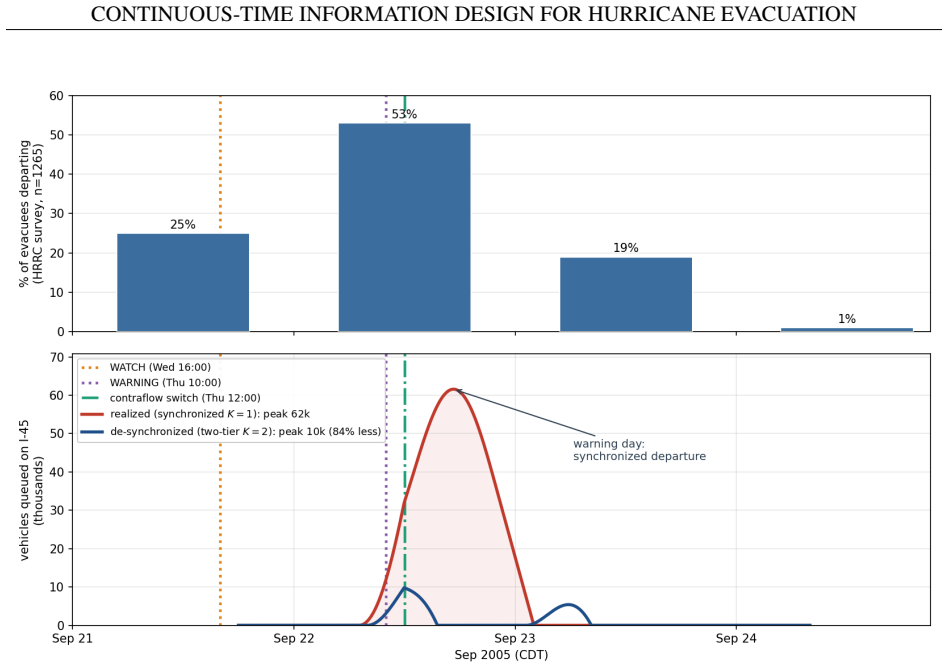
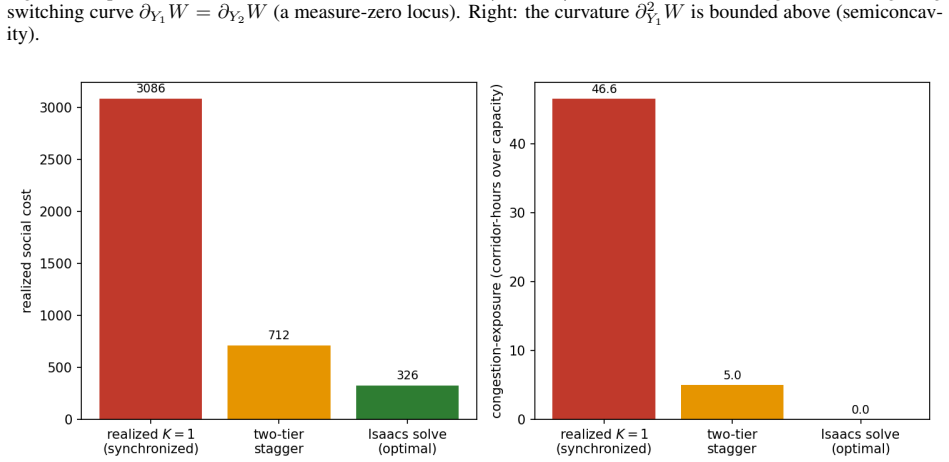
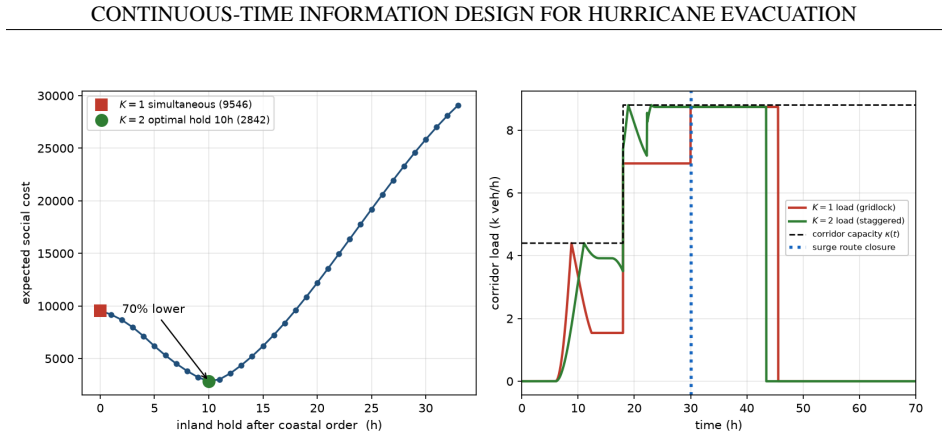
Without transfers the leader's first-order condition retains an equilibrium-response term, so optimal information design operates as a second-best congestion toll; the derived policy removes essentially all in-transit congestion exposure and reduces social cost by 89 percent, while staggered disclosure by itself yields a 70 percent reduction.
What carries the argument
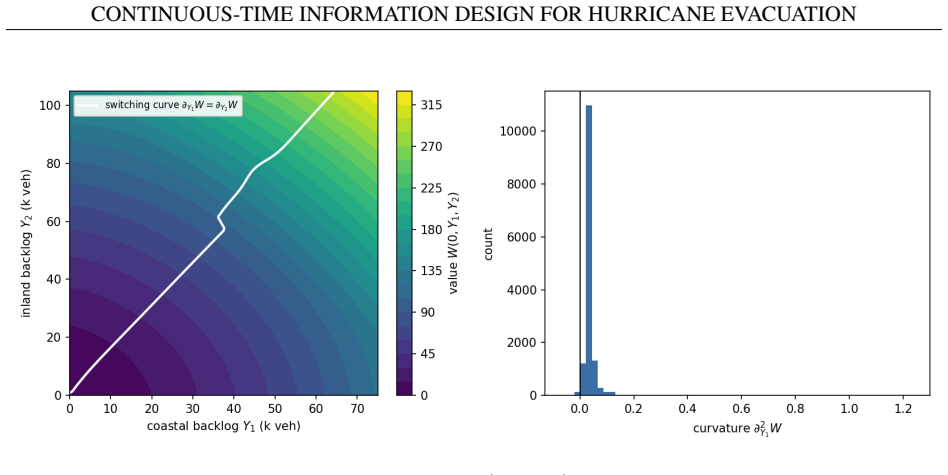
The Isaacs equation for the leader's distributionally robust relative-entropy problem, obtained after the followers' game is reduced to a convex control problem whose running cost couples beliefs to a convex congestion externality.
If this is right
- A staggered evacuation order dominates simultaneous advisories.
- Phased evacuation emerges endogenously as the optimal information design.
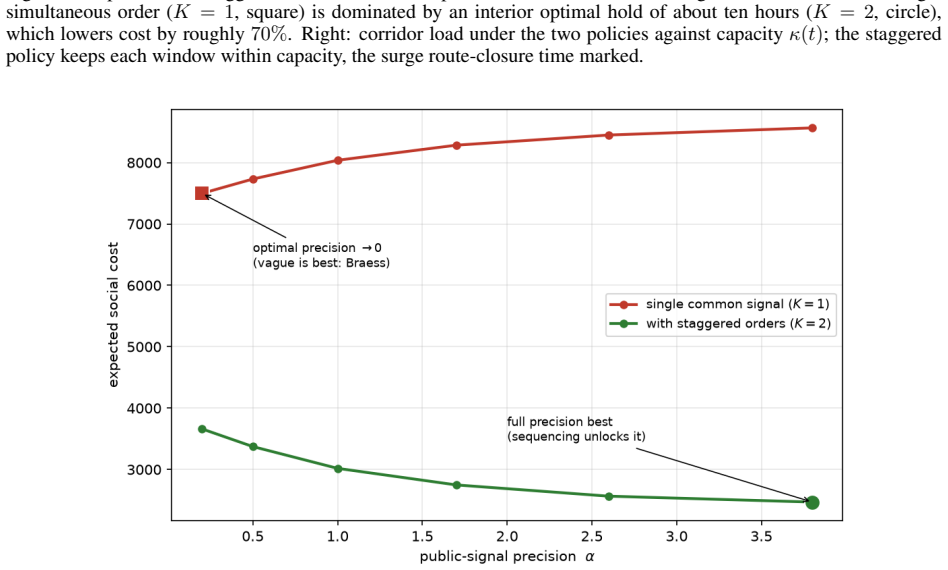
- Public-signal precision is sign-ambiguous because of an informational Braess effect, so vague advisories can be optimal unless paired with staggering.
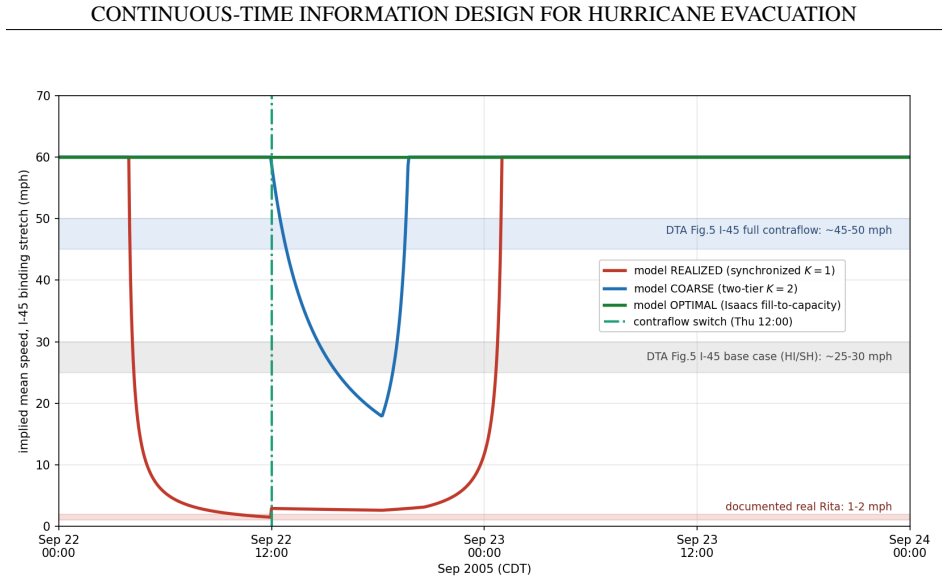
- The model reproduces the gridlock observed along the I-45 corridor during Hurricane Rita.
Where Pith is reading between the lines
- The same belief-congestion coupling could be used to design release schedules for wildfire or flood evacuations on shared routes.
- If monetary transfers were added, information design might become a first-best instrument rather than second-best.
- The finite-dimensional filter for the jump-diffusion storm allows the agency to update advisories in real time as new intensity observations arrive.
Load-bearing premise
The followers' congestion game admits a potential reduction to a convex control problem whose running cost directly links beliefs to a convex congestion externality, and the latent storm admits an exact finite-dimensional belief filter.
What would settle it
Numerical solution of the calibrated model on the I-45 corridor under an alternative storm path or capacity schedule that produces materially higher in-transit congestion exposure than the reported 89 percent reduction.
Figures
read the original abstract
We study continuous-time information design for emergency evacuation, where an Emergency Management Agency (the Stackelberg leader) steers strategic evacuation zones via two levers: public advisory precision (information design) and a tiered release schedule. The latent storm is a jump-diffusion process with publicly observed rapid-intensification epochs tracked by an exact finite-dimensional belief filter. Zones play a capacity-constrained congestion game on shared corridors with belief-weighted hazard exposure. The running cost couples beliefs to a convex congestion externality, making disclosure double-edged: sharper information reduces false-alarm departures but synchronizes genuine ones, and convex congestion penalizes that synchronization. We prove that: (i) the followers' game admits a potential reduction to a convex control problem; (ii) the leader's distributionally robust relative-entropy problem is characterized by an Isaacs equation whose value is the unique viscosity solution, with verification valid for non-smooth bang-bang feedback; and (iii) without transfers, the leader's first-order condition retains an equilibrium-response term, positioning optimal information design as a second-best congestion toll. Structurally, we show that a staggered evacuation order dominates simultaneous advisories; phased evacuation emerges endogenously as optimal information design. Furthermore, public-signal precision is sign-ambiguous due to an informational Braess effect, where vague advisories are optimal unless complemented by a staggered order. Calibrated to Hurricane Rita using NHC archives, TxDOT capacities, and HRRC surveys, the model reproduces the observed gridlock along the Interstate 45 (I-45) evacuation corridor in Texas. The optimal policy removes essentially all in-transit congestion exposure, reducing social cost by 89%, while staggered disclosure alone yields a 70% reduction.
Editorial analysis
A structured set of objections, weighed in public.
Referee Report
Summary. The paper models continuous-time information design for hurricane evacuation as a Stackelberg game in which an agency designs public signals and phased releases to steer zones playing a capacity-constrained congestion game on shared corridors. The latent storm is a jump-diffusion with an exact finite-dimensional belief filter. The authors prove three results: (i) the followers' game admits an exact potential reduction to a convex control problem whose running cost couples belief-weighted hazard exposure to a convex congestion externality; (ii) the leader's distributionally robust relative-entropy problem is characterized by an Isaacs equation whose value is the unique viscosity solution, with verification holding for non-smooth bang-bang feedback; (iii) the leader's first-order condition retains an equilibrium-response term, so that optimal information design functions as a second-best congestion toll. They further show that staggered disclosure dominates simultaneous advisories, that public-signal precision is sign-ambiguous due to an informational Braess effect, and that a calibrated policy to Hurricane Rita data removes essentially all in-transit congestion, yielding an 89% social-cost reduction (70% from staggered disclosure alone).
Significance. If the potential reduction and Isaacs verification are rigorous, the work supplies a mathematically grounded link between information design and dynamic congestion management under model uncertainty, with direct policy relevance for emergency management. The calibration exercise supplies quantitative evidence that the structural results translate into large welfare gains on real data, strengthening the applied contribution.
major comments (3)
- [Abstract, item (i)] Abstract, item (i): The assertion that the capacity-constrained multi-zone game admits an exact potential reduction to a convex control problem whose minimizer coincides with Nash equilibrium rests on an integrability condition for the belief-weighted hazard plus convex congestion running cost under a common time-varying belief process driven by the jump-diffusion filter. No explicit statement or verification of this condition appears in the provided abstract or model-setup paragraphs; if the condition fails, the reduction does not hold, the leader's problem cannot be recast as convex control, and both the Isaacs characterization and the quantitative claims collapse.
- [Abstract, calibration exercise] Abstract, calibration exercise: The reported 89% and 70% social-cost reductions are obtained after fitting jump-diffusion parameters, the congestion convexity coefficient, belief-filter initial conditions, and hazard-exposure weights to NHC, TxDOT, and HRRC data. The manuscript should supply either a sensitivity table or explicit bounds showing how these percentages vary when the fitted parameters are perturbed within their estimation uncertainty; without such analysis the quantitative claims remain sensitive to the free parameters listed in the axiom ledger.
- [Abstract, item (ii)] Abstract, item (ii): The verification that the Isaacs equation admits a unique viscosity solution and that this solution equals the value function is stated to hold for non-smooth bang-bang feedback. The precise conditions (e.g., continuity or semi-continuity requirements on the Hamiltonian, or the form of the relative-entropy penalty) under which verification succeeds for discontinuous controls should be stated explicitly, as non-smoothness can invalidate standard verification arguments in distributionally robust control problems.
minor comments (1)
- [Abstract] The abstract refers to 'an informational Braess effect' without a forward reference to the section where this effect is derived; a parenthetical citation to the relevant proposition would improve readability.
Simulated Author's Rebuttal
We thank the referee for the careful and constructive report. We respond to each major comment below.
read point-by-point responses
-
Referee: [Abstract, item (i)] Abstract, item (i): The assertion that the capacity-constrained multi-zone game admits an exact potential reduction to a convex control problem whose minimizer coincides with Nash equilibrium rests on an integrability condition for the belief-weighted hazard plus convex congestion running cost under a common time-varying belief process driven by the jump-diffusion filter. No explicit statement or verification of this condition appears in the provided abstract or model-setup paragraphs; if the condition fails, the reduction does not hold, the leader's problem cannot be recast as convex control, and both the Isaacs characterization and the quantitative claims collapse.
Authors: The integrability condition is satisfied by the combination of convex congestion and bounded belief-weighted hazard exposure under the finite-dimensional jump-diffusion filter; this is verified explicitly in the model derivation (Section 3). We will add a concise statement of the condition together with its verification to both the abstract and the model-setup paragraphs. revision: yes
-
Referee: [Abstract, calibration exercise] Abstract, calibration exercise: The reported 89% and 70% social-cost reductions are obtained after fitting jump-diffusion parameters, the congestion convexity coefficient, belief-filter initial conditions, and hazard-exposure weights to NHC, TxDOT, and HRRC data. The manuscript should supply either a sensitivity table or explicit bounds showing how these percentages vary when the fitted parameters are perturbed within their estimation uncertainty; without such analysis the quantitative claims remain sensitive to the free parameters listed in the axiom ledger.
Authors: We agree that sensitivity analysis is needed to support the quantitative claims. The revised manuscript will include a sensitivity table that perturbs the fitted parameters within ranges consistent with their estimation uncertainty and reports the resulting variation in the reported cost reductions. revision: yes
-
Referee: [Abstract, item (ii)] Abstract, item (ii): The verification that the Isaacs equation admits a unique viscosity solution and that this solution equals the value function is stated to hold for non-smooth bang-bang feedback. The precise conditions (e.g., continuity or semi-continuity requirements on the Hamiltonian, or the form of the relative-entropy penalty) under which verification succeeds for discontinuous controls should be stated explicitly, as non-smoothness can invalidate standard verification arguments in distributionally robust control problems.
Authors: The verification argument relies on the relative-entropy penalty and the convexity of the running cost, which together guarantee the required semi-continuity of the Hamiltonian for bang-bang controls. We will state these conditions explicitly in the revised text, with reference to the relevant viscosity-solution results for distributionally robust problems. revision: yes
Circularity Check
No significant circularity; derivations presented as independent proofs
full rationale
The provided abstract and description state that the paper proves three distinct items: (i) potential reduction of the followers' game to a convex control problem, (ii) Isaacs equation characterization with unique viscosity solution, and (iii) first-order condition retaining an equilibrium-response term. These are framed as proved results rather than definitions or fits. Calibration to Rita data reproduces observed gridlock and then reports optimized policy outcomes (89% and 70% reductions), but these are model-evaluated results, not quantities forced by construction from the fit itself. No self-definitional steps, fitted inputs renamed as predictions, self-citation chains, or ansatz smuggling are quotable from the text. The derivation chain is self-contained against the stated assumptions and external data sources.
Axiom & Free-Parameter Ledger
free parameters (2)
- jump-diffusion parameters and congestion convexity coefficient
- belief-filter initial conditions and hazard-exposure weights
axioms (3)
- standard math Existence and uniqueness of viscosity solution to the Isaacs equation for the distributionally robust problem
- domain assumption The followers' strategic game admits an exact potential-function reduction to a convex control problem
- domain assumption Convex congestion externality couples directly to belief-weighted hazard exposure
Reference graph
Works this paper leans on
-
[1]
Distributionally robust joint information and mechanism design for multi-area power system coordination,
Furkan Sezer. Distributionally robust joint information and mechanism design for multi-area power system coordination,
-
[2]
URLhttps://arxiv.org/abs/2606.24015
work page internal anchor Pith review Pith/arXiv arXiv
-
[3]
Bayesian persuasion.American Economic Review, 101(6):2590–2615, October
Emir Kamenica and Matthew Gentzkow. Bayesian persuasion.American Economic Review, 101(6):2590–2615, October
-
[4]
URLhttps://www.aeaweb.org/articles?id=10.1257/aer.101.6.2590
DOI: 10.1257/aer.101.6.2590. URLhttps://www.aeaweb.org/articles?id=10.1257/aer.101.6.2590
-
[5]
Jeffrey C. Ely. Beeps.American Economic Review, 107(1):31–53, 2017. DOI: 10.1257/aer.20150218. 19 CONTINUOUS-TIME INFORMATION DESIGN FOR HURRICANE EV ACUATION
-
[6]
Informed information design.Journal of Political Economy, 131(11):3186–3232, 2023
Fr ´ed´eric Koessler and Vasiliki Skreta. Informed information design.Journal of Political Economy, 131(11):3186–3232, 2023. DOI: 10.1086/724843
-
[7]
Information design: A unified perspective.Journal of Economic Literature, 57(1):44– 95, March 2019
Dirk Bergemann and Stephen Morris. Information design: A unified perspective.Journal of Economic Literature, 57(1):44– 95, March 2019. DOI: 10.1257/jel.20181489. URLhttps://www.aeaweb.org/articles?id=10.1257/jel.20181489
-
[8]
Reducing congestion through information design
Sanmay Das, Emir Kamenica, and Renee Mirka. Reducing congestion through information design. In2017 55th Annual Allerton Conference on Communication, Control, and Computing (Allerton), pages 1279–1284, 2017. DOI: 10.1109/ALLER- TON.2017.8262884
-
[9]
Daron Acemoglu, Ali Makhdoumi, Azarakhsh Malekian, and Asuman Ozdaglar. Informational braess’ paradox: The effect of information on traffic congestion.Operations Research, 66(4):893–917, 2018. DOI: 10.1287/opre.2017.1712. URL https://doi.org/10.1287/opre.2017.1712
-
[10]
Informational incentives for congestion games
Hamidreza Tavafoghi and Demosthenis Teneketzis. Informational incentives for congestion games. In2017 55th Annual Allerton Conference on Communication, Control, and Computing (Allerton), page 1285–1292, Monticello, IL, USA, 2017. IEEE Press. DOI: 10.1109/ALLERTON.2017.8262885
-
[11]
Pamela Murray-Tuite and Brian Wolshon. Evacuation transportation modeling: An overview of research, devel- opment, and practice.Transportation Research Part C: Emerging Technologies, 27:25–45, 2013. ISSN 0968- 090X. DOI: https://doi.org/10.1016/j.trc.2012.11.005. URLhttps://www.sciencedirect.com/science/article/ pii/S0968090X12001386
-
[12]
Review of policies and practices for hurri- cane evacuation
Brian Wolshon, Elba Urbina Hamilton, Marc Levitan, and Chester Wilmot. Review of policies and practices for hurri- cane evacuation. ii: Traffic operations, management, and control.Natural Hazards Review, 6(3):143–161, 2005. DOI: 10.1061/(ASCE)1527-6988(2005)6:3(143)
-
[13]
Hayssam Sbayti and Hani S. Mahmassani. Optimal scheduling of evacuation operations.Transportation Research Record, 1964(1):238–246, 2006. DOI: 10.1177/0361198106196400126
-
[14]
Sargent.Robustness
Lars Peter Hansen and Thomas J. Sargent.Robustness. Princeton University Press, Princeton, NJ, 2008
2008
-
[15]
Fleming and Halil Mete Soner.Controlled Markov Processes and Viscosity Solutions
Wendell H. Fleming and Halil Mete Soner.Controlled Markov Processes and Viscosity Solutions. Springer, New York, NY , 2nd edition, 2006. DOI: 10.1007/0-387-31071-1
-
[16]
Martino Bardi and Italo Capuzzo-Dolcetta.Optimal Control and Viscosity Solutions of Hamilton–Jacobi–Bellman Equations. Birkh¨auser, Boston, MA, 1997. DOI: 10.1007/978-0-8176-4755-1
-
[17]
Crandall, Hitoshi Ishii, and Pierre-Louis Lions
Michael G. Crandall, Hitoshi Ishii, and Pierre-Louis Lions. User’s guide to viscosity solutions of second order partial differ- ential equations.Bulletin of the American Mathematical Society, 27:1–67, 1992. URLhttps://www.ams.org/journals/ bull/1992-27-01/S0273-0979-1992-00266-5/S0273-0979-1992-00266-5.pdf
1992
-
[18]
Birkh ¨auser, Boston, MA, 2004
Piermarco Cannarsa and Carlo Sinestrari.Semiconcave Functions, Hamilton–Jacobi Equations, and Optimal Control, vol- ume 58 ofProgress in Nonlinear Differential Equations and Their Applications. Birkh ¨auser, Boston, MA, 2004. ISBN 978-0-8176-4084-2. DOI: 10.1007/b138356
-
[19]
Francis H. Clarke, Yuri S. Ledyaev, Ronald J. Stern, and Peter R. Wolenski.Nonsmooth Analysis and Control Theory. Springer, New York, NY , 1998. DOI: 10.1007/b97650
-
[20]
Robert S. Liptser and Albert N. Shiryaev.Statistics of Random Processes I: General Theory. Springer, Heidelberg, Germany, 2nd edition, 2001. DOI: 10.1007/978-3-662-13043-8
-
[21]
Stackelberg stochastic differential games in feedback information pattern with applications
Qi Huang and Jingtao Shi. Stackelberg stochastic differential games in feedback information pattern with applications. Dynamic games and applications, 14(5):1191–1224, 2024. DOI: 10.1007/s13235-023-00549-0
-
[22]
Jinyoung Lee, Qingxin Meng, and Jun Moon. Linear-quadratic stochastic stackelberg differential games for jump-diffusion systems under general partial information.Dynamic Games and Applications, 16(1):157–197, 2026. DOI: 10.1007/s13235- 025-00659-x
-
[23]
Yiting Wu and Junyu Zhang. Discounted stochastic stackelberg games for peer-to-peer energy sharing.Dynamic Games and Applications, pages 1–23, 2026. DOI: 10.1007/s13235-026-00703-4
-
[24]
Tamer Bas ¸ar and Quanyan Zhu. Prices of anarchy, information, and cooperation in differential games.Dynamic Games and Applications, 1(1):50–73, 2011. DOI: 10.1007/s13235-010-0002-3
-
[25]
Brian Wolshon. “one-way-out”: Contraflow freeway operation for hurricane evacuation.Natural Hazards Review, 2(3): 105–112, 2001. DOI: 10.1061/(ASCE)1527-6988(2001)2:3(105)
-
[26]
Praprut Songchitruksa, Russell Henk, Steven Venglar, and Xiaosi Zeng. Dynamic traffic assignment evaluation of hurricane evacuation strategies for the houston–galveston, texas, region.Transportation Research Record, 2312(1):108–119, 2012. DOI: 10.3141/2312-11
-
[27]
Hao-Che Wu, Michael K. Lindell, and Carla S. Prater. Logistics of hurricane evacuation in hurricanes katrina and rita.Transportation Research Part F: Traffic Psychology and Behaviour, 15(4):445–461, 2012. ISSN 1369-8478. DOI: https://doi.org/10.1016/j.trf.2012.03.005
-
[28]
Hurricane Rita, September 18–26, 2005
Jeff Lindner. Hurricane Rita, September 18–26, 2005. Meteorological event report, Texas Floodplain Management Asso- ciation, Houston, TX, 2005. URLhttps://cdn.ymaws.com/www.tfma.org/resource/resmgr/Center_Page_News_ Brief/Hurricane_Rita.pdf
2005
-
[29]
Why didn’t officials order the evacuation of Houston? NPR, The Two- Way, August 2017
Camila Domonoske. Why didn’t officials order the evacuation of Houston? NPR, The Two- Way, August 2017. URLhttps://www.npr.org/sections/thetwo-way/2017/08/28/546721363/ why-didn-t-officials-order-the-evacuation-of-houston. Accessed June 2026. 20
2017
discussion (0)
Sign in with ORCID, Apple, or X to comment. Anyone can read and Pith papers without signing in.