REVIEW 3 major objections 5 minor 192 references
A fractional gravity model with varying G and a scalar field can match late-time data when the quartic potential term is switched off, producing an overdamped relaxation of about 9 Gyr and cosmographic signatures that may ease the H0 and S8
Reviewed by Pith at T0; open to challenge. T0 means a machine referee read the full paper against a public rubric. the ladder, T0–T4 →
A fractional gravity model with dynamical G and scalar field fits late-time data only in the μ=0 case, mimics ΛCDM expansion, but is disfavored by BIC and yields an unphysically large universe age.
T0 review reviewed 2026-07-14 challenge →
load-bearing objection Solid dynamical-systems and multi-probe MCMC work on a fractional varying-G model, but the preferred age is ~40 Gyr and the H(z) pipeline rests on a convenience ansatz. the 3 major comments →
Varying Gravity from a Modified Fractional Model: Observational Constraints and Slow-Fast Dynamics
The pith
A machine-rendered reading of the paper's core claim, the machinery that carries it, and where it could break.
The reading
Core claim
When the scalar potential is purely quadratic (μ=0), the fractional model with dynamically evolving G and H becomes the only variant that is both statistically competitive with ΛCDM and dynamically consistent: it yields an overdamped relaxation timescale τ_rel≈9 Gyr, well-constrained fractional exponents, and late-time cosmographic functions that closely track but do not coincide with those of ΛCDM, while the full quartic model is disfavored by BIC and by parameter degeneracies.
What carries the argument
The closed evolution equation for the diagnostic R ≡ (Ġ/G)/H, together with the slow–fast decomposition of the regularized autonomous system in the variables (u,v1,v2,v3,R). R organizes both the modified continuity equation and the growth of density perturbations, converting the nonlocal fractional corrections into observable shifts of H(z) and fσ8.
Load-bearing premise
The entire reconstruction rests on a specific three-term ansatz for the Hubble rate, H = H0 + ξφ + ε/t with ε fixed to (α−1)/3, that eliminates the time-dependent friction and forces the scalar equation into a solvable Levinson–Smith form; if that functional form is not a faithful description of the true expansion history, the fitted posteriors and cosmographic signatures lose their foundation.
What would settle it
A direct measurement of the present-day logarithmic growth rate fσ8 (or of the cosmographic jerk and snap at z≲1) that is incompatible with the μ=0 posterior predictions at more than 3σ would rule out the claim that the fractional model is observationally viable and dynamically preferred.
If this is right
- Late-time acceleration can be reproduced without a pure cosmological constant once fractional nonlocal corrections and a slowly varying G are admitted.
- The overdamped 9 Gyr relaxation timescale sets a concrete, observationally accessible damping scale for the scalar field that can be tested against future growth-rate surveys.
- Distinctive departures of the jerk and snap from their ΛCDM values become diagnostic signatures that future cosmographic reconstructions can hunt for.
- The sign and magnitude of R on the slow manifold simultaneously control the local expansion rate and the amplitude of structure growth, linking the H0 and S8 tensions inside a single geometric mechanism.
- BBN abundance measurements can be used as a high-redshift filter on the allowed range of α and β because rapid early variations of G are tightly constrained by light-element yields.
Where Pith is reading between the lines
- If the slow-manifold value of R remains negative at late times, the same mechanism that lowers σ8 would also pull the local H0 toward the lower CMB-inferred value, potentially reconciling both tensions with a single sign choice.
- The requirement that μ vanish for statistical viability suggests that the quartic self-interaction of the scalar is radiatively suppressed or irrelevant at late times, a prediction that could be checked in a UV completion of the fractional RG flow.
- Because the model already produces cyclic and oscillatory early phases, a dedicated primordial-nucleosynthesis likelihood analysis could turn the present BBN consistency arguments into a quantitative prior on the fractional order α.
- The geometric slow–fast structure implies that any future detection of a non-constant G on cosmological scales would automatically select a preferred region of the (α,ζ) plane already constrained by the MCMC chains.
Editorial analysis
A structured set of objections, weighed in public.
Referee Report
Summary. The manuscript constructs a fractional-action cosmological model (FRGIC/FEG) with a scalar field and a time-varying gravitational constant G, motivated by renormalization-group ideas. After imposing a phenomenological Hubble ansatz H = H0 + ξφ + ε/t with the special choice ε = (α−1)/3, the authors reduce the dynamics to a regularized autonomous system, analyze its slow–fast structure and critical points, and reconstruct H(z). Bayesian MCMC fits to SNe Ia (Pantheon+), cosmic chronometers, DESI BAO, H0LiCOW lensing and black-hole shadows are presented for two variants (μ ≠ 0 and μ = 0) and compared with flat ΛCDM. The authors conclude that only the μ = 0 model is statistically competitive (slightly lower χ²_min, well-constrained α and ζ, overdamped relaxation τ_rel ≃ 9 Gyr), that it reproduces late-time acceleration while producing distinctive cosmographic signatures, and that fractional nonlocal corrections may help address the H0 and S8 tensions.
Significance. If the reduction and the observational pipeline were robust, the work would supply a concrete, observationally constrained fractional-gravity scenario with an explicit slow–fast geometric structure and a diagnostic R ≡ (Ġ/G)/H that links early-universe (BBN) and late-time (growth, H0) physics. The dynamical-systems analysis (regularization via u = H0/H, Puiseux expansions, critical-point classification, desingularization of u = 0) is carefully executed and of independent interest for fractional cosmologies. The MCMC implementation uses standard data sets and reports BIC comparisons honestly. These technical strengths are real; the central viability claim, however, rests on an ansatz whose status is not derived from the fractional field equations, which limits the present significance for the H0/S8 problem.
major comments (3)
- The entire H(z) reconstruction and the MCMC posteriors of Table 1 and Figs. 1–7 rest on the phenomenological ansatz H = H0 + ξφ + ε/t together with the special choice ε = (α−1)/3 (Eqs. 8, 12 and the paragraph after Remark 3). That choice is introduced explicitly “to simplify the analytical solution” and to cancel the time-dependent friction term in the scalar equation (10), converting it into a Levinson–Smith oscillator. It is not a consequence of the fractional Euler–Lagrange equations (3)–(6) nor of the RG-improved action. If a generic ε is retained, or if H is obtained by simultaneous integration of the full (G, φ, a) system, the first-order system (55)–(56) used for the emcee chains ceases to be valid. The statistical-viability claim for μ = 0 therefore inherits the status of an untested ansatz. The manuscript should either (i) derive the ansatz from the field equations under control
- Table 1 reports τ0 ≃ 2.94 and an inferred cosmic age t0 ≃ 40 Gyr (1σ lower bound still ≃ 24 Gyr) for both Fractional variants. This is grossly inconsistent with stellar ages, globular-cluster ages and the CMB-inferred age of the Universe (≃ 13.8 Gyr). The text attributes the result to a strong degeneracy between α and τ0 (Eqs. 45, 56) and notes that only a 1σ lower bound is obtained, yet still presents t0 ≃ 40 Gyr as a model outcome. A cosmologically viable model cannot leave an age of ∼40 Gyr as an acceptable posterior region. Either a prior that enforces a realistic age must be imposed and the chains re-run, or the degeneracy must be broken by additional data (e.g., high-z BAO or CMB distance priors) so that the age posterior is brought into agreement with independent constraints. Until this is done, the claim that the μ = 0 model is “statistically viable” is incomplete.
- The abstract and §12 assert that fractional nonlocal corrections “may offer new pathways toward addressing the H0 and S8 tensions.” The MCMC analysis, however, yields h ≃ 0.72 for all three models (ΛCDM and both Fractional variants) and does not include growth data (fσ8 or weak lensing) in the likelihood; the S8 discussion in §11 remains at the level of qualitative sign arguments for R. Moreover, BIC strongly favors ΛCDM (ΔBIC > 10). The tension-resolution language should be either supported by an explicit joint fit that includes growth observables and a quantitative ΔH0/ΔS8 assessment, or substantially softened to match what the present data actually constrain.
minor comments (5)
- Notation for the fractional parameter is occasionally overloaded: α appears both as the FALVA order and (via α = 1 + 3τ_rel) as a derived age-related quantity. A single consistent definition table would help.
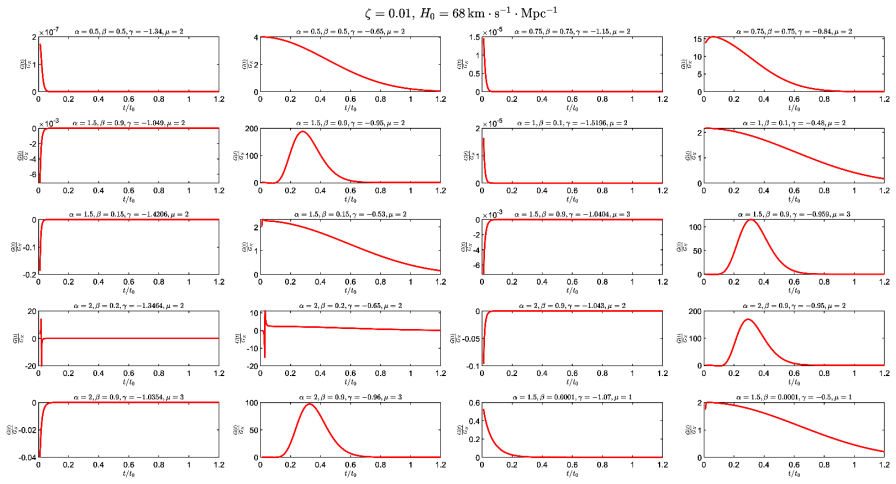
- Figures 11–14 (G(t) variations) are repeated with the same caption block; panel labels and parameter values should be made unique and legible.
- The prior ranges (e.g., α ∈ [1,4], μ ∈ [−3,10]) are stated but not motivated by theoretical bounds; a short justification or sensitivity check would strengthen §4.2.
- Several long passages in §§7–10 restate the same slow–fast geometry in three different charts (λ, T, w). Condensing the comparative synthesis would improve readability without loss of content.
- Typographical issues: “CNAAR” in Funding, duplicated figure captions, and occasional missing spaces around equation references.
Circularity Check
Central H(z) reconstruction, MCMC viability claims, and overdamped 'confirmation' rest on an undervived convenience ansatz H=H0+ξφ+ε/t with ε=(α-1)/3 plus algebraic relations among fitted parameters.
specific steps
-
other
[Section 2, Eq. (8) and paragraph after Remark 3 (point 4)]
"Motivated by various scalar field and quintessence cosmological models [73, 74, 75], we suggest the generalized ansatz H=H0 +ξφ+ε/t,(8) ... we have selectedε= (α−1)/3 for two main reasons: first, it considerably simplifies the analytical solution, and second, it eliminates the time-dependent friction term in the differential equation, so we will deal only with constant friction."
The entire numerical pipeline (system (55)–(56), E(τ), H(z) reconstruction, MCMC posteriors in Table 1, cosmographic plots Figs. 4–7, and the claim that μ=0 is the only statistically viable variant) is derived under this special value of ε. The choice is not obtained from the fractional field equations (4)–(6) but imposed for analytic convenience; therefore the reported H(z) evolution and viability statements are those of the simplified ansatz model by construction, not predictions of the general FRGIC/FEG theory.
-
self definitional
[Section 5.1, Eqs. (153)–(157) and surrounding text]
"Using the best-fit values in Table 1, m≃30.8 +28.0 −20.9 km s−1 Mpc−1, Γ≃108.3±1.1 km s−1 Mpc−1, ... Δ=... Since Δ>0, the system lies in the overdamped regime. ... τd=1/|λ+|≈...≈9.0 Gyr≃τ_rel=9.037+0.091−0.094 Gyr, in excellent agreement with the fitted value reported in Table 1."
τ_rel is defined from the free parameters via α=1+3τ_rel and λ=1/τ_rel (Eqs. 36, 41); m=ζ H0 and Γ=3/2 H0 are likewise direct functions of the same fitted (ζ,h). The eigenvalues λ± and the derived τ_d are therefore algebraic rearrangements of the best-fit numbers under the overdamped approximation; the 'agreement' and 'confirmation of an overdamped regime' are identities, not independent dynamical results.
-
fitted input called prediction
[Abstract and Section 4.3 / Table 1]
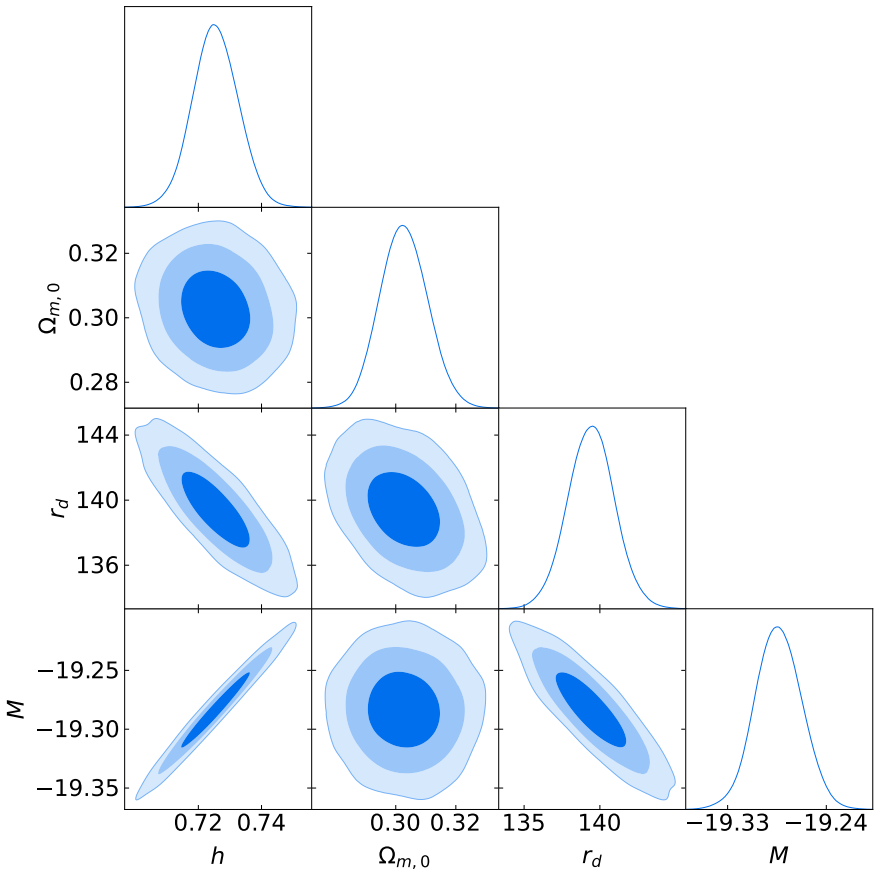
"A Bayesian analysis shows that the Fractional model with μ=0 is the only statistically viable variant. The inferred Hubble parameter is stable across models (h≃0.72), while the fractional parameters are significantly better constrained in the μ=0 case (α=1.20+0.25−0.14, ζ=0.43+0.39−0.29). ... Although the μ=0 model attains a slightly lower χ2_min than ΛCDM, the BIC strongly favors ΛCDM ... Overall, the model reproduces late-time acceleration and mimics ΛCDM while introducing distinctive cosmographic signatures."
The free parameters of the ansatz-reduced system (including α, ζ, τ0, q0 that fix the initial conditions (56) and the friction) are fitted by MCMC to the same SNe+CC+BAO+GL+BHS data that are then used to declare the model 'reproduces late-time acceleration' and yields 'distinctive cosmographic signatures'. The H(z), q(z), j(z), s(z) curves shown in Figs. 4–7 are therefore the best-fit realizations of the parametrized ansatz, not out-of-sample predictions.
full rationale
The paper's strongest statistical claim (μ=0 Fractional model is the only viable variant, with quoted posteriors on α, ζ, m, Γ, τ_rel and distinctive cosmographic signatures that may address H0/S8) is obtained by integrating the reduced first-order system (55)–(56) whose form is forced by the phenomenological Hubble ansatz (8) together with the special value ε=(α-1)/3. That choice is not a consequence of the fractional Euler–Lagrange equations (3)–(6) or the RG-improved action; it is imposed explicitly 'to simplify the analytical solution' and to cancel the time-dependent friction term, converting the scalar equation into a Levinson–Smith oscillator. All subsequent numerical H(z), cosmographic functions, emcee chains, Table 1 and Figs. 4–7 therefore describe this simplified ansatz model, not the general fractional theory. In addition, the 'excellent agreement' between the damping timescale τ_d computed from best-fit (m,Γ) and the reported τ_rel is algebraic consistency under the definitions α=1+3τ_rel, Γ=3/2 H0 and the overdamped approximation, not an independent dynamical prediction. These are partial circularities of the fitted-input and self-definitional kinds; the Bayesian comparison itself is otherwise standard and the dynamical-systems analysis of critical points is independent of the data fit. Score 5 reflects that the load-bearing observational claims reduce to the ansatz plus parameter fitting, while the pure phase-space geometry does not.
Axiom & Free-Parameter Ledger
free parameters (7)
- α (fractional order) =
1.20^{+0.25}_{-0.14}
- ζ = m/H0 =
0.43^{+0.39}_{-0.29}
- μ (quartic coupling) =
0 (preferred) or 4.0^{+2.8}_{-2.5}
- τ0 = H0 t0 =
2.94^{+0.77}_{-1.18}
- q0 (present deceleration) =
−0.502^{+0.027}_{-0.023}
- h, rd, M =
h≃0.72, rd≃139 Mpc, M≃−19.29
- β (in Λ=Λ0 G^β)
axioms (5)
- domain assumption Fractional action-like variational approach (FALVA) replaces the ordinary action integral by a fractional integral of order α.
- ad hoc to paper Hubble ansatz H=H0+ξφ+ε/t with the specific choice ε=(α−1)/3.
- ad hoc to paper Phenomenological law Λ=Λ0 G^β.
- domain assumption Flat FLRW metric and a single scalar field dominate the late universe.
- domain assumption Pre-recombination sound horizon rd can be treated as a free parameter independent of early-universe microphysics.
invented entities (2)
-
Fractional Renormalization-Group Improved Cosmology (FRGIC / FEG)
no independent evidence
-
Diagnostic R ≡ (Ġ/G)/H
no independent evidence
Cite this review
Pith. "Pith review of Varying Gravity from a Modified Fractional Model: Observational Constraints and Slow-Fast Dynamics." pith.science (2026). https://pith.science/paper/ZVBQIVDP
@misc{pith2026260709722,
  author       = {Pith},
  title        = {Pith review of: Varying Gravity from a Modified Fractional Model: Observational Constraints and Slow-Fast Dynamics},
  year         = {2026},
  howpublished = {\url{https://pith.science/paper/ZVBQIVDP}},
  note         = {Machine review of arXiv:2607.09722}
}
read the original abstract
We investigate a fractional gravity model in which both the Hubble parameter and the gravitational constant evolve dynamically due to fractional renormalization-group effects. The model incorporates a scalar field coupled to a time-varying $G$, generating nonlocal corrections characteristic of fractional--action cosmology. Analytical and numerical solutions reveal oscillatory regimes, cyclic phases, and rapid variations with implications for BBN and early-universe evolution. A robust numerical framework is developed to integrate the regularized system and compare the resulting $H(z)$ evolution with observational data from the Hubble parameter, baryon acoustic oscillations, type Ia supernovae, gravitational lensing, and black hole shadows, thereby enabling a consistent reconstruction of cosmographic quantities. A Bayesian analysis shows that the Fractional model with $\mu=0$ is the only statistically viable variant. The inferred Hubble parameter is stable across models ($h\simeq 0.72$), while the fractional parameters are significantly better constrained in the $\mu=0$ case ($\alpha=1.20^{+0.25}_{-0.14}$, $\zeta=0.43^{+0.39}_{-0.29}$). The dynamical sector yields $m=30.8^{+28.0}_{-20.9}$ and $\Gamma=108.3\pm1.1$, leading to a positive discriminant and a well-determined relaxation timescale $\tau_{\rm rel}\simeq 9$ Gyr, confirming an overdamped regime. Although the $\mu=0$ model attains a slightly lower $\chi^2_{\min}$ than $\Lambda$CDM, the BIC strongly favors $\Lambda$CDM due to its smaller parameter space. Overall, the model reproduces late-time acceleration and mimics $\Lambda$CDM while introducing distinctive cosmographic signatures. The dynamical systems analysis clarifies the stability structure and parameter dependence, indicating that fractional nonlocal corrections may offer new pathways toward addressing the $H_0$ and $S_8$ tensions.
Figures




Reference graph
Works this paper leans on
-
[1]
E. Komatsu, K.M. Smith, J. Dunkley, C. L. Bennett, B. Gold, G. Hinshaw, N. Jarosik, D. Larson, M. R. Nolta, L. Page, D. N. Spergel, M. Halpern, R.S. Hill, A. Kogut, M. Limon, S. S. Meyer, N. Odegard, G.S. Tucker, J. L. Weiland, E. Wollack, E. L. Wright, Seven-year Wilkinson Microwave Anisotropy Probe (WMAP) observations: cosmological interpretation, Astro...
-
[2]
S.F. Flender, D.J. Schwarz, Newtonian versus relativistic cosmology, Phys. Rev. D86, (2012) 063527.https://doi.org/10.1103/PhysRevD.86.063527
-
[3]
Weinberg, The Cosmological constant problem, Rev
S. Weinberg, The Cosmological constant problem, Rev. Mod. Phys. 61 (1989) 1.https://doi. org/10.1103/RevModPhys.61.1
-
[4]
Steinhardt, Critical Problems in Physics
P.J. Steinhardt, Critical Problems in Physics. Princeton, NJ: Princeton University Press, 1997
1997
-
[5]
I. Zlatev, L.-M. Wang, P.J. Steinhardt, Quintessence, cosmic coincidence, and the cosmological constant, Phys. Rev. Lett. 82, (1999) 896.https://doi.org/10.1103/PhysRevLett.82.896
-
[6]
G. Hinshaw, D. Larson, E. Komatsu, D.N. Spergel, C. L. Bennett, J. Dunkley, M.R. Nolta, M. Halpern, R.S. Hill, N. Odegard, L. Page, K.M. Smith, J.L. Weiland, B. Gold, N. Jarosik, A. Kogut, M. Limon, S.S. Meyer, G.S. Tucker, E. Wollack, E.L. Wright, Nine-year Wilkinson Mi- crowave Anisotropy Probe (WMAP) observations: cosmological parameter results, Astrop...
-
[7]
A. G. Riess, L. M. Macri, S. L. Hoffmann, D. Scolnic, S. Casertano, A. V. Filippenko, B. E. Tucker, M. J. Reid, D. O. Jones, J. M. Silverman and R. Chornock, A 2.4% determination of the local value of the Hubble constant, Astrophys. J. 826, (2016) 56.http://dx.doi.org/10. 3847/0004-637X/826/1/56
2016
-
[8]
Thakur, S
RK. Thakur, S. Gupta, R. Nigam, P.K. Thiruvikraman, Investigating the Hubble tension through Hubble parameter data, Res. Astron. Astrophys. 23, (2023) 065017.https://doi.org/10.1088/ 1674-4527/acd0e8
2023
-
[9]
Riess, S
A.G. Riess, S. Casertano, W. Yuan, L.M. Macri and D. Scolnic, Large Magellanic cloud Cepheid Standards provide a 1% foundation for the determination of the Hubble constant and stronger evidence for physics beyond ΛCDM, Astrophys. J. 876, (2019) 85.https://doi.org/10.3847/ 1538-4357/ab1422
2019
-
[10]
R.K. Thakur, H, Kumar, S. Gupta, D. Verma, R. Nigam, Investigating the Hubble tension: Effect of Cepheid calibration, Phys. Lett. B840, (2023) 137886.https://doi.org/10.1016/j. physletb.2023.137886
doi:10.1016/j 2023
-
[11]
Riess, L
A.G. Riess, L. Macri, S. Casertano, H. Lampeitl, H.C. Ferguson, A.V. Filippenko, S.W. Jha, W. Li, R. Chornock, A 3% solution: determination of the Hubble constant with the Hubble space telescope and wide field camera, Astrophys. J. 730, (2011) 119.http://dx.doi.org/10.1088/ 0004-637X/730/2/119
2011
-
[12]
K. Nozari, S. Saghafi, M. Hajebrahimi, Extended uncertainty principle: a deeper insight into the Hubble tension? Phys. Dark Universe 46, (2024) 101571.https://doi.org/10.1016/j.dark. 2024.101571
doi:10.1016/j.dark 2024
-
[13]
Cook, The Lambda-CDM-NG cosmological model: a possible resolution of the Hubble tension, Astrophys
R.J. Cook, The Lambda-CDM-NG cosmological model: a possible resolution of the Hubble tension, Astrophys. J. 965, (2024) 127.https://doi.org/10.3847/1538-4357/ad3207
-
[14]
W. Anukool, R.A. El-Nabulsi, An oscillating Chern-Simons universe crossing the phantom divide line and alleviating the Hubble tension, Mod. Phys. Lett. A39, (2024) 2450086.https://doi. org/10.1142/S021773232450086X
-
[16]
El-Nabulsi, Cosmology with a fractional action principle, Rom
R.A. El-Nabulsi, Cosmology with a fractional action principle, Rom. Rep. Phys. 59, (2007) 763. https://rrp.nipne.ro/2007_59_3/3-Nabulsi_El-Rami.pdf
2007
-
[17]
El-Nabulsi, Non-minimal coupling in fractional action cosmology, Indian J
R.A. El-Nabulsi, Non-minimal coupling in fractional action cosmology, Indian J. Phys. 87, (2013) 835.https://doi.org/10.1007/s12648-013-0295-3
-
[18]
El-Nabulsi, Fractional action oscillating phantom cosmology with conformal coupling, Eu- rop
R.A. El-Nabulsi, Fractional action oscillating phantom cosmology with conformal coupling, Eu- rop. Phys. J. P. 130, (2015) 102.https://doi.org/10.1140/epjp/i2015-15102-9
-
[19]
El-Nabulsi, Wormholes in fractional action cosmology, Can J
R.A. El-Nabulsi, Wormholes in fractional action cosmology, Can J. Phys. 95, (2017) 605-609. https://doi.org/10.1139/cjp-2017-0109
-
[20]
El-Nabulsi, Some fractional geometrical aspects of weak field approximation and Schwarzschild spacetime, Rom
R.A. El-Nabulsi, Some fractional geometrical aspects of weak field approximation and Schwarzschild spacetime, Rom. J. Phys. 52, (2007) 655-662.https://rjp.nipne.ro/2007_52_ 5-6/0705_0716.pdf
2007
-
[21]
El-Nabulsi, Fractional action cosmology with variable order parameter, Int
R.A. El-Nabulsi, Fractional action cosmology with variable order parameter, Int. J. Theor. Phys. 56, (2017) 1159-1182.https://doi.org/10.1007/s10773-016-3260-z
-
[22]
U. Debnath, S. Chattopadhyay, M. Jamil, Fractional action cosmology: some dark energy models in emergent, logamediate, and intermediate scenarios of the universe, J. Theor. Appl. Phys. 7, (2013) 25.https://doi.org/10.1186/2251-7235-7-25
-
[23]
M. Jamil, A. M. Rashid, D. Momeni, O. Razina, K. Esmakhanova, Fractional action cosmology with power-law weight function, J. Phys.: Conf. Ser. 354, (2012) 012008.https://iopscience. iop.org/article/10.1088/1742-6596/354/1/012008/pdf
-
[24]
U. Debnath, M. Jamil, S. Chattopadhyay, Fractional action cosmology: emergent, logamediate, intermediate, power law scenarios of the universe and generalized second law of thermodynamics, Int. J. Theor. Phys. 51, (2012) 812.https://doi.org/10.1007/s10773-011-0961-1
-
[25]
Shchigolev, Fractional Einstein-Hilbert action cosmology, Mod
V K. Shchigolev, Fractional Einstein-Hilbert action cosmology, Mod. Phys. Lett. A28, 14, (2013) 1350056.https://doi.org/10.1142/S0217732313500569
-
[26]
V.K. Shchigolev, Cosmic evolution in fractional action cosmology, Discontinuity, Nonlinearity and Complexity, 2, (2013) 115.https://doi.org/10.5890/DNC.2013.04.002
-
[27]
Shchigolev, Cosmological models with fractional derivatives and fractional action functional, Comm
V.K. Shchigolev, Cosmological models with fractional derivatives and fractional action functional, Comm. Theor. Phys. 56, (2011) 389.https://doi.org/10.1088/0253-6102/56/2/34
-
[28]
V. K. Shchigolev, Testing fractional action cosmology, Eur. Phys. J. Plus 131, 256 (2016).https: //doi.org/10.1140/epjp/i2016-16256-6
-
[29]
R.A. El-Nabulsi, Fractional Lagrangian formulation of general relativity and emergence of com- plex, spinorial and noncommutative gravity, Int. J. Geom. Methods Mod. Phys. 6, (2009) 25-76. https://doi.org/10.1142/S021988780900345X
-
[30]
S. M. M. Rasouli, E. W. de Oliveira Costa, P. Moniz, S. Jalalzadeh, Inflation and fractional quan- tum cosmology, Frac. Fract. 6, (2022) 655.https://doi.org/10.3390/fractalfract6110655
-
[32]
R. A. El-Nabulsi, Implications of the Ornstein-Uhlenbeck-like fractional differential equation in cosmology, Rev. Mex. Fis. 62, (2016) 240-250.https://rmf.smf.mx/ojs/index.php/rmf/ article/view/4204
2016
-
[33]
R. A. El-Nabulsi, String cosmology from fractional action with solitonic NS–NS matter and possibility of an accelerated expanding universe without dark energy, Can. J. Phys. 99, (2021) 691-695.https://doi.org/10.1139/cjp-2020-0575. 74
-
[34]
A. Pasqua, S. Chattopadhyay, Theoretical constraints on kinetic k-essence dark energy model in El-Nabulsi fractional action cosmology, Can. J. Phys. 91, (2013) 844-849.https: //cdnsciencepub.com/doi/10.1139/cjp-2013-0325
-
[35]
E.W. de Oliveira Costa, R. Jalalzadeh, P.F. da Silva J´ unior, S.M. Mousavi Rasouli, S. Jalalzadeh, Estimating age of the universe in fractional cosmology, Fractal Frac. 7, (2023) 854.https: //doi.org/10.3390/fractalfract7120854
-
[36]
S.M.M. Rasouli, S. Cheraghchi, P.V. Moniz, Fractional scalar field cosmology, Fractal Frac. 8, (2024) 281.https://doi.org/10.3390/fractalfract8050281
-
[37]
El-Nabulsi, C.F.L
R.A. El-Nabulsi, C.F.L. Godinho, I.V. Vancea, Fractional mimetic dark matter: A fractional action-like variational approach, Mod. Phys. Lett. A39, (2024) 2450147.https://doi.org/10. 1142/S0217732324501475
2024
-
[38]
B. Micolta-Riascos, A.D. Millano, G. Leon, C. Erices, A. Paliathanasis, Revisiting fractional cosmology,Fractal Fract.7, (2023) 149.https://doi.org/10.3390/fractalfract7020149
-
[39]
R. A. El-Nabulsi, Increasing effective gravitational constant in fractional ADD brane cosmol- ogy, Electron. J. Theor. Phys. 5, (2008) 103–106
2008
-
[40]
M. A. Garc´ ıa-Aspeitia, G. Fernandez-Anaya, A. Hern´ andez-Almada, G. Leon, J. Maga˜ na, Cos- mology under the fractional calculus approach, Mon. Not. R. Astron. Soc. 517, (2022) 4813- 4826.https://doi.org/10.1093/mnras/stac3006
-
[41]
R.A. El-Nabulsi, A Cosmology governed by a fractional differential equation and the generalized Kilbas-Saigo-Mittag-Leffler function, Int. J. Theor. Phys. 55, (2016) 625-635.https://doi.org/ 10.1007/s10773-015-2700-5
-
[42]
Calcagni, S
G. Calcagni, S. Kuroyanagi, S Tsujikawa, Cosmic microwave background and inflation in multi- fractional spacetimes. J. Cosmol. Astropart. Phys. 08, (2016) 039.http://dx.doi.org/10. 1088/1475-7516/2016/08/039
2016
-
[43]
Calcagni, Multifractional theories: An updated review, Mod
G. Calcagni, Multifractional theories: An updated review, Mod. Phys. Lett. A 36, (2021) 2140006.https://doi.org/10.1142/S021773232140006X
-
[44]
Calcagni, Classical and quantum gravity with fractional operators, Class
G. Calcagni, Classical and quantum gravity with fractional operators, Class. Quant. Grav. 38, (2021) 165005,https://doi.org/10.1088/1361-6382/ac1081.,Erratum in Class. Quant. Grav. 38, (2021) 169601.https://doi.org/10.1088/1361-6382/ac1bea
-
[45]
S. Jalalzadeh, E.W.O. Costa, P.V. Moniz, de Sitter fractional quantum cosmology. Phys. Rev. D105, (2022) L121901.https://doi.org/10.1103/PhysRevD.105.L121901
-
[46]
R.A. El-Nabulsi, W. Anukool, The paradigm of quantum cosmology through Dunkl fractional Laplacian operators and fractal dimensions, Chaos Solitons + Fractals 167, (2023) 113097. https://doi.org/10.1016/j.chaos.2022.113097
-
[47]
G. Leon Torres, M.A. Garc´ ıa-Aspeitia, G. Fernandez-Anaya, A. Hern´ andez- Almada, J. Maga˜ na, E. Gonz´ alez, Cosmology under the fractional calculus ap- proach: a possible H0 tension resolution? Proc. Sci. 2022, (2022) 248.https: //doi.org/10.22323/1.436.0248
-
[48]
M. Reuter, C. Wetterich, Effective average action for gauge theories and exact evolution equa- tions, Nucl. Phys. B427, (1994) 291.https://doi.org/10.1016/0550-3213(94)90543-6
-
[49]
Reuter, Nonperturbative evolution equation for quantum gravity, Phys
M. Reuter, Nonperturbative evolution equation for quantum gravity, Phys. Rev. D57, (1998) 971.https://doi.org/10.1103/PhysRevD.57.971
-
[50]
O. Lauscher, M. Reuter, Ultraviolet fixed point and generalized flow equation of quantum gravity, Phys. Rev. D65, (2002) 025013.https://doi.org/10.1103/PhysRevD.65.025013
-
[51]
A. Bonanno, M. Reuter, Cosmology of the Planck era from a renormalization group for quantum gravity, Phys. Rev. D65, (2002) 043508.https://doi.org/10.1103/PhysRevD.65.043508. 75
-
[52]
A. Bonanno, M. Reuter, Quantum gravity effects near the null black hole singularity, Phys. Rev. D60, (1999) 084011.https://doi.org/10.1103/PhysRevD.60.084011
-
[53]
A. Bonanno, M. Reuter, Renormalization group improved black hole spacetimes, Phys. Rev. D62, (2000) 043008.https://doi.org/10.1103/PhysRevD.62.043008
-
[54]
E. Piedipalumbo, P. Scudellaro, G. Esposito, C. Rubano, A matter-dominated cosmological model with variableGand Λ and its confrontation with observational data, Gen. Relativ. Gravit. 44, (2012) 2477-2501.https://doi.org/10.1007/s10714-012-1409-5
-
[55]
Bonanno, G
A. Bonanno, G. Esposito, C. Rubano, P. Scudellaro, Noether symmetry approach in pure gravity with variable G and Lambda, Class. Quant. Grav. 24, (2007) 1443-1455.https://doi.org/10. 1088/0264-9381/24/6/005
2007
-
[56]
A. Bonanno, G. Esposito, C. Rubano, P. Scudellaro, Noether symmetry approach to scalar- field-dominated cosmology with dynamically evolving G and Lambda, Int. J. Geom. Meth. Mod. Phys. 5, (2008) 329-337.https://doi.org/10.1142/S0219887808002801
-
[57]
El-Nabulsi, Dark energy and cyclic universe from Arnowitt-Deser-Misner renormal- izable group approach, Braz
R.A. El-Nabulsi, Dark energy and cyclic universe from Arnowitt-Deser-Misner renormal- izable group approach, Braz. J. Phys. 39, (2009) 107-111.https://doi.org/10.1590/ S0103-97332009000100018
2009
-
[58]
Linde, A brief history of the multiverse, Rep
A. Linde, A brief history of the multiverse, Rep. Prog. Phys. 80, (2017) 022001.https://doi. org/10.1088/1361-6633/aa50e4
-
[59]
Tsujikawa, Quintessence: a review, Class
S. Tsujikawa, Quintessence: a review, Class. Quant. Grav. 30, (2013) 214003.https://doi. org/10.1088/0264-9381/30/21/214003
-
[60]
Arturo Urena-Lopez, Scalar fields in cosmology: dark matter and inflation, J
L. Arturo Urena-Lopez, Scalar fields in cosmology: dark matter and inflation, J. Phys.: Conf. Ser. 761, (2016) 012076.https://doi.org/10.1088/1742-6596/761/1/012076
-
[61]
R.A. El-Nabulsi, Maxwell brane cosmology with higher-order string curvature corrections, a nonminimally coupled scalar field, dark matter–dark energy interaction and a varying speed of light, Int. J. Mod. Phys. D18, (2009) 289-318.https://doi.org/10.1142/S0218271809014431
-
[62]
El-Nabulsi, Modified braneworld cosmologies in the presence of stringy corrections coupled to a canonical scalar field, Int
R.A. El-Nabulsi, Modified braneworld cosmologies in the presence of stringy corrections coupled to a canonical scalar field, Int. J. Mod. Phys. D18, (2009) 691-715.https://doi.org/10.1142/ S0218271809014716
2009
-
[63]
R.A. El-Nabulsi, Accelerated D-dimensional compactified universe in Gauss–Bonnet–dilatonic scalar gravity from D-brane/M-theory, Chin. Phys. Lett. 25, (2008) 2785.https://iopscience. iop.org/article/10.1088/0256-307X/25/8/014/meta
-
[65]
R.A. El-Nabulsi, Effective cosmological constant from supergravity arguments and non-minimal coupling, Phys. Lett. B619, (2005) 26-29.https://doi.org/10.1016/j.physletb.2005.06. 002
-
[66]
Tamanini, Dynamics of cosmological scalar fields, Phys
M. Tamanini, Dynamics of cosmological scalar fields, Phys. Rev. D89, (2014) 083521.https: //doi.org/10.1103/PhysRevD.89.083521
-
[67]
M. Szydlowski, O. Hrycyna, A. Stachowski, Scalar field cosmology-geometry of dynamics, Int. J. Geom. Meth. Mod. Phys. 11, (2014) 1460012.https://doi.org/10.1142/S0219887814600123
-
[68]
S. Ghosh, R. Solanki, P.K. Sahoo, Dynamical system analysis of scalar field cosmology in co- incident f(Q) gravity, Phys. Script. 99, (2024) 055021.https://doi.org/10.1088/1402-4896/ ad39b5. 76
-
[70]
K.V. Berghaus, J.A. Kable, V. Miranda, Quantifying scalar field dynamics with DESI 2024 Y1 BAO measurements, Phys. Rev. D110, (2024) 103524.https://doi.org/10.1103/PhysRevD. 110.103524
doi:10.1103/physrevd 2024
-
[71]
R.A. El-Nabulsi, D.F.M. Torres, Fractional actionlike variational problems, J. Math. Phys. 49, (2008) 053521-053529.https://doi.org/10.1063/1.2929662
-
[72]
R.A. El-Nabulsi, D.F.M. Torres, Necessary optimality condition for fractional action-like varia- tional approach with-Liouville derivatives of order (alfa,beta), Math. Meth. Appl. Sci. 30, (2007) 1931-1939.https://doi.org/10.1002/mma.879
-
[73]
T. Harko, F.S.L. Lobo, M.K. Mak, Arbitrary scalar-field and quintessence cosmological models, Eur. Phys. J. C74, (2014) 2784.https://doi.org/10.1140/epjc/s10052-014-2784-8
-
[75]
Kh. Saaidi, A. Mohammadi, T. Golanbari, Light of Planck-2015 on non-canonical field, Adv. High Energy Phys. 2015, Article ID926807, (2015) 11 pages.https://doi.org/10.1155/2015/ 926807
-
[76]
A. G. Muslimov, On the scalar field dynamics in a spatially flat Friedman universe, Class. Quant. Grav. 7, (1990) 231-237.https://iopscience.iop.org/article/10.1088/0264-9381/ 7/2/015
-
[77]
R. A. El-Nabulsi, Accelerated expansion from a modified quadratic gravity, Astrophys. Space Sci. 332, (2010) 491.https://doi.org/10.1007/s10509-010-0518-4
-
[78]
R. A. El-Nabulsi, Dark energy from logarithmic modified gravity and deformed Coleman- Weinberg potential, Res. Astron. Astrophys. 11, (2011) 759-766.https://iopscience.iop. org/article/10.1088/1674-4527/11/7/002
-
[79]
R. A. El-Nabulsi, Accelerated dilatonic Brans-Dicke cyclic and non-singular universe from string theory, Res. Astron. Astrophys. 11, (2011) 1249-1256
2011
-
[80]
R. A. El-Nabulsi, Dark energy in five-dimensional Brans-Dicke cosmology with dimensional re- duction, Res. Astron. Astrophys. 11, (2011) 888-894.https://iopscience.iop.org/article/ 10.1088/1674-4527/11/8/002
-
[81]
R. A. El-Nabulsi, Exact solution of a tachyon oscillating cosmology with a supergravity tracking potential, Europ. Phys. J. Plus128, (2013) 55.https://doi.org/10.1140/epjp/ i2013-13055-7
doi:10.1140/epjp/ 2013
-
[82]
Wang, Exact solution in the new inflation scenario with induced gravity
W.-F. Wang, Exact solution in the new inflation scenario with induced gravity. Comm. Theor. Phys. 36, (2001) 509.https://iopscience.iop.org/article/10.1088/0253-6102/36/4/509
-
[83]
J. Magana, T. Matos, A brief review of the scalar field dark matter model, J. Phys. Conf. Ser. 378, (2012) 012012.https://doi.org/10.1088/1742-6596/378/1/012012
-
[84]
V.K. Chandrasekar, M. Senthilvelan, M. Lakshmanan, Unusual Li´ enard-type nonlinear oscillator, Phys. Rev. E. 72, (2005), 066203.https://doi.org/10.1103/physreve.72.066203
- [85]
This paper was first reviewed by grok-4.5 on July 14, 2026.
discussion (0)
Sign in with ORCID, Apple, or X to comment. Anyone can read and Pith papers without signing in.