REVIEW 3 major objections 7 minor 52 references
A five-agent prompt-optimization loop improves LLM emotion diagnosis on six benchmarks, with the largest gains on multi-label depression data.
Reviewed by Pith at T0; open to challenge. T0 means a machine referee read the full paper against a public rubric. the ladder, T0–T4 →
T0 review · deepseek-v4-flash
2026-08-03 09:31 UTC pith:ZVTR7FOT
load-bearing objection The reported gains are test-set-selected rather than independently evaluated; the framework is an honest but incremental extension of MARS wrapped in decorative POMDP language. the 3 major comments →
Towards Efficient and Robust Linguistic Emotion Diagnosis for Mental Health via Multi-Agent Instruction Refinement
The pith
A machine-rendered reading of the paper's core claim, the machinery that carries it, and where it could break.
Core claim
The central claim is that structuring prompt optimization as a multi-agent decision process, with risk- and cost-aware trajectory planning plus Socratic teacher-critic-student refinement, yields prompts that diagnose co-occurring emotional states more accurately than baseline prompting and optimization methods. On six emotion benchmarks and three LLM backbones, the optimized prompts are reported to outperform the strongest baseline by roughly 3% Macro F1, with especially large gains on the multi-label depression dataset where exact-match ratio rises to about 29%. The paper attributes the gain to the planner decomposing the task into sub-goals, the teacher-critic-student triad iteratively ref
What carries the argument
The carrying mechanism is the closed-loop multi-agent refinement cycle. A Planner turns the diagnosis task into a sequence of sub-goals under risk and cost penalties; a Teacher–Critic–Student triad runs Socratic dialogue to rewrite the prompt step by step; a Target agent scores the resulting prompt on a held-out test set and decides whether to continue. The framework models this as a Partially Observable Markov Decision Process whose latent state is the diagnostic hypothesis and whose observation is the current instruction, so prompt edits are treated as uncertainty-reducing actions rather than raw text mutations.
Load-bearing premise
The paper's headline numbers rest on the assumption that optimizing the prompt using feedback computed on the test set still yields a prompt that generalizes to unseen data — if the test set was used to select the prompt, the reported gains are maxima chosen on that test data, not independent estimates.
What would settle it
Run APOLO with a true held-out test set that is never touched during optimization (use only a development split for the Target agent's reward), then compare Macro F1 to the baselines under identical budgets; if the advantage over the strongest baseline disappears or reverses, the central claim that the multi-agent loop improves diagnostic accuracy is not supported.
If this is right
- Finding one good prompt can be automated end-to-end, so clinicians could obtain better instructions for LLM-based emotion screening without prompt-engineering expertise.
- Gains concentrate on rare and co-occurring emotions, which matters for detecting suicide intent, hopelessness, and worthlessness that flat single-label prompts miss.
- The method transfers across three very different LLM backbones, suggesting the optimization mechanism rather than a specific model drives the improvement.
- One in-context example suffices to beat baselines that consume up to 100 samples, cutting the annotation and API cost of prompt search.
- The optimized prompt for depression diagnosis evolves into an explicit multi-step chain-of-thought instruction, giving a legible audit trail for why certain emotions are selected.
Where Pith is reading between the lines
- If the loop is re-run with a separate validation set — as one passage in the paper claims, though its Algorithm 1 uses the test set to compute the reward and stop — the reported three-point gains may shrink; the paper's own algorithm makes the headline numbers maxima selected on the test data, so an independent held-out evaluation is the natural next check.
- The same Planner–Teacher–Critic–Student loop could be pointed at other high-stakes text tasks — suicide-risk triage, adverse-event detection in clinical notes, or crisis-counselor response scoring — where co-occurring categories and safety constraints matter.
- Emotional comorbidity is handled implicitly through prompt phrasing; a more explicit approach would condition the prompt on predicted label subsets, which the current framework does not attempt.
- The reported efficiency advantage suggests prompt optimization can be made cheap enough for per-task deployment, but the comparison depends on how baselines' token budgets are tallied; a like-for-like cost accounting would strengthen that claim.
Editorial analysis
A structured set of objections, weighed in public.
Referee Report
Summary. The paper proposes APOLO, a multi-agent prompt-optimization framework for linguistic emotion diagnosis. APOLO models prompt refinement as a POMDP and uses Planner, Teacher, Critic, Student, and Target agents to iteratively generate and refine prompts. Experiments across six emotion-diagnosis datasets and three LLM backbones report consistent gains over baselines (e.g., +2.96 Macro F1 and +3.40 Micro F1 over OPRO on average), together with ablations, convergence, and sample-efficiency analyses. The central claim is that APOLO improves diagnostic accuracy and robustness for LLM-based emotion diagnosis.
Significance. The topic is timely, and the multi-agent POMDP formulation is a plausible design for automated prompt optimization in a high-stakes domain. The paper is broad in coverage: six datasets, three backbones, ablations, and efficiency analyses. If the reported numbers were independent held-out estimates, the framework would be of practical interest for mental-health text analysis. However, the evaluation as specified uses test-set labels inside the optimization loop, so the headline results are not independent estimates. The theoretical bound is also non-substantive. The framework's empirical contribution is therefore not established by this manuscript.
major comments (3)
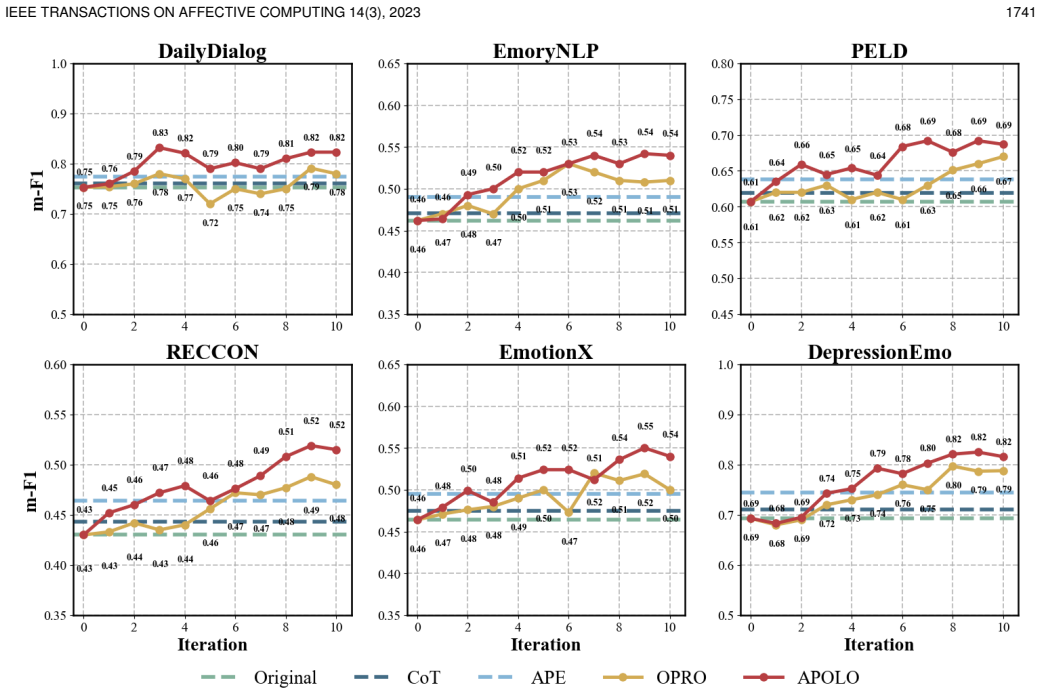
- [§3.4, Eq. (9); Algorithm 1 lines 15–16; §4.1] The optimization loop uses D_test as the reward signal. Eq. (1) defines the objective as argmax over D_test; Algorithm 1 line 15 sets R(t) by summing f over D_test, and line 16 stops when the D_test reward gain falls below δ. Section 3.4 calls D_test the 'held-out test set,' and Section 4.1 says the Target agent evaluates 'on the entire test set... to track the optimization trajectory comprehensively.' The only mention of a validation set is the early-stopping sentence in §4.1, which contradicts the algorithm. Thus every score in Table 1 is selected or early-stopped using test labels, not an independent evaluation. This invalidates the central comparison and propagates to Tables 2–4 and Figures 4–5, which use the same protocol. The authors must define a genuine validation split, use it for all prompt selection and early stopping, evaluate the final prompt once on an untouched test split,
- [§3.5, Eq. (11)] The 'Unified improvement bound' is not a substantive theoretical guarantee. The quantities A_i, B_r, and B_c are introduced by assumption, and the proof sketch states that standard KL-regularized policy improvement gives ΔR_i ≥ A_i − σ²/(2λ), which is essentially the conclusion being proved. No measurable or verifiable conditions are supplied, so the bound cannot be checked or falsified. The claim of monotonic improvement is therefore unsupported. Either derive a bound from observable quantities or clearly present this as intuition rather than a theorem.
- [§4.1, Table 4] The evaluation protocol is not specified in enough detail to assess fairness. It is unclear what data the baselines (APE, ProTeGi, OPRO, PE2) use for prompt selection and early stopping. Table 4 compares APOLO using 0/1/3 samples against baselines using 20–100 samples, but because APOLO's numbers come from the test-contaminated loop, this does not establish sample efficiency. In addition, no standard deviations, confidence intervals, or significance tests are reported for any table or figure; several differences are small, and statistical testing is needed to support the claims.
minor comments (7)
- [§4.1] The text says 'two distinct large language models' but immediately lists three (GPT-5-mini, DeepSeek-V3, Qwen-32B).
- [§5.2] The section heading contains a typo: 'Converagence' should be 'Convergence.'
- [Eq. (8)] The distribution D in the joint policy optimization objective is not defined. It should be specified as the validation distribution (or training/validation split) that is not used for final test evaluation.
- [Table 5] The final Target prompt for the DepressionEmo task is internally contradictory: it instructs the model to identify 'all relevant psychological emotion labels' and gives a multi-label example, but then ends with 'Your output MUST be a single word representing the emotion.' This needs to be reconciled for a multi-label task.
- [§6.3] The Planner is described as producing a 'six-step plan,' but the enumeration lists two 'Step 2' entries, so the plan structure is unclear.
- [Conclusion] The conclusion states results on 'multilingual' benchmarks, but all six datasets are English. This overclaim should be removed or supported.
- [§4.3, Figure 4] The efficiency analysis does not explain how token counts and scaling curves are computed, nor whether the Target agent's test-set scoring calls are included in the token totals. This should be clarified.
Circularity Check
APOLO's reported gains are the test-set objective itself: Eq. (1), Algorithm 1 line 15, and §4.1 select/stop on D_test, so Table 1 scores are in-sample maxima rather than independent predictions.
specific steps
-
fitted input called prediction
[Section 3.1, Eq. (1); Algorithm 1, line 15]
"p∗ = arg max p∈P E(x,Y)∼Dtest [ f(πtar(x|p), Y) ] , (1) ... R(t) = P (x,Y)∈Dtest f(πtar(x;p(t)ℓ), Y)"
The objective that APOLO optimizes is the multi-label metric f evaluated on D_test. The final prompt p* is chosen by Eq. (1) to maximize f on D_test, and Algorithm 1 line 15 computes the reward used for stopping on the same D_test. Therefore every headline number in Table 1 is the value of the optimized objective on the very data used to select the prompt, i.e., an in-sample maximum, not a held-out prediction.
-
fitted input called prediction
[Section 3.4 and Section 4.1 (Implementation Details)]
"After completing the refinement steps, the final prompt pℓ = pn is evaluated by the Target agent on the held-out test set. ... Following each optimization cycle, the performance of the generated prompt is rigorously evaluated by the Target agent on the entire test set of the respective dataset to track the optimization trajectory comprehensively."
Section 3.4 labels D_test 'held-out', but Section 4.1 states the Target agent evaluates on the entire test set each cycle, and Algorithm 1 uses that same reward for early stopping. The only mention of a 'validation set' (Section 4.1) contradicts Algorithm 1 and does not provide a separate evaluation. Under either reading, the reported test performance is not independent of the data used to guide prompt selection and stopping.
-
other
[Section 3.5, Eq. (11) and Proof sketch]
"Let (qi, ci) denote the Teacher–Critic action at refinement step i, with expected advantage Ai and bounded variance σ2. Let Br and Bc provide upper bounds for the cumulative risk and cost penalties incurred along the planned trajectory. Then ... E[R(pn)]−R(p0) ≥ Σ(Ai − σ2/2λ) − γrBr − γcBc."
The bound is constructed from unmeasured quantities: A_i is defined as the expected advantage, B_r and B_c are assumed upper bounds, and the per-step inequality ΔR_i ≥ A_i − σ²/2λ is asserted as 'standard analysis' with no verification. The inequality is an analytic restatement of KL-regularized policy improvement in new notation; it cannot fail and carries no empirically testable content about APOLO.
full rationale
The central empirical claim—that APOLO consistently outperforms baselines (Table 1, avg Macro F1 49.25% vs OPRO 46.29%, etc.)—reduces by the paper's own equations to optimizing and then reporting the same objective on the same data. Eq. (1) defines the search objective over D_test; Eq. (9)/Algorithm 1 lines 15-17 use D_test reward for selection and stopping; Section 4.1 confirms full-test evaluation each cycle. Thus the reported gains are test-set selected maxima, not independent held-out estimates, and the 'held-out test set' label in Section 3.4 is contradicted by the algorithm. The same protocol underlies the ablations (Table 2), convergence analysis (Fig. 5), initial-prompt robustness (Table 3), and efficiency analysis (Fig. 4), so the problem propagates throughout. The theoretical bound Eq. (11) is also definitional rather than predictive. Self-citations to MARS [21], MAXS [35], and MAPS [38] are disclosed and are not the load-bearing circularity here; the fatal issue is that the evaluation is the optimization objective. Score 8: the central result is forced by construction, though the multi-agent architecture itself has some independent descriptive content.
Axiom & Free-Parameter Ledger
free parameters (8)
- gamma_r (risk trade-off coefficient) =
not reported
- gamma_c (cost trade-off coefficient) =
not reported
- lambda (alignment coefficient in Eq 8) =
not reported
- delta (early-stopping threshold) =
0.01
- I (maximum outer iterations) =
10
- alpha_l, alpha_call, alpha_time (cost weights) =
1/3 each
- K (number of candidate trajectories sampled by Planner) =
not specified
- decoding temperature =
0.6
axioms (7)
- domain assumption Evaluation set labels are not used to choose the optimized prompt
- ad hoc to paper A_i advantages in Eq (11) are positive on average
- ad hoc to paper The POMDP abstraction (S,A,T,O,R) faithfully represents the prompt-refinement loop
- domain assumption LLM agents' free-text Socratic dialogue reliably improves prompt quality
- domain assumption Risk(ST) and Cost(ST) can be evaluated from text by the Planner
- domain assumption Public benchmark labels are a valid proxy for clinical emotion diagnosis
- standard math KL-regularized policy improvement bounds apply to prompted LLM agents
invented entities (2)
-
Five-role multi-agent system (Planner, Teacher, Critic, Student, Target)
no independent evidence
-
POMDP process model (S,A,T,O,R)
no independent evidence
read the original abstract
Linguistic expressions of emotions such as depression, anxiety, and trauma-related states are pervasive in clinical notes, counseling dialogues, and online mental health communities, and accurate recognition of these emotions is essential for clinical triage, risk assessment, and timely intervention. Although large language models (LLMs) have demonstrated strong generalization ability in emotion analysis tasks, their diagnostic reliability in high-stakes, context-intensive medical settings remains highly sensitive to prompt design. Moreover, existing methods face two key challenges: emotional comorbidity, in which multiple intertwined emotional states complicate prediction, and inefficient exploration of clinically relevant cues. To address these challenges, we propose APOLO (Automated Prompt Optimization for Linguistic Emotion Diagnosis), a framework that systematically explores a broader and finer-grained prompt space to improve diagnostic efficiency and robustness. APOLO formulates instruction refinement as a Partially Observable Markov Decision Process and adopts a multi-agent collaboration mechanism involving Planner, Teacher, Critic, Student, and Target roles. Within this closed-loop framework, the Planner defines an optimization trajectory, while the Teacher-Critic-Student agents iteratively refine prompts to enhance reasoning stability and effectiveness, and the Target agent determines whether to continue optimization based on performance evaluation. Experimental results show that APOLO consistently improves diagnostic accuracy and robustness across domain-specific and stratified benchmarks, demonstrating a scalable and generalizable paradigm for trustworthy LLM applications in mental healthcare.
Figures



Reference graph
Works this paper leans on
-
[1]
Compu- tational analysis of stress, depression and engagement in mental health: A survey,
P . Kumar, A. Vedernikov, Y. Chen, W. Zheng, and X. Li, “Compu- tational analysis of stress, depression and engagement in mental health: A survey,”arXiv preprint arXiv:2403.08824, 2024
Pith/arXiv arXiv 2024
-
[2]
A survey of large language models in mental health disorder detec- tion on social media,
Z. Ge, N. Hu, D. Li, Y. Wang, S. Qi, Y. Xu, H. Shi, and J. Zhang, “A survey of large language models in mental health disorder detec- tion on social media,” in2025 IEEE 41st International Conference on Data Engineering Workshops (ICDEW). IEEE, 2025, pp. 164–176. IEEE TRANSACTIONS ON AFFECTIVE COMPUTING 14(3), 2023 1745 Fig. 6. A complete example of the co...
2025
-
[3]
PhysReason: A comprehensive benchmark towards physics-based reasoning,
X. Zhang, Y. Dong, Y. Wu, J. Huang, C. Jia, B. Fernando, M. Z. Shou, L. Zhang, and J. Liu, “PhysReason: A comprehensive benchmark towards physics-based reasoning,” inProceedings of the 63rd Annual Meeting of the Association for Computational Linguistics (Volume 1: Long Papers). Association for Computational Linguistics, 2025, pp. 16 593–16 615. [Online]. ...
2025
-
[4]
A survey on multilingual mental disorders detection from social media data,
A.-M. Bucur, M. Zampieri, T. Ranasinghe, and F. Crestani, “A survey on multilingual mental disorders detection from social media data,”arXiv preprint arXiv:2505.15556, 2025
arXiv 2025
-
[5]
Emotion fusion for mental illness detection from social media: A survey,
T. Zhang, K. Yang, S. Ji, and S. Ananiadou, “Emotion fusion for mental illness detection from social media: A survey,”Information Fusion, vol. 92, pp. 231–246, 2023
2023
-
[6]
Erreval: Error-aware evaluation for question generation through explicit diagnostics,
W. Fu, B. Wei, J. Hao, Y. Zhang, J. Zhang, J. Wang, B. Li, Y. He, L. Zhang, and J. Liu, “Erreval: Error-aware evaluation for question generation through explicit diagnostics,”arXiv preprint arXiv:2601.10406, 2026
Pith/arXiv arXiv 2026
-
[7]
Mur: Momentum uncertainty guided rea- soning for large language models,
H. Yan, F. Xu, R. Xu, Y. Li, J. Zhang, H. Luo, X. Wu, L. A. Tuan, H. Zhao, Q. Linet al., “Mur: Momentum uncertainty guided rea- soning for large language models,”arXiv preprint arXiv:2507.14958, 2025
Pith/arXiv arXiv 2025
-
[8]
A systematic survey of prompt engineering in large language models: Techniques and applications,
P . Sahoo, A. K. Singh, S. Saha, V . Jain, S. Mondal, and A. Chadha, “A systematic survey of prompt engineering in large language models: Techniques and applications,”arXiv preprint arXiv:2402.07927, 2024
Pith/arXiv arXiv 2024
-
[9]
Are large language models really good logical reasoners? a comprehensive evaluation and beyond,
F. Xu, Q. Lin, J. Han, T. Zhao, J. Liu, and E. Cambria, “Are large language models really good logical reasoners? a comprehensive evaluation and beyond,”IEEE Transactions on Knowledge and Data Engineering, 2025
2025
-
[10]
Has multimodal learning delivered universal intelligence in healthcare? a comprehensive survey,
Q. Lin, Y. Zhu, X. Mei, L. Huang, J. Ma, K. He, Z. Peng, E. Cam- bria, and M. Feng, “Has multimodal learning delivered universal intelligence in healthcare? a comprehensive survey,”Information Fusion, vol. 116, p. 102795, 2025
2025
-
[11]
A survey of automatic prompt engineering: An optimization perspective,
W. Li, X. Wang, W. Li, and B. Jin, “A survey of automatic prompt engineering: An optimization perspective,”arXiv preprint arXiv:2502.11560, 2025
Pith/arXiv arXiv 2025
-
[12]
Automatic prompt optimization via heuristic search: A survey,
W. Cui, J. Zhang, Z. Li, H. Sun, D. Lopez, K. Das, B. A. Malin, and S. Kumar, “Automatic prompt optimization via heuristic search: A survey,”arXiv preprint arXiv:2502.18746, 2025
Pith/arXiv arXiv 2025
-
[13]
A systematic sur- vey of automatic prompt optimization techniques,
K. Ramnath, K. Zhou, S. Guan, S. S. Mishra, X. Qi, Z. Shen, S. Wang, S. Woo, S. Jeoung, Y. Wanget al., “A systematic sur- vey of automatic prompt optimization techniques,”arXiv preprint arXiv:2502.16923, 2025
arXiv 2025
-
[14]
Ef- ficient prompting methods for large language models: A survey,
K. Chang, S. Xu, C. Wang, Y. Luo, X. Liu, T. Xiao, and J. Zhu, “Ef- ficient prompting methods for large language models: A survey,” arXiv preprint arXiv:2404.01077, 2024
Pith/arXiv arXiv 2024
-
[15]
Emotions in the loop: A survey of affective computing for emotional support,
K. Hegde and H. Jayalath, “Emotions in the loop: A survey of affective computing for emotional support,”arXiv preprint arXiv:2505.01542, 2025
Pith/arXiv arXiv 2025
-
[16]
Large language models are human-level prompt engineers,
Y. Zhou, A. I. Muresanu, Z. Han, K. Paster, S. Pitis, H. Chan, and J. Ba, “Large language models are human-level prompt engineers,” inThe Eleventh International Conference on Learning Representations (ICLR), 2023
2023
-
[17]
Reprompting: Au- tomated chain-of-thought prompt inference through gibbs sam- pling,
W. Xu, A. Banburski-Fahey, and N. Jojic, “Reprompting: Au- tomated chain-of-thought prompt inference through gibbs sam- pling,”arXiv preprint arXiv:2305.09993, 2023
Pith/arXiv arXiv 2023
-
[18]
Promptagent: Strategic planning with language models enables expert-level prompt optimization,
X. Wang, C. Li, Z. Wang, F. Bai, H. Luo, J. Zhang, N. Jojic, E. P . Xing, and Z. Hu, “Promptagent: Strategic planning with language models enables expert-level prompt optimization,”arXiv preprint arXiv:2310.16427, 2023
Pith/arXiv arXiv 2023
-
[19]
Large language models as optimizers,
C. Yang, X. Wang, Y. Lu, H. Liu, Q. V . Le, D. Zhou, and X. Chen, “Large language models as optimizers,” inThe Twelfth International Conference on Learning Representations, ICLR 2024, Vienna, Austria, May 7-11, 2024. OpenReview.net, 2024. [Online]. Available: https://openreview.net/forum?id=Bb4VGOWELI
2024
-
[20]
Prompt engineering a prompt engineer,
Q. Ye, M. Axmed, R. Pryzant, and F. Khani, “Prompt engineering a prompt engineer,”arXiv preprint arXiv:2311.05661, 2023
Pith/arXiv arXiv 2023
-
[21]
Mars: A multi-agent framework incorporating socratic guidance for automated prompt optimization,
J. Zhang, Z. Wang, H. Zhu, J. Liu, Q. Lin, and E. Cambria, “Mars: A multi-agent framework incorporating socratic guidance for automated prompt optimization,” inProceedings of the AAAI Conference on Artificial Intelligence, 2026
2026
-
[22]
A detailed sentiment analysis survey based on machine learning techniques,
N. Singh and U. C. Jaiswal, “A detailed sentiment analysis survey based on machine learning techniques,”ADC-AIJ: Advances in Distributed Computing and Artificial Intelligence Journal, vol. 12, no. 2, pp. 201–216, 2023
2023
-
[23]
A comprehensive survey on senti- ment analysis techniques,
A. Hassan and M. R. Islam, “A comprehensive survey on senti- ment analysis techniques,”International Journal of Computers and Applications, vol. 185, no. 12, pp. 1–11, 2023
2023
-
[24]
Jcbie: a joint continual learning neural network for biomedical information extraction,
K. He, R. Mao, T. Gong, E. Cambria, and C. Li, “Jcbie: a joint continual learning neural network for biomedical information extraction,”BMC bioinformatics, vol. 23, no. 1, p. 549, 2022
2022
-
[25]
Enhancing facial emotion recognition through deep learning: Integrating CNN and RNN- LSTM models,
X. Zhu, T. Liu, Y. Wu, and Z. Wang, “Enhancing facial emotion recognition through deep learning: Integrating CNN and RNN- LSTM models,” inProceedings of the 2nd International Conference on Machine Learning and Gerontechnology, 2024, pp. 1–6
2024
-
[26]
A CNN-LSTM based deep neural networks for facial emotion detection in videos,
V . Bhat, R. Shah, and N. Mehendale, “A CNN-LSTM based deep neural networks for facial emotion detection in videos,”Interna- tional Journal of Creative Research Thoughts (IJCRT), vol. 9, no. 11, pp. d327–d332, 2021
2021
-
[27]
Speech emotion recognition using LSTM and RNN,
P . Mishra and M. P , “Speech emotion recognition using LSTM and RNN,”Journal of Electrical Engineering, vol. 20, no. 3, pp. 1–6, 2020
2020
-
[28]
Gem: Empowering mllm for grounded ecg understanding with time series and images,
X. Lan, F. Wu, K. He, Q. Zhao, S. Hong, and M. Feng, “Gem: Empowering mllm for grounded ecg understanding with time series and images,”arXiv preprint arXiv:2503.06073, 2025
arXiv 2025
-
[29]
Trans- former models for text-based emotion detection: a review of BERT- based approaches,
F. A. Acheampong, H. Nunoo-Mensah, and W. Chen, “Trans- former models for text-based emotion detection: a review of BERT- based approaches,”Artificial Intelligence Review, vol. 54, no. 8, pp. 5789–5829, 2021
2021
-
[30]
Bert-based meta-learning approach with looking back for sentiment analysis of literary book reviews,
H. Bao, K. He, X. Yin, X. Li, X. Bao, H. Zhang, J. Wu, and Z. Gao, “Bert-based meta-learning approach with looking back for sentiment analysis of literary book reviews,” inCCF International Conference on Natural Language Processing and Chinese Computing. Springer, 2021, pp. 235–247
2021
-
[31]
Language and mental health: Measures of emotion dynamics from text as linguistic biosocial markers,
K. Vishnubhotla and S. M. Mohammad, “Language and mental health: Measures of emotion dynamics from text as linguistic biosocial markers,” inProceedings of the 2023 Conference on Empirical Methods in Natural Language Processing (EMNLP). Association for Computational Linguistics, 2023, pp. 3117–3133
2023
-
[32]
Au- toPrompt: Eliciting knowledge from language models with auto- matically generated prompts,
T. Shin, Y. Razeghi, R. L. Logan IV , E. Wallace, and S. Singh, “Au- toPrompt: Eliciting knowledge from language models with auto- matically generated prompts,” inProceedings of the 2020 Conference on Empirical Methods in Natural Language Processing (EMNLP). Association for Computational Linguistics, 2020, pp. 4222–4235
2020
-
[33]
Prefix-Tuning: Optimizing continuous prompts for generation,
X. L. Li and P . Liang, “Prefix-Tuning: Optimizing continuous prompts for generation,” inProceedings of the 59th Annual Meeting of the Association for Computational Linguistics and the 11th Inter- national Joint Conference on Natural Language Processing (Volume 1: Long Papers). Association for Computational Linguistics, 2021, pp. 4582–4597
2021
-
[34]
Gkg-llm: A unified framework for generalized knowl- edge graph construction,
J. Zhang, S. Qi, Y. Dong, L. Yuan, T. Shen, W. Fu, B. Wei, H. Zhu, and J. Liu, “Gkg-llm: A unified framework for generalized knowl- edge graph construction,”Information Fusion, p. 103956, 2025
2025
-
[35]
Maxs: Meta-adaptive exploration with llm agents,
J. Zhang, Z. Wang, Z. Wang, Y. He, H. Luo, L. Zhang, R. Mao, Q. Lin, J. Liuet al., “Maxs: Meta-adaptive exploration with llm agents,”arXiv preprint arXiv:2601.09259, 2026
arXiv 2026
-
[36]
Meta prompting for ai systems,
Y. Zhang, Y. Yuan, and A. C.-C. Yao, “Meta prompting for ai systems,” 2025. [Online]. Available: https://arxiv.org/abs/2311. 11482
2025
-
[37]
RLPrompt: Optimizing discrete text prompts with reinforcement learning,
M. Deng, J. Wang, C.-P . Hsieh, Y. Wang, H. Guo, T. Shu, M. Song, E. P . Xing, and Z. Hu, “RLPrompt: Optimizing discrete text prompts with reinforcement learning,” inProceedings of the 2022 Conference on Empirical Methods in Natural Language Processing (EMNLP). Association for Computational Linguistics, 2022, pp. 7576–7593
2022
-
[38]
J. Zhang, Z. Wang, Z. Wang, X. Zhang, F. Xu, Q. Lin, R. Mao, E. Cambria, and J. Liu, “Maps: A multi-agent framework based on big seven personality and socratic guidance for multimodal scientific problem solving,”arXiv preprint arXiv:2503.16905, 2025
arXiv 2025
-
[39]
Dailydialog: A manually labelled multi-turn dialogue dataset,
Y. Li, H. Su, X. Shen, W. Li, Z. Cao, and S. Niu, “Dailydialog: A manually labelled multi-turn dialogue dataset,”arXiv preprint arXiv:1710.03957, 2017
Pith/arXiv arXiv 2017
-
[40]
Emotion detection on tv show transcripts with sequence-based convolutional neural networks
S. M. Zahiri and J. D. Choi, “Emotion detection on tv show transcripts with sequence-based convolutional neural networks.” inAAAI Workshops, vol. 18, 2018, pp. 44–52
2018
-
[41]
Automatically select emotion for response via personality-affected emotion transition,
Z. Wen, J. Cao, R. Yang, S. Liu, and J. Shen, “Automatically select emotion for response via personality-affected emotion transition,” inFindings of the Association for Computational Linguistics: ACL- IJCNLP 2021, 2021, pp. 5010–5020
2021
-
[42]
Rec- ognizing emotion cause in conversations,
S. Poria, N. Majumder, D. Hazarika, D. Ghosal, R. Bhardwaj, S. Y. B. Jian, P . Hong, R. Ghosh, A. Roy, N. Chhayaet al., “Rec- ognizing emotion cause in conversations,”Cognitive Computation, vol. 13, no. 5, pp. 1317–1332, 2021. IEEE TRANSACTIONS ON AFFECTIVE COMPUTING 14(3), 2023 1747
2021
-
[43]
Socialnlp emotionx 2019 challenge overview: Predicting emotions in spoken dialogues and chats,
B. Shmueli and L.-W. Ku, “Socialnlp emotionx 2019 challenge overview: Predicting emotions in spoken dialogues and chats,”
2019
-
[44]
Depressionemo: A novel dataset for multilabel classifica- tion of depression emotions,
A. B. S. Rahman, H.-T. Ta, L. Najjar, A. Azadmanesh, and A. S. G¨onul, “Depressionemo: A novel dataset for multilabel classifica- tion of depression emotions,”Journal of Affective Disorders, vol. 366, pp. 445–458, 2024
2024
-
[45]
(2025) Introducing gpt-5
OpenAI. (2025) Introducing gpt-5. Accessed: Aug. 2025. [Online]. Available: https://openai.com/index/introducing-gpt-5/
2025
-
[46]
A. Liu, B. Feng, B. Xue, B. Wang, B. Wu, C. Lu, C. Zhao, C. Deng, C. Zhang, C. Ruanet al., “Deepseek-v3 technical report,”arXiv preprint arXiv:2412.19437, 2024
Pith/arXiv arXiv 2024
-
[47]
A. Yang, A. Li, B. Yang, B. Zhang, B. Hui, B. Zheng, B. Yu, C. Gao, C. Huang, C. Lvet al., “Qwen3 technical report,”arXiv preprint arXiv:2505.09388, 2025
Pith/arXiv arXiv 2025
-
[48]
Automatic prompt optimization with
R. Pryzant, D. Iter, J. Li, Y. T. Lee, C. Zhu, and M. Zeng, “Automatic prompt optimization with ”gradient descent” and beam search,” inProceedings of the 2023 Conference on Empirical Methods in Natural Language Processing, (EMNLP), 2023, pp. 7957–7968. [Online]. Available: https://doi.org/10.18653/v1/2023.emnlp-main.494
-
[49]
Harnessing the power of llms in practice: A survey on chatgpt and beyond,
J. Yang, H. Jin, R. Tang, X. Han, Q. Feng, H. Jiang, S. Zhong, B. Yin, and X. Hu, “Harnessing the power of llms in practice: A survey on chatgpt and beyond,”ACM Transactions on Knowledge Discovery from Data, vol. 18, no. 6, pp. 1–32, 2024
2024
-
[50]
A survey of sentiment analy- sis: Approaches, datasets, and future research,
M. A. Al-Taei and S. M. Al-Taei, “A survey of sentiment analy- sis: Approaches, datasets, and future research,”Applied Sciences, vol. 13, no. 12, p. 7091, 2023
2023
-
[51]
Prompt compression for large language models: A survey,
Z. Li, Y. Liu, Y. Su, and N. Collier, “Prompt compression for large language models: A survey,” inProceedings of the 2025 Conference of the Nations of the Americas Chapter of the Association for Compu- tational Linguistics: Human Language Technologies (Volume 1: Long Papers), 2025, pp. 7182–7195
2025
-
[2019]
Available: https://arxiv.org/abs/1909.07734
[Online]. Available: https://arxiv.org/abs/1909.07734
Pith/arXiv arXiv 1909
discussion (0)
Sign in with ORCID, Apple, or X to comment. Anyone can read and Pith papers without signing in.