A multi-differential constraint map for quarkonium suppression mechanisms in high-multiplicity pp and pPb collisions
Pith reviewed 2026-07-01 01:04 UTC · model grok-4.3
The pith
Six differential constraints disfavour local track density and total multiplicity as sole controllers of quarkonium suppression in high-multiplicity pp and pPb collisions.
A machine-rendered reading of the paper's core claim, the machinery that carries it, and where it could break.
Core claim
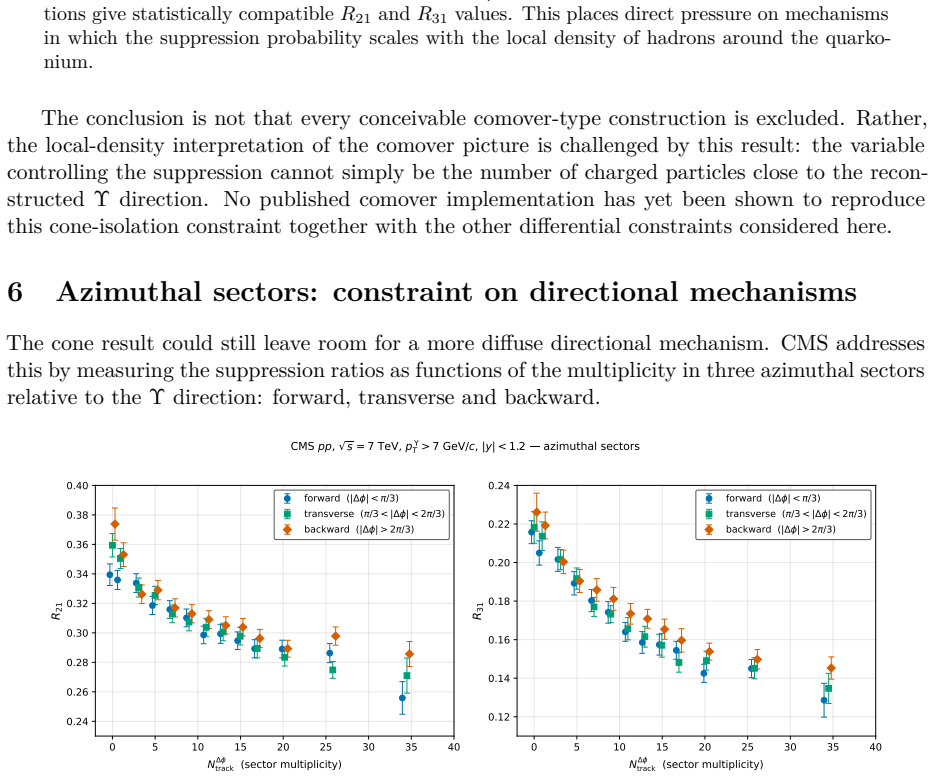
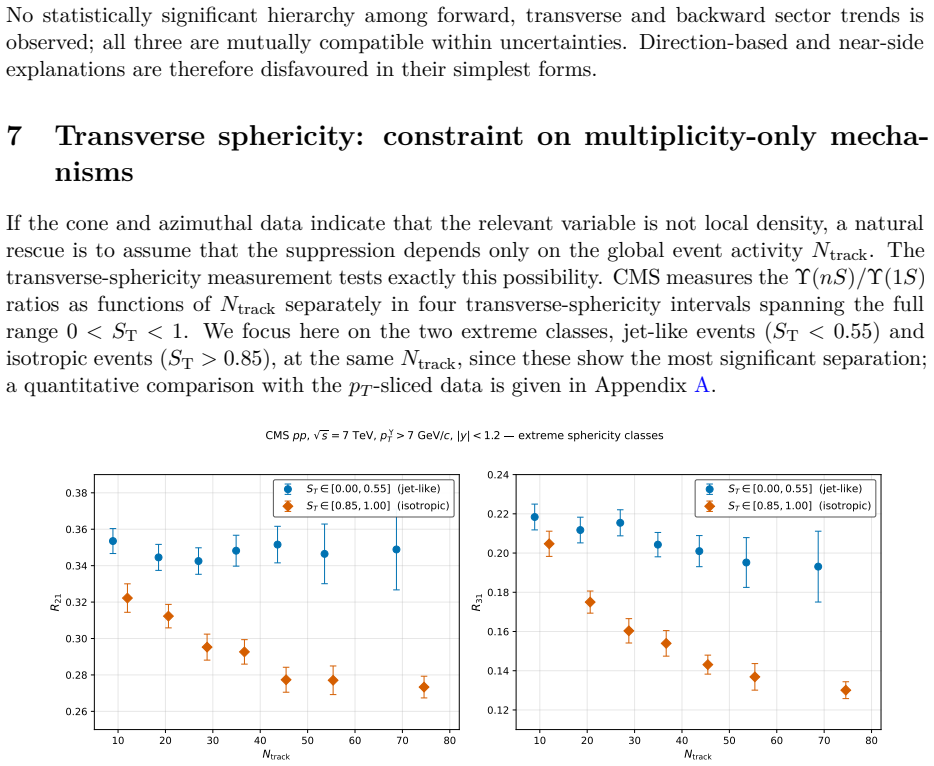
Taken together, the six complementary differential constraints disfavour mechanisms controlled solely by local track density or by total multiplicity, and are consistent with an early, globally correlated, topology-sensitive suppression pattern. The characteristic multiplicity scale at which suppression sets in is independently consistent with the onset of a qualitative change in soft-sector behaviour identified from inclusive charged-particle observables. The result is a data-driven constraint map consistent with an early, coloured pre-hadronic environment, possibly involving a deconfined stage.
What carries the argument
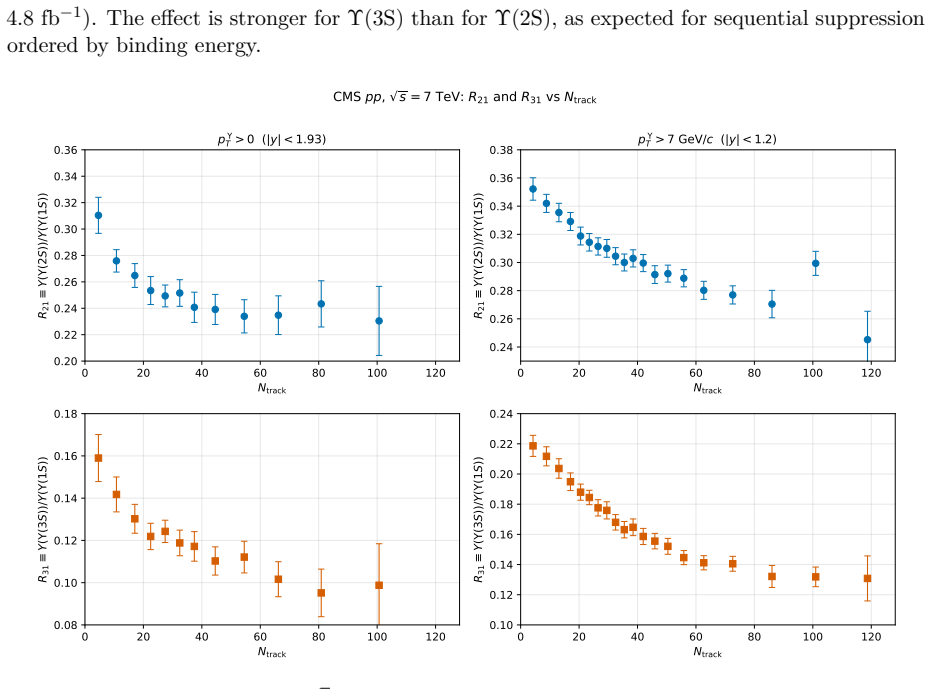
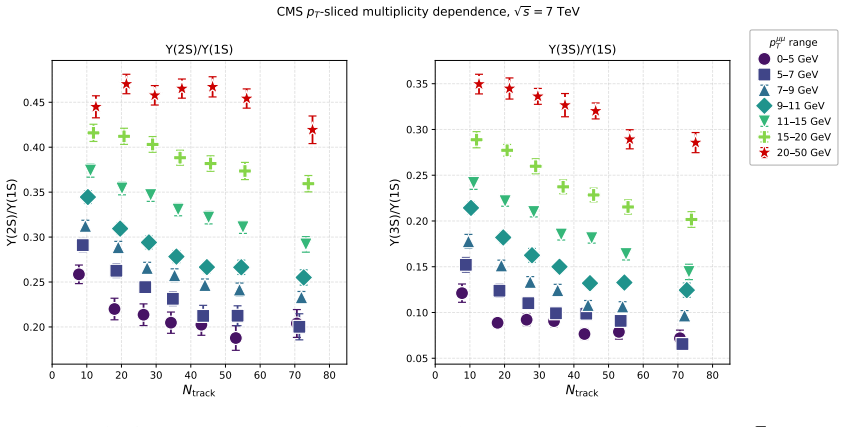
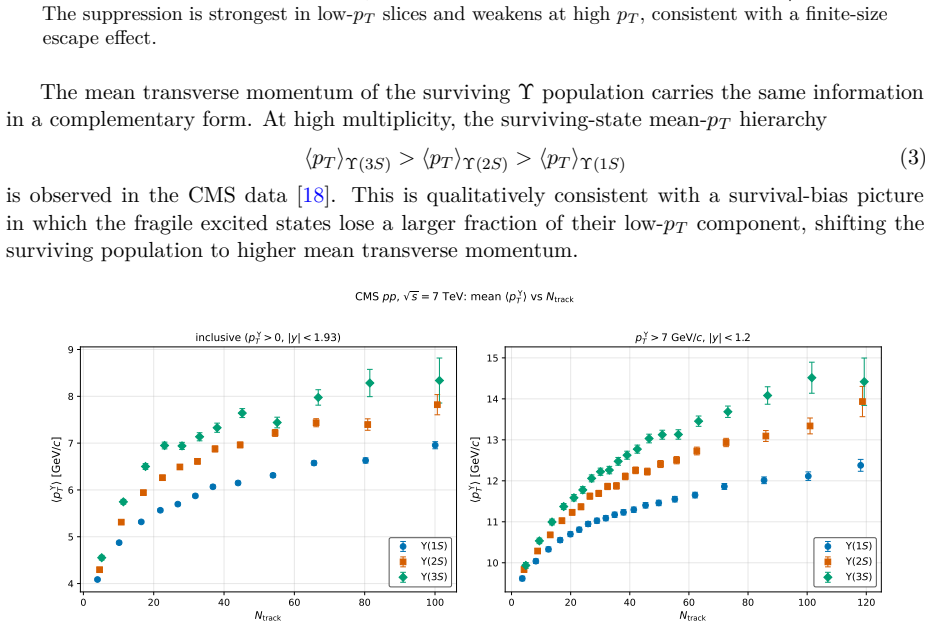
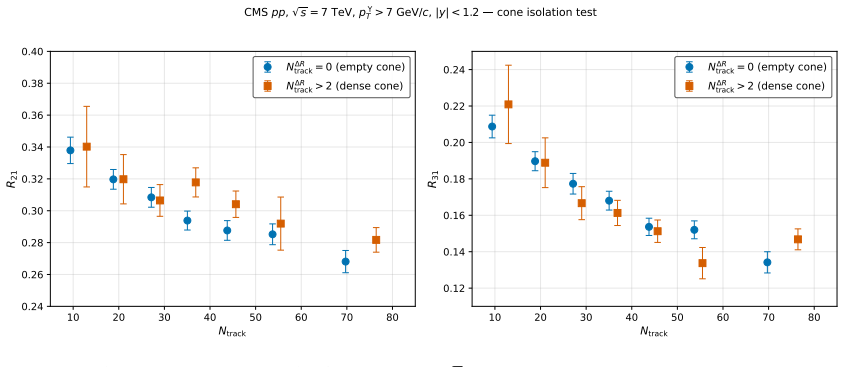
The multi-differential constraint map constructed from the six observables (cone isolation, azimuthal-sector equivalence, transverse sphericity, transverse-momentum ordering, forward-ET long-range correlation, and pPb/Pbp forward-backward asymmetry).
If this is right
- Suppression is not explained by mechanisms that depend only on local track density.
- Suppression is not explained by mechanisms that depend only on total multiplicity.
- The pattern is consistent with an early, globally correlated suppression that is sensitive to event topology.
- The multiplicity scale where suppression begins matches an earlier observed shift in soft-particle production.
- The data support the possibility of an early coloured pre-hadronic environment that may include a deconfined stage.
Where Pith is reading between the lines
- If the constraints hold, models of quarkonium suppression in small systems must incorporate global event topology at early times rather than purely local or integrated quantities.
- The link to soft-sector changes suggests that the same underlying dynamics may affect both heavy and light particle production.
- Further tests could involve applying the same differential slices to other quarkonium states or collision systems to check consistency.
- The constraint map provides a benchmark that any microscopic model must satisfy before being considered viable.
Load-bearing premise
The six listed differential constraints are independent of each other and together sufficient to rule out local-density and total-multiplicity mechanisms without needing explicit model simulations to check for hidden degeneracies.
What would settle it
An explicit model calculation demonstrating that a local track density mechanism can simultaneously reproduce all six differential constraints in the observed data patterns.
Figures
read the original abstract
The multiplicity-dependent suppression of $\Upsilon(nS)$ excited states in high-multiplicity $pp$ and $p$Pb collisions is analysed using publicly available CMS and LHCb data; preliminary CMS Physics Analysis Summary results in $p$Pb and light-ion collisions are used only as supporting cross-system evidence. Six complementary differential constraints are considered: cone isolation, azimuthal-sector equivalence, transverse sphericity, transverse-momentum ordering, forward-$E_T$ long-range correlation, and the pPb/Pbp forward-backward asymmetry. Taken together, these constraints disfavour mechanisms controlled solely by local track density or by total multiplicity, and are consistent with an early, globally correlated, topology-sensitive suppression pattern. The characteristic multiplicity scale at which suppression sets in is independently consistent with the onset of a qualitative change in soft-sector behaviour identified by Campanini and Ferri \cite{CampaniniFerri2011} from inclusive charged-particle observables. The result is a data-driven constraint map consistent with an early, coloured pre-hadronic environment, possibly involving a deconfined stage.
Editorial analysis
A structured set of objections, weighed in public.
Referee Report
Summary. The manuscript analyzes multiplicity-dependent suppression of Υ(nS) excited states in high-multiplicity pp and pPb collisions using publicly available CMS and LHCb data (with preliminary CMS results as supporting evidence). It defines six differential constraints—cone isolation, azimuthal-sector equivalence, transverse sphericity, transverse-momentum ordering, forward-ET long-range correlation, and pPb/Pbp forward-backward asymmetry—and interprets their combined pattern as disfavouring mechanisms controlled solely by local track density or total multiplicity. The constraints are instead taken to support an early, globally correlated, topology-sensitive suppression pattern. The multiplicity scale at onset is stated to be independently consistent with a qualitative change in soft-sector behaviour identified in Campanini and Ferri (2011). The result is presented as a data-driven constraint map consistent with an early coloured pre-hadronic environment.
Significance. If the central claim holds after quantitative validation, the work supplies a parameter-free, data-driven framework for constraining quarkonium suppression mechanisms in small systems by combining multiple differential observables. The approach leverages public data and avoids ad-hoc model tuning, offering a reproducible way to distinguish local-density from global, topology-sensitive effects. This could inform interpretations of possible deconfined stages in high-multiplicity collisions. The multi-differential strategy itself is a methodological strength that merits further development.
major comments (3)
- [Abstract] Abstract: the claim that the six constraints 'taken together' disfavour mechanisms controlled solely by local track density or total multiplicity rests on an interpretive summary; no quantitative demonstration (e.g., joint likelihood, degeneracy checks, or explicit comparison to tuned local-density models) is supplied showing that such models cannot reproduce all six patterns simultaneously. This is load-bearing for the central exclusion result.
- [Abstract] Abstract / multiplicity-scale paragraph: the characteristic multiplicity scale is described as independently consistent with the onset identified in Campanini and Ferri (2011), yet the current differential constraints are not shown to provide an independent test beyond the inclusive charged-particle observables of that earlier work; the independence of the consistency therefore requires explicit justification.
- [Abstract] Abstract: the central conclusion is presented without accompanying quantitative results, error bars, statistical significance measures, or explicit data-selection criteria, leaving the exclusion of local-density and total-multiplicity mechanisms resting on qualitative pattern interpretation rather than falsifiable metrics.
minor comments (1)
- The six constraints are listed without a dedicated table or figure summarizing their individual and joint implications; adding such a summary would improve clarity of the constraint map.
Simulated Author's Rebuttal
We thank the referee for the constructive report and the recognition of the multi-differential strategy as a methodological strength. We address each major comment below with the strongest honest defense of the manuscript while acknowledging where clarifications or additions are warranted. The core result remains the joint pattern of six independent constraints derived from public data.
read point-by-point responses
-
Referee: [Abstract] Abstract: the claim that the six constraints 'taken together' disfavour mechanisms controlled solely by local track density or total multiplicity rests on an interpretive summary; no quantitative demonstration (e.g., joint likelihood, degeneracy checks, or explicit comparison to tuned local-density models) is supplied showing that such models cannot reproduce all six patterns simultaneously. This is load-bearing for the central exclusion result.
Authors: The exclusion rests on the logical incompatibility of a purely local-density or total-multiplicity mechanism with the full set of six constraints simultaneously: cone isolation and pT-ordering disfavour locality, while azimuthal equivalence, sphericity, forward-ET correlations and pPb asymmetry disfavour global multiplicity scaling without topology dependence. Because the constraints are constructed from orthogonal observables, a local model would require coordinated fine-tuning across all six to mimic the data pattern. We agree that an explicit discussion of possible degeneracies would strengthen the presentation and will add a dedicated paragraph in the revised manuscript. revision: partial
-
Referee: [Abstract] Abstract / multiplicity-scale paragraph: the characteristic multiplicity scale is described as independently consistent with the onset identified in Campanini and Ferri (2011), yet the current differential constraints are not shown to provide an independent test beyond the inclusive charged-particle observables of that earlier work; the independence of the consistency therefore requires explicit justification.
Authors: The multiplicity variable is the same, but the test is independent because the new constraints involve topology (sphericity, azimuthal sectors), long-range correlations (forward-ET), and system asymmetry (pPb/Pbp) that are absent from the inclusive charged-particle analysis of Campanini and Ferri. These observables probe whether the suppression onset coincides with a change in event structure rather than merely with multiplicity. We will revise the abstract and the relevant paragraph to state this distinction explicitly. revision: yes
-
Referee: [Abstract] Abstract: the central conclusion is presented without accompanying quantitative results, error bars, statistical significance measures, or explicit data-selection criteria, leaving the exclusion of local-density and total-multiplicity mechanisms resting on qualitative pattern interpretation rather than falsifiable metrics.
Authors: The data-selection criteria follow the published CMS and LHCb analyses (explicitly referenced); the patterns are taken directly from the public distributions. The result is falsifiable because any future measurement violating one or more of the six constraints would invalidate the map. While we do not perform new statistical fits (covariance matrices are not public), the multi-differential consistency itself supplies the metric. We will add a short table in the methods section summarising the data sources and selection criteria. revision: partial
Circularity Check
No significant circularity; main claim is data-driven from external observables
full rationale
The paper constructs its multi-differential constraint map directly from six listed observables (cone isolation, azimuthal-sector equivalence, transverse sphericity, pT ordering, forward-ET correlation, pPb/Pbp asymmetry) applied to publicly available CMS and LHCb Υ(nS) data. The disfavouring of local-density or total-multiplicity mechanisms is asserted from the observed patterns in these data. The single self-citation to CampaniniFerri2011 is invoked only for external consistency of the multiplicity scale and is not required for the derivation of the constraint map itself. No equations, fitted parameters, or self-referential definitions reduce the central result to its inputs by construction. The argument remains self-contained against external benchmarks.
Axiom & Free-Parameter Ledger
axioms (1)
- standard math Standard assumptions of perturbative QCD and heavy-quarkonium production models hold for the interpretation of Υ suppression.
Reference graph
Works this paper leans on
-
[1]
CMS Collaboration, Event activity dependence ofΥ(nS)production in √sNN = 5.02TeV pPb and√s= 2.76TeV pp collisions, JHEP04(2014) 103, arXiv:1312.6300
work page internal anchor Pith review Pith/arXiv arXiv 2014
-
[2]
CMS Collaboration, Event activity dependence of relativeΥ(nS)production in 8.16 TeV pPbcollisions, CMSPhysicsAnalysisSummaryCMS-PAS-HIN-25-005(preliminary), CERN, Geneva (2026)
2026
-
[3]
CMS Collaboration, Evidence for sequentialΥmeson suppression in light ion collisions, CMS Physics Analysis Summary CMS-PAS-HIN-25-015 (preliminary), CERN, Geneva (2026)
2026
-
[4]
Kim et al., Model study onΥ(nS)modification in small collision systems, Phys
J. Kim et al., Model study onΥ(nS)modification in small collision systems, Phys. Rev. C 107(2023) 054905, arXiv:2209.12303
- [5]
-
[6]
Bazavovet al.(HotQCD), Chiral crossover in QCD at zero and non-zero chemical potentials, Phys
HotQCD Collaboration, A. Bazavov et al., Chiral crossover in QCD at zero and non-zero chemical potentials, Phys. Lett. B795(2019) 15, arXiv:1812.08235
-
[7]
Initial energy density of $\sqrt{s}=$ 7 and 8 TeV p+p collisions at the LHC
M. Csanád, T. Csörgő, Z.-F. Jiang and C.-B. Yang, Initial energy density of√s= 7and 8 TeVp+pcollisions at the LHC, Universe3(2017) no. 1, 9, arXiv:1609.07176 [nucl-th]
work page internal anchor Pith review Pith/arXiv arXiv 2017
-
[8]
Heavy quarkonium: progress, puzzles, and opportunities
N. Brambilla et al., Heavy quarkonium: progress, puzzles, and opportunities, Eur. Phys. J. C71(2011) 1534, arXiv:1010.5827
work page internal anchor Pith review Pith/arXiv arXiv 2011
-
[9]
M. Strickland, S. Thapa, and R. Vogt,Υsuppression in proton-nucleus collisions, Phys. Rev. C109(2024) 044912, arXiv:2401.16704. 19
-
[10]
A. Islam and M. Strickland, Bottomonium suppression and elliptic flow using Heavy Quarko- nium Quantum Dynamics, JHEP03(2021) 235, arXiv:2010.05457
- [11]
- [12]
- [13]
- [14]
-
[15]
CMS Collaboration, Measurement of the speed of sound in the strongly interacting matter created in proton-lead collisions at√sNN = 8.16TeV, CMS Physics Analysis Summary CMS- PAS-HIN-25-001 (2025)
2025
-
[16]
Matsui and H
T. Matsui and H. Satz, J/ψsuppression by quark-gluon plasma formation, Phys. Lett. B 178(1986) 416
1986
-
[17]
Colour Deconfinement and Quarkonium Binding
H. Satz, Colour deconfinement and quarkonium binding, J. Phys. G32(2006) R25, arXiv:hep-ph/0512217
work page internal anchor Pith review Pith/arXiv arXiv 2006
- [18]
- [19]
- [20]
-
[21]
Armesto and A
N. Armesto and A. Capella, A quantitative model forJ/ψsuppression in nuclear collisions, Phys. Lett. B430(1998) 23
1998
-
[22]
Charmonium Suppression by Comover Scattering in Pb+Pb Collisions
S. Gavin and R. Vogt, Charmonium suppression by comover scattering in Pb+Pb collisions, Phys. Rev. Lett.78(1997) 1006, arXiv:hep-ph/9606460
work page internal anchor Pith review Pith/arXiv arXiv 1997
-
[23]
E.G. Ferreiro and J.P. Lansberg, Is bottomonium suppression in proton-nucleus and nucleus-nucleus collisions at LHC energies due to the same effects?, JHEP10(2018) 094, arXiv:1804.04474
work page internal anchor Pith review Pith/arXiv arXiv 2018
-
[24]
Collective Effects: the viewpoint of HEP MC codes
T. Sjöstrand, Collective effects: the viewpoint of HEP MC codes, Nucl. Phys. A982(2019) 43, arXiv:1808.03117 [hep-ph]
work page internal anchor Pith review Pith/arXiv arXiv 2019
-
[25]
Computing Quark and Gluon Distribution Functions for Very Large Nuclei
L. McLerran and R. Venugopalan, Computing quark and gluon distribution functions for very large nuclei, Phys. Rev. D49(1994) 2233, arXiv:hep-ph/9309289
work page internal anchor Pith review Pith/arXiv arXiv 1994
-
[26]
F. Gelis, E. Iancu, J. Jalilian-Marian and R. Venugopalan, The Color Glass Condensate, Ann. Rev. Nucl. Part. Sci.60(2010) 463, arXiv:1002.0333 [hep-ph]
work page internal anchor Pith review Pith/arXiv arXiv 2010
- [27]
- [28]
-
[29]
CMS Collaboration, Observation of long-range near-side angular correlations in proton– proton collisions at the LHC, JHEP09(2010) 091, arXiv:1009.4122 [hep-ex]
work page internal anchor Pith review Pith/arXiv arXiv 2010
- [30]
-
[31]
ALICE Collaboration, Observation of partonic flow in proton–proton and proton–nucleus collisions, Nature Commun.17(2026) 2585, doi:10.1038/s41467-025-67795-1
-
[32]
CMS Collaboration, Evidence for collectivity inppcollisions at the LHC, Phys. Lett. B765 (2017) 193, arXiv:1606.06198 [hep-ex]
work page internal anchor Pith review Pith/arXiv arXiv 2017
-
[33]
Determining the existence and nature of the quark-gluon plasma by Upsilon suppression at the LHC
J.F. Gunion and R. Vogt, Determining the existence and nature of the quark-gluon plasma byΥsuppression at the LHC, Nucl. Phys. B492(1997) 301, arXiv:hep-ph/9610420
work page internal anchor Pith review Pith/arXiv arXiv 1997
-
[34]
Improved Measurement of Branching Fractions for pipi Transitions among Upsilon(nS)States
CLEO Collaboration, D. Besson et al., Observation ofΥ(1S)π+π−andΥ(1S)π0π0 transi- tions fromΥ(2S)andΥ(3S), Phys. Rev. D30(1984) 1924; updated world-average branch- ing fractions from M. Artuso et al. (CLEO Collaboration), Phys. Rev. D80(2009) 112003, arXiv:0809.1110 [hep-ex]
work page internal anchor Pith review Pith/arXiv arXiv 1984
-
[35]
R. Campanini and G. Ferri, Experimental equation of state in proton-proton and proton- antiproton collisions and phase transition to quark gluon plasma, Phys. Lett. B703(2011) 237, arXiv:1106.2008
work page internal anchor Pith review Pith/arXiv arXiv 2011
-
[36]
ATLAS Collaboration, Correlation ofΥmeson production with the underlying event inpp collisions measured by the ATLAS experiment, ATLAS-CONF-2022-023, CERN, Geneva (2022). 21
2022
discussion (0)
Sign in with ORCID, Apple, or X to comment. Anyone can read and Pith papers without signing in.