REVIEW 4 major objections 6 minor 4 cited by
This paper claims that skipping attention scores as Mx1 slices rather than MxM blocks makes video diffusion generation over 1.5x faster with negligible quality loss.
Reviewed by Pith at T0; open to challenge. T0 means a machine referee read the full paper against a public rubric. the ladder, T0–T4 →
T0 review · deepseek-v4-flash
2026-08-04 16:03 UTC pith:ZXPWT5DD
load-bearing objection Genuinely new fine-grained sparse attention kernel with plausible video-DiT speedups, but the quality claim rests on an under-tested heuristic and the numbers need reconciling. the 4 major comments →
FG-Attn: Leveraging Fine-Grained Sparse Attention in Video Diffusion Models
The pith
A machine-rendered reading of the paper's core claim, the machinery that carries it, and where it could break.
Core claim
FG-Attn establishes that the attention-score matrices of video diffusion transformers contain abundant fine-grained sparsity: dropping to 16x16 blocks reveals roughly 70% of scores below threshold, versus only about 22% at 64x64 blocks, yet generating with only 20% of scores still yields valid videos. The method exploits this by treating each Mx1 slice (M=128 in the H100 implementation) as the unit of skipping, and by loading only the keys and values corresponding to the kept slices. The load is implemented with a new asynchronous gather-load primitive that computes addresses for sparse vector indices in parallel threads and issues asynchronous memory loads, so the overhead does not sit on t
What carries the argument
The central object is the Mx1 slice of the attention-score matrix: one column of scores produced by M contiguous queries against a single key. FG-Attn decides at this granularity which slices to compute, skipping 64x64 or 128x128 blocks entirely and instead keeping only the slices that the mask marks as significant. The enabling mechanism is the asynchronous gather-load primitive, which takes the sparse list of key/value indices, distributes address generation across threads and warps, and loads exactly those vectors into shared memory in a swizzled, tensor-core-ready tile while the compute side of the kernel proceeds in parallel. The mask itself comes from two training-free procedures: a ca
Load-bearing premise
The load-bearing premise is that the set of significant attention slices for a group of queries can be reliably predicted from the group's mean query (or from the previous denoising iteration); if queries within a group attend to genuinely different keys, or patterns shift between iterations, the mask drops essential scores and quality suffers.
What would settle it
Take a set of prompts, compute full attention maps, mark every Mx1 slice containing at least one score above the threshold used by FG-Attn, and compare that ground-truth slice set with the slices selected by FG-Attn-cached and FG-Attn-pooling; if the predicted mask's recall is well below 100% on typical prompts, the claimed quality preservation is not supported. Additionally, run FG-Attn-pooling over a prompt set and check per-prompt quality-metric variance against the baseline—large variance would show the mean-query heuristic is prompt-dependent.
If this is right
- Video diffusion attention is far sparser than block-sparse methods exploit; switching from 64x64 blocks to 16x16 or Mx1 granularity exposes roughly 3x more skippable computation on typical attention maps.
- FG-Attn delivers average 1.48x (up to 1.65x) end-to-end video generation speedup on single-H100 runs of Wan 2.1 1.3B/14B and HunyuanVideo, and the attention kernel itself is about 2x faster than the PyTorch baseline.
- Because the mask can be cached across denoising iterations, the one-time cost of computing a full attention map is amortized over the remaining iterations, making the sparse kernel nearly free of masking overhead.
- FG-Attn's slice-based skipping is a drop-in replacement for block-sparse kernels: it matches or exceeds the speed of prior coarse-grained sparse attention methods on the same models, and learned or static masks from those methods can be fed directly into FG-Attn.
- The method is training-free, so it can be applied to existing video diffusion models without fine-tuning or retraining.
Where Pith is reading between the lines
- If the reported slice-level sparsity and cross-iteration stability generalize, the same Mx1 skipping plus gather-load recipe should transfer to other long-context diffusion workloads (3D, audio, image) and to LLM prefill, though the paper itself flags that memory-bound decoding may not hide the gather latency.
- The average-query heuristic makes a testable locality assumption: adjacent spatial-temporal embeddings have similar attention patterns. A direct measurement of the divergence between top-k keys per mean query and top-k keys per individual query would give a sharper bound on when FG-Attn-pooling degrades than aggregate quality scores do.
- Mask recall—how many truly significant slices the cached or pooled mask retains—would be a stronger quality gate than VBench aggregates; per-prompt quality variance would reveal whether threshold choices work uniformly across prompts or only on average.
Editorial analysis
A structured set of objections, weighed in public.
Referee Report
Summary. The paper proposes FG-Attn, a fine-grained sparse attention mechanism for video diffusion transformers. Instead of skipping entire M×M blocks of attention scores as in block-sparse attention, FG-Attn skips M×1 slices (M≥16, N=1 in the tile), where a slice corresponds to M queries and a single key. To make this efficient on H100 GPUs, the authors introduce an asynchronous gather-load primitive that packs sparse key/value vectors into tensor-core-compatible tiles in shared memory. Two training-free mask-generation strategies are proposed: a caching strategy that reuses the significant-slice mask across denoising iterations, and a pooling strategy that uses the average query of a group to score keys. The paper reports end-to-end speedups on Wan 2.1 and HunyuanVideo, with VBench quality metrics showing negligible degradation, and claims that FG-Attn can supersede existing block-sparse attention methods.
Significance. If the reported results hold, FG-Attn addresses a real bottleneck: attention computation dominates video DiT inference, and existing 64×64 block-sparse methods leave much of the fine-grained sparsity unexploited. The M×1 slice granularity, combined with the asynchronous gather-load primitive, is a plausible and interesting systems contribution, and the open-source code link is a strength. The paper also provides a useful quantitative analysis of attention-map sparsity at different block sizes (Table 2). However, the central quantitative claim is undermined by inconsistent speedup numbers across the abstract, the body, and the conclusions, as well as by the absence of the claimed FlashInfer and FlashAttention-3 comparisons in the experimental section. The quality-preservation claim also rests on the average-query heuristic whose threshold is undefined and whose recall is never measured. These issues are fixable within the scope of the paper, so the work warrants revision rather than rejection.
major comments (4)
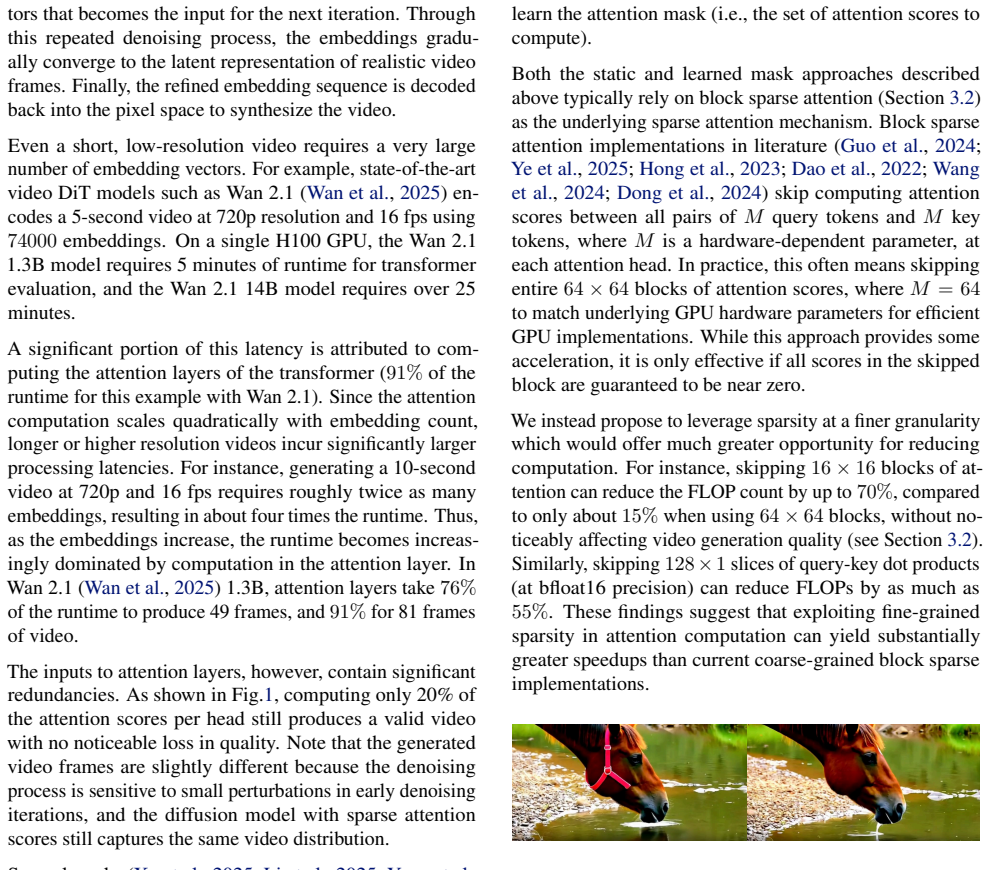
- [Abstract (metadata), §5.2, §8] The speedup numbers are internally inconsistent: the metadata abstract reports up to 1.40×/1.18× average over FlashAttention 3; the full-text abstract reports average 1.55×/1.41× for 480p/720p; the body (§5.2) reports an average 1.48× and up to 1.65×; and Fig. 12 reports attention-kernel speedups of 1.93× average and 2.38× max. The experiments in Section 5 compare against a PyTorch baseline, SparseVideoGen, and RadialAttention, but not against FlashAttention 3 or FlashInfer, both of which appear in the abstract/related work. This makes the central speedup claim irreproducible. Please reconcile all reported numbers and provide a table of raw end-to-end times with clearly stated baselines.
- [§4.4 and Table 3] The average-query masking strategy is not sufficiently validated. The threshold in Eq. (the formula with exp(k·qavg/√D)/D < τ1) is undefined: τ1 is never specified in the text or in Section 5.1 (the cached threshold is given as 0.5/N, but the pooling threshold is not). More importantly, the quality claim 'negligible degradation' is supported only by aggregate VBench scores in Table 3 and three visual examples. No error bars are reported, and per-prompt failures can be hidden by aggregate scores. Since the pooling mask is derived from qavg rather than from each individual query, a key that is important for one query in the group may be skipped if it scores low against qavg. Please report mask recall (fraction of significant per-query keys retained by the qavg mask) and per-prompt quality metrics (e.g., PSNR/LPIPS against the full-attention output, or a dispersion measure of VBench scores)
- [§4.2 and §4.5] The memory overhead of the sparse-index mask is stated as O(BHN^2/M) and dismissed as 'negligible runtime overhead,' but the absolute memory footprint is never quantified. For N≈74,000 (720p, 5s), M=128, and a typical number of heads, the cached mask [B,H,N/M,N] of 32-bit integers can be several GB per batch. This is not negligible for the caching strategy and may affect its feasibility on memory-constrained GPUs. Please report the measured HBM usage for the evaluated configurations and separate memory overhead from runtime overhead.
- [§5.2, Fig. 11-13] The speedup plots and ablation do not report the number of runs, variance, or confidence intervals. The normalized end-to-end times in Fig. 11 appear to be single measurements; the ablation in Fig. 13 has no error bars. Given that diffusion sampling is stochastic, run-to-run variance in generation time (due to dynamic masking and asynchronous loads) should be characterized. Please include at least 3–5 repeated runs for each configuration and report mean ± std, or justify why variance is negligible.
minor comments (6)
- [§4.1] Typo: 'altenative' should be 'alternative' in the description of the second mask-generation strategy.
- [§5.1] Typo: 'spatio templaral tokens' should be 'spatio-temporal tokens'.
- [§5.2, Fig. 11-12] Legend labels 'FGSpAttn-pooled' and 'FGSpAttn-cached' are inconsistent with the text's 'FG-Attn-pooling' and 'FG-Attn-cached'. Please use one consistent naming throughout.
- [§4.4] The notation for thresholds is inconsistent: τcached is mentioned in the text, the pooling formula uses τ1, and Section 5.1 introduces a threshold of 0.5/N for the cached strategy. Please define every threshold symbol at first use.
- [§1 and §3.2] The FLOP-reduction estimates for 16×16 blocks (70%) and 128×1 slices (55%) are not tied to the measured speedups. Consider adding a small table that maps sparsity, FLOP reduction, and measured kernel speedup for each configuration, so the reader can distinguish theoretical savings from achieved speedups.
- [References] Some references are incomplete or inconsistently formatted (e.g., 'Spargeattention' vs. 'SpargeAttention'; several arXiv entries lack version numbers). Please proofread the reference list.
Circularity Check
No significant circularity; central claims are empirical speedup and quality measurements.
full rationale
The paper's central claims are measured end-to-end and attention-kernel speedups (Section 5.2) against external baselines (FlashAttention, SparseVideoGen, Radial Attention) and VBench quality metrics (Section 5.3). The sparse mask thresholds (τ_cached = 0.5/N, and the pooling heuristic τ1) are heuristic parameters, not fitted to reproduce the reported speedups or quality numbers. The caching strategy (Section 4.4) derives masks from the model's own attention scores in a previous denoising iteration; this is a runtime optimization, not a self-definitional or fitted prediction. The pooling strategy (Section 4.4) uses qavg to select keys; while the paper does not measure mask recall and the inequality for τ1 appears ambiguous, this is a validity/correctness risk rather than circularity. The paper cites prior works (Hu et al. 2025; Ma et al. 2025) for the observation that embeddings change slowly across denoising steps; these are external works and the observation is used as motivation, not as an input that forces the reported results. No self-citation is load-bearing, no uniqueness theorem is imported, and no known result is simply renamed. The derivation chain is self-contained: the sparsity analysis (Table 2) motivates the design, but the speedup is measured empirically, not derived from a formula that includes the target outcome.
Axiom & Free-Parameter Ledger
free parameters (4)
- threshold for cached mask (tau_cached) =
0.5/N
- threshold for pooling mask (tau_1) =
unspecified
- cache refresh interval =
every 15 DiT iterations
- query block size M =
128 (for Hopper implementation)
axioms (4)
- domain assumption Most significant attention scores are concentrated in static regions, especially around the diagonal, across all layers.
- ad hoc to paper Nearby embeddings (queries) tend to produce similar query distributions, so a group's mean query represents the group.
- domain assumption Across denoising iterations, the intermediate embeddings remain approximately unchanged, so attention masks are stable enough to cache.
- ad hoc to paper Skipping attention slices whose scores are below threshold does not affect output quality.
Cite this review
Pith. "Pith review of FG-Attn: Leveraging Fine-Grained Sparse Attention in Video Diffusion Models." pith.science (2026). https://pith.science/paper/ZXPWT5DD
@misc{pith2026250916518,
  author       = {Pith},
  title        = {Pith review of: FG-Attn: Leveraging Fine-Grained Sparse Attention in Video Diffusion Models},
  year         = {2026},
  howpublished = {\url{https://pith.science/paper/ZXPWT5DD}},
  note         = {Machine review of arXiv:2509.16518}
}
read the original abstract
Using diffusion transformers for media generation may require evaluating attention over extremely long sequences, with attention layers accounting for the majority of generation latency. Exploiting sparsity in attention maps offers a promising opportunity to reduce this cost. In this work, we show that attention maps in diffusion transformers exhibit significant fine-grained sparsity in video generation models. Existing sparse attention methods, however, are too coarse-grained, leaving a large fraction of redundant computation unaddressed, or incur high overheads at finer granularity. We propose FG-Attn, a novel, low-overhead fine-grained sparse attention mechanism that skips score computations at the granularity of a MxN tile, where N>=1 and M>=16, and where each block is the result of query-key dot products between M queries and N keys. FG-Attn addresses the key challenge of hardware underutilization in sparse attention kernels on GPUs, without incurring the overheads of irregular memory access and redundant operations. FG-Attn can fully supersede existing sparse attention methods and extend block sparse attention methods to finer granularities on modern GPUs. At 70% sparsity, FG-Attn is up to 2.45X faster than the state-of-art FlashInfer, and reduces attention kernel time by 14.7% on average. FG-Attn speeds up end-to-end video generation times by up to 1.40X (1.18X on average) over Flash Attention 3.
Figures




Forward citations
Cited by 4 Pith papers
-
DFSAttn: Dynamic Fine-grained Sparse Attention for Efficient Video Generation
DFSAttn is a training-free framework for dynamic fine-grained sparse attention in video DiTs that achieves up to 2.1x speedup while preserving generation quality via Hilbert reordering, hierarchical scoring, and adapt...
-
Efficient Video Diffusion Models: Advancements and Challenges
A survey that groups efficient video diffusion methods into four paradigms—step distillation, efficient attention, model compression, and cache/trajectory optimization—and outlines open challenges for practical use.
-
Video Generation Models as World Models: Efficient Paradigms, Architectures and Algorithms
Video generation models can function as world simulators if efficiency gaps in spatiotemporal modeling are bridged via organized paradigms, architectures, and algorithms.
-
Video Generation Models as World Models: Efficient Paradigms, Architectures and Algorithms
In twisted bilayer nodal d-wave superconductors, interlayer hopping creates nodes on the C2 axis and Bogoliubov flat bands when the single-layer Berry connection is parallel to that axis.
Reference graph
Works this paper leans on
-
[1]
Chen, J., Yu, J., Ge, C., Yao, L., Xie, E., Wu, Y ., Wang, Z., Kwok, J., Luo, P., Lu, H., et al. Pixart-alpha: Fast training of diffusion transformer for photorealistic text-to-image synthesis.arXiv preprint arXiv:2310.00426,
-
[4]
Flashdecoding++: Faster large language model inference on gpus.arXiv preprint arXiv:2311.01282,
Hong, K., Dai, G., Xu, J., Mao, Q., Li, X., Liu, J., Chen, K., Dong, Y ., and Wang, Y . Flashdecoding++: Faster large language model inference on gpus.arXiv preprint arXiv:2311.01282,
-
[6]
Kong, W., Tian, Q., Zhang, Z., Min, R., Dai, Z., Zhou, J., Xiong, J., Li, X., Wu, B., Zhang, J., et al. Hunyuan- video: A systematic framework for large video generative models.arXiv preprint arXiv:2412.03603,
-
[7]
Diffwave: A versatile diffusion model for audio synthesis
Kong, Z., Ping, W., Huang, J., Zhao, K., and Catanzaro, B. Diffwave: A versatile diffusion model for audio synthesis. arXiv preprint arXiv:2009.09761,
Pith/arXiv arXiv 2009
-
[9]
dkv-cache: The cache for diffusion language models.arXiv preprint arXiv:2505.15781,
Ma, X., Yu, R., Fang, G., and Wang, X. dkv-cache: The cache for diffusion language models.arXiv preprint arXiv:2505.15781,
-
[10]
F., Arora, S., Singhal, A., Fu, D
Spector, B. F., Arora, S., Singhal, A., Fu, D. Y ., and R ´e, C. Thunderkittens: Simple, fast, and adorable ai kernels. arXiv preprint arXiv:2410.20399,
-
[11]
Wan: Open and advanced large-scale video generative models.arXiv preprint arXiv:2503.20314,
Wan, T., Wang, A., Ai, B., Wen, B., Mao, C., Xie, C.-W., Chen, D., Yu, F., Zhao, H., Yang, J., et al. Wan: Open and advanced large-scale video generative models.arXiv preprint arXiv:2503.20314,
-
[13]
Xi, H., Yang, S., Zhao, Y ., Xu, C., Li, M., Li, X., Lin, Y ., Cai, H., Zhang, J., Li, D., et al. Sparse videogen: Acceler- ating video diffusion transformers with spatial-temporal sparsity.arXiv preprint arXiv:2502.01776,
-
[14]
Xattention: Block sparse attention with antidiagonal scoring.arXiv preprint arXiv:2503.16428,
Xu, R., Xiao, G., Huang, H., Guo, J., and Han, S. Xattention: Block sparse attention with antidiagonal scoring.arXiv preprint arXiv:2503.16428,
-
[15]
Yang, S., Xi, H., Zhao, Y ., Li, M., Zhang, J., Cai, H., Lin, Y ., Li, X., Xu, C., Peng, K., et al. Sparse videogen2: Accel- erate video generation with sparse attention via semantic- aware permutation.arXiv preprint arXiv:2505.18875,
-
[16]
Ye, Z., Chen, L., Lai, R., Lin, W., Zhang, Y ., Wang, S., Chen, T., Kasikci, B., Grover, V ., Krishnamurthy, A., et al. Flash- infer: Efficient and customizable attention engine for llm inference serving.arXiv preprint arXiv:2501.01005,
-
[17]
Yuan, J., Gao, H., Dai, D., Luo, J., Zhao, L., Zhang, Z., Xie, Z., Wei, Y ., Wang, L., Xiao, Z., et al. Native sparse attention: Hardware-aligned and natively trainable sparse attention.arXiv preprint arXiv:2502.11089,
-
[18]
Zhang, J., Huang, H., Zhang, P., Wei, J., Zhu, J., and Chen, J. Sageattention2: Efficient attention with thorough out- lier smoothing and per-thread int4 quantization.arXiv preprint arXiv:2411.10958, 2024a.14 Zhang, J., Wei, J., Huang, H., Zhang, P., Zhu, J., and Chen, J. Sageattention: Accurate 8-bit attention for plug-and-play inference acceleration.arX...
-
[2020]
Li, X., Li, M., Cai, T., Xi, H., Yang, S., Lin, Y ., Zhang, L., Yang, S., Hu, J., Peng, K., et al. Radial atten- tion: o(nlogn) sparse attention with energy decay for long video generation.arXiv preprint arXiv:2506.19852,
-
[2022]
Dong, J., Feng, B., Guessous, D., Liang, Y ., and He, H. Flex attention: A programming model for gen- erating optimized attention kernels.arXiv preprint arXiv:2412.05496,
-
[2023]
S., Seo, J.-s., Zhang, Z., and Gupta, U
Hu, Z., Meng, J., Akhauri, Y ., Abdelfattah, M. S., Seo, J.-s., Zhang, Z., and Gupta, U. Accelerating diffusion language model inference via efficient kv caching and guided diffusion.arXiv preprint arXiv:2505.21467,
-
[2024]
Dosovitskiy, A., Beyer, L., Kolesnikov, A., Weissenborn, D., Zhai, X., Unterthiner, T., Dehghani, M., Minderer, M., Heigold, G., Gelly, S., et al. An image is worth 16x16 words: Transformers for image recognition at scale.arXiv preprint arXiv:2010.11929, 2020.13 Esser, P., Kulal, S., Blattmann, A., Entezari, R., M¨uller, J., Saini, H., Levi, Y ., Lorenz, ...
Pith/arXiv arXiv 2010
-
[2025]
Flashmask: Efficient and rich mask extension of flashattention.arXiv preprint arXiv:2410.01359,
Wang, G., Zeng, J., Xiao, X., Wu, S., Yang, J., Zheng, L., Chen, Z., Bian, J., Yu, D., and Wang, H. Flashmask: Efficient and rich mask extension of flashattention.arXiv preprint arXiv:2410.01359,
discussion (0)
Sign in with ORCID, Apple, or X to comment. Anyone can read and Pith papers without signing in.