REVIEW 2 major objections 5 minor 17 references
Language Models Largely Exhibit Human-like Constituent Ordering Preferences
T0 review · 2 major / 5 minor · reviewed 2026-08-08 · deepseek-v4-flash
Pith's one-line read Across three of four constituent-ordering phenomena, LLM preferences correlate with human naturalness judgments; particle movement is the outlier.
desk verdict A broad, useful empirical follow-up to Futrell and Levy, but the main claim rests on absolute correlations that hide whether models are aligned or anti-aligned. read the letter →
The pith
A machine-rendered reading of the paper's core claim, the machinery that carries it, and where it could break.
The reading
What carries the argument
The central object is $M_{\mathrm{preference}}$, the difference between a model's summed log-probability of the unshifted and shifted versions of the same sentence; a positive value means the model prefers the unshifted order. It is computed over roughly 400,000 synthetic minimal pairs plus mined Penn Treebank-2 sentences, across four movement types. The same design supports a regression analysis: generalized additive mixed models (GAMMs) with verb-level random effects are fit to $M_{\mathrm{preference}}$ as a function of word length, syllable weight, token length, and modifier weight, and each predictor is ablated in turn to see which weight measure the model's preferences actually depend on. Human naturalness ratings on 500 sentence pairs, collected on a 1–7 scale from 126 native speakers, form the comparison baseline, and the Spearman correlation between mean human scores and $M_{\mathrm{preference}}$ is the headline agreement statistic.
What would settle it
Recompute the dative-alternation correlations after normalizing $M_{\mathrm{score}}$ by sequence length or after matching the two forms on token count; if the reported correlations (for example, GPT-2's 0.651) drop to near zero, the ordering-preference alignment is an artifact of the length confound rather than a shared ordering preference.
Extended reading notes
Core claim
The paper claims that, when a sentence can be reordered without changing its truth conditions, a language model's relative preference for the two orders — measured as $M_{\mathrm{preference}} = M_{\mathrm{score}}(\text{unshifted}) - M_{\mathrm{score}}(\text{shifted})$, the difference of full-sequence log-probabilities — tracks human naturalness judgments for heavy NP shift, dative alternation, and multiple PP shift, with absolute Spearman correlations typically between 0.3 and 0.6 across the GPT-2, Llama-3, Mistral, OLMo, and BabyLM-style model families. Particle movement is the outlier, with low human-model agreement and a non-monotonic weight effect in which shifting motivation first rises and then falls. The paper further finds that among several weight measures, syllable weight best explains model shifting behavior (word length best for dative alternation), and that instruction-tuned models consistently show lower agreement with human judgments than their base counterparts. These results are presented as evidence that weight-based end-weight ordering principles, long studied in human psycholinguistics, are largely induced by autoregressive language models, while the failure of particle movement marks a genuine boundary.
Load-bearing premise
The load-bearing assumption is that $M_{\mathrm{preference}}$ isolates ordering preference; for dative alternation the shifted form adds the word 'to', so the score also changes with length and lexical content, and if that confound is large the reported human-model correlations for dative alternation could overstate genuine ordering alignment.
Editorial extensions
If this is right
- If model preferences genuinely track human rankings, the same weight-based theory of end-weight ordering applies to how transformer language models evaluate sentences, not just to how humans produce them.
- Syllable weight being the best single predictor suggests that model ordering behavior is not purely token-level and may reflect an induced proxy for phonological or prosodic heaviness.
- Instruction-tuned models correlating less with humans than base models implies that human-feedback training does not automatically make syntactic micro-preferences more human-like; it can move them away.
- Particle movement is a distinct case: human-model agreement is low, and beyond a weight threshold additional weight no longer motivates shifting, so the general end-weight story does not cover all movement types.
Reading between the lines
- Because the dative-alternation score conflates ordering with the added preposition 'to', the paper's highest human-model correlations are the least clean; a length-normalized re-analysis could revise those numbers.
- The instruction-tuning gap suggests a testable prediction for future models: methods that emphasize naturalistic generation or register diversity might restore or improve base-model-level alignment on these small-scale word-order choices.
- The same $M_{\mathrm{preference}}$ protocol could be run on languages with freer post-verbal ordering to see whether human-model agreement holds cross-linguistically, which the paper notes as outside its scope.
- If syllable weight genuinely drives model preferences, perturbing syllable counts while holding token counts fixed should move model scores predictably; that experiment would separate a phonological proxy from purely token-level statistics.
Editorial analysis
A structured set of objections, weighed in public.
Referee Report
Summary. The paper compares LLM preferences on four types of English constituent movement (Heavy NP Shift, Particle Movement, Dative Alternation, and Multiple PP Shift) against human naturalness judgments. Model preferences are computed as the difference in full-sequence log-probabilities between unshifted and shifted sentence pairs (M_preference), using frozen autoregressive models across several families and sizes. Human judgments come from a Prolific crowdsourced study on a subset of the sentence pairs. The authors report that LLMs generally align with human ordering preferences except for particle movement, that syllable weight is the most important weight measure in explaining model preferences, and that instruction-tuned models align with humans less than their base counterparts. The paper also provides a large synthetic dataset and a smaller mined dataset, with code and data publicly available.
Significance. If the headline result holds, this is a valuable large-scale benchmark for syntactic ordering preferences in LLMs, with implications for psycholinguistic modeling and for claims about human-like inductive biases in language models. The paper's strengths include the use of raw probability scores from frozen pretrained models (so nothing is fitted to the human judgments), the breadth of model families and scales, the combination of synthetic and naturally occurring data, and the public release of code and data. The finding that instruction-tuned models correlate less with human judgments than their base counterparts is a useful and somewhat counterintuitive contribution. However, two load-bearing issues in the current presentation—the use of absolute Spearman correlations and the non-minimal-pair dative alternation stimuli—mean the central 'generally align' claim is not yet actually demonstrated by the reported evidence.
major comments (2)
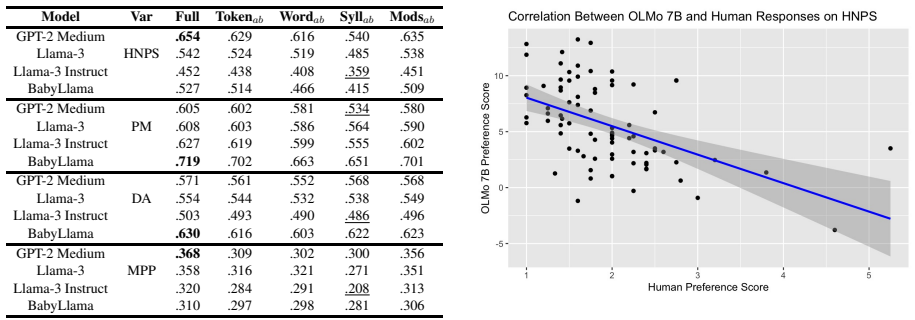
- [Section 7.2, Table 4] The paper reports only absolute Spearman correlations between LLM M_preference scores and human naturalness judgments. This is not sufficient to support the claim that LLMs 'generally align' with humans. Given the definitions in Section 5.1 and the human-rating scale described in Section 7.1, M_preference = Mscore(U) - Mscore(S), with positive values indicating preference for the unshifted form, while the human score is 1 when the first (unshifted, as listed in Table 1) sentence is more natural and 7 when the second (shifted) sentence is more natural. Under genuine alignment, the signed Spearman rho should be negative. Reporting |rho| conflates correctly aligned models (negative rho) with anti-aligned models (positive rho), and the 'low' particle-movement correlations could in fact be active reversals. The abstract's central claim cannot be evaluated from Table 4 as presented. Please report signed correlations with a clear sign convention, or provide scatterplots with axes that make the direction of association visible.
- [Section 5.1, Table 1] The dative alternation (DA) stimuli are not a minimal pair: the shifted form 'He sent a gift to her' adds the preposition 'to' compared with the unshifted 'He sent her a gift'. Because Mscore is the unnormalized sum of per-token log-probabilities over sequences of different lengths, the DA M_preference difference necessarily includes a systematic length and lexical confound that is independent of ordering preference. This confound could inflate (or deflate) the reported DA correlations, including the highest human-model correlation in the paper (GPT-2, DA, rho = 0.651 in Table 4). The paper should either normalize by sequence length, use a matched control condition, or explicitly quantify the contribution of the added token to the model score difference before drawing conclusions about DA alignment.
minor comments (5)
- [Section 7.1] The human judgment study description is sparse; please report the number of sentence pairs per shift type after exclusions, the number of judgments per pair, the agreement threshold applied, and how the 500 pairs were sampled from the larger synthetic and mined datasets.
- [Table 1] The note for MPP states that 'the unshifted and shifted form for MPP is ambiguous; the unshifted and shifted forms cannot be derived separately given an example.' This is confusing as written, since the table does provide two distinct rows; please clarify what ambiguity is intended.
- [Section 6.2, Table 3] The claim that syllable weight is 'often the most important predictor' is based on raw differences in R-squared between the full GAMM and ablated models, without confidence intervals or significance tests; for several rows the differences are small (e.g., Table 3, DA rows), so this claim currently rests on descriptive differences only.
- [Section 5.2 and Figure 5] The textual descriptions ('converge above 0', 'plateau below zero') are not easy to verify from the small excerpt of Figure 5; please ensure the figure is legible with labeled axes and visible trend lines, and consider adding individual data point density.
- [Section 8.3] The statement that Table 4 shows 'relatively high correlation effects' lacks a benchmark or effect-size interpretation; a correlation of 0.3-0.5 may be modest depending on the context, and adding confidence intervals or a comparison with baseline correlations would strengthen the interpretation.
Circularity Check
No significant circularity: model preferences are measured from frozen models and compared with independently collected human judgments.
full rationale
The derivation chain is self-contained. The model-side quantity M_preference = Mscore(U) − Mscore(S) (Section 5.1) is computed directly from frozen pretrained LLM log-probabilities on paired unshifted/shifted sentences, with no parameters fitted to the human data. The human-side judgments come from a separate Prolific crowdsourcing study (Section 7.1), and the Spearman correlations in Table 4 compare these two independently obtained sets of scores. The GAMM analysis (Section 6) is descriptive: it measures how well weight predictors explain each model's own M_preference scores and is not used to generate the human-alignment claim. The only self-citation, Kamath et al. (2024), supports the methodological decision to use raw probability scores rather than prompting; that choice is independently backed by Hu and Levy (2023) and is not the target result, so it is not load-bearing. Two validity concerns raised in review—the absence of signed correlations in Table 4 (absolute values cannot distinguish aligned from anti-aligned models) and the DA shifted form adding the preposition "to" so the pair is not a minimal ordering contrast—are substantive measurement and reporting issues, but neither makes the reported correlation equal to an input by construction. No fitted parameter is renamed as a prediction, and no load-bearing self-citation chain is invoked.
Assumptions & free parameters
free parameters (1)
- human_exclusion_sd_threshold =
1.5
assumptions (4)
- domain assumption Model log-probability differences reflect linguistic acceptability
- domain assumption Human naturalness ratings are valid ground truth
- domain assumption Synthetic template sentences are valid English
- domain assumption Penn Treebank-2 parses are accurate
Cite this review
Pith. "Pith review of Language Models Largely Exhibit Human-like Constituent Ordering Preferences." pith.science (2026). https://pith.science/paper/ZZFQFNL7
@misc{pith2026250205670,
  author       = {Pith},
  title        = {Pith review of: Language Models Largely Exhibit Human-like Constituent Ordering Preferences},
  year         = {2026},
  howpublished = {\url{https://pith.science/paper/ZZFQFNL7}},
  note         = {Machine review of arXiv:2502.05670}
}
read the original abstract
Though English sentences are typically inflexible vis-\`a-vis word order, constituents often show far more variability in ordering. One prominent theory presents the notion that constituent ordering is directly correlated with constituent weight: a measure of the constituent's length or complexity. Such theories are interesting in the context of natural language processing (NLP), because while recent advances in NLP have led to significant gains in the performance of large language models (LLMs), much remains unclear about how these models process language, and how this compares to human language processing. In particular, the question remains whether LLMs display the same patterns with constituent movement, and may provide insights into existing theories on when and how the shift occurs in human language. We compare a variety of LLMs with diverse properties to evaluate broad LLM performance on four types of constituent movement: heavy NP shift, particle movement, dative alternation, and multiple PPs. Despite performing unexpectedly around particle movement, LLMs generally align with human preferences around constituent ordering.
Figures


Figures from the paper (3 more)


Reference graph
Works this paper leans on
-
[4]
RNNs as psycholinguistic subjects: Syntactic state and grammatical dependency
Rnns as psycholinguistic sub- jects: Syntactic state and grammatical dependency. Preprint, arXiv:1809.01329. Dirk Groeneveld, Iz Beltagy, Pete Walsh, Akshita Bha- gia, Rodney Kinney, Oyvind Tafjord, Ananya Harsh Jha, Hamish Ivison, Ian Magnusson, Yizhong Wang, Shane Arora, David Atkinson, Russell Authur, Khyathi Raghavi Chandu, Arman Cohan, Jennifer Dumas...
-
[8]
Mistral 7b. Preprint, arXiv:2310.06825. Gaurav Kamath, Sebastian Schuster, Sowmya Vajjala, and Siva Reddy
-
[10]
Targeted syn- tactic evaluation of language models. In Proceed- ings of the 2018 Conference on Empirical Methods in Natural Language Processing, pages 1192–1202, Brussels, Belgium. Association for Computational Linguistics. David J. Medeiros, Paul Mains, and Kevin B. Mc- Gowan
work page 2018
-
[11]
arXiv preprint arXiv:2203.13112
minicons: Enabling flex- ible behavioral and representational analyses of transformer language models. arXiv preprint arXiv:2203.13112. Savithry Namboodiripad
-
[12]
Gpt-4 technical report. Preprint, arXiv:2303.08774. Long Ouyang, Jeff Wu, Xu Jiang, Diogo Almeida, Car- roll L. Wainwright, Pamela Mishkin, Chong Zhang, Sandhini Agarwal, Katarina Slama, Alex Ray, John Schulman, Jacob Hilton, Fraser Kelton, Luke Miller, Maddie Simens, Amanda Askell, Peter Welinder, Paul Christiano, Jan Leike, and Ryan Lowe
-
[13]
Training language models to follow instructions with human feedback. Preprint, arXiv:2203.02155. Steven Pinker
-
[14]
When a sentence does not introduce a discourse entity, transformer-based models still sometimes refer to it. In Proceedings of the 2022 Conference of the North American Chapter of the Association for Computa- tional Linguistics: Human Language Technologies , pages 969–982. Márton Sóskuthy
work page 2022
-
[17]
Association for Computational Linguistics
What do RNN language models learn about filler–gap dependencies? In Proceedings of the 2018 EMNLP Workshop Black- boxNLP: Analyzing and Interpreting Neural Net- works for NLP, pages 211–221, Brussels, Belgium. Association for Computational Linguistics. Simon N. Wood
work page 2018
Show all 17 references
-
[1909]
Indogermanische Forschungen (1909), 25(1909):110–142
Beziehungen zwischen umfang und reihenfolge von satzgliedern. Indogermanische Forschungen (1909), 25(1909):110–142. Otto Behaghel
1909
-
[2005]
Journal of Memory and Language , 52(1):58–70
The lexical bias effect is mod- ulated by context, but the standard monitoring account doesn’t fly: Related beply to baars et al.(1975). Journal of Memory and Language , 52(1):58–70. John A. Hawkins
1975
-
[2016]
Preprint, arXiv:1611.01368
Assessing the ability of lstms to learn syntax-sensitive dependencies. Preprint, arXiv:1611.01368. Emily Walker Manetta
-
[2017]
Preprint, arXiv:1703.05339
Generalised additive mixed models for dynamic analysis in linguistics: a practi- cal introduction. Preprint, arXiv:1703.05339. Hua Wang and Haitao Liu
-
[2018]
Richard Futrell, Kyle Mahowald, and Edward Gibson
Do rnns learn human-like abstract word order preferences? Preprint, arXiv:1811.01866. Richard Futrell, Kyle Mahowald, and Edward Gibson
-
[2019]
Ethan Wilcox, Roger Levy, Takashi Morita, and Richard Futrell
What syntactic structures block dependencies in rnn language models? Preprint, arXiv:1905.10431. Ethan Wilcox, Roger Levy, Takashi Morita, and Richard Futrell
1905 arXiv
-
[2022]
Preprint, arXiv:2106.08694
On the proper role of linguistically-oriented deep net analysis in linguistic theorizing. Preprint, arXiv:2106.08694. Otto Behaghel
-
[2023]
Preprint, arXiv:2305.13264
Prompting is not a substitute for probability measurements in large lan- guage models. Preprint, arXiv:2305.13264. Albert Q. Jiang, Alexandre Sablayrolles, Arthur Men- sch, Chris Bamford, Devendra Singh Chaplot, Diego de las Casas, Florian Bressand, Gianna Lengyel, Guillaume L...
-
[2024]
Preprint, arXiv:2402.00838
Olmo: Accelerating the science of language models. Preprint, arXiv:2402.00838. Jeannette K. Gundel
Reviewed August 8, 2026 · model on record in the stance chip above.
Discussion (0). Continue with ORCID to comment.