REVIEW 3 major objections 4 minor 1 cited by
Complex Langevin Simulations of Zero-dimensional Supersymmetric Quantum Field Theories
T0 review · 3 major / 4 minor · reviewed 2026-08-14 · deepseek-v4-flash
Pith's one-line read This paper claims that complex Langevin dynamics with twisted boundary conditions correctly identifies spontaneous supersymmetry breaking in zero-dimensional $\mathcal{N}=2$ models with real and complex actions, recovering known results…
desk verdict Honest and useful complex Langevin study of zero-dimensional SUSY models, but the complex-action conclusions outrun the reliability evidence. read the letter →
The pith
A machine-rendered reading of the paper's core claim, the machinery that carries it, and where it could break.
The reading
What carries the argument
The load-bearing object is the twisted-boundary-condition order parameter: fermions are assigned boundary phase $e^{i\alpha}$, which softly breaks supersymmetry and replaces the ill-defined $\langle B\rangle=0/0$ with a finite $\langle B\rangle_\alpha$; spontaneous supersymmetry breaking is then read off from whether the $\alpha\to0$ extrapolation of $\langle B\rangle_\alpha$ vanishes. The evolution is the complex Langevin update $\phi(\tau+\Delta\tau)=\phi(\tau)-\Delta\tau\,\partial S^{\rm eff}_\alpha/\partial\phi+\sqrt{\Delta\tau}\,\eta(\tau)$, where the effective action $S^{\rm eff}_\alpha=\tfrac12 W'^2-\ln(e^{i\alpha}-1+W'')$ generates a complex drift and the noise is real Gaussian to tame imaginary excursions. Two diagnostics carry the reliability argument: the Fokker-Planck condition $\langle\tilde{L}O\rangle=0$ on observables, and the probability distribution $P(u)$ of the drift magnitude $u$, whose exponential tail is the cited criterion for correct convergence.
What would settle it
Compute $\langle B\rangle_\alpha$ for $W'=ig(\phi^2+\mu^2)$ or a $\delta$-potential by an independent route, such as direct numerical quadrature of the twisted partition function along a steepest-descent contour or a Lefschetz-thimble sum, and compare the $\alpha\to0$ extrapolation with the Langevin values; disagreement would show the complex Langevin equilibrium is not the path integral. A second check is to extend the Langevin time and see whether the high-drift tail of $P(u)$ develops the exponential falloff that the criterion requires.
Extended reading notes
Core claim
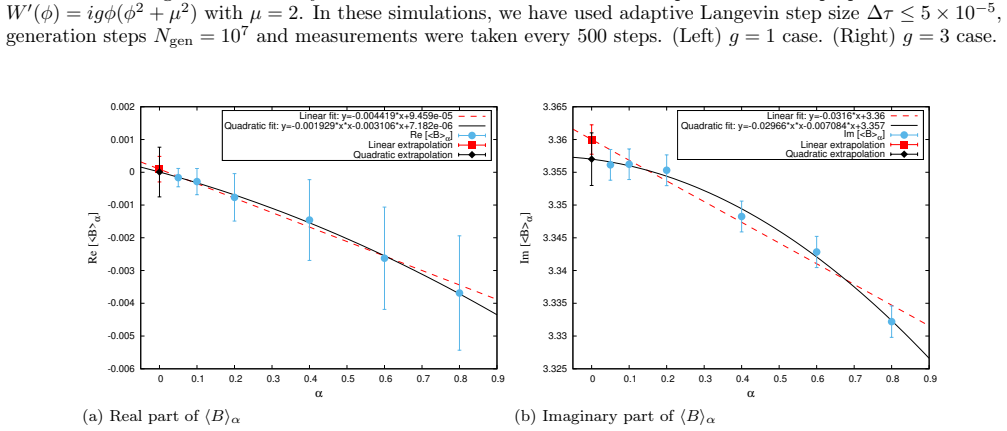
The central claim is that complex Langevin dynamics with stochastic quantization correctly captures the presence or absence of spontaneous supersymmetry breaking in a class of zero-dimensional $\mathcal{N}=2$ models with real and complex actions, with the twisted-boundary auxiliary-field expectation value $\langle B\rangle_\alpha$ serving as the order parameter. Where analytic answers exist, the method reproduces them: the real double-well $W'=g(\phi^2+\mu^2)$ gives a non-vanishing $\langle B\rangle$ at $\alpha=0$ and hence broken SUSY, while a real even-degree polynomial $W'$ breaks SUSY and an odd-degree one preserves it. For complex actions the paper reports new determinations: $W'=ig(\phi^2+\mu^2)$ preserves SUSY, $W'=ig\phi(\phi^2+\mu^2)$ breaks it, and the $PT$-symmetric $\delta$-potential family $W'=-ig(i\phi)^{1+\delta}$ preserves SUSY for $\delta=1,2,3,4$. The authors state that these simulations successfully capture the pattern, while noting that the complex-action results rest on the unverified reliability of the complex Langevin equilibrium in the face of power-law drift tails.
Load-bearing premise
The claim stands or falls on the assumption that the complex Langevin process samples the correct equilibrium distribution for the complex actions, even though the measured drift-magnitude distribution $P(u)$ falls off as a power law rather than the exponential tail that the cited correctness criterion demands.
Editorial extensions
If this is right
- If the complex Langevin equilibrium is correct, then the same twisted-boundary $\langle B\rangle_\alpha$ order parameter can diagnose spontaneous supersymmetry breaking in any zero-dimensional model where an analytic answer is unavailable.
- The even/odd degree rule for real polynomial superpotentials becomes a validated benchmark: even-degree $W'$ breaks supersymmetry and odd-degree preserves it, and the method reproduces this rule numerically.
- The complex double-well family splits by parity-like structure: $W'=ig(\phi^2+\mu^2)$ preserves supersymmetry while $W'=ig\phi(\phi^2+\mu^2)$ breaks it, showing that complex coefficients do not uniformly destroy or preserve supersymmetry.
- The $PT$-symmetric $\delta$-potentials preserve supersymmetry for $\delta=1,2,3,4$, matching the perturbative expectation that parity-breaking alone does not break supersymmetry, now at the nonperturbative level.
- The method is positioned to be extended to the 1- and 2-dimensional supersymmetric models listed as future work, where the action is genuinely complex and no perturbative or exact result is available.
Reading between the lines
- An editor's extension: the same order parameter could be applied at multiple couplings $g$ and masses $\mu$; a stable $\alpha\to0$ intercept across a parameter scan would separate a genuine SUSY phase from a numerical artifact at a single point.
- The observed power-law tail in $P(u)$ suggests a testable boundary: fit the tail exponent as a function of $g$, $\delta$, and $\alpha$, and compare predictions with a thimble or direct quadrature reference to map where the method can be trusted.
- If the complex-action results are confirmed, the natural next probe is the continuous-$\delta$ extension the authors mention; the $\langle B\rangle_\alpha$ observable could reveal whether SUSY restoration is abrupt or smooth as $\delta$ moves between integer values.
- The method's success on these zero-dimensional models would not automatically transfer to higher-dimensional lattices; the drift-tail diagnostic should be re-checked there, since the power-law behavior may worsen with more degrees of freedom.
Signed reviews
Editorial analysis
A structured set of objections, weighed in public.
Referee Report
Summary. The paper applies complex Langevin dynamics (CL) with stochastic quantization to a class of zero-dimensional N=2 supersymmetric models with real and complex actions. The authors use the expectation value of the auxiliary field under twisted boundary conditions, extrapolated to zero twist, as an order parameter for spontaneous supersymmetry breaking. They first validate the CL method on bosonic correlators for actions derived from -g/N (iφ)^N, then treat a real double-well superpotential and a general real polynomial superpotential, where exact analytic results for SUSY breaking are available. They then turn to complex superpotentials, including W'=ig(φ^2+μ^2), W'=igφ(φ^2+μ^2), and PT-symmetric delta-potential models W'=-ig(iφ)^{1+δ} with δ=1,2,3,4, and conclude that SUSY is preserved in the first and third classes and broken in the second. The paper also contains an appendix discussing two standard CL reliability criteria: the Fokker-Planck correctness criterion and the decay of the drift-magnitude distribution.
Significance. If the complex-action predictions are correct, the paper would demonstrate that complex Langevin dynamics can determine SUSY-breaking patterns in a nontrivial class of zero-dimensional models, including PT-symmetric ones, where exact results are not available. The analytic setup with twisted boundary conditions (Eqs. (33)-(39)) is a useful framework, and the real-action checks (Tables II, IV and the bosonic checks in Table I) are clean and agree with exact results. The authors also deserve credit for explicitly reporting the drift-tail diagnostic and flagging the power-law behavior, rather than hiding it. However, the paper's main new conclusions all concern complex actions for which the manuscript's own reliability diagnostics are inconclusive or fail, so the significance of the claimed results is currently limited by lack of independent verification.
major comments (3)
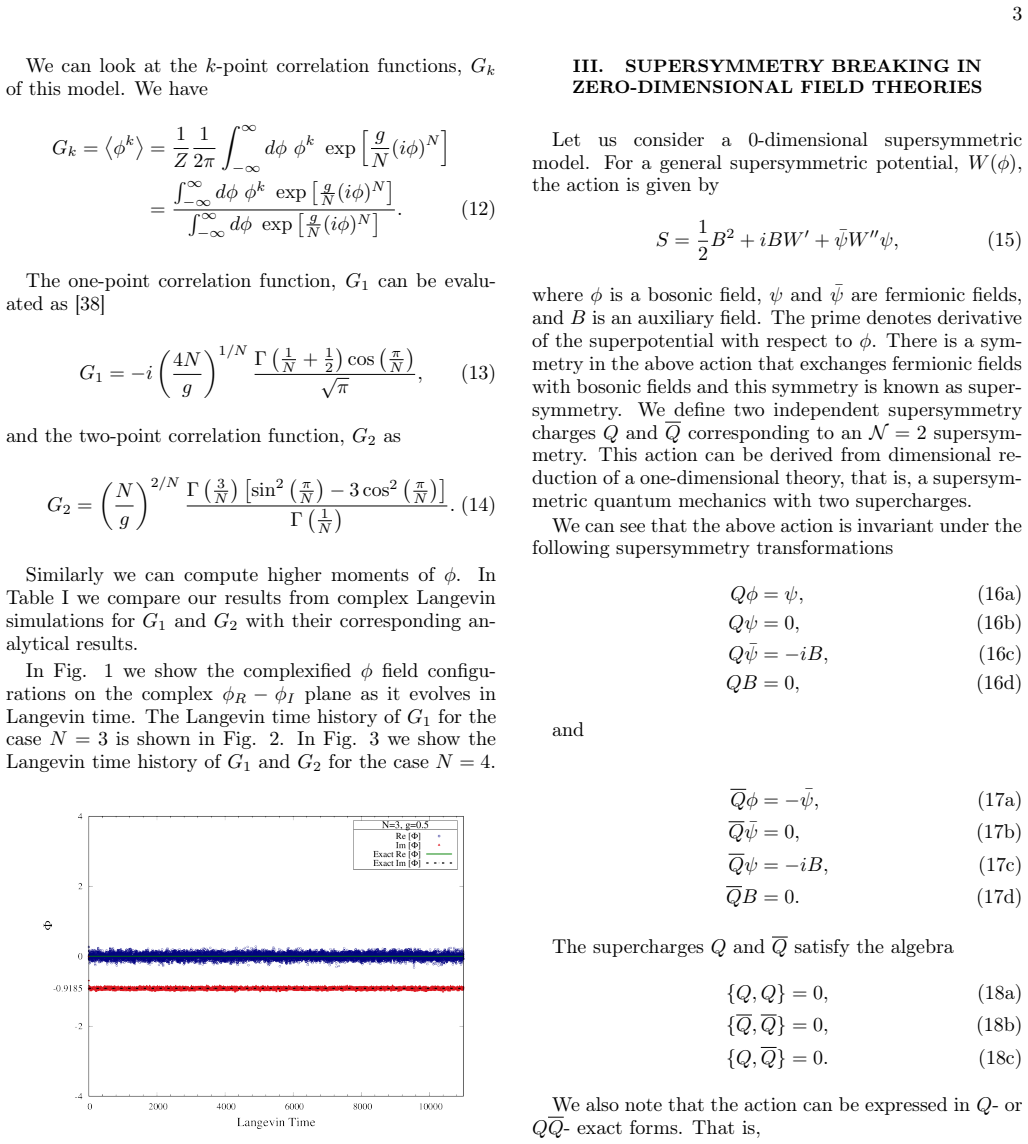
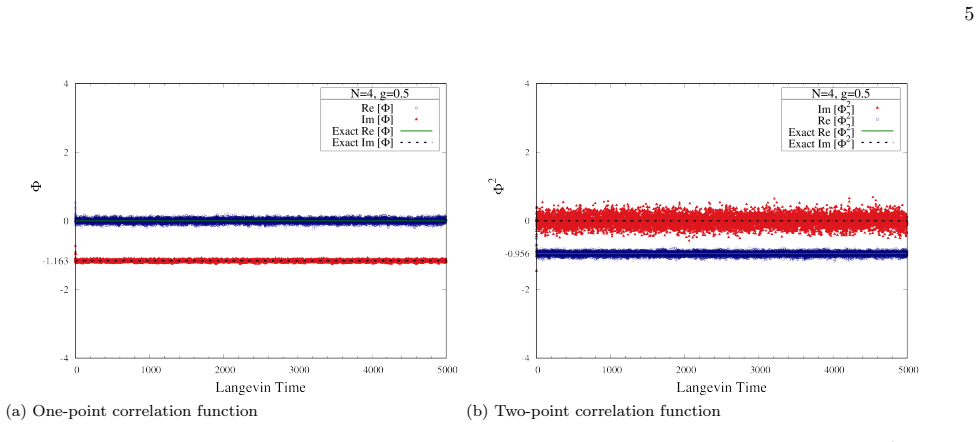
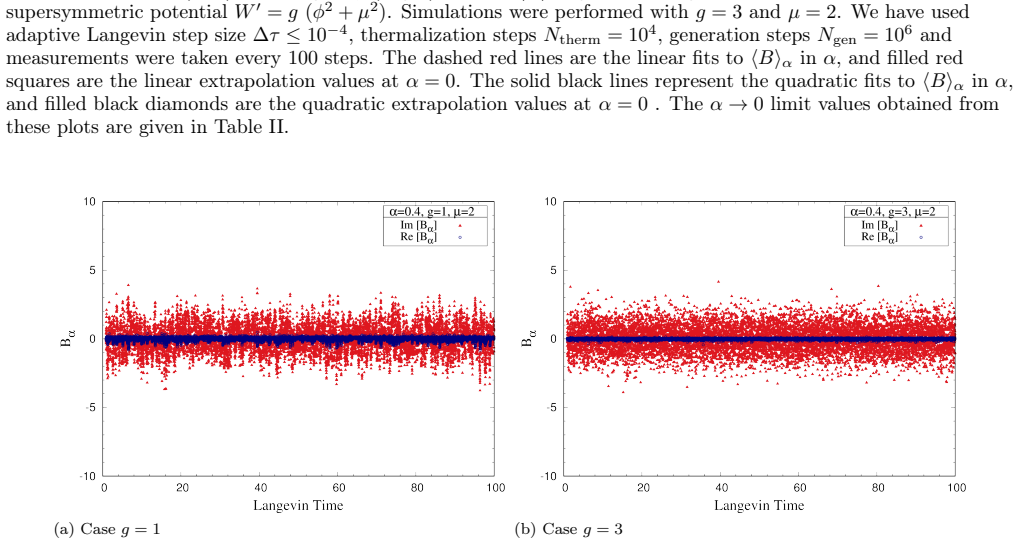
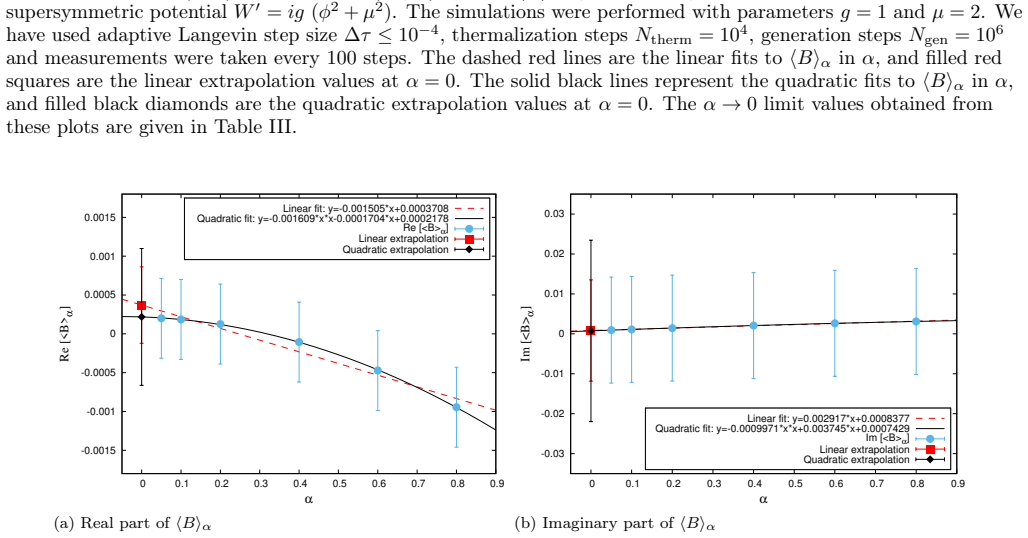
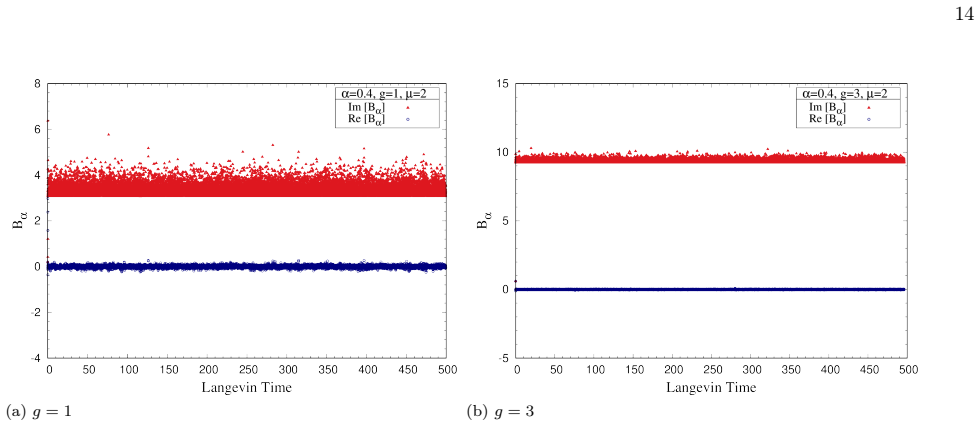
- [Appendix A2, Figs. 21-22] The drift-tail diagnostic fails exactly for the models that produce the new physics. For W'=g(φ^2+μ^2) (Fig. 21) and W'=-ig(iφ)^{1+δ} (Fig. 22), the probability distribution P(u) decays as a power law in u, whereas the criterion of Refs. [42,43] requires exponential suppression before complex Langevin results can be trusted. The text states that 'this needs further investigations, and we save it for future work,' so the manuscript explicitly defers the issue. Every complex-action conclusion—Table III for W'=ig(φ^2+μ^2), Table V for W'=igφ(φ^2+μ^2), and Tables VI-VII for the δ-potentials—rests on the unverified premise that the CL process samples the correct complex-weight equilibrium despite the power-law tail. This is load-bearing: it is precisely the abstract's claim of 'successfully capture the presence or absence of supersymmetry breaking.' An independent check, such as a Lefschetz-thimble evaluation of ⟨B⟩_α for at least one of these actions, is needed before these predictions can be regarded as established.
- [Appendix A1, Tables VIII-X] The Fokker-Planck criterion is presented as a correctness check, but the numbers do not rule out a nonzero ⟨~LB⟩. For example, Table VIII gives ⟨~LB⟩_{α→0} = 0.0023(230)+i0.0555(2357) for g=1, and Table IX gives −1.2716(2.421)−i0.1173(2.122) for δ=1; in essentially all rows the statistical error is comparable to or larger than the central value. The criterion is also applied to a single observable B, whereas the cited literature (Ref. [31]) requires a complete set of observables. Thus Appendix A1 provides at best a necessary condition and cannot compensate for the failed drift-tail criterion.
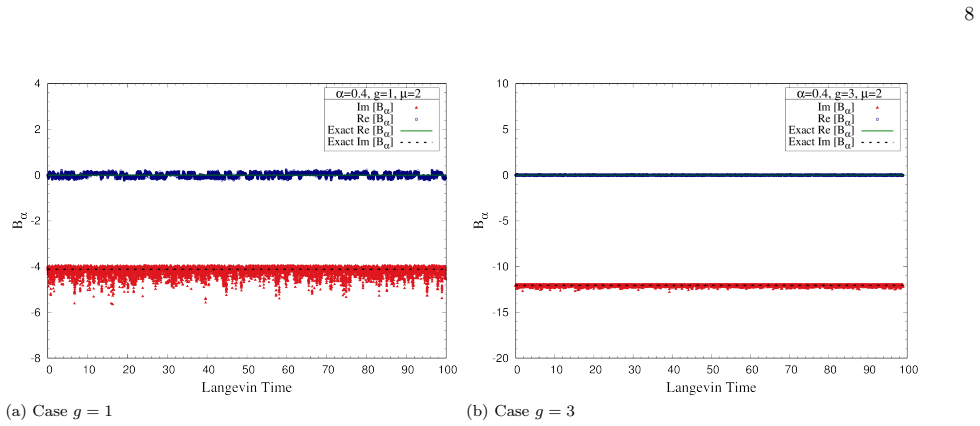
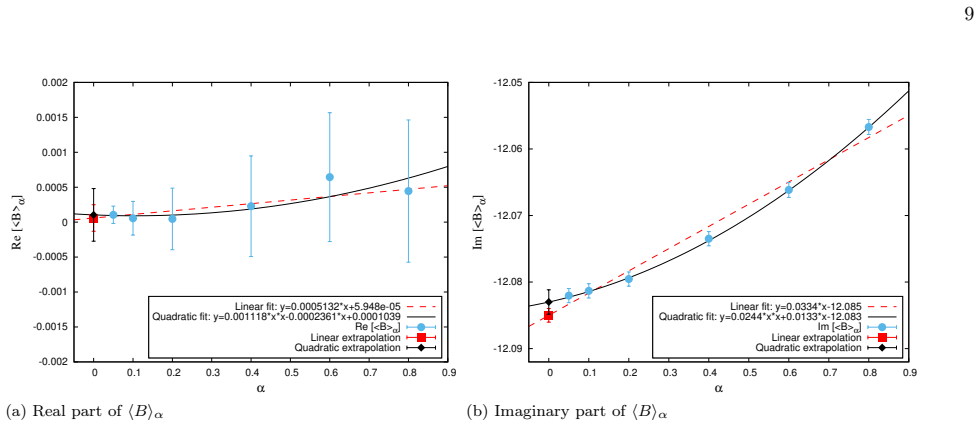
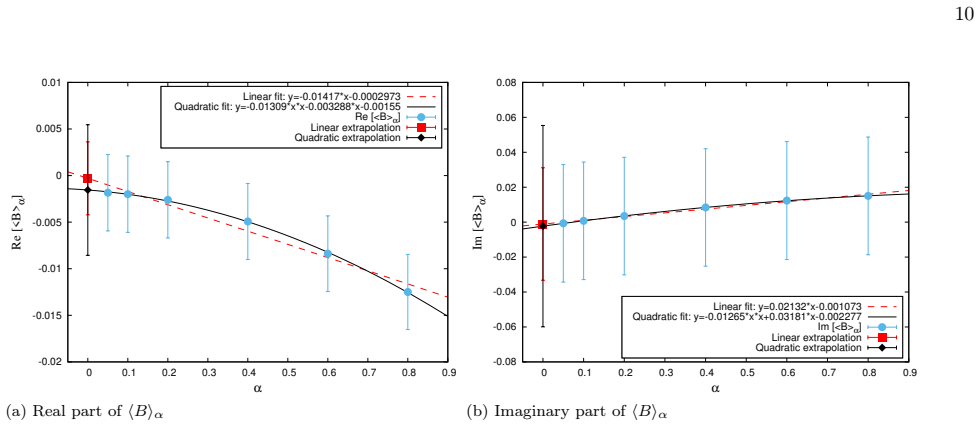
- [Table II and Eq. (48)] For W'=g(φ^2+μ^2), the exact ⟨B⟩_α is independent of α because the α-dependent factor cancels in Eq. (47)/(48). The simulated values in Table II nevertheless drift from −i4.2250(72) at α=0.05 to −i4.1537(74) at α=0.8 for g=1, and the reported α→0 extrapolation −i4.2340(123) differs from the exact value −i4.115 by about 3%. This α-dependence is a systematic CL artifact; it should be quantified and addressed before the same extrapolation procedure is used as the basis for the complex-model conclusions.
minor comments (4)
- [Section IV.C title] The title 'PT-symmetric models inspiredδ-potentials' should read 'inspired by δ-potentials'.
- [Table VI caption] The caption contains a typo: 'g = 0.5 ad δ = 1, 3' should be 'g = 0.5 and δ = 1, 3'.
- [Fig. 10 caption] The caption reads 'The first105 points' and 'every102 steps'; these should be typeset as 10^5 and 10^2.
- [Section IV.C] The analytic evaluations for δ=0,2,4 are performed as real integrals over φ, while the CL simulations explore the complexified plane; a sentence explaining the contour/analytic-continuation prescription used in the exact evaluations would improve readability.
Circularity Check
No significant circularity: the order parameter is measured, analytic SUSY rules are derived independently, and self-citations are contextual.
full rationale
The paper's core derivation chain is self-contained rather than circular. The SUSY-breaking criterion is derived analytically in Eqs. (51)-(56): for real polynomial superpotentials the twisted partition function Z_alpha and <B>_alpha are evaluated in closed form, giving <B>_{alpha->0}=0 for odd degree and nonzero for even degree. These analytic predictions are then checked against complex Langevin simulations for W'=g(phi^2+mu^2), for k=3,4 polynomials, and for delta=0,2 potentials; the simulations use the directly measured observable <B>_alpha, not a parameter fitted to the desired conclusion. For the complex-action cases (W'=ig(phi^2+mu^2), W'=ig phi(phi^2+mu^2), and delta=1,2,3,4 potentials) the alpha->0 extrapolation is a genuine prediction from the simulated ensemble. The paper's own reliability caveat is explicit: 'the probability distribution falls off like a power law with u... This needs further investigations, and we save it for future work,' and the Fokker-Planck check in Tables VIII-X has errors comparable to the central values. That is an unverified correctness premise for the complex-action claims, not a circular reduction to the inputs. The only self-citations are contextual: Ref. [26] (Basu-Jaswin-Joseph) is mentioned as a previous application of complex Langevin, and Ref. [37] ('In preparation') points to future work; neither carries a load-bearing argument. Hence no circular step can be exhibited; the score reflects only the minor non-load-bearing self-citation.
Assumptions & free parameters
free parameters (1)
- alpha-extrapolation intercept for <B>_alpha =
For delta = 1: Re = -0.2433(2213), Im = +0.0742(5080)
assumptions (4)
- ad hoc to paper The complex Langevin process converges to the correct complex-weight equilibrium even when the drift-magnitude distribution P(u) falls off as a power law.
- domain assumption The alpha-twisted expectation value <B>_alpha is a valid order parameter for spontaneous SUSY breaking, with the alpha-to-zero limit vanishing if and only if SUSY is preserved.
- domain assumption The zero-dimensional path integrals with complex superpotentials are well-defined along the integration contour sampled by complex Langevin dynamics.
- standard math Using real Gaussian noise in the Langevin update does not bias the equilibrium results.
Cite this review
Pith. "Pith review of Complex Langevin Simulations of Zero-dimensional Supersymmetric Quantum Field Theories." pith.science (2026). https://pith.science/paper/VYLZBZ7Y
@misc{pith2026190804153,
  author       = {Pith},
  title        = {Pith review of: Complex Langevin Simulations of Zero-dimensional Supersymmetric Quantum Field Theories},
  year         = {2026},
  howpublished = {\url{https://pith.science/paper/VYLZBZ7Y}},
  note         = {Machine review of arXiv:1908.04153}
}
abstract
We investigate the possibility of spontaneous supersymmetry breaking in a class of zero-dimensional ${\cal N} = 2$ supersymmetric quantum field theories, with complex actions, using complex Langevin dynamics and stochastic quantization. Our simulations successfully capture the presence or absence of supersymmetry breaking in these models. The expectation value of the auxiliary field under twisted boundary conditions was used as an order parameter to capture spontaneous supersymmetry breaking in these models.
Figures

Figures from the paper (19 more)





Forward citations
Cited by 1 Pith paper
-
Thermodynamic Diagnostics for Complex Langevin Simulations: The Role of Configurational Temperature
Configurational temperature from action gradients and Hessians offers a sensitive new correctness diagnostic for complex Langevin simulations, reproducing input temperature to 0.2-3% in 1D PT-symmetric models.
Reference graph
Works this paper leans on
-
[31]
Complex Langevin Dynamics in LargeN Unitary Matrix Models,
P. Basu, K. Jaswin, and A. Joseph, “Complex Langevin Dynamics in LargeN Unitary Matrix Models,”Phys. Rev. D98 no. 3, (2018) 034501,arXiv:1802.10381 [hep-th]
arXiv 2018
-
[1]
Fokker-Planck equation as correctness criterion 15
-
[2]
Simulation Data Tables 17 References 24 I
Decay of the drift terms 16 B. Simulation Data Tables 17 References 24 I. INTRODUCTION We can investigate numerous nonperturbative features of quantum field theories using lattice regularized form of the field theory path integral. Monte Carlo methods can be used to reliably extract the physics of such sys- tems. The fundamental idea behind path integral Mo...
arXiv 1908
-
[3]
J. R. Klauder, “Coherent State Langevin Equations for Canonical Quantum Systems With Applications to the Quantized Hall Effect,”Phys. Rev. A29 (1984) 2036–2047
work page 1984
-
[4]
F okker-Planck equation as correctness criterion The holomorphic observables of the theory O[φ,τ ] evolve according to [30, 31, 41] ∂O[φ,τ ] ∂τ =~LO[φ,τ ], (A1) where ~L is the Langevin operator ~L = [ ∂ ∂φ− ∂ ∂φS[φ] ] ∂ ∂φ. (A2) Once the equilibrium distribution is reached, assuming that it exists, we can remove theτ dependence from the observables. Then...
-
[5]
Decay of the drift terms Another method to check the correctness of the com- plex Langevin dynamics, as proposed in Refs. [42, 43], is to look at the probability distributionP (u) of the mag- nitude of the drift termu at large values of the drift. We have the magnitude of the drift term u = ⏐⏐⏐⏐ ∂S ∂φ ⏐⏐⏐⏐. (A5) In Refs. [42, 43] the authors demonstrated,...
work page 1932
-
[6]
J. R. Klauder, “STOCHASTIC QUANTIZATION,” Acta Phys. Austriaca Suppl. 25 (1983) 251–281
work page 1983
-
[7]
A Langevin Approach to Fermion and Quantum Spin Correlation Functions,
J. R. Klauder, “A Langevin Approach to Fermion and Quantum Spin Correlation Functions,”J. Phys. A16 (1983) L317
work page 1983
Show all 48 references
-
[8]
Lefschetz-thimble analysis of the sign problem in one-site fermion model,
Y. Tanizaki, Y. Hidaka, and T. Hayata, “Lefschetz-thimble analysis of the sign problem in one-site fermion model,”New J. Phys. 18 no. 3, (2016) 033002, arXiv:1509.07146 [hep-th]
2016 arXiv
-
[9]
ON COMPLEX PROBABILITIES,
G. Parisi, “ON COMPLEX PROBABILITIES,”Phys. Lett. 131B (1983) 393–395
1983
-
[10]
New approach to the sign problem in quantum field theories: High density QCD on a Lefschetz thimble,
AuroraScience Collaboration, M. Cristoforetti, F. Di Renzo, and L. Scorzato, “New approach to the sign problem in quantum field theories: High density QCD on a Lefschetz thimble,”Phys. Rev. D86 (2012) 074506, arXiv:1205.3996 [hep-lat]
2012 arXiv
-
[11]
Hybrid Monte Carlo on Lefschetz thimbles - A study of the residual sign problem,
H. Fujii, D. Honda, M. Kato, Y. Kikukawa, S. Komatsu, and T. Sano, “Hybrid Monte Carlo on Lefschetz thimbles - A study of the residual sign problem,”JHEP 10 (2013) 147, arXiv:1309.4371 [hep-lat]
2013 arXiv
-
[12]
Thimble regularization at work: from toy models to chiral random matrix theories,
F. Di Renzo and G. Eruzzi, “Thimble regularization at work: from toy models to chiral random matrix theories,”Phys. Rev. D92 no. 8, (2015) 085030, arXiv:1507.03858 [hep-lat]
2015 arXiv
-
[13]
Simulating nonequilibrium quantum fields with stochastic quantization techniques,
J. Berges and I. O. Stamatescu, “Simulating nonequilibrium quantum fields with stochastic quantization techniques,”Phys. Rev. Lett. 95 (2005) 202003, arXiv:hep-lat/0508030 [hep-lat]
2005 arXiv
-
[14]
Monte Carlo study of Lefschetz thimble structure in one-dimensional Thirring model at finite density,
H. Fujii, S. Kamata, and Y. Kikukawa, “Monte Carlo study of Lefschetz thimble structure in one-dimensional Thirring model at finite density,”JHEP 12 (2015) 125, arXiv:1509.09141 [hep-lat] . [Erratum: JHEP09,172(2016)]
2015 arXiv
-
[15]
Our simulation results imply that expectation value of auxiliary field, ⟨B⟩α does not vanish in the limit,α→ 0
The results are tabulated in Table V. Our simulation results imply that expectation value of auxiliary field, ⟨B⟩α does not vanish in the limit,α→ 0. Hence SUSY is broken in this model. C. PT -symmetric models inspired δ-potentials Let us consider the superpotential W (φ) =− g ...
-
[16]
Monte Carlo algorithm for simulating fermions on Lefschetz thimbles,
A. Alexandru, G. Basar, and P. Bedaque, “Monte Carlo algorithm for simulating fermions on Lefschetz thimbles,”Phys. Rev. D93 no. 1, (2016) 014504, arXiv:1510.03258 [hep-lat]
2016 arXiv
-
[17]
Stochastic Quantization,
P. H. Damgaard and H. Huffel, “Stochastic Quantization,”Phys. Rept. 152 (1987) 227
1987
-
[18]
Complex Langevin and other approaches to the sign problem in quantum many-body physics,
C. E. Berger, L. Rammelm§ller, A. C. Loheac, F. Ehmann, J. Braun, and J. E. Drut, “Complex Langevin and other approaches to the sign problem in quantum many-body physics,”arXiv:1907.10183 [cond-mat.quant-gas]
1907 arXiv
-
[19]
Lattice simulations of real-time quantum fields,
J. Berges, S. Borsanyi, D. Sexty, and I. O. Stamatescu, “Lattice simulations of real-time quantum fields,”Phys. Rev. D75 (2007) 045007, arXiv:hep-lat/0609058 [hep-lat]
2007 arXiv
-
[20]
Real-time gauge theory simulations from stochastic quantization with optimized updating,
J. Berges and D. Sexty, “Real-time gauge theory simulations from stochastic quantization with optimized updating,”Nucl. Phys. B799 (2008) 306–329, arXiv:0708.0779 [hep-lat]
2008 arXiv
-
[21]
Complex Langevin Simulation of a Random Matrix Model at Nonzero Chemical Potential,
J. Bloch, J. Glesaaen, J. J. M. Verbaarschot, and S. Zafeiropoulos, “Complex Langevin Simulation of a Random Matrix Model at Nonzero Chemical Potential,” JHEP 03 (2018) 015, arXiv:1712.07514 [hep-lat]
2018 arXiv
-
[22]
Stochastic quantization at finite chemical potential,
G. Aarts and I.-O. Stamatescu, “Stochastic quantization at finite chemical potential,”JHEP 09 (2008) 018, arXiv:0807.1597 [hep-lat]
2008 arXiv
-
[23]
Complex Langevin Equations and Schwinger-Dyson Equations,
C. Pehlevan and G. Guralnik, “Complex Langevin Equations and Schwinger-Dyson Equations,”Nucl. Phys. B811 (2009) 519–536,arXiv:0710.3756 [hep-th]
2009 arXiv
-
[24]
Can stochastic quantization evade the sign problem? The relativistic Bose gas at finite chemical potential,
G. Aarts, “Can stochastic quantization evade the sign problem? The relativistic Bose gas at finite chemical potential,”Phys. Rev. Lett. 102 (2009) 131601, arXiv:0810.2089 [hep-lat]
2009 arXiv
-
[25]
Complex Langevin dynamics at finite chemical potential: Mean field analysis in the relativistic Bose gas,
G. Aarts, “Complex Langevin dynamics at finite chemical potential: Mean field analysis in the relativistic Bose gas,”JHEP 05 (2009) 052, arXiv:0902.4686 [hep-lat]
2009 arXiv
-
[26]
Degenerate distributions in complex Langevin dynamics: one-dimensional QCD at finite chemical potential,
G. Aarts and K. Splittorff, “Degenerate distributions in complex Langevin dynamics: one-dimensional QCD at finite chemical potential,”JHEP 08 (2010) 017, arXiv:1006.0332 [hep-lat]
2010 arXiv
-
[27]
Complex Langevin dynamics in the SU(3) spin model at nonzero chemical potential revisited,
G. Aarts and F. A. James, “Complex Langevin dynamics in the SU(3) spin model at nonzero chemical potential revisited,”JHEP 01 (2012) 118, arXiv:1112.4655 [hep-lat]
2012 arXiv
-
[28]
The complex Langevin analysis of spontaneous symmetry breaking induced by complex fermion determinant,
Y. Ito and J. Nishimura, “The complex Langevin analysis of spontaneous symmetry breaking induced by complex fermion determinant,”JHEP 12 (2016) 009, arXiv:1609.04501 [hep-lat]
2016 arXiv
-
[29]
Spontaneous symmetry breaking induced by complex fermion determinant — yet another success of the complex Langevin method,
Y. Ito and J. Nishimura, “Spontaneous symmetry breaking induced by complex fermion determinant — yet another success of the complex Langevin method,” PoS LA TTICE2016(2016) 065, arXiv:1612.00598 [hep-lat]
2016 arXiv
-
[30]
Complex Langevin analysis of the spontaneous symmetry breaking in dimensionally reduced super Yang-Mills models,
K. N. Anagnostopoulos, T. Azuma, Y. Ito, J. Nishimura, and S. K. Papadoudis, “Complex Langevin analysis of the spontaneous symmetry breaking in dimensionally reduced super Yang-Mills models,”JHEP 02 (2018) 151, arXiv:1712.07562 [hep-lat]
2018 arXiv
-
[32]
Possible Third Order Phase Transition in the Large N Lattice Gauge Theory,
D. J. Gross and E. Witten, “Possible Third Order Phase Transition in the Large N Lattice Gauge Theory,”Phys. Rev. D21 (1980) 446–453
1980
-
[33]
A Study of U(N) Lattice Gauge Theory in 2-dimensions,
S. R. Wadia, “A Study of U(N) Lattice Gauge Theory in 2-dimensions,”arXiv:1212.2906 [hep-th]
-
[34]
N = Infinity Phase Transition in a Class of Exactly Soluble Model Lattice Gauge Theories,
S. R. Wadia, “N = Infinity Phase Transition in a Class of Exactly Soluble Model Lattice Gauge Theories,” Phys. Lett. 93B (1980) 403–410
1980
-
[35]
The Complex Langevin method: When can it be trusted?,
G. Aarts, E. Seiler, and I.-O. Stamatescu, “The Complex Langevin method: When can it be trusted?,” Phys. Rev. D81 (2010) 054508, arXiv:0912.3360 [hep-lat]
2010 arXiv
-
[36]
Complex Langevin: Etiology and Diagnostics of its Main Problem,
G. Aarts, F. A. James, E. Seiler, and I.-O. Stamatescu, “Complex Langevin: Etiology and Diagnostics of its Main Problem,”Eur. Phys. J. C71 (2011) 1756, arXiv:1101.3270 [hep-lat]
2011 arXiv
-
[37]
Justification of the complex Langevin method with the gauge cooling procedure,
K. Nagata, J. Nishimura, and S. Shimasaki, “Justification of the complex Langevin method with the gauge cooling procedure,”PTEP 2016 no. 1, (2016) 013B01, arXiv:1508.02377 [hep-lat] . 25 δ α ⟨~LB⟩|α 2.0 0.05 0.0036(49)−i0.1572(1315) 0.1 0.0082(94)−i0.2145(1273) 0.2 0.0113(156)−...
2016 arXiv
-
[38]
NUMERICAL INTEGRATION OF MULTIPLICATIVE NOISE STOCHASTIC DIFFERENTIAL EQUATIONS,
J. R. Klauder and W. P. Petersen, “NUMERICAL INTEGRATION OF MULTIPLICATIVE NOISE STOCHASTIC DIFFERENTIAL EQUATIONS,” SIAM J. Num. Anal. 22 (1985) 1153–1166
1985
-
[39]
SPECTRUM OF CERTAIN NONSELFADJOINT OPERATORS AND SOLUTIONS OF LANGEVIN EQUATIONS WITH COMPLEX DRIFT,
J. R. Klauder and W. P. Petersen, “SPECTRUM OF CERTAIN NONSELFADJOINT OPERATORS AND SOLUTIONS OF LANGEVIN EQUATIONS WITH COMPLEX DRIFT,”J. Stat. Phys. 39 (1985) 53–72
1985
-
[40]
Complex Langevin Equations and Their Applications to Quantum Statistical and Lattice Field Models,
H. Gausterer and J. R. Klauder, “Complex Langevin Equations and Their Applications to Quantum Statistical and Lattice Field Models,”Phys. Rev. D33 (1986) 3678
1986
-
[41]
Model of supersymmetric quantum field theory with broken parity symmetry,
C. M. Bender and K. A. Milton, “Model of supersymmetric quantum field theory with broken parity symmetry,”Phys. Rev. D57 (1998) 3595–3608, arXiv:hep-th/9710076 [hep-th]
1998 arXiv
-
[42]
In preparation,
A. Joseph and A. Kumar, “In preparation,”
-
[43]
Solution of Schwinger-Dyson equations for PT symmetric quantum field theory,
C. M. Bender, K. A. Milton, and V. M. Savage, “Solution of Schwinger-Dyson equations for PT symmetric quantum field theory,”Phys. Rev. D62 (2000) 085001, arXiv:hep-th/9907045 [hep-th]
2000 arXiv
-
[44]
Spontaneous supersymmetry breaking in large-N matrix models with slowly varying potential,
T. Kuroki and F. Sugino, “Spontaneous supersymmetry breaking in large-N matrix models with slowly varying potential,”Nucl. Phys. B830 (2010) 434–473, arXiv:0909.3952 [hep-th]
2010 arXiv
-
[45]
Spontaneous supersymmetry breaking in matrix models from the viewpoints of localization and Nicolai mapping,
T. Kuroki and F. Sugino, “Spontaneous supersymmetry breaking in matrix models from the viewpoints of localization and Nicolai mapping,”Nucl. Phys. B844 (2011) 409–449,arXiv:1009.6097 [hep-th]
2011 arXiv
-
[46]
Localised distributions and criteria for correctness in complex Langevin dynamics,
G. Aarts, P. Giudice, and E. Seiler, “Localised distributions and criteria for correctness in complex Langevin dynamics,”Annals Phys. 337 (2013) 238–260, arXiv:1306.3075 [hep-lat]
2013 arXiv
-
[47]
Argument for justification of the complex Langevin method and the condition for correct convergence,
K. Nagata, J. Nishimura, and S. Shimasaki, “Argument for justification of the complex Langevin method and the condition for correct convergence,”Phys. Rev. D94 no. 11, (2016) 114515,arXiv:1606.07627 [hep-lat]
2016 arXiv
-
[48]
Testing the criterion for correct convergence in the complex Langevin method,
K. Nagata, J. Nishimura, and S. Shimasaki, “Testing the criterion for correct convergence in the complex Langevin method,”JHEP 05 (2018) 004, arXiv:1802.01876 [hep-lat]
2018 arXiv
Reviewed August 14, 2026 · model on record in the stance chip above.
Discussion (0). Continue with ORCID to comment.