Double-Q chiral stripe order in the anomalous Hall antiferromagnet CoNb₃S₆
Pith reviewed 2026-05-24 07:33 UTC · model grok-4.3
The pith
A non-coplanar double-Q order in CoNb3S6 creates a modulated stripe pattern of staggered scalar spin chirality that permits a finite anomalous Hall effect.
A machine-rendered reading of the paper's core claim, the machinery that carries it, and where it could break.
Core claim
The resonant x-ray data reveal a non-coplanar double-Q magnetic order in CoNb3S6 formed by a commensurate non-collinear part and an incommensurate helical part. This order generates a staggered scalar spin chirality that appears in a modulated stripe pattern with no uniform component. The structure is stabilized by four-spin exchange interactions and exhibits a complex domain structure indicating lowered structural symmetry. Symmetry considerations show that the double-Q order enables a finite anomalous Hall effect.
What carries the argument
The non-coplanar double-Q order, which combines one commensurate and one incommensurate wavevector to generate a modulated stripe-like pattern of scalar spin chirality.
Load-bearing premise
The polarization analysis of the resonant scattering signals is taken to select a specific non-coplanar double-Q spin arrangement over other possible magnetic structures.
What would settle it
A measurement showing zero anomalous Hall conductivity in a single-domain sample, or neutron scattering data that can be fully accounted for by a coplanar single-Q structure, would falsify the assignment.
Figures


read the original abstract
We present fine momentum space resolution resonant elastic x-ray scattering measurements of the magnetic structure of the metallic antiferromagnet CoNb$_3$S$_6$. Using circular dichroism and full linear polarization analysis of the magnetic scattering, we reveal a non-coplanar double-$Q$ ($2Q$) order, with a non-collinear commensurate component and a long-wavelength incommensurate helical component. This $2Q$ structure exhibits a staggered scalar spin chirality that forms a modulated stripe-like pattern with no uniform component. This novel magnetic order is naturally explained by the presence of four-spin exchange interactions and exhibits a complex domain structure that suggests a lowering of the structural symmetry. A symmetry analysis indicates that the $2Q$ order enables a finite anomalous Hall effect in CoNb$_3$S$_6$. In addition to identifying a novel type of magnetic ordering and its origin, our results provide insight into the mechanism of the unconventional magnetotransport phenomena in CoNb$_3$S$_6$ and thus identifies potential routes for realizing novel electronic phenomena in metallic antiferromagnets.
Editorial analysis
A structured set of objections, weighed in public.
Referee Report
Summary. The manuscript presents resonant elastic x-ray scattering (REXS) measurements on the metallic antiferromagnet CoNb3S6, using circular dichroism and full linear polarization analysis to identify a non-coplanar double-Q (2Q) magnetic structure consisting of a commensurate non-collinear component and a long-wavelength incommensurate helical component. This 2Q order is reported to produce a modulated stripe-like pattern of staggered scalar spin chirality with no uniform component, naturally arising from four-spin exchange interactions, and to possess a magnetic space group that permits a finite anomalous Hall effect (AHE). The work also notes a complex domain structure suggestive of lowered structural symmetry and links the order to the material's unconventional magnetotransport.
Significance. If the 2Q assignment and its symmetry consequences hold, the result identifies a previously unrecognized type of non-coplanar order in a metallic antiferromagnet that can account for observed AHE without a uniform chirality component, thereby providing a concrete microscopic mechanism for magnetotransport in this class of materials and suggesting routes to engineer similar phenomena via multi-Q states.
major comments (2)
- [REXS polarization analysis] Polarization analysis and circular dichroism data: the manuscript interprets the measured intensities as uniquely selecting the non-coplanar 2Q state with one commensurate and one incommensurate helical component, yet does not present exhaustive model comparisons (e.g., to ensembles of single-Q domains or alternative incommensurate modulations) that would demonstrate these alternatives cannot reproduce the observed domain-averaged signals in the reported channels. This uniqueness is load-bearing for the central claim of staggered scalar chirality and the symmetry-allowed AHE.
- [Experimental results and data analysis] Data presentation and fitting: the text states that circular dichroism and polarization analysis support the 2Q assignment, but does not supply the full datasets, quantitative error bars on the extracted intensities, or detailed fitting procedures and domain-population constraints used to reach the assignment. Without these, the robustness of the interpretation against the domain-averaging ambiguities noted in the skeptic's assessment cannot be independently verified.
Simulated Author's Rebuttal
We thank the referee for their detailed and constructive report. The two major comments highlight important points on model uniqueness and data completeness. We address each below and have revised the manuscript and supplementary information accordingly to strengthen the presentation.
read point-by-point responses
-
Referee: [REXS polarization analysis] Polarization analysis and circular dichroism data: the manuscript interprets the measured intensities as uniquely selecting the non-coplanar 2Q state with one commensurate and one incommensurate helical component, yet does not present exhaustive model comparisons (e.g., to ensembles of single-Q domains or alternative incommensurate modulations) that would demonstrate these alternatives cannot reproduce the observed domain-averaged signals in the reported channels. This uniqueness is load-bearing for the central claim of staggered scalar chirality and the symmetry-allowed AHE.
Authors: We agree that explicit comparisons to alternative models would strengthen the uniqueness argument. In the revised manuscript we have added a dedicated subsection and supplementary figures that compare the measured circular dichroism asymmetries and linear polarization dependencies against (i) all possible single-Q domain ensembles and (ii) alternative single-component incommensurate modulations. These calculations show that neither class of models can simultaneously reproduce the observed intensities in the reported scattering channels, particularly the sign and magnitude of the circular dichroism and the specific azimuthal dependence of the linear polarization analysis. The 2Q structure remains the only assignment consistent with the full dataset. revision: yes
-
Referee: [Experimental results and data analysis] Data presentation and fitting: the text states that circular dichroism and polarization analysis support the 2Q assignment, but does not supply the full datasets, quantitative error bars on the extracted intensities, or detailed fitting procedures and domain-population constraints used to reach the assignment. Without these, the robustness of the interpretation against the domain-averaging ambiguities noted in the skeptic's assessment cannot be independently verified.
Authors: We acknowledge the omission. The revised supplementary information now includes the complete raw and processed datasets for all measured reflections, with quantitative error bars derived from counting statistics and systematic uncertainties. We also provide the full fitting protocol, including the least-squares procedure, the explicit domain-population parameters and their constraints, and the goodness-of-fit metrics. These additions allow direct verification that the 2Q model is robust against the domain-averaging effects discussed. revision: yes
Circularity Check
No significant circularity; experimental claims grounded in data and standard symmetry analysis
full rationale
The manuscript is an experimental study using resonant elastic x-ray scattering with circular dichroism and full polarization analysis to determine the magnetic structure. The identification of the non-coplanar 2Q order follows directly from measured scattering intensities and channel dependencies. The symmetry analysis permitting a finite anomalous Hall effect applies standard magnetic space-group considerations to the observed order parameter and does not reduce to any fitted parameter, self-citation chain, or ansatz imported from prior work by the same authors. No derivation step equates a prediction to its own input by construction; the central claims remain independent of the patterns that would trigger circularity flags.
Axiom & Free-Parameter Ledger
axioms (1)
- domain assumption Resonant x-ray scattering intensity is proportional to the square of the magnetic structure factor with standard polarization dependence.
Lean theorems connected to this paper
-
IndisputableMonolith/Foundation/RealityFromDistinction.leanreality_from_one_distinction unclear?
unclearRelation between the paper passage and the cited Recognition theorem.
We present fine momentum space resolution resonant elastic x-ray scattering measurements... non-coplanar double-Q (2Q) order... staggered scalar spin chirality that forms a modulated stripe-like pattern
-
IndisputableMonolith/Cost/FunctionalEquation.leanwashburn_uniqueness_aczel unclear?
unclearRelation between the paper passage and the cited Recognition theorem.
four-spin exchange interactions... Kondo lattice picture... biquadratic interactions originating from Fermi surface instabilities
What do these tags mean?
- matches
- The paper's claim is directly supported by a theorem in the formal canon.
- supports
- The theorem supports part of the paper's argument, but the paper may add assumptions or extra steps.
- extends
- The paper goes beyond the formal theorem; the theorem is a base layer rather than the whole result.
- uses
- The paper appears to rely on the theorem as machinery.
- contradicts
- The paper's claim conflicts with a theorem or certificate in the canon.
- unclear
- Pith found a possible connection, but the passage is too broad, indirect, or ambiguous to say the theorem truly supports the claim.
Reference graph
Works this paper leans on
-
[1]
commensurate component and a long-wavelength modulation. Circular dichroism and linear polarization analysis reveal that the commensurate components on the two Co sites are noncollinear and the modulation is helical. The resulting magnetic structure has a staggered scalar spin chirality forming a stripe pattern in real space. Furthermore, we found that th...
-
[2]
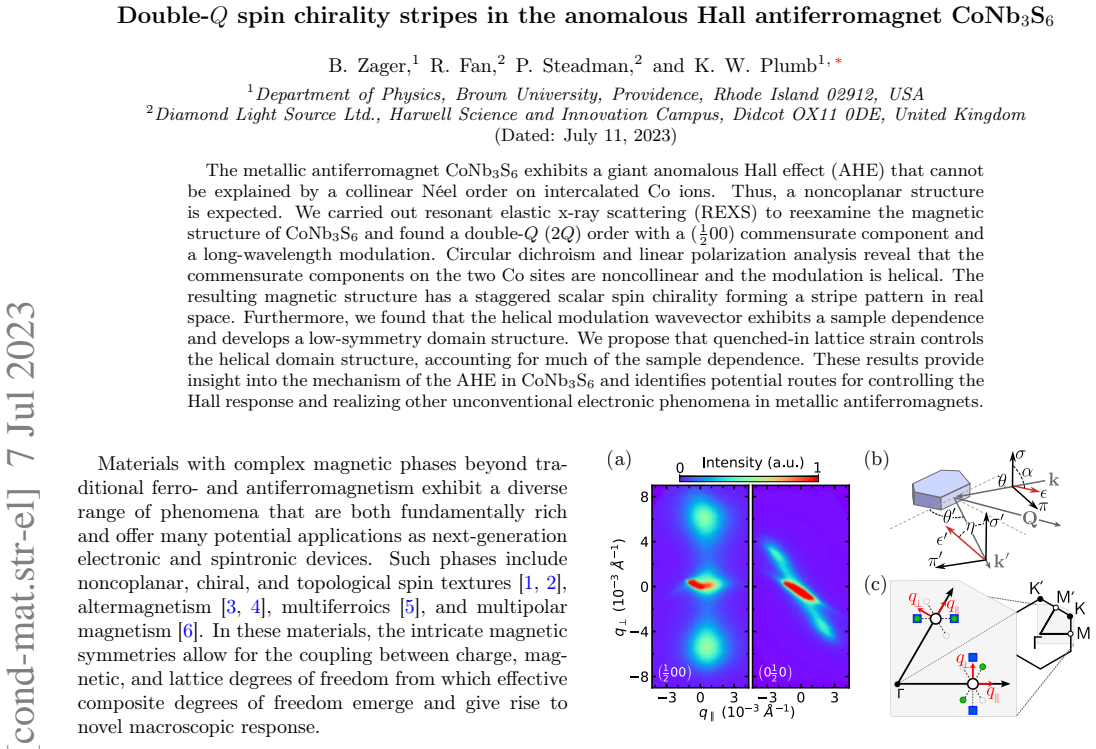
component and incommensurate Q0±q modulation giving rise to a stag- gered scalar spin chirality with a modulated stripe or (b) (c) (a) FIG. 1. (a) Magnetic REXS intensity in sample 3 at 16 K using circularly polarized x-rays. (b) Experimental geometry, incident (outgoing) polarization channelsσ(σ′) and π(π′) correspond toα(η) of 0° and 90° respectively. (...
-
[3]
Dashed lines with empty markers show positions of symmetry allowed peaks that were not observed
and (0 1 20), green circles show the magnetic reflections observed in samples 1 and 2 and blue squares show those found in sample 3 as in (a). Dashed lines with empty markers show positions of symmetry allowed peaks that were not observed. checkerboard pattern. The commensurate component of the structure is noncollinear and the incommensurate component is...
-
[5]
mag- netic wavevectors at2θ=106.2° at the CoL3 edge (778.5 eV). In this geometry the x-ray beam scatters from a (110) facet probing an effective area of20×200µm, and with a penetration depth of 0.3 µm. Thus, our mea- surements probe a macroscopic sample volume contain- ing many basal plane layers. Data was collected for four different samples using an are...
-
[6]
were observed in all samples, consistent with previous reports [11]. Our fine resolution measurements also revealed a long-wavelength incommensurate modulation of the magnetic structure through satellite magnetic reflections atQ0±q [Fig. 1]. These satellites showed three distinct behaviors between samples as summarized in Fig. 1(b). In samples 1 and 2, sa...
-
[7]
reflections in sample 3 [Fig. 1(a)] break both C6 rotational and mirror symmetry about (110) of the triangular lattice, while the satellite reflections observed in samples 1 and 2 possess mirror symmetry but break the C6 rotational symmetry. Such symme- try reductions indicate that ( 1
-
[8]
belong to distinct domains, not a single multi-Q domain, as will be further confirmed by the linear polarization analysis presented below. In this case, the particular long wave- length modulation of the magnetic structure realized in each domain of a given sample may be selected through a symmetry-breaking field such as small lattice strains that are que...
-
[9]
and Q0 +(δ2δ0) in sample 3. Both sets of peaks have the same critical temperature of TN = 28 K and an intensity that varies smoothly with temperature. We also observed a smooth decrease in the 0 1 2 3 4 5 δ (10−3 Å−1) 776 778 780 E (eV) 0 2 4 Intensity (a.u.) TFY ( 1 2 00) 15 20 25 30 T (K) 0 1I(T)/I(12 K) ( 1 2 00) ( 1 2 −δ 2δ 0) FIG. 2. Normalized tempe...
-
[10]
We also find that the CD varies between ZFC and 0.1 T FC measurements, es- pecially for the ( 1
shows a vari- ation along the (120) direction suggesting the presence of opposite chirality domains that may have slightly dif- ferent values ofδor are spatially separated on a length scale comparable to the beam size. We also find that the CD varies between ZFC and 0.1 T FC measurements, es- pecially for the ( 1
-
[11]
peaks, which is consistent with a redistribution of chiral domains, as we discuss below. Precise moment directions were determined from full linear polarization analysis (FLPA) by measuring the in- tensity atQ0 as a function of incident polarization angle αat various fixed analyzer angles η[Fig. 1(b)]. The polarization-dependent intensity shown in Fig. 4(...
-
[12]
(b) FC vs ZFC Line cuts along(δ,−2δ,0) at ( 1
for field-cooling (FC). (b) FC vs ZFC Line cuts along(δ,−2δ,0) at ( 1
-
[13]
ThenormalizedCDisdefinedas (C +−C−)/ ∫ (C ++ C−)
and along (δ00) at (0 1 20), averaged over 0.0025 Å−1 along the transverse direction. ThenormalizedCDisdefinedas (C +−C−)/ ∫ (C ++ C−). Inset shows energy scans at fixedQ = ( 1 2 −δ,2δ,0). structure is mn(rj) = cos(q·rj +ψn) cos(Q0·rj +ϕn)ˆun + sin(Q0·rj +ϕn)ˆvn, + cos(q·rj +ψn + π 2χ) cos(Q0·rj +ϕn) ˆwn, (1) where n = 1, 2 labels the sublattices at 2 Co ...
-
[14]
109(1)° 37(2)° 109(1)° 14(2)° (0 1
-
[15]
We sepa- rately consider two cases:∆ϕ=0 ° or ∆ϕ=180 ° and find for both µ= 109(1)° at ( 1
12(1)° 24(2)° 12(1)° 9(2)° constrains ∆ϕ=ϕ2−ϕ1 to either0° or 180° [22]. We sepa- rately consider two cases:∆ϕ=0 ° or ∆ϕ=180 ° and find for both µ= 109(1)° at ( 1
-
[16]
and µ= 12(1)° at (0 1 20), or nearly±80° from Q0. The in-plane angle relative to Q0 is opposite in each domain, with the same broken symmetry as the modulation wavevectors in samples 1 and 2 [15]. For ∆ϕ= 0 ° we findν= 37(2) ° at ( 1 200) and ν= 24(2)° at (0 1 20). While for ∆ϕ= 180°, we find ν= 14(2)° at ( 1
-
[17]
Both cases adequately describe the data at( 1
and ν= 9(2)° at (0 1 20). Both cases adequately describe the data at( 1
-
[18]
while neither fully matches the intensity atπ-σfor (0 1 20). We attribute this discrepancy to an experimental artifact likely due to a slight analyzer misalignment. Furthermore, we cannot rule out contributions from domains with different mo- ment orientations because the x-ray intensity measures an ensemble-average for a givenQ. The results of our fit ar...
-
[19]
(b) Real space depiction of magnetic structure on a single sublattice for Q0 = (1
and (0 1 20). (b) Real space depiction of magnetic structure on a single sublattice for Q0 = (1
-
[20]
and q = (−δ,2δ,0), plotted forδ= 0.053 r.l.u., ϕ= 45°, µ= 110°, ν= 30°. (c) Co2+ triangular plaquettes used to define the intra- and inter-sublattice scalar spin chirality contributionsχ∥ s and χ⊥ s . (d) Scalar spin chirality contribution from the inter-sublattice plaquettesχ⊥ s for the spin configuration in (c) with∆ϕ= 0, ∆ψ= 180°. The color of each tri...
-
[21]
are not along symmetry-equivalent directions and these two peaks cannot be described as separate domains of the same structure. In this sample, the surface normal is tilted away from (110), possibly giving rise to a rotated residual strain that may stabilize the transverse modula- tion in oneQ0-domain. This same rotation in the other Q0-domain would place...
-
[22]
C. Sang-Wook and X. Xianghan, NPJ Quantum Materi- als 7, 10.1038/s41535-022-00447-5 (2022)
-
[23]
S. Nakatsuji and R. Arita, Annual Review of Condensed Matter Physics 13, 119 (2022)
work page 2022
- [24]
- [25]
- [26]
- [27]
-
[28]
S. S. P. Parkin and R. H. Friend, Philosophical Magazine B 41, 65 (1980)
work page 1980
-
[29]
L. S. Xie, S. Husremović, O. Gonzalez, I. M. Craig, and D.K.Bediako,JournaloftheAmericanChemicalSociety 144, 9525 (2022)
work page 2022
-
[30]
N. J. Ghimire, A. Botana, J. Jiang, J. Zhang, Y.-S. Chen, and J. Mitchell, Nat. Commun.9, 1 (2018)
work page 2018
-
[31]
G. Tenasini, E. Martino, N. Ubrig, N. J. Ghimire, H. Berger, O. Zaharko, F. Wu, J. F. Mitchell, I. Mar- tin, L. Forró, and A. F. Morpurgo, Phys. Rev. Research 2, 023051 (2020)
work page 2020
-
[32]
S. S. P. Parkin, E. A. Marseglia, and P. J. Brown, Journal of Physics C: Solid State Physics16, 2765 (1983)
work page 1983
- [34]
- [35]
-
[36]
See Supplemental Material for sample characterization, additional REXS data, presentation of phase variable dependence of scalar chirality and details of the calcu- lations
-
[38]
T.A.W.Beale, T.P.A.Hase, T.Iida, K.Endo, P.Stead- man, A. R. Marshall, S. S. Dhesi, G. van der Laan, and P.D.Hatton,ReviewofScientificInstruments 81,073904 (2010)
work page 2010
-
[39]
H. Wang, P. Bencok, P. Steadman, E. Longhi, J. Zhu, and Z. Wang, Journal of Synchrotron Radiation19, 944 (2012)
work page 2012
-
[40]
Y. A. Izyumov, Soviet Physics Uspekhi27, 845 (1984)
work page 1984
-
[41]
J. Herrero-Martín, A. N. Dobrynin, C. Mazzoli, P. Stead- man, P. Bencok, R. Fan, A. A. Mukhin, V. Skumryev, and J. L. García-Muñoz, Phys. Rev. B91, 220403 (2015)
work page 2015
- [42]
-
[43]
S. Wu, Z. Xu, S. C. Haley, S. F. Weber, A. Acharya, E. Maniv, Y. Qiu, A. A. Aczel, N. S. Settineri, J. B. Neaton, J. G. Analytis, and R. J. Birgeneau, Phys. Rev. X 12, 021003 (2022)
work page 2022
- [44]
-
[45]
L. Šmejkal, R. González-Hernández, T. Jungwirth, and J. Sinova, Science Advances6, eaaz8809 (2020)
work page 2020
-
[46]
L. Šmejkal, A. H. MacDonald, J. Sinova, S. Nakat- suji, and T. Jungwirth, Nature Reviews Materials7, 482 (2022)
work page 2022
-
[47]
S. Hayami and M. Yatsushiro, Journal of the Physical Society of Japan91, 094704 (2022)
work page 2022
- [49]
- [50]
- [51]
- [52]
-
[53]
S. Hayami and Y. Motome, Journal of Physics: Con- densed Matter 33, 443001 (2021)
work page 2021
-
[54]
X. P. Yang, H. LaBollita, Z.-J. Cheng, H. Bhandari, T. A. Cochran, J.-X. Yin, M. S. Hossain, I. Belopolski, Q. Zhang, Y. Jiang, N. Shumiya, D. Multer, M. Liske- vich, D. A. Usanov, Y. Dang, V. N. Strocov, A. V. Davy- dov, N. J. Ghimire, A. S. Botana, and M. Z. Hasan, Phys. Rev. B 105, L121107 (2022)
work page 2022
-
[55]
Hayami, Journal of Magnetism and Magnetic Materi- als 513, 167181 (2020)
S. Hayami, Journal of Magnetism and Magnetic Materi- als 513, 167181 (2020)
work page 2020
-
[56]
K. Shibata, J. Iwasaki, N. Kanazawa, S. Aizawa, T. Tani- gaki, M. Shirai, T. Nakajima, M. Kubota, M. Kawasaki, H. Park, et al., Nature nanotechnology10, 589 (2015)
work page 2015
-
[57]
Y. Nii, T. Nakajima, A. Kikkawa, Y. Yamasaki, K. Ohishi, J. Suzuki, Y. Taguchi, T. Arima, Y. Tokura, and Y. Iwasa, Nature communications6, 8539 (2015)
work page 2015
- [58]
-
[59]
S. Lee, T. Choi, W. Ratcliff, R. Erwin, S.-W. Cheong, and V. Kiryukhin, Phys. Rev. B78, 100101 (2008)
work page 2008
-
[60]
N. S. Gusev, A. V. Sadovnikov, S. A. Nikitov, M. V. Sapozhnikov, and O. G. Udalov, Phys. Rev. Lett.124, 157202 (2020)
work page 2020
-
[61]
G. Simutis, J. Küspert, Q. Wang, J. Choi, D. Bucher, M. Boehm, F. Bourdarot, M. Bertelsen, C. N. Wang, T. Kurosawa, et al. , Communications Physics 5, 296 (2022)
work page 2022
-
[62]
P. Canfield, R. Movshovich, R. Robinson, J. Thomp- son, Z. Fisk, W. Beyermann, A. Lacerda, M. Hundley, R. Heffner, D. MacLaughlin, F. Trouw, and H. Ott, Phys- ica B: Condensed Matter197, 101 (1994)
work page 1994
- [63]
-
[64]
S.Lim, F.-T.Huang, S.Pan, K.Wang, J.Kim,andS.-W. Cheong, preprint (2020)
work page 2020
- [65]
- [66]
-
[67]
S. Mangelsen, P. Zimmer, C. Näther, S. Mankovsky, S. Polesya, H. Ebert, and W. Bensch, Phys. Rev. B103, 184408 (2021)
work page 2021
- [68]
-
[69]
S. L. Zhang, A. Bauer, D. M. Burn, P. Milde, E. Neuber, L. M. Eng, H. Berger, C. Pfleiderer, G. van der Laan, and T. Hesjedal, Nano Letters16, 3285 (2016)
work page 2016
-
[70]
Double-$Q$ chiral stripe order in the anomalous Hall antiferromagnet CoNb$_3$S$_6$
Y. Okamura, Y. Yamasaki, D. Morikawa, T. Honda, V. Ukleev, H. Nakao, Y. Murakami, K. Shibata, F. Ka- gawa, S. Seki, T. Arima, and Y. Tokura, Phys. Rev. B 96, 174417 (2017). Supplementary Material for Double- Q spin chirality stripes in the anomalous Hall antiferromagnet CoNb 3S6 B. Zager, 1 R. Fan, 2 P. Steadman, 2 and K. W. Plumb 1 1Department of Physics...
work page internal anchor Pith review Pith/arXiv arXiv 2017
-
[71]
along the L direction for (a) sample 1, (b) sample 2, (c) sample 3, and (d) sample 4
in the (HK 0) plane integrated over 0.003 r.l.u. along the L direction for (a) sample 1, (b) sample 2, (c) sample 3, and (d) sample 4. III. CORRELA TION LENGTHS Fig. 3 shows line cuts along the L direction for each main and satellite peak in all samples. We use a Lorentzian fit to obtain an out-of-plane correlation length ξc. Fig. 4 shows in-plane transve...
-
[72]
( 1 2δ0) ( 1 2δ0) (0 1
-
[73]
Measured correlation lengths for sample 3
( δ1 20) Sample 1 ξab(nm) 563(8) 570(9) 151(14) 93(3) 85(2) 247(7) 107(1) 102(2) ξc (nm) 571(5) 563(5) 212(1) 135(1) 133(1) 265(2) 143(1) 172(1) Sample 2 ξab (nm) 274(14) 216(12) 136(2) 197(5) 90(2) 99(2) 107(2) 122(2) ξc (nm) - 182(6) 159(2) 139(2) 112(2) 98(2) 110(2) 97(1) Sample 4 ξab (nm) 394(8) 474(11) 469(40) - - 352(37) - - ξc (nm) 195(2) 199(2) 14...
-
[74]
( 1 2 +δ,− 2δ,0) ( 1 2 −δ,2δ,0) (0 1
-
[75]
( δ1 20) ξab (nm) 274(14) 216(12) 136(2) 197(5) 90(2) 99(2) 107(2) 122(2) ξc (nm) - 182(6) 159(2) 139(2) 112(2) 98(2) 110(2) 97(1) 3 (a) (b) (c) (d) FIG. 3. Line cuts through the magnetic peaks along the L direction integrated over 0.005 r.l.u. along the H andK directions in (a) sample 1, (b) sample 2, (c) sample 3, and (d) sample 4. (d) (c) (b) (a) FIG. ...
-
[76]
using the parameters from the main text. (c) FLPA data at (0 1 20). (d) FLPA calculation at (0 1
-
[77]
using the parameters from the main text. B. Circular dichroism For circularly polarized x-rays ϵ±= 1√ 2(σ∓iπ), the intensity I±=I±±+I∓±is [9] I±= 1 2(|Sσ′σ|2 +|Sσ′π|2 +|Sπ′σ|2 +|Sπ′π|2)±Im(Sσ′σS∗ σ′π+Sπ′σS∗ π′π), (14) The circular dichroism is I+−I−= 2 Im(Sπ′σS∗ π′π), (15) where we have assumed Sσ′σ= 0. Thus the condition for finite CD is a finite structu...
-
[78]
The vertical dashed lines show the value of νdetermined from FLPA for each choice of phases
and Q0 ± (0δ0) for each of the four phase combinations with µ= 109°. The vertical dashed lines show the value of νdetermined from FLPA for each choice of phases. The magnetic structure determined from FLPA is consistent with the CD-REXS results. The condition for CD at Q0 is finite intensity in bothσ-πandπ-π, which arises from the noncollinear moments wit...
-
[79]
and q =( −δ,2δ,0), δ=0.053 r.l.u., ϕ=45 °. (a) (c) (d) (b) FIG. 12. Scalar spin chirality χ⊥ s from the inter-sublattice plaquettes projected on the z-component of the plaquette normal vectors for the structure with Q0 =( 1
-
[80]
(larger than the observed value of δ= 0.003 r.l.u
and q =( −δ,2δ,0), δ=0.053 r.l.u. (larger than the observed value of δ= 0.003 r.l.u. to simplify visualization), ϕ=45 °, µ=110 °, ν=30 ° (a) ∆ ϕ= 0°, ∆ ψ= 0°. (b) ∆ ϕ= 0°, ∆ ψ= 180°. (c) ∆ ϕ= 180°, ∆ ψ= 0°. (d) ∆ ϕ= 180°, ∆ ψ= 180°. 9
-
[81]
N. J. Ghimire, A. Botana, J. Jiang, J. Zhang, Y.-S. Chen, and J. Mitchell, Nat. Commun. 9, 1 (2018)
work page 2018
- [82]
-
[83]
T. Ueno, K. Yamamoto, H. Matsukura, T. Kusawake, and K. ichi Ohshima, Science and Technology of Advanced Materials 6, 684 (2005), https://doi.org/10.1016/j.stam.2005.05.007
-
[84]
S. S. P. Parkin, E. A. Marseglia, and P. J. Brown, Journal of Physics C: Solid State Physics 16, 2765 (1983)
work page 1983
discussion (0)
Sign in with ORCID, Apple, or X to comment. Anyone can read and Pith papers without signing in.