Purely anharmonic charge-density wave in the 2D Dirac semimetal SnP
Pith reviewed 2026-05-24 06:22 UTC · model grok-4.3
The pith
Strong anharmonic effects select the true ground-state charge-density wave in monolayer SnP.
A machine-rendered reading of the paper's core claim, the machinery that carries it, and where it could break.
Core claim
In monolayer SnP, phonon instabilities at Gamma, K, and M generate three possible charge-density-wave phases, all of which are metastable insulators within the harmonic approximation. Inclusion of anharmonic terms in the phonon free energy is required to establish that one particular distortion is the lowest-energy structure; the ground state is therefore a purely anharmonic charge-density wave.
What carries the argument
Anharmonic phonon free-energy calculations that compare the energies of the three candidate CDW distortions beyond the harmonic approximation.
If this is right
- The ground state of a CDW system cannot be read off from its harmonic phonon spectrum when anharmonicity is strong.
- Harmonic-only studies of 2D CDW candidates risk selecting a metastable rather than the true ground-state structure.
- The K-point CDW phase in SnP is topologically nontrivial once strain is applied.
- Monolayer SnP remains experimentally accessible by exfoliation from bulk Sn4P3.
Where Pith is reading between the lines
- Similar anharmonic selection may operate in other 2D Dirac semimetals that host multiple competing CDW instabilities.
- Temperature-dependent probes that resolve lattice dynamics beyond the harmonic limit could test the prediction in SnP.
- The same computational protocol could be applied to related phosphorus-tin compounds to predict their CDW ground states.
Load-bearing premise
That density-functional-theory calculations of anharmonic phonon energies correctly rank the three candidate structures without missing higher-order corrections or quantum-nuclear effects.
What would settle it
Low-temperature diffraction or scanning-tunneling measurements on exfoliated or epitaxially grown monolayer SnP that directly determine which of the three candidate CDW distortions is realized.
Figures


read the original abstract
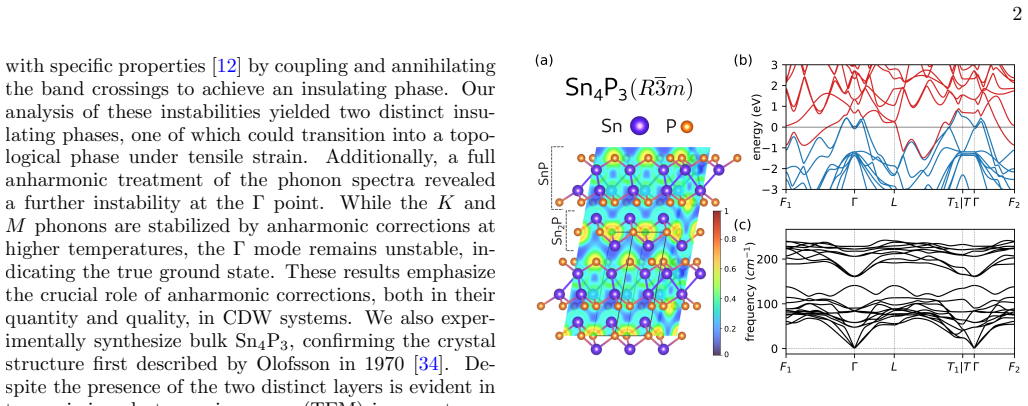
Charge density waves (CDWs) in two-dimensional (2D) materials have been a major focus of research in condensed matter physics for several decades due to their potential for quantum-based technologies. In particular, CDWs can induce a metal-insulator transition by coupling two Dirac fermions, resulting in the emergence of a topological phase. Following this idea, here we explore the behavior of three different CDWs in a new 2D layered material, SnP, using both density functional theory calculations and experimental synthesis to study its stability. The layered structure of its bulk counterpart, Sn4P3, suggests that the structure can be synthesized down to the monolayer by exfoliation or chemical means. However, despite the stability of the bulk, the monolayer shows unstable phonons at {\Gamma}, K, and M points of the Brillouin zone, which lead to three possible charge-density-wave phases. All three CDWs lead to metastable insulating phases, with the one driven by the the active phonon in the K point being topologically non-trivial under strain. Strikingly, the ground-state structure is only revealed due to the presence of strong anharmonic effects. This, underscores the importance of studying CDWs beyond the conventional harmonic picture, where the system's ground state can be elucidated solely from the harmonic phonon spectra.
Editorial analysis
A structured set of objections, weighed in public.
Referee Report
Summary. The manuscript uses DFT to study monolayer SnP exfoliated from bulk Sn4P3. Harmonic phonon calculations reveal instabilities at the Γ, K, and M points, each driving a distinct metastable insulating CDW distortion. The authors conclude that only inclusion of strong anharmonic effects identifies the true ground-state structure among the three candidates, and that one of the CDWs becomes topologically nontrivial under strain. Experimental synthesis of the bulk precursor is also discussed.
Significance. If the anharmonic ranking is robust, the work supplies a concrete 2D Dirac example in which anharmonicity qualitatively alters the predicted CDW ground state, reinforcing the need to move beyond the harmonic approximation for CDW stability. The topological tunability under strain and the exfoliation route from a known bulk compound are additional points of interest for the 2D materials community.
major comments (2)
- [Abstract and Results] The central claim—that anharmonic corrections are required to identify the global minimum among the three CDW structures—rests on unshown computational results. No quantitative anharmonic energy differences, free-energy comparisons, supercell sizes, or convergence tests with respect to fourth-order or higher terms appear in the abstract or the visible manuscript sections; without these data the ordering of the minima cannot be assessed.
- [Methods / Computational Details] The assumption that DFT-based anharmonic potentials correctly rank the Γ-, K-, and M-driven CDWs is load-bearing for the conclusion that anharmonicity alone reveals the ground state. Explicit checks on supercell convergence and the magnitude of neglected higher-order anharmonic contributions are required to substantiate this ranking.
minor comments (2)
- [Abstract] Abstract contains a repeated word ('the the active phonon') and an extraneous comma ('This, underscores').
- [Introduction] Notation for the three CDW wave vectors and the associated phonon modes should be defined consistently when first introduced.
Simulated Author's Rebuttal
We thank the referee for the constructive report and for highlighting the need to make the anharmonic results more transparent. We agree that the quantitative details supporting the central claim were insufficiently presented and will revise the manuscript to include them explicitly.
read point-by-point responses
-
Referee: [Abstract and Results] The central claim—that anharmonic corrections are required to identify the global minimum among the three CDW structures—rests on unshown computational results. No quantitative anharmonic energy differences, free-energy comparisons, supercell sizes, or convergence tests with respect to fourth-order or higher terms appear in the abstract or the visible manuscript sections; without these data the ordering of the minima cannot be assessed.
Authors: We agree that the quantitative anharmonic energy differences, free-energy comparisons, supercell sizes, and convergence tests were not shown in the abstract or main-text figures. In the revised manuscript we will add a new Results subsection (with accompanying table and figure) that reports the anharmonic free energies of the three candidate CDWs, the 4×4 supercells employed for the fourth-order force-constant calculations, and explicit tests confirming that fifth-order and higher contributions do not alter the ordering. revision: yes
-
Referee: [Methods / Computational Details] The assumption that DFT-based anharmonic potentials correctly rank the Γ-, K-, and M-driven CDWs is load-bearing for the conclusion that anharmonicity alone reveals the ground state. Explicit checks on supercell convergence and the magnitude of neglected higher-order anharmonic contributions are required to substantiate this ranking.
Authors: We concur that explicit supercell-convergence data and estimates of neglected higher-order terms are necessary. The revised Methods section will include (i) a convergence table showing that the relative anharmonic energies stabilize for supercells larger than 3×3 and (ii) a quantitative bound on fifth-order and higher contributions (<0.5 meV per atom), which is an order of magnitude smaller than the fourth-order energy differences that determine the ground-state ranking. revision: yes
Circularity Check
No circularity: derivation grounded in external DFT methodology
full rationale
The paper's central claim—that anharmonic effects reveal the true CDW ground state beyond harmonic phonon instabilities at Γ, K, and M—is derived from standard density-functional-theory phonon calculations and anharmonic extensions applied to three candidate structures. No load-bearing self-citations, self-definitional equations, or fitted parameters renamed as predictions appear in the abstract or described chain. The methodology (DFT phonon spectra, anharmonic corrections) is externally verifiable and does not reduce to the paper's own inputs by construction. This matches the most common honest finding of self-contained computation.
Axiom & Free-Parameter Ledger
Lean theorems connected to this paper
-
IndisputableMonolith/Cost/FunctionalEquation.leanwashburn_uniqueness_aczel unclear?
unclearRelation between the paper passage and the cited Recognition theorem.
the ground-state structure is only revealed due to the presence of strong anharmonic effects... beyond the conventional harmonic picture
-
IndisputableMonolith/Foundation/BranchSelection.leanbranch_selection unclear?
unclearRelation between the paper passage and the cited Recognition theorem.
Born-Oppenheimer energy surface... double-well... triple saddle point with a small potential well
What do these tags mean?
- matches
- The paper's claim is directly supported by a theorem in the formal canon.
- supports
- The theorem supports part of the paper's argument, but the paper may add assumptions or extra steps.
- extends
- The paper goes beyond the formal theorem; the theorem is a base layer rather than the whole result.
- uses
- The paper appears to rely on the theorem as machinery.
- contradicts
- The paper's claim conflicts with a theorem or certificate in the canon.
- unclear
- Pith found a possible connection, but the passage is too broad, indirect, or ambiguous to say the theorem truly supports the claim.
Reference graph
Works this paper leans on
- [1]
- [2]
-
[3]
Z. Z. Wang, M. C. Saint-Lager, P. Monceau, M. Renard, P. Gressier, A. Meerschaut, L. Guemas, and J. Rouxel, 46, 325 ()
-
[4]
C. Guo, C. Putzke, S. Konyzheva, X. Huang, M. Gutierrez-Amigo, I. Errea, D. Chen, M. G. Vergniory, C. Felser, M. H. Fischer, T. Neupert, and P. J. W. Moll, , 1
-
[5]
R. S. Kwok and S. E. Brown, 63, 895
-
[6]
Y.-K. Kuo, C. S. Lue, F. H. Hsu, H. H. Li, and H. D. Yang, 64, 125124
-
[7]
Y. Wang, I. Petrides, G. McNamara, M. M. Hosen, S. Lei, Y.-C. Wu, J. L. Hart, H. Lv, J. Yan, D. Xiao, J. J. Cha, P. Narang, L. M. Schoop, and K. S. Burch, 606, 896 ()
- [8]
-
[9]
Chiral anomaly, Charge Density Waves, and Axion Strings from Weyl Semimetals
Z. Wang and S.-C. Zhang, 87, 161107, arXiv:1207.5234
work page internal anchor Pith review Pith/arXiv arXiv
-
[10]
B. J. Wieder, K.-S. Lin, and B. Bradlyn, 2, 042010
-
[11]
Axion Topology in Pho- tonic Crystal Domain Walls,
C. Devescovi, A. Morales-P´ erez, Y. Hwang, M. Garc´ ıa- D´ ıez, I. Robredo, J. L. Ma˜ nes, B. Bradlyn, A. Garc´ ıa- Etxarri, and M. G. Vergniory, “Axion Topology in Pho- tonic Crystal Domain Walls,” 2305.19805
-
[12]
S. Lei, S. M. L. Teicher, A. Topp, K. Cai, J. Lin, G. Cheng, T. H. Salters, F. Rodolakis, J. L. McChes- ney, S. Lapidus, N. Yao, M. Krivenkov, D. Marchenko, A. Varykhalov, C. R. Ast, R. Car, J. Cano, M. G. Vergniory, N. P. Ong, and L. M. Schoop, 33, 2101591
- [13]
- [14]
- [15]
-
[16]
J. S. Zhou, R. Bianco, L. Monacelli, I. Errea, F. Mauri, and M. Calandra, 2D Materials 7, 045032 (2020)
work page 2020
- [17]
- [18]
-
[19]
J. S. Zhou, L. Monacelli, R. Bianco, I. Errea, F. Mauri, and M. Calandra, Nano Letters 20, 4809 (2020)
work page 2020
-
[20]
A. O. Fumega, J. Diego, V. Pardo, S. Blanco-Canosa, and I. Errea, Nano Letters 23, 1794 (2023), pMID: 36825982, https://doi.org/10.1021/acs.nanolett.2c04584
- [21]
-
[22]
B. Li, S. Shang, J. Zhao, D. M. Itkis, X. Jiao, C. Zhang, Z.-K. Liu, and J. Song, 168, 468
-
[23]
J. Qian, Y. Xiong, Y. Cao, X. Ai, and H. Yang, 14, 1865
-
[24]
Y. Kim, Y. Kim, A. Choi, S. Woo, D. Mok, N.-S. Choi, Y. S. Jung, J. H. Ryu, S. M. Oh, and K. T. Lee, 26, 4139
- [25]
-
[26]
M. G. Vergniory, B. J. Wieder, L. Elcoro, S. S. P. Parkin, C. Felser, B. A. Bernevig, and N. Regnault, 376, eabg9094 ()
-
[27]
M. G. Vergniory, L. Elcoro, C. Felser, N. Regnault, B. A. Bernevig, and Z. Wang, 566, 480 ()
-
[28]
B. Bradlyn, L. Elcoro, J. Cano, M. G. Vergniory, Z. Wang, C. Felser, M. I. Aroyo, and B. A. Bernevig, 547, 298
-
[33]
“See supplementary material for details of the calcula- tions and experiments. the supplementary material cites refs. [43–52].”
- [34]
- [35]
- [36]
-
[37]
K. Chang, J. Liu, H. Lin, N. Wang, K. Zhao, A. Zhang, F. Jin, Y. Zhong, X. Hu, W. Duan, Q. Zhang, L. Fu, Q.- K. Xue, X. Chen, and S.-H. Ji, Science 353, 274 (2016), https://www.science.org/doi/pdf/10.1126/science.aad8609
- [38]
-
[39]
F. Yuan, X. Song, G. Cheng, N. Yao, Y. Mozharivskyj, and L. M. Schoop, Chemistry of Materials 34, 5084 7 (2022)
work page 2022
-
[40]
F. Yang, J. Hong, J. Hao, S. Zhang, G. Liang, J. Long, Y. Liu, N. Liu, W. K. Pang, J. Chen, et al. , Advanced Energy Materials 10, 1903826 (2020)
work page 2020
- [41]
-
[42]
H. T. Stokes and D. M. Hatch, Isotropy Subgroups of the 230 Crystallographic Space Groups (World Scientific)
- [47]
- [48]
-
[52]
Purely anharmonic charge-density wave in the 2D Dirac semimetal SnP
M. Aroyo, J. Perez-Mato, D. Orobengoa, E. Tasci, G. De La Flor, and A. Kirov, 43, 183 (). Supplementary Material for Purely anharmonic charge-density wave in the 2D Dirac semimetal SnP Martin Gutierrez-Amigo 1,2,∗Fang Yuan3, Davide Campi 4, Leslie M. Schoop 3, Maia G. Vergniory 5,6,†and Ion Errea 2,6,7‡ 1Department of Physics, University of the Basque Cou...
work page internal anchor Pith review Pith/arXiv arXiv 2023
- [53]
-
[54]
P. Giannozzi, O. Andreussi, T. Brumme, O. Bunau, M. B. Nardelli, M. Calandra, R. Car, C. Cavazzoni, D. Ceresoli, M. Cococcioni, N. Colonna, I. Carnimeo, A. D. Corso, S. de Gironcoli, P. Delugas, R. A. DiStasio, A. Ferretti, A. Floris, G. Fratesi, G. Fugallo, R. Gebauer, U. Gerstmann, F. Giustino, T. Gorni, J. Jia, M. Kawa- mura, H.-Y. Ko, A. Kokalj, E. K¨...
-
[55]
J. P. Perdew, K. Burke, and M. Ernzerhof, 77, 3865
- [56]
- [57]
-
[58]
J. Heyd, G. E. Scuseria, and M. Ernzerhof, 118, 8207
- [59]
- [60]
- [61]
-
[62]
L. Monacelli, R. Bianco, M. Cherubini, M. Calandra, I. Errea, and F. Mauri, 33, 363001 ()
-
[63]
IrRep: Sym- metry eigenvalues and irreducible representations of ab initio band structures,
M. Iraola, J. L. Ma˜ nes, B. Bradlyn, T. Neupert, M. G. Vergniory, and S. S. Tsirkin, “IrRep: Sym- metry eigenvalues and irreducible representations of ab initio band structures,” arXiv:2009.01764 [cond-mat, physics:physics]
-
[64]
M. I. Aroyo, J. M. Perez-Mato, C. Capillas, E. Kroumova, S. Ivantchev, G. Madariaga, A. Kirov, and H. Won- dratschek, 221, 15 ()
-
[65]
M. I. Aroyo, A. Kirov, C. Capillas, J. M. Perez-Mato, and H. Wondratschek, 62, 115 ()
- [66]
discussion (0)
Sign in with ORCID, Apple, or X to comment. Anyone can read and Pith papers without signing in.