SimSiam Naming Game: A Unified Approach for Representation Learning and Emergent Communication
Pith reviewed 2026-05-23 19:07 UTC · model grok-4.3
The pith
SimSiam Naming Game aligns agent representations via self-supervised messages to enable feedback-free emergent communication with improved downstream utility.
A machine-rendered reading of the paper's core claim, the machinery that carries it, and where it could break.
Core claim
SSNG formulates symbol emergence as an alignment process between agents' latent representations mediated by message exchange, building on a variational inference-based probabilistic interpretation of self-supervised learning. Discrete symbolic messages are learned via Gumbel-Softmax relaxation to allow end-to-end optimization. On CIFAR-10 and ImageNet-100, the emergent messages achieve substantially higher linear-probe classification accuracy than those from referential games, reconstruction games, and MHNG.
What carries the argument
The SimSiam Naming Game mechanism, which performs symmetric self-supervised alignment of agents' representations through exchanged discrete messages relaxed by Gumbel-Softmax.
If this is right
- Feedback-free emergent communication becomes feasible in high-dimensional perceptual spaces.
- Self-supervised objectives can mediate symbol emergence without joint attention or rewards.
- Learned messages support stronger linear classification performance on standard image benchmarks.
- End-to-end differentiable training is possible while keeping messages discrete.
Where Pith is reading between the lines
- If the alignment works across agents, it may extend to larger populations of agents developing shared languages.
- Representation learning objectives could be applied directly to communication emergence in other domains like robotics.
- Future work might explore whether the same variational interpretation applies to other self-supervised methods beyond SimSiam.
Load-bearing premise
That a symmetric self-supervised alignment objective between agents can produce shared symbolic representations without any explicit success signal or reward.
What would settle it
Running the linear probe experiment on CIFAR-10 with SSNG messages and finding no improvement or lower accuracy compared to MHNG messages would falsify the performance claim.
Figures
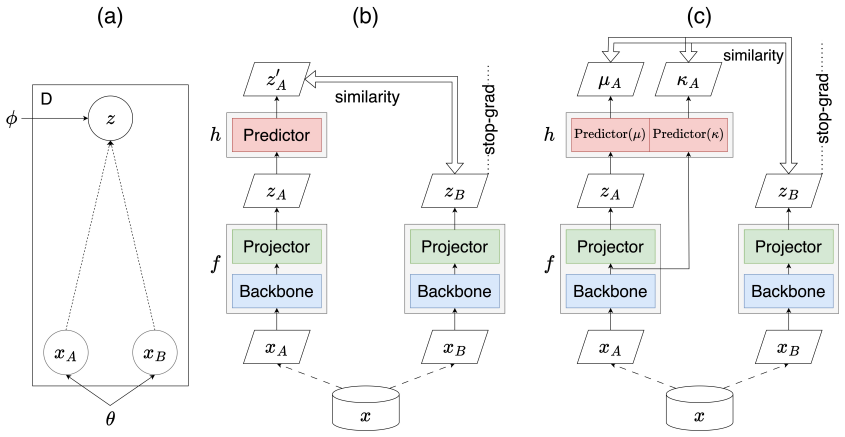


read the original abstract
Emergent Communication (EmCom) investigates how agents develop symbolic communication through interaction without predefined language. Recent frameworks, such as the Metropolis--Hastings Naming Game (MHNG), formulate EmCom as the learning of shared external representations negotiated through interaction under joint attention, without explicit success or reward feedback. However, MHNG relies on sampling-based updates that suffer from high rejection rates in high-dimensional perceptual spaces, making the learning process sample-inefficient for complex visual datasets. In this work, we propose the SimSiam Naming Game (SSNG), a feedback-free EmCom framework that replaces sampling-based updates with a symmetric, self-supervised representation alignment objective between autonomous agents. Building on a variational inference--based probabilistic interpretation of self-supervised learning, SSNG formulates symbol emergence as an alignment process between agents' latent representations mediated by message exchange. To enable end-to-end gradient-based optimization, discrete symbolic messages are learned via a Gumbel--Softmax relaxation, preserving the discrete nature of communication while maintaining differentiability. Experiments on CIFAR-10 and ImageNet-100 show that the emergent messages learned by SSNG achieve substantially higher linear-probe classification accuracy than those produced by referential games, reconstruction games, and MHNG. These results indicate that self-supervised representation alignment provides an effective mechanism for feedback-free EmCom in multi-agent systems.
Editorial analysis
A structured set of objections, weighed in public.
Referee Report
Summary. The paper proposes SimSiam Naming Game (SSNG), a feedback-free emergent communication framework that replaces MHNG's sampling-based updates with a symmetric self-supervised representation alignment objective between agents. Discrete messages are obtained via Gumbel-Softmax relaxation, and experiments on CIFAR-10 and ImageNet-100 report substantially higher linear-probe classification accuracy for SSNG messages versus referential games, reconstruction games, and MHNG.
Significance. If the empirical comparison holds under rigorous controls, the work offers a scalable, gradient-based alternative to sampling-heavy methods for symbol emergence in high-dimensional visual domains and provides a concrete bridge between self-supervised representation learning and multi-agent emergent communication.
major comments (2)
- [Experiments] Experiments section: the headline claim of substantially higher linear-probe accuracy is presented without error bars, number of independent runs, or statistical significance tests against the three baselines; this information is load-bearing for evaluating whether the reported gains are robust rather than implementation artifacts.
- [Method] Method and experimental setup: the Gumbel-Softmax temperature is listed as a free hyperparameter, yet no sensitivity analysis or ablation on its value is reported; because the discretization step directly affects message quality and downstream probe accuracy, this choice must be shown not to drive the comparative result.
minor comments (2)
- [Introduction] The variational-inference framing of SSL is introduced in the abstract and introduction but is not used in any derivation that alters the implemented objective; a brief clarification would remove potential reader confusion without changing the technical contribution.
- [Method] Notation for the two agents, their encoders, and the message channel is introduced piecemeal; a single consolidated table or diagram early in the method section would improve readability.
Simulated Author's Rebuttal
We thank the referee for the constructive comments on our manuscript. We address each major comment below, indicating planned revisions where appropriate.
read point-by-point responses
-
Referee: [Experiments] Experiments section: the headline claim of substantially higher linear-probe accuracy is presented without error bars, number of independent runs, or statistical significance tests against the three baselines; this information is load-bearing for evaluating whether the reported gains are robust rather than implementation artifacts.
Authors: We agree that the absence of error bars, details on the number of independent runs, and statistical significance tests weakens the strength of the empirical claims. In the revised manuscript we will report results aggregated over multiple independent runs (with standard deviations) and include pairwise statistical significance tests against the baselines. revision: yes
-
Referee: [Method] Method and experimental setup: the Gumbel-Softmax temperature is listed as a free hyperparameter, yet no sensitivity analysis or ablation on its value is reported; because the discretization step directly affects message quality and downstream probe accuracy, this choice must be shown not to drive the comparative result.
Authors: We acknowledge that an ablation on the Gumbel-Softmax temperature is necessary to demonstrate that the reported gains are not driven by a particular temperature choice. We will add a sensitivity analysis varying the temperature across a reasonable range and include the corresponding linear-probe accuracies in the revised experimental section. revision: yes
Circularity Check
No significant circularity
full rationale
The paper introduces SSNG as a new feedback-free EmCom framework replacing MHNG's sampling with a symmetric self-supervised alignment objective (SimSiam-style) plus Gumbel-Softmax. The central claim is empirical: higher linear-probe accuracy on CIFAR-10 and ImageNet-100 versus referential, reconstruction, and MHNG baselines. This rests on concrete new experiments and re-implementations rather than any equation reducing by construction to fitted parameters, self-citations, or renamed inputs. The variational-inference framing of SSL is presented as interpretive scaffolding, not a load-bearing derivation that forces the result. No self-definitional, fitted-prediction, or uniqueness-imported steps appear in the provided abstract or framing.
Axiom & Free-Parameter Ledger
free parameters (1)
- Gumbel-Softmax temperature
axioms (1)
- domain assumption A variational inference-based probabilistic interpretation of self-supervised learning extends to formulating symbol emergence as alignment between agents' latent representations
Forward citations
Cited by 1 Pith paper
-
Decentralized Collective World Model for Emergent Communication and Coordination
A decentralized collective world model integrates predictive coding with bidirectional communication to achieve simultaneous symbol emergence and coordination, outperforming non-communicative baselines in a two-agent ...
Reference graph
Works this paper leans on
-
[2]
Contrastive Variational Autoencoder Enhances Salient Features
URL http://arxiv.org/abs/1902.04601. Jyoti Aneja, Alex Schwing, Jan Kautz, and Arash Vahdat. A contrastive learning approach for training variational autoencoder priors. In A. Beygelzimer, Y. Dauphin, P. Liang, and J. Wortman Vaughan (eds.), Advances in Neural Information Processing Systems ,
work page internal anchor Pith review Pith/arXiv arXiv 1902
-
[3]
Yoshua Bengio, Aaron Courville, and Pascal Vincent
doi: 10.1098/rstb.2019.0307. Yoshua Bengio, Aaron Courville, and Pascal Vincent. Representation learning: A review and new perspec- tives. IEEE transactions on pattern analysis and machine intelligence , 35(8):1798–1828, 2013a. Yoshua Bengio, Nicholas L´ eonard, and Aaron Courville. Estimating or propagating gradients through stochastic neurons for condit...
-
[4]
Henry Brighton and Simon Kirby
doi: 10.1109/ACCESS.2023.3339656. Henry Brighton and Simon Kirby. Understanding linguistic evolution by visualizing the emergence of topo- graphic mappings. Artificial life, 12(2):229–242,
-
[5]
Angelo Cangelosi and Domenico Parisi
doi: 10.1162/106454606776073323. Angelo Cangelosi and Domenico Parisi. Computer simulation: A new scientific approach to the study of language evolution. Simulating the Evolution of Language , pp. 3–28,
-
[6]
Emerging properties in self-supervised vision transformers
10 Mathilde Caron, Hugo Touvron, Ishan Misra, Herv´ e Jegou, Julien Mairal, Piotr Bojanowski, and Armand Joulin. Emerging properties in self-supervised vision transformers. In 2021 IEEE/CVF International Conference on Computer Vision (ICCV) , pp. 9630–9640,
work page 2021
-
[7]
Walk in the cloud: Learning curves for point clouds shape analysis, pp
doi: 10.1109/ICCV48922.2021.00951. Rahma Chaabouni, Eugene Kharitonov, Diane Bouchacourt, Emmanuel Dupoux, and Marco Baroni. Com- positionality and generalization in emergent languages. In Proceedings of the 58th Annual Meeting of the Association for Computational Linguistics , July
-
[8]
Ting Chen, Simon Kornblith, Mohammad Norouzi, and Geoffrey Hinton
doi: 10.4324/9780203014936. Ting Chen, Simon Kornblith, Mohammad Norouzi, and Geoffrey Hinton. A simple framework for contrastive learning of visual representations. InProceedings of the 37th International Conference on Machine Learning (ICML),
-
[9]
Elijah Cole, Xuan Yang, Kimberly Wilber, Oisin Mac Aodha, and Serge Belongie. When does contrastive visual representation learning work? In 2022 IEEE/CVF Conference on Computer Vision and Pattern Recognition (CVPR), pp. 01–10,
work page 2022
-
[10]
doi: 10.1109/CVPR52688.2022.01434. Kevin Denamgana¨ ı, Sondess Missaoui, and James Alfred Walker. Visual referential games further the emer- gence of disentangled representations,
-
[11]
Hiroto Ebara, Tomoaki Nakamura, Akira Taniguchi, and Tadahiro Taniguchi
URL https://arxiv.org/abs/2304.14511. Hiroto Ebara, Tomoaki Nakamura, Akira Taniguchi, and Tadahiro Taniguchi. Multi-agent reinforcement learning with emergent communication using discrete and indifferentiable message. In 2023 15th Inter- national Congress on Advanced Applied Informatics Winter (IIAI-AAI-Winter) , pp. 366–371,
-
[12]
doi: 10.1109/IIAI-AAI-Winter61682.2023.00073. Jakob N. Foerster, Yannis M. Assael, Nando de Freitas, and Shimon Whiteson. Learning to communicate with deep multi-agent reinforcement learning,
-
[13]
Learning to Communicate with Deep Multi-Agent Reinforcement Learning
URL https://arxiv.org/abs/1605.06676. Karl Friston, Rosalyn J Moran, Yukie Nagai, Tadahiro Taniguchi, Hiroaki Gomi, and Josh Tenenbaum. World model learning and inference. Neural networks: the official journal of the International Neural Network Society, 144:573–590,
work page internal anchor Pith review Pith/arXiv arXiv
-
[14]
Lukas Galke, Yoav Ram, and Limor Raviv
doi: 10.1016/j.neunet.2021.09.011. Lukas Galke, Yoav Ram, and Limor Raviv. Emergent communication for understanding human language evolution: What’s missing? arXiv,
-
[15]
Serhii Havrylov and Ivan Titov
doi: 10.3389/ frobt.2019.00134. Serhii Havrylov and Ivan Titov. Emergence of language with multi-agent games: Learning to communicate with sequences of symbols. In Advances in Neural Information Processing Systems 30 , pp. 2146–2156,
-
[16]
ISBN 9780199682737. doi: 10.1093/ acprof:oso/9780199682737.001.0001. Jun Inukai, Tadahiro Taniguchi, Akira Taniguchi, and Yoshinobu Hagiwara. Recursive metropolis-hastings naming game: Symbol emergence in a multi-agent system based on probabilistic generative models. Fron- tiers in Artificial Intelligence ,
-
[17]
doi: 10.3389/frai.2023.1229127
ISSN 2624-8212. doi: 10.3389/frai.2023.1229127. Eric Jang, Shixiang Gu, and Ben Poole. Categorical reparameterization with gumbel-softmax. In Interna- tional Conference on Learning Representations,
-
[18]
Auto-Encoding Variational Bayes
Diederik P Kingma and Max Welling. Auto-encoding variational bayes. arXiv, https://arxiv.org/abs/1312.6114,
work page internal anchor Pith review Pith/arXiv arXiv
-
[19]
Angeliki Lazaridou, Alexander Peysakhovich, and Marco Baroni
URL https://arxiv.org/abs/2006.02419. Angeliki Lazaridou, Alexander Peysakhovich, and Marco Baroni. Multi-agent cooperation and the emergence of (natural) language. In The International Conference on Learning Representations (ICLR) ,
-
[20]
doi: 10.1109/access.2020.3031549
ISSN 2169-3536. doi: 10.1109/access.2020.3031549. URL http://dx.doi.org/10.1109/ACCESS.2020.3031549. Yann LeCun, Yoshua Bengio, and Geoffrey Hinton. Deep learning. Nature, 521(7553):436–444,
-
[21]
Cr-vae: Contrastive regularization on variational autoencoders for preventing posterior collapse
Fotios Lygerakis and Elmar Rueckert. Cr-vae: Contrastive regularization on variational autoencoders for preventing posterior collapse. In 2023 7th Asian Conference on Artificial Intelligence Technology (ACAIT), pp. 427–437,
work page 2023
-
[22]
Ryota Okumura, Tadahiro Taniguchi, Yosinobu Hagiwara, and Akira Taniguchi
doi: 10.48550/arxiv.2203.11437. Ryota Okumura, Tadahiro Taniguchi, Yosinobu Hagiwara, and Akira Taniguchi. Metropolis-hastings algo- rithm in joint-attention naming game: Experimental semiotics study. Frontiers in Artificial Intelligence , 6,
-
[23]
doi: 10.3389/frai.2023.1235231
ISSN 2624-8212. doi: 10.3389/frai.2023.1235231. Jannik Peters, Constantin Waubert de Puiseau, Hasan Tercan, Arya Gopikrishnan, Gustavo Adolpho Lu- cas De Carvalho, Christian Bitter, and Tobias Meisen. A survey on emergent language,
-
[24]
Mathieu Rita, Paul Michel, Rahma Chaabouni, Olivier Pietquin, Emmanuel Dupoux, and Florian Strub
URL https://arxiv.org/abs/2409.02645. Mathieu Rita, Paul Michel, Rahma Chaabouni, Olivier Pietquin, Emmanuel Dupoux, and Florian Strub. Language evolution with deep learning,
-
[25]
URL https://arxiv.org/abs/2403.11958. Claude E. Shannon and Warren Weaver. The Mathematical Theory of Communication. University of Illinois Press, Urbana, IL,
-
[26]
Tadahiro Taniguchi, Takayuki Nagai, Tomoaki Nakamura, Naoto Iwahashi, Tetsuya Ogata, and Hideki Asoh
doi: 10.3389/frobt.2024.1353870. Tadahiro Taniguchi, Takayuki Nagai, Tomoaki Nakamura, Naoto Iwahashi, Tetsuya Ogata, and Hideki Asoh. Symbol emergence in robotics: a survey. Advanced Robotics, 30(11-12):706–728,
-
[27]
Tadahiro Taniguchi, Shingo Murata, Masahiro Suzuki, Dimitri Ognibene, Pablo Lanillos, Emre Ugur, Lorenzo Jamone, Tomoaki Nakamura, Alejandra Ciria, Bruno Lara, and Giovanni Pezzulo. World mod- els and predictive coding for cognitive and developmental robotics: frontiers and challenges. Advanced Robotics, 37(13), 2023a. Tadahiro Taniguchi, Yuto Yoshida, Yu...
-
[28]
URL https://arxiv.org/abs/2102.06810. Tobias Uelwer, Jan Robine, Stefan Sylvius Wagner, Marc H¨ oftmann, Eric Upschulte, Sebastian Konietzny, Maike Behrendt, and Stefan Harmeling. A survey on self-supervised representation learning,
- [29]
-
[30]
Yu Wang, Hengrui Zhang, Zhiwei Liu, Liangwei Yang, and Philip S
doi: 10.1177/10597123030111003. Yu Wang, Hengrui Zhang, Zhiwei Liu, Liangwei Yang, and Philip S. Yu. Contrastvae: Contrastive variational autoencoder for sequential recommendation. In Proceedings of the 31st ACM International Conference on Information & Knowledge Management, CIKM ’22, pp. 2056–2066, New York, NY, USA,
-
[31]
Association for Computing Machinery. ISBN 9781450392365. doi: 10.1145/3511808.3557268. URL https://doi.org/ 10.1145/3511808.3557268. Han Xiao, Kashif Rasul, and Roland Vollgraf. Fashion-mnist: a novel image dataset for benchmarking machine learning algorithms,
-
[32]
Fashion-MNIST: a Novel Image Dataset for Benchmarking Machine Learning Algorithms
URL https://arxiv.org/abs/1708.07747. 13 Zhenlin Xu, Marc Niethammer, and Colin Raffel. Compositional generalization in unsupervised composi- tional representation learning: A study on disentanglement and emergent language. International Con- ference on Neural Information Processing Systems ,
work page internal anchor Pith review Pith/arXiv arXiv
-
[33]
log ηθ MY i=1 vMF(fϕ(xj); µz = gθ(xi), κz) ! − log 1 M # (47) := 1 M MX j=1
A Comparison among referential game, Metropolis-Hastings nam- ing game and SimSiam naming game Aspect Referential Game Metropolis-Hastings (MH) Naming Game SimSiam Naming Game (SSNG) Objective Develop emergent lan- guage (EmLang) to refer to shared objects or concepts, focusing on com- munication accuracy. Develop EmLang through probabilistic updates, opt...
work page 2017
-
[34]
is a collection of 60,000 color images, each of size 32x32 and belonging to one of 10 different classes with 50,000 training and 10,000 testing images. Model Architecture: • Backbone network: – FashionMNIST Backbone: A custom CNN with two convolutional layers: the first outputs 16 channels (kernel size 4, stride 2, padding 1), and the second doubles the c...
work page 2016
discussion (0)
Sign in with ORCID, Apple, or X to comment. Anyone can read and Pith papers without signing in.