Decentralized Collective World Model for Emergent Communication and Coordination
Pith reviewed 2026-05-22 21:34 UTC · model grok-4.3
The pith
A decentralized world model lets agents coordinate actions and develop meaningful shared symbols through bidirectional communication even when their perceptions differ.
A machine-rendered reading of the paper's core claim, the machinery that carries it, and where it could break.
Core claim
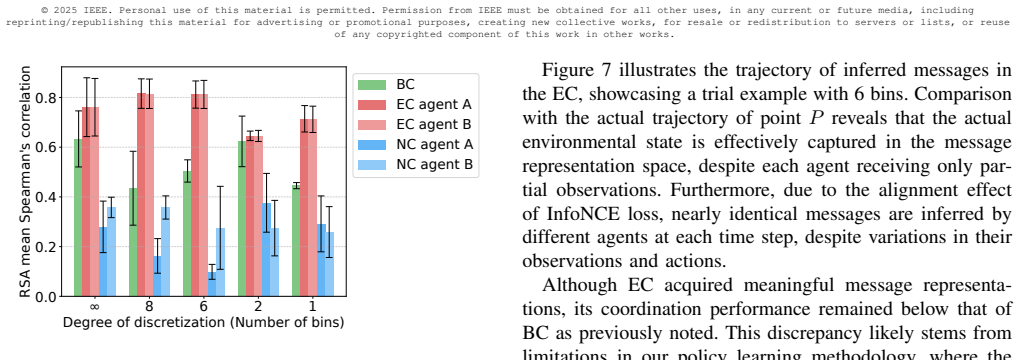
The central claim is that integrating world models with communication channels through bidirectional message exchange and contrastive learning for message alignment enables agents to predict environmental dynamics, estimate states from partial observations, and share critical information, resulting in coordination performance that surpasses non-communicative baselines when perceptual capabilities diverge and that ranks second only to centralized models, while also producing symbol systems that accurately reflect environmental states under the constraint that no agent can access another's internal representations.
What carries the argument
The decentralized collective world model formed by temporal extension of collective predictive coding, which carries the argument by letting each agent maintain predictive models that are aligned across agents solely through constrained message passing.
If this is right
- Communication-based decentralized models outperform non-communicative models on coordination when agents receive divergent observations.
- The same decentralized constraints that block direct state access produce emergent symbols that more closely match environmental states than symbols arising without those constraints.
- The approach reaches coordination performance second only to fully centralized models while remaining fully decentralized.
- Predictive coding extended across agents and time supplies the mechanism that simultaneously supports state estimation and message alignment.
Where Pith is reading between the lines
- The same architecture could be tested on tasks requiring longer temporal horizons or more than two agents to check whether symbol quality and coordination scale together.
- If the emergent symbols prove stable across different drawing trajectories, they might serve as reusable building blocks for other coordination problems without retraining.
- Replacing the contrastive loss with other alignment objectives would offer a direct test of whether the reported symbol accuracy depends on that specific choice.
- The finding that decentralization plus communication constraints improves symbol quality suggests similar benefits might appear in domains where agents must operate under privacy or bandwidth limits.
Load-bearing premise
Bidirectional message exchange plus contrastive learning will automatically produce both improved coordination and symbols that track environmental states when agents cannot directly inspect one another's internal states.
What would settle it
Running the two-agent trajectory drawing task with the contrastive alignment term removed and finding no gain in coordination score or symbol accuracy over the non-communicative baseline would falsify the central claim.
Figures



read the original abstract
We propose a fully decentralized multi-agent world model that enables both symbol emergence for communication and coordinated behavior through temporal extension of collective predictive coding. Unlike previous research that focuses on either communication or coordination separately, our approach achieves both simultaneously. Our method integrates world models with communication channels, enabling agents to predict environmental dynamics, estimate states from partial observations, and share critical information through bidirectional message exchange with contrastive learning for message alignment. Using a two-agent trajectory drawing task, we demonstrate that our communication-based approach outperforms non-communicative models when agents have divergent perceptual capabilities, achieving the second-best coordination after centralized models. Importantly, our decentralized approach with constraints preventing direct access to other agents' internal states facilitates the emergence of more meaningful symbol systems that accurately reflect environmental states. These findings demonstrate the effectiveness of decentralized communication for supporting coordination while developing shared representations of the environment.
Editorial analysis
A structured set of objections, weighed in public.
Referee Report
Summary. The manuscript proposes a fully decentralized multi-agent world model based on temporal extension of collective predictive coding. Agents integrate individual world models with bidirectional communication channels and use contrastive learning to align messages without direct access to each other's internal states. In a two-agent trajectory drawing task with divergent perceptual capabilities, the approach outperforms non-communicative baselines in coordination while achieving second-best performance after centralized models, and produces emergent symbols claimed to accurately reflect environmental states.
Significance. If the grounding and coordination results hold under rigorous evaluation, the work would be significant for multi-agent systems research by showing how decentralized predictive coding can simultaneously support emergent communication and task coordination. The explicit constraints on internal-state access and the comparison against both non-communicative and centralized controls provide a clear testbed for claims about meaningful symbol emergence.
major comments (2)
- [§3.2] §3.2 (contrastive alignment objective): the description of the bidirectional message exchange and contrastive loss does not specify whether negative pairs are drawn from distinct environmental configurations or only from the same trajectory. Without negatives that vary environmental state, the loss can succeed at inter-agent alignment while leaving symbols ungrounded in the shared environment, directly undermining the claim that symbols 'accurately reflect environmental states.'
- [§4.3] §4.3 (symbol quality evaluation): the reported 'more meaningful' symbols are assessed via coordination performance and qualitative inspection, but no quantitative metric (e.g., mutual information with held-out ground-truth state variables or decoding accuracy on unseen trajectories) is provided. This leaves the central claim about environmental reflection unsupported by the presented evidence.
minor comments (2)
- [Abstract] The abstract introduces 'temporal extension of collective predictive coding' without a one-sentence gloss or citation; a brief parenthetical definition would aid readers.
- [Figure 3] Figure 3 (trajectory examples) would benefit from explicit annotation of the divergent observation masks used by each agent.
Simulated Author's Rebuttal
We thank the referee for the constructive comments, which help clarify key aspects of our method and evaluation. We address each major comment point by point below.
read point-by-point responses
-
Referee: [§3.2] §3.2 (contrastive alignment objective): the description of the bidirectional message exchange and contrastive loss does not specify whether negative pairs are drawn from distinct environmental configurations or only from the same trajectory. Without negatives that vary environmental state, the loss can succeed at inter-agent alignment while leaving symbols ungrounded in the shared environment, directly undermining the claim that symbols 'accurately reflect environmental states.'
Authors: We agree that the current description in §3.2 is insufficiently precise on this point. In the implemented contrastive objective, negative pairs are sampled from distinct environmental configurations (different initial states and trajectories in the dataset) rather than solely within the same trajectory. This design choice is intended to promote grounding in shared environmental features. We will revise §3.2 to explicitly document the negative sampling procedure and confirm that negatives vary across environmental states. revision: yes
-
Referee: [§4.3] §4.3 (symbol quality evaluation): the reported 'more meaningful' symbols are assessed via coordination performance and qualitative inspection, but no quantitative metric (e.g., mutual information with held-out ground-truth state variables or decoding accuracy on unseen trajectories) is provided. This leaves the central claim about environmental reflection unsupported by the presented evidence.
Authors: We acknowledge that the current evaluation in §4.3 relies on coordination performance and qualitative inspection, which does not directly quantify how well symbols reflect environmental states. To strengthen this claim, we will add a quantitative analysis in the revised manuscript, including mutual information between emergent symbols and held-out ground-truth state variables evaluated on unseen trajectories. revision: yes
Circularity Check
No significant circularity detected
full rationale
The paper presents an empirical method for decentralized multi-agent world modeling via temporal extension of collective predictive coding, bidirectional messaging, and contrastive alignment, validated on a two-agent trajectory task against non-communicative and centralized baselines. No equations or derivation steps are shown that reduce by construction to fitted inputs, self-definitions, or self-citation chains. The central claims rest on experimental comparisons rather than any load-bearing self-referential step, making the work self-contained against external benchmarks.
Axiom & Free-Parameter Ledger
Reference graph
Works this paper leans on
-
[1]
A. S. Roth, “Shared Agency,” in The Stanford Encyclopedia of Philosophy, Summer 2017 ed., E. N. Zalta, Ed. Metaphysics Research Lab, Stanford University, 2017
work page 2017
-
[2]
arXiv preprint arXiv:2012.08630 , year=
A. Dafoe, E. Hughes, Y . Bachrach, T. Collins, K. R. McKee, J. Z. Leibo, K. Larson, and T. Graepel, “Open problems in cooperative AI,” CoRR, vol. abs/2012.08630, 2020. [Online]. Available: https://arxiv.org/abs/2012.08630
-
[3]
Tom2c: Target-oriented multi-agent communication and cooperation with theory of mind,
Y . Wang, F. Zhong, J. Xu, and Y . Wang, “Tom2c: Target-oriented multi-agent communication and cooperation with theory of mind,” in International Conference on Learning Representations, 2022. © 2025 IEEE. Personal use of this material is permitted. Permission from IEEE must be obtained for all other uses, in any current or future media, including reprinti...
work page 2022
-
[4]
Angeliki Lazaridou, Alexander Peysakhovich, and Marco Baroni
A. Lazaridou and M. Baroni, “Emergent multi-agent communication in the deep learning era,” CoRR, vol. abs/2006.02419, 2020. [Online]. Available: https://arxiv.org/abs/2006.02419
-
[5]
Toward more human-like ai communication: A review of emergent communication research,
N. Brandizzi, “Toward more human-like ai communication: A review of emergent communication research,” IEEE Access, vol. 11, pp. 142 317–142 340, 2023
work page 2023
-
[6]
Recurrent world models facilitate policy evolution,
D. Ha and J. Schmidhuber, “Recurrent world models facilitate policy evolution,” in Advances in Neural Information Processing Systems, S. Bengio, H. Wallach, H. Larochelle, K. Grauman, N. Cesa-Bianchi, and R. Garnett, Eds., vol. 31. Curran Associates, Inc., 2018. [Online]. Available: https://proceedings.neurips.cc/paper files/paper/ 2018/file/2de5d16682c3c...
work page 2018
-
[7]
Mastering Diverse Domains through World Models
D. Hafner, J. Pasukonis, J. Ba, and T. Lillicrap, “Mastering diverse domains through world models,” 2024. [Online]. Available: https://arxiv.org/abs/2301.04104
work page internal anchor Pith review Pith/arXiv arXiv 2024
-
[8]
T. Taniguchi, S. Murata, M. Suzuki, D. Ognibene, P. Lanillos, E. Ugur, L. Jamone, T. Nakamura, A. Ciria, B. Lara, and G. P. and, “World models and predictive coding for cognitive and developmental robotics: frontiers and challenges,” Advanced Robotics, vol. 37, no. 13, pp. 780–806, 2023. [Online]. Available: https://doi.org/10.1080/01691864.2023.2225232
-
[9]
Emergent language: a survey and taxonomy,
J. Peters, C. Waubert de Puiseau, H. Tercan, A. Gopikrishnan, G. A. Lucas de Carvalho, C. Bitter, and T. Meisen, “Emergent language: a survey and taxonomy,” Autonomous Agents and Multi-Agent Systems, vol. 39, no. 1, p. 18, Mar 2025. [Online]. Available: https://doi.org/10.1007/s10458-025-09691-y
-
[10]
Multi-agent actor-critic for mixed cooperative- competitive environments,
R. Lowe, Y . WU, A. Tamar, J. Harb, O. Pieter Abbeel, and I. Mordatch, “Multi-agent actor-critic for mixed cooperative- competitive environments,” in Advances in Neural Information Processing Systems, I. Guyon, U. V . Luxburg, S. Bengio, H. Wallach, R. Fergus, S. Vishwanathan, and R. Garnett, Eds., vol. 30. Curran Associates, Inc., 2017. [Online]. Availab...
work page 2017
-
[11]
Multi-agent reinforcement learning is a sequence modeling problem,
M. Wen, J. G. Kuba, R. Lin, W. Zhang, Y . Wen, J. Wang, and Y . Yang, “Multi-agent reinforcement learning is a sequence modeling problem,” in Proceedings of the 36th International Conference on Neural Information Processing Systems, ser. NIPS ’22. Red Hook, NY , USA: Curran Associates Inc., 2022
work page 2022
-
[12]
V-learning - A simple, efficient, decentralized algorithm for multiagent RL,
C. Jin, Q. Liu, Y . Wang, and T. Yu, “V-learning - A simple, efficient, decentralized algorithm for multiagent RL,” CoRR, vol. abs/2110.14555, 2021. [Online]. Available: https://arxiv.org/abs/2110. 14555
-
[13]
Learning to communicate through implicit communication channels,
H. Wang, B. Chen, T. Zhang, and B. Wang, “Learning to communicate through implicit communication channels,” in The Thirteenth International Conference on Learning Representations, 2025. [Online]. Available: https://openreview.net/forum?id=wm5wwAdiEt
work page 2025
-
[14]
Learning to ground multi-agent communication with autoencoders,
T. Lin, J. Huh, C. Stauffer, S. N. Lim, and P. Isola, “Learning to ground multi-agent communication with autoencoders,” in Advances in Neural Information Processing Systems, M. Ranzato, A. Beygelzimer, Y . Dauphin, P. Liang, and J. W. Vaughan, Eds., vol. 34. Curran Associates, Inc., 2021, pp. 15 230–15 242. [Online]. Available: https://proceedings.neurips...
work page 2021
-
[15]
Fully independent communication in multi-agent reinforcement learning,
R. Pina, V . De Silva, C. Artaud, and X. Liu, “Fully independent communication in multi-agent reinforcement learning,” in Proceedings of the 23rd International Conference on Autonomous Agents and Multiagent Systems, ser. AAMAS ’24. Richland, SC: International Foundation for Autonomous Agents and Multiagent Systems, 2024, p. 2423–2425
work page 2024
-
[16]
M. A. Nowak and D. C. Krakauer, “The evolution of language,” Proceedings of the National Academy of Sciences, vol. 96, no. 14, pp. 8028–8033, 1999. [Online]. Available: https://www.pnas.org/doi/ abs/10.1073/pnas.96.14.8028
-
[17]
Collective predictive coding hypothesis: symbol emergence as decentralized bayesian inference,
T. Taniguchi, “Collective predictive coding hypothesis: symbol emergence as decentralized bayesian inference,” Frontiers in Robotics and AI, vol. V olume 11 - 2024, 2024. [Online]. Avail- able: https://www.frontiersin.org/journals/robotics-and-ai/articles/10. 3389/frobt.2024.1353870
-
[18]
Generative emergent communication: Large language model is a collective world model,
T. Taniguchi, R. Ueda, T. Nakamura, M. Suzuki, and A. Taniguchi, “Generative emergent communication: Large language model is a collective world model,” 2024. [Online]. Available: https: //arxiv.org/abs/2501.00226
-
[19]
R. P. N. Rao and D. H. Ballard, “Predictive coding in the visual cortex: a functional interpretation of some extra-classical receptive-field effects,”Nature Neuroscience, vol. 2, no. 1, pp. 79–87, Jan 1999. [Online]. Available: https://doi.org/10.1038/4580
-
[20]
The free-energy principle: a unified brain theory? , volume =
K. Friston, “The free-energy principle: a unified brain theory?” Nature Reviews Neuroscience, vol. 11, no. 2, pp. 127–138, Feb 2010. [Online]. Available: https://doi.org/10.1038/nrn2787
-
[21]
doi: 10.3389/frai.2023.1235231
R. Okumura, T. Taniguchi, Y . Hagiwara, and A. Taniguchi, “Metropolis-hastings algorithm in joint-attention naming game: experimental semiotics study,” Frontiers in Artificial Intelligence, vol. V olume 6 - 2023, 2023. [Online]. Available: https://www.frontiersin. org/journals/artificial-intelligence/articles/10.3389/frai.2023.1235231
-
[22]
T. Taniguchi, Y . Yoshida, Y . Matsui, N. L. Hoang, A. Taniguchi, and Y . H. and, “Emergent communication through metropolis- hastings naming game with deep generative models,” Advanced Robotics, vol. 37, no. 19, pp. 1266–1282, 2023. [Online]. Available: https://doi.org/10.1080/01691864.2023.2260856
-
[23]
SimSiam Naming Game: A Unified Approach for Representation Learning and Emergent Communication
N. L. Hoang, T. Taniguchi, F. Tianwei, and A. Taniguchi, “Simsiam naming game: A unified approach for representation learning and emergent communication,” 2024. [Online]. Available: https://arxiv.org/abs/2410.21803
work page internal anchor Pith review Pith/arXiv arXiv 2024
-
[24]
T. Nakamura, A. Taniguchi, and T. Taniguchi, “Control as probabilistic inference as an emergent communication mechanism in multi-agent reinforcement learning,” CoRR, vol. abs/2307.05004, 2023. [Online]. Available: https://doi.org/10.48550/arXiv.2307.05004
-
[25]
H. Ebara, T. Nakamura, A. Taniguchi, and T. Taniguchi, “Multi-agent reinforcement learning with emergent communication using discrete and indifferentiable message,” in 2023 15th International Congress on Advanced Applied Informatics Winter (IIAI-AAI-Winter), 2023, pp. 366–371
work page 2023
-
[26]
T. Taniguchi, S. Takagi, J. Otsuka, Y . Hayashi, and H. T. Hamada, “Collective predictive coding as model of science: formalizing scientific activities towards generative science,” Royal Society Open Science, vol. 12, no. 6, p. 241678, 2025. [Online]. Available: https://royalsocietypublishing.org/doi/abs/10.1098/rsos.241678
-
[27]
Learning multi-agent communication with contrastive learning,
Y . L. Lo, B. Sengupta, J. N. Foerster, and M. Noukhovitch, “Learning multi-agent communication with contrastive learning,” in The Twelfth International Conference on Learning Representations, 2024. [Online]. Available: https://openreview.net/forum?id=vZZ4hhniJU
work page 2024
-
[28]
Markov games as a framework for multi- agent reinforcement learning,
M. L. Littman, “Markov games as a framework for multi- agent reinforcement learning,” in Machine Learning Proceedings 1994, W. W. Cohen and H. Hirsh, Eds. San Francisco (CA): Morgan Kaufmann, 1994, pp. 157–163. [Online]. Available: https: //www.sciencedirect.com/science/article/pii/B9781558603356500271
work page 1994
-
[29]
The complexity of decentralized control of markov decision processes,
D. S. Bernstein, R. Givan, N. Immerman, and S. Zilberstein, “The complexity of decentralized control of markov decision processes,” Mathematics of Operations Research, vol. 27, no. 4, pp. 819–840,
-
[30]
Available: https://doi.org/10.1287/moor.27.4.819.297
[Online]. Available: https://doi.org/10.1287/moor.27.4.819.297
-
[31]
Learning Latent Dynamics for Planning from Pixels
D. Hafner, T. Lillicrap, I. Fischer, R. Villegas, D. Ha, H. Lee, and J. Davidson, “Learning latent dynamics for planning from pixels,” arXiv preprint arXiv:1811.04551, 2018
work page internal anchor Pith review Pith/arXiv arXiv 2018
-
[32]
Learning Phrase Representations using RNN Encoder-Decoder for Statistical Machine Translation
K. Cho, B. Van Merri ¨enboer, C. Gulcehre, D. Bahdanau, F. Bougares, H. Schwenk, and Y . Bengio, “Learning phrase representations using rnn encoder-decoder for statistical machine translation,” arXiv preprint arXiv:1406.1078, 2014
work page internal anchor Pith review Pith/arXiv arXiv 2014
-
[33]
Noise-contrastive estimation: A new estimation principle for unnormalized statistical models,
M. Gutmann and A. Hyv ¨arinen, “Noise-contrastive estimation: A new estimation principle for unnormalized statistical models,” in Proceedings of the Thirteenth International Conference on Artificial Intelligence and Statistics, ser. Proceedings of Machine Learning Research, Y . W. Teh and M. Titterington, Eds., vol. 9. Chia Laguna Resort, Sardinia, Italy:...
work page 2010
-
[34]
Representation Learning with Contrastive Predictive Coding
A. van den Oord, Y . Li, and O. Vinyals, “Representation learning with contrastive predictive coding,” 2019. [Online]. Available: https://arxiv.org/abs/1807.03748
work page internal anchor Pith review Pith/arXiv arXiv 2019
-
[35]
Representational similarity analysis – connecting the branches of systems neuroscience , issn =
N. Kriegeskorte, M. Mur, and P. A. Bandettini, “Representational similarity analysis - connecting the branches of systems neuroscience,” Frontiers in Systems Neuroscience, vol. 2, 2008. [Online]. Available: https://www.frontiersin.org/journals/systems-neuroscience/ articles/10.3389/neuro.06.004.2008
-
[36]
On the pitfalls of measuring emergent communication,
R. Lowe, J. Foerster, Y .-L. Boureau, J. Pineau, and Y . Dauphin, “On the pitfalls of measuring emergent communication,” in Proceedings of the 18th International Conference on Autonomous Agents and MultiAgent Systems, ser. AAMAS ’19. Richland, SC: International Foundation for Autonomous Agents and Multiagent Systems, 2019, p. 693–701
work page 2019
discussion (0)
Sign in with ORCID, Apple, or X to comment. Anyone can read and Pith papers without signing in.