Exo-Daisy World: Revisiting Gaia Theory through an Informational Architecture Perspective
Pith reviewed 2026-05-25 08:44 UTC · model grok-4.3
The pith
An Exo-Daisy World model shows biosphere-environment correlations intensify with rising stellar luminosity through distinct phases of information exchange.
A machine-rendered reading of the paper's core claim, the machinery that carries it, and where it could break.
Core claim
By formulating a system of stochastic differential equations for an Exo-Daisy World tailored to M-dwarf exoplanets, the analysis reveals that correlations between the biosphere and environment intensify with rising stellar luminosity, and how these correlations correspond to distinct phases of information exchange between the coupled systems. This rein control provides a quantitative description of the informational feedback between the biosphere and its host planet.
What carries the argument
Rein control, the quantitative mapping of information-exchange phases between biosphere and environment obtained from correlations in the stochastic Daisy World trajectories as stellar luminosity is varied.
If this is right
- The same rein-control diagnostic can be applied to more elaborate ExoGaia models that include additional biogeochemical cycles.
- Agnostic biosignature searches could incorporate statistical measures of biosphere-environment information flow extracted from time-series observations.
- The phases of information exchange may correspond to observable transitions in planetary albedo or temperature stability on M-dwarf worlds.
- The framework supplies a route to quantify Gaia-style regulation without assuming Earth-like biology.
Where Pith is reading between the lines
- The same correlation-based diagnostic might be tested on Earth-system models under changing solar output to see whether historical climate states map onto the same information phases.
- If rein control proves robust, atmospheric retrievals from future telescopes could be re-analyzed for the presence of these statistical signatures rather than for individual molecular features.
- Extending the model to include additional feedback loops, such as ocean chemistry or volcanic outgassing, would test whether the luminosity dependence of the phases survives greater realism.
Load-bearing premise
Semantic Information Theory can be operationalized through stochastic differential equations inside an adapted Daisy World model to capture the actual information architecture of a living planet.
What would settle it
Running the stochastic model across a grid of luminosities and finding that biosphere-environment correlations remain flat or do not organize into distinct exchange phases.
Figures
read the original abstract
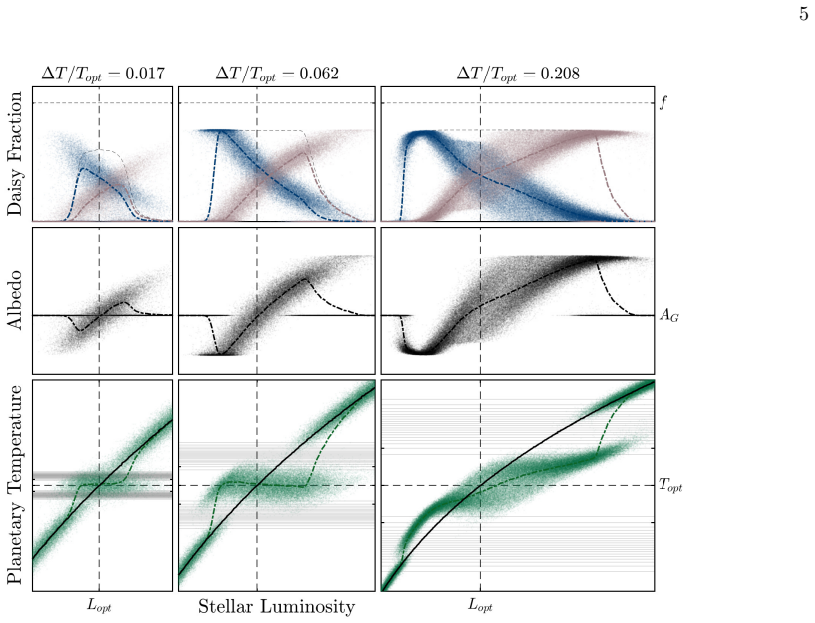
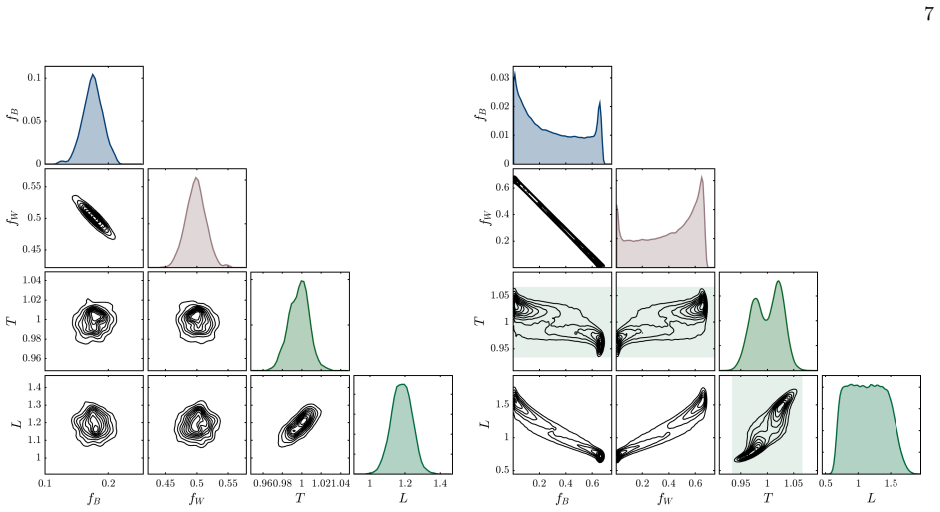
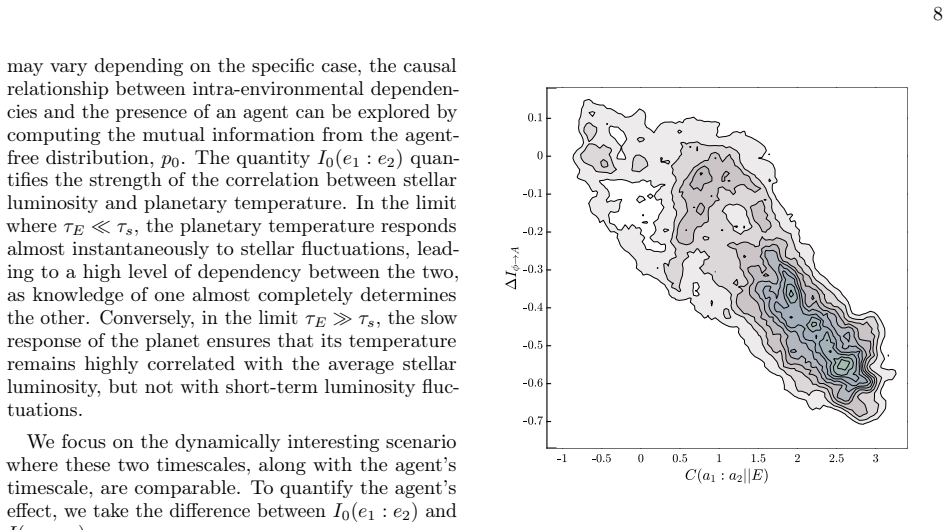
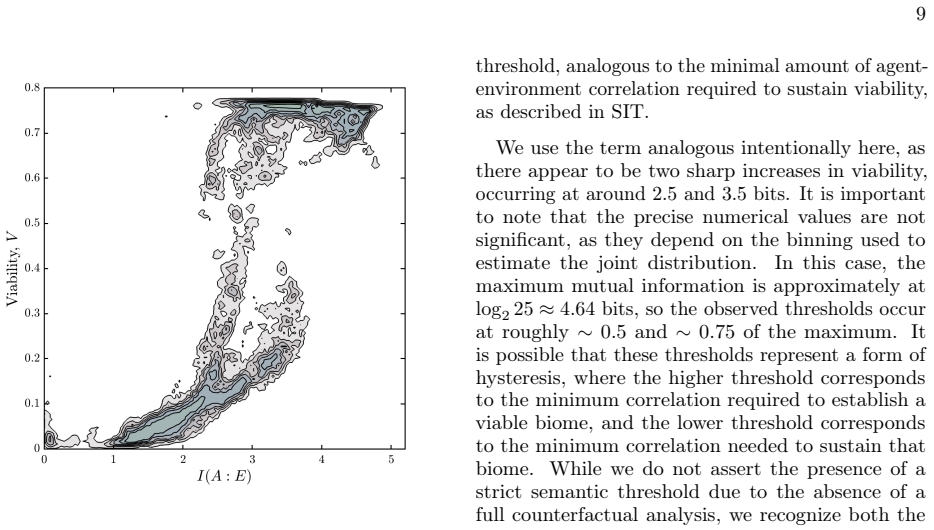
The Daisy World model has long served as a foundational framework for understanding the self-regulation of planetary biospheres, providing insights into the feedback mechanisms that may govern inhabited exoplanets. In this study, we extend the classic Daisy World model through the lens of Semantic Information Theory (SIT), aiming to characterize the information flow between the biosphere and planetary environment -- what we term the \emph{information architecture} of Daisy World systems. Our objective is to develop novel methodologies for analyzing the evolution of coupled planetary systems, including biospheres and geospheres, with implications for astrobiological observations and the identification of agnostic biosignatures. To operationalize SIT in this context, we introduce a version of the Daisy World model tailored to reflect potential conditions on M-dwarf exoplanets, formulating a system of stochastic differential equations that describe the co-evolution of the daisies and their planetary environment. Analysis of this Exo-Daisy World model reveals how correlations between the biosphere and environment intensify with rising stellar luminosity, and how these correlations correspond to distinct phases of information exchange between the coupled systems. This \emph{rein control} provides a quantitative description of the informational feedback between the biosphere and its host planet. Finally, we discuss the broader implications of our approach for developing detailed ExoGaia models of inhabited exoplanetary systems, proposing new avenues for interpreting astrobiological data and exploring biosignature candidates.
Editorial analysis
A structured set of objections, weighed in public.
Referee Report
Summary. The paper extends the classic Daisy World model to an 'Exo-Daisy World' variant for M-dwarf exoplanets by incorporating Semantic Information Theory (SIT). It formulates a system of stochastic differential equations governing the co-evolution of daisy coverage fractions and planetary temperature, analyzes how correlations between biosphere and environment strengthen with increasing stellar luminosity, identifies distinct phases of information exchange, and defines a 'rein control' metric to quantify informational feedback. The work positions this as a quantitative approach to Gaia-like self-regulation with implications for astrobiological observations and agnostic biosignatures.
Significance. If the SIT operationalization proves non-circular and the rein control metric adds information beyond standard correlation measures, the framework could supply a new quantitative language for coupled biosphere-environment dynamics on exoplanets. The manuscript supplies no machine-checked proofs, reproducible code, or parameter-free derivations, so its primary contribution would remain conceptual rather than providing falsifiable predictions or validated numerics.
major comments (3)
- [Model formulation] Model formulation section: the stochastic differential equations are introduced without an explicit semantic valuation (utility or meaning function) that maps daisy coverage or temperature variables onto semantic content required by SIT. Absent this step, the reported intensification of correlations with stellar luminosity remains a dynamical observation rather than a characterization of information architecture.
- [Rein control definition] Rein control definition and results section: the rein control metric is constructed directly from the same SDE parameters governing daisy growth and environmental response; this raises the possibility that the quantity reduces by construction to a reparameterized correlation rather than emerging as an independent descriptor of informational feedback.
- [Correlation analysis] Correlation analysis: the claim that correlations correspond to 'distinct phases of information exchange' is presented without reported sensitivity tests to the free SDE parameters or error analysis on the phase boundaries, leaving open whether the phase structure is robust or an artifact of parameter choice.
minor comments (2)
- [Abstract] The abstract supplies no equations, parameter values, or validation steps, which should be added to the main text for reproducibility.
- [Notation] Notation for the stochastic terms and the precise definition of 'rein control' should be clarified with an explicit equation reference.
Simulated Author's Rebuttal
We thank the referee for the constructive comments on our manuscript. We address each major comment point by point below, indicating where revisions will strengthen the presentation of the Exo-Daisy World model and its connection to Semantic Information Theory.
read point-by-point responses
-
Referee: [Model formulation] Model formulation section: the stochastic differential equations are introduced without an explicit semantic valuation (utility or meaning function) that maps daisy coverage or temperature variables onto semantic content required by SIT. Absent this step, the reported intensification of correlations with stellar luminosity remains a dynamical observation rather than a characterization of information architecture.
Authors: We agree that the current manuscript does not include an explicit semantic valuation function mapping the state variables onto semantic content. The SDE formulation captures the coupled dynamics, with information architecture characterized via emergent correlations and rein control. To address the gap, we will add a dedicated paragraph in the Model formulation section that explicitly links daisy coverage and temperature to semantic utility within SIT, referencing the theory's emphasis on functional meaning in feedback systems. This will be incorporated in the revision. revision: yes
-
Referee: [Rein control definition] Rein control definition and results section: the rein control metric is constructed directly from the same SDE parameters governing daisy growth and environmental response; this raises the possibility that the quantity reduces by construction to a reparameterized correlation rather than emerging as an independent descriptor of informational feedback.
Authors: The rein control metric is formulated from the SDE parameters but is intended to quantify directional informational feedback and phase-dependent rein control, which is conceptually distinct from pairwise correlation. We will revise the definition and results sections to include an explicit comparison demonstrating regimes where rein control deviates from correlation strength, thereby clarifying its independent descriptive role. This addition will be made without altering the core derivation. revision: partial
-
Referee: [Correlation analysis] Correlation analysis: the claim that correlations correspond to 'distinct phases of information exchange' is presented without reported sensitivity tests to the free SDE parameters or error analysis on the phase boundaries, leaving open whether the phase structure is robust or an artifact of parameter choice.
Authors: The lack of sensitivity tests and error analysis on phase boundaries is a valid limitation of the presented results. We will perform additional numerical experiments sweeping the principal SDE parameters (growth rates, noise amplitudes, and luminosity scaling) and report robustness of the identified phases together with uncertainty estimates on the boundary locations. These tests and revised figures will be added to the Correlation analysis section. revision: yes
Circularity Check
No significant circularity in the derivation chain
full rationale
The paper introduces an adapted Daisy World model via stochastic differential equations to operationalize Semantic Information Theory, then analyzes resulting correlations and labels them as phases of information exchange and 'rein control'. This constitutes a standard modeling-and-simulation workflow in which the claimed information architecture is an output of the constructed dynamics rather than presupposed by definition in the inputs. No quoted step shows a quantity defined in terms of itself, a fitted parameter renamed as a prediction, or a load-bearing claim resting solely on self-citation. The derivation remains self-contained as an extension of an existing model.
Axiom & Free-Parameter Ledger
free parameters (1)
- SDE parameters for daisy growth and environmental response
axioms (1)
- domain assumption Classic Daisy World feedback mechanisms remain valid when adapted to M-dwarf stellar spectra and stochastic dynamics
invented entities (1)
-
rein control
no independent evidence
Lean theorems connected to this paper
-
IndisputableMonolith/Cost/FunctionalEquation.leanwashburn_uniqueness_aczel unclear?
unclearRelation between the paper passage and the cited Recognition theorem.
we adopt a Semantic Information Theory (SIT) framework... viability V=EA[fB+fW/f]... mutual information I(A:E)... interaction information C(a1:a2||E)
-
IndisputableMonolith/Foundation/AlphaCoordinateFixation.leanJ_uniquely_calibrated_via_higher_derivative unclear?
unclearRelation between the paper passage and the cited Recognition theorem.
rein control provides a quantitative description of the informational feedback
What do these tags mean?
- matches
- The paper's claim is directly supported by a theorem in the formal canon.
- supports
- The theorem supports part of the paper's argument, but the paper may add assumptions or extra steps.
- extends
- The paper goes beyond the formal theorem; the theorem is a base layer rather than the whole result.
- uses
- The paper appears to rely on the theorem as machinery.
- contradicts
- The paper's claim conflicts with a theorem or certificate in the canon.
- unclear
- Pith found a possible connection, but the passage is too broad, indirect, or ambiguous to say the theorem truly supports the claim.
Forward citations
Cited by 1 Pith paper
-
Information bounds production in replicator systems
Replicator productivity decomposes into environmental uncertainty, side information, and distribution mismatch terms, yielding optimal strategies and bounds that extend Kelly gambling concepts to autocatalytic networks.
Reference graph
Works this paper leans on
-
[1]
and more recently in Savi and Viola’s 2023 vari- ant [15]. To our knowledge, our variant is the first to generalize Daisy World using coupled stochastic differential equations, which allow the application of information-theoretic measures to the model. Our overarching aim is to bring these information-centric methods to the study of biospheres, clarifying...
work page 2023
- [2]
-
[3]
J. Zalasiewicz, M. Williams, C. N. Waters, A. D. Barnosky, J. Palmesino, A.-S. Rönnskog, M. Edge- worth, C. Neal, A. Cearreta, E. C. Ellis,et al., The Anthropocene Review 4, 9 (2017)
work page 2017
-
[4]
V. I. Vernadsky, American scientist33, 1 (1945)
work page 1945
-
[5]
J. E. Lovelock and L. Margulis, Tellus26, 2 (1974)
work page 1974
- [6]
-
[7]
J. E. Lovelock and A. J. Watson, Planetary and Space Science 30, 795 (1982). 11
work page 1982
- [8]
-
[9]
Dawkins, The Extended Phenotype: The Long Reach of the Gene(Oxford University Press, 1982)
R. Dawkins, The Extended Phenotype: The Long Reach of the Gene(Oxford University Press, 1982)
work page 1982
-
[10]
W. F. Doolittle, Journal of Theoretical Biology434, 11 (2017), the origin of mitosing cells: 50th anniver- sary of a classic paper by Lynn Sagan (Margulis)
work page 2017
-
[11]
J. W. Kirchner, Climatic change52, 391 (2002)
work page 2002
-
[12]
W. Steffen, K. Richardson, J. Rockström, H. J. Schellnhuber, O. P. Dube, S. Dutreuil, T. M. Lenton, and J. Lubchenco, Nature Reviews Earth and Envi- ronment 1, 54 (2020)
work page 2020
-
[13]
Krakauer,The Complex World: An Introduction to the Foundations of Complexity Science(2024) pp
D. Krakauer,The Complex World: An Introduction to the Foundations of Complexity Science(2024) pp. Intro–3
work page 2024
-
[14]
A. J. Watson and J. E. Lovelock, Tellus B: Chemical and Physical Meteorology35, 284 (1983)
work page 1983
-
[15]
A. J. Wood, G. J. Ackland, J. G. Dyke, H. T. Williams, and T. M. Lenton, Reviews of Geophysics 46 (2008)
work page 2008
-
[16]
M. A. Savi and F. M. Viola, Fractal and Fractional 7, 190 (2023)
work page 2023
-
[17]
S. I. Walker, H. Kim, and P. C. Davies, Philosophical Transactions of the Royal Society A: Mathematical, Physical and Engineering Sciences 374, 20150057 (2016)
work page 2016
-
[18]
M. D. Egbert and J. Pérez-Mercader, Artificial life 24, 106 (2018)
work page 2018
-
[19]
C. E. Shannon, The Bell system technical journal 27, 379 (1948)
work page 1948
- [20]
- [21]
-
[22]
X. E. Barandiaran and M. D. Egbert, Artificial Life 20, 5 (2014)
work page 2014
- [23]
-
[24]
J. K. D Polani, T Martinez,An information-theoretic approach for the quantification of relevance(Springer, Berlin, Germany, 2001)
work page 2001
- [25]
-
[26]
C. L. Nehaniv, D. Polani, K. Dautenhahn, R. te Beokhorst, and L. Cañamero, inProceedings of the Eighth International Conference on Artificial Life, ICAL 2003 (MIT Press, Cambridge, MA, USA,
work page 2003
- [27]
-
[28]
T. W. Deacon, Cognitive Semiotics1, 123 (2007)
work page 2007
-
[29]
P. A. Corning, Systems Research and Behavioral Science: The Official Journal of the International Federation for Systems Research24, 297 (2007)
work page 2007
-
[30]
M. Gleiser and D. Sowinski, The Map and the Terri- tory: Exploring the Foundations of Science, Thought and Reality , 141 (2018)
work page 2018
-
[31]
D. R. Sowinski,Complexity and stability for epis- temic agents: the foundations and phenomenology of configurational entropy(Dartmouth College, 2016)
work page 2016
-
[32]
J. A. Acebrón, L. L. Bonilla, C. J. Pérez Vicente, F.Ritort, andR.Spigler,ReviewsofModernPhysics 77, 137 (2005)
work page 2005
-
[33]
D. García-Selfa, G. Ghoshal, C. Bick, J. Pérez- Mercader, and A. P. Muñuzuri, Chaos, Solitons & Fractals145, 110809 (2021)
work page 2021
- [34]
- [35]
-
[36]
J. E. COHEN, Nature270, 165 (1977)
work page 1977
- [37]
-
[38]
J. C. Xavier, W. Hordijk, S. Kauffman, M. Steel, and W. F. Martin, Proceedings of the Royal Society B: Biological Sciences287, 20192377 (2020)
work page 2020
-
[39]
J. C. Blain and J. W. Szostak, Annual Review of Biochemistry 83, 615 (2014), pMID: 24606140, https://doi.org/10.1146/annurev-biochem-080411- 124036
- [40]
- [41]
-
[42]
I. G.-A. Pemartín, E. Mompó, A. Lasanta, V. Martín- Mayor, and J. Salas, Physical Review Letters132, 117102 (2024)
work page 2024
-
[43]
D. R. Sowinski, J. Carroll-Nellenback, R. N. Markwick, J. Piñero, M. Gleiser, A. Kolchinsky, G. Ghoshal, and A. Frank, PRX Life 1, 023003 (2023)
work page 2023
- [44]
-
[45]
R. R. Martínez, L. A. Lopez, B. J. Shappee, S. J. Schmidt, T.Jayasinghe, C.S.Kochanek, K.Auchettl, and T. W.-S. Holoien, The Astrophysical Journal 892, 144 (2020)
work page 2020
-
[46]
T. J. Henry and W.-C. Jao, Annual Review of As- tronomy and Astrophysics62 (2024)
work page 2024
-
[47]
Frequency of planets orbiting M dwarfs in the Solar neighbourhood
M. Tuomi, H. R. Jones, R. Butler, P. Arria- gada, S. Vogt, J. Burt, G. Laughlin, B. Holden, S. Shectman, J. Crane, et al., arXiv preprint arXiv:1906.04644 (2019)
work page internal anchor Pith review Pith/arXiv arXiv 1906
-
[48]
Pearl, Causality (Cambridge university press, 2009)
J. Pearl, Causality (Cambridge university press, 2009)
work page 2009
-
[49]
M. Salaris and S. Cassisi,Evolution of stars and stellar populations (John Wiley & Sons, 2005)
work page 2005
- [50]
-
[51]
Schrodinger,What is life(Cambridge: Cambridge University Press, 1944)
E. Schrodinger,What is life(Cambridge: Cambridge University Press, 1944)
work page 1944
-
[52]
Brillouin, Journal of Applied Physics24, 1152 (1953)
L. Brillouin, Journal of Applied Physics24, 1152 (1953)
work page 1953
-
[53]
S. Kullback and R. A. Leibler, The annals of mathe- matical statistics 22, 79 (1951)
work page 1951
-
[54]
R. G. James, C. J. Ellison, and J. P. Crutchfield, Chaos: An Interdisciplinary Journal of Nonlinear Science 21 (2011)
work page 2011
-
[55]
P. L. Williams and R. D. Beer, arXiv preprint arXiv:1004.2515 (2010). 12
work page internal anchor Pith review Pith/arXiv arXiv 2010
- [56]
- [57]
-
[58]
Rößler, SIAM Journal on Numerical Analysis47, 1713 (2009)
A. Rößler, SIAM Journal on Numerical Analysis47, 1713 (2009)
work page 2009
-
[59]
Modify the Improved Euler scheme to integrate stochastic differential equations
A. Roberts, arXiv preprint arXiv:1210.0933 (2012)
work page internal anchor Pith review Pith/arXiv arXiv 2012
-
[60]
Matlab version: 9.13.0 (r2022b),
T. M. Inc., “Matlab version: 9.13.0 (r2022b),” (2022)
work page 2022
-
[61]
W. R. Inc., “Mathematica, Version 12,” Champaign, IL, 2024. Appendix A: Simulation Methodology Dimensionalization Exo-Daisy World is a dynamical system of four degrees of freedom,{fB, fW , T, L}, whose evolution is described by d fB dt = β(TW )(f − fB − fW )fB − γDfB (A1) d fW dt = β(TB)(f − fB − fW )fW − γDfW (A2) dT dt = 1 16πr2hρcV L(1 − AG − (AB − AG)...
work page 2024
discussion (0)
Sign in with ORCID, Apple, or X to comment. Anyone can read and Pith papers without signing in.